
Biography | Research | Publications

Associate Professor
(401) 863-3770
Stephen_Gatesy@brown.edu
 

My research is directed at understanding the evolution of the vertebrate locomotor system. More specifically, I am interested in the functional consequences of changing morphology and evaluating how elements of the locomotor complex interact to facilitate or constrain evolutionary transformation.


First dinosaur tracks discovered in Greenland

In my lab we strive to integrate several disciplines by combining data from structural, functional, historical, developmental, and computer modeling approaches. Traditional anatomical studies form the foundation for experimental analyses of walking, running, and flying animals. Techniques such as electromyography (recording of voltage changes during muscle activity) and motion analysis are used to interpret the interaction of the skeletal, muscular, and nervous systems during locomotion. These data are then coupled with paleontological and developmental data to arrive at a more complete picture of the phylogenetic and ontogenetic history of locomotor structures.

I have focused on locomotion in archosaurs, a group that includes birds, dinosaurs and crocodilians. Two related topics that my lab is pursuing are the mechanisms of terrestrial movement in extinct theropod dinosaurs and the origin of avian flight. What can we infer about how Tyrannosaurus or Velociraptor walked and ran? How was the body plan of a terrestrial biped transformed into an arboreal flier? Both of these questions involve gaining a better understanding of how birds use their legs, wings and tail. Results from analyses of living birds and crocodilians are used to help deduce the functional significance of evolving characters. In this way we study function in fossil and extant theropods within a phylogenetic context.


Deep theropod track
from Greenland

Shallow theropod track
from Greenland

Past projects have focused on issues such as: the evolution of theropod limb retraction, the origin of tail fanning, long bone scaling and limb posture, the mechanisms of turning flight, flight and the modular design of the avian locomotor system, and theropod limb disparity. Ongoing work includes a functional analysis of locomotion in Triassic theropods based on fossil trackways I discovered in Greenland, the development of a technique for comparing movement in limbs of different shape, and a study of theropod hallux evolution. In the past three years we have added the tool of 3-D computer animation to our lab. We are using Alias/Wavefront software to help quantify complex movements in living animals, to compare hypothetical strides in virtual limbs, and to reconstruct locomotor behavior in Greenlandic theropods through track simulation.

Additional images & animations

Black and white stereo photos of deep theropod track

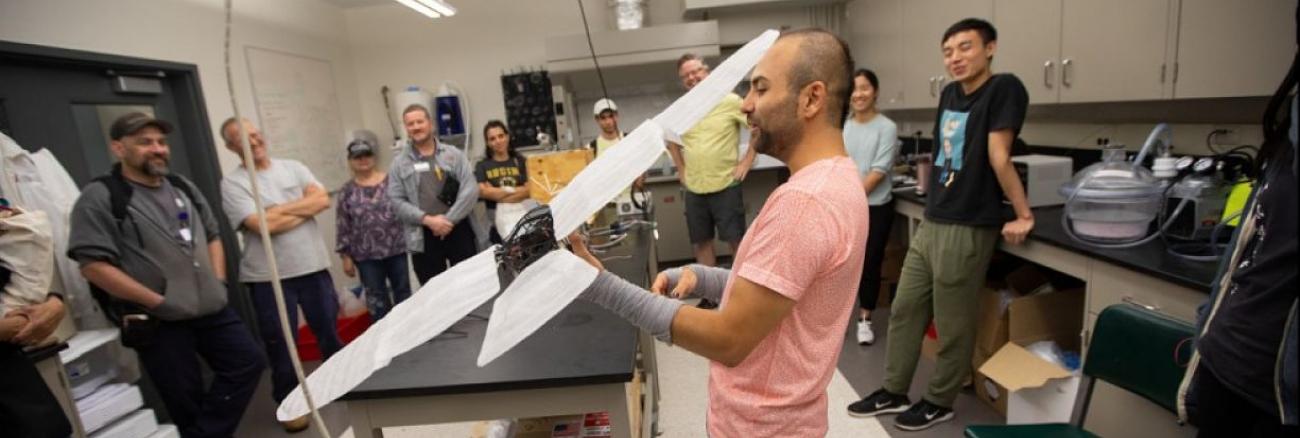
3-D pigeon wing model

Three-dimensional computer animation of a theropod foot creating a deep print (Quicktime format.mov)

Three-dimensional computer animation of a theropod foot creating a deep print (MPEG format.mpv)

top


Box G, Brown University, Providence, RI 02912
ph: 401.863.3324 | e-mail: Carol_Casper@brown.edu

Copyright © 2003 Brown University. All Rights Reserved.
Site design Academic Web Pages