

Overview of Program |
Application Information |
Handbook & Forms |
Student Life |
Current Students
Maya Almaraz
B.S. Conservation and Resource Studies, University of California, Berkeley
B.A. Public Health, University of California, Berkeley
I am a first year graduate student in the Brown/MBL program, working under the direction of
Dr. Stephen Porder and Dr. Christopher Neill. I am interested in carbon and nitrogen cycling
related to land use and climate change. This summer I went to Puerto Rico and worked on a
project looking at net nitrogen mineralization on a topographic gradient on two different types
of soil. For my dissertation I plan to work on the PIRE project in Sub-Saharan Africa. Mainly,
what are the environmental consequences of the Green Revolution in Africa and how can we
best manage the land to provide sufficient calories to those who need them while preserving the
environment? I spent the last two years working in Dr. Whendee Silver’s lab at UC Berkeley
where I participated primarily in projects looking at carbon sequestration in rangelands,
greenhouse gas dynamics in response to a hurricane simulation, and redox dynamics in tropical
forests. As an undergraduate I worked as a research assistant in plant ecology and entomology.
Angus Angermeyer
B.S. University of Washington (Microbiology), 2008.
I study the ecology of microbial communities and how the diversity of microbes varies over geographic distance.
My research has two main themes: 1) Using DNA sequencing and fingerprinting methods, I track the allelic variation of sulfate reducing enzymes within and between east coast salt marshes. 2) I study the biofilm structures of hydrothermal vent bacteria and their methods of communication and dispersal.
Henry Astley
B.S. Aerospace Eng., FIT '01
B.S. Biology, U. of Cincinnati '05
M.S. Biology, U. of Cincinnati '08
My interest is in the biomechanics of animal locomotion, especially the insights that can be
gained from organisms with unusual body plans or extreme performance. My prior work
examined the effects of habitat structure on arboreal snake locomotion, and I am currently
examining the role of muscle-tendon systems in power amplification in frog jumping.
Joseph Bahlman
B.S. Evolution and Ecology, University of California at Davis, 2005
Generally I am interested in how variation in morphology relates to variation in ecological
niches through some differential performance. Currently, I am studying bats to determine how
variation in wing shape, musculo-skeletal anatomy, and kinematics affect different aspects of
flight performance. To answer these questions, I use a combination of comparative anatomy,
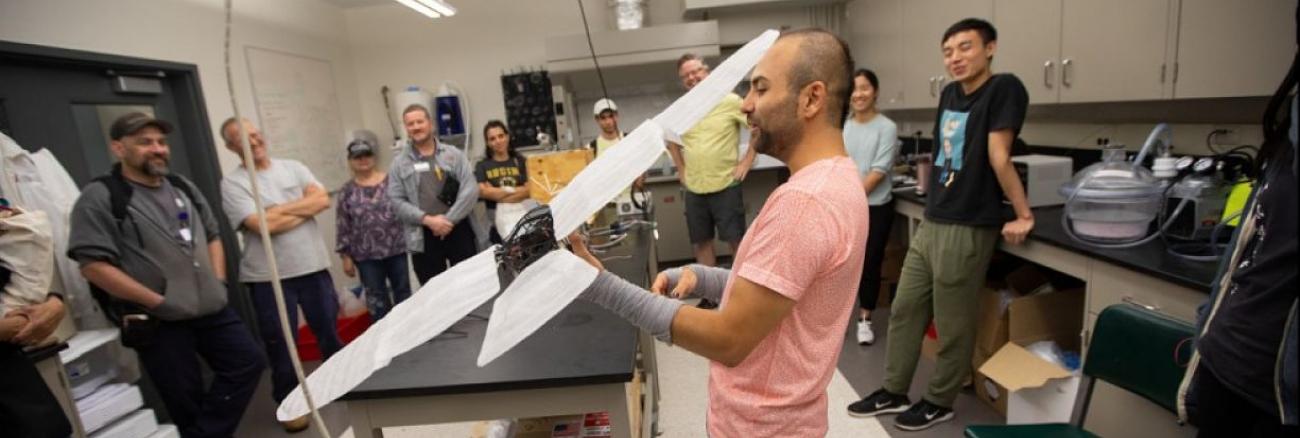
kinematic analysis, mathematical modeling, and physical models in a wind tunnel including a
robotic bat wing I have built.
L. Margarita (Maggy) Brandt
B.S. Universidad San Francisco de Quito, Ecuador (Applied Ecology), 2003.
I study marine community ecology in subtidal systems. In general, I am interested in
understanding how physical, ecological and evolutionary processes affect both community and
genetic structure in marine protected areas. More specifically, I am interested in: (1) determining
to what extent species perform similar functions (functional redundancy), and (2) understanding
how different communities are linked to one another (community connectivity). To address these
topics, I am using a combination of field surveys, manipulative field experiments, and molecular
techniques to examine the roles of functional redundancy and community connectivity in the
Galapagos Marine Reserve.
Lindsay Brin
B.A. Swarthmore College (Biology and Environmental Studies), 2005.
M.A. Boston University Marine Program (Biology), 2008.
I study the biogeochemistry of coastal ecosystems, and particularly, the control of nitrogen
cycling by changing environmental factors. My dissertation work focuses on the role of
temperature in regulating nitrate reduction (mainly denitrification and anammox) in coastal
sediments, at the scales of process kinetics, microbial communities, and ecosystems. Although
the biogeochemical tools that I use allow me to explore ecosystem functioning at a very
basic, chemical level, I try to maintain a broader ecological perspective, and relate my
research questions to societally relevant issues. For example, how will climate change affect
eutrophication, and the way that we regulate nitrogen loading to coastal ecosystems?
Ariel Camp
B.S. Hofstra University 2009
My current research focuses on how fish power suction feeding, the dominant feeding
mode among the over 25,000 species of ray-finned fish. Suction feeding relies on
explosive expansion of the mouth cavity to accelerate water and prey into the mouth.
The power required for this expansion may be produced largely by axial body muscles.
To measure axial muscle strain and skeletal kinematics during suction feeding, I am
using XROMM (X-ray Reconstruction of Moving Morphology) of feeding in Largemouth
Bass. These data will allow me to investigate how this diverse group of vertebrates uses
skeletal kinematics and muscular power to expand the mouth during suction feeding.
Ryan Carney
B.A. Integrative Biology, University of California, Berkeley, 2003
B.A. Art Practice, University of California, Berkeley, 2003
M.B.A., Yale University, 2010
M.P.H., Yale University, 2010
I am interested in the morphological and kinematic changes that occurred during the evolution
of flight in dinosaurs, with particular emphasis on Archaeopteryx. Current and future methods of
investigation include 3D x-ray imaging of fossil and extant archosaurs, XROMM, and computer
animation. Other research projects include reconstructing the feather color of the Archaeopteryx
holotype and a GIS-based early warning system for predicting epidemics of vector-borne
diseases such as dengue and West Nile virus.
Jorn Cheney
Sarah Corman
B.A., Biology, Tufts University, 2006 M.S.
Biological Oceanography, University of Rhode Island, 2009
(Thesis title: "Salt Marsh Mosquito Ditches on Fire Island, NY: Sedimentation
Rate, Nekton Community and Implications for Restoration") I am interested in coastal ecology,
particular that of salt marshes and rocky shores. I am currently interested in how multiple
stressors (including global change) will impact salt marsh structure and function, and my
dissertation will focus on the impact of warming on salt marshes on the Atlantic coast of the U.S.
Terry Dial
B.S. Loyola Marymount University (2007)
M.S. University of Utah (2010)
I am interested in the developmental trade-offs associated with animal form and
function. Young vertebrates enter the world at many different levels of morphological maturity
(e.g., humans vs. horses) and display an array of developmental strategies taking them into
adulthood. I would like to understand how developmental strategy influences locomotor
performance of both juvenile and adult forms. In the past I've primarily worked on developing
birds (mallard ducks and chukar partridge), but am now branching out to the ectothermic world,
which arguably exhibits the most interesting morphological and life-history variation.
Laura Garrison
B.A. 2000, U.C. Berkeley, Comparative Literature (magna cum laude)
M.S. 2007, San Francisco State University, Ecology & Systematic Biology
My research will focus on nutrient limitation and productivity in two areas of Brazil with very
different land use histories: the Atlantic Forest and the Amazon. The former has a much longer
history including multiple periods of use and abandonment, while the latter has experienced
rapid, widespread change in the last several decades. I am particularly interested in the
biogeochemical cycles of secondary forests and how these cycles have been influenced by the
duration and intensity of past land use.
For my Master’s thesis, I examined the effects of urbanization on carbon storage in soils and
vegetation near Apalachicola Florida using a combination of field sampling, GIS, and remote
sensing. Other recent projects have explored how changes in forest cover in the southeast US
alter stream water quality and hydrology.
Nicholas Gidmark
B.S. University of Minnesota 2006 (thesis title: character suites suggest punctuated evolution of
trophic morphologies in minnows, Cyprinidae)
My research at Brown in the Brainerd Laboratory focuses on muscle performance and jaw
biomechanics in Cyprinid fishes -- minnows and carps. These fishes mechanically break down
food unsing derived gill arch structures called pharyngeal jaws. Since these fishes do not have
oral jaw teeth or strong stomach muscles, the mechanical action of the pharyngeal jaws limits
feeding performance. I use in-vivo musculoskeletal imaging (X-ray Reconstruction of Moving
Morpholgoy, XROMM) and in-situ muscle stimulation experiments to quantify how the jaws
and their muscles are functioning mechanically as well as physiological characteristics limiting
performance.
Chris Graves
B.S. Biological Sciences, University of Vermont
My interests are in directly testing predictions of evolutionary theory through controlled
experimental studies of evolution in microbial populations. Much of our understanding of
evolution comes from mathematical inference rather than empirical observation due to the
time scale on which most evolutionary processes act. Bacteria and other microbes offer an
exciting model system because their short generation time and small genomes allow evolutionary
processes to be examined while they occur and enable quantitative predictions based on
evolutionary theory to be experimentally tested in the lab.
Caroline J. Harper
B.A., Psychology Based Human Relations, Connecticut College, 2001.
M.S., Biology, UNC Wilmington, 2007. Morphology of the Melon and its Tendinous
Connections to the Facial Muscles in Bottlenose Dolphins (Tursiops truncatus).
Rebecca Helm
In both developmental biology and evolutionary theory scientists aim to understand how life
changes through time. I am interested in understanding the dynamic between evolution and
development. How is development shaped by evolution and vice versa? How tightly linked
are specific developmental processes with phenotypic outcomes? How do developmental and
evolutionary transitions occur? To this end, I am focusing on a group of organisms called
cnidarians (jellyfish, corals, siphonophores, Hydra). This group represents an excellent
opportunity to address these questions due to its incredible developmental and phenotypic
diversity. I use molecular and embryological techniques to explore developmental dynamics and
evolution within this fascinating lineage.
Robert Kambic
B.S., Biology, University of Maryland, College Park 2003
M.S., Earth Sciences, Montana State University 2008
I am generally interested in the biomechanics and evolutionary history of terrestrial locomotion
in vertebrates. I concentrate particularly on theropod dinosaur and avian locomotion. Currently I
am working on a project involving kinematics and kinetics of guineafowl locomotion as well as
a series of projects investigating joint construction and diversity within birds and theropods. My
previous work was in morphometrics and multivariate methods for correlating locomotor habits
and foot morphology.
Catherine Luria
B.S. Iowa State University, 2005
M.S. Virginia Commonwealth University, 2010
I am interested in the forces that shape natural microbial communities and how these in turn
impact ecosystem function. My current research focuses on the marine microbial communities of
the Western Antarctic Peninsula, a region that undergoes extreme light-driven seasonal
transitions. I plan to examine how these transitions, especially spring sea-ice melt and
phytoplankton blooms, drive changes in bacterial diversity and activity.
Chelsea Nagy
B.Phil., Environmental Science, Miami University
M.S., Forestry, Auburn University
My research will focus on nutrient limitation and productivity in two areas of Brazil with very
different land use histories: the Atlantic Forest and the Amazon. The former has a much longer
history including multiple periods of use and abandonment, while the latter has experienced
rapid, widespread change in the last several decades. I am particularly interested in the
biogeochemical cycles of secondary forests and how these cycles have been influenced by the
duration and intensity of past land use.
For my Master’s thesis, I examined the effects of urbanization on carbon storage in soils and
vegetation near Apalachicola Florida using a combination of field sampling, GIS, and remote
sensing. Other recent projects have explored how changes in forest cover in the southeast US
alter stream water quality and hydrology.
R. Matthew Ogburn
Shelby Riskin
I am interested in biogeochemical cycling, how this cycling affects ecosystem functioning, and
what, then, happens with anthropogenic land use changes. I did my undergrad research in rural
Iowa, an area that has seen some of the most rapid and complete land use change in the world,
looking at nutrient loading in stream and lake systems. I have also worked in Brazil, a region
under immense development pressure, for Chris Neill of MBL, who was looking at nutrients
and hydrologic flowpaths in small streams, comparing catchments in tropical forest and pasture.
Most recently, however, I worked as a consultant, conducting sampling of impaired waterbodies
in Minnesota as well as working on hazardous material clean ups. My dissertation work will
focus on the effects of forest and pasture conversion to intensive soybean agriculture in Brazil.
Victor Schmidt
B.S. Biology, 2006. St. Lawrence University, Canton, NY.
M.S. Marine Biology, 2009. University of North Carolina, Wilmington.
I am primarily interested in the influence community shifts within host microbiomes can have
on disease development, pathogen transmission and environmental health. Our current research
follows the microbiomes associated with ornamental (pet) fish across a trade route sourced
from Southeast Asian reefs to New England pet stores. This trade route is an ideal system to
look at both how humans mediate the dispersal of infectious diseases across the globe, and
the ecological dynamics of host-associated microbial communities over time and space. We
plan to address 1, the scale and diversity of ‘pathogen pollution’ entering the United States in
commercially shipped wildlife 2, how the overall microbial community within the animal host
influences pathogen persistence over a trade route and 3, how a host microbial community
changes as the host moves from a healthy to diseased state.
Lauren Szathmary
B.S. 2004, University of South Carolina
M.S. 2006, University of South Carolina
Fulbright 2009, University of Otago, New Zealand
I am generally interested in drivers of spatial and temporal patterns in marine ecosystems, and
how these patterns affect ecosystem function. More specifically, I am interested in understanding
the impacts of various types of disturbances on marine systems, and how ecosystem resilience
to disturbances can ameliorate impacts and/or allow for recovery. My current research focuses
on community changes and resilience in salt marshes in response to human impacts, particularly
climate change and overfishing. I use a combination of manipulative field experiments, field
surveys, and historical ecology techniques to better understand how these systems cope with
anthropogenic stressors.
|