Mark Dion, New England Digs


Mark dion, New England Digs


Mark Dion, New England Digs


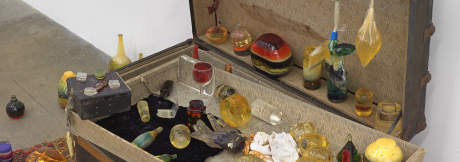
Over the course of five weeks in the spring of 2001, Mark Dion, along with photographer Bob Braine and nearly 90 volunteers, took to the shores, vacant lots, and farmland of New England. The result of these surveys is New England Digs, a multi-process exhibition that involved finding sites in Brockton, Providence, and New Bedford, collecting materials, cleaning them, and re-contextualizing the objects into a final exhibition.

Dion and volunteers spent a week at each site collecting contemporary detritus alongside 18th and 19th century debris like bits of glass and porcelain. The digging began in Providence, on the shores of the Seekonk River and Narragansett Bay where the dig team found large amounts of industrial debris and contemporary flotsam and jetsam. Next, the team moved to New Bedford to dig a giant hole, nearly seven feet deep, on the land where O'Malley's Tavern once stood, sifting through materials including mountains of broken glass and pottery shards, in hopes of reaching the former landmark's basement. Finally, the digs commenced in Brockton as mounds of farmland dirt that had been moved several times were raked down, revealing domestic objects, intact bottles and some industrial items.

In witnessing the digs themselves, it is evident that there is a distinct type of energy that prevails throughout the process, as people relish in the excitement of each new find. After the digs, each artifact is revisited again and discovered anew during the cleaning and classification stages. The process then comes to its fruition as the objects enter their final resting place, the finished display cabinets. In the end, the objects have traveled full circle from being once useful things to becoming trash to treasure to artwork. . .

The exhibition was organized by the Fuller Museum of Art, in collaboration with the David Winton Bell Gallery at Brown University, the New Bedford Whaling Museum and the University of Massachusetts Dartmouth, and has been generously funded by Fleet and the LEF Foundation.

Denise Markonish Curator, Fuller Museum of Art


Extreme Horiticulture includes photographs taken over the last three years in private and public gardens around the US. The series continues the artist's interest in nature and man's effects on nature. Subjects range from the sublimely beautiful Birch Allee at Stan Hywet Gardens in Akron, Ohio, to the ridiculous Fifty-foot Inchworm, an azalea topiary at Cypress Gardens, Florida. Pfahl photographed at the J. Paul Getty Center, the Huntington Desert Garden, and in Rhode Island at Green Animals, Portsmouth, and The Elms in Newport.

Pfahl's reputation was immediately established in the late 1970s with the creation of a series of color photographs entitled Altered Landscapes. These seemingly simple photographs combined natural landscapes with geometric shapes (right-angles, arrows, etc.) that seemed to be drawn on the surface of the photograph. The images were, in fact, complex perceptual exercises in which the shapes were painstaking created within the landscape to look flat and two dimensional.

Pfahl has created numerous series since then, all of which have concentrated on merging idealized landscape images with visual traces of human existence. His work has been discussed in relation to the Hudson River School, luminism, and the picturesque and sublime. In Power Places, his 1980s series, the viewer is presented with exquisite landscapes in which power plant, nuclear and otherwise, just happen to exist. The images are so neutral in attitude, that they have been praised by both proponents and opponents of nuclear power.

Continuing this theme, Extreme Horticulture illustrates nature at its most rigorously controlled: in landscaped and manicured gardens throughout the United States.