 Laboratory Primate Newsletter
Laboratory Primate Newsletter
Laboratory Primate Newsletter VOLUME 37 NUMBER 2 APRIL 1998
Articles and Notes
A Simple and Inexpensive Pole Syringe for Injecting Caged Primates, by C. J. Jolly...... 1
Mobility as Enrichment for Captive Primates, by S. L. Williams & J. W. Kelley...... 3
History and Development of the Institute of Medical Primatology of the Russian Academy of Medical Sciences, by B. A. Lapin ...... 5
News, Information, and Announcements
Award Nominations...... 2
. . .
Integration of Research & Education; Fyssen Foundation 1998 International
Prize; ASP Awards & Recognition
News Briefs...... 8
. . .
Philadelphia Zoo Primate House; Ivan -- Another Zoo Atlanta Success! Changes
in Washington, DC; Orangutans Flee Indonesian Fires - Again; Ralph Dell Becomes
ILAR Director; Joint Statement of NYU and the NYU Med. Center; New Arrivals!
Rehearing of Primate Well-Being Regs; Fossil Orangutan Found in Vietnam
Research Opportunities at Regional Primate Research Centers...... 10
Research and Educational Opportunities...... 11
. . .
Advanced Courses in Ethology; Animal Behavior Summer Field Course; Symposium
on Laboratory Animal Diseases; New NSF Initiative: KDI; Research Training
Scholarships; Orangutan Foundation International Fellowship; E.U. Research
Projects, Computational Anthropology
Volunteer Opportunities...... 13
. . .
University Research Expeditions Program; International Center for Gibbon
Studies; Earthwatch
Grants Available...... 16
. . .
Immunological Memory; NIAMS Research Core Centers; Pilot Grants for Aging
Research; Small Grant Program for the NIAMS; Complex Biological Systems;
Short-term Institutional Research Training Grants
AAALAC International Opens European Office...... 18
Primates de las Américas...La Página...... 19
Resources Wanted and Available...... 20
. . .
Photos on CD-ROM; Book Bargains from CRC Press; Collaboration in Malaria
Research; Safety Videos; Mating Systems and Immunological Activity; Normative
Birthweights of Pigtail Macaques
Awards Granted...... 22
. . .
IPS 1997 Awards; Galdikas, Goodall, & Schaller Share Tyler Prize;
Galdikas Wins Indonesian Awards; Francine Patterson is Kilby Foundation
Laureate
Letters: Geronimo! ...... 22
Information Requested or Available...... 23
. . .
Careers in Primatology; Internet Translation Capability; More Accessible Web
Sites; Web Access via E-mail; More Interesting Web Sites
What To Do With Surplus Chimpanzees, by L. Brent...... 24
Editors' Notes: Visiting Arizona; Oops! ...... 24
Meeting Announcements...... 25
Hand Rearing Cotton-tops: A Pragmatic Comment, by J. Magill...... 26
Workshop Announcements...... 27
. . .
European Fed. for Primatology; 1998 AWIC Dates; MEEGID-3, Rio de Janeiro;
NIH/OPRR Animal Welfare Education
Addendum to the Directory of Graduate Programs in Primatology and Primate Research (1998) ...... 28
Announcements from Publications...... 29
. . .
Sulawesi Primate Newsletter; The Cryptozoologist; Animal Cognition;
Developmental Science; Tech Talk
Departments
Positions Available...... 14
. . .
Field Assistant, Puerto Rico; Field Research Assistant, Uganda; Temporary
Position, Budongo Forest Project; Laboratory Animal Veterinarian, Madison, WI;
Veterinary Internship/Fellowship; Assistant Director, Animal Services Unit;
Field Adjunct Professor -- Panama
Recent Books and Articles...... 30
Address Changes...... 36
* * *
Clifford J. Jolly
Department of Anthropology, New York University
When experimental protocols call for the injection of an unrestrained medium- or large-sized primate which is housed in a cage or trap lacking a squeeze mechanism, a pole syringe is often the most convenient and safest means of delivery. Like most custom-made laboratory apparatus, however, commercially available pole syringes are expensive. This note describes a robust pole syringe easily constructed in a few minutes from a commercially available product. It costs less than $15 and has proved effective and durable under rugged field conditions.
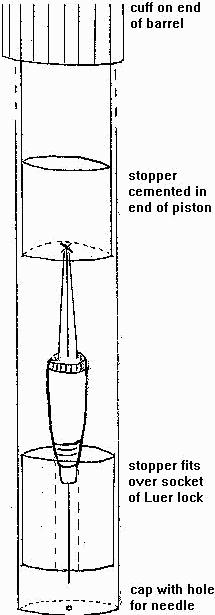
The foundation of the instrument is a telescoping aluminum pole intended as a handle for window-washing tools, purchased from a hardware store for about $10 (more recent models made of tough polyvinyl would probably also be effective). It consists of two tubes, each 90 cm long. The inner tube ("piston") slides snugly into the outer ("barrel"), and a twisting cuff at the top end of the barrel locks the piston at any point. It is important that the piston can be removed completely from the barrel, and it may be necessary in some models to remove a stop on the barrel to achieve this. The free end of the piston has a threaded plastic extension for the attachment of a brush; this can be left in place as a handle. Additional pieces required for the conversion are an ordinary, disposable, plastic Luer-lock 10-cc syringe, and two rubber laboratory stoppers.
The butt of the barrel becomes the "nose" or needle end of the pole syringe. Its only modification is a 2-mm-diameter hole drilled through the center of the composition plug that caps it, to allow passage of the needle (in some models, the hole is already present). The piston is converted to bear the hypodermic syringe and needle. A tight-fitting rubber stopper is cemented in place in its open (inside) end. The 10-cc hypodermic syringe is modified by cutting off the button-like end of its plastic plunger. The stem of the plunger, cross-shaped in section, is then pushed into a corresponding cut made in the stopper. This friction joint is tight enough to hold the syringe in place during use, yet permits it to be removed and replaced if necessary. The remaining piece of the device is a second rubber stopper, slightly smaller in diameter than the bore of the barrel, and about 2.5 cm in length, longitudinally bored so as to fit snugly over the collar-like socket of the syringe's Luer lock. This stopper acts as a cushion between the syringe and the plug at the end of the barrel, and also serves to center the needle on the hole. It remains unattached, and is removed each time the needle and/or syringe is changed. When the device is assembled, the point of a 1.5" needle projects only about 7 mm beyond the nose. Our experience is that 16-gauge needles, being less susceptible to bending, cause fewer injuries than the smaller 18-gauge.
Figure 1: The pole syringe (not to scale).
For loading, the piston with attached syringe and needle is completely withdrawn from the barrel, and the syringe charged in the usual way, via the needle. After the loaded syringe assembly is returned to the barrel, the twist-lock can be used to fix the piston in a slightly retracted position, so that the needle is safely shielded in the barrel until use. To inject the animal, release the lock, grasp the end of the piston, and poke the nose of the device firmly and squarely against a fleshy part of the animal (thigh, buttock, lumbar region, or shoulder). Since both the syringe and its plunger move with the piston, a single motion, easily performed with one hand, exposes the needle, drives its point in, and expresses the drug. This is an advantage over devices in which the body and needle of the syringe are fixed to the barrel, and an extended plunger is connected to a button at the butt end, requiring the operator to use both hands. The flat, rather than tapered, profile of the device's needle end requires that the thrust be more or less normal to the body surface, reducing the incidence of "skidding" that can slash the animal's skin, and its flat end acts as a stop, ensuring that the point of the needle does not penetrate more than 7 mm. Since the needle's bevel is approximately 4 mm in length, most of the injection is placed immediately under the skin. No serious injuries have been caused by this procedure. In most cases, there is only minor bleeding at the site of the puncture. More copious bleeding may occur if the animal jumps at the instant of injection, and the needle causes a slashing cut. This bleeding stops spontaneously within a few minutes, however, and no injury sustained in this way has yet required stitches.
In 10 field seasons of 5-10 weeks each, the Awash Primate Research Project has successfully tranquilized more than 700 baboons (Papio hamadryas anubis and P. h. hamadryas), and smaller numbers of grivet monkeys (Chlorocebus aethiops aethiops), by Ketamine injection, after capture in a cage-trap. A device of the kind described here has been used to administer the drug to all animals (>600 baboons, 20 grivets) too large to be injected by hand syringe. While showing superficial signs of the many bites it has received, its function is unimpaired.
-----------------------
Author's address: Department of Anthropology, New York University, New York, NY 10003 [e-mail: [email protected]].
-----------------------
* * *
Awards for the Integration of Research and Education
The National Science Foundation (NSF) is holding a special competition to recognize baccalaureate-granting institutions for their past accomplishments and future plans for integrating research and education on their campuses. NSF intends to make 10-20 awards not to exceed $500,000 each. The solicitation for this activity will not be published in hard copy; it will be found only on the NSF home page, at <www.nsf.gov/od/osti>.
Fyssen Foundation 1998 International Prize
The Fyssen Foundation's aim is "to encourage all forms of scientific inquiry into cognitive mechanisms, including thought and reasoning, underlying animal and human behavior, their biological and cultural bases, and phylogenetic and ontogenetic development." The Foundation wishes to support, particularly, research in such fields as: Ethology and Psychology: Nature and development of the cognitive processes in man and animals, both ontogenetic and phylogenetic. Neurobiology: Neurobiological bases of cognitive processes, their embryonic and postnatal development, and their elementary mechanisms. Anthropology-Ethnology: Cognitive aspects of the representations of natural and cultural environments; analysis of their construction principles and transfer mechanisms; analysis of forms of social organization and their technological systems. Human Paleontology: Origin and evolution of the human brain and human artifacts.
An International Prize of 200,000 ff is awarded annually to a scientist who has conducted distinguished research in the areas supported by the Foundation. It has been awarded to Professors A. Leroi-Gourhan (1980), W. H. Thorpe (1981), V. B. Mountcastle (1982), H. C. Conk-lin (1983), R. W. Brown (1984), P. Buser (1985), D. Pilbeam (1986), D. Premack (1987), J. C. Gardin (1988), P. S. Goldman-Rakic (1989), J. Goody (1990), G. A. Miller (1991), P. Rakic (1992), L. L. Cavalli-Sforza (1993), L. R. Gleitman (1994), W. D. Hamilton (1995), and C. Renfrew (1996). The topic considered for the 1998 prize is Origins of Man. Nominations should be sent to the Secretariat of the Foundation, 194, rue de Rivoli, 75001 Paris, France before October 30, 1998.
ASP Awards and Recognition
The American Society of Primatologists is soliciting nominations for two awards via the Awards and Recognition Committee: 1) The Distinguished Primatologist Award, which honors a primatologist who has had an outstanding career and made significant contributions to the field. Previous awards have honored Dr. William Mason, Dr. Philip Hershkovitz, Dr. Charles Southwick, and Dr. Orville Smith. Nominations should be made in writing and must include a narrative that describes the nature and extent of the nominee's contribution to primatology. Nominators must also see that two additional letters of support be submitted on behalf of the nominee.
2) The Distinguished Service Award, which is presented to deserving individuals who have contributed long-time service to the ASP and to primatology in general. Former awardees are Dr. Richard Harrison, Historian for the ASP; Dr. Leo Whitehair, for long-time accomplishments on behalf of primatology; Judith Schrier, Editor of the Laboratory Primate Newsletter; and Larry Jacobsen, Head of Library Services at the Wisconsin RPRC. A nominating letter of support must be included at submission.
If you would like to nominate individuals for either of these special awards (Deadline for receipt is May 15, 1998), send pertinent information to Gerry Ruppenthal, Chair, Awards and Recognition Committee, Box 357920, University of Washington, Seattle, WA 98195 [fax: 206-616-9774; e-mail: [email protected]].
* * *
Shelly L. Williams and John W. Kelley
Language Research Center, Georgia State University
Introduction
Giving nonhuman primates control over their environment helps to reduce stress (Spinelli & Markowitz, 1985). Also, providing novel, ever-changing events to engage the primates' attention reduces boredom and ameliorates the lack of stimulation often observed in captive environments (Washburn & Rumbaugh, 1992).
In this article we describe a way to provide mobility to an ape who is too large to be safely transported solely by human strength or with a collar and lead. Our method is safe for ape and caregiver, and requires neither restraint nor sedation of the ape. A similar technique, using mobile caging, has already proven useful in providing social contact and exercise for monkeys in indoor enclosures (Seier & de Lange, 1996). The technique described here is used with larger nonhuman primates (apes), and includes transportation throughout a 55-acre outdoor environment consisting of several buildings and a forest with areas where food can be found (Savage-Rumbaugh, 1987; Savage-Rumbaugh, Brakke, & Hutchins, 1992).
Our method utilizes a transport box large enough to house a full-grown chimpanzee (Pan troglodytes). In the box, the ape can communicate to a human its travelling intentions by gesturing, by choosing from options provided by pictures, or (if language-trained) by using lexigrams (Savage-Rumbaugh, 1986; Savage-Rumbaugh, et al., 1992). In this article, we describe in detail our procedures for box training and habituation to movement and noise.
Apparatus and Subject
The transport box is 107 cm long x 107 cm high x 79 cm wide.[See footnote]The frame is constructed of aluminum angle, reinforced by rectangular aluminum bars on all six sides of the frame, and covered on three sides with 9-gauge galvanized steel chain-link. The top of the box is covered by polypropylene. The bottom consists of an aluminum sheet welded to the frame. Spaces are left open to provide for water drainage and easy cleaning.
The door of the box is constructed of polypropylene that slides horizontally within a channel. It is held shut by heavy-duty brass locks on one side. Two openings on the front and side of the box serve as pass-through windows. These windows, made of transparent Lexan, slide in aluminum channels. They open easily and can be bolted shut. Four flanges located on each corner of the back side of the box can be locked tightly to four similar connections on the doors of the apes' home cages.
The transport box fits perfectly inside a 4-wheeled dolly 16.5 cm high which moves easily on smooth surfaces because all wheels rotate 360deg.. For travelling outdoors, where there are changes in gradient and surface texture, the transport box is rolled up a ramp and secured onto a small wagon that is pulled by a garden tractor.
Panzee, an 11-1/2-year-old female chimpanzee, was co-reared with a bonobo (Pan paniscus) and raised by humans (Brakke & Savage-Rumbaugh, 1995). She has actively participated in language acquisition and cognitive assessment projects for almost her entire life. Up to the age of seven years she was able to travel on a lead with a caregiver through 55 acres of forested land. She was allowed to visit other buildings and to watch other apes and humans. When she became an adult, she was housed with other chimpanzees in indoor and outdoor cages.
Training
Panzee was first allowed free access to the box so that she could investigate and explore its construction. She was then given her daily ad lib food items in her box. She was never deprived of food. Grooming sessions were also given within the box so that she would associate positive activities with box training. Other positive activities included access to pictures, magazines, paper and drawing utensils, blankets or towels, and one of her favorite toys: a mask. This was continued until she appeared comfortable and relaxed in the transport box.
The next phase of training required that Panzee allow the caregiver to close the polypropylene door separating her, in the transport box, from the home cage. Close approximations to the desired response were followed with verbal, gestural, and facial praise. The caregiver would be sure Panzee was comfortable as the door moved closer to its locked position. If the ape appeared uncomfortable, nervous, or upset with door movement, caregivers patiently waited until she was ready. Readiness was determined by the ape's posture, gestures, facial expressions, and eye movements.
Practice with the transport box occurred daily at various times. Activities in the box varied from session to session.
With the door shut and locked, the door to the home cage was also shut and locked. The flange locks were then removed to disengage the transport box from the home cage. Care was taken to move slowly and talk to Panzee about what was to happen next using gestures and eye movements. Initially showing her pictures of where she was travelling or just gesturing impending movement caused much excitement. At first, her transport box was moved about 10 feet into a kitchen area where she could gesture for foods she wanted from the refrigerator.
We were then able to take her out onto the sidewalk to visit other locations by loading the transport box onto the tractor-pulled cart. Panzee tolerated the noise and compensated for gradient changes in the ground by grabbing the chain link. At times, she sought physical reassurance from the caregiver by displaying a facial kiss or gently extending her finger out to the caregiver. She appeared excited to see familiar sites and visit familiar apes and people. She vocalized when she met other chimpanzees or bonobos and interacted with people by putting her mask onto her face. If a mask was not available she would make one from a piece of paper by biting one or two holes in it for the eyes. She stayed in the transport box on her first outing for more than two hours and appeared to enjoy the experience. Panzee also asked for various food items and ate them eagerly in her box while watching people and other animals outside.
Next we put the transport box into a van with windows on all sides. The box was tightly secured to the inside of the van with nylon straps. Panzee was driven around the laboratory and, again, appeared to enjoy the experience, looking out all the windows from the three directions permitted by the box. She would gesture and grunt when she wanted to go in a specific direction. Eventually she was so relaxed that she took a short nap.
Panzee now asks to go into her transport box by grunting to the caregiver to get her attention and then gesturing to the box. Because this now is an attractive experience for her, it can also be used as an incentive for performing other behaviors as requested by the caregiver.
Discussion
We have established the use of this equipment as an environmental enhancement. Panzee readily enters the box when it is available to her and vocalizes her excitement, demonstrating her motivation. We have also successfully trained an adult bonobo to engage in similar activities and are currently training three more adult chimpanzees, two bonobos, and one orangutan.
Besides being a flexible tool for environmental enhancement, the box has the potential for numerous other uses. Varying time of day, type of reward, length of stay in box, caretaker, and so forth ensures that no specific aspect of the training would condition the apes to respond only to consistent attributes. This inconsistency can be extremely useful if the ape needs to be transported elsewhere for medical care, isolation, or examination.
The box also offers opportunities for training apes to engage in behaviors that are difficult to train for in their home cage (e.g., giving injections, weighing, and testing using computers). This mobility is especially necessary if the testing equipment is located elsewhere - it is usually easier to move the ape than the equipment.
References
Brakke, K. E. & Savage-Rumbaugh, E. S. (1995). The development of language skills in bonobo and chimpanzee: I. Comprehension. Language and Communication, 15[2], 121-148.
Savage-Rumbaugh, E. S. (1986). Ape Language: From Conditioned Response to Symbol. New York: Columbia University Press.
Savage-Rumbaugh, E. S. (1987). A new look at ape language: Comprehension of vocal speech and syntax. In R. A. Dienstbier (Ed.), Nebraska Symposium on Motivation: Comparative Perspectives in Modern Psychology, 35, 201-255.
Savage-Rumbaugh, E. S., Brakke, K. E., & Hutchins, S. S. (1992). Linguistic development: Contrasts between co-reared Pan troglodytes and Pan paniscus. In Nishida, McGrew, Marler, Pickford, & de Waal (Eds.), Topics in Primatology, 1, Human Origins (pp. 51-66). Tokyo: University of Tokyo Press.
Seier, J. V. & de Lange, P. W. (1996). A mobile cage facilitates periodic social contact and exercise for singly caged adult vervet monkeys. Journal of Medical Primatology, 25, 64-68.
Spinelli, J. S. & Markowitz, J. (1985). Prevention of cage associated distress. Lab Animal, November/December, 19-28.
Washburn, D. A. & Rumbaugh, D. M. (1992). Investigations of rhesus monkey video-task performance: Evidence for enrichment. Contemporary Topics in Laboratory Animal Science, 31[5], 6-10.
-----------------------
First author's address: Georgia State University, Language Research Center, Atlanta, Georgia 30303. Acknowledgements -- Supported by the College of Arts and Sciences of Georgia State University. The authors wish to thank Sue Savage-Rumbuagh for initiating and developing the idea for ape mobility as a form of environmental enhancement that supports their well-being. We thank David Washburn and Duane Rumbaugh for their helpful comments. The authors also wish to acknowledge the help provided by the Primate Information Center of the University of Washington.
For complete, detailed plans of the box and dolly, please write to the author.
-----------------------
* * *
Boris A. Lapin, Director
Early in the 20th Century a group of Russian scientists applied to the government for funds with which to found a monkey colony. Such a colony would ensure a supply of monkeys, enabling scientists to conduct experiments using these "laboratory doubles of man." Sukhumi was chosen as the site of this colony, and in August, 1927, the first monkeys arrived, forming the nucleus of the Russian primate center, formally known as the Sukhumi Monkey Colony of the Moscow Institute of Endocrinology. The Sukhumi Monkey Colony went through several name changes, and is now called the Institute of Medical Primatology of the Russian Academy of Medical Sciences (RAMS).
From the very beginning, it was clear that infectious pathology would be an especially fruitful field for study. Accordingly, many monkeys were drawn into a wide circle of research on infectious processes. In the infectious disease division, highest priority was given to solving the problem of poliomyelitis. This research was conducted especially intensively in the USSR and the USA. In the USSR it was conducted by M. Chumakov and his wife M. Voroshilova here at the Medico-Biological Station in Sukhumi. Members of the Station staff also took an active part in this research. Later this research was transferred to the specially founded Moscow Institute of Poliomyelitis, also under the aegis of the Soviet Academy of Medical Sciences.
Many distinguished scientists have collaborated with the Sukhumi Institute over the years, with the goal of creating monkey models of human infectious diseases and studying their etiology, prevention, and treatment. One of the first laboratories established in the Institute was the Laboratory of Infectious Diseases, founded by E. K. Dzhikidze. Trials of vaccines and chemotherapeutic drugs were conducted here by Z. Ermolyeva, I. Gvazava, and G. Magakyan.
At this point I would like to mention one study conducted here, undeservedly forgotten, and unfortunately never completed. I have in mind the work of L. Zilber, N. Konovalov, and their associates, who induced in monkeys a slowly progressing pathological process with vague neurological symptoms, by inoculating them with an emulsion of brain tissue from deceased human patients with amyotrophic lateral sclerosis.
Investigation of the higher nervous activities of monkeys began in 1929 in a specially created laboratory of physiology, associated with the name of the great Russian physiologist I. Pavlov. Many normal and pathological features of higher neural activity in monkeys were identified, as well as norms for various physiological functions. A very important part of this research was inducing experimental neuroses and studying the somatic pathology produced by them: hypertension, coronary insufficiency, myocardial infarction, gastric achylia, and sexual cycle disturbances. This work was conducted by D. Miminoshvili, G. Cherkovich, G. Kokaya, V. Startsev, and L. Alekseeva.
The Laboratory of Experimental Oncology opened in 1937. N. Petrov and his associates were the first in the world to produce, after many years of experiments, malignant tumors by inserting methylcholanthrene and radium ore into the bone. It is difficult to explain why no one could produce such tumors before, although unsaturated hydrocarbons and radioactive substances had been known to produce tumors in small laboratory animals and even in man. Perhaps it was because the latent period in monkeys was very long, sometimes 10 years or more. Petrov's study became widely known and was awarded the Mechnikov Prize by the Academy of Sciences of the USSR.
The experiments begun by L. Zilber in the Institute were a real breakthrough because he showed that it is possible to produce different kinds of fibromyosarcoma by injecting monkeys with avian Rouse virus. He proved that 1) monkeys are susceptible to tumorogenic viruses; and 2) tumorogenic viruses cross not only species barriers but also class barriers. Similar experiments were being done in the US at the same time by S. Munroe and W. Windl.
Of special interest are viral neoplasms of the hemopoietic system, which have been investigated at the Institute since 1966. Inoculation of baboons with the blood of human leukemia patients in 1968 produced malignant lymphomas. The DNA- and RNA- viruses associated with them were isolated, their molecular-biological structure was studied, and the possibility of horizontal spreading of the viruses and of disease, as well as routes of spreading, were shown. The viruses proved to be contagious and could cause outbreaks of lymphoma. Modern molecular-biological methods (e.g., PCR and its modifications and the sequencing of virus genomes) have revealed the fine structure of the viruses, their intraspecies peculiarities, and the possibility of hybridization of different strains of the same virus. Most of this work was done in collaboration with well known American scientists, such as J. Moloney, F. Deinhardt, W. Parks, and R. Goldberg, according to the Soviet-American Agreement.
Intensive investigation into the field of primate comparative pathology began in 1950 with the work of B. Lapin, L. Yakovleva, and R. Krylova. Their data showed great similarity between the classifications of monkey and of human diseases; this was additional evidence for including monkeys and man in the same order, Primates.
Radiobiological research began in Sukhumi in 1950. Shortly thereafter it came under the leadership of L. Semenov, an expert in radioprotectors. Of special interest were investigations into the effects of chronic low doses of radiation, and a device was constructed for this purpose. The results were published in numerous articles and in monographs, one by L. Yakovleva, another by L. Sevenov. Radiobiological investigations on monkeys are of great importance because monkeys and humans have similar sensitivity to radiation, in contrast to other laboratory animals. Radiocytogenic sensitivity is also similar in monkeys and man. The data obtained here forced radiologists (N. Dubinin and associates) to decrease the limits of biosafe radiation doses, which had previously been established for humans on the basis of experiments done with mice.
From the very beginning, the Sukhumi Primate Center has closely collaborated with many research centers in Moscow, Leningrad, and elsewhere in Russia, as well as with many scientists abroad -- mainly in the US, Germany, Czechoslovakia, and Hungary. Such ties were promoted by annual national and international symposia on various topics held in Sukhumi and its vicinity.
Research at the Institute encouraged the creation of new primate colonies. The largest monkey colony was established at the Institutes of Poliomyelitis and Viral Vaccines in Moscow. Collaborations with other scientists and Institutes stimulated the founding of smaller monkey colonies at the Institutes of Biophysics and of Biomedical Problems, both of the Ministry of Health, and at the Research-Production Association in Novosibirsk.
The Sukhumi Institute led two expeditions, to Viet Nam in 1961, and to Nigeria in 1965-66 -- places with monkeys in their natural habitat -- to study monkeys' natural behavior and spontaneous pathology in the wild.
Extremely important for the growth of world primatology was the visit to the Sukhumi Institute by a delegation of American scientists, headed by the famous cardiologist Dr. Paul Dudley White, in 1956. A report by this delegation to the Congress of the USA resulted in the establishment of the seven Regional Primate Centers in various parts of the US.
Almost since the beginning, this Center has been conducting research in endocrinology. Since 1962 we have been collaborating with German scientists in studying metabolism in the adrenal and sex glands. It has been established that the metabolism of these hormones is closer to the human pattern in baboons than in green monkeys and macaques. This line of research received a significant impetus from a WHO symposium dedicated to reproductive endocrinology, held in Sukhumi in 1971.
Since 1963 the Institute has joined in space research. Experiments with baboons showed that it was not only possible but safe to send women into space. From the moment that the international program Bion was begun, the Institute has participated in it, choosing monkey cosmonauts and carrying out their basic training.
The Primatological Center of the USSR has come a long way since its founding as the Sukhumi Monkey Colony of the Moscow Institute of Endocrinology (1927-1933), subsequently called the Subtropical Branch of the Leningrad Institute of Experimental Medicine (1933-1944), the Medico-Biological Station of the Academy of Medical Sciences (1944-1958), the Research Institute of Experimental Pathology and Therapy, AMS, of the USSR (1958-1992), and now the Institute of Medical Primatology of the Russian Academy of Medical Sciences (1992-) in Sochi-Adler. In February, 1992, the Russian Academy of Medical Sciences decided to divide the Sukhumi Institute of Experimental Pathology and Therapy into two Institutes: the Sukhumi Institute of Experimental Pathology and Therapy and the Institute of Medical Primatology, RAMS, in Sochi-Adler. The reason for this division was the incipient break-up of the USSR, the appearance of nationalist, extremist coalitions in Georgia and Abkhazia, the impending secession of Georgia from the USSR, and the incipient military actions between Georgia and Abkhasia.
At present the Institute of Medical Primatology has about 2500 animals (mostly Macaca mulatta, but also M. fascicularis, Chlorocebus aethiops, and Papio hamadryas) and is located in Russian territory, in Sochi-Adler. It is the leading primate center in Russia, and through its historical derivation from the Sukhumi center, which was founded in 1927, it remains the oldest. The All-Russian Primate Committee of the RAMS Presidium is based at the Center. In spite of a significant number of difficulties and problems (basically related to finances), the Center continues to work and develop. It occupies 100 hectares and includes open-air cages, with enclosed shelters for the monkeys in winter, and corncrib-like structures. The Institute of Medical Primatology has several laboratories: Microbiology and Virology, Pathologic Anatomy, Endocrinology, Microbiology and Virology, the Virology and Immunology of Cancer, and Colony Management and Behavior. In contrast, the number of monkeys in the Sukhumi facility has decreased from 7,000 to 200 or 300, and the scientists who are left there have no opportunities to conduct any research at all.
In conclusion I extend my sincere thanks to my colleagues who have been working side by side with me for many years, sharing all of the problems and difficulties. I thank the Administration of the City of Sochi for its unfailing support and many courtesies. And I extend heartfelt thanks to my numerous foreign colleagues and friends for their moral support and monetary aid.
Selective Bibliography
Indzhia, L. V., Yakovleva, L. A., Overbaugh, J., Liccardi, K. A., Chikobava, M. G., Klotz, I. N., Torres, R., Indzhiia, V. O., Lapin, B. A., Clark, E. A., & Valentine, M. A. (1992). Baboon T cell lymphomas expressing the B cell-associated surface proteins CD40 and Bgp95. Journal of Immunology, 12[3], 225-236.
Lapin, B. (1973). Epidemiology and genetic aspects of the outbreak of leukemia among hamadryas baboons of the Sukhumi Monkey Coloney. In R. M. Dutcher & L. Chieco-Bianchi (Eds.), Unifying Concepts of Leukemia, Bibliotheca haematologica no. 39 (pp. 463-468). Basel: Karger.
Lapin, B. A. (1976). Epidemiology of leukemia among the baboons of Sukhumi Monkey Coloney. In J. Clemmensen & D. S. Yohn (Eds.), Comparative Leukemia Research, Bibliotheca haematologica no. 43 (pp. 489-492). Basel: Karger.
Lapin, B. A. (1985). Hematopoietic diseases in nonhuman primates. In F. Deinhardt (Ed.), Proceedings of XIIth Symposium for Comparative Research on Leukemia and Related Diseases (pp. 277-296). Hamburg.
Lapin, B. (1987a). Nonhuman primate models of human hematological malignancies. In R. Neth, R. C. Gallo, M. F. Greaves, & H. Kabisch (Eds.), Trends in Human Leukemia VII (pp. 440-444). Berlin: Springer-Verlag.
Lapin, B. (1987b). Baboon Lymphoma Viruses. In G. Darai (Ed.), Virus Diseases in Laboratory and Captive Animals (pp. 135-151). Boston: Nijhoff.
Lapin, B. A., Dzhikidze, E. K., & Fridman, E. P. (1987). Manual of Medical Primatology. Moscow: "Medi-tsina".
Lapin, B. A., Dzhikidze, E. K., & Yakovleva, L. A. (1965). (Monkey diseases in natural habitat in Viet Nam). Moscow: "Meditsina".
Lapin, B. & Fridman, E. (1963). (Monkeys for Science) Moscow: Novosti Press Agency Publishing House.
Lapin, B. A., Norkina, L. N., Cherkovich, G. M., Yakovleva, L. A., Kuksova, M. I., Alekseeva, L. V., Fufacheva, A. A., & Startsev, V. G. (1963). (Monkey - as an object for medical and biological experiments.) Sukhumi.
Lapin, B. A. & Yakovleva, L. A. (1963). Comparative Pathology in Monkeys. Springfield, IL: Thomas.
Lapin, B. A. & Yakovleva, L. A. (1964). Vergleichende Pathologie der Affen. Jena:VEB Gustav Fisher Verlag.
Lapin, B. A., Yakovleva, L. A., Agrba, V. Z., & Voevodin, A. F. (1979). (Hemoblastoses in primates and role of viruses in their origin). Moscow: "Meditsina".
Lapin, B. A. & Yohn, D. S. (Eds.) (1980). (Advances in Comparative Leukemia Research). Moscow: Izdat. Akad. Med. Nauk SSSR.
Semenov, L. F. (1967). (Prophylaxis of acute radiation sickness in experiments.) Moscow: "Meditsina".
Voevodin, A. F., Lapin, B. A., Tatosyan, A. G., & Hirsch, I. (1987). Markers of HTLV-1-related virus in Hamadryas baboon lymphoma In R. Neth, R. C. Gallo, M. F. Greaves, & H. Kabisch (Eds.), Trends in Human Leukemia VII (pp. 392-394). Berlin: Springer-Verlag.
Voronin, L. G., Kanfor, I. S., Lakin, G. F., & Tikh, N. A. (1948). (Experience of monkey care and breeding in Sukhumi). Moscow: Izdat. Akad. Med. Nauk SSSR.
Yakovleva, L. A. (1966). (Comparative study of acute radiation sickness and its aftereffects.). Leningrad: "Meditsina".
Yakovleva, L., Chikobava, M., Indzhiia, L., Shatzl, H., von der Helm, K., & Lapin, B. (1996). Interrelation between morpho-immunological phenotype and presence of T-lymphotropic retroviral genome in DNA of primate peripheral T-cell malignant lymphoma. Tumor Research, 31, 99-109.
Yakovleva, L. A., Lennert, K., Chikobava, M. G., Indzhiia, L. V., Klotz, I. N., & Lapin, B. A. (1993). Morphological characteristics of malignant T-cell lymphomas in baboons. Virchows Archiv für Pathologisches Anatomie und Physiologie und für klinische Medizin, 422, 109-120.
Yohn, D. S., Lapin, B. A., & Blakeslee, J. R. (Eds.). (1980). Advances in Comparative Leukemia Research. New York: Elsevier/North-Holland.
-----------------------
Author's address: Inst. Med. Primatology, Veseloye 1, Adler, Sochi 354597, Russia [e-mail: [email protected]].
This paper is based on a talk presented at the 70th anniversary celebration of the Institute of Medical Primatology.
Translated by Eugenia Cherkovich and Elva Mathiesen.
-----------------------
* * *
Philadelphia Zoo Primate House
Ground was broken for the new Primate House at the Philadelphia Zoo on January 22. The 24-million-dollar "Primate Reserve" is scheduled to be finished and open to the public next spring. The two-and-a-half-acre reserve will be home to three dozen primates, including lowland gorillas, lemurs and monkeys.
The reserve replaces the Zoo's old primate house, which was destroyed by fire in December of 1995. Twenty-three animals died in the blaze. Zoo President Pete Hoskins, who also helped break ground, said the new facility will have sophisticated alarm systems to make it highly unlikely such an accident will happen again. -- From ABC News, reported on Primate-Talk
Ivan -- Another Zoo Atlanta Success!
On January 22 Ivan, the gorilla who spent most of his life in a Washington State shopping center (see LPN, 1994, 33[4], 13; 1995, 34[1], 7), mated with one of the two females who share his enclosure at Zoo Atlanta, where he was sent in 1995, after much controversy. The "lucky female" is Kinyani, who will be 15 years old in March. Ivan did not mate with forty-year-old Shamba, another female who shares the enclosure, nor has she shown much interest in Ivan. Kinyani, on the other hand, has been "warm for Ivan's form" for months now. This was the first time Ivan showed he knew what she wanted, however.
Zoo Atlanta has done it again. While the miracle of resocialization belongs to the gorillas themselves, Zoo Atlanta has provided the excellent care and conditions making such miracles possible. Willie B, who came to Zoo Atlanta after 27 years in solitary housing, has two daughters, with another two females pregnant. While Ivan may never produce offspring (hope springs eternal, though!), Zoo Atlanta has achieved its goal of socializing Ivan successfully. -- Reported on Primate-Talk by Jane Dewar
Changes in Washington, DC
On February 13, President Clinton announced that Dr. Jack Gibbons is retiring from his position as Director of the Office of Science and Technology Policy. Dr. Neal Lane, currently Director of the National Science Foundation, will replace Gibbons. The President also announced his intention to appoint Dr. Rita Colwell, former President of AAAS and current President of the University of Maryland Biotechnology Institute, to head the National Science Foundation.
Orangutans Flee Indonesian Fires -- Again
JAKARTA, Feb. 9 (AP) -- Dozens of park rangers and Indonesian soldiers fought raging forest fires in a national park today as orangutans and other animals fled the blazes. In the last week, the fires have razed up to 4000 acres in Kutai National Park in Indonesia's East Kalimantan province, 850 miles northeast of the capital, Jakarta. Birds, lizards, monkeys and other animals are in danger. The fires, exacerbated by a long drought linked to the El Niño weather phenomenon, have raised fears that a choking smog that shrouded parts of Southeast Asia for months last year could return -- and again threaten the health of millions. Kutai park chief Warsito said the fires had flushed orangutans from their habitats. "I myself saw a mother orangutan with her two children running towards the street,'' the official Antara news agency quoted him as saying.
Last year, dozens of orangutans were forced out of their forest by wildfires on Indonesia's islands of Borneo and Sumatra. Warsito said farmers who cleared land by burning the forest were responsible for many fires and that hundreds of families were illegally occupying park land. Forest Minister Djamaludin Suryohadikusomo said two companies were responsible for many fires in East Kalimantan. He did not name the companies. Last week, haze from the fires delayed flights at a regional airport in East Kalimantan. -- Posted to Primate-Talk
Ralph Dell Becomes ILAR Director
Ralph B. Dell, MD, has been named Director of the National Research Council's Institute of Laboratory Animal Research (ILAR). A pediatric nephrologist on the faculty of Columbia University's College of Physicians and Surgeons for 34 years, he served as chairman of the IACUC there for over a decade. Dr. Dell is a leading advocate for laboratory animal welfare and responsible research. He has worked actively for these goals with the Association for Assessment and Accreditation of Laboratory Animal Care International, the Scientists Center for Animal Welfare, and the Health, Safety, and Research Alliance of New York State. Thomas Wolfle, DVM, PhD, who headed ILAR through the Nineties and the last revision of the Guide for the Care and Use of Laboratory Animals, among many other efforts, is staying on to finish current projects. -- From NABR Update, 18[28], December 5, 1997
Joint Statement of NYU and the NYU Med. Center
On November 11, 1997, New York University and its Medical Center made the following announcement: "As a result of months-long negotiations, the NYU Medical Center has announced that all of the remaining chimpanzees at its LEMSIP facility will be retired after which no further research will be conducted on these chimpanzees. None of the remaining chimpanzees at its LEMSIP facility will be transferred to the Coulston Foundation.
"Twelve to thirteen of the chimpanzees will be retired after completion of an ongoing study in approximately two to three years. The remaining ten to fifteen chimpanzees will be retired no later than December 31, 1997. The fact of their retirement will be made available to the NYU community.
"New York University President L. Jay Oliva will request the university Senate Academic Affairs Committee to assess the desirability of the appointment of student representation to the University's Washington Square and Medical Center Institutional Animal Care and Use Committees and report its recommendations to the Senate and the President no later than the April, 1998 Senate meeting. Student groups will have equal opportunity to present their arguments to the Senate Academic Affairs Committee." -- Signed: Dr. Robert Berne, Vice President for Academic Development, NYU; Dr. David S. Scotch, Associate Dean, NYU School of Medicine
New arrivals!
The Comparative Cognition Project, The Ohio State University, Columbus, OH, is pleased to announce the adoption of two new chimpanzee infants. The infants, Ivy (female, age 12 mos.) and Keeli (male, age 16 mos.) have been together since Ivy's mother was unable to care for her. Their joint adoption (we didn't want to separate them; and Keeli was owned by NIH) required significant and persistent efforts by Dr. Michael Keeling (Anderson/Univ. Texas Cancer Center at Bastrop) for Keeli to be donated to our project. Dr. Tom Butler (Southwest Foundation for Biomedical Research, San Antonio TX) generously arranged for Ivy to come to us. Dr. Michele Martino, SWFBR veterinarian, who travelled with Dr. Linda Brent to bring the infants to Columbus, gives generously of her time for the care of chimpanzees at Primarily Primates, which is directed by Wally Swets.
Both infants have adapted well to their new life with us here at OSU, although we are still adjusting our schedules to baby bottles, potty training, and all-nighters at the chimp center. Next week, the infants will be out of quarantine, and we will begin the introduction process with our adult females, two of whom (ages 16 and 38) will interact directly with humans, which should facilitate the introduction process. We look forward to exciting new cognitive studies which will remind us further of the mere shadow that lies between our two species. Thanks again to Drs. Keeling, Butler, Brent, & Martino for their willingness to work together to bring this cooperative effort to fruition. -- Announced December 1, 1997 on Primate-Talk by Sally Boysen, Director, Comparative Cognition Project, The Ohio State University Chimpanzee Center [e-mail: [email protected]]
Rehearing on Primate Well-Being Regs
The U.S. Court of Appeals has issued an order granting rehearing by the full Court in a challenge brought by the Animal Legal Defense Fund (ALDF), and individuals, to regulations USDA issued in purported compliance with a 1985 amendment to the Animal Welfare Act regarding the psychological well-being of nonhuman primates.
On December 9, 1997, Judges Sentelle and Henderson held that plaintiffs lacked standing to challenge USDA's failure to issue standards for the psychological well-being of nonhuman primates, requiring that regulated entities (research labs, zoos, circuses and animal dealers) set those standards themselves. The National Association for Biomedical Research (NABR) and the US Department of Justice had argued that ALDF and all other appellees (plaintiffs) failed to meet the tests of legal standing necessary to sue the USDA. Judge Patricia Wald dissented from the ruling, finding that, "it is striking, particularly in a world in which animals cannot sue on their own behalf, how far the majority opinion goes toward making governmental action that regulates the lives of animals...unchallengeable." Plaintiffs asked for rehearing by the three judge panel that heard the case and for rehearing by the entire Court. The Court's order vacated the December 9, 1997 ruling, and stated that a majority of the judges voted to have the case reheard by the full court.
In support of its rehearing petition, ALDF had claimed that the majority opinion conflicts with established standing law and "immunizes a vast amount of agency conduct from judicial review." -- From the NABR Update, February 12, 1998, and a press release by Valerie Stanley, attorneyl for ALDF
Fossil Orangutan Found in Vietnam
Dr. Vu The Long [e-mail: [email protected]], of the Institute of Archeology in Hanoi, Vietnam, has returned from excavating a limestone cave site in Hoa Binh Province, southwest of Hanoi in northern Vietnam. He was acting on the information of a hunter who had visited the cave.
At a location some 70 meters from the cave mouth, Dr. Long uncovered one complete adult fossil Pongo specimen, a fragment of an infant orangutan skull and long bones, as well as the skull of a gibbon. Dr. Long suggests that, the fossils "look not so old but may belong to late Pleistocene or begining of Holocene." If this date is correct, it would make these the most recent fossil orangutan known from Vietnam and (I believe) the only known complete fossil specimen.
Long is now working at another site, but I do hope that he will add to this brief description soon. -- Posted to Primate-talk by Vern Weitzel, March 5, 1998
* * *
Nonhuman primate species have played a key role in advancing our knowledge base in understanding disease processes and it is important that research efforts utilizing these models be expanded. Although much progress has been made in the development of nonhuman primate animal model systems, particularly for AIDS-related research, cures for many diseases and effective preventive measures are lacking. It is clear that further studies are needed to identify the basic mechanisms of disease processes in order to develop methods for prevention and/or control.
The National Center for Research Resources (NCRR) recognizes that nonhuman primate research resources may not be readily accessible to all investigators who wish to use them in research. To make these resources more readily accessible to researchers, NCRR invites investigator-initiated research project grants applications for research that utilizes nonhuman primates and other research resources at the seven Regional Primate Research Centers (RPRCs). The National Institute of Allergy and Infectious Diseases (NIAID) is a co-sponsor of this solicitation. Applications that are within the mission of NIAID will receive funding consideration from that Institute. The overall objectives of this initiative are to: (1) promote cutting-edge scientific research; (2) enhance utilization of nonhuman primates and other resources within the RPRCs; and (3) promote coordinated research efforts with Center staff scientists who are located at the seven RPRCs.
The proposed research must be conducted at one of the seven RPRCs and in collaboration with one or more RPRC staff scientists. To be eligible, the Principal Investigator must not currently be a center/core staff member receiving support (salary and/or other research support) from the NCRR-supported RPRC grant and may not be located at a RPRC. If the Principal Investigator's grantee institution is different from the grantee institution of the RPRC, a consortium or contractual agreement must be established with the RPRC.
Direct inquires regarding basic research programmatic issues and the RPRC Program to Jerry A. Robinson, Comparative Medicine, NCRR, 6705 Rockledge Dr., Suite 6030, Bethesda, MD 20892 [301) 435-0744; fax: 301-435-3819; e-mail: [email protected]]. Direct inquiries regarding NIAID research program issues to: Stephen M. Rose, Div. of Allergy, Immunology and Transplantation, NIAID, 6003 Executive Blvd, Rm 4A14. Bethesda, MD 20892-7640 [301-496-5598; fax: 301-402-2571; e-mail: [email protected]].
Direct inquiries regarding a particular Regional Primate Research Center to:
* Andrew G. Hendrickx, Director, California RPRC, UC, Davis, CA 95616 [916-752-0420; fax: 916-752-8201; <www.primate.ucdavis.edu/crprc/homepage.html>]
* Ronald D. Hunt, Director, New England RPRC, One Pine Hill Dr., Southborough, MA 01772 [508-624-8002; fax: 508-460-0612]
* M. Susan Smith, Director, Oregon RPRC, 505 N.W. 185th Ave, Beaverton, OR 97006 [503-645-1141; fax: 503-690-5532; <www.teleport.com/~orprc>]
* Peter J. Gerone, Director, Tulane RPRC, 18703 Three Rivers Rd, Covington, LA 70433 [504-892-2040; fax: 504-893-1352; <www.tpc.tulane.edu>]
* William R. Morton, Director, Washington RPRC, P.O. Box 357330, UW, Seattle, WA 98195-7330 [206-543-0440; fax: 206-685-0305]
* Joseph W. Kemnitz, Interim Director, Wisconsin RPRC, UW-Madison, 1220 Capitol Ct, Madison, WI 53715-1299 [608-263-3500; fax: 608-263-4031; <www.primate.wisc.edu>]
* Thomas R. Insel, Director, Yerkes RPRC, Emory University, 954 Gatewood Rd, N.E., Atlanta, GA 30329 [404-727-7707 or 727-7721; fax: 404-727-0623; <www.cc.emory.edu/YERKES/>].
* * *
Advanced Courses in Ethology
The Institute of Applied Psychology (ISPA), in Lisbon, is holding a series of advanced courses given by invited scientists. The seminars are open to post-graduate students or post-docs working in animal behavior or related areas. The courses are based on discussion groups, although basic information will be presented in informal lecture sessions. When available, sessions will be supported by computer-aided learning packages. The number of participants will be limited. Three courses are planned for 1998: "Conflict and cooperation: The roots of social behaviour," by M. Taborsky (Konrad Lorenz Institute, Vienna), 20-22 April 1998; "Parental investment in animals," by K. Lessels (NIOO, The Netherlands), 24-26 September 1998; "Hormonal activation and differentiation of male sexual behaviour in higher vertebrates," by J. Balthazart (Univ. Liége, Belgium), 8-10 October 1998. Requests for further information and applications should be addressed to: Rui F. Oliveira, ISPA, Rua Jardim do Tabaco 44, 1100 Lisboa, Portugal [351-1-8863184; fax: 351-1-8860954; e-mail: [email protected]]. -- From ABSnet V3 #48
Animal Behavior Summer Field Course
A four week field course in animal behavior is offered for the summer of 1998 by the Psychology Department at the Georgia Institute of Technology and Zoo Atlanta. This intensive course takes place in Atlanta, South Africa, and Kenya, and is designed to teach students how to conduct behavioral observations in a field setting.
As the priority of the course is to develop the observational skills of students, the focus is on observational data collection. In Atlanta, students are taught data collection methods and the behavior of East African animals by zoo, academic, and field scientists. Students then use this information in Africa to conduct daily observations on a variety of species. Observations are conducted in national parks and on private reserves, which permits students to compare the behavior of a single species across settings. Students also use the comparative psychology approach to examine behavior across closely related species.
Daily observations are supplemented by readings, discussions, and lectures by field scientists. The course also places a strong emphasis on conservation, and students read and discuss many of the issues related to conservation in Africa.
There are no course prerequisites, but a background of introductory psychology, biology, or animal behavior is recommended. The course dates are June 30-July 26, 1998, for 6 quarter hours of credit. The approximate cost will be $6100. The instructor for 1998 is Dr. Debra Forth-man, Dir. of Field Conservation, Zoo Atlanta, and Adjunct Prof. of Psychology, Georgia Inst. of Technology.
For more information contact Tara Stoinski, Zoo Atlanta, 800 Cherokee Ave, Atlanta, GA 30315 [404-624-5826; fax; 404-627-7514; e-mail; [email protected]]. -- From ABSnet V3 #48
Symposium on Laboratory Animal Diseases
The Midwest Division of the Charles Louis Davis, DVM, Foundation for the Advancement of Veterinary Medicine and Comparative Medicine, in co-sponsorship with the Biologic Resources Laboratory of the University of Illinois at Chicago, will present a symposium on laboratory animal diseases on Saturday, April 18, 1998, in the first floor auditorium of the Molecular Biology Research Building, 900 South Ashland Street, Chicago.
The Biologic Resources Laboratory slide collection will be available for review beginning Wednesday, April 15th at 8:30 a.m. along with 66 videotapes of C. L. Davis lectures. The collection includes 14,000 Kodachromes on laboratory animal diseases and management. Simulated Practical Examinations will be given by members of the senior staff on Friday, April 17, 1998. Dr. Linda Lowenstine from the University of California School of Veterinary Medicine will be the principal speaker and will review the "Diseases of nonhuman primates". Dr. Lowenstine's formal presentation will be followed by selected case presentations presented by veterinary pathologists from both the academic and industrial facilities within the Midwest region, as well as from the zoo pathology program. They will present cases from their own collections. These cases will be heavily weighted to cover conditions seen in laboratory animals, but cases which present classical pathological lesions from experimentally induced conditions and those found in more exotic species will be included.
For registration information contact the C. L. Davis Office, 6245 Formoor Lane, Gurnee, IL 60031 [847-367-4359] or B. Taylor Bennett [312-996-1221; e-mail: [email protected]].
New NSF Initiative: KDI
The National Science Foundation (NSF) is in the process of developing agendas for future research in the area of "Knowledge and Distributed Intelligence" (KDI), which builds on NSF's earlier successes with the Internet and advanced computing. If researchers want to know what KDI is, in order to start thinking about preparing proposals, they can check out the various workshop reports.
On 30-31 October, 1997, the "NetLab Workshop" examined the state of knowledge-networking research in the social and behavioral sciences. The goal of the workshop was to identify the potential for furthering our understanding of social interactions via knowledge networking research, with a focus on the development of a new medium for research on social interactions: large-scale Internet-based experiments. The report of this workshop is available on the Web at <www.uiowa.edu/~grpproc/netlab.htm>. Three earlier workshops defined other aspects of the "Knowledge Networking" component of KDI: * Knowledge -Networking Processes, Philadelphia, PA, June 9 and 10, 1997 <www.lrsm.upenn.edu/lrsm/KNP.html> * Distributed Heterogeneous Knowledge Networks, Boulder, CO May 8 and 9, 1997 <www.scd.ucar.edu/info/KDI/> * Human Dimensions of Knowledge Networking, Santa Barbara, CA, June 19-20, 1997, <www.alexandria.ucsb.edu/workshops/NSF/>.
Another component of KDI, Learning and Intelligent Systems, has already been the focus of an NSF research competition, and should continue to be important for the scientific community. See <www.ehr.nsf.gov/lis/index.htm>.
Research Training Scholarships
To encourage high quality science likely to lead to substantial advances in animal welfare, the Universities Federation for Animal Welfare (UFAW) will award Animal Welfare Research Training Scholarships for promising veterinary or other science graduates in the UK to undertake three-year research projects leading to degrees at the doctorate level.
UFAW is particularly keen to receive applications for studies that may lead to significant developments in the assessment of the welfare of animals, or new approaches to providing insight into the subjective mental experiences of animals relevant to their welfare. However, applications for projects in other aspects of animal welfare science will also be considered. Application is by a two-stage process with project supervisors initially submitting a brief concept note. This year's deadline is April 3, for scholarships to be awarded in July 1998. Similar schedules will hold in future years. For further information and application forms for the concept note, contact UFAW, The Old School, Brewhouse Hill, Wheathampstead, Herts AL4 8AN [01582-831818; Fax 01582-831414; e-mail: [email protected]; <www.users.dircon.co.uk/~ufaw3/>].
Orangutan Foundation International Fellowship
Students planning to conduct wildlife research on orangutans can seek financial assistance from the Orangutan Foundation International (OFI). The Lorraine P. Jenkins Memorial Fellowship for Orangutan and Rainforest Research (LPJ Memorial Fellowship) was announced today by Dr. Gary Shapiro, Vice President of OFI, and son of Mrs. Lorraine Jenkins who passed away on November 21, 1997. OFI President Dr. Birute Galdikas proposed that a new fellowship be named after Mrs. Jenkins, who was "a strong long-term supporter of the Foundation and an inspiration to all those around her. Mrs. Jenkins worked ceaselessly to help achieve the goals of the Foundation, and it's appropriate that our first endowed fellowship be named after her."
The LPJ Memorial Fellowship is a competitive award open to any graduate or undergraduate student planning to conduct orangutan, primate, or related rainforest field research in either Indonesia or Malaysia. Priority consideration will be given to students planning to study new populations of orangutans. Students from orangutan habitat and tropical rain forest countries are encouraged to apply. Two inaugural LPJ Memorial Fellowships of $1000.00 will be awarded in 1998.
Interested students should apply during the spring of each year to be considered for an early summer award. Application forms can be obtained by contacting OFI. Applications for 1998 are due on April 20, 1998. For applications or more information, contact the Orangutan Foundation International, attn: LPJ Memorial Fellowship, 822 S. Wellesley Ave., Los Angeles, CA 90049. Recipients of the inaugural LPJ Memorial Fellowships will be notified by phone and a formal announcement will be made at the Third International Conference on Great Apes of the World, July 3-6, 1998, in Kuching, Sarawak, Malaysia.
E.U. Research Projects, Computational Anthropology
Up to two studentships may be awarded to any suitably-qualified European Union citizen for research in computational anthropology, to be held jointly in the Departments of Archaeology and of Electronics and Computer Science of the University of Southampton. These studentships will be available, starting October 1998, to candidates who are of high academic caliber.
Proposed areas of study are: * Simulating genetic divergence rates on realistic surfaces, and * Primate geographical ranges: Habitat characteristics and demographic implications. The latter project will involve analysis of the geographical ranges of living nonhuman primates in relation to habitat cover, population density, and life history strategy. Particular emphasis will be placed on estimating extinction risks, as a contribution to primate conservation biology. Secondary emphasis will also be placed on using such techniques to estimate speciation and extinction probabilities for Pleistocene hominid populations in Africa and Eurasia.
These Studentships are each for three years of full-time research, including tuition fees and a maintenance grant (currently around 5000 pounds sterling). It is expected that a holder will submit a dissertation for the award of a PhD at the end of the third year. For these projects, you should have (or expect to have by October, 1998) a very good honors degree in biology, anthropology, archaeology, or a closely-related discipline. You should be well motivated, and have a demonstrable aptitude for computing and for quantitative analysis (programming experience is not required). You should also be capable of teamwork in a research group environment.
Deadline for applications: as soon as possible, but before 1st May at the latest. For more information please contact James Steele, Dept of Archaeology, University of Southampton, Highfield, Southampton SO17 1BJ, England [01703 594198; e-mail: [email protected]; fax: 01703 593032]. -- Posted to Primate-Talk
* * *
University Research Expeditions Program
The University of California operates the University Research Expeditions Program, sending participants on field research projects around the world. Participants "share the costs and lend a helping hand" to faculty and graduate student researchers on projects in biology, anthropology, environmental studies, and other sciences. Students and teachers can receive academic credit for participation, and there are a limited number of scholarships available. 1998 expeditions include "Monkeys and Capybaras in Formosa, Argentina," led by E. Fernández-Duque and R. Murphy. For a catalog, contact UREP, U.C.-B., Berkeley, CA 94720-7050 [510-642-6586; fax: 510-642-6791; e-mail: [email protected]; <www.mip.berkeley.edu/urep>].
International Center for Gibbon Studies
The International Center for Gibbon Studies (ICGS), directed by Alan Mootnick, is a nonprofit organization and the only facility in the world devoted exclusively to the study, preservation, and propagation of these endangered lesser apes, the gibbons, by establishing secure captive gene pools in case attempts to preserve the species in the wild fail. ICGS is seeking volunteers to serve as primate keepers, collect and enter behavioral data (on Macintosh) on approximately 35 captive gibbons, assist with routine yearly exams, and do occasional grounds maintenance.
Qualifications include a love of animals; honesty; dedication; computer literacy; and knowledge of, or willingness to learn, cage-building and gardening skills. We require a variety of vaccinations and medical tests to ensure the gibbons' and volunteers' health. Housing is provided; transportation to and from Los Angeles Airport is provided at arrival and departure.
While volunteers are needed all year, we generally have a shortage from September to April. We ask volunteers to commit to one month minimum stay. For more information, contact Patti Dahle, Volunteer Coordinator, International Center for Gibbon Studies, P.O. Box 800249, Santa Clarita, CA 91380 [805-296-2737; fax: 805-296-1237; e-mail: [email protected]].
Earthwatch
The nonprofit Earthwatch Institute is recruiting paying volunteers to help scientists with diverse backgrounds in ecological research worldwide. Among the 150 research projects sponsored in 1998 and 1999 are:
* Fourteen days working with Roger and Deborah Fouts at Central Washington University's Chimpanzee and Human Communication Inst., beginning June 28, July 19, August 23, September 13, and October 4.
* Two weeks studying the genetic and behavioral basis of population and group structure of the howler monkey in Argentina, with Govindasamy Agoramoorthy, of the Govindamay Nayakkar Memorial Foundation, India, and Ragna Lohmann, of the Max Planck Inst., Germany. Sessions begin July 2 and 17, and August 2.
* Take observations on feeding behavior of golden bamboo lemurs on Madagascar with Patricia Wright, starting November 1 and 15.
* Follow and observe macaques in Sri Lanka with Wolfgang Dittus, of the Smithsonian Institution, for 13 days beginning June 15, July 6 and 20, August 10 and 24, and September 14.
* Study capuchin monkeys in Venezuela with Lynne Miller of UC San Diego for 13 days, starting January 10 and 24, February 7, March 21, and April 4 and 18, 1999.
Participants pay their own travel expenses, plus a share of research costs. Contact Earthwatch Inst., 680 Mt. Auburn, P.O. Box 9104, Watertown, MA 02272 [e-mail: [email protected]; <www.earthwatch.org>].
* * *
Field Assistant, Puerto Rico
The Caribbean Primate Research Center, Puerto Rico, is seeking a field assistant to work with the free-ranging rhesus monkeys on the island of Cayo Santiago, PR, as part of a longitudinal study of biobehavioral development and temperament in young rhesus monkeys. Responsibilities will include collection of behavioral data, data tabulation, weekly reports, and assisting senior investigators with physiological sampling during the annual trapping of the colony. This appointment is for one year or more, beginning July 1998. Qualifications include a bachelor's degree in biology, zoology, psychology, or anthropology; experience collecting behavioral data (preferably with primates); and familiarity with computers. A high level of maturity and ability to get along with people is essential. Send resume and three references to Dr. Kathlyn Rasmussen, NIH Animal Center, Bldg. 112, P.O. Box 529, Poolesville, MD 20837 [e-mail: [email protected]].
Field Research Assistant, Uganda
The Bwindi-Impenetrable Great Ape Project (BIGAPE) is a study on the behavioral ecology of sympatric mountain gorillas and chimpanzees in Bwindi National Park, southwestern Uganda. They are looking for a field assistant for June 1998 - June 1999.
Duties of the field assistant will include helping with camp construction and maintenance; assisting in preparing a map of the site and setting up phenology transects (and conducting monthly monitoring); collecting field data on both species -- following feeding trails and collecting food and dung samples; counting nests and chimpanzee tools, and mapping nest sites; and habituating the chimpanzees to observers. The work is primarily ecological, working with unhabituated or semi-habituated animals. Local assistants will aid the field assistant. The applicant should have a college degree in biology, ecology, anthropology, or zoology. Past field experience is required. The terrain is very rugged and requires a physically fit person (people with asthma or allergies may experience difficulties). We are looking for a responsible, very self-motivated person who enjoys being in the forest. The camp is both remote and primitive and is a 5-hour walk from the park headquarters. BIGAPE will provide roundtrip airfare and a monthly stipend of $150 to pay for basic living expenses. Applicants should send a letter of interest, a CV, and the names and e-mail addresses of three references to Dr. Craig B. Stanford, Dept of Anthropology, USC, Los Angeles, CA 90089-0032 [213-740-1918]. Also send a copy of your application materials to Dr. Michele L. Goldsmith, Dept of Anthropology, Dartmouth College, Hanover, NH 03755-3570 [603-646-3436]. The application deadline is April 30. -- Posted to Primate-Talk and listed on Primate-Jobs
Temporary Position, Budongo Forest Project
A temporary co-director is needed for the Budongo Forest Project for the months July to October 1998, inclusive, while the current co-director, Jeremy Lindsell, is away on leave. Applicants should preferably have a higher degree (masters or doctoral level) and prior field project management experience in Africa. Accounting skills will also be an advantage. Please reply by April 30 to Prof. V. Reynolds, Inst. of Biological Anthropology, 58 Banbury Rd, Oxford OX2 6QS, UK [e-mail: [email protected]], enclosing a CV, statement of relevant experience, and names of two references.
Laboratory Animal Veterinarian, Madison, WI
The University of Wisconsin-Madison Medical School Animal Care Unit (ACU) is seeking a staff veterinarian. This is a full-time, non-tenure track position reporting to the Director of the ACU. The successful candidate for this new position will provide veterinary care to a wide variety of species including nonhuman primates; provide assistance and consultation to faculty and research staff on animal care and use, animal techniques, animal models, federal regulations, and husbandry and health of research animals; conduct and coordinate training and teaching programs; assist in maintaining AAALAC accreditation; participate in IACUC functions; provide surgical and technical assistance to researchers; and assist in the management of the animal facilities.
A DVM degree from an AVMA-accredited institution is required, and the candidate must have strong medical and surgical skills. Training and/or experience in laboratory animal medicine is preferred. Strong interpersonal and communications skills are essential. Salary is competitive and commensurate with qualifications and experience. Applicants are invited to send a curriculum vitae and the names, addresses, and telephone numbers of five references to Dr. Joseph Thulin, Director, Animal Care Unit, Univ. of Wisconsin Med. School, K4/114 CSC, 600 Highland Ave., Madison, WI 53792 [e-mail: [email protected]], before May 15, 1998. The position will be available July 1, 1998.
Unless confidentiality is requested in writing, information regarding applicants and nominees must be released upon request. Finalists cannot be guaranteed confidentiality. The University of Wisconsin-Madison is an affirmative action/equal opportunity employer.
Veterinary Internship/Fellowship
The William and Charlotte Parks Foundation annually invites applications for * a one-year internship in animal welfare from final year veterinary students or veterinary graduates at US institutions; and * a PhD fellowship from students already enrolled in a PhD program at an accredited institution of higher learning in the United States. The successful candidate will receive a grant of $30,000. For veterinary interns, $18,000 is identified for stipend and the remainder would be available for institutional and other expenses related to the proposed project. For PhD candidates, the award is meant to be a multi-year award providing three years stipendiary support (up to a maximum of $24,000 for the three years), with the balance of up to $6000 being available for the costs of the research project and relevant institutional expenses.
Applications should be sent to the William & Charlotte Parks Foundation for Animal Welfare, c/o Dr. Barbara Orlans, 7106 Laverock Lane, Bethesda, MD 20817 by December 1 of any year. They should include a no more than 5-page description of a proposed project or work to be undertaken, addressing the welfare of companion, laboratory, or farm animals. Only a single award will be made each year.
Assistant Director, Animal Services Unit
The Animal Services Unit (ASU) of the Institute for Human Gene Therapy (IHGT) at the University of Pennsylvania is seeking a graduate of an AVMA-accredited School of Veterinary Medicine to serve as Assistant Director. This person provides leadership and directs the overall operation of the ASU, which includes animal housing (rodent and nonhuman primate), surgical facilities, pre-clinical toxicology-dedicated facilities, and a transgenic facility. Tasks include * oversight of scientific staffing, facilities, physical plant and property, safety, financial, and compliance matters * supervising professional and technical staff of at least ten, including a manager of the IHGT rodent facility, a facilities coordinator, an administrative assistant, seven husbandry staff * acting as primary interface with University Laboratory Animal Resources (ULAR) staff, including the ULAR Director * interfacing with faculty and staff who utilize the services of the unit * providing clinical veterinary care to animals housed within IHGT facilities * sharing on-call responsibilities for after-hours and weekend or holiday duties * ensuring compliance with standards and guidelines of regulatory agencies * directing ASU staff in ensuring that IHGT animal facilities are in compliance with all aspects of proper laboratory animal care and laboratory animal husbandry * implementing improvements in all aspects of animal welfare as needed. Must be licensed to practice veterinary medicine within the United States; must be a graduate of a laboratory animal medicine training program from which graduates have been accepted by the American College of Laboratory Animal Medicine (ACLAM) as having participated in a qualified program and have a commitment to seek ACLAM certification, or otherwise be eligible to seek ACLAM certification. Must be licensed to practice veterinary medicine and be USDA-accredited in Pennsylvania, or be willing to commit to obtaining licensing and accreditation in Pennsylvania within the first year of employment. Previous experience conducting biomedical research is required, preferably in an academic environment; experience working with a variety of laboratory animals, including nonhuman primates, is necessary. Excellent organizational, written and oral communication skills necessary. Proven clinical and management skills needed. Experience with good laboratory practices is highly desirable, as is a master's degree in a biomedical field. Must be flexible with a schedule to include working nights, weekends and holidays; must be willing to have on-call responsibilities. Send resume to Karen Wisnia, IHGT, 204 Wistar Inst., 3601 Spruce St, Philadelphia, PA 19104-4268 [e-mail: [email protected]]. (AA/EOE)
Field Adjunct Professor -- Panama
The International Primate Sanctuary of Panama will be hosting a 9-week, 14-semester-hour Primate Behavior and Ecology Program this summer from May 25 to July 25. Florida State University-Panama Canal Branch is seeking a PhD or PhD candidate to teach two courses in this program. In addition the person will supervise about half of the students' independent research projects. The person hired for the position will be expected to have a strong commitment to undergraduate teaching and should also be interested in working with the students in developing papers for publication or presentations at professional meetings. This is a demanding position requiring 12-hour days in the field and extensive experience in conducting field research on nonhuman primates and in teaching undergraduate courses. Spanish speaking ability would be useful but not essential.
The successful candidate for the position must be qualified to teach at least two of the following courses: * Primate Behavior * Approaches to the Study of Behavior (with laboratory) * Animal Behavior * Applied Regression Methods. Salary will vary with experience. Starting salary is $2000 for the 9 week program. Travel expenses to and from Panama will be paid. The application deadline is April 30, 1998. Please send your CV and three letters of recommendation to: Dennis R. Rasmussen, PSC #4 Box 3351, APO AA 34004 [011-507-285-6388; fax: 011-507-285-6386; e-mail: [email protected]].
* * *
Immunological Memory
The National Institute of Allergy and Infectious Diseases (NIAID), the National Institute of Dental Research (NIDR), and the National Institute of Arthritis and Musculoskeletal and Skin Diseases (NIAMS), National Institutes of Health (NIH), invite applications for basic immunological research on the generation, maintenance, and functional diversity of memory B and T lymphocytes, in order to provide information needed for improved vaccine development for infectious diseases, and for development of novel therapeutic approaches to the treatment of autoimmune and allergic diseases, as well as transplant rejection.
The fundamental importance of research on immunological memory for application to the treatment of human disease provides a strong impetus for expanded efforts to identify those factors that regulate the generation, maintenance and functional diversity of memory B and T cells. Innovative approaches are sought to identify the genetic, biochemical, cellular and systemic components of immune memory that might serve as targets for therapeutic intervention. Investigators are encouraged to propose creative experimental approaches for well-defined studies in human or animal systems.
Inquiries may be directed to: Helen Quill, Div. of Allergy, Immunology & Transplantation, NIAID, 6003 Executive Blvd, Rm 4A22, Bethesda, MD 20892-7640 [301-496-7551; fax: 301-402-2571; e-mail: [email protected]]; Dennis F. Mangan, Div. of Extramural Research, NIDR, Bldg 45, Rm 4AN-32F, Bethesda, MD 20892-6402 [301-594-2421; fax: 301-480-8318; e-mail: [email protected]]; Susana Serrate-Sztein, Rheumatic Diseases Branch, NIAMSD, Natcher Bldg, Rm 5AS-37G, Bethesda, MD 20892 [301-594-5032; fax: 301-480-4543; e-mail: [email protected]].
NIAMS Research Core Centers
The National Institute of Arthritis and Musculoskeletal and Skin Diseases (NIAMS) invites applications for research core centers in (1) skin diseases and (2) musculoskeletal disorders. The Research Core Centers (RCs) will provide the resources for a number of established, currently funded investigators, often from different disciplines, to adopt a multidisciplinary approach to common research problems in skin diseases (or in musculoskeletal disorders), and to ensure greater productivity than from each of the separate projects. The choice of research area upon which the RC would focus is made by the principal and collaborating currently funded investigators.
The RCs will provide support for: * Core resources and facilities to be used by investigators of individually supported research projects in order to enhance and coordinate their activities, which may include personnel, equipment, supplies, services, and facilities. * Direct costs for pilot and feasibility studies. * Program enrichment activities. * Administrative Core. An RC should be an identifiable organizational unit within a university-affiliated medical center.
Letter of intent receipt date is May 15, 1998; application receipt date is July 15, 1998. Inquiries may be directed to: Dr. Julia B. Freeman, Centers Program, EP, NIAMSD, Natcher Bldg, Rm 5AS.19F, MSC 6500, Bethesda, MD 20892-6500 [301-594-5052; fax: 301-480-4543; e-mail: [email protected]]. Guidelines for the NIAMS Core Center program may be obtained from: NIAMS Clearinghouse, 1 AMS Circle, Bethesda, MD 20892-3675 [301-495-4484; fax: 301-587-4352].
Pilot Grants for Aging Research
The National Institute on Aging (NIA) is seeking small grant applications in specific areas to: (1) stimulate and facilitate the entry of promising new investigators into aging research, or (2) encourage established investigators to enter new targeted, high priority areas in this research field. This Small Grant Program provides support for pilot research that is likely to lead to a subsequent individual research project grant and /or a significant advancement of aging research. For a new investigator to be eligible the individual should be in the first five years of his or her independent research career. If the applicant is in the final stages of training it is permissible to apply but no award will be made to individuals who are still in training or fellowship status at the time of award. For an established investigator to be eligible, the individual must propose research that is unrelated to a currently funded research project in which the investigator participates.
Areas which will be considered for support include: * Cartilage aging/Osteoarthritis * Cardiovascular and cerebrovascular aging * Reproductive aging * Nutrient modulation * DNA polymorphisms * Gene expression vectors * Behavior genetics and aging, including attention, processing speed, memory, intelligence, training, emotionality, sense of control, motivation, and temporal organization * Sensory and motor processing * Attention and frontal lobe function * Neuronal tissue RNA metabolism * Sleep and circadian processes * Blood-brain barrier * Amyloid precursor protein * Pathogenic organisms * Non-neuronal cells in the nervous system.
Application receipt dates are March 17, July 17, and November 17, 1998. For more information, contact the person in the relevant Program: Dr. David B. Finkelstein, Biology of Aging Program, NIA, 7201 Wisconsin Ave, Suite 2C231, MSC 9205, Bethesda, MD 20892-9205 [301-496-6402; fax: 301-402-0010]; Ms. Angie Chon-Lee, Behavioral & Social Research Program, NIA, 7201 Wisconsin Ave, Suite 5C533, MSC 9205, Bethesda, MD 20892-9205 [301-594-5943; fax: 301-402-0051]; Dr. Judy Finkelstein, Neuroscience & Neuropsychology of Aging Program, NIA, 7201 Wisconsin Ave, Suite 3C307, MSC 9205, Bethesda, MD 20892-9205 [301-496-9350; fax: 301- 496-1494]; Ms. Wanda Solomon, Geriatrics Program, NIA, 7201 Wisconsin Ave, Suite 3E327, MSC 9205, Bethesda, MD 20892-9205 [301-435-3046; fax: 301-402-1784]. E-mail address for all is [email protected]
Small Grant Program for the NIAMS
The National Institute of Arthritis and Musculoskeletal and Skin Diseases (NIAMS) is seeking small grant applications to stimulate and facilitate the entry of promising new investigators into targeted, high priority areas of NIAMS research. This solicitation will provide support for pilot research that is likely to lead to a subsequent individual research project grant. The work proposed may not overlap significantly with the aims of currently supported projects in which the principal investigator has participated during the last five years. Current and previous recipients of NIH funding through Research Project Grants or FIRST awards are ineligible for this Program. Investigators who have questions about eligibility should contact one of the program officials listed below.
Investigators may apply for a small grant to support research in the following general areas: * Angiogenesis * Mechanisms of self-recognition in autoimmunity * Stem Cell Biology * Growth and Repair of bone and connective tissue, including cartilage, tendon, ligament and muscle * Models and Markers of gender and genetic factors in musculoskeletal injuries and diseases, including animal models of human disease * Rheumatic and dermatological manifestations of acquired immunodeficiency syndrome * Pathogenesis of alopecia areata and vitiligo.
Application receipt date is April 29, 1998. Direct inquiries regarding programmatic issues to one of the following persons, according to scientific area: Rheumatic Diseases: Susana A. Serrate-Sztein, 45 Center Dr., Rm 5AS-37G, Bethesda, MD 20892-6500 [301-594-5032; fax: 301-480-4543; e-mail: [email protected]]; Cartilage & Connective Tissue: Bernadette Tyree, 45 Center Dr., Rm 5AS-37J, Bethesda, MD 20892-6500 [301-594-5032; fax: 301-594-4543; e-mail: [email protected]]; Muscle Biology: Richard W. Lymn, 45 Center Dr., Rm 5AS-49E; Bethesda, MD 20892-6500 [301-594-5128; fax: 301-480-4543; e-mail: [email protected]]; Orthopedics: James S. Panagis, 45 Center Dr., Rm 5AS-37K, Bethesda, MD 20892-6500 [301-594-5055; fax: 301-594-4543; e-mail: [email protected]]; Skin Diseases: Alan N. Moshell, 45 Center Dr., Rm 5AS-25L, Bethesda, MD 20892-6500 [301-594-5017; fax: 301-480-4543; e-mail: [email protected]]; Bone Biology: William J. Sharrock, 45 Center Dr., Rm 5AS-37A, Bethesda, MD 20892-6500 [301-594-5055; fax: 301-480-4543; e-mail: [email protected]].
Complex Biological Systems
The National Institute of General Medical Sciences (NIGMS) will provide supplements to existing NIGMS grants to support the salary and expenses of collaborating investigators such as physicists, engineers, mathematicians, and other experts with quantitative skills relevant to the analysis of complex systems. It is expected that the collaboration will result in new directions for the parent project, or new research projects that will compete for independent funding.
The principal investigator must have an active investigator-initiated research grant funded by NIGMS. In all cases, the parent grant must have at least one year of support remaining at the time of the supplemental award. Because the supplements are intended to develop cross-disciplinary research collaborations, the prospective collaboration must propose new approaches to the subject area of the parent grant. Therefore, the expertise of the prospective collaborator should not substantively overlap that of the principal investigator. The collaborator need not have prior experience with biological problems, but must have established credentials in the area of his/her expertise. The proposed research project also must be distinct from the collaborator's ongoing research. Investigators are encouraged to contact the program director of the parent grant or NIGMS staff listed below, to discuss eligibility requirements.
Direct inquiries regarding programmatic issues to either the program director listed on your award statement, or to James C. Cassatt, Div. of Cell Biology & Biophysics, NIGMS, 45 Center Dr., MSC 6200, Bethesda, MD 20892-6200 [301-594-0828; fax: 301-480-2004; e-mail: [email protected]]; Judith H. Greenberg, Div. of Genetics & Developmental Biology, NIGMS, 45 Center Dr., MSC 6200, Bethesda, MD 20892-6200 [301-594-0943; fax: 301-480-2228; e-mail: [email protected]]; or Michael E. Rogers, Div. of Pharmacology, Physiology & Biological Chemistry, NIGMS, 45 Center Dr., MSC 6200, Bethesda, MD 20892-6200 [301-594-3827; fax: 301-480-2802; e-mail: [email protected]].
Short-Term Institutional Research Training Grants
The National Institutes of Health (NIH) will award National Research Service Awards (NRSA) Short-Term Institutional Research Training Grants to eligible institutions to develop or enhance research training opportunities for individuals interested in careers in biomedical and behavioral research. Many of the NIH Institutes and Centers use this grant mechanism exclusively to support intensive, short-term research training experiences for students in health professional schools during the summer. In addition, the Short-Term Institutional Research Training Grant can be used to support other types of predoctoral and postdoctoral training in focused, often emerging, scientific areas relevant to the mission of the funding NIH institute or center. This grant mechanism will help ensure that a diverse and highly trained workforce is available to carry out the nation's biomedical and behavioral research agenda.
The proposed training must be in either basic or clinical aspects of the health-related sciences. The training should be of sufficient depth to enable the trainees, upon completion of the program, to have a thorough exposure to the principles underlying the conduct of research.
For additional information, see current document titled "Guidelines for National Research Service Awards-Institutional Grants", usually available at the applicant's institution, or contact the appropriate NIH institute representative below (or see <www.nih.gov>). Since each NIH institute and center has different program goals and initiatives with regard to NRSA short-term institutional training grants, applicants are strongly encouraged to contact the individuals listed below, in advance of preparing an application, for additional information concerning areas of research, receipt dates, and other types of pre-application consultation. National Institute on Aging receipt date: January 10; contact: Robin A. Barr [301-496-9322; fax: 301-402-2945; e-mail: [email protected]]. National Institute of Allergy & Infectious Diseases receipt date: September 10; Dr. Milton Hernandez [301-496-3775; fax: 301-402-0369; e-mail: [email protected]]. National Institute of Child Health & Human Development receipt date: January 10; Danuta Krotoski [301-402-2242; fax: 301-402-0832; e-mail: [email protected] .gov]. National Institute of Dental Research receipt date: January 10; James A. Lipton [301-594-2618; fax: 301-480-8318; e-mail: [email protected]]. National Institute of Diabetes Digestive & Kidney Disease receipt date: January 10; Judith Podskalny [301-594-8876; fax: 301-480-8300; e-mail: [email protected]]. National Institute on Drug Abuse receipt dates: January 10, May 10, & September 10; Lucinda Miner [301-443-6071; fax: 301-443-6277; e-mail: [email protected]]. National Institute of Environmental Health Sciences receipt date: July 10; Dr. Michael Galvin [919-541-7825; fax: 919-541-2843; e-mail: [email protected]]. National Eye Institute receipt date: May 10; Maria Y. Giovanni [301-496-0484; fax: 301-402-0528; e-mail: [email protected]]. National Heart, Lung & Blood Institute: receipt date: May 10; Mary Reilly [301-435-0222; fax: 301-480-3557; e-mail: [email protected]]. National Institute of Mental Health receipt date: May 10; Walter Goldschmidts [301- 443-3563; fax: 301-443-1731; e-mail: [email protected]]. National Center for Research Resources receipt date: January 10; Neal B. West [301-435-0749; fax: 301-480-3819; e-mail: [email protected]].
* * *
AAALAC International (the Association for Assess-ment and Accreditation of Laboratory Animal Care International) has opened a second office, in Brussels, Belgium, to provide evaluation and accreditation services to European institutions that use animals in research, teaching, or testing. The Brussels office will support AAALAC's two key programs: AAALAC Accreditation, and its new Program Status Evaluation service (see the January, 1998, issue of the LPN for their announcement and description of this service).
The long-standing AAALAC Accreditation program includes an extensive evaluation and peer review that provides a thorough, confidential assessment of an animal care and use program. Programs that meet or exceed AAALAC standards (which are based on national requirements and the principles outlined in the widely-recognized Guide for the Care and Use of Laboratory Animals, published by the National Research Council, 1996) are awarded AAALAC Accreditation. More than 620 institutions in 10 countries have successfully completed the process of earning accreditation, demonstrating their commitment to responsible animal care and use.
A full range of information services will be provided through the Brussels office. Institutions seeking information and application packages for AAALAC Accreditation or Program Status Evaluation service can contact the office directly. Institutions already accredited can obtain the materials needed to maintain their accreditation. Contact AAALAC International, Ave de Tervueren 402, 1150 Brussels, Belgium [+32.2.761.66.78; fax: +32.2.761.66.79; e-mail: [email protected]; <www.aaalac.org>].
* * *
En este segundo número de "la página" nos ha motivado conocer algo más del papel que representaban y aún representan los primates para las comunidades indígenas de las distintas regiones de latinoamérica. Sin duda para cada región existirán innumerables leyendas o historias que involucren a los primates como un elemento central de la vida cotidiana. Para la reflexión de este número, nos hemos permitido incluir un reporte sobre el papel de los monos en el México prehispánico, así como la letra de una canción de los indígenas Lacandones quienes aún habitan las selvas de Chiapas, en el sur de México. Esta canción básicamente hace referencia al respeto y al gusto que para los Lacandones implica el convivir con estos elementos de la fauna.....o mejor dicho de "Su Fauna"....esa que nosotros tan ansiosamente buscamos para estudiar. Seguimos esperando sus amables contribuciones para esta sección. Los Editores: Juan Carlos Serio Silva y Elva Mathiessen.. e-mail: [email protected]
Los Monos en el México Prehispánico.
Los monos u Ozomatli eran muy apreciados en el seno de la sociedad prehispánica, se les quería y cuidaba como un miembro más de la familia. No se tienen noticias de prácticas de sacrificio de ninguna naturaleza; a Xochipilli, su gemelo, en la fiesta de las flores) se les ofrendaban flores de bellos colores, productos de la cosecha, alimentos y adornos de papel. En ella se cantaba y se bailaba, todo era alegría y no había sacrificios humanos o animales. En el calendario prehispánico, el onceavo día de cada mes (de 20 días) recibía el nombre de Ozomatli (mono). A todos los nacidos en ese día, se les consideraba "hombres alegres, truhanes, graciosos, representadores que dedicaban su vida a ello; tendrían muchos amigos, tendrían cabida entre reyes y señores, y si fuera mujer seria cantora, regocijada, graciosa y muy fácil de persuadir para cualquier cosa".
Los monos no tuvieron importancia dentro de la dieta (nunca se comieron, ni siquiera en forma de ritual). Morían por vejez o enfermedad. Ya muertos eran enterrados en vasijas o bien directamente en la tierra, con gran dolor de sus propietarios. Después de esto, el mono o bien segmentos corporales del mismo, eran muy apreciados por hechiceros, magos y mercaderes. Los cuerpos eran robados y mutilados. A los hechiceros y magos les importaban los brazos ya que con ellos aumentaban sus poderes hasta hacerse "invencibles".
A los mercaderes les interesaban las manitas, pues no salían a sus viajes sin llevar una de ellas, ya que éstas les traían fortuna en el camino para la adquisición demercancías, mientras que para los vendedores de "Pulque" (bebida fermentada tradicional) lo que les interesaba eran los pelos de la cabeza que, curados con dos chiles la noche anterior, propiciaban la buena venta del producto. Con base en lo anterior no es extraño el hallazgo en una de las últimas perforaciones llevadas a cabo en la periferia de Teotihuacan, de un fémur de mono como elemento central de la ofrenda de un entierro. -- Autor: Francisco García Orduña - Univ. Veracruzana, México - Tomado de "Monoticias"- Hablando de Monos- Noticias de la Primatología en México No. 3, 1996
Canción Lacandona sobre los Monos
(Lengua de los Lacandones)
Maxoh! Maxoh! - Papay k'äche' maxoh, - Maxoh, sinte `bät, - u k'ayil maxoh, - hihix uch, hihix ya'. Tan u tal maxoh liliche' - tan u tal maxoh. - Ts'ats !ah wäch' u tal maxoh. - Tu sina nahwits tan u man, ts'ats'a wäch' u man. - Maxoh'! Maxoh! Tan u man tu sina nahwits - Hihix onte'. U man Maxoh - Tan nuh hihix ya' - Tan nuh hihix uch. - Hun yal wits u tal u k'ay mahox - Hun yal hebän u tal lu k'ay Mahox!. - Ch'äkp'alen un p'okil hu'un u tal mahox. Muyal u tal u k'ay maxoh.
(Traducción al Español):
Oh, Monos! Oh Monos!, - Jala y jala las ramas del árbol, Oh Monos!.
Oh monos, estirados como granizo, la canción de los monos - azota y azota el zapote negro**, Azota y azota los chicozapotes**. -
Vienen los monos - sacudiendo los árboles. - Vienen los monos - Monda y monda guapaque** al andar -
Monos! Oh Monos!, Están andando, donde se extiende la sierra alta. - azota y azota el aguacate silvestre**.
Andan los monos - Están azota y azota el chicozapote**. - Están azota y azota el zapote negro** - de una cordillera viene - la canción de los monos - de una cañada viene su canción. -
Oh monos! - Cortando sus cintas de amate rojo** - vienen los monos - desde las nubes viene la canción de los monos. -- (Canción Lacandona de autor desconocido)
** Hace referencia a nombres comunes de árboles identificados como elementos de la dieta de estas especies de primates (Monos araña - Ateles geofforyi y Monos aulladores - Alouatta pigra).
* * *
Photos on CD-ROM
Paul Flecknell and members of the British Laboratory Animal Veterinary Association (BLAVA) and of the Association of Veterinary Anaesthetists (AVA) have put together two collections of images on CD-ROM. They hope these will be the first in a series of CDs that will be of use to those who teach research workers, or to anyone needing some extra pictures for a seminar. The images are in jpeg format, saved at minimal compression (i.e., highest quality) at two resolutions: 1536 x 1024 and 3072 x 2048. The lower resolution is suitable for making 35 mm slides combining text and graphics, where the image is primarily a general illustration. For pointing out clinical detail, or enlarging one area of the image, the higher resolution is better. These also produce the best quality 35mm slides, if you simply wish to reproduce the original image on film. A sample slide produced this way is included with the CD. Some of the images can be viewed on the AVA Web site <www.mandm.ncl.ac.uk/MANDMWEB/AVA/vetanimages.html>.
The slide collection is somewhat eclectic, consisting of images accumulated over the years and used in teaching. The first CD, "Anaesthesia" (vols. 1 and 2 combined), consists of the images from the original BLAVA slide set and an additional 150 or so images (200 in all) of assorted anaesthetic topics, primarily dealing with small mammal anaesthesia, together with equipment, drugs, etc., and some large animal illustrations. The second CD, "Health and Welfare," includes the original BLAVA set plus another 100 or so images (200 in all), and provides a series of illustrations of animals with normal and abnormal clinical appearance.
If you have images to donate for future CDs, please send Dr. Flecknell 35 mm color slides, together with a brief description of the images -- in exchange you will get a discount on the price of any of the CDs in the collection.
The images on these discs have been contributed by a number of colleagues -- they are provided for your personal use for teaching anaesthesia or in your research seminars. The only restriction is that you do not use the images in any publications, or in any other image collections, without first contacting the original owner for permission -- the contributors are indicated on the print-out that accompanies the CDs. If necessary, you can contact any of the contributors through Dr. Flecknell, Comparative Biology Centre, Medical School, Framlington Place,Newcastle, UK, NE2 4HH [0191 222 6715; fax 0191 222 8688; e-mail: [email protected]].
If you have contributed slides, the cost is 20 pounds sterling (US$40) per disk, including packing and postage. If you have not contributed slides, the cost is 35 pounds sterling (US$70). The price covers costs of production and a small contribution toward buying a faster CD ROM writer. Each CD comes with a color printout (low resolution) of the images; a Filemaker pro database can also be provided if requested at the time of ordering. The CDs are readable by both MACs and PCs, as long as your Windows box (or MAC) has standard drivers loaded (for ISSO 9660, Multisession). Make checks payable to R. Flecknell (Paul's son), who is producing the discs, c/o the above address.
Book Bargains from CRC Press
In its "Winter Inventory Reduction Sale" catalog, CRC Press, 2000 Corporate Blvd, NW, Boca Raton, FL 33431-9868 [800-272-7737] offers A Primate Model for the Study of Colitis and Colonic Carcinoma: The Cotton-top Tamarin (Saguinus oedipus), edited by N. K. Clapp in 1993, for $50. A large number of other books on medicine, biology, neuroscience, etc. are available at various discounts.
Collaboration in Malaria Research
Ananias Escalante writes: I am working on a comparative study of primate malaria parasites (genus Plasmodium) at the Centers for Disease Control and Prevention, in collaboration with Dr. Altaf A. Lal and Dr. W. Collins from the Division of Parasitic Diseases. Most of the molecular and immunologic research has been made on human parasites with limited attention to those parasites specific to primates, but primate parasites can provide critical information about the evolution of the genetic diversity of pathogens, and basic information about life history traits such as virulence and host specificity.
The interest of biomedical researchers has been complemented by the renewed interest of wildlife researchers and conservation biologists in the role played by parasites in nature. Contrary to the classical view that natural parasites will be selected to produce only mild or no effect on their hosts, a new trend has developed. Evolutionary biologists consider that traits of the host-parasite relationship, such as virulence and host range, are not attributes of the parasites or their hosts, but the result of the complex ecological and evolutionary interactions between them. Conservation efforts to protect wild populations of primates can benefit by obtaining basic molecular data about their parasites. Molecular information about primate parasites can provide tools for diagnosis that can facilitate epidemiological studies as part of conservation efforts for treated populations. It will provide basal information about parasites that might threaten animals in wildlife reserves under conditions of high density, or in fragmented habitat. It also may be important if vector populations change their geographic distribution due to global change or environmental intervention. Knowledge about the presence or absence of primate parasites is also critical in those cases where animals need to be relocated or reintroduced, because naive individuals may be exposed to parasites they never have faced before. These convergent interests of biomedical and wildlife researchers open a broad range of possibilities for collaboration.
I am looking for collaborators interested in participating in this project by collecting samples of parasites of the genus Plasmodium and related genera, such as Hepatocystis. Ideally, I would like to establish collaboration with people involved in conservation biology or basic biology of primates who may find it interesting and useful to understand the potential effect of primate malaria in wild populations, and to develop specific diagnostic tools for malaria in primates. Since blood samples are needed, this may be a limiting factor for those colleagues studying behavior. However, if primatologists are interested in the issue, we may find ways of bypassing this problem. I understand the inconvenience of taking blood samples from primates, so using those rare opportunities when it is ethically and technically possible is vital for the success of this project. I will appreciate any information that you can provide me; suggestions about colleagues who may be interested in these issues are welcome. I believe the results can be very interesting to those concerned with evolutionary studies, conservation biology, and public health. I can make arrangements based on specific interests of those researchers who answer this request. I will be happy to send more details. A protocol has been developed and will be sent to those colleagues interested in participating. If you have questions or suggestions, please contact me at: Centers for Disease Control and Prevention, Division Of Parasitic Diseases, Mail Stop F-12, 4770 Buford Hwy, Chamblee, GA 30341 USA [770-488-4030; fax: 770-488-4454; e-mail: [email protected] or [email protected]]. -- reprinted, with permission, from Asian Primates
Safety Videos
Ray Hamel, of the Audiovisual Service of the Wisconsin RPRC Library, reminds us that a number of videotapes that detail safe handling procedures are available on loan from their archive. Subjects include herpes-virus diseases in primates, handling and restraint of non-human primates, training monkeys for fecal and blood sample collection, catching individual monkeys living in captive groups, animal handling and restraint. If you wish to borrow any item(s), contact Ray Hamel, Primate Center Library, 1220 Capitol Court, Madison, WI 53715 [608-263-3512; fax: 608-263-4031; e-mail: [email protected]]; or request an item through interlibrary loan at your local library. AV materials may be borrowed at the library without cost, but there are service fees for mailing. Materials circulate for a two-week period, including shipping time (28 days outside the US). They can be renewed for an additional two weeks if not requested by another user.
Mating Systems and Immunological Activity
Frode Skarstein has been collecting data for a comparative study on leucocyte values in various primate species. He wrote to Primate-Talk: "As some of you may know, theories of parasite-mediated sexual selection make clear predictions about how immunological activity should cause a sex difference and that this sex difference should vary across a gradient of sexual selection. I've finally found time to thoroughly analyze the data, and I feel that the dataset I've gathered is good. It contains sex-split data on 35 species of adult primates, and should cover more than what has been actually published. If you have data that you think I might be interested in, I'd still love to hear from you...I'm interested in data from both captive and wild-caught animals, as I've yet to actually find consistent differences between the two groups.
"Also, before I can finish the analysis, I need to know if anyone can help me with the mating system of three species for which I have hematology data: Aotus nancymai, Aotus vociferans, and Macaca tonkeana. (I realize that there may be some discussion regarding whether the two Aotus species are species at all. And an update on that would be good too.)" Contact Frode Skarstein, Department of Ecology/Zoology, IB, University of Tromso, 9037 Tromso, Norway [+ 47 77 64 45 27; fax: + 47 77 64 56 00; e-mail: [email protected]].
Normative Birthweights of Pigtail Macaques
The Washington RPRC's Infant Primate Laboratory (IPRL) has developed a new Web page. It currently contains an electronic version of their Research Protocol and Technician's Manual and a prototype normative data page for birthweights of pigtail macaques.
The prototype page is an example of one type of archival data page that Jim Sackett hopes will be peer reviewed under the auspices of the American Journal of Primatology, with an abstract of the page appearing in print in the journal. Jim is asking for comments about the birthweight prototype. There is a unique feature allowing reader interaction. By inputting a birthweight for a male or female born under various housing conditions, the reader gets back the birthweight percentile from colony norms based on over 5000 live births. The page is found at <www.rprc.washington.edu/iprl/>.
* * *
IPS 1997 Awards
The M. J. Galante Conservation Fellowship for 1997 was awarded to Ariel Rodriguez Vargas, of Panama, studying Wildlife Conservation and Management at Univ. Nacional, Heredia, Costa Rica. He has been working with Aotus and Saguinus in Costa Rica, and will do thesis work with S. oerstedi. The Galante Fellowship is an annual award given to a member of the International Primatological Society from a developing country, and provides around $2500 for training in conservation. The 1996 award was to Daoying Yan, of China.
The IJP Subscription Awards for 1997 were given to Mukesh Kumar Chalise, of Nepal, and Carmen Alonso, of Brazil. These awards provide a complimentary subscription to the International Journal of Primatology.
Galdikas, Goodall, and Schaller Share Tyler Prize
The 1997 Tyler Prize of $150,000, funded by the Alice C. Tyler Trust through the University of Southern California, was shared by Birute Galdikas, Jane Goodall, and the late George Schaller. Since 1973, the Tyler Prize has been the premier environmental science and leadership prize in the world.
Birute Galdikas Wins Indonesian Awards
Birute Galdikas, President of the Orangutan Foundation International, is the recipient of Indonesia's Kalpataru ("Hero of the Earth") Award. The Kalpataru Award is Indonesia's highest award for environmental leadership.
In recognition of her long-term dedication to Indonesia's wildlife, the Kalpataru Award was presented to Dr. Galdikas by His Excellency President Suharto of Indonesia, during ceremonies at the Presidential Palace in early June. Dr. Galdikas is the only Westerner ever to have been bestowed this prestigious national honor. Several other dedicated Indonesian environmentalists also received the award during the ceremonies.
Francine Patterson Is Kilby Foundation Laureate
The Gorilla Foundation is proud to announce that Dr. Francine G. (Penny) Patterson has been chosen as a 1997 Kilby Foundation Laureate. She was recognized during a November 8 ceremony in Dallas, TX. The Kilby International Awards honor Jack St. Clair Kilby, an inventor of the microchip. The awards recognize honorees' contributions to society and for their excellence in science, technology, innovation, invention and education.
Dr. Patterson was chosen as an award recipient in honor of her 25 years dedicated to the study of primate linguistic abilities. While a graduate student at Stanford University in 1972 she started her work with the then year-old Koko. -- Posted to Primate-Talk by Michael Sierchio
* * *
Jo Fritz, of the Primate Foundation of Arizona, writes: "Judith - If you ever need a `filler' use this, - it is a very, very true story...."
Geronimo, adult male, had been temporarily separated from (placed adjacent to) his group because of excess (in our opinion) aggression. He had been given many enrichment devices - just in case he became bored. One of his favorites was a food-puzzle maze, a topless box with a pattern of ridges on the bottom. It is fastened to the cage mesh so that it slants slightly down toward the cage. It requires a twig to push, pull, and poke raisins or other small treats up to the cage mesh openings, where they can finally be fingered through to the mouth. Everyone thought Geronimo was exceptionally brilliant or extremely adept at using the maze, because the food treats disappeared so rapidly that the maze had to be filled several times daily. Other chimpanzees had taken all day to empty a maze once. Geronimo had rapidly learned to use the maze and made a great show of picking out the appropriate twig for "fishing" - the speed with which he emptied the maze was phenomenal.
Now, however, the mystery has been solved. As long as he is observed, he patiently works the raisins through the maze. Once all observers leave and he is certain he is alone (we peeked around the corner), he bangs the cage wire with his hand, causing raisins to jump up in the maze, over the little maze walls, and forward to the cage mesh. He continues this until all raisins are in the front of the maze and then in one scoop he has them all!
The joys of enriching the life of captive chimpanzees!
* * *
Careers in Primatology
The Wisconsin RPRC has developed a Website called Careers in Primatology. Larry Jacobsen, the Center's Librarian, estimates that there are more than 5000 people worldwide involved in some aspect of primate conservation, education, research or veterinary medicine. The objective of the site is to provide realistic and encouraging advice to those seeking careers in primatology.
The Center is still planning to offer a series of videotaped interviews with primatologists (completed at IPS/ASP 1996) through the Audiovisual Archive. They will be listed on the Careers site.
Look at www.primate.wisc.edu/pin/careers.html . If you would like to help with its development, or have additional links to suggest, please contact Larry, 1223 Capitol Ct, Madison, WI 53715-1299 [608-263-3512; e-mail: [email protected]].
Internet Translation Capability
Digital Equipment Corporation announced on December 9 that a free translation service between English, Spanish, French, German, Portuguese, and Italian is available on Digital's AltaVista Search service.
"We are launching this technology as a global experiment and we invite our 12 million monthly users to test drive this breakthrough technology for the Web," said Louis Monier, director of technology for Digital's AltaVista Search service. "For the first time, users will be able to understand, in real-time, Web sites written in other languages. With 70 percent of the Web pages written in English, our technology provides access to a world of information to a greater population."
A test version of the technology that provides real-time language translation capabilities is now available at <babelfish.altavista.digital.com>. With a click of the mouse, users can instantly translate a search query, Web page, or section of text, such as an e-mail, by cutting and pasting the text. Users can also translate their own query and send the translation to the search engine. The technology works best when the text is grammatically correct and does not use too many idioms; however, users can usually understand the meaning of even a poorly written document.
More Accessible Web Sites
Neal Lane, Director of the National Science Foundation, writes, "The multimedia nature of the World Wide Web, which makes it so inviting to some, can create barriers for others. Some who use the Internet: Can't see graphics because of visual impairments. Can't hear audio because of hearing impairments. Have difficulty navigating sites because of limited mobility. Use slow connections and modems that can't download large files.
"Increasingly, NSF partners and grantees are creating Web sites to share information or publish research findings. We encourage this trend, as it is an economical, efficient method of disseminating information. However, we urge Web developers to use design principles that promote universal access so that all Internet users can get to the information they need, regardless of their disabilities or the limitations of their equipment and software.
"As a service to our grantee community, we have posted a set of resources about Web site accessibility at <www.nsf.gov/oirm/web/access.htm>. The resources include basic Web guidelines, Web accessibility guidelines, and links to places for more information. We strongly encourage our partners and grantees to review and make use of these resources.
Web Access via E-mail
As information is increasingly posted on the World Wide Web, there is
still a sizable community of Internet users with access only to e-mail.
Webmail servers are used to retrieve WWW pages via e-mail. By sending e-mail to
the servers below, you can retrieve documents from the specified web site.
Here are a few useful addresses:
[email protected]
[email protected]
[email protected]
[email protected]
[email protected]
In the body of your message type ONLY: GET http://... (then the URL)
If you have direct Internet access, let others who are less fortunate use the e-mail servers. Try to limit your data transfers to one megabyte per day. Don't swamp the servers with many requests at a time. -- From a posting to tdr-scientists list
More Interesting Web Sites
* Ken Boschert (Washington University) reported on his CompMed list that GovBot, a new Web resource from the University of Massachusetts at Amherst, has cataloged over 500,000 government Web pages and "has a decent search engine." He found around 2000 veterinary-related and 3000 animal-related pages referenced there: cobar.cs.umass.edu/ciirdemo/Govbot/
* The Chronicle of Higher Education: chronicle.com
* Darwinian Notions: www.chimp.com
* Haz-Map: An Occupational and Environmental Toxicology Database (includes some specific information on a Herpes B Virus Safety Program): www.haz-map.com/
* Maria Bocci's Observational Methods page: www.fpg.unc.edu/activities/cores/omc/omc.htm
*Chimp Haven: www.sfbr.org/ChimpHaven
* Annotated bibliography on environmental enrichment: www.animalwelfare.com/Lab_animals/biblio/
* Medical Geography Page: www.geocities.com/Tokyo/Flats/7335/medical_geography.htm
* Universities Federation for Animal Welfare: www.users.dircon.co.uk/~ufaw3/
*Association for Veterinary Informatics Newsletter: netvet.wustl.edu/avi.htm
* Johns Hopkins Center for Alternatives to Animal Testing Newsletter: www.sph.jhu.edu/~altweb
* Review of potential primate zoonotic diseases: www.primate.wisc.edu/pin/zoonoses.txt
* GorillaLine: www.waypt.com/~gorillas/gorline.htm
* GorillaLine's completely unofficial gorilla stud book: www.waypt.com/~gorillas/gorline.htm
* GorillaLine bookstore: www.waypt.com/~gorillas/gorline.htm
* Links to on-line training materials, including interactive programs, texts, exams, and "how-to-do-it" programs: nersp.nerdc.ufl.edu/~iacuc/Training.htm
* Virtual Animal & Veterinary Sciences site: acuc.ag.uidaho.edu/vavs
* * *
Linda Brent
Chimp Haven provides one solution to the current surplus chimpanzee dilemma. Chimp Haven, Inc. is a nonprofit organization whose mission is to provide permanent homes for chimpanzees no longer needed in research, in entertainment, or as pets. Chimp Haven was founded and is directed by primatologists, veterinarians, and others with expertise in chimpanzee behavior and management. Due to the critical need for appropriate "retirement" facilities for research chimpanzees, the main objective of Chimp Haven is the construction and operation of a facility able to care for chimpanzees previously used in medical experiments. Plans for Chimp Haven include spacious, 1-2-acre outdoor enclosures with trees and grass, along with comfortable indoor dens. These enclosures will provide an opportunity to house chimpanzees in groups of 10-15, but smaller enclosures will also be available for individuals who do not do well in large groups. The facility will eventually be able to house 200 chimpanzees. Environmental enrichment and training programs will be emphasized, and noninvasive research with the goal of improving our knowledge of, and ability to care for, chimpanzees will be encouraged. Educational opportunities for students as well as the lay public are planned.
A site for Chimp Haven has recently been selected. It is a remote 330-acre piece of land covered with oak trees located just east of San Antonio, Texas. Fundraising efforts have begun in order to purchase this property and begin the first phase of construction. Donations are currently being accepted from private individuals as well as corporate sponsors.
-----------------------
Author's address: Chimp Haven, Inc., P.O. Box 760081, San Antonio, TX 78245; or contact Linda Brent, PhD [210-645-3402; e-mail: [email protected]]. The Chimp Haven Web site is <www.sfbr.org/ChimpHaven>.
-----------------------
* * *
Visiting Arizona
The Editor, Copy Editor, and our Educational Materials Editor (Paul Wilde) were in Arizona this February, and were warmly (if damply) welcomed by Jo Fritz and the staff of the Primate Foundation of Arizona. We enjoyed an educational tour of the facility, seeing a number of the chimpanzees who were in outdoor cages. The animals are being kept in social groups which have been organized so that the probability of pregnancy is minimal.
We also visited Irene Pepperberg's parrot cognition laboratory at the University of Arizona. Alex, her most famous bird, perched on our hand and preened. We also met Irene's two younger African Grey parrots, Kyaaro and Griffin.
Oops!
Our printer sends his apologies for somehow managing to print pages 4 and 41 upside down in some copies of the last issue. We apologize for not noticing until after we had mailed it out. All we can do is hope that you didn't mind too much having to invert the issue to read those pages. All of the issues we still have on hand are "bad" ones.
* * *
The Royal Society will sponsor Supradarwinian Modes of Evolution, 22-23 April, 1998, in London. Contact Science Promotion Section, The Royal Society, 6 Carlton House Terrace, London, SW1Y 5AG, UK [<britac3.britac.ac.uk/rs/>].
An American College of Laboratory Animal Medicine Forum, "Bioethics and the Use of Laboratory Animals -- Ethics in Theory and Practice," will be held 3-6 May, 1998 at the Pheasant Run Resort and Conference Center, St. Charles, IL. Contact Dr. Charles McPherson, ACLAM Executive Director, 200 Summerwinds Drive, Cary, NC 27511 [fax: 919-851-3126; e-mail: [email protected]].
The US Department of Agriculture's Animal and Plant Health Inspection Service (APHIS) Animal Care Program plans to hold a public meeting to discuss the animal welfare program and initiatives. The public meeting will be held at the USDA Conference Center in Riverdale, MD, Tuesday, May 12. Registration will take place from 7 a.m. until 9 a.m. The meeting will begin immediately after registration and end at 5 p.m. For more information contact W. Ron DeHaven, Acting Deputy Administrator, Animal Care, APHIS, 4700 River Rd, Unit 81, Riverdale, MD 20737 [301-734-4981; fax: 301-734-4328].
An International Conference on Social Networks (Joint 5th European and 18th Sunbelt) will be held 28-31 May, 1998, at the Gran Sitges Hotel, Sitges, Spain (near Barcelona). This conference will be an interdisciplinary forum for social scientists, mathematicians, computer scientists, ethologists, and all others interested in social networks [<www.heinz.cmu.edu/project/INSNA/>].
An Electronic Media and Applications Conference, jointly sponsored by the NIH's Office for Protection from Research Risks (OPRR), Washington University in St. Louis (WUSTL), and the American Association for Laboratory Animal Science (AALAS), will be held June 18-19 in St. Louis, MO. For more information, see <www.aalas.org/calendar/jun98.htm>.
The 38th Annual Symposium of the Canadian Association for Laboratory Animal Science / L'association canadienne pour la science des animaux de laboratoire (CALAS/ACSAL) will be held 21-24 June, 1998, at the Coast Plaza Hotel, Calgary, Alberta. The theme of the symposium is: We Care: Training for Excellence. The program includes workshops, scientific sessions in laboratory animal science, a poster session, and an autotutorial section. The scientific sessions will include a seminar on "Working with Industry" (CALAM-sponsored), and a forum on "Training and the Three R's". Scheduled workshops include: Laparoscopic surgery; Experimental design; Health, safety, and liability in a research facility; Immunological diagnostic procedures; Identification of animals; and Maintenance and repair of cage wash equipment and of surgical equipment. Contact Dr. Don McKay, CALAS/ACSAL National Office, Biosciences Animal Service, CW 401 Bio. Sciences Bldg, Edmonton, Alberta, Canada T6G 2E9 [403-492-5193; fax: 403-492-7257; e-mail: [email protected]; or see <www.utoronto.ca/calas/>].
The Human Behavior and Evolution Society will meet 8-12, July, 1998, at the University of California, Davis, CA. The subject will be "Nonhuman animals' Relevance to human behavior." Contact Peter Richerson, Div. of Environmental Studies, or Monique Borgerhoff Mulder, Dept of Anthropology, UC-Davis, CA 95616 [<www.des.ucdavis.edu>].
The Society for Conservation Biology will meet 13-16 July, 1998, at Macquarie University, Sydney, Australia. Contact Dr. R. Frankham, School of Biological Sciences, Macquarie University, Sydney, NSW 2109, Australia. [+612 850 8186; fax: +61 2 850 8245].
The Animal Behavior Society will hold its annual meeting 18-22 July, 1998, at Southern Illinois University, Carbondale, IL. Contact Lee Drickamer [e-mail: [email protected]].
Foraging/98, an international conference on foraging behavior, will be held 21-24 July, 1998, in Santa Cruz, CA. Contact Foraging/98, Ecology, Evolution and Behavior, Univ. of Minnesota, 1987 Upper Buford Circle, St Paul, MN 55108 [e-mail: [email protected]; <nash.cbs.umn.edu/foraging>].
The 7th International Behavioral Ecology Congress will be held 27 July-1 August, 1998, at the Asilomar Conference Center, Monterey Peninsula, CA. Contact Walt Koenig [e-mail: [email protected]] or Janis Dickinson [e-mail: [email protected]; or see <socrates.berkeley.edu/~isbe98/>].
The Society for the Study of Reproduction will meet 9-11 August, 1998, at College Station, TX. Contact SSR, 1526 Jefferson St, Madison, WI 53711-2106 [1-608-256-2777; fax: 1-608-256-4610].
A conference on the Biology of Animal Stress and the Implications for Animal Well-being will be held at the University of California, Davis, August 16-19, 1998. Presentations will cover four general areas: biology of the stress response, impact of long-term stress on animals, cognitive and developmental aspects of animal stress, and methods for alleviating animal stress. The goal of the conference is to facilitate the exchange of ideas and research data among individuals working with laboratory animals, farm animals, and zoo animals. For more information, contact the Center for Animal Welfare, Center for Special Programs, Meyer Hall, University of California, One Shields Ave, Davis, CA 95616 [530-752-5597; e-mail: [email protected]; or see <.www.aes.ucdavis.edu/AnStress.html>].
The Association for the Study of Animal Behaviour and Societa Italiana di Ethologia will sponsor a meeting on "Intraspecific Variation in Behaviour," 2-4 September, 1998, at the University of Urbino, Italy. Contact Prof. Giorgio Malacame, Dept of Sciences & Advanced Technologies, Borsalino 54, 15100 Alessandria, Italy [e-mail: [email protected]]; or Tim Roper, School of Biological Sciences, University of Sussex, Brighton BN1 9QG, UK [e-mail: [email protected]].
The Seventeenth European Course in Tropical Epidemiology (ECTE) will take place in Lisbon on September 7-19, 1998. Details of the course are available at <www.ihmt.unl.pt/epitrop98.htm> or contact Paulo Ferrinho, Course Convenor, Instituto de Higiene e Medicina Tropical, Universidade Nova de Lisboa, Portugal [e-mail: [email protected]]. ECTE is an introductory course in epidemiology. The emphasis will be on the methodology and practical application of epidemiological tools in developing countries. As such it is appropriate for those with no formal training in epidemiology and statistics. The course is very intensive and will be given in English. Deadline for registration and payment of fees is June 30.
The 22nd Annual Conference of the Australian and New Zealand Society for Laboratory Animal Science will be held in Melbourne, Australia, 21-24 September, 1998. Contact Susan M. Maastricht, Manager, Monash Univ. Animal Services, Wellington Rd, Clayton, 3168, Victoria, Australia [61 3 99054871; fax: 61 3 99055736; e-mail: [email protected]].
The Association for the Study of Animal Behaviour will sponsor a meeting on "Genetic Analysis of Behaviour," 3-4 December, 1998 at the Zoological Society of London. Contact Dr. M. G. Ritchie, Environmental & Evolutionary Biology, Bute Medical Bldg, University of St. Andrews, Fife KY16 9TS, UK. [fax: +44 (0) 1334 463600; e-mail: [email protected]], or Dr. Bambos Kyriacou, Dept of Genetics, Adrian Bldg, University of Leicester, Leicester LE1 7RH, UK [fax: +44 (0) 1162 523378; e-mail: [email protected]].
The New York Regional Primatology Group and The New York Consortium in Evolutionary Primatology (NYCEP) invite you to attend the following seminars: April 9, 1998, at 8 pm: Ines Horovitz, Department of Vertebrate Paleontology, American Museum of Natural History, "A morphological and molecular phylogenetic analysis of platyrrhines." April 30, 1998, at 8 pm: Anne Yoder, Department of Cell and Molecular Biology, Northwestern Univ. Medical School, "Phylogeography of the Malagasy primates." May 14, 1998, at 8 pm: Susan Alberts, Museum of Comparative Zoology, Harvard University, "Inbreeding avoidance, kin recognition, and diversity in MHC genes." Lectures will be held in Room 467, Schermerhorn Extension, Columbia University. If you have any questions, please contact Marina Cords at [email protected] or 212-854-7337. Refreshments served after the talks!
* * *
We have hand-reared many cotton-top tamarins and find the following works well: 10 ml S26 or SMA (baby formula milk) with 25 ml of cooled boiled water, and about .005 gm glucose powder. It is a good idea to test for glucose in the urine and adjust the proportion accordingly. Sometimes the parents eat the babies if there is something wrong with the babies. If you suspect that the babies might have an infection you can add a mild antibiotic like Oxytetracycline for three days, after which you must add a drop of natural yogurt to the formula.
On the fifth day we start adding 3-4 mls of rice cereal to the gluten-free formula. The babies are introduced back to the parents as soon as they start to eat on their own (6 to 8 weeks). The earlier the better; you can always feed the babies in the enclosure. The parents will usually not carry the babies so they have to be old enough to run about on their own.
It is important to feed cotton-tops a high protein diet for the last two weeks of pregnancy. Live grasshoppers are good if you can find enough of them. If the female was hand reared, then she will drop the first two or three lots of babies. If, however, you reintroduce those babies back to the pair, then the next ones usually will be reared by the parents. -- Posted on 9 Dec 1997 to the PEF mailing list by Jimmy Magill, Director, EndoFaun cc, P.O. Box 136, Bapsfontein 1510, Gauteng, South Africa [+2711-964-1446; fax: +2711-964-1294; cell: 082-445-8256; e-mail: [email protected]].
* * *
European Federation for Primatology
A workshop, "EFP `98 - Diet, foraging behavior, and time-budgets in nonhuman primates: How field studies may help improve the welfare of captive primates," will be held April 16-18, 1998, at the Station Biologique de Paimpont, Université de Rennes, France. This workshop will review evidence from field studies about diet, foraging behavior and time budgets in different primate species, especially those, or closely related to those, commonly used in laboratory experiments. Other issues such as food processing, food palatability and attractiveness, and digestibility will be tackled. Social constraints on feeding behavior and feeding devices designed to provide environmental enrichment will be discussed. The EFP'98 Workshop will include oral presentations by invited speakers and oral communications and posters from participants. For more details, and registration and abstract forms, contact Workshop EFP'98 -- Station Biologique, 35380 Paimpont, France [e-mail: [email protected] or [email protected]].
1998 AWIC Workshop Dates
The Animal Welfare Information Center (AWIC) of the U.S. Department of Agriculture, National Agricultural Library (NAL), has developed a workshop, "Meeting the Information Requirements of the Animal Welfare Act", for individuals who are responsible for providing information to meet the requirements of the Animal Welfare Act. The Act requires that investigators provide Institutional Animal Care and Use Committees (IACUCs) with documentation demonstrating that a thorough literature search was conducted regarding alternatives (any procedures which result in the reduction in the numbers of animals used, refinement of techniques, or replacement of animals). The objectives of the workshop are to provide: * an overview of the Animal Welfare Act and the information requirements of the Act * a review of the alternatives concept * a comprehensive introduction to NAL, AWIC and other organizations * instruction on the use of existing information databases/networks * on-line database searching experience.
This free workshop is targeted for principal investigators, members of IACUCs, information providers, administrators of animal use programs, and veterinarians. All participants will receive a resource manual. Workshops will be held on June 24-25 and October 28-29, 1998. For more information, contact AWIC, NAL, 10301 Baltimore Blvd, Beltsville, MD 20705-2351 [301-504-6212; fax: 301-504-7125; e-mail: [email protected]; <www.nal.usda.gov/awic/news/newsinfo.htm >].
MEEGID-3, Rio de Janeiro
The 3rd International Workshop on Molecular Epidemiology and Evolutionary Genetics of Infectious Diseases will be held at Rio de Janeiro, Brazil, June 7-10, 1998. It is being organized under the auspices of the Instituto Oswaldo Cruz-FIOCRUZ, ORSTOM (the National French Agency for scientific research in developing countries), CNRS (the National French agency for basic research) and the Centers for Disease Control and Prevention (CDC). The goal of the workshop is the integration of laboratory science and epidemiology, which will foster the use of genetic information for studying evolution, emergence, reemergence, and dispersal of microorganisms. For more information, contact MEEGID-3, Dept of Biochem. & Molec. Biol., Inst. Oswaldo Cruz, FIOCRUZ, Av. Brasil 4365, Rio de Janeiro 21045-900, Brazil [55-21-290-7549/ 55-21-598-4347; fax: 55-21-590-3545/ 590-3495; e-mail: [email protected]; <www.dbbm.fiocruz.br/www-mem/meeting/>]; Michel Tibayrenc, Centre d'Etudes sur le Polymorphisme des Microorganismes, ORSTOM, BP 5045, 34032 Montpellier Cedex 1, France [33 4 67 41 61 97; fax: 33 4 67 41 62 99; e-mail [email protected]]; or Altaf Lal, Div. of Parasitic Diseases, National Center for Infectious Diseases, CDC, Mail Stop F-12, 4770 Buford Hwy NE, Chamblee, GA 30341-3724 [1-770-488-4047; fax: 1-770-488-4454; e-mail: [email protected]].
NIH/OPRR Animal Welfare Education Workshops
The Office of Protection from Research Risks, NIH, continues to sponsor workshops on implementing the Public Health Service Policy on Humane Care and Use of Laboratory Animals. The workshops are open to institutional administrators, members of IACUCs, lab animal veterinarians, investigators, and other staff who have responsibility for high-quality management of sound institutional animal care and use programs. * "The Effective IACUC: A Workshop on Programmatic Management" will be held June 1-2 at the University of Nevada, Reno. For information and registration, contact Richard C. Simmonds, Lab. Animal Med., Nellor Bldg (MS340), Univ. of Nevada, Reno, NV 89557 [702-784-4874; fax: 702-784-4201; e-mail: [email protected]]. * "Electronic Media and Applications in Biomedical Research and Laboratory Animal Science and Management" will be held June 18-19 at Washington University, St. Louis, MO. For information and registration, contact Betty Cartwright, Meeting Services, AALAS, 70 Timber Creek Dr., Cordova, TN 38018-4233 [901-754-8620; fax: 901-753-0046; e-mail: [email protected]].
* * *
* City University of New York, Anthropology Department
See under: The New York Consortium in Evolutionary Primatology
* Columbia University, Anthropology Department
See under: The New York Consortium in Evolutionary Primatology
* New York Consortium in Evolutionary Primatology (NYCEP)
PROGRAM DESCRIPTION: NYCEP is a graduate training program funded by NSF. It
consists of three degree-granting institutions -- City University of New York
(CUNY), Columbia University (CU), and New York University (NYU) -- in
collaboration with the American Museum of Natural History (AMNH) and the
Wildlife Conservation Society (WCS). Our focus is human as well as nonhuman
primates from the perspectives of comparative morphology, paleontology and
systematics, molecular and population genetics, behavior and ecology, and
conservation biology. Students in this program will take courses in all these
areas at the three universities, attend seminars that draw upon the staff of
all five cooperating institutions, and have the opportunity to engage in
original research in laboratories, museums, and in the field. NYCEP will offer
up to six renewable fellowships yearly (to US citizens, nationals, and
permanent residents), each with a stipend and full tuition waiver. Members of
groups underrepresented in science are especially encouraged to apply. In
addition, the graduate programs of the three collaborating universities offer
full financial aid programs with regular fellowships as well as special
opportunities for minority students and all highly qualified applicants
regardless of nationality. NYCEP further offers our students lab and field
internships, special funds for summer research and meeting participation, and
additional funds for minority support. Appropriate undergraduate majors for
NYCEP applicants include biological anthropology and other life sciences.
Applicants not accepted by NYCEP will be considered for regular financial aid
and may participate in many of the special programs. Students apply jointly to
NYCEP and to one or more cooperating universities.
FACULTY AND THEIR SPECIALTIES: Patricia S. Bridges, CUNY (skeletal biology and
paleopathology of human populations); Tim Bromage, CUNY (paleo-anthropology and
developmental morphology); Marina Cords, CU (primate behavior, especially
African cercopithecids); Eric Delson, CUNY (paleoanthropology; catarrhine
systematics and evolution, biochronology); Rob De Salle, AMNH (molecular
systematics); Todd R. Disotell, NYU (molecular systematics and evolution,
catarrhine primates); Patrick J. Gannon, CUNY (Primate brain evolution and
relationship to communication; neurochemistry); Sharon L. Gursky, CUNY
(Primate social behavior, ecology and conservation, especially tarsiers);
Terry Harrison, NYU (catarrhine systematics, comparative morphology and primate
paleontology); Ralph L. Holloway, CU (paleoneurology, human evolution);
Clifford J. Jolly, NYU (genetics, systematics, and comparative morphology of
primates); Fred Koontz, WCS (conservation biology, translocation and
reintroduction of primate populations); Jeffrey T. Laitman, CUNY
(paleoanthropology, evolution of speech); Robert J. Lee, WCS (Primate social
behavior, ecology and conservation, especially in Sulawesi); Ross D. MacPhee,
AMNH (development and systematics of primates and other mammals); Colleen
McCann, WCS (conservation biology, behavior and ecology of cercopithecids,
hormonal mediation of behavior); Don J. Melnick, CU (population genetics and
molecular evolution of higher primates); Michael Novacek, AMNH (systematics of
mammals and early primates); John F. Oates, CUNY (ecology and behavior of
catarrhine primates, tropical forest conservation); Andrew J. Plumptre, WCS
(Primate social behavior, ecology and conservation, especially gorillas); John
G. Robinson, WCS (conservation biology, neotropical primates); Frank Spencer,
CUNY (history of biological anthropology); Eleanor J. Sterling, AMNH (primate
social behavior, ecology and conservation, especially in Madagascar); Sara
Stinson, CUNY (population biology of living humans); Karyl Swartz, CUNY
(comparative psychology, primate cognition); Frederick S. Szalay, CUNY
(morphology, paleontology, and systematics of primates and other mammals); Ian
Tattersall, AMNH (systematics and evolution of lemuriform primates and
hominids); John A. Van Couvering, AMNH (geochronology and stratigraphy of the
Old World Cenozoic); John Wahlert, CUNY (mammalian, especially rodent,
paleontology, morphology and evolution); Ward Wheeler, AMNH (molecular
systematics). Field adjuncts: Marcio Ayres, WCS-Brazil (conservation biology
and ecology of neotropical primates); Elizabeth Bennett, WCS-Malaysia
(conservation biology and leaf monkey ecology).
FOR FURTHER INFORMATION: Dr. Eric Delson, Department of Vertebrate
Paleontology, American Museum of Natural History, New York, NY 10024
[212-769-5992; FAX: 212-769-5842; e-mail: [email protected]].
* New York University, Anthropology Department
See under: The New York Consortium in Evolutionary Primatology
* * *
Sulawesi Primate Newsletter
Eva Leanora Bynum and Nenny Babo have received a small grant from the Margot Marsh Biodiversity Foundation in support of the Sulawesi Primate Newsletter. The bulk of the monies will go toward development of the Indonesian language edition. Voluntary subscriptions to the English language edition (suggested US$7.50 per year) remain important.
Articles, letters, book reviews, and other items in English should be sent to Eva Leanora Bynum, Organization for Tropical Studies, Box 90630, Durham, NC 27708-0630 [919-684-5774; fax: 919-684-5661; e-mail: [email protected]].
The Cryptozoologist
Announcing The Cryptozoologist, a multidisciplinary and refereed journal about the people who search, catalogue, pursue, research, and study the as-yet-undiscovered animals roaming the wild places around the globe. Learn more about the new science of cryptozoology from the inside out, from the people doing the work, from the challenges they face. Join a battery of seasoned authors and academics who examine the efforts of the world's hardest working cryptozoologists on the track of unknown animals. Submissions are welcome: book reviews, essays, research reports, scholarly pieces on personalities.
The first annual issue will be published late in 1998 at US$15 per yearly issue. For more information contact Loren Coleman, Ed., The Cryptozoologist, P.O. Box 360, Portland, ME 04112 [e-mail: [email protected]].
Animal Cognition
Animal Cognition is a soon-to-be-released print journal with a full-text electronic edition, published by Springer Verlag, Berlin/Heidelberg. It will be an interdisciplinary journal publishing current research from various backgrounds and disciplines (ethology, behavioral ecology, animal behavior and learning, cognitive sciences, comparative psychology and evolutionary psychology) on all aspects of animal (and human) cognition in an evolutionary framework.
The aim of the journal is to establish the course of the evolution of "intelligence", of the mechanisms, functions, and adaptive value of basic and complex cognitive abilities, and the evolution of intelligent behavior and intelligent systems from invertebrates to humans.
Animal Cognition publishes original empirical and theoretical work, reviews, short communications and correspondence. Papers should focus on the information processing and cognitive abilities that animals use when making decisions in foraging, parental and mating behavior, avoiding predators, communicating with conspecifics, and other domains.
Experiments and field studies with animals and humans and the comparative method will be given preference, but simulation models and theoretical analyses will also be considered. For more information, contact the Chief Editor, Tatiana Czeschlik [e-mail [email protected]] or see the web page: <link.springer.de/link/service/journals/10071/index.htm>.
Development Science
An international research journal on developmental biology named Development Science (ISSN 0971-9067) is starting this winter. This journal is half-yearly. It accepts original papers and review articles, which may be sent by post or e-mail directly to the publisher at the address below. The annual subscription charge will be US$150 for individuals and US$125 for institutions. For a sample copy, contact Odyssey Publishing House, Acharya Vihar Commercial Complex, Room No. BS 2-3, Acharya Vihar, Bhubaneswar - 751013, Orissa, India [e-mail: [email protected]].
Tech Talk
Tech Talk, the quarterly AALAS newsletter for Laboratory Animal Science Technicians, is looking for submissions. "If you know a trick on handling, an alternative housing arrangement, inexpensive ways to make restrainers, or any other words of wisdom, here's your forum. An extra bonus: if you are AALAS certified and participate in the certification registry, you can receive 4 Continuing Education Units for each article published!" Send submissions to Sonia Doss, BS, RLATG, Office of Lab Animal Care, College of Veterinary Medicine, University of Tennessee, P.O. Box 1071, Knoxville, TN 37901-1071 [423-974-5507; fax: 423-974-5640; e-mail: [email protected]].
* * *
(Addresses are those of first authors)
Books
* Machiavellian Intelligence II: Extensions and Evaluations. A.
Whiten & R. W. Byrne (Eds.). New York: Cambridge University Press, 1997.
[Price: $79.95 (hardback); $34.95 (Paperback)]
. . .
Contents: Machiavellian intelligence, by R. W. Byrne & A. Whiten;
Friendships, alliances, reciprocity and repair, by M. Cords; Why Machiavellian
intelligence may not be Machiavellian, by S. C. Strum, D. Forster, & E.
Hutchins; Social intelligence and success: Don't be too clever in order to be
smart, by A. Schmitt & K. Grammer; Minding the behaviour of deception, by
M. D. Hauser; The Machiavellian mindreader, by A. Whiten; Exploiting the
expertise of others, by A. E. Russon; Primates' knowledge of their natural
habitat: As indicated in foraging, by C. R. Menzel; Evolution of the social
brain, by R. A. Barton & R. I. M. Dunbar; The modulation of social
intelligence, by G. Gigerenzer; The Technical Intelligence hypothesis: An
additional evolutionary stimulus to intelligence? by R. W. Byrne; Protean
primates: The evolution of adaptive unpredictability in competition and
courtship, by G. F. Miller; Egalitarian behaviour and the evolution of
political intelligence, by C. Boehm; Social intelligence and language: Another
Rubicon, by E. N. Goody.
*Primates: The Amazing World of Lemurs, Monkeys, and Apes. Photography by A. Wolfe, text by B. Sleeper, foreword by R. A. Mittermeier. San Francisco: Chronicle Books, 1997. 176 pp. [Price: $24.95 paper]
*The Primate Anthology. R. L. Ciochon & R. A. Nisbett (Eds.).
Upper Saddle River, NJ: Prentice Hall, 1998. 246 pp. [Price: $26.00 plus
shipping & handling]
. . .
Articles, published over 20 years in Natural History magazine,
reporting field studies of free-ranging primates.
*The Human Use of Animals: Case Studies in Ethical Choice. F. B.
Orlans, T. L. Beauchamp, R. Dresser, D. B. Morton, & J. P. Gluck. New
York: Oxford University Press, 1998. 352 pp. [Price: $26, paper; $55, cloth]
. . .
The contents of this thoughtful book include: "Baboon-human liver transplants:
The Pittsburgh case;" "Head injury experiments on primates at the University of
Pennsylvania;" "What does the public have a right to know?" "Apes and language:
Washoe and her successors;" "Can animal aggression be studied in an ethical
manner?" and "Monkeys without mothers."
*Animal Models of Human Psychology: Critique of Science, Ethics and
Policy. K. J. Shapiro. Göttingen: Hogrefe & Huber, 1997. 328 pp.
[Price: $39.50]
. . .
The author examines the costs and benefits associated with using nonhuman
animals to study human phenomena, using historical, conceptual, ethical, and
political analyses.
*Environmental Enhancement for Caged Rhesus Macaques: A Photographic
Documentation. V. Reinhardt & D. Selig. Washington, DC: Animal
Welfare Institute, 1998. 115 pp. [First copy free, from V. Reinhardt, 4605
Crescent Rd, Madison, WI 53711]
. . .
A revised edition of the slide set of the same name, available on loan from
AWI, P.O. Box 3650, Washington, DC 20007-0150, and also available at
<www.primate.wisc.edu/pin/pef/slide/intro.html>.
Audiovisual Material
* Nonhuman Primates--A four-part set (Slides or Videotapes) with
an accompanying printed manual. [Univ. of Washington Health Sciences Center
for Educational Resources (206-685-1186; fax: 206-543-8051; e-mail:
[email protected])].
. . .
Introduction and Taxonomy (V-9010), by A. F. Moreland (1993), 68
slides, 30 min. [Price: DA55a Slide set $150; DA55av Videotape $85]
. . .
Use in Research (V-9011), by A. F. Moreland (1993), 54 slides, 30
min. [Price: DA55b Slide set $140; DA55bv Videotape $85].
. . .
Biosafety (V-9018), by J. R. Broderson (1992), 60 slides, 25 min.
[Price: DA62 Slide set $144; DA62v Videotape $85].
. . .
Environmental Enrichment (V-9019), by K. Bayne (1992), 61 slides, 25
min. [Price: DA63 Slide set $144; DA63v Videotape $85].
. . .
* Nonhuman Primates Videotape Set [Price: DA55s4 $250].
Bibliographies
*Environmental Enrichment for Nonhuman Primates: An Annotated
Bibliography for Animal Care Personnel. V. Reinhardt, A. Reinhardt, & D.
Seelig. Washington, DC: Animal Welfare Institute, 1998. [Free from Viktor
Reinhardt, AWI, 4605 Crescent Rd, Madison, WI 53711]
. . .
You can also access this document at:
<www.animalwelfare.com/Lab_animals/biblio/>.
Bulletins
* Comparative Pathology Bulletin,1997, 29[4]. [Registry of Comparative Pathology, AFIP, Washington, DC 20306-0001]
Directories
*Directory of the Consortium of Aquariums, Universities and Zoos,
1997-98. D. F. Hardy (Ed.). [Price: $20, from D. F. Hardy, Psychology
Dept., Cal. State University, Northridge, CA 91330]
. . .
A comprehensive listing of over 280 researchers involved in animal behavior
studies at a variety of sites and with a broad range of objectives, with name,
institutional affiliation, professional research focus, taxonomic group of
study, and field projects.
Magazines and Newsletters
*Animal Welfare Information Center Newsletter, Winter 1997/1998,
8[3-4]. [Natl Agricultural Library, AWIC, 10301 Baltimore Ave,
Beltsville, MD 20705-2351]
. . .
Includes "Assessment and alleviation of post-operative pain," by P.
Flecknell.
Asian Primates: A Newsletter of the IUCN/SSC Primate Specialist Group.
1996, 6[1-2]. [A. A. Eudey, 164 Dayton St, Upland, CA 91786]
. . .
Includes "Report on the distribution and status of Delacour's langur
(Trachypithecus delacouri)," by T. Nadler; "Notes on the grizzled leaf
monkey (Presbytis comata) from two nature reserves in west Java,
Indonesia," by R. Melisch & I. W. A. Dirgayusa; and "Foreign aid and
conservation of tropical forests: An action plan for change," by T. T.
Struhsaker & C. Oren.
CCC Update, Spring/Summer 1997, 8[2]. [Community
Conservation Consultants, Howlers Forever, Inc., RD 1, Box 96, Gays Mills, WI
54631]
. . .
Includes articles about primate conservation projects in India.
IPPL News, December 1997, 24[3]. [IPPL, P.O. Box 766,
Summerville, SC 29484]
. . .
Includes further reports on monkeys, including infants and pregnant females,
shipped by air in apparent violation of US and international laws and
regulations. Also extensive coverage of the fires in Indonesia.
Johns Hopkins Center for Alternatives to Animal Testing Newsletter,
1997, 15[1]. [111 Market Pl., Suite 840, Baltimore, MD 21202-6709]
. . .
This is the last paper issue of this Newsletter. In future, it will only be
<www.sph.jhu.edu/~altweb>.
Neotropical Primates: A Newsletter of the Neotropical Section of the
IUCN/SSC Primate Specialist Group, December, 1997, 5[4].
[Conservation International, Ave. Antônio Abrahão Caram 820/302,
31275-000, Belo Horizonte, Minas Gerais, Brazil]
. . .
Contents include: Preliminary field observations of golden-mantled tamarins,
Saguinus tripartitus, in eastern Ecuador, by C. E. Kostrub; Methods of
assessing dietary intake: A case study from wedge-capped capuchins in
Venezuela, by L. E. Miller; Cambios en la actividad de juego en infantes y
jóvenes de mono aullador (Alouatta seniculus), by J. A. Cabrera;
Aggressive response toward intruders by captive male Leontopithecus
chrysomelas, by A. C. de A. Moura, S. Porfíro, & C. Alonso; A
study of the black uakari, Cacajao melanocephalus melanocephalus, in the
Pico da Neblina National Park, Brazil, by J. P. Boubli; and an index to volume
5.
Noldus News, 1998[1]. [Costerweg 5, P.O. Box 268, 6700 AG Wageningen, Netherlands, or 6 Pidgeon Hill Dr., Suite 180, Sterling, VA 20165]
Primate Eye, February 1998, No. 64. [Bill Sellers, Primate Soc. of Great Britain, Dept of Anatomy, Univ. of Edinburgh, Med. School, Teviot Pl., Edinburgh EH8 9AG, Scotland]
New Journals
* Journal of Applied Animal Welfare Science, 1998, 1[1].
Lawrence Erlbaum Associates, Inc. [Quarterly. Price: $35 Individuals, $150
Institutions (USA); Outside USA $60 Individuals; $150 Institutions]
. . .
Contents include: Editors' introduction, by K. J. Shapiro & S. L.
Zawistowski; "Destructible toys as enrichment for captive chimpanzees," by L.
Brent & A. Stone; and "On the psychological well-being of chimpanzees," by
R. S. Fouts.
Proceedings
*The Care and Management of Captive Chimpanzees Workshop: Facility
Design. Proceedings from the 4th Annual Workshop. Compiled by L. Brent.
[Southwest Fnd. for Biomed. Research, P.O. Box 760549, San Antonio, TX]
. . .
Proceedings of the workshop held in conjunction with the Annual Meeting of the
American Society of Primatologists, San Diego, CA, June 27, 1997. Invited
presentations were "Chimpanzee enclosure design for the 21st century," by N.
Lash, and "The role of behavioral management in enhancing chimpanzee exhibit
design and use," by G. Laule.
*Communication and Respect: A New Perspective in Hand-Rearing
Chimpanzees. V. Landau, P. Noble & B. A. Stair (Eds.). Tucson, AZ:
ChimpanZoo, 1997. [Price: $16 USA (Includes S&H); $22 non-USA, from
ChimpanZoo, Geronimo Bldg. #308, 800 E. University Blvd, Tucson, AZ 85721]
. . .
Proceedings of the 12th Annual ChimpanZoo Conference, Wichita, KS, September
28, 1996.
*Handbook: Marmosets and Tamarins in Biological and Biomedical
Research. C. Pryce, L. Scott, & C. Schnell (Eds.). Salisbury, UK: DSSD
Imagery, 1997. [Price: [[sterling]]20 plus S & H]
. . .
Proceedings of a workshop organized by the European Marmoset Research Group.
Contents: The Callitrichidae: a biological overview, by A. B. Rylands; Current
practice in maintaining marmosets: results of a UK survey, by R. C. Hubrecht;
Integrating marmoset husbandry and research, by C. R. Pryce & N. A. Samson;
Environmental control: an important feature of good captive callitrichid
environments, by H. M. Buchanan-Smith; Physical environment and its influence
on behaviour in captive common marmosets, by A. Dettling; Response to a novel
object by socially-housed common marmosets, by A. Vitale, F. Santamaria, &
A. Queyras; Experimental development of the complete marmoset diet, by A. M.
Thornhill; A comparative summary of the nutritional adaptations and needs of
callitrichids and application to captive management, by J. B. Carroll;
Veterinary care of callitrichids, by T. J. Gatesman; Comparative
pathological-clinical aspects of captive callitrichids at the Jersey Wildlife
Preservation Trust, by N. Robert & J. B. Carroll; Callitrichid social
biology and its significance for captive management, by H. O. Box; Evolutionary
and comparative biology: Their significance for callitrichid research, by C.
R. Pryce; Circadian rhythms in the marmoset: Their significance for
fundamental and applied research, by H. G. Erkert; Quantitative analysis of
marmoset vocal communication, by B. S. Jones; Application of urinary oestrogen
in monitoring and control of reproduction in captive common marmosets, by C.
Nievergelt; Neurotransmission in the common marmoset, by J.-P. Hornung;
Behavioural conditioning in marmosets, by L. Scott; Haemodynamic measurements
by telemetry in conscious unrestrained marmosets, and responses to stress
events, by C. R. Schnell; The relative merits of the marmoset in toxicological
testing, by P. A. McAnulty; The relative merits of the marmoset as a model in
reproductive medicine, by S. F. Lunn.
Special Journal Issues
Cognition and behavior of nonhuman primates. Japanese Psychological
Research, 1996, 38[3]. Guest Editors: M. Jitsumori, T. Matsuzawa
and S. Kojima.
. . .
Contents: Editorial: A brief note on the historical background of the study of
cognition and behavior in nonhuman primates by Japanese researchers, by T.
Matsuzawa, S. Kojima, and M. Jitsumori; Toward a new outlook on primate
learning and behavior: Complex learning and emergent processes in comparative
perspective, by D. M. Rumbaugh, E. S. Savage-Rumbaugh, and D. A. Washhurn;
Visually guided drawing in the chimpanzee (Pan troglodytes), by I. H.
Iversen and T. Matsuzawa; Linear perspective and the Ponzo illusion: a
comparison between rhesus monkeys and humans, by K. Fujita; Light-induced
inhibition in a delayed matching task with rhesus monkeys: Effects of point of
illumination during the delay, by M. Takahashi; Influence of two types of
information trials on the formation of a discrimination-reversal learning set
in Japanese monkeys, by J. Komaki; Tool use by chimpanzees (Pan
troglodytes) of the Arnhem Zoo community, by H. Takeshita and J. A. R. A.
M. van Hooff; An exploratory study of gaze-monitoring in nonhuman primates, by
S. Itakura.
AGE, 1997, 20[1]. Guest Editor: M. A. Lane.
. . .
Contents: Age-related pathology and biosenescent markers in captive rhesus
macaques, by H. Uno; Aging and atherosclerosis in human and nonhuman primates,
by W. T. Cefalu & J. D. Wagner; Functional and neurobiological similarities
of aging in monkeys and humans, by M. L. Voytko; and Beyond the rodent model:
Calorie restriction in rhesus monkeys, by M. A. Lane, D. K. Ingram, & G. S.
Roth.
Supplements
* Current Primate Field Studies. Primate Eye, February 1998, No.
64 (supplement). [Bill Sellers, Primate Soc. of Great Britain, Dept of Anatomy,
Univ. of Edinburgh, Med. School, Teviot Pl., Edinburgh EH8 9AG, Scotland]
. . .
Projects are listed by country, and there are tables and graphs giving the
conservation status of primate families and species.
Anatomy & Physiology
*Morphological changes of female reproductive organs of Japanese monkeys
with reproductive conditions. Hayama, S.-I., Kamiya, S., & Nigi, H. (Div.
Wild Animal Med., Nippon Vet. & Animal Sci. Univ., 1-7-1 Kyonan-cho,
Musashino, Tokyo 180, Japan). Primates, 1997, 38, 349-367.
. . .
Macroscopic and histological changes in the reproductive organs were examined
in deceased female Macaca fuscata which had lived in captive or
provisioned troops. The number of parturitions was roughly proportional to
degrees of sclerosis in myometrial vessels. The nipple length of parous
animals was longer than that of nulliparous ones. A difference in length of
more than 3 mm between right and left nipples indicated nursing experience.
Results suggest that female sexual maturity and nursing experience can be
estimated by the measurement of reproductive organs in M. fuscata.
Animal Models
*Virus-induced congenital cataracts in animals. Gelatt, K. N. (Dept of
Small Animal Clinical Science, College of Vet. Med., Gainesville, FL 32610). In
E. Cotlier, S. Lambert, & D. Taylor (Eds.), Congenital Cataracts
(pp. 55-63). Austin: R. G. Landes, 1994.
. . .
The relationship between previous viral infections and the development of
congenital cataracts is summarized. Inoculating Venezuelan equine encephalitis
vaccine virus intracerebrally into 100-day-old rhesus monkey fetuses resulted
in microencephaly, hydrocephalus, and congenital cataracts in 2/3 of the
animals.
*Beyond the rodent model: Calorie restriction in rhesus monkeys. Lane,
M. A., Ingram, D. K., & Roth, G. S. (Gerontology Research Ctr, NIA, NIH,
4940 Eastern Ave, Baltimore, MD 21224). AGE, 1997, 20, 45-56.
. . .
Lifespan extension and reduction of age-related disease by calorie restriction
(CR) have been demonstrated many times in rodents and other short-lived
species. Studies of CR and aging using nonhuman primates were begun several
years ago at NIH and the Universities of Wisconsin and Maryland. Preliminary
findings suggest that CR in rhesus monkeys could slow the rate of aging and
reduce age-related disease, specifically diabetes and cardiovascular disease.
* Orthotopic fetal bone allografts in primates: Histologic outcome in three
recipient baboons (Papio ursinus). Ripamonti, U. & van den Heever,
B. (Bone Research Lab., MRC/Univ. of the Witwatersrand, Med. School, 7 York Rd,
Parktown 2193, Johannesburg, RSA). Transplantation Proceedings, 1996,
28, 1968-1970.
. . .
This study explored the possible application of fetal replacement therapies in
bone regeneration, transplanting into adult baboons fetal bone grafts that may
have biologic and immunologic advantages over adult allografts or
alloimplants.
* Osteoinduction in porous hydroxyapatite implanted in heterotopic sites of
different animal models. U. Ripamonti (Address same as above).
Biomaterials, 1996, 17, 31-35.
. . .
Porous hydroxyapatite, obtained after hydrothermal conversion of the calcium
carbonate exoskeleton of coral, was implanted in the rectus abdominis of adult
rabbits, dogs, and baboons. Specimens were harvested on day 90 after
implantation and subjected to histological and histomorphometrical analysis.
Minimal amounts of bone formed in specimens harvested from rabbits and dogs.
Substantial bone differentiation did occur, however, in those harvested from
the baboons.
*Effects of partial versus complete lesions of the amygdala on
cross-modal associations in cynomolgus monkeys. Málková, L. &
Murray, E. A. (E. A. M., Lab. of Neuropsychology, NIMH, Bldg 49, Rm 1B80,
Beth-esda, MD 20892). Psychobiology, 1996, 24, 255-264.
. . .
Aspiration lesions of the amygdala plus subjacent cortex were found earlier to
produce a severe impairment in cross-modal (tactual-to-visual) recognition. To
determine whether more selective lesions would also produce this effect, we
trained 8 naive cynomolgus monkeys on a tactual-visual version of delayed
nonmatching-to-sample and then injected ibotenic acid bilaterally into either
the basolateral (n = 4) or centromedial (n = 4) subdivisions of
the amygdala. Neither of the excitotoxic lesions affected performance. In a
second experiment, we aspirated the amygdala plus subjacent cortex in similarly
trained monkeys. The performance of these animals fell significantly and
remained substantially below preoperative levels despite extensive
postoperative retraining.
Behavior
*Agonistic interactions and matrifocal dominance rank of wild bonobos
(Pan paniscus) at Wamba. Furuichi, T. (Lab. of Biology, Meiji-Gakuin
Univ., 1518 Kamikurata, Totsuka, Yokohama, 224 Japan). International
Journal of Primatology, 1997, 18, 855-875.
. . .
Results of over 528 hours of observation of a wild group of 28 individuals.
Although agonistic interactions between males occurred frequently, most of them
consisted only of display. Dominant males usually stayed in the central
position of the (mixed) party, and had more access to estrous females, though
they rarely disturbed copulatory behavior by subordinate males. Existence of a
male's mother in the group and her dominance status among females seemed to
influence his dominance rank among males. In some cases, change in dominance
between high-ranking males was preceded by a corresponding change in dominance
between their mothers.
* Infant carrying behavior in callitrichid primates: Callithrix and
Leontopithecus. Santos, C. V., French, J. A., & Otta, E. (J. A. F.,
Dept of Psychology, Univ. of Nebraska, Omaha, NE 68182-0274). International
Journal of Primatology, 1997, 18, 889-907.
. . .
Captive social groups were observed at the Rio de Janeiro Primate
Center-FEEMA, Brazil, where social groups are housed in 4x3x2 m outdoor cages.
Data is presented on patterns of infant-carrying in social groups of two taxa
throughout the first three months of infant life, in small (two or fewer
juvenile or subadult helpers) and larger (three or more such helpers) groups.
Group size had little effect on levels of maternal carrying effort in either
taxon. Carrying efforts by fathers were significantly reduced in groups with
many helpers relative to small groups. Helpers carried at consistent rates
during the second and third months of infant life in Leontopithecus,
while in Callithrix, carrying by helpers peaked during the second
month.
* Group fission in Barbary macaques (Macaca sylvanus) at Affenberg Salem.
Kuester, J. & Paul, A. (Abt. Funktionelle Morphologie, Ruhr-Univ. Bochum,
D-44780 Bochum, Germany). International Journal of Primatology, 1997,
18, 941-966.
. . .
Analysis of eight group fissions which occurred over 20 years in three groups
of a free-ranging, provisioned Barbary macaque population at a reservation in
Germany.
* Behavioural indicators of anxiety: An empirical test in chimpanzees. Baker,
K. C. & Aureli, F. (Yerkes RPRC, Emory Univ., Atlanta, GA 30322).
Behaviour, 1997, 134, 1031-1050.
. . .
Data were collected on 81 captive chimpanzees housed in conditions varying
from indoor single caging to indoor/outdoor enclosures containing up to 14
individuals. Observation of gentle and rough scratching, self-grooming, and
yawning were used to test predictions concerning the response of individuals to
neighbor vocalization, which has been previously demonstrated to increase the
likelihood of intragroup agonistic behavior. In socially housed chimpanzees,
all of these behaviors were significantly more common after neighboring
individuals vocalized than before. Single-caged chimpanzees, for whom neighbor
vocalization carries no risk of aggression by group members, showed no increase
in self-directed behavior when neighbor vocalization level was high, suggesting
that the risk of intra-group aggression, rather than neighbor vocalization
itself, elicits anxiety.
* The behavior of peripheral males during the mating season in Macaca
fuscata. Jack, K. M. & Pavelka, M. S. M. (Dept of Anthropology, Univ.
of Alberta, Edmonton, Alberta, T6G 0H4, Canada). Primates, 1997, 38,
369-377.
. . .
Although all peripheral males increased their proximity to the main troop
during the mating season, there was great variation in this behavior, from
those who became virtually indistinguishable from the main troop males to those
who moved in and out of the main troop in clandestine fashion, to those who had
only visual contact from a distance of 25 m.
* Drinking from tails: Social learning of a novel behaviour in a group of
ring-tailed lemurs (Lemur catta). Hosey, G. R., Jacques, M., &
Pitts, A. (Biology & Environ. Studies, Bolton Inst., Deane Rd, Bolton, BL3
5AB, England). Primates, 1997, 38, 415-422.
. . .
The first recorded instance, in a prosimian, of a novel behavior, arising
spontaneously in the group and spreading by learning. The behavior, dipping
the tail in water and then drinking from the wet tail, was observed in a group
of semi-free-ranging Lemur catta. Seventeen of 28 animals showed the
behavior, including the adult males.
Care
*Grooming-contact bars provide social contact for individually caged
laboratory macaques. Crockett, C. M., Bellanca, R. U., Bowers, C. L., &
Bowden, D. M. (RPRC, Box 357330, University of Washington, Seattle, WA
98195-7330). Contemporary Topics in Laboratory Animal Science, 1997,
36[6], 53-60.
. . .
Adult Macaca fascicularis were housed in pairs using widely spaced,
vertical grooming-contact (G-C) bars that allow physical contact but prevent
pursuit by one animal into the other's cage. Neighbors can choose physical
social contact when both are next to the bars, and either of them can avoid
physical contact by keeping out of reach. At the same time, the monkeys are
easily accessible to research and husbandry staff because they are in
individual cages and do not have to undergo stressful separation procedures.
Pairs housed in G-C cages were evaluated long-term (at least 3 mo) or
short-term (8 days). The basic success of pairs, unique combinations of two
individuals, was defined as the absence of the necessity for premature
separation due to injury or persistent aggression. All 21 male-female pairs (9
long-term; 12 short-term) and all 16 female-female pairs (1 long-term; 15
short-term) were successful, but 5 of 45 male-male pairs were unsuccessful
(including the single long-term male-male pair tested). Although compatible
male pairs can be found, far less compatibility testing is required to meet the
social needs of long-tailed macaque males by pairing them with females in G-C
cages. We anticipate that caging with G-C bars is a housing innovation that
will become a widely accepted means of providing social housing and physical
contact for adult laboratory primates.
Conservation
*The fencing in of Africa. McNeil, D. G., Jr. Photographs by J.
Leachman. New York Times Magazine, Dec. 14, 1997, 70-74.
. . .
"In the southern part of the continent, wildlife management is now a
multimillion-dollar industry: animals are herded into ranches, auctioned for
big money, displayed for tourists...Crass and unromantic as it sounds, game
ranching may be the best hope for many of Africa's threatened animals."
*The vanishing De Brazza's monkey (Cercopithecus neglectus
Schlegel) in Kenya. Mugambi, K. G., Butynski, T. M., Suleman, M. A., &
Ottichilo, W. (Inst. of Primate Research, Nat'l Museums of Kenya, P.O. Box
24481, Karen, Nairobi, Kenya). International Journal of Primatology,
1997, 18, 995-1004.
. . .
A trail survey of De Brazza's monkeys on Mt. Elgon and the Cherangani
Hills between Oct. 1994 and Feb. 1995 counted a total of 49 monkeys. Wanton
habitat destruction was evident in all the forest habitats. The species now
inhabits unprotected remnant strips of riverine forest. The Kapolet Forest
Reserve offers little or no protection to the monkeys or their habitat.
Translocation of the monkeys from unprotected areas to a protected habitat is
recommended as an urgent conservation measure to save this population.
* Rarity in primates: Implications for conservation. Jones, C. B. (1406
E. Front St, Plainfield, NJ 07062). Mastozoología Neotropical,
1997, 4, 35-47.
. . .
Three domains of rarity have been defined: within-habitat (population
density), between-habitat (number of habitats occupied by a local population),
and "geographic" (e.g., the areal range of a species). It has been argued that
species may be "extinction prone" because they occur in one or more domain of
rarity, and that causes of extinction may be multidimensional. These factors
were studied in 97 species of the Primate order. The traits that predispose
primates to extinction-vulnerability are components of the dimensions of rarity
and may predict those strategies most likely to maximize the preservation of
primate species diversity. It is concluded that primates will be conserved
where they coexist with other fauna and flora of greater ecological
significance in "hotspots" of biological activity in large reserves that are
close together.
Disease
*Induction of AIDS by simian immunodeficiency virus lacking NF-B and SP1
binding elements. Ilyinskii, P. O., Simon, M. A., Czajak, S. C., Lackner, A.
A., & Desrosiers, R. C. (R. C. D., New England RPRC, One Pine Hill Dr., Box
9102, Southborough, MA 01772-9102). Journal of Virology, 1997, 71,
1880-1887.
. . .
Rhesus monkeys were infected with five strains of SIV derived from SIVmac239
containing deletions () or substitutions (subst) in NF-B and Sp1 binding sites.
All but one of the infected animals showed an early spike in plasma
antigenemia, maintained high virus burdens, and had significant changes in
lymphoid tissues, and six died with AIDS within the first 60 weeks of
infection. One of the animals infected with the SIV strain NFBSp1234 showed
lower levels of plasma antigenemia and lower virus burdens; the other animal
infected with this same mutant strain died with AIDS 17 weeks after
inoculation. No consistent novel mutations or reversions were detected in
proviral sequences derived from the animals infected with the deletions mutants
and the subsSp12 mutant by 20 weeks postinfection. Point-mutated sequences
were partially deleted in both animals infected with the substSP1234 strain.
These results indicate that the NF-B and Sp1 binding sites are not essential
for the induction of AIDS by SIVmac239. They also provide indirect evidence
for the importance of a novel enhancer element in the U3 region of the SIVmac
long terminal repeat that is located immediately upstream of the NF-B binding
site within the C-terminal region of the nef coding sequence.
*B-virus from Pet Macaque Monkeys: An Emerging Threat in the United
States? Ostrowski, S. R., Leslie, M. J., Parrott, T., Abelt, S., & Piercy,
P. E. (CDC, Atlanta, GA 30333). Emerging Infectious Diseases, 1998,
4[1].
. . .
Of primary concern when evaluating macaque bites are bacterial and B-virus
infections. B-virus infection is highly prevalent (80% to 90%) in adult
macaques and may cause a potentially fatal meningoencephalitis in humans.
Seven nonoccupational exposure incidents involving 24 persons and eight
macaques were examined. Six macaques were tested for herpes B; four (67%) were
seropositive. A common observation was that children were more than three
times as likely to be bitten than adults. The virus must be assumed to be a
potential health hazard in macaque bite wounds; this risk makes macaques
unsuitable as pets.
Evolution, Genetics, and Taxonomy
*High mitochondrial DNA diversity with little structure within and among
leaf monkey populations (Trachypithecus cristatus and Trachypithecus
auratus). Rosenblum, L. L., Supriatna, J., Hasan, M. N., & Melnick, D.
J. (D. J. M., Ctr Environ. Res. & Conserv., Columbia Univ., 1012
Schermerhorn Ext., Mail Code 5556, New York, NY 10027). International
Journal of Primatology, 1997, 18, 1005-1028.
. . .
Analyses of mitochondrial DNA restriction site polymorphisms were used
to estimate population genetic structure and phylogenetic relationships among
42 individuals from two Asian leaf monkey species (Trachypithecus auratus
and T. cristatus) and to compare them to the geographically
proximate species Presbytis comata. T. auratus and T. cristatus
are not internally monophyletic with respect to each other, indicating either a
recent speciation event with the retention of ancestral polymorphisms or that
the two taxa are not separate species.
Field Studies
*Home range size and habitat use in the black lion tamarin
(Leontopithecus chrysopygus). Albernaz, A. L. K. M. (Inst. Nac.
Pesquisas da Amazonia, Coord. de Pesquisas em Ecologia, C.P. 478, 69011-970
Manaus, AM, Brazil). International Journal of Primatology, 1997, 18,
877-887.
. . .
A group was studied for four months in Morros do Diabo State Park,
Brazil. Home range was estimated to be 106 ha. They ate insects most
frequently; then fruit; then gum. The exploitation of fruits was associated
with dryland forest, while gum-feeding occurred mainly in swamp forest. The
group used a transition zone between dryland and swamp forest most frequently,
and all of their sleeping trees were located there. Although the vegetation
reached 15-20 m, the group spent 55% of their time in the upper understory,
between 4 and 8 m high.
* Food competition between wild orangutans in large fig trees. Utami, S. S.,
Wich, S. A., Sterck, E. H. M., & van Hooff, J. A. R. A. M. (E. H. M. S.,
Ethology & Socioecology, Utrecht Univ., P.O. Box 80086, 3508 TB Utrecht,
Netherlands). International Journal of Primatology, 1997, 18,
909-927.
. . .
Orangutans are usually solitary, but occasionally aggregations are
formed, especially in large fruiting fig trees. Orangutans seem to adjust
aggregation size to the number of available ripe fruits in a fig tree in such a
way that "scramble" competition was absent. "Contest" competition determined
access to the trees.
* Factors affecting proximity among members of a wild group of moor macaques
during feeding, moving, and resting. Matsumura, S. & Okamoto, K. (Primate
Research Inst., Kyoto Univ., Inuyama, Aichi 484, Japan). International
Journal of Primatology, 1997, 18, 929-940.
. . .
A study of the effects of kinship, age, sex, and other factors on
patterns of spatial proximity among group members in a wild group of Macaca
maurus in Sulawesi, Indonesia. Moor macaques stay close to their
matrilineal relatives more frequently when the group moves or rests than when
they feed. Subjects of similar age, sex, or rank tended to stay close to each
other. Females were in the proximity of females with newborn infants
regardless of the activity of the group. Weak effects of kinship during
feeding may result from weak contest competition for food within the
group.
*Better to live with allogenerics than to live alone? The case of
single male Cercopithecus pogonias in troops of Colobus satanas.
Fleury, M.-C. & Gautier-Hion, A. (A. G.-H., UMR 6552, CNRS, Univ. de Rennes
1, Station Biologique, F 35380 Paimpont, France). International Journal of
Primatology, 1997, 18, 967-974.
. . .
Single male crowned guenons were observed in three troops of black colobus in
Gabon on 30% of observation days (n = 231). Activities of the guenons did not
differ significantly from those of the colobus with which they associated. It
is suggested that the main benefits the males gained was to live in a social
context.
*Chuck vocalizations of wild female squirrel monkeys (Saimiri
sciureus) contain information on caller identity and foraging activity.
Boinski, S. & Mitchell, C. L. (Dept. of Anthropology, 1350 Turlington,
Univ. of Florida, Gainesville, FL 32611). International Journal of
Primatology, 1997, 18, 975-993.
. . .
Analysis of the acoustic signal of the chuck vocalizations of adult
female squirrel monkeys in Peru revealed consistent differences within and
between individuals. Another category of information potentially encoded in
the acoustic structure of chuck vocalizations is foraging activity.
*Population density of chimpanzees and gorillas in the Petit Loango
Reserve, Gabon: Employing a new method to distinguish between nests of the two
species. Furuichi, T., Inagaki, H., & Angoue-Ovono, S. (Lab. of Biology,
Meiji-Gakuin Univ., 1518 Kamikurata, Totsuka, Yokohama, 244 Japan).
International Journal of Primatology, 1997, 18, 1029-1046.
. . .
Nests were identified by a combination of field observation of nests and fecal
samples, and examination of hair samples under a scanning electron
microscope.
Reproduction
*Sexual behavior of adult male chimpanzees of the Mahale Mountains
National Park, Tanzania. Nishida, T. (Sub-Dept. of Anthropology, Graduate
School of Science, Kyoto Univ., Sakyo-ku, Kyoto 606-01, Japan). Primates,
1997, 38, 379-398.
. . .
This study, based on 687 hr of focal observations, describes overall patterns
of sexual behavior, comparing the results with previous reports, and attempting
to explain variations between studies.
-----------------------
In many cases, the original source of references in this section has been the Current Primate References prepared by the Primate Information Center, UW RPRC, Westlake Facility, 1101 Westlake Avenue North, Seattle, WA 98109-3527. Because of this excellent source of references, the present section is devoted primarily to presentation of abstracts of articles of practical or of general interest. We would also like to acknowledge Primate-Talk as a source for information about new books.
-----------------------
* * *
Larry D. Byrd, 2730 Camp Branch Rd, Buford, GA 30519-4455.
Dr. Ken Gold, Apenheul Primate Park, P.O. Box 97, 7300 AB Apeldoorn, The Netherlands.
The Journal of NIH Research, 5 Paragon Dr., Montvale, NJ 07645-1725.
Brent Martin, Lab. Animal Med., MCO, Health Education Bldg, 3055 Arlington Ave, Toledo OH 43614-5806.
Whitney Taylor, 2625 Pimineas Way #227, Carlsbad, CA 92009.
Universities Federation for Animal Welfare, The Old School, Brewhouse Hill, Wheathampstead, Herts AL4 8AN, UK.
* * *
All correspondence concerning the Newsletter should be addressed to:
Judith E. Schrier, Psychology Department, Box 1853, Brown University
Providence, Rhode Island 02912. [401-863-2511; FAX: 401-863-1300]
e-mail address: Judith_Schrier@brown.edu
Current and back issues of the Newsletter are available on the
World Wide Web at
http://www.brown.edu/Research/Primate
The Newsletter is supported by U. S. Public Health Service Grant RR-00419 from the Comparative Medicine Program, National Center for Research Resources, N.I.H.
Cover illustration of a lowland gorilla (Gorilla gorilla gorilla) by Anne M. Richardson
Copyright (c) 1998 by Brown University
Copy Editor: Elva Mathiesen
Last updated: March 17, 1998