 Laboratory Primate Newsletter Laboratory Primate Newsletter
 VOLUME 41 NUMBER 2 APRIL 2002
Articles and Notes
Body Weight and Bipedality in Captive Chimpanzees (Pan troglodytes), by E. N. Videan & W. C. McGrew ......1
Intestinal Parasites of Macaca fascicularis in a Mangrove Forest, Ho Chi Minh City, Vietnam, by Vo Dinh Son ......4
A Successful Program for Same- and Cross-Age Pair-Housing Adult and Subadult Male Macaca fascicularis, by L. M. Watson ......6
Mantled Howlers Cause a Decrease in Distance Between Members of a Group of Rufous-Naped Tamarins: A Field Experiment, by D. R. Rasmussen, I. Broekema, B. L. Chapin, & C. M. Chambers ......10
News, Information, and Announcements
Editors’ Note: Thanks to Our Subscribers ......5
Announcements from Publications ......9
CIRES Journal Information on the Web; New Online Journal of Ecology; Evolution of Communication
Resources Available ......14
U.K. Research Defence Society Publication; Used Handheld Computers Available; New Edition of Comfortable Quarters
Addenda to the Directory of Graduate Programs in Primatology and Primate Studies ......15
Grants Available ......15
NIAMS Small Grant Program for New Investigators; NIAMS Career Transition Award, Tolerance for Heart and Lung Transplantation; NIA Pilot Research Grant Program; Links Between Immune System and Brain Function; Innovation Grants for AIDS Research; Fogarty International Research Collaboration Award; Cortical Control of Neural Prostheses; Mentored Research Scientist Development Award; SPF Rhesus and Pigtailed Macaque Colonies
Information Requested or Available ......19
Bibliography of Refinement and Enrichment Update; Guide to Behavioral, Social Sciences Grants at NIH; Mammalian Species Information; New Enrichment Lists; More Interesting Websites
Research and Educational Opportunities ......20
Delhi Continuing Education Courses; European Course in Tropical Epidemiology; Research Ethics Fellowship Program; Behavioral Research Internship - Arizona; Postdoc in Social Behavior and Vocal Communication
Volunteer Opportunities ......23
Manager - Guinea (West Africa); Primate Caregiver - Oklahoma
Meeting Announcements ......24
News Briefs ......25
Fake Crocs Fail to Keep Rice Fields Monkey Free; FDA Study on Monkey Virus in Blood Supply? More Ebola Fever Deaths in Africa; Chimps Get New Home; Bank Files for Foreclosure of Coulston Foundation; Will Congo Volcano Eruption Hurt Wildlife? Uganda Wildlife Authority Permits Killing Baboons; Black Crested Gibbons Reported in Vietnam
Commentary: Invasive and Noninvasive Research ......27
Workshop Announcements ......28
Tree Climbing and Primate Ecology; Measuring Behavior 2002; Advanced Training for IACUC Members; Meeting Information Requirements of the AWA
Award Nominations ......29
Fyssen Foundation International Prize; Nominations for Russell and Burch Award
Departments
Primates de las Américas…La Página ......3
Positions Available ......22
Research Positions - Maryland; Lab Animal Technicians - Connecticut; Environmental Enrichment Associate - Everett, WA
Recent Books and Articles ......30
* * *
Body Weight and Bipedality in Captive Chimpanzees (Pan troglodytes)
Elaine N. Videan and W. C. McGrew
Miami University
Introduction
Body weight is often used as an indicator of overall health and physical condition when evaluating captive (Terranova & Coffman, 1997) and wild (Wrangham, 1975) primates. Excess weight is thought to be a primary health problem for primates in captivity (Terranova & Coffman, 1997). Many environmental enrichment studies seek to increase the activity of captive primates, but changes in body weight are rarely examined (Hemphill & McGrew, 1998). For humans, the link between body weight and inactivity is well known (Chirico & Stunkard, 1960), but it is usually ignored for nonhuman primates. This is especially problematic when captive primates are used in ethological studies of activity, such as positional behavior, i.e., locomotion and posture (Prost, 1965; see also Curtis & Feistner, 1994; Rosenberger & Stafford, 1994).
This report examines the relationship of body weight to one aspect of activity, bipedality, in chimpanzees (Pan troglodytes).
Methods
The chimpanzees studied lived at the University of Texas M. D. Anderson Cancer Center Science Park (UTMDACC), near Bastrop, Texas. They lived in four groups of mixed sex and age, numbering nine to 14 individuals each. All groups were stable over the study. UTMDACC records gave actual or estimated dates of birth. Age classes were defined using Goodall’s (1986) system. We selected four each of adult males and females (14+ years), and one each adolescent male and female (8 to 14 years). Mean body weights were calculated from weights obtained by UTMDACC staff 6 to 24 months before the study began. The median body weight was 52.0 kg for females and 53.6 kg for males (Table 1).
The chimpanzees were observed in circular outdoor enclosures 22 m in diameter. Cement walls about 5 m high separated the subjects from staff and visitors. The substrate was flat sand and grass with two or three elevated flat wooden platforms (2 x 4 m each). “Arboreal” structures included horizontal and sloped wooden beams, horizontal metal pipes, and suspended ropes. Portable environmental enrichment objects, such as tubs, barrels, and balls, were usually available. Observation was done through 10 barred “windows” (1 x 2 x 1.5 m) along the enclosure’s periphery or, mostly, from a nearby rooftop deck.
Terrestrial positional behavior was recorded over two months by instantaneous focal-subject observations every 30 sec (Altman, 1974). This yielded a mean of 8.82 (± 1.02) hours of observations per individual. The data recorded included terrestrial positional behavior by type, function, and substrate; categories follow Hunt et al. (1996). Bipedal behavior was either postural or locomotor, with each either assisted or unassisted. Assisted bipedality was defined as upright posture or locomotion in which the legs support more than half the body weight with minimal support from another body part (e.g., arm resting against wall for balance). All cases of terrestrial bipedality, its function, and substrate for non-focal subjects visible during the experiment were also recorded on an all-occurrence basis.
| Subject | Sex | Age | Origin | Rearing | Weight | High-Weight? |
| Pepper | F | 32 | Wild | Mother | 76.5 | Y |
| Muffin | F | 18 | Captive | Mother | 63.8 | Y |
| Jana | F | 11 | Captive | Mother | 52.0 | Y |
| Junie | F | 33 | Wild | Mother | 48.2 | N |
| Alpha | F | 15 | Captive | Nursery | 44.9 | N |
| Big | M | 30 | Wild | Mother | 78.3 | Y |
| Moose | M | 29 | Wild | Mother | 63.8 | Y |
| CJ | M | 31 | Wild | Mother | 53.6 | N |
| Maynard | M | 27 | Wild | Mother | 52.1 | N |
| Radar | M | 9 | Captive | Mother | 36.6 | N |
Table 1: Demography of subjects listed by sex and ranked by weight.
Individuals were classed as high-weight (based on Kemnitz et al., 1989) if they weighed more than two standard deviations over the mean body weight of wild chimpanzees: 46.9 ± 4.9 kg for males and 41.2 ± 4.8 kg for females. The wild chimpanzee value used was calculated from published figures of eastern (P. t. schweinfurthii) and western (P. t. verus) chimpanzees (Videan, 2000). The three high-weight female chimpanzees had a median weight of 63.8 kg, versus a median of 46.6 kg for the two non-high-weight females. The two high-weight males had a median weight of 71.1 kg, versus 47.3 for the three non-high-weight males. The two groups were matched by age, sex, and rearing.
Observational data were summarized as bout rates per hour of positional behavior. The relationship between body weight and bipedality, controlling for sex, was tested using a Partial Correlation Coefficient (SPSS Software). The effect of weight on bipedality also was tested by comparing rates of bipedality for non-high-weight versus high-weight subjects, using a Mann-Whitney U-test (SPSS Software). Statistical significance was set at 0.05 and all tests were two-tailed.
Results
Heavier chimpanzees were less bipedal, at least in terms of total locomotor bipedality and unassisted locomotor bipedality (Table 2). For high-weight versus non-high-weight subjects, the lighter chimpanzees showed almost four times more total and unassisted bipedal locomotion than the heavier chimpanzees (Table 3).
| Type of Bipedality | R | P-value |
| Total Posture | -0.01 | 0.98 |
| Assisted | 0.25 | 0.51 |
| Unassisted | -0.20 | 0.60 |
| Total Locomotion | *-0.70 | 0.03 |
| Assisted | 0.17 | 0.66 |
| Unassisted | *-0.68 | 0.04 |
Table 2: Partial correlation between body weight (kg) and rates (per hour) of bipedality for subjects (N = 10), controlling for sex. * Significant correlation
| Type of Bipedality | High-weight | Non-high-weight | z-score | P-value |
| Total Posture | 1.00 ± 0.47 | 1.40 ± 0.53 | -1.26 | 0.21 |
| Assisted | 0.61 ± 0.48 | 0.69 ± 0.64 | -0.21 | 0.83 |
| Unassisted | 0.48 ± 0.19 | 0.71 ± 0.40 | -0.74 | 0.46 |
| Total Locomotion | 0.20 ± 0.23 | 0.78 ± 0.35 | -2.20 | *0.03 |
| Assisted | 0.04 ± 0.09 | 0.04 ± 0.06 | -0.39 | 0.70 |
| Unassisted | 0.16 ± 0.18 | 0.73 ± 0.32 | -2.20 | *0.03 |
Table 3: Mean (± standard deviation) rates (per hour) of bipedality by high-weight (N = 5) and non-high-weight (N = 5) chimpanzees (sexes combined). * Significant difference
Discussion
Researchers have long speculated on the relationship between body weight and positional behavior (Cant, 1992; Hunt, 1994; Doran, 1995), but most research has focused on arboreal locomotion. These studies linked greater body size with lower frequencies of arboreal locomotion, especially leaping, and their results have influenced speculation on the positional behavioral repertoire of early hominids. However, none of the previous studies directly addressed the relationship between body size and bipedality, either arboreal or terrestrial.
Wild primates often weigh less than their captive counterparts (Leigh, 1994). Differences in body weight may result from many factors, such as diet, activity, and biotic and abiotic environmental stressors. Whether the correlation observed here between bipedality and body weight is due to excess weight or greater overall mass, whatever their health status, awaits further study. In any case, behavioral studies of captive primates should report their body weights.
References
Altmann, J. (1974). Observational study of behavior: Sampling methods. Behaviour, 49, 227-267. Cant, J. G. H. (1992). Positional behavior and body size of arboreal primates: A theoretical framework for field studies and an illustration of its application. American Journal of Physical Anthropology, 88, 273-283.
Chirico, A. M., & Stunkard, A. J. (1960). Physical activity and human obesity. New England Journal of Medicine, 263, 935-940.
Curtis, D. J., & Feistner, A. T. C. (1994). Positional behavior in captive aye-ayes (Daubentonia madagascariensis). Folia Primatologica, 62, 155-159.
Doran, D. M. (1993). Sex differences in adult chimpanzee positional behavior: The influence of body size on locomotion and posture. American Journal of Physical Anthropology, 91, 99-115.
Goodall, J. (1986). The Chimpanzees of Gombe: Patterns of Behavior. Cambridge, MA: Belknap Press of Harvard University.
Hemphill, J., & McGrew, W. C. (1998). Environmental enrichment thwarted: Food accessibility and activity levels in captive western lowland gorillas (Gorilla gorilla gorilla). Zoologische Garten, 68, 381-394.
Hunt, K. D. (1994). Body-size effects on vertical climbing among chimpanzees. International Journal of Primatology, 15, 855-865.
Hunt, K. D., Cant, J. G. H., Gebo, D. L., Rose, M. D., Walker, S. E., & Youlatos, D. (1996). Standardized descriptions of primate locomotor and postural modes. Primates, 37, 363-387.
Kemnitz, J. W., Goy, R. W., Flitsch, R. J., Lohmiller, J. J., & Robinson, J. A. (1989). Obesity in male and female rhesus monkeys: Fat distribution, glucoregulation, and serum androgen levels. Journal of Clinical Endocrinology and Metabolism, 69, 287-293.
Prost, J. H. (1965). A definitional system for the classification of primate locomotion. American Anthropologist, 67, 1198-1214.
Rosenberger, A. L., & Stafford, B. J. (1994). Locomotion in captive Leontopithecus and Callimico: A multimedia study. American Journal of Physical Anthropology, 94, 379-394.
Terranova, C. J., & Coffman, B. S. (1997). Body weights of wild and captive lemurs. Zoo Biology, 16, 17-30.
Videan, E. N. (2000). Bipedality in bonobo (Pan paniscus) and chimpanzee (Pan troglodytes): Implications for the evolution of bipedalism in hominids. Master’s Thesis. Department of Zoology, Miami University, Oxford, Ohio.
----------
First author’s address: Dept of Zoology, Miami Univ., Oxford, OH 45056 [e-mail: [email protected]].
We thank Dr. J. D. Preutz for arranging contacts at the UTMDACC Science Park; the staff at the Park; Susan Lambeth, Jessica Powell, and Steve Schapiro for special help; and the Department of Zoology, Miami University, for funding.
----------
* * *
Primates de las Américas...La Página
Nuevamente estamos aquí - después de nuestra ausencia del número anterior, iniciamos la participación de este 2002 comentándoles que a partir del siguiente número “La Página” tendrá un formato mas dinámico y mucho mas ágil a fin de facilitar la interacción entre los investigadores que nos favorecen con su lectura. Mientras esto sucede, concluimos esta etapa de “La Página” con la descripción de la interesante línea de investigación que formalmente se ha establecido en el Instituto de Ecología AC, de Xalapa, Veracruz, México. Sin duda, esta área de trabajo impulsará fuertemente la creación de un nuevo grupo de primatólogos de campo en México, los cuales han mostrado un real interés académico y sobre todo el genuino convencimiento en favor de la conservación de los primates nativos de México. Finalmente, les recomendamos poner atención a la nueva dirección institucional que les ofrecemos. Les enviamos un cordial saludo y estamos a sus órdenes Juan Carlos Serio Silva y Elva Mathiesen, División Académica de Ciencias Biológicas, Universidad Juárez Autónoma de Tabasco, calle Ucase no. 117, Fracc. Bosques de Villahermosa, CP 86035, Villahermosa, Tabasco, México [e-mail: [email protected]].
Análisis demográfico, conductual y genético del mono aullador (Alouatta palliata mexicana) y mono araña (Ateles geoffroyi vellerosus) en un paisaje fragmentado del sur de Veracruz, México
Investigador Responsable: Dr. Salvador Mandujano Rodríguez, Depto. Ecología y comportamiento animal, Instituto de Ecología AC, km. 2.5 antigua carretera a Coatepec, Ap. 63 CP 91000, Xalapa, Veracruz, México [e-mail: [email protected]].
Las poblaciones del mono aullador (Alouatta palliata mexicana) y mono araña (Ateles geoffroyi vellerosus) se han reducido en un 90% en la región de “Los Tuxtlas”, Veracruz, México, por lo que estas especies presentan problemas serios para su conservación. Lo anterior se debe a las altísimas tasas de deforestación del bosque tropical lluvioso que aparecía en esos sitios y que actualmente contiene hábitat disponible (relativamente intacto y extenso) únicamente en las partes altas de los volcanes, mientras que en las partes bajas la deforestación produjo una notable fragmentación del hábitat. Con base en lo anterior, muchos grupos de ambas especies de primates quedaron limitadas a vivir en pequeños parches de vegetación. Este es el escenario actual, por lo que es urgente proponer planes de conservación para los monos que se encuentran habitando este paisaje alterado. El presente proyecto de investigación tiene como objetivo principal analizar algunos de los posibles efectos de la fragmentación de la selva sobre aspectos demográficos, conductuales y genéticos de las poblaciones de Alouatta y Ateles, en una región de la zona sur dentro del área de amortiguamiento de la reserva de la biosfera “Los Tuxtlas”. En este trabajo proponemos como alternativa de conservación in situ, conocer la dinámica espacial y temporal de los grupos a una escala del paisaje. Este análisis permitirá definir la viabilidad, los procesos de flujo génico y el tamaño efectivo de la población, con el propósito de delimitar áreas asignadas como fragmentos más importantes y establecer una mayor conexión entre estos a través de la creación y/o mejoramiento de corredores.
Este proyecto se sustenta en las bases teóricas y metodológicas de la ecología del paisaje, la ecología poblacional y metapoblacional, la genética de poblaciones, y la biología de la conservación. Para lo cual se están planteando cinco objetivos:
1) Desarrollar un modelo del paisaje actual y potencial para conservación,
2) Analizar la dinámica poblacional local y metapoblacional para estimar la probabilidad de persistencia a nivel del paisaje,
3) Conocer la variación de aspectos conductuales como el forrajeo, uso y movimientos dependiendo de las características de los fragmentos,
4) Estimar la estructura genética, el flujo génico y la endogamia en individuos de los grupos, y
5) Proponer alternativas para incrementar la probabilidad de persistencia a nivel regional de ambas especies de primates.
Finalmente, con el presente estudio se pretende integrar investigadores de diversas disciplinas e instituciones, técnicos y estudiantes, con la finalidad de formar un nuevo equipo especializado y permanente en el campo de la primatología en el país.
* * *
Intestinal Parasites of Macaca fascicularis in a Mangrove Forest, Ho Chi Minh City, Vietnam
Vo Dinh Son
Saigon Zoo
Introduction
In wild populations, as well as under captive conditions, macaques are easily infected by some pathological agents, including intestinal parasites. There have been reports of intestinal parasites in captive and free ranging crab-eating macaques (Macaca fascicularis) (Honjo et al., 1963; Kuntz & Myer, 1969; Matsubayashi & Sajuthi, 1981; Tada et al., 1983; Matsubayashi et al., 1992).
In Viet Nam, previous reports described intestinal parasite infection of some macaque and gibbon species at Saigon Zoo and Hanoi Zoo (Huan et al., 1989; Lang et al., 1999). However, there has been no published information on the state of endoparasite infection of crab-eating macaques in their natural habitat so far.
The objective of this preliminary study was to determine endoparasite species infecting the macaque population in a semi-natural setting, Can Gio Mangrove Park. Such information is necessary both for treatment of macaques and for prevention of parasite transmission between humans and macaques. It is also important to know the relationship between macaques and their habitat. This is the first report of intestinal infection in semi-wild, mangrove-living, crab-eating macaques.
Materials and Methods
Study area: This study was conducted at Can Gio Mangrove Park from August to September, 2000. The park is located 45 km east of Ho Chi Minh City and covers an area of 22.15 km2. A census carried out in July, 2000, found there were about 500 macaques in four groups.
Besides food provisioning at feeding sites by the Park officers, macaques often receive food from tourists. Thousands of tourists from Ho Chi Minh City visit the monkey park on weekends and holidays. For details of the study area, see Nam et al. (1997).
Sample collection: 118 stool samples were collected from fresh droppings at four feeding sites in the mornings. They were stored in vacuum flasks in ice and sent to the Diagnostic Laboratory, Sub-Department of Animal Health, Ho Chi Minh City, for identification. Feces were examined by sedimentation method and Willis’s method for detection of intestinal parasites.
Results and Discussion
Of 118 feces samples examined, 65 samples (55%) were positive, of which 52 were infected by one intestinal parasite species, 12 by two species, and one by three species (Table 1).
----------------------------------------------------------------------
Oesopha-   Trichuris   Tricho   Trongyloides  Ancylostoma   No. of
gostomum   trichiura  stronglus  Fulleborni   duodenale     positive
   sp                    sp                                 samples
----------------------------------------------------------------------
    x                                                           4
               x                                               19
                          x                                    11
                                       x                        9
                                                   x            9
               x                       x                        6
               x                                   x            2
               x          x                                     1
               x          x            x                        1
                          x            x                        2
                                       x           x            1
----------------------------------------------------------------------
Table 1: Species of intestinal parasite found.The infection rate of each intestinal parasite is shown in Table 2.
| Species | Infected samples/ Samples examined | Rate (%) |
| Trichuris trichiura (whipworm) | 29/118 | 24.6 |
| Strongyloides fulleborni (threadworm) | 18/118 | 15.3 |
| Trichostrongylus (hairworms) | 15/118 | 12.7 |
| Ancylostoma duodenale (hookworm) | 12/118 | 10.2 |
| Oesophagostomum (nodular worms) | 4/118 | 3.4 |
Table 2: Prevalence of intestinal parasites.
These rates of infection are not the percent of macaques infected but the percent of samples infected. Since we may have taken samples from a single individual more than once, there may be a sampling bias. According to Huffman et al. (1997), the percent of individuals infected (individuals infected/total number of individuals analyzed) is always significantly higher than the percent of samples infected.
Five endoparasite species were detected in feces of Can Gio macaques, a smaller number than were found in macaques kept in the Vietnamese zoos.
According to Lang et al. (1999), macaques and gibbons at Hanoi Zoo were infected by one cestode species and 10 nematode species. Three intestinal parasite species found at a high rate were Ascaris lumbricoides (57.1%), Oesphgustomum sp. (35.7%), Ancylostoma sp. (21.4%). At Saigon Zoo, a survey on endoparasite infection was made by Huan & Thuy (1999). Five species of intestinal parasites were detected in crab-eating macaques: A. lumbricoides (40%) Ancylostoma sp. (40%), followed by Trichocephalus trichura, Oesophagostomum sp., and Enterobius sp. Although macaques at the two zoos mentioned were infected with A. lumbricoides at 57.1% and 40%, we found no eggs of A. lumbricoides in feces samples of the Can Gio macaques.
It was remarkable that all the five species found in the present study are nematodes, which do not need intermediate hosts to develop. Matsubayashi et al. (1991) suggested that intestinal helminth infection depends largely on the climates of the areas where the animals live. The limited number of species of endoparasites found in the macaques living in Can Gio suggests that such a forest lacks some intermediate hosts, so that the life cycles of helminth parasite species are interrupted. That is, their eggs or larvae cannot survive or continue to infect. We need to examine whether such a relationship is also found in other mangrove forests. It would be interesting to investigate relationships between parasite infection and macaque habitats.
References
Honjo, S., Muto, K., Fujiwara, T., Susuki, T., & Imaizumi, K. (1963). Statistical survey of internal parasites in cynomolgus monkeys (Macaca irus). Japanese Journal of Medical Science and Biology, 16, 217-224.
Huan, L. U., & Thuy, L. T. (1999). Survey on helminth infestation of macaques, gibbons, chimpanzees and orangutans kept at Saigon Zoo (in Vietnamese). Unpublished BSc thesis, University of Forest and Agriculture, Ho Chi Minh City.
Huffman, M. A., Gotoh, S., Turner, A. T., Hamai, M., & Yoshida, K. (1997). Seasonal trends in intestinal nematode infection and medicinal plant use among chimpanzees in the Mahale Mountains, Tanzania. Primates, 38, 111-125.
Kuntz, R. E., & Myer. J. B., (1969). A checklist of parasites and commensals reported for the Taiwan macaque (Macaca cyclopis Swinhoe, 1862). Primates, 10, 71-80.
Lang, P. S., Thanh, N. T. K., Tiep, M. Q., & Xuan, M. T. (1999). Situation on parasitism of primates in the zoo of Hanoi (in Vietnamese). Science et Technique Veterinaire, 6[3].
Matsubayashi, K., & Sajuthi, D. (1981). Microbiological and clinical examination of cynomolgus monkeys in Indonesia. Kyoto University Overseas Research Report of Studies on Indonesian Macaque, 1, 47-56.
Matsubayashi, K., Gotoh, S., Kawamoto, Y., Watanabe, T., Nozawa, K., Takasaka, M., Narita, T., Griffiths, O., & Stanley, M. A. (1992). Clinical examinations on crab-eating macaques in Mauritius. Primates, 33, 281-288.
Matsubayashi, K., Gotoh, S., Kawamoto, Y., Nozawa, K., Watanabe, T., Takasaka, M., Narita, T., Griffiths, O., & Stanley, M. A. (1991). Hematological, parasitological and microbiological examinations on crab-eating macaques in Mauritius. Kyoto University Oversea Research Report of Studies on Asian Non-human Primates, 8, 1-10.
Tada, M., Sugitani, T., Orita, S., Akita, T., Miyajima, H., & Imai, K. (1983). Identification of Edesonfilaria malayensis from cynomolgus monkeys (Macaca fascicularis) and description of the microfilariae. Japanese Journal of Parasitology, 32, 509-515.
----------
Author’s address: Saigon Zoo, 2 Nguyen Binh Khiem, Q1, Ho Chi Minh City, Vietnam [084 9100885; fax: 084 8228309; e-mail: [email protected]].
The author would like to thank the Directorate and macaque keepers of Can Gio Mangrove Park for permission to investigate the macaques and for their assistance in the field. Thanks also to Dr. Shuichi Matsumura, Primate Research Institute, Kyoto University, for his comment on an earlier version of the manuscript.
----------
* * *
Editors’ Note: Thanks to Our Subscribers
We would like to thank all of our subscribers who have sent us money to help pay for printing and mailing paper issues of the LPN, and all of those who have decided to “save a tree” by reading the LPN on the Web or by e-mail. However, We must give an especially large “Thank You” to one research company, which does not wish to be named, for an especially large donation.
* * *
A Successful Program for Same- and Cross-Age Pair-Housing Adult and Subadult Male Macaca fascicularis
Lyna M. Watson
Wyeth Genetics Institute
Within the amendments to the Animal Welfare Act (1985 and 1991) are stipulations that research facilities promote the psychological well-being and environmental enrichment of nonhuman primates by social housing, when possible. A species that is widely used in such facilities is Macaca fascicularis, commonly called the cynomolgus (“cyno”) or long-tailed macaque. There have been some reports on pairing cynos, especially adult males (Crockett et al., 1994; Clarke et al., 1995; Asvestas & Reininger, 1998; Lynch, 1998; Seelig, 1998; Crockett, 2001), but it is commonly believed that adult cyno males do not tolerate one another well (Goosen et al., 1984; Clarke et al., 1986; Crockett et al., 1994; and Lynch 1998) while adult female cynos are usually amenable to pairing (Line et al., 1990; Schino et al., 1990).
When pairing animals, the species’ behavioral attributes must be considered (Line, 1987). Field data indicate that male cynos emigrate from their natal group in small groups more often as subadults than as full adults. Emigrations occur with one or more group-mates and the monkeys tend to migrate to groups where they know the resident males (Van Noordwijk & Van Schaik, 1985; Wheatley, 1982). This information is vital in understanding how best to begin pairing captive, adult cyno macaques. Based on the species’ naturally occurring behaviors, it should be easier to form pairs of younger males than adults. It is not impossible to pair-house adult male cynos, but it requires additional preparatory steps and closer monitoring. This report describes the process adopted by Wyeth-Ayerst Research (Genetics Institute) in Andover, Massachusetts, to form isosexual (same sex) pairs of cynos of both sexes in same-age (adult) or cross-age (adult + juvenile) pairs.
Beginning in May, 1999, the author designed a psychological well-being and behavioral management program which included pairing nonhuman primates. Initially, only four of 126 cynos on site were in an isosexual pair situation (about 3% of the population). Nearly 2.5 years later, 90 of 136, or 68%, are paired. This increase was achieved through a well-documented step-by-step process, requiring cooperation and constant communication between management, investigative, veterinary, husbandry, and behavioral personnel.
Prior to pairing adult- or cross-aged monkeys, a number of variables must be considered. Some of the variables are similar to those described by Clarke et al. (1995) and Hartner (2001) in their reports on first pair-housing, then group-housing, adult or sub-adult male cynos. Variables considered at our facility are presented below.
Subjects
The Genetic Institute’s nonhuman primate population is in constant flux. Presently, there are 136 cyno macaques (four ovariectomized females and 132 males). Ages range from approximately 2.5 to 12 years, with a weight range of 4.7 to 11 kg.
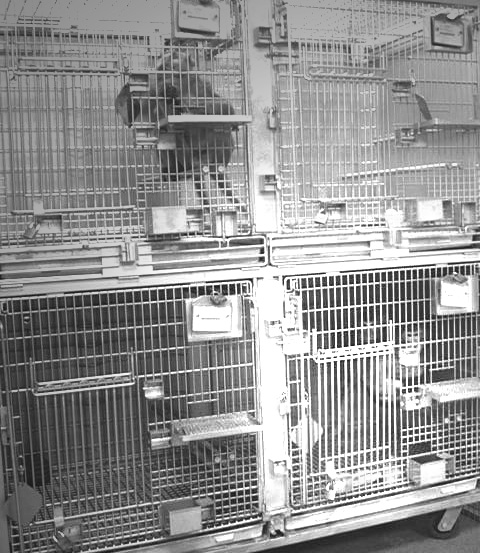
The monkeys are kept in rooms at 75º F. (± 2º), with relative humidity at 55% (± 5%), and a 12:12 light/dark cycle. They are fed twice a day (morning and afternoon) with commercial dry food; have ad libitum access to water; and are given fruit and/or treats five days/week. Their individual caging consists of four compartmentalized (two over two) units (Figure 1) equipped with perches. Each cage is 32” high, with 4.5 sq-ft of floor space. Removable mesh panels separate the compartments. These dividers allow visual and olfactory - but restrict tactile - communication between animals that are housed side-by-side. Between the upper two and lower cages solid dividers, provide privacy and also keep top-housed animals’ shavings, feces, and urine away from the bottom cages.
Figure 1: Four-compartment standard housing unit containing two pairs of M. fascicularis (top two on center perch and bottom two in right lower cage).
For standard environmental enrichment each animal is provided with a hanging mirror and one hard (dental or nylabone) and one soft (Kong or disc-shaped) floor toy. A food treat of fruit, flavored ice cubes, peanuts, or granola forage, is provided every day except weekends. All animals have visual, auditory, and olfactory communication with other monkeys within the room.
Procedures
Documentation: Each animal’s individual record contains a behavioral section with two forms referring to the pairing process: one to record observations on the animal’s behaviors during pairing, and the other a record of any previous pairings. The latter includes dates of pairings, outcome (successful or unsuccessful), possible reasons for unsuccessful pairings, and recommendations for future pairings. For example, a younger animal may not get along with adult individuals due to intimidation. An attempt is made to locate a comparably aged animal for the next pairing. A notation of “not a good pairing candidate” is listed in the file of any animal that fails to be paired with three different animals, along with the reasons, if known, for the failures.
Additional documentation includes separate listings of paired or singly-housed monkeys. By keeping separate summary sheets and distributing them to all staff members, everyone has up-to-date accounts of each animal’s housing situation. Keeping a copy of the pairing sheet outside every monkey room minimizes the possibility of animals that are no longer compatible being placed together; or compatible animals being separated for an extended time. Changes in these listings are the responsibility of the behaviorist (currently, the author).
Prior to pairing monkeys: With slight modifications, the process published by Reinhardt (1994) has been adopted for pair-housing cynos at this facility. The modifications include a less random approach (see below) to choosing candidates and a less rigid, slightly different definition of the macaques’ exhibition of a dominant/subordinate relationship. For instance, ideally, a newly formed pair would demonstrate grooming as an indicator of cementing their bond. But, to this author, once the animals display some other affiliative behaviors (such as perch sharing, cage sharing, comfortably consuming food and treats in company with the other, and teamwork - responding to the other’s solicitation of support in agonistic behaviors directed to humans or other monkeys), they may be suitable as a pair with restrictions (see Crockett et al., 1994, for definitions of types of pairs).
Variables to be considered:
1) Animal’s age, personality (i.e. withdrawn, active), gender, and social origin/experience (Novak & Suomi, 1988). Because an individual’s age and social history (experience) are rarely provided in the written record, it is necessary to “piece” together or extract as much information as possible from various entries. The age may be approximated by an animal’s size and/or more reliably by its dentition. If possible, candidates for pairing should have similar social backgrounds.
2) Animal’s location within its homeroom. The author prefers to pair monkeys who are not housed right next to one another or who have had no visual access (e.g., across the room) to each other for an extended period of time. This is because a relationship established in this housing situation may not transfer to being good cage mates.
3) The needs of the investigators to whom the animal is assigned. If possible, animals assigned to the same person and on the same protocol schedule/regime are paired. Ideally, the animals are paired prior to the commencement of any procedures. This allows the animals time to adjust, and the pairing procedure does not interfere with the investigator’s or staff’s work requirements.
4) Workload of the husbandry (caretaking) staff. Time must be allowed for them to move the animals into the “howdy” or side-by-side caging prior to pairing. This move is done towards the end of the week, on a Thursday or Friday. No pairings are scheduled during weeks when holidays or long weekends occur.
Four animals (two potential pairs) are placed in neutral (not the home cage of any individual) side-by-side caging with mesh panels separating them. This allows visual and auditory, but no tactile, communication (the noncontact familiarization period). The quad cage containing the four animals is placed in a room other than the animals’ homeroom. This neutral room should also contain other monkeys (paired or singly-housed). The “howdy” quad containing the potential pairs is located at the back of the room and turned to face the wall. This placement restricts the monkeys’ visual contact with other monkeys housed in the room, but does allow auditory and olfactory communication. For the next three to five days, behavioral observations are recorded, including any dominant/subordinate, affiliative, or aggressive interactions between members of potential pairs. Some behaviors that indicate pairing may proceed are: one or both animals spending time near the cage divider watching the potential cage mate (showing interest); or mimicking - e.g., picking up an enrichment device after the other animal does so. Behaviors which indicate a pairing should not proceed include: two animals sitting near the cage divider and exhibiting aggression (open-mouth threats or attempts to grab the potential cage mate); or one animal staying at the back of its cage, appearing fearful to approach or interact with the other.
During pairing:
1) Pairing begins early in the day to allow for maximum observation time. The animals are fed their regular chow allotment and given extra floor toys. Just prior to actual pairing both animals are given an extra food treat.
2) If the observer deems the animals’ behavior appropriate, i.e., there is no aggressive activity, then the divider between the monkeys is partially opened. This final stage of the pairing process is closely monitored and the animals’ behavior is recorded for the next four hours. This vigilance has contributed to a low frequency of injuries during this crucial stage. In the last 2.5 years only six of nearly three hundred animals have sustained injuries that required veterinary care during this period.
3) Some behaviors indicating a successful match include: perch sharing, cage sharing, comfort in acquiring and eating food, grooming, and demonstration of “team” types of behaviors: the two animals in tandem exhibit cooperative behaviors, i.e., defensive vocalizations and/or postures, either toward the observer or toward other monkeys in the room when visual contact is restored.
4) If the two monkeys exhibit most of the positive behaviors above, then they are allowed to stay together the first night. If none of the above behaviors are observed, then they are separated (the panel is re-inserted between their cages) for the first night and the pairing process continues the next day. After two days, a successful pair is returned to their homeroom in a quad placed at the rear of the room; any unsuccessful pairs are returned to their original homeroom, but in a single-cage and preferably not in the vicinity of the individual with whom the pairing failed.
Post-pairing:
1) Successful pairs’ IDs are placed on the summary pairs’ list and a completed observational form is added to each of their individual permanent files. The animals are monitored daily by husbandry and behavioral staff. Any problems with food consumption, aggression, etc., are listed on the summary pairs’ list. If one animal is intimidating the other, e.g., during feedings or treat distribution, a special color-coded tag is placed on their cages. The situation is noted on the pairs list and the tag indicates that the animals are to be separated by temporarily inserting the mesh panel between the cage halves during feeding or treat distribution. If a problem escalates, e.g., an animal is not receiving required food or severe fighting ensues, the pair is permanently separated. This is noted in their respective permanent records and their IDs are removed from the summary pairs’ list.
2) An individual animal is provided the opportunity to pair with up to three different animals. If the three attempts are all unsuccessful, a notation is made on the singly-housed list: “not a good social candidate”.
Discussion
Over one hundred and fifty pairings have been made at this facility in the last 2.5 years. This reflects the changing population of monkeys. A summary of the current population and their housing situations is presented in Table 1. These numbers reflect a paired population of nearly 68% of the total (90 out of 136) cynos housed on site. As mentioned earlier, one contributing factor to this success is the constant observation for the first four hours by a person trained and familiar with macaque behavior. Such vigilance has led to a low frequency of animals requiring veterinary care during this stage of the pairing process (only six of nearly 300 monkeys).
The observations and monitoring continue for two weeks after pairing. While only six animals have required veterinary care during the actual pairing process, there have been an additional seven animals that have sustained injuries during the first two weeks of pairing. Of these seven, five were re-paired successfully with their cagemates and no additional injuries occurred.
The day-to-day maintenance of an isosexual colony of paired male cynos is based on:
a) Thorough documentation and methods to ensure that animals are re-paired after any veterinary or scientific procedures. Communication between behavioral, husbandry, management, and research staff is crucial for such a socialization program to succeed.
b) Any modifications and/or adjustments to the pairing of monkeys are clearly disseminated to all pertinent staff members. This includes, for example, placing colored tags on the cages indicating that animals need to be separated for treats and/or food items; as well as different colored tags placed by research staff to indicate that an animal’s temporary separation from a cagemate is due to a scientific procedure (e.g., fasting).
| Number of Pairs | Type of Pair | Age Class at pairing | Time Together | Notes |
| 2 | female | adult | 15 months | none |
| 6 | cross-aged male | adult/sub-adult or juvenile | range: 3-17 mo.; mean: 13 mo. | Two pairs separated for food/treats |
| 5 | male | subadult or juvenile | range: 4-15 mo.; mean: 11 mo. | none |
| 31 | male | adult | range: 1 mo. to 3 yr; mean: 17 mo. | Seven pairs separated for food/treats |
Table 1: Histories and demographies of paired M. fascicularis. Of the 31 adult male pairs, two pairs are temporarily separated for medical reasons (one animal in each pair sustained injuries during minor fighting). Attempts to re-pair will occur in the near future.
References
Animal Welfare Act Amendments, Pub. 1l, No. 99-198 (1985).
Animal Welfare Act - Final Rule: Animal Welfare; Standards; Part 3. (1991). Federal Register, 55[32], 6426-6505.
Asvestas, C., & Reininger, M. (1999). Forming a bachelor group of long-tailed macaques (Macaca fascicularis). Laboratory Primate Newsletter, 38[3], 14-15.
Crockett, C. M., Koberstein, D., & Heffernan, K. S. (2001). Compatibility of laboratory monkeys housed in grooming-contact cages varies by species and sex (abstract). American Journal of Primatology, 54[Supp. 1], 51-52.
Crockett, C. M., Bowers, C. L., Bowden, D. M., & Sackett, G. P. (1994). Sex differences in compatibility of pair-housed adult longtailed macaques. American Journal of Primatology, 32, 73-94.
Clarke, M. R., Kaplan, J. R., Bumsted, P. T., & Koritnik, D. R. (1986). Social dominance and serum testosterone concentration in dyads of male Macaca fascicularis. Journal of Medical Primatology, 15, 419-432.
Clarke, A. S., Czekala, N. M., & Lindburg, D. G. (1995). Behavioral and adrenocortical responses of male cynomolgus and lion-tailed macaques to social stimulation and group formation. Primates, 36, 41-56.
Goosen, C., Van Der Gulden, W., Rozemond, H., Balner, H., Bertens, A., Boot, R., Brinkert, J., Dienske, H., Janssen, G., Lammers, A., & Timmermans, P. (1984). Recommendation for the housing of macaque monkeys. Laboratory Animals, 18, 99-102.
Hartner, M., Hall, J., Penderghest, J., & Clark, L. (2001) Group-housing subadult male cynomolgus macaques in a pharmaceutical environment. Lab Animal, 30[8], 53-57.
Line, S. W., Morgan, K. N., Markowitz, H., Roberts, J. A., & Riddell, M. (1990). Behavioral responses of female long-tailed macaques (Macaca fascicularis) to pair formation. Laboratory Primate Newsletter, 29[4], 2-5.
Lynch, R. (1998) Successful pair-housing of male macaques (Macaca fascicularis). Laboratory Primate Newsletter, 37[1], 7-9.
Novak, M., & Suomi, S. (1988). Psychological well-being of primates in captivity. American Psychologist, 43, 765-773.
Reinhardt, V. (1994). Pair-housing rather than single-housing for laboratory rhesus macaques. Journal of Medical Primatology, 23, 426-431.
Schino, G., Maestripieri, K., Schucchi, S., & Turillazzi, P. G. (1990). Social tension in familiar and unfamiliar pairs of long-tailed macaques. Behaviour, 113, 264-272.
Seelig, D. (1998) Pair-housing male macaca fascicularis: A summary. Laboratory Primate Newsletter, 37[3], 20-22.
Van Noordwijk, M., & Van Schaik, C. P. (1985). Male migration and rank acquisition in wild long-tailed macaques (Macaca fascicularis). Animal Behaviour, 33, 849-861.
Wheatley, B. P. (1982). Adult male replacement in Macaca fascicularis of East Kalimantan, Indonesia. International Journal of Primatology, 3, 203-219.
----------
Author’s address: Dr. Lyna M. Watson, Genetics Institute, Bioresources Dept., Bldg G., One Burtt Rd., Andover, MA 01810 [e-mail: [email protected]].
I would like to thank Dr. Karen Krueger and the Operations and Clinical staffs for their assistance.
----------
* * *
Announcements from Publications
CIRES Journals Information on the Web
The Center for Investigation and Reproduction of Wildlife Species [Centro de Investigación y Reproducción de Especies Silvestres] (CIRES) is posting the titles and abstracts of articles published in their journals Zoocriaderos and Revista de Ecología Latinoamericana at <www.ciens.ula.ve/~cires/>. To receive complete copies of articles, in pdf format, contact the Editor, Héctor Aguilar [e-mail: [email protected]].
New Online Journal of Ecology
BMC Ecology covers environmental and population ecology of plants, animals, and microbes. The journal is published by BioMed Central, a recently established online publishing house, committed to making original research articles in biological and medical science freely available. Instructions for paper submission are at <www.biomedcentral.com/manuscript/checklist.asp>. Some recently published research articles: <www.biomedcentral.com/biology.asp>. For more information contact Peter Newmark [e-mail: [email protected]]. For updates on research, reviews, and editorials published by BioMed Central, register at: <www.biomedcentral.com/registration/>.
Evolution of Communication
Evolution of Communication, a broadly conceived journal providing an interdisciplinary forum for fields sharing an interest in communication, including evolutionary biology, behavioral ecology, animal behavior, primatology, artificial intelligence, linguistics, cognitive science, neuroscience, social and developmental psychology, and cultural and biological anthropology, invites contributions, which may be sent, in triplicate, to Harold Gouzoules, Dept of Psychology, 532 Kilgo Circle, Emory Univ., Atlanta, GA 30322. For more information, see <www.emory.edu/COLLEGE/CULPEPER/GOUZOULES/harold/eoc.html>.
* * *
Mantled Howlers Cause a Decrease in Distance Between Members of a Group of Rufous-Naped Tamarins: A Field Experiment
Dennis R. Rasmussen, Iris Broekema, Bridget L. Chapin, and Caryn M. Chambers
The Primate Foundation of Panama
The purpose of this experimental study was to learn how the presence of mantled howler monkeys (Alouatta palliata) might influence a group of rufous-naped tamarins (Saguinus geoffroyi). Two howler monkeys were introduced onto an island where a group of five tamarins lived. Howler monkeys and tamarins are sympatric in many locations in Panama (Moynihan, 1970). We have also frequently observed howlers and tamarins close to each other on islands where they live together at the Primate Refuge and Sanctuary of Panama (PRSP). Systematic study of an introduction of these two species to each other should help guide management of groups of tamarins and howler monkeys that live in the same area and hence be useful to the PRSP and other refuges and zoological parks. The study also has bearing on evolutionary theories concerning the formation of more compact groups in the presence of danger, interspecies interactions, mixed-species associations, and social ecology.
Howlers and tamarins have not been observed to form mixed-species associations in completely natural environments. We have, however, observed howlers following tamarins at the PRSP. We have also seen an adult female howler monkey carry, sit next to, and be followed by an orphaned juvenile tamarin for weeks. In addition, placing the two species together on a small island forces them into proximity similar to that of natural mixed-species associations.
Mixed-species associations occur between many forest primates. Some associations are notable for their long-term stability (Buchanan-Smith, 1990) and some seem to occur more often than could be expected by chance (Holenweg et al., 1996). Mixed-species groups have the advantages of decreased risk of predation (Noë & Bshary, 1997; Chapman & Chapman, 2000), improved foraging success (Buchanan-Smith, 1999), and improved resource defense (Buchanan-Smith, 1991). Costs of mixed-species group formation are thought to be very low: mainly feeding competition (Terborgh, 1983) and the energy involved in maintaining association, e.g. calling when separated and choosing sleeping sites relatively near each other (reviewed in Heymann and Buchanan-Smith, 2000; see p. 185).
The portion of the multivariate study reported here is focused on how the presence of the howler monkeys influenced the spatial compactness, or group spread, of the tamarins. There are several ways in which the presence of the howlers might do this.
Because the howlers were about four times heavier than the tamarins (2000 grams compared to about 530 grams; see Rasmussen, 1989) and the tamarins had no previous experience in interacting with these two howlers, it is likely that the tamarins would initially react to them as a threat. Humans (Brigham, 1991), nonhuman primates (Rasmussen, 1983), and other animals (Hamilton, 1971) have been noted to bunch together when threatened or when confronted with a potentially dangerous situation. Williams provided an evolutionary theory to explain this pattern in fishes (1964), and Hamilton expanded and extended this theory to all animals (1971): by increasing proximity to conspecifics, an individual decreases the likelihood that it will be selected as the target of a predator. This theory may be broadened to nonpredators that could inflict damage. There are other evolutionary advantages of increased proximity in the face of a threat, such as exchange of information and group defense (Kummer, 1971).
Another way in which the howlers might influence group spread is by causing the tamarins to move more frequently. Mixed-species associations have been found to travel more than single species groups (Holenweg et al., 1996, Chapman and Chapman, 2000). Tamarin groups may become more compact when moving, hence howlers might cause a tamarin group to move more and thus have less group spread.
There are numerous observational and correlative studies showing that primates bunch together when faced with a potential danger (Altmann, 1974; Rasmussen, 1983). However, we found only one experiment on nonhuman primates that shows a causal relationship between the presence of a potential threat, a conspecific group, and decreased distance between group members (Zinner et al., 2001). We have found no previous study exploring the effect of a different species on intragroup spacing in nonhuman primates.
We used an experimental design from the experimental analysis of behavior, an A-B-A-B reversal design (Baer, Wolf & Risley, 1968), to determine whether the presence of the howlers would decrease the spread of individuals in a group of tamarins. We feel this approach holds considerable potential for field experiments conducted on nonhuman primates.
Methods
Experimental Design: The dependent variable was the estimated spread of a group of five tamarins. The maximum distance between any two group members was the measure used to assess group spread. Since group spread is a function of the movements of all individuals in the group, there was a single unit of analysis, the group of tamarins. The independent variable was the presence or absence of two juvenile howler monkeys.
Data were collected on the tamarin group from dawn to dusk during every condition of the experiment. The first baseline condition, A1, was conducted before the howlers were introduced. For the first experimental condition, B1, the howlers were present. The second baseline, A2, was conducted after the howlers were removed, and the final experimental condition, B2, after the howlers had been reintroduced. Four days of data were collected during each condition. The howler monkeys were placed on the island with the tamarins at 7:00 a.m., a few minutes before data collection on the first day of each experimental condition. The howlers were removed a few minutes before the initiation of data collection on the first day of the second baseline, A2.
Study Area and Study Animals: The group of five tamarins lives on Isla Tigrito II in Gatun Lake, Republic of Panama. This 2441 sq-m island is 117 m in length and varies from 10 to 35 m in width. It is located about 45 m off the northwest shore of Isla Tigre in the Tigre Islands near the Atlantic entrance to the Panama Canal (see <www.primatesofpanama.org/lakemap.htm>). The vegetation is secondary neotropical forest, about 60 years old. Fruit bushes and trees provide food for the tamarins and howlers. In addition, the tamarins frequently catch insects and other arthropods, and the howlers eat the leaves of several species of trees. The food available on the island was supplemented with seven bananas every morning during the baseline conditions and, when the howlers were present, 14 bananas. The bananas were cut into 3-4 cm cross-sections. During all conditions there were always a few pieces of banana left at the end of the day. Bananas were placed on a wire mesh screen about 40 by 40 sq-cm and mounted 1.5 m above the ground in a tree with many aerial pathways to other trees.
The tamarin group consisted of an adult female, estimated to be less than 3 years old when introduced onto Isla Tigrito II on November 12, 1999; an adult male, introduced onto the island on November 14, 1999, when he was 13 months old; and three juvenile males, twins aged 13 months, and another aged 4 months. All three juveniles were the surviving offspring of the two adults.
We have never observed a howler to cause physical damage to a tamarin or vice versa. We used two juvenile howler monkeys that lived with another group of tamarins on Isla Tigrito I as the individuals to be introduced to the study group of tamarins. These howlers were known to be gentle with tamarins and were selected for this reason. The two howlers were unknown to the subjects in this experiment, and the tamarins had not had contact with other howlers for 9 months before the onset of the experiment. The howler monkeys were estimated to be 9 months old.
A group of four howler monkeys had lived on Isla Tigrito II from November 6, 1999 until September 22, 2000. The adult female and male tamarins of our study group had lived with them for 11 months, and the twins had lived with this group for the first four months of their lives. The youngest juvenile tamarin had never been with howlers before our study. The howlers that were introduced during the first experimental phase had never been with the tamarins on Isla Tigrito II.
The tamarins and the howlers were habituated to the presence of observers. The tamarins were subjects of a study of over one year duration and were also the subjects of a three-month study. Animal caretakers have visited the island to provide food every day from the first day that the tamarins were placed on the island. Observers could approach as close as 10 m to the tamarins before the tamarins moved away.
The male howler had been hand raised and bottle fed for four months. The female had been hand raised for one month. They had been released and were free ranging for two months on a nearby island before the onset of this study. They appeared to relish the return to their natural habitat and did not come closer than 10 m to observers or their previous handler. They were coaxed out of trees into the arms of their former caretaker with enticing food items. Once in her arms they were transported to Isla Tigrito II for each of the experimental phases.
Sampling Methods: Three teams of four students collected the data. Team members practiced data collection and were lectured on methods during an intensive three-day training period before the initiation of data collection. An experienced observer worked with the observation teams and monitored their data collection every day.
The first team collected data from 7:00 AM until 10:40 AM, the second from 10:40 AM till 2:20 PM, and the third team from 2:20 PM until 5:40 PM. The observation teams were moved to the previous shift each day so the teams collected data during a different shift for three sequential days. Recording sessions were broken up into 30-min sessions on focal subjects. Focal subjects were systematically sampled from a list of the five group members. Each of the five tamarins was focal sampled during every shift and the following shift picked up with the next tamarin on the list. Each tamarin was sampled at different times during every shift and every day. A mean of 50.06 2-min samples were collected on each tamarin per day (3.4 30-min sampling sessions per tamarin per day).
One team member observed the focal subject. Two other team members kept track of the distance separating the tamarins that were farthest apart and the location of the howler monkeys. The fourth team member entered the data into a laptop computer. The computer operator also called out two-minute intervals (audibly cued by the computer) to other team members.
The distance between the two tamarins that were farthest apart, estimated to the nearest meter, was used to assess group spread. Instantaneous samples were taken on group spread once every 2 min during the 30-min sessions. If all group members’ locations were not known at the moment of the instantaneous sample, no estimate was made. Instantaneous 2 min samples were also collected on the distance between the focal subject and the closest howler monkey. Six hundred and thirty-three group spread estimates were made during A1, 668 during B1, 821 during A2 and 786 during B2.
Observers kept 10 to 20 m away from the tamarins, and did not touch the tamarins or the howlers. Numbered aluminum posts about 1 m tall were placed in a straight centered line along the length of the island at 10-m intervals, promoting accuracy in distance estimates. In addition a wire was hung vertically in a visible central location on the island with ribbons tied at 2-meter intervals. This promoted accuracy in assessment of height differences. A 5 m by 5 m quadrat system was imposed on a map of the island. This map, in conjunction with the visual markers, further helped observers to accurately estimate distances.
Data were uploaded from the laptop to a desktop computer for editing within 24 hours of collection. The SPSS (10.0.7) statistical software system was used for file management, data description, and analysis.
Results
Statistical Analyses: The focus of this study is a single measure, group spread. This analysis is therefore treated as a repeated-measure study conducted on a single entity. As in classic applied behavioral analysis, we therefore use only descriptive statistics and graphical analyses. There is a long and complex history in the philosophy of science focused on single subjects that goes far beyond the scope of this article (see Iwata et al., 2000, for detailed discussions). We therefore note briefly that the goal of experiments is to prove cause and that the A-B-A-B single subject design used here can show that systematic manipulation of the experimental variable has a causal influence on the dependent variable.
Observer Effects: Although the tamarins were habituated to the presence of observers, they had not previously been observed by teams of four observers. Monkeys who have been observed for years may still become more habituated (Rasmussen, 1991). In addition, observers do change in their ability to collect data and can drift in data collection techniques (Martin & Bateson, 1993). Both observer effects on tamarins and changes in observers might therefore influence estimated group spread. To check these possibilities we examined the correlation between mean group spread per day and the cumulative number of days the tamarins were observed, hereafter referred to as number of observation days. Number of observation days seems likely to be sensitive to both increased habituation of the tamarins to the observers across the study (Rasmussen, 1979, 1991) and changes in the way in which observers collected data. A moderate positive correlation was found between group spread and cumulative days observed (r=. 34). If the tamarins became less afraid of the observers, they may have become less spatially compact as the study progressed. Observation teams may also have improved at having all tamarins in view so they could estimate group spread. This latter possibility is supported by a positive correlation between number of samples collected per day and number of observation days (r=+. 64).
Habituation and observer effects were statistically controlled by regression of mean group spread per day on number of observation days. The standardized residuals from this regression are the daily variation in group spread after removal of linear effects of number of observation days.
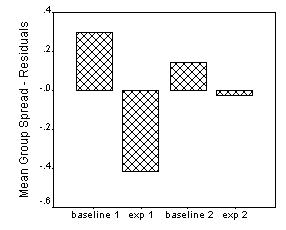
Effects of Howler Presence on Group Spread: The mean values of the standardized residuals of the regression of group spread on number of observation days are presented in Table 1. When these values are graphed in Figure 1 it is apparent that (1) group spread tended to be less when the howlers were present and (2) the difference between presence and absence of howlers decreased in A2-B2 compared to A1-B1.
| Condition of Experiment | Mean | Standard Deviation |
| baseline 1 (A1) | .2993 | .5250 |
| exp 1 (B1) | -.4115 | 1.1850 |
| baseline 2 (A2) | .1421 | 1.3909 |
| exp 2 (B2) | .0025 | .8218 |
Table 1: Mean and standard deviation of residualized group spread per condition of the experiment.
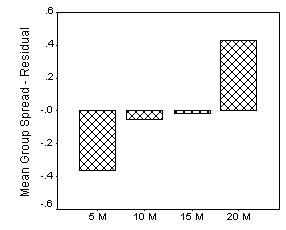
If the howlers were the causal factor responsible for changes in group spread, then it might be anticipated that the closer the howlers were to the tamarins, the smaller would be their group spread. To check this possibility, distances of howlers from focal subjects were grouped into four categories: 0-5m, 5-10m, 10-15m, and 15-20m. The residuals from the regression of group spread on number of observation days were again used in this analysis. As may be seen in Figure 2, tamarin group spread was negatively related to howler distance: the closer the howlers were, the less spread was the group.
Figure 1: Mean residualized group spread per experimental condition.
Figure 2: Mean residualized group spread by distance of the nearest howler from the focal tamarin.
Discussion
The results of this experiment indicate that the presence of howlers caused a decrease in the group spread of the tamarin group. The results also indicate that this effect decreased from the first to the second experimental condition. A theoretically satisfying explanation for these effects is that the tamarins initially perceived the howlers as a danger but they became more habituated to them, as they do to human observers. This explanation is satisfying since there is a fully developed theory to account for a decrease in group spread in the face of danger (Hamilton, 1971). Habituation of primates to the presence of other species of primates, human observers, is also well documented (Rasmussen,1998).
Other potential explanations exist. For example the presence of the howlers may have led the tamarins to move more about the island (and vice versa) and this movement caused the group spread to decrease. By the second experimental condition, the presence of howlers might have diminished the abundance of clumped natural food sources forcing the tamarins to spread out more when the howlers were present. Further analyses of the other variables collected in this multivariate experiment may help shed light on the exact causal mechanism(s) responsible for decreased group spread when the howlers were present.
References
Altmann, S. A. (1974). Baboons, space, time, and energy. American Zoologist, 14, 221-248.
Baer, D. M., Wolf, M. M., & Risley, T. R. (1968). Some current dimensions of applied behavior analysis. Journal of Applied Behavior Analysis, 1, 91-97.
Brigham, J. C. (1991). Social Psychology, Second Edition. New York: Harper Collins.
Buchanan-Smith, H. M. (1990). Polyspecific association of two tamarin species, Saguinus labiatus and Saguinus fuscicollis, in Bolivia. American Journal of Primatology, 22, 205-214.
Buchanan-Smith, H. M. (1991). Encounters between neighbouring mixed species groups of tamarins in northern Bolivia. Primate Report, 31, 95-99.
Buchanan-Smith, H. M. (1999). Exploration of unfamiliar areas and detection of potentially threatening objects in single- and mixed-species groups of tamarins. International Journal of Comparative Psychology, 12, 2-20.
Chapman, C. A., & Chapman, L. J. (2000). Interdemic variation in mixed-species association patterns: Common diurnal primates of Kibale National Park, Uganda. Behavioral Ecology and Sociobiology, 47, 129-139.
Hamilton, W. D. (1971). Geometry for the selfish herd. Journal of Theoretical Biology, 31, 295-311.
Heymann, E. W., & Buchanan-Smith, H. M. (2000). The behavioral ecology of mixed-species troops of callitrichine primates. Biological Reviews of the Cambridge Philosophical Society, 75, 169-190.
Holenweg, A. K., Noë, R., & Schabel, M. (1996). Waser’s gas model applied to association between red colobus and Diana monkeys in Taï National Park, Ivory Coast. Folia Primatologica, 67, 125-136.
Iwata, B. A., Neef, N. A., Wacker, D. P., Mace, F. C., & Vollmer, T. R. (Eds.). (2000). Methodological and conceptual issues in applied behavior analysis, Second Edition. Kansas: Society for the Experimental Analysis of Behavior, University of Kansas.
Kummer, H. (1971). Primate societies: Group techniques of ecological adaptation. Chicago: Aldine-Atherton.
Martin, P., & Bateson, P. (1993). Measuring behavior: An introductory guide, Second edition. Cambridge: Cambridge University Press.
Moynihan, M. (1970). Some behavior patterns of Platyrrhine monkeys. II. Saguinus geoffroyi and some other tamarins. Smithsonian Contributions to Zoology, 28, 1-60.
Noë, R., & Bshary, R. (1997). The formation of red colobus-diana monkey associations under predation pressure from chimpanzees. Proceedings of the Royal Society of London, 264, 253-259.
Rasmussen, D. R. (1979). Correlates of patterns of range use of a troop of yellow baboons (Papio cynocephalus). I. Sleeping sites, impregnable females, births, and male emigrations and immigrations. Animal Behaviour, 27, 1098-1112.
Rasmussen, D. R. (1983). Correlates of patterns of range use of a troop of yellow baboons (Papio cynocephalus). II. Spatial structure, cover density, food gathering, and individual behavior patterns. Animal Behaviour, 31, 834-856.
Rasmussen, D. R. (1989). Social ecology and conservation of the Panamanian tamarin. Anthroquest, 40, 12-15.
Rasmussen, D. R. (1991). Observer influence on range use of Macaca arctoides after 14 Years of observation? Laboratory Primate Newsletter, 30[3], 6-11.
Rasmussen, D. R. (1998). Changes in range use of Geoffoy’s tamarins (Saguinus geoffroyi) associated with habituation to observers. Folia Primatologica, 69, 153-159.
Terborgh, J. (1983). Five New World primates. Princeton: Princeton University Press.
Williams, G. C. (1964). Measurement of consociation among fishes and comments on the evolution of schooling. Publications of the Museum, Michigan State University, East Lansing, Biological Series, 2, 351-383.
Zinner, D., Hindahl, J., & Kaumanns, W. (2001). Experimental intergroup encounters in lion-tailed macaques (Macaca silenus). Primate Report, 59, 77-92.
----------
The first author is the Director, and the second author the Development Manager of the Primate Refuge and Sanctuary of Panama
----------
* * *
The Research Defence Society in the U.K. has launched a new campaign in support of scientists’ work with animals in biomedical research. A publication, The Hope, The Challenge, The People, explores the issue of animal research through the eyes of six people: a patient, a general practitioner, a surgeon, a researcher, an animal technician, and a veterinarian. It is available as a pdf file at <www.rds-online.org.uk/pdf/leaflet.pdf>. Two subsidiary publications, which will be updated annually, provide facts and figures on animal research in the U.K. and a guide to sources of information. - from an Americans for Medical Progress press release
Used Handheld Computers Available
The Kahn Research Group has four Psion workabout handheld computers loaded with the Noldus Observer Mobile package for sale. The units have less than 30 hours of use each. They were used in an indoor environment for a marketing behavioral research study. These items are basically brand new and come with a charger, a serial sync cable, all observer mobile software, memory cards, and four licenses. For general information about the Observer, see <www.noldus.com>. For more information about these used Psions, contact Benjamin Epstein, Chief Technology Officer, Kahn Research Group, 13809 Cinnabar Pl., Huntersville, NC 28037 [704.947.9299; fax: 775.227.0524; e-mail: [email protected]].
New Edition of Comfortable Quarters
A new edition of Comfortable Quarters for Laboratory Animals, edited by V. and A. Reinhardt, is available at: <www.awionline.org/pubs/cq02/cqindex.html>. Contents include “The ill-effects of uncomfortable quarters”, by W. M. S. Russell; and “Comfortable quarters for primates in research institutions”, by V. Reinhardt.
* * *
* Duke University, Department of Biological Anthropology and Anatomy
England
* University of Liverpool Hominid Palaeontology Research Group (Department of Human Anatomy and Cell Biology) and School of Archaeology, Classics and Oriental Studies (Department of Archaeology)
* * *
The National Institute of Arthritis and Musculoskeletal and Skin Diseases (NIAMS) is seeking small grant (R03) applications to stimulate and facilitate the entry of promising new investigators into areas of research of interest to the NIAMS, that is, arthritis and musculoskeletal and skin diseases and injuries. This solicitation will provide support for pilot research that is likely to lead to a subsequent individual research project grant (R01). Foreign organizations and institutions are not eligible. Participation in the program by investigators at minority-serving institutions is strongly encouraged. Grants awarded through this program may not be used to support thesis or dissertation research. Investigators who have questions about eligibility should contact one of the program officials listed below. For detailed information about scientific areas of interest to the NIAMS, applicants are encouraged to refer to <www.niams.nih.gov>.
Direct inquiries as follows: Rheumatic Diseases: Immunology and Inflammation: Elizabeth Gretz, Rm. 5A19J [301-594-5032; fax: 301-480-4543; e-mail: [email protected]]; Cartilage and Connective Tissue: Bernadette Tyree, Rm 5AS-37J0 [301-594-5032; fax: 301-594-4543; e-mail: [email protected]]; Behavioral and Prevention Research: Deborah Ader, Rm. 5A19H [301-594-5032; fax: 301-480-4543; e-mail: [email protected]]; Genetics and Clinical Trials: Susana A. Serrate-Sztein, Rm 5AS-37G [301-594-5032; fax: 301-480-4543; e-mail: [email protected]]; Muscle Biology: Richard W. Lymn, Rm 5AS-49E [301-594-5128; fax: 301-480-4543; e-mail: [email protected]]; Musculoskeletal Diseases: Osteoarthritis Initiative and Diagnostic Imaging: Gayle E. Lester, Rm 5AS-43C [301-594-5055; fax: 301-480-4543; e-mail: [email protected]]; Orthopedics and Bioengineering: James S. Panagis, Rm 5AS-37K [301-594-5055; fax: 301-594-4543; e-mail: [email protected]]; Bone Biology: William J. Sharrock, Rm 5AS-37A [301-594-5055; fax: 301-480-4543; e-mail: [email protected]]; Bone Diseases: Joan McGowan, Musculoskeletal Diseases Branch, Rm 5AS-43E [301-594-5055; fax: 301-480-4543; e-mail: [email protected]]; and Skin Diseases: Alan N. Moshell, Rm 5AS-25L [301-594-5017; fax: 301-480-4543; e-mail: [email protected]]. All addresses are at 45 Center Dr., Bethesda, MD 20892-6500. Application receipt dates will be June 21 and October 18, 2002; February 21, June 20, and October 17, 2003.
NIAMS Career Transition Award
The goals of the National Institute of Arthritis and Musculoskeletal and Skin Diseases (NIAMS) Career Transition Award program are to enable outstanding individuals to obtain a research training experience in the NIAMS Intramural Research Program and to facilitate their successful transition to an extramural environment as independent researchers. The award will provide two to three years of support for research training in a NIAMS intramural laboratory followed by two to three years of support for an independent research project in an extramural institution. It is anticipated that awardees will subsequently obtain research project grants to support the continuation of their work.
The Intramural Research Program at NIAMS conducts basic, translational, and clinical research. Intramural investigators pursue diverse projects in biomedical research ranging from fundamental analyses of protein structure and function involving crystallography, cryoelectron microscopy, and atomic force microscopy, through protein chemistry, cell biology, signal transduction, gene regulation, tissue development and differentiation, genetics, and immunology, to more directly applicable research on the genetics, etiology, pathogenesis, and treatment of a variety of rheumatic, autoimmune, inflammatory, joint, skin, and muscle diseases. Information about potential intramural mentors can be obtained at: <www.niams.nih.gov/rtbc/index.htm>. For details about the Career Transition Award program, see <grants.nih.gov/grants/guide/pa-files/PAR-02-056.html>.
Tolerance for Heart and Lung Transplantation
The National Heart, Lung, and Blood Institute (NHLBI) <www.nhlbi.nih.gov> encourages submission of applications for the development of organ-specific tolerance protocols using * large animal models for heart transplantation, and * both large and small animal models for lung transplantation. The long-range goal is to provide animal models that may be used for preclinical studies of immune tolerance induction, specifically in heart or lung studies, and improve the long-term quality of life and survival of recipients of heart and lung transplants.
In rodent models, numerous strategies have been used successfully to induce tolerance to heart transplantation. However, these strategies have not been reproducible for heart transplantation in large animal models, such as nonhuman primates or miniature swine. Although the rodent is an economical model for identifying strategies of tolerance induction, its immune system may be too different from that of the human to serve as a pre-clinical model. Ethical considerations require a more suitable pre-clinical model to more accurately predict how the protocol will work in humans. Thus, a large animal model, with an immune system more reflective of the human immune system, is essential for testing heart and lung tolerance protocols before moving into clinical studies. The primary focus for immune tolerance in lung transplantation at present, however, is to develop protocols in small animal models that can be moved into large animals.
This announcement seeks to encourage multidisciplinary research that will focus on elucidating methods and mechanisms of antigen-specific tolerance induction and maintenance in clinically relevant animal transplant models. Specific examples of areas of research interest may include, but are not restricted to, the following: * Definition and manipulation of specific immune pathways involved in the induction and maintenance of antigen-specific tolerance, including: co-stimulatory pathways, cytokine modulation, the role of adhesion molecules, and leukocyte migration. * Identification of allo-reactive lymphocyte subsets and their correlation with functions such as inflammation, homing and migration. * Determination and validation of biomarkers of antigen-specific immune tolerance. * Studies of the genetics of tolerance induction and long-term maintenance of tolerance. * Elucidation of the molecular, biochemical and cellular mechanisms involved in the loss of antigen-specific tolerance. * Use of very young animals to determine whether it is easier to induce tolerance in a young animal before the immune system is mature.
Direct questions about scientific/research issues to: Judith Massicot-Fisher, Division of Heart and Vascular Disease, NHLBI, Rockledge II, Rm 9184, Bethesda, MD 20892-7940 [301-435-0528; fax: 302-480-1454; e-mail: [email protected]]; or Dorothy Gail, Lung Biology and Diseases Program, Division of Lung Diseases, NHLBI, Rockledge II, Rm 10100, Bethesda, MD 20892-7952 [301-435-0222; fax: 301-480-3557; e-mail: [email protected]].
NIA Pilot Research Grant Program
The National Institute on Aging (NIA) is seeking small grant applications in specific areas to: * stimulate and facilitate the entry of promising new investigators into aging research, and * encourage established investigators to enter new targeted, high priority areas in this research field. This Small Grant Program provides support for pilot research that is likely to lead to a subsequent individual research project grant that is focused on aging and/or a significant advancement of aging research.
The 24 objectives listed in the announcement (see <grants.nih.gov/grants/guide/pa-files/PAR-02-049.html>) are grouped under * Improve Health and Quality of Life of Older People * Understand Healthy Aging Processes * Reduce Health Disparities Among Older Persons and Populations * and Enhance Resources to Support High Quality Research. One objective in the last category is: “Development of new and informative animal models for aging research, including genetically defined and or genetically altered animals.” The National Institute on Aging will modify the selected topic areas annually by reissuing the program announcement. Information on other initiatives supported by NIA may be found at <www.nih.gov/nia>. Application receipt dates are March 15, July 15, and November 15, 2002.
Direct questions to: David B. Finkelstein, Biology of Aging Program, NIA, 7201 Wisconsin Ave, Suite 2C231, MSC 9205, Bethesda, MD 20892-9205 [301-496-6402; fax: 301-402-0010; e-mail: [email protected]]; Judy Finkelstein, Neuroscience and Neuropsychology of Aging Program, NIA, 7201 Wisconsin Ave, Suite 3C307, MSC 9205, Bethesda, MD 20892-9205 [301-496-9350; fax: 301-496-1494; e-mail: [email protected]]; or Wanda Solomon, Geriatrics Program, NIA, 7201 Wisconsin Ave, Suite 3E327, MSC 9205, Bethesda, MD 20892-9205 [301-435-3046; fax: 301-402-1784; e-mail: [email protected]].
Links Between Immune System and Brain Function
The National Institute of Mental Health (NIMH), National Institute on Neurological Disorders and Stroke (NINDS), National Institute on Drug Abuse (NIDA), and National Institute of Arthritis and Musculoskeletal and Skin Diseases (NIAMS) request research grant applications to study neuroimmune molecules and mechanisms involved in regulating normal and pathological central nervous system (CNS) function.
Areas of interest include development and extension of animal models of immune signaling in the brain: e.g. * Model chronic therapeutic administration of cytokines as used in chemotherapy to examine the mechanisms responsible for effects on mood and cognition; * Develop and refine models to examine the potential effects of pre- and post-natal infection on brain development and adult brain function and behavior; * Model effects of acute and chronic immune challenge on neuroendocrine systems, neurochemistry, electrophysiology, molecular signaling, and gene expression in neurons; * Model neural effects of autoantibodies and other immune molecules implicated in autoimmune disorders affecting mental health; * Examine the potential role of abnormalities of the blood/brain barrier in determining neuroimmune responses.
NIAMS also solicits applications to study immune-CNS interactions in rheumatic diseases. Research could improve significantly with the development of new techniques and with the development of new animal models to explore the pathogenesis of cognitive and psychiatric disorders in the rheumatic diseases.
Direct questions to: Lois Winsky, Division of Neuroscience and Basic Behavioral Research, NIMH, 6001 Executive Blvd, Rm 7184, MSC 9641, Bethesda, MD 20892-9641 [301-443-5288; fax: 301-402-4740; e-mail: [email protected]]; Ursula Utz, Program Director, Neural Environment, NINDS, 6001 Executive Blvd, Rm 2134, Bethesda, MD 20892-9521 [301-496-1431; fax: 301-480-2424; e-mail: [email protected]]; Charles Sharp, Division of Neuroscience and Behavior Research, NIDA, 6001 Executive Blvd, Room 4269, Bethesda, MD 20892 [301-435-1887; fax: 301-594-6043; e-mail: [email protected]]; or Deborah N. Ader, Director, Behavioral and Prevention Research Program, NIAMS, 45 Center Dr., Bldg 45, Rm 5A19H, Bethesda, MD 20892-6500 [301-594-5032; fax: 301-480-4543; e-mail: [email protected]].
Applications will be accepted up to the standard application deadlines, which are available at <grants.nih.gov/grants/dates.htm>.
Innovation Grants for AIDS Research
The National Institutes of Allergy and Infectious Diseases (NIAID), Biomedical Imaging and Bioengineering (NIBIB), Child Health and Human Development (NICHD), Dental and Craniofacial Research (NIDCR), Diabetes and Digestive and Kidney Diseases (NIDDK), and Mental Health (NIMH), encourage the submission of applications to bring new, scientifically challenging and untested ideas into AIDS research.
The sponsoring NIH institutes are seeking applications in the areas of therapeutics discovery, microbicide discovery, and pathogenesis research. Direct inquiries regarding programmatic issues to: Carl W. Dieffenbach, NIAID, Rm 4133, MSC-7626, 6700-B Rockledge Dr., Bethesda, MD 20892-7626 [301-496-0637; fax: 301-402-3211; e-mail: [email protected]]; Joan Harmon, NIBIB, 31 Center Dr., Rm 1B37, MSC 2077, Bethesda, MD 20892-2077 [301-451-6772; fax: 301-480-4515; e-mail: [email protected]]; Robert Nugent, NICHD, Rm 4B11C, MSC-7510, 6100 Executive Blvd., Bethesda, MD 20892-7510 [301-435-6871; fax: 301-496-8678; e-mail: [email protected]]; Dennis Mangan, NIDCR, Rm 4AN-32F, MSC-6402, 45 Center Dr., Bethesda, MD 20892-6402 [301-594-2421; fax: 301-480-8318; e-mail: [email protected]]; Frank A. Hamilton, M.D., NIDDK, Democracy 2, Rm 669, MSC-5450, 6707 Democracy Blvd., Bethesda, MD 20892-5450 [301-594-8877; fax: 301-480-8300; e-mail: [email protected]]; or Dianne M. Rausch, NIMH, 6001 Executive Blvd, Rm 6212, MSC 9619, Bethesda, MD 20892-9619 [301-443-7281; fax: 301-443-9719; e-mail: [email protected]]. Applications will be accepted at the standard application deadlines; see above.
Fogarty International Research Collaboration Award
The Fogarty International Research Collaboration Award (FIRCA) facilitates collaborative research between U.S. biomedical scientists supported by the National Institutes of Health (NIH) and investigators in the developing countries of Africa, Asia, Latin America, and the Caribbean region, as well as in countries of the former Soviet Union, and in central and eastern Europe. The FIRCA will extend and enhance the research interests of both the U.S. scientist and the collaborating scientist, and will help to increase the research capacity of the foreign scientist and institution. Awards are made to the U.S. applicant institution to support a collaborative research project that will be carried out mainly at the foreign collaborator’s research site. Direct costs of $32,000 per year are available for up to three years to help cover purchase of supplies and equipment, technical assistance at the foreign collaborator’s laboratory or research site, a small salary or consultant fee for the foreign investigator, and travel for the collaborators and their research associates, as justified by the needs of the research.
All biomedical and behavioral research topics supported by the NIH are eligible for inclusion under this program. Investigators working on topics related to human immunodeficiency virus, acquired immunodeficiency syndrome, or related illnesses should apply for the Fogarty International Center’s HIV/AIDS and Related Illnesses Collaboration Award (AIDS-FIRCA): see <www.nih.gov/fic/programs/aidsfirc.html>.
Direct your questions about scientific/research issues to Kathleen Michels, Program Officer, Div. of International Training and Research, Fogarty International Center, Bldg 31, Rm B2C39, 31 Center Dr., MSC 2220, Bethesda, MD 20892-2220 [301-496-1653; fax: 301-402-0779; e-mail: [email protected]]; or Janice Solomon, Program Specialist, same address and phone numbers [e-mail: [email protected]]; and see <grants.nih.gov/grants/guide/pa-files/PA-02-057.html>.
Application receipt dates are July 25 and November 25, 2002.
Cortical Control of Neural Prostheses
The National Institute of Neurological Disorders and Stroke (NINDS), National Institutes of Health, announces the availability of a Request for Proposals (RFP) to support research on Cortical Control of Neural Prostheses. The goal of this research is to establish the feasibility of generating control signals from cortical neurons involved in the voluntary control of limb movement. The focus of this research will be on the development of chronic microelectrode recording techniques in primates with a gyrencephalic brain, which can realistically be adapted to human implantation. There will also be research on extracting control signals from the recorded neural activities. Results from this area of research are needed by the Neural Prosthesis Program for providing information on the design of microelectrode recording arrays, the selection of recording sites, the number of cells required for providing stable and functional control signals, and the plasticity in recorded cell populations when the neural activity is co-opted to control an artificial device. Based on the results of these studies, the contractors will make recommendations about the feasibility of future human studies. Experiments on human subjects, however, are not included in the current supported research program. It is anticipated that two cost-reimbursement type contracts will be made for a period of four years in September, 2002. The RFP is available at <www.fedbizopps.gov> or at <www.ninds.nih.gov/funding/currentrfps.htm>.
Inquiries may be directed to: Desiree Wheeler, Contract Specialist, Contracts Management Branch, NINDS, NIH, NeuroScience Center, Suite 3287, 6001 Executive Boulevard, MSC 9531, Bethesda, Maryland 20892 [301-496-1813; e-mail: [email protected]].
Mentored Research Scientist Development Award
The National Institute of Diabetes and Digestive and Kidney Disease (NIDDK) invites applications for Mentored Research Scientist Development Awards from basic scientists interested in pursuing research careers in the areas of diabetes, endocrinology, metabolic disorders, digestive diseases, nutrition, obesity, and kidney, urologic, and hematologic disorders. The intent of these awards is to provide support for the critical transition period between postdoctoral training and independent funding for non-clinical investigators. Candidates must justify the need for a three-, four-, or five-year period of mentored research experience and provide a convincing case that the proposed period of support will substantially enhance his/her career as an independent investigator.
For information, contact James Hyde, Div. of Diabetes, Endocrinology, and Metabolic Diseases, NIDDK, 6707 Democracy Blvd., Rm 609, MSC 5460, Bethesda, MD 20892-5460 [301-594-7692; e-mail: [email protected]]; Judith Podskalny, Div. of Digestive Diseases and Nutrition, NIDDK, 6707 Democracy Blvd., Rm 667, MSC 5450, Bethesda, MD 20892-5450 [301-594-8876; e-mail: [email protected]]; or Terry Rogers Bishop, Div. of Kidney, Urologic, and Hematologic Disorders, NIDDK, 6707 Democracy Blvd., Rm 619, MSC 5458, Bethesda, MD 20892-5458 [301-594-7717; e-mail: [email protected]].
SPF Rhesus and Pigtailed Macaque Colonies
The National Center for Research Resources (NCRR, see <www.ncrr.nih.gov>) is soliciting applications for the establishment of additional colonies of Specific Pathogen Free (SPF) rhesus macaques. Proposals are sought from prospective grantees who can breed rhesus and pigtailed macaques that are SPF and provide them to NIH grantees for AIDS-related research. The term SPF in the context of this solicitation is defined as animals free (antibody negative) of herpes B virus; simian immunodeficiency virus; Type D simian retrovirus; and simian T-lymphotropic virus. The presence of the retroviral infections makes the infected animals unsuitable for AIDS-related research projects. Although the herpes B virus does not appear to compromise AIDS-related investigations, the potential health risks for personnel dictate that the breeding colonies must be free of this virus as well.
It is also recognized that there is a special need for Major Histocompatability Complex (MHC)-defined rhesus macaques for certain types of AIDS-related research. A major component of the evaluation of AIDS vaccines in nonhuman primates and in humans is the measurement of virus-specific T-cell immune responses. The majority of immunogenic Cytotoxic T Lymphocytes (CTL) bind to MHC class I molecules. Thus, the screening of such animals should be included as a component of the application. This may involve establishing a collaborative arrangement with facilities that are capable of providing MHC screening. Selected pedigree breeding for specific MHC type I haplotypes could then be initiated. A specific example is if collaborative arrangements have been established for the screening of MHC-1 haplotype, such an arrangement would facilitate the genetic management of the colonies to provide genetically defined animals for AIDS research. Such animals could be invaluable for the AIDS research community.
Direct your questions to: Jerry A. Robinson, Div. of Comp. Medicine, NCRR, 1 Rockledge Centre, Rm 6164, 6705 Rockledge Dr., Bethesda, MD 20892 [301-435-0744; fax: 301-480-3819; e-mail: [email protected]]. The application receipt date is April 25, 2002.
* * *
Viktor and Annie Reinhardt have updated and expanded the Annotated Bibliography on Refinement and Environmental Enrichment for Primates Kept in Laboratories. The update is available at the old Website:
<www.awionline.org/lab_animals/biblio/index.html>.
Headings include: Extraneous Variables; Refinement; Environmental Enrichment; and Ethical Considerations.
Guide to Behavioral, Social Sciences Grants at NIH
The NIH Office of Behavioral and Social Sciences Research (OBSSR) is launching a new e-mail service for announcing NIH funding opportunities in the behavioral and social sciences. OBSSR will distribute monthly a listing of, and hyperlinks to, recent funding announcements (Program Announcements, Requests for Applications, Notices) published in the NIH Guide to Grants and Contracts.
To receive these monthly announcements, send an e-mail message to <[email protected]>. The message should read “SUBscribe BSSR-Guide-L [your full name].” The message is case sensitive, so capitalize as indicated! Don’t include the brackets. The subject line should be blank. You will receive back an acknowledgement of your subscription that will also provide instructions on how to unsubscribe from the list.
For more information, contact: Ronald P. Abeles, OBSSR, NIH, Gateway Bldg, Rm 2C234, 7201 Wisconsin Ave, MSC 9205, Bethesda, MD 20892-9205 [301-496-7859; fax: 301-435-8779; e-mail: [email protected]].
Mammalian Species Information
The American Society of Mammalogists has put 631 mammalian “species accounts” on-line as pdf files. These are technical, peer-reviewed summaries of everything known about 631 different species (although some of the older ones may be getting a bit out of date). There are five primate species included (Callithrix pygmaea, Leontopithecus rosalia, Callicebus moloch, Pan troglodytes, and Pongo pygmaeus). See <www.science.smith.edu/departments/Biology/VHAYSSEN/msi/msiaccounts.html>.
New Enrichment Lists
The Primate Enrichment Forum has been split into two new e-mail lists: The Laboratory Primate Enrichment Forum (L-PEF) will be open only to personnel of primate laboratories. Members will need to demonstrate that they work in a research facility or are affiliated with a relevant organization, such as AALAS. The Zoological Environmental Enrichment List (ZEEL) will be open to all for discussion of enrichment for all exotic animal species. While the ZEEL is intended primarily for zoological parks and sanctuaries, anyone who is interested in animal enrichment will be invited to subscribe. For information about these lists, which will be starting up soon, contact David Seelig, Volen Center for Complex Systems, Brandeis University, Waltham, MA 02454 [e-mail: [email protected]].
More Interesting Websites
* Anesthesia of Exotic Animals: <www.ispub.com/journals/IJA/Vol2N3/zoo.htm>
* Cognitive Science journal:
<www.elsevier.nl/inca/publications/store/6/2/0/1/9/4/>
* Database of medical, pharmaceutical, etc. abbreviations, also usable for Palm Pilots: <www.pharma-lexicon.com>
* Discovering Chimps: <biosci.cbs.umn.edu/chimp/>
* Research Network Job Site: <www.researchnetwork.com>
* Primate Enrichment Network: <primate-enrichment.net>
* Students’ Primate Conservation Grant Locator: <www.primate.wisc.edu/pin/grants.html>
* * *
Continuing Education for Laboratory Animal Technicians/Technologists will be offered at SUNY Delhi’s College of Technology during 2002. The following courses will be offered; additional courses may be added later. For further information and registration, contact Jackie Howard, SUNY, 136 Farnsworth Hall, Delhi, NY 13753 [607-746-4305; e-mail: [email protected]].
Laboratory Animal Technologist Review is a formal lecture and demonstration course, designed to aid the qualified candidate in preparing for the national AALAS Certification Examination for Laboratory Animal Technologists. The candidate is encouraged to take the exam as soon as possible after completion of the review class. The goal of the course is to embellish the course outline for the Technologist certification level and to concentrate on those areas where the candidate feels an academic weakness. The candidate must submit an application to AALAS according to protocol. Reference study material will be mailed to participants when the College of Technology receives registration for the review class. The class will be held June 9-14, 2002, with a registration deadline of May 17. The course fee is $550 ($500 before May 1). Instructors are Ken Pyle, LATG, and staff.
Applied Primatology is an introduction to the biology and husbandry of nonhuman primates used in biomedical research. It includes hands-on experience in catching and restraining primates, administering drugs and compounds, and collecting samples, plus a description of different housing regimes, anesthesia, TB testing, and physiological data collection (ECG, blood pressure, and pulse oximetry). Registrants must provide evidence of a current (within one year) negative TB test. One-day classes will be held May 30 and June 8, 2002, with registration deadlines of May 16 and May 24, respectively. The fee for each is $250, with an early registration fee (before May 1 or May 15, respectively) of $225. The instructor is Ken Pyle.
Parasitology is a one-day course, which includes a lecture and a hands-on lab, and which reviews parasitic infestations of various species. The lab will include techniques for collecting and preparing specimens, microscopic evaluation of ova, and other tests commonly performed. It will be held June 8, 2002, with a registration deadline of May 24. The fee is $75 ($50 before May 10). It will be taught by Amy Baeza, CVT.
Veterinary Dentistry gives the opportunity to “brush up” on your skills, or learn the basics of dental prophylaxis and periodontal therapy. Ultrasonic and Rotosonic techniques for cats, dogs, and primates will be used. The class will be held May 31, 2002, with a registration deadline of May 17. Fee is $175 ($150 before May 1). It will be taught by Cheryl Peletz, LVT.
Advanced Dentistry Techniques is a one-day course for laboratory animal veterinarians and technicians to enhance basic knowledge and add to a set of skills by performing hands-on work with dogs, cats, and monkeys. Topics include radiographic positioning and techniques, periodontics, and surgical extraction. Also included will be dental grinding as an alternative to endodontics and extraction for disarming the canines of nonhuman primates. The class will be held June 1, 2002; registration deadline is May 17. Fee is $325 ($275 before May 1). It will be taught by R. Rosenburg, DDS, and Cheryl Peletz.
European Course in Tropical Epidemiology
The European Course in Tropical Epidemiology (ECTE) is a collaborative venture among various European institutes of tropical medicine and public health and is held annually at a different location. In 2002, from September 16 to 27, the Antwerp Institute for Tropical Medicine will organize the program in Antwerp, Belgium.
ECTE is an intensive basic course in epidemiology and medical statistics, intended for physicians, nurses, health program managers, and health administrators from tropical countries, or other persons with a professional interest in health in tropical countries. The course provides participants with basic epidemiological and statistical skills in the assessment of health problems and service priorities and in the planning of field studies. Emphasis is on methodology and practical application of epidemiological tools in developing countries, on interpretation of data, and on reporting results from operational field studies. The course fee is 1,350.00 Euros.
Detailed information and an application form can be found at <www.itg.be/ecte/>; or contact Anne Marie Trooskens, ECTE 2002 Course Secretariat, Institute of Tropical Medicine, Nationalestraat 155, B-2000 Antwerp, Belgium [+32-3-24 76 305; fax: +32-3-24 76 258; e-mail: [email protected]].
Research Ethics Fellowship Program
A two-year, non-degree fellowship is being offered by the Program on Ethical Issues in International Health Research in the Department of Population and International Health of the Harvard School of Public Health. The program will support four Fellows and is funded by an International Bioethics Education and Career Development grant from the Fogarty International Center of the National Institutes of Health. This fellowship is intended for citizens of Asian countries who are involved in all areas of international health research, including medicine, anthropology, epidemiology, education, journalism, political science, and law; government, foundation, and industry officials with funding responsibilities; and members of institutional and governmental review boards. For more information, see <www.hsph.harvard.edu/bioethics>; or contact Ms. Tracy Rabin, Bldg I, Rm 1106, Dept of Population and International Health, Harvard School of Public Health, 665 Huntington Ave, Boston, MA 02115 [617-432-3998; fax: 617-566-0365; e-mail: [email protected]]. If you are interested in this program and are not a citizen of an Asian country, please visit the Websites of the sister programs at the Johns Hopkins University Bioethics Institute <www.med.jhu.edu/bioethics_institute/>, the Case Western Reserve University Center for Biomedical Ethics <www.cwru.edu/med/bioethics/met/maprog.html>, the Albert Einstein College of Medicine <www.aecom.yu.edu/crtp/resethics/trprog/overview.htm>, and the University of Toronto Joint Centre for Bioethics <www.utoronto.ca/jcb/Education/mhsc_international_overview.htm>.
Behavioral Research Internship - Arizona
The Primate Foundation of Arizona (PFA) is accepting applications for its Behavioral Research Internship program. PFA is a private, non-profit corporation devoted to the preservation, propagation, and study of the chimpanzee (Pan troglodytes). It is currently home to more than 70 socially-housed chimpanzees, and conducts behavioral research with the goal of improving captive management, environmental enrichment, and well-being.
The Behavioral Research Internship provides college students in the behavioral and biological sciences the opportunity for behavioral research experience. It includes three basic components: * an introduction to chimpanzee behavior and behavioral observation data collection; * training in chimpanzee psychological wellness and environmental enrichment; and * research support tasks such as data entry. The introduction to chimpanzee behavioral observation is the primary component of the internship and includes data collection on an assigned project, entering the data into a spreadsheet program, conducting preliminary analyses, and completion of a background literature review. At the end of the internship, the intern presents the results of his/her project to the full staff, thus acquiring presentation experience.
This is a volunteer internship, so no tuition is required and no stipend is given. Students should have completed at least two years of a four-year program (Junior level standing) in the behavioral or biological sciences. Both undergraduate and graduate students are encouraged to apply. Previous course work and/or experience in primatology/animal behavior is required for all students. Applications are accepted for three 3-month-long internships: Summer: June 15 to August 31; Fall: September 1 to November 28; and Spring: March 1 to May 30. Applications should be submitted at least six weeks in advance of the internship start date. Please submit your application as soon as possible, as we receive as many as 100 applications per position.
For further information and application materials, please send a letter, including your full name and mailing address, to: Sue Howell, Research Director, Primate Foundation of Arizona, P.O. Box 20027, Mesa, AZ 85277-0027 [e-mail: [email protected]].
Postdoc in Social Behavior and Vocal Communication
Dorothy Cheney and Robert Seyfarth are looking for a postdoctoral fellow who would participate in research on the social behavior and vocal communication of baboons at their field research site in the Okavango Delta, Botswana. Candidates must have extensive field experience and have completed the PhD by Fall, 2002. They should be prepared to work in the field for at least one year beginning in December, 2002. Pending budgetary approval, this would be a three-year position, about half of the time in the field and half in the Biology and Psychology Departments at the University of Pennsylvania. For both scientific and practical reasons, we would be particularly interested in applicants who could work in the field as a team. For descriptions of recent research projects, see <www.bio.upenn.edu/faculty/cheney/> or <www.psych.upenn.edu/~seyfarth/>. Prospective applicants should send a CV and recent papers, and arrange for two or three letters of recommendation to be sent to Dorothy Cheney, Dept of Biology, Univ. of Pennsylvania, Philadelphia, PA 19104-6018.
* * *
The University of Maryland, Baltimore, seeks to fill three laboratory research positions. * A Research Supervisor will be responsible for supervising the day-to-day operations of a research laboratory and providing administrative and technical support to research activities in the Obesity and Diabetes Research Center. This person supervises staff including training, scheduling, delegating work and evaluating performance; performs routine and advanced laboratory research activities such as specialized surgery, primate husbandry protocols, and surgery; administers daily laboratory operations including monitoring the budget, quality control, safety, laboratory maintenance, and ordering of supplies; compiles and analyzes data and records/reports results in order to meet program deadlines; and may prepare or assist with the preparation of manuscripts and scientific illustrations in a timely manner. The position requires comprehensive knowledge of research techniques and laboratory equipment; excellent communication, leadership and team-building skills; ability to use verifiable information for making decisions or judgments; skill in data analysis systems using Excel, Access, SAS, etc.; ability to use a consultative approach to resolve issues in area of responsibility; and participation in research design and report preparation. Other qualifications include a bachelor’s degree in biology, chemistry and/or a related field, but a master’s degree in biology or physiology is preferred; and 3-5 years experience in laboratory research, including one year of direct supervision or responsibility for training, coordinating, and monitoring the work of others.
* The Department of Physiology has an opportunity for a Research Assistant with an emphasis on studying molecular genetic factors involved with the development of diabetes, obesity, and the aging process. Duties include performing advanced molecular and genetic procedures involving cloning and sequencing. Additional duties may include analysis of gene expression using Northern blotting, Western blotting, RT-PCR, RNase protection assays, and microarray procedures. Other duties may include studying gene expression in cell culture using the above procedures or using transfection procedures to assay for reporter genes. The suitable candidate should be able to participate in the design of research studies, analyze research data using appropriate computer software applications, use bioinformatic resources on the Internet, and contribute to the preparation of technical procedures and reports. The position requires a bachelor’s degree in physiology, biology, biochemistry, or other related field with a minimum of one year of laboratory experience preferred. Experience with several of the molecular techniques described above is a plus for consideration. Experience with collecting and/or processing samples from human or nonhuman primates is desired but not required. Familiarity with Microsoft Office software is important. The ideal candidate should be able to work independently and as part of a team.
* The Department of Physiology also has an opportunity available for a Research Assistant with an emphasis on in vivo research. This person will be responsible for performing advanced laboratory research activities such as blood sampling, protocol testing, and sterile procedures. S/he will compile and may analyze research data using Excel, Access, or other computer software applications; assist with literature research, scientific illustrations, and computer graphics for publication; may perform administrative duties such as training and guiding students and/or other laboratory technicians; assist in developing procedures for studies, taking inventory, and ordering supplies; provide guidance, training and basic oversight to laboratory personnel and students; be able to lead certain research activities and perform various advanced procedures; evaluate procedures and introduce changes as necessary; be able to use routine research equipment, diagnose equipment malfunctions, and evaluate repair options; and be able to participate in the design of research studies and preparation of technical procedures and reports. A bachelor’s degree in biology, chemistry, and/or a related field and one year of experience in a laboratory are required. Education in animal science is strongly preferred. An equivalent combination of education and experience may be considered. The ideal candidates will have skill in animal care and handling as well as the ability to remain composed and function appropriately in challenging situations, follow projects or problems to resolution, and work as part of a team.
All salaries will be commensurate with education and experience. The University of Maryland offers an excellent benefits package, which includes (but is not limited to) competitive salaries, excellent health insurance plans, 22 days of vacation leave, and tuition remission at any of the 13 University System of Maryland campuses for employees and their immediate family members.
For more information, or to apply, contact Jolene Lantz, Univ. of Maryland, 737 W. Lombard St., Human Resource Services, Baltimore, MD 21201 [410-706-7171; fax: 410-706-8178; e-mail: [email protected]].
Lab Animal Technicians - Connecticut
A pharmaceutical company in Hartford County is seeking four lab technicians, at salaries ranging from $32,000 to $40,000 per year, depending on experience, especially experience with nonhuman primates. These technicians will provide husbandry, enrich the environment, and perform the technical aspects of study protocols, including dosing, sample collection, and data collection, on primates and rodents. The company offers benefits that include medical insurance, tuition aid, 401(k), a stock option plan, and more. At least an associate degree in any science is required, but an animal science degree is preferred. Any previous experience as a lab technician in a pharmaceutical or biotechnology company is strongly preferred. Contact Sandra Benge, KirklandSearch, 427 Bridgeport Ave, Shelton, CT 06484 [203-925-1400; fax: 203-925-1881; e-mail: [email protected]]; or see <www.kirklandsearch.com>.
Environmental Enrichment Associate - Everett, WA
Shin Nippon Biomedical Laboratory USA, Ltd., seeks an Environmental Enrichment Associate. This person will implement environmental enrichment plans for various species, including nonhuman primates. S/he will maintain good laboratory practices, prepare and distribute enrichment items, document compliance, assist with data management and record keeping, perform behavioral observations and assessments, and train animals for procedures. A BA or BS degree in a related field, with at least 1-2 years’ experience working with animals, is preferred. Experience working with primates is an asset. The salary range will be $11-13/hour.
For more information, contact Mark Honda, Shin Nippon Biomedical Laboratory USA, Ltd., 6605 Merrill Creek Pkwy, Everett, WA [425-407-0121, ext. 2148; fax: 425-407-8601; e-mail: [email protected]]. Please submit a cover letter and resume, describing why you are interested in this opportunity, to Human Resources at the above address [fax: 425-407-8601; e-mail: [email protected]]. Shin Nippon is an Equal Opportunity Employer.
* * *
The Chimpanzee Conservation Center (CCC) is seeking a manager, who will be in charge of supervising local workers to ensure chimpanzee well-being. This person will be involved in every part of the project: the job includes taking care of the quarantine babies, doing weekly shopping, participating in veterinary procedures and taking the chimps for walks in the bush, as well as doing accounting and administrative jobs.
The CCC is home to 31 orphan chimpanzees, aged seven months to 18 years old. The CCC’s aim is to release most of them into the wild. Until then, the animals are being prepared to be less humanized and more “wild”.
Qualifications required include experience traveling. Speaking French and having experience with nonhuman primates would be bonuses. Lodging and meals will be provided, but no travel expenses. You will be required to commit to work for at least six months. Contact Estelle Raballand, CCC Director [e-mail: [email protected]].
Primate Caregiver - Oklahoma
Mindy’s Memory Primate Sanctuary is seeking an experienced live-in Primate Caregiver to assist the Director with all facets of animal care and shelter management. This job is unpaid, but a furnished efficiency apartment and utilities are provided.
The Caregiver will work with a variety of monkey species, including herpes-B-positive macaques. Responsibilities will include diet preparation and feeding, enclosure and grounds cleaning and maintenance, careful animal observation and record keeping, assisting in medical procedures, and providing daily enrichment. The position will also include public relations, fundraising, training and supervision of volunteers, and assistance with various administrative tasks, as needed. The Caregiver will be trained in all aspects of running a primate shelter and may be called upon to oversee operations on occasion.
The successful applicant will be a mature, highly motivated, caring self-starter with a strong knowledge of primatology and several years’ experience in primate care, including working in biohazardous conditions. This person should * possess a genuine love for animals and an enthusiasm for contributing to their daily well-being; * be able to learn the daily routine and the normal condition and behavior of each monkey quickly; * have good observational and organizational skills, as well as the ability and willingness to assume increasing responsibility; * be unafraid of hard work, and able to work outdoors under any weather conditions, performing any necessary task, often with very little help. This person, after a training period, should be able to assess the daily needs of the monkeys and the facility and act independently, supervising the work of volunteers while maintaining a work schedule, and displaying professionalism in all dealings with the public. Some knowledge of computers is preferred.
Please send resume, letter of interest, and work and personal references to: Mindy’s Memory Primate Sanctuary, P.O. Box 134, Newcastle, OK 73065 [e-mail: [email protected]]. All references will be checked. A negative TB test is required. For more information on the sanctuary see <www.mindysmem.org>.
** * *
LAMA’s Annual Meeting and Educational Seminar will be held May 1-3, 2002, in Jackson Hole, Wyoming, sponsored by the Laboratory Animal Management Association and the Allied Trades Association. The title of the meeting is “Earth, Wind and Fire: Avoiding Blood, Sweat and Tears”, and it will focus on disaster planning. For information, contact Jim Manke, Executive Director, LAMA, 7300 Metro Blvd #585, Edina, MN 55439 [952-250-6201].
A New York Regional Primatology Colloquium will be held May 16 at the CUNY Graduate Center, Room C204, 365 Fifth Ave (34-35 Sts), New York City, sponsored by the New York Consortium in Evolutionary Primatology. Dr. Sylvia Atsalis, of the Encyclopaedia Britannica, will discuss “Feeding, Fattening and Sex in the Brown Mouse Lemur”. Contact: Eric Delson [212-769-5992; e-mail: [email protected]].
A Scientists Center for Animal Welfare Conference: Improving Research Animal Well-being, will be held May 16-17, 2002, in Baltimore, Maryland. Some of the subjects to be discussed will be: Principles of enrichment; Assessment for enrichment: What works where? Species specific enrichment methods; Animal training as enrichment; and Emerging issues in enrichment. For full program, registration, and accommodation information, see <www.scaw.com> or contact SCAW at 7833 Walker Dr., Suite 410, Greenbelt, MD 20770 [301-345-3500; fax: 301-345-3503; e-mail: [email protected]].
A meeting on Encroachment on Wildlife Ecosystems: New and Re-Emerging Viral Epidemics will be held June 9-11, 2002, at the Artis Zoological Gardens, Amsterdam, The Netherlands. The meeting will focus on the consequences of altering ecosystems, with effects on established virus-host balances, leading to new and re-emerging diseases. It is the aim of the organizers to have experts on wildlife and zoo animal virology discuss the consequences of trans-species transmission to and from wildlife, domestic animals, and human populations. The meeting will be an informal opportunity to exchange experience and expertise in the monitoring, diagnosis, prevention (including wildlife vaccination), and control of outbreaks. Contact Ms. Jeanette Schouw, Dept of Virology, Biomedical Primate Research Centre, P.O. Box 3306, 2280 GH Rijswijk, The Netherlands [e-mail: [email protected]]; or see <www.wildlife2002.nl>.
The First European Conference on Behavioural Biology will be held July 31 to August 4, 2002, in Muenster, Germany. This will be a joint meeting of the European Societies for Behavioural Biology, including the Association for the Study of Animal Behaviour, Ethologische Gesellschaft, Nederlandse Vereniging voor Gedragsbiologie, Sociedade Portuguesa de Etologia, Société Française pour l’Étude du Comportement Animal, Groupement de Recherche en Ecologie Comportementale, Societa Italiana di Etologia, and the Sociedad Española de Etología, which have agreed to begin a tradition of biannual joint meetings. The broad theme is “Conflict and Resolution”. For information, contact Dr. Norbert Sachser, Inst. für Neuro- und Verhaltensbiologie, Abt. für Verhaltensbiologie, Westfälische Wilhelms-Universität Münster, Badestraße 9, D-48149 Münster [0251-83 23884; Fax: 0251-83 23896; e-mail: [email protected]]; or see <www.behaviour2002.de/index.html>.
The Xth Congresso Brasileiro de Primatologia will be held August 26-30, 2002, at the Universidade Federal do Pará, Belem, hosted by the Sociedade Brasileira de Primatologia. For more information, contact Stephen Ferrari, Depto de Genética, Univ. Federal do Pará, Campus do Guamá, Caixa Postal 8607, 66075-150 Belém, Pará, Brazil [e-mail: [email protected]].
The 4th International Symposium on Physiology and Behavior of Zoo Animals will be held in Berlin September 29 to October 2, 2002. Our aim is to bring together scientists from various disciplines working with free-ranging and captive animals to encourage an exchange of ideas. Plenary speakers include Donald Broom, Terry Burke, Andrew Kitchener, and Bill Sutherland. The main topics of the symposium will be reproductive biology, stress and disturbance, behavioral science, wildlife conservation, evolutionary genetics, and nutrition and digestive physiology. For more information, see <www.IZW-Berlin.de>.
The European Marmoset Research Group (EMRG) 2002 Meeting will be held October 14-16, 2002, Paris, France. Topics will include biomedical, clinical, basic biological, and pharmaceutical research in marmosets and tamarins; in addition there will be workshops and discussion groups dealing with new developments in husbandry, handling, and research techniques. Further information will be available in the next EMRG newsletter. To receive the newsletter, contact David Abbott, Dept of Ob/Gyn, Physiological Ethology Research Group, Wisconsin RPRC, 1220 Capitol Ct, Madison, WI 53715-1299 [e-mail: [email protected]].
* * *
Farmers in Thailand are failing in their efforts to use fake crocodiles to scare marauding monkeys from their rice crops. The monkeys are not being scared away, but have been destroying the reptile scarecrows. Hundreds of monkeys from a forest are raiding rice fields in Tha Phae district of Satun province.
Police Sergeant Kasen Sanlem said his family’s farm was among those ransacked by the short-tailed monkeys, who have spent the past three weeks eating up his unharvested crop. About 100 other farmers nearby have the same problem, he said. “The monkeys are not afraid of people at all because they outnumber us,” Kasem said.
Local belief holds that monkeys are scared of crocodiles, but they weren’t convinced by the fakes some farmers placed in their fields. The desperate farmers have asked the Forestry Department to help solve the problem. - From the Ananova Website, December 22, 2001
FDA Study on Monkey Virus in Blood Supply?
Expert advisors to the U.S. Food and Drug Administration (FDA) were split on whether to recommend that the agency proceed with a study to determine whether the simian foamy virus (SFV), a retrovirus, can be spread through transfusion of blood and blood products. Simian foamy virus is found in monkeys and other primates and can be found in a very small percentage of people who come into close contact with the animals, such as zookeepers and researchers. There is no evidence that the virus can cause illness, or even any symptoms, in humans.
The FDA asked for their Blood Products Advisory Committee’s recommendation because retroviruses can integrate into the genetic material of a host. Other retroviruses that have spread from wild animals to humans have been linked to life-threatening diseases and conditions. For example, HIV is thought to have originated in chimpanzees. At present, there is no evidence that SFV can cause disease or be transmitted through transfusion of blood or blood products.
FDA officials estimate that a study of SFV would cost around $60,000. But about half the members of the Committee expressed concern that this study could also lead to deferral of potential blood donors based upon a theoretical risk. Instead, the FDA committee unanimously threw its weight behind a proposed Centers for Disease Control and Prevention (CDC) study to determine how prevalent the virus is among humans and whether it can cause disease.
The dilemma facing Committee members was whether the CDC study also suggested the need to study whether SFV can be transmitted through blood transfusions. On this question, the Committee could not reach a consensus. At dispute was whether this data would serve any public health purpose or be a waste of resources that could lead to the unnecessary screening and deferral of potential blood donors. Some supporters of the study said it was needed because of the nation’s previous experience with crossover primate viruses, such as HIV. In the 1980s, federal inaction was blamed for allowing the spread of HIV to over 10,000 hemophiliacs because the FDA delayed deferring blood donors infected with the virus.
“If there is any cross-species transfusion, I believe it should be restricted,’’ said temporary voting member Dr. Jonathan Allan, a scientist at the Southwest Foundation for Biomedical Research. Others also noted that SFV is now being considered as a possible vector for genetic therapies, increasing the need for further data on its potential to spread. But opponents of the study noted that there are more immediate concerns, and that the virus has never been shown to cause disease since it was discovered in 1954. They also noted that the continued deferral of blood donors based upon theoretical risks could stress the nation’s blood supply.
“The evidence is that it’s not pathogenic,” noted Dr. Mark A. Mitchell, a committee member and president of Mitchell Health Consultants in Hartford, Connecticut. “We can’t study them all.”
“On the other side of the (FDA) question is what would we do with that (FDA study) data,” cautioned committee Chair Dr. Kenrad E. Nelson, a professor of epidemiology at John Hopkins University in Baltimore, Maryland.
Also at odds with the potential deferral of blood donors infected with the simian virus was the American Association of Blood Banks (AABB), a professional society representing individuals involved in blood banking and transfusion medicine. “We applaud the monitoring activities that are taking place,” said AABB Director of Regulatory Affairs Kay R. Gregory. “At the same time, we would like to emphasize that available data on SFV suggest action regarding blood donors is not currently appropriate.” - From a Reuters Health report by Ori Twersky, December 14, 2001
More Ebola Fever Deaths in Africa
On January 16, Gabon’s health minister, Faustin Boukoubi, said that two more people had died in the Ebola fever outbreak, bringing the death toll in Gabon to 20. Those deaths brought to 27 the total number of people who had died of Ebola in Central Africa since the outbreak began in October. At that date seven people had died in neighboring Republic of Congo, according to World Health Organization figures.
A 17-member team and representatives of Gabon’s Health Ministry withdrew from the area because of threats from local inhabitants who blame outsiders for many of their problems. Villagers say they can no longer sell their bushmeat and crops, which are their only sources of income. Those who have had contact with the victims also resent being confined to their villages for 21 days of medical observation to make sure they don’t come down with the disease.
Some victims of the outbreak may have died after eating monkey meat, news reports quoted the government as saying. The dead reportedly include 11 members of one family. Gabon, which appealed for international help, has placed the affected province, Ogooue-Ivindo, under quarantine and warned people against eating bushmeat.
Health officials feared on February 4 that Ebola hemorrhagic fever might still be spreading in the Republic of Congo after six people died in a remote northeastern district that had previously escaped the deadly disease. The latest victims came from two villages and were believed to have eaten monkey meat. They had developed symptoms of the disease, but officials were still waiting for laboratory confirmation.
This is the fourth outbreak of Ebola in Gabon. The first was in 1994, when the disease left more than 20 dead. At least 66 people died in a 1996 epidemic. Ebola is one of the deadliest viral diseases, causing death in 50-90% of cases. The virus is transmitted by direct contact with the blood or body fluids of infected persons or primates. - From the UN Integrated Regional Information Networks
Chimps Get New Home
The Jane Goodall Institute (Uganda) will establish another chimpanzee sanctuary on Nsadzi Island on Lake Victoria. Cherie Montgomery, the education and outreach coordinator, said 40 acres of land have been leased.
Dr. Richard Ssuna of Ngamba Chimpanzee Sanctuary, which had provided a haven for chimpanzees rescued from smugglers since 1998, said Ngamba Island is full. “We have 33 chimpanzees, yet the island is capable of accommodating only 30 chimpanzees. We have two groups of chimpanzees, the adult and infant groups, and they have failed to co-exist.” Ssuna said 10 adult chimpanzees on Ngamba Island would be relocated to Nsadzi Island. - from New Vision, Kampala, January 14
Bank Files for Foreclosure of Coulston Foundation
First National Bank in Alamogordo has filed papers in 12th Judicial District Court to foreclose on the Coulston Foundation. The biomedical research facility operates chimpanzee housing and a laboratory. The court documents, filed in December, state that the foundation has a principal of more than $400,000 from a nearly $1 million 1997 loan; a mortgage dating back to 1989, which was modified in 1995, 1996, twice in 1997, and in 1998; and a $50,598 loan in 1998. The document refers to additional loans, which it states remain “unpaid.” First National asserts the foundation has defaulted and is seeking to foreclose, asking that “a special master be appointed to sell the subject property.” The foundation’s attorney handling the matter would not comment.
Coulston employs approximately 90 people. In recent years, the facility, and founder Dr. Fred Coulston, have been the targets of attacks by animal rights activists who allege animal cruelty. In one, a bomb scare occurred at Coulston’s residence; in another, he was one of several researchers, nationwide, who were mailed razor blades.
Last year, after Sept. 11, Alamogordo Department of Public Safety (DPS) firefighters put down an arson blaze before an explosive device under a building was ignited. Damage was estimated at $1 million. The Bureau of Alcohol, Tobacco and Firearms has been investigating. On Dec. 28, according to a DPS report, a Coulston security guard reported that “a male subject wearing dark clothes attempted to break into” chimp living-quarters, but ran off after the guard spotted him. - From an article by Michael Shinabery in the Alamagordo Daily News, January 7
Will Congo Volcano Eruption Hurt Wildlife?
Many wild animals in the forests around Congo’s Nyiragongo volcano are likely to be harmed by the torrent of lava, ash and sulfurous gas pouring from the crater, wildlife experts said on January 19. Nyiragongo is one of eight volcanoes on the borders of Rwanda, the Democratic Republic of Congo, and Uganda, a region dense with tropical forests and famously home to rare mountain gorillas. However the gorillas inhabit only the slopes of the six dormant volcanoes, and experts said they should be safe from direct impact from the destruction inflicted by Nyiragongo on the town of Goma and nearby forest.
“It is unlikely that the forest the gorillas inhabit will be affected greatly,” Annette Lanjouw, head of the International Gorilla Conservation Program, said. “However, chimpanzees and other wildlife in the forest around Nyiragongo will probably be devastated.”
The East African representative for the World Wide Fund For Nature, Sam Kanyamibwa, said the recent eruption would affect every level of the mountain’s ecosystem, from worms to primates. “The problem is the physical destruction of habitat, and of course the sulfur gases over the area,” he told Reuters. “Obviously some animals have some possibility of moving to other places, snakes for example, but some will be trapped in the area...The impact is enormous.”
While the mountain gorillas are too far from Nyiragongo to fear immediate harm, the long-term effects from the volcano’s eruption could be more severe. “The ecological integration in the whole region is going to be affected one way or another,’’ Kanyamibwa said. “Also the movement of the population, refugees, may lead to some instability in the region. This may lead to some problems for gorillas.”
Only about 650 mountain gorillas remain in the world, and more than half of those inhabit the slopes of the six dormant Virunga volcanoes. They are ranked as critically endangered by international wildlife conventions. There are also fears that the lava pouring into Lake Kivu beside Goma will severely contaminate the water and may even cause explosions, due to the lake’s unusual accumulation of carbon dioxide in the lower strata of its basin. - from a Reuters report by Fiona O’Brien
Uganda Wildlife Authority Permits Killing Baboons
An unspecified number of baboons and vervet monkeys will be killed to reduce massive destruction of crops in various parts of Uganda. Uganda Wildlife Authority (UWA) Public Relations Officer, Lilly Ajarova, said yesterday that the population of baboons and vervets had increased, causing danger to food security. “The baboons and vervet monkeys were recently declared as vermin,’’ she said, adding that they had become a menace as they invade and destroy people’s crops. Ajarova said UWA would allow district vermin control officers to kill the wild animals outside of protected areas.
“The baboons and vervet monkeys outside national parks and game and forest reserves should be hunted with the approval of UWA,’’ she said. She said the action was necessary because baboons and vervets are not endangered and have high reproductive rates. “Baboons and vervet monkeys are abundant,’’ Ajarova said. However, she said the baboons in Busitema would not be eliminated because they inhabit West Bugwe forest reserve, which is a protected area. - From New Vision, January 25, 2002, by Gerald Tenywa
Black Crested Gibbons Reported in Vietnam
On February 18, The Vietnam Investment Review reported that Vietnamese biologists from Fauna and Flora International (FFI) had confirmed for the first time the presence of a surviving population of the eastern black crested gibbon (Nomascus nasutus) in Cao Bang province. Discovered by La Quang Trung and Trinh Dinh Hoang, and confirmed by recordings of their song, at least eight of the gibbons now survive in a tiny forest fragment in Trung Khanh district near the Chinese border. Previously, six gibbons were reported in Bac Can province by local hunters, but four months of intensive surveying by the same organization could not confirm their presence. - Reported on Topics in Primate Conservation
* * *
The line between invasive and noninvasive [research] has probably been blurry since the distinction was first made. Exactly where on the spectrum things get fuzzy is a function of the perspective of the person making the classification. I, for one, would classify collecting feces off the ground left by wild chimpanzees (or any other species, generally) to fall far toward the noninvasive end of the spectrum. Transects in primate habitat that count nesting sites also seem to fall at the noninvasive end as well, to me. Playing recorded vocalizations to wild monkeys in order to infer the meaning of the utterances, seems to inch further toward the invasive end. Darting and affixing transponders to animals seems to take a couple of giant steps toward the invasive end.
More troubling for the animal communities’ long-term health is the fact that many, if not most, of the protected areas are protected only because animals there were being studied in the first place. As I understand the situation at Gombe, it is now essentially an island, protected only because of Goodall’s studies.
It is not clear to me that we should avoid, always, looking at and being with other species. Elephant seals have begun congregating and calving only in the past few years quite near where I live. You can sit literally twenty feet away and see hundreds of the animals living their elephant seal lives. Doing so does not seem to bother them and does not feel invasive to me when I do so. I could cite many similar instances with other species.
Calling the feces collection at Gombe “biomedical research” may be razor-thin correct, but doing so blurs the issue of the use of primates (and other animals) in laboratory experiments that defy any notion of humane use or respect for the animals, to say nothing of trampling on their rights.
Borderline situations are always of interest because they help us clarify our positions, beliefs, and arguments. The borderline issues, however, are rarely where the preponderance of the problems lie.
* * *
A workshop/symposium entitled “Canopy Biology, Tree Climbing Strategies, and Primate Ecology” will be presented in Beijing at the 19th Congress of the International Primatological Society, August 4-9, 2002. The first part of this half-day gathering will present communications for better understanding the primate canopy (field study and modelling). The second part will focus on both tree climbing techniques and canopy access strategies. Every tree can be accessible, regardless of its height, size, shape and complexity. Canopy access is safe and provides the exceptional advantage of complete autonomy to the researcher. Experienced climbers will present and exchange ideas on techniques, tricks, equipment, and strategies. A teaching lesson will be provided thereafter to interested volunteers.
The following themes are proposed for the Symposium: habitat and microhabitat description such as physical milieu and light availability; food (color vision, distribution in crowns, biomass, quality, density, and defensibility); foraging efficiency; sleeping sites; nest building and nesting behavior of apes, lemurs, and galagos (live galagos and nests of galagos were found within chimpanzees’ nests in Kibale); DNA analyses derived from hairs collected in nests; information sharing (visual scan from adjacent and emergent trees); and physical anthropology.
For information, contact Alain Houle, Dépt des Sciences Biologiques, Univ. du Québec à Montréal, C.P. 8888, Succ. Centre-Ville, Montréal, PQ, Canada H3P 3C8 [514-483-6665; fax: 514-987-4647; e-mail: [email protected]]; or Emmanuelle Grundmann, Lab. de Conservation des Espèces Animales/Lab. d’Éco-anthropologie, Museum d’Histoire Naturelle de Paris, 57 rue Cuvier, 75005 Paris, France [+33 1 43 65 83 34; fax: +33 1 43 56 65 17; e-mail: [email protected]].
Measuring Behavior 2002
Measuring Behavior, a biennial conference on methods and techniques in behavioral research, will be held August 27-30, 2002, at the Vrije Universiteit in Amsterdam, The Netherlands, and co-organized by Noldus Information Technology, manufacturer of software and instrumentation for behavioral research. At a Measuring Behavior meeting, one finds ethologists; behavioral ecologists; behavioral neuroscientists; developmental, social, and work psychologists; psychiatrists; linguists; psychophysiologists; toxicologists; and ergonomists, human factors researchers, movement scientists, and usability testers. Although the research questions and applications may be highly diverse, all delegates share an interest in methods, techniques, and tools for the study of human or animal behavior. The past three conferences have proven that the focus on methodological and technical themes can lead to productive cross-fertilization between research fields.
The conference program will offer presentations on new methods and techniques grouped in thematic symposia, covering a wide variety of topics. Besides reading papers, delegates will present posters and demonstrate software or equipment. The program will also include scientific tours, technical training sessions, special interest groups, workshops, and user meetings organized by vendors, as well as an exhibition of scientific books, instruments, and software. May 15 is the deadline for early registration (reduced fee). For more information, go to: <www.noldus.com/events/mb2002/>.
Advanced Training for IACUC Members
The Scientists Center for Animal Welfare (SCAW) has developed a new, advanced program to train members of Institutional Animal Care and Use Committees (IACUCs). IACUC-Advanced will give IACUC members an opportunity to learn new information, to discuss complicated protocols with fellow IACUC members, and to keep current with new and developing events.
IACUC-Advanced will provide one-day workshops to be held in different regions of the United States. The format will let small groups discuss specific, complex topics that are relevant to IACUC functions. Each workshop will be structured similarly, with slight changes made to update information and to meet special needs.
The workshop is not an introduction to IACUC responsibilities and deliberations, but will focus on advanced training for IACUC members. The prerequisite is attendance at entry-level workshops such as IACUC 101, or three years’ experience as a member of an IACUC.
IACUC-Advanced workshops will focus on advanced protocol review and other issues, such as what to look for in a protocol that includes relieved and/or unrelieved pain and distress; how to recognize and evaluate the level of pain and distress; appropriate end points stated in the protocol; and special environmental conditions required because of potential pain and/or distress.
IACUC-Advanced workshops will be held in different regions of the United States. The first will be held in conjunction with the Tribranch AALAS meeting in Philadelphia on June 2, 2002. The second will be held in Research Triangle Park, North Carolina, and the third on the west coast. Based on the programs’ success, several workshops will be anticipated for 2003, including one in the Baltimore - Washington, D.C. area, although more may be added if funding is available. For more information, contact SCAW, 7833 Walker Dr., Suite 410, Greenbelt, MD 20770 [301-345-3500; fax: 301-345-3503; e-mail: [email protected]]; or see <www.scaw.com>.
Meeting Information Requirements of the AWA
The Animal Welfare Information Center (AWIC) of the U.S. Department of Agriculture, National Agricultural Library (NAL), has developed a day-and-a-half workshop for individuals who are responsible for providing information to meet the requirements of the Animal Welfare Act (AWA). This workshop is targeted for principal investigators, members of IACUCs, information providers, administrators of animal use programs, and veterinarians. The objectives of the workshop are to provide: * An overview of the AWA and the information requirements of the act; * A review of the alternatives concept; * A comprehensive introduction to NAL, AWIC and other organizations; * Instruction on the use of existing information databases/networks; * On-line database searching experience.
Workshops will be held at the NAL in Beltsville, Maryland on April 10-11, June 5-6, and October 9-10, 2002. Each workshop is limited to 20 persons. For more information, contact AWIC, NAL, 10301 Baltimore Ave., Beltsville, MD 20705-2351 [301-504-6212; fax 301-504-7125; e-mail: [email protected]]; or see <www.nal.usda.gov/awic/awicworkshops/awicworkshops.htm>.
* * *
The aim of the Fyssen Foundation is to “encourage all forms of scientific enquiry into cognitive mechanisms, including thought and reasoning, that underlie animal and human behavior, their biological and cultural bases, and phylogenetic and ontogenetic development.” The Foundation supports research in ethology, psychology, neurobiology, anthropology, ethnology, human paleontology, and archeology.
An International Prize of 45,735 Euros is awarded annually to a scientist who has conducted distinguished research in the areas supported by the Foundation. Recipients of previous awards are Professors A. Leroi-Gourhan (1980), W. H. Thorpe (1981), V. B. Mountcastle (1982), H. C. Conklin (1983), R. W. Brown (1984), P. Buser (1985), D. Pilbeam (1986), D. Premack (1987), J. C. Gardin (1988), P. S. Goldman-Rakic (1989), J. Goody (1990), G. A. Miller (1991), P. Rakic (1992), L. L. Cavalli-Sforza (1993), L. R. Gleitman (1994), W. D. Hamilton (1995), C. Renfrew (1996), M. Jouvet (1997), A. Walker (1998), B. Berlin (1999) and J. Fuster (2000). The topic for the 2002 International Prize is “Rational Thought Mechanisms”.
Proposals for candidates should consist of: * curriculum vitae; * list of publications; * a summary (four pages maximum) of the research. Candidates cannot apply directly and should be proposed by recognized scientists. The proposal should be submitted in 15 copies to: Secretariat de la Fondation Fyssen, 194, rue de Rivoli, 75001 Paris, France. The closing date for nominations of candidates is October 31, 2002.
Nominations for Russell and Burch Award
The Humane Society of the United States (HSUS) presents the Russell and Burch Award to scientists who have made outstanding contributions toward the advancement of alternative methods in the areas of biomedical research, testing, or higher education. Alternative methods are those that can replace or reduce the use of animals in specific procedures, or refine procedures so that animals experience less pain or suffering. The award, which carries a $5,000 prize, is named in honor of William M. Russell and Rex L. Burch, the scientists who formulated the Three Rs approach of replacement, reduction, and refinement. Prior to 1999, The HSUS presented the award annually. It is now bestowed every three years at the triennial World Congress on Alternatives and Animal Use in the Life Sciences. The next World Congress will be held in August, 2002 in New Orleans, Louisiana. For more information, see <www.worldcongress.net>.
The Russell and Burch Award is a means of recognizing the important role that scientists themselves can and do play in advancing the cause of animal protection in laboratories. Candidates for the award are judged on the scientific merit of their contribution to the alternatives field and on their professional commitment to this field. Applicants should have a history of laboratory work that is above reproach on humane grounds.
Send nominations by May 15, 2002, to: Russell and Burch Award, Animal Research Issues Section, The HSUS, 2100 L St, NW, Washington, DC 20037 [301-258-3041, fax: 301-258-7760, e-mail: [email protected]]. No special forms are necessary. Persons nominating themselves should submit a cover letter explaining their suitability for the award, a CV, and representative published articles. Persons nominating others should submit a letter explaining the nominee’s suitability for the award and arrange to have supporting documents forwarded. Winners are selected with the aid of an advisory panel.
* * *
Books
* The Monkey in the Mirror: Essays on the Science of What Makes Us Human. Ian Tattersall. Orlando, FL: Harcourt, Inc., 2002. [Price: $ 25.00]
* Gorillas Among Us: A Primate Ethnographer’s Book of Days. D. Prince-Hughes. Illustrations by A. Hulse. Foreward by J. Goodall. Tucson: University of Arizona Press, 2001. [Price: $40.00 cloth, $17.95 paper]
* Mountain Gorillas: Three Decades of Research at Karisoke. M. M. Robbins, P. Sicotte, & K. J. Stewart (Eds.). New York: Cambridge University Press, 2001. [Price: $80.00]
* Systematic Review of the Taiwanese Macaque, Macaca Cyclopis Swinhoe, 1863. Fieldiana, Zoology New Series, No. 98. J. Fooden & H.-Y. Wu. Chicago: Field Museum of Natural History, 2001. (Order from Fortsas Books, Ltd., 5435 N. Lovejoy, Chicago, IL 60630 [e-mail: [email protected]])
* Colbert’s Evolution of the Vertebrates: A History of the Backboned Animals Through Time. Fifth Edition. E. H. Colbert, M. Morales, & E. C. Minkoff. Somerset, NJ: Wiley-Liss, 2001. [Price: $145.00]
* In the Kingdom of Gorillas: Fragile Species in a Dangerous Land. B. Weber & A. Vedder. Riverside, NJ: Simon & Schuster, 2001. [Price: $27.50]
* Notes on the Elements of Behavioral Science. D. Zumpe & R. P. Michael. New York: Kluwer Academic/Plenum Publishers, 2001. [Price: $85]
* Human Evolution Through Developmental Change. N. Minugh-Purvis & K. J. McNamara (Eds.). Baltimore: Johns Hopkins University Press, 2002. [Price: $58.00]
Children’s Books
Magazines and Newsletters
* IPPL News, November, 2001, 28 [3]. [IPPL, P.O. Box 766, Summerville, SC 29484]
* Lemur News: The Newsletter of the Madagascar Section of the IUCN/SSC Primate Specialist Group, July, 2001, 6. [K. Glander, Duke Univ. Primate Center, 3705 Erwin Rd, Durham, NC 27705]
* Neotropical Primates: A Newsletter of the Neotropical Section of the IUCN/SSC Primate Specialist Group, December, 2001, 9[1]. [CABS, Conservation International, 1919 M St, NW, Suite 600, Washington, DC 20036]
* The Newsletter, 2002, 13[1]. [Primate Foundation of Arizona, P.O. Box 20027, Mesa, AZ 85277-0027] * The Newsletter, 2002, 13[1]. [Primate Foundation of Arizona, P.O. Box 20027, Mesa, AZ 85277-0027]
* Pongo Quest, 2001, 11[1]. [Orangutan Foundation, 822 Wellesley Ave, Los Angeles, CA 90049]
Monographs
Manuals
New Journals
Pamphlets
Proceedings
* 2000 ChimpanZoo Conference Proceedings. V. Landau (Ed.). Tucson, AZ: ChimpanZoo, 2001. [Price: $18.00, from ChimpanZoo, Geronimo Bldg. #308, 800 E. University Blvd., Tucson, AZ 85721]
* Performance Standards and Animal Welfare: Definition, Application and Assessment - Parts I & II. J. C. Gonder, R. R. Smeby, & T. L. Wolfle (Eds.). Greenbelt, MD: SCAW, 2001. [Price: $25 from 7833 Walker Dr., Suite 410, Greenbelt, MD 20770]
* Sexual Selection in Primates: Causes, Mechanisms, Consequences. 3. Göttinger Freilandtage, December 11-14, 2001. Primate Report, 2001, Special Issue 60-1.
Reports
* Counting the cost: Welfare implications of the acquisition and transport of non-human primates for use in research and testing. M. J. Prescott. (Royal SPCA, Wilberforce Way, Southwater, Horsham, West Sussex RH13 9RS, U.K. [e-mail: [email protected]]).
Special Journal Issues
* Primate cognition. M. Tomasello (Ed.). Cognitive Science, 2000, 24[3].
* Non-human primate models for human disease and immunobiology. Immunological Reviews, 2001, 183[1].
*Sampling Neotropical primates: Implications for conservation and socioecology. Primate Report, November, 2001, 61. [German Primate Center (DPZ), Kellnerweg 4, 37077 Göttingen, Germany]
Workbook
* Primate Behavior: An Exercise Workbook. Second Edition. J. D. Paterson. Prospect Heights, IL: Waveland Press, 2001. 231 pp + an instructional CD. (Price: $23.95)
Anatomy and Physiology
* The auditory behaviour of primates: A neuroethological perspective. Ghazanfar, A. A., & Hauser, M. D. (Max Planck Inst. for Biological Cybernetics, Spemannstrasse 38, 72076 Tübingen, Germany [e-mail: [email protected]]). Current Opinion in Neurobiology, 2001, 11, 712-720.
* Visual categorization shapes feature selectivity in the primate temporal cortex. Sigala, N., & Logothetis, N. K. (Address same as above [e-mail: natasha.sigala@ tuebingen.mpg.de]). Nature, 2002, 415, 318-320.
* Neurogenesis in adult primate neocortex: An evaluation of the evidence. Rakic, P. (Dept of Neurobiology, Yale Univ. School of Med., New Haven, CT 06520 [e-mail: [email protected]]). Nature Reviews Neuroscience, 2002, 3, 65 -71.
* An auditory domain in primate prefrontal cortex. Romanski, L. M., & Goldman-Rakic, P. S. (Address same as above [e-mail: [email protected]]). Nature Neuroscience, 2002, 5, 15-16.
* Progesterone decreases mating and estradiol uptake in preoptic areas of male monkeys. Zumpe, D., Clancy, A. N., & Michael, R. P. (Dept of Psychiatry and Behavioral Sciences, Emory Univ. School of Med., Atlanta, GA 30322). Physiology & Behavior, 2001, 74, 603-612.
* Fecal analysis of ovarian cycles in female black-handed spider monkeys (Ateles geoffroyi). Campbell, C. J., Shideler, S. E., Todd, H. E., & Lasley, B. L. (c/o Zooarchaeology Lab., Cotsen Inst. of Archaeology, A-210 Fowler, UCLA, Los Angeles, CA 90095 [e-mail: [email protected]]). American Journal of Primatology, 2001, 54, 79-89.
Animal Care
* Refining procedures for the administration of substances: Report of the BVAAWF/FRAME/RSPCA/ UFAW Joint Working Group on Refinement. Morton, D. B., Jennings, M., Buckwell, A., Ewbank, R., Godfrey, C., Holgate, B., Inglis, I., James, R., Page, C., Sharman, I., Verschoyle, R., Westall, L., & Wilson, A. B. (Dept of Biomedical Sciences and Biomedical Ethics, The Med. School, Univ. of Birmingham, Edgbaston, Birmingham B15 2TT, U.K.). Laboratory Animals, 2001, 35, 1-41.
Animal Models
* Eventual AIDS vaccine failure in a rhesus monkey by viral escape from cytotoxic T lymphocytes. Barouch, D. H., Kunstman, J., Kuroda, M. J., Schmitz, J. E., Santra, S., Peyerl, F. W., Krivulka, G. R., Beaudry, K., Lifton, M. A., Gorgone, D. A., Montefiori, D. C., Lewis, M. G., Wolinsky, S. M., & Letvin, N. L. (Dept of Med., Harvard Med. School, Beth Israel Deaconess Med. Center, Research East Rm 113, 330 Brookline Ave, Boston, MA 02215 [e-mail: [email protected]]). Nature, 2002, 415, 335-339.
* Ethanol consumption alters electroretinograms and depletes neural tissues of docosahexaenoic acid in rhesus monkeys: Nutritional consequences of a low n-3 fatty acid diet. Pawlosky, R. J., Bacher, J., & Salem, Jr., J. (Food Composition Lab., Bldg 151, 10300 Baltimore Ave, Beltsville, MD 20706 [e-mail: [email protected]]). Alcoholism: Clinical and Experimental Research, 2001, 25, 1758-1765.
* Rhesus monkey placental transgene expression after lentiviral gene transfer into preimplantation embryos. Wolfgang, M. J., Eisele, S. G., Browne, M. A., Schotzko, M. L., Garthwaite, M. A., Durning, M., Ramezani, A., Hawley, R. G., Thomson, J. A., & Golos, T. G. (T. G. G., Wisconsin RPRC, 1223 Capitol Ct, Madison, WI 53715-1299. e-mail: [email protected]]). Proceedings of the National Academy of Sciences, USA, 2001, 98, 10728-10732.
* The primate amygdala and the neurobiology of social behavior: Implications for understanding social anxiety. Amaral, D. G. (Dept of Psychiatry, Center for Neuroscience, California RPRC, Davis, CA 95816 [e-mail: [email protected]]). Biological Psychiatry, 2002, 51, 11-17.
* The African green monkey model for cutaneous and visceral leishmaniasis. Obolo, J. O., Gicheru, M. M., & Anjili, C. O. (Dept of Med. Microbiology, Makerere Univ., P.O. Box 7072, Kampala, Uganda [e-mail: [email protected]]). Trends in Parasitology, 2001, 17, 588-592.
* Numerical representation for action in the parietal cortex of the monkey. Sawamura, H., Shima, K., & Tanji, J. (Dept of Physiology, Tohoku Univ. School of Med., Sendai 980, Japan [e-mail: [email protected]]). Nature, 2002, 415, 918-922.
Animal Welfare
Behavior
* Monitoring spatial transpositions by bonobos (Pan paniscus) and chimpanzees (P. troglodytes). Beran, M. J., & Minahan, M. F. (Language Research Ctr, 3401 Panthersville Rd, Decatur, GA 30034 [e-mail: [email protected]]). International Journal of Comparative Psychology, 2000, 13, 1-15.
* Drinking behavior in the black howler monkey (Alouatta caraya). Mario Giudice, A., & Mudry, M. D. (Group of Investigation in Evolutionary Biology, Biology Dept, Facultad de Ciencias Exactas y Naturales, Universidad de Buenos Aires, Buenos Aires, Argentina [e-mail: [email protected]]). Zoocriaderos, 2000, 3[1], 11-19.
* Interfering in affiliations: Sabotaging by stumptailed macaques, Macaca arctoides. Mondragón-Ceballos, R. (Abt. Verhaltensforschung und Ökologie, DPZ, Kellnerweg 4, D-37077 Göttingen, Germany [e-mail: [email protected]]). Animal Behaviour, 2001, 62, 1179-1187.
* Carriage of infants by a silverback mountain gorilla. Warren, Y., & Williamson, E. A. (E. A. W., Dept of Psychology, Univ. of Stirling, Stirling FK9 4LA, Scotland [e-mail: [email protected]]). Folia Primatologica, 2001, 72, 245-247.
* Inter-group variation in abnormal behavior in chimpanzees (Pan troglodytes) and rhesus macaques (Macaca mulatta). Hook, M. A., Lambeth, S. P., Perlman, J. E., Stavisky, R., Bloomsmith, M. A., & Schapiro, S. J. (Dept of Vet. Sci., UTMDACC, 650 Cool Water Dr., Bastrop, TX 78602 [e-mail: [email protected]]). Applied Animal Behaviour Science, 2002, 76, 165-176.
* Observation of a wild Japanese macaque mother pacifying her distressed infant with an acorn. Matsubara, M., & Funakoshi, M. (PRI, Kyoto Univ., Inuyama, Aichi 484-8506, Japan [e-mail: [email protected]]). Primates, 2001, 42, 171-173.
Care
* Self-biting in caged macaques: Cause, effect, and treatment. Reinhardt, V., & Rossell, M. (15507 Lakeside Dr., Weed, CA 96094). Journal of Applied Animal Welfare Science, 2001, 4, 285-294.
* Integration of new males into four social groups of tufted capuchins (Cebus apella). Cooper, M. A., Bernstein, I. S., Fragaszy, D. M., & de Waal, F. B. M. (I. S. B., Dept of Psychology, Univ. of Georgia, Athens, GA 30602 [e-mail: [email protected]]). International Journal of Primatology, 2001, 22, 663-683.
Conservation
* Human demography and reserve size predict wildlife extinction in West Africa. Brashares, J. S., Arcese, P., & Sam, M. K. (Centre Appl. Conservation Biol., Univ. of British Columbia, 3041-2424 Main Mall, Vancouver, BC Canada V6T 1Z4 [e-mail: [email protected]]). Proceedings of the Royal Society of London, Series B, 2001, 268, 2473-2478.
* Abundance, diversity, and patterns of distribution of primates on the Tapiche River in Amazonian Peru. Bennett, C. L., Leonard, S., & Carter, S. (Dallas Zoo, 650 So. R. L. Thornton Freeway, Dallas, TX 75203 [e-mail: [email protected]]). American Journal of Primatology, 2001, 54, 119-126.
* Neotropical primates in a regenerating Costa Rican dry forest: A comparison of howler and capuchin population patterns. Fedigan, L. M., & Jack, K. (Dept of Anthropology, Univ. of Alberta, Edmonton, Alberta, Canada T6G 2H4 [e-mail: [email protected]]). International Journal of Primatology, 2001, 22, 689-713.
Conservation
Disease
* Laboratory-acquired parasitic infections from accidental exposures. Herwaldt, B. L. (Div. of Parasitic Diseases, Centers for Disease Control and Prevention, Atlanta, GA 30341-3724). Clinical Microbiology Reviews, 2001, 14, 659-688.
* African trypanosomiasis in travelers returning to the United Kingdom. Moore, D. A. J., Edwards, M., Escombe, R., Agranoff, D., Bailey, J. W., Squire, S. B., & Chiodini, P. L. (P. L. C., Dept of Clinical Parasitology, Hospital for Tropical Diseases, Mortimer Market, Capper St, London WC1E 6AU, U.K. [fax: 44-207-383-0041; e-mail: [email protected]]). Emerging Infectious Diseases Journal, 2002, 8, <www.cdc.gov/ncidod/EID/>.
* Horizontal transmission of toxoplasma gondii in squirrel monkeys (Saimiri sciureus). Furuta, T., Une, Y., Omura, M., Matsutani, N., Nomura, Y., Kikuchi, T., Hattori, S., & Yoshikawa, Y. (Div. of Infection Genetics, Dept of Microbiology and Immunology, Inst. of Med. Science, Univ. of Tokyo, 4-6-1- Shirokanedai, Minato-ku, Tokyo 108-8639, Japan). Experimental Animals, 2001, 50, 299-306.
* Detection of B virus infection in cynomolgus monkeys by ELISA using simian agent 8 as alternative antigen. Takano, J., Narita, T., Fujimoto, K., Mukai, R., & Yamada, A. (Corp. for Production and Research of Lab. Primates, 1 Hachimandai, Tsukuba-shi, Ibaraki 305-0843, Japan). Experimental Animals, 2001, 50, 345-347.
* SIVcpz in wild chimpanzees. Santiago, M. L., Rodenburg, C. M., Kamenya, S., Bilollet-Ruche, F., Gao, F., Bailes, E., Meleth, S., Soong, S.-J., Kilby, J. M., Moldoveanu, Z., Fahey, B., Muller, M. N., Ayouba, A., Nerrienet, E., McClure, H. M., Heeney, J. L., Pusey, A. E., Collins, D. A., Boesch, C., Wrangham, R. W., Goodall, J., Sharp, P. M., Shaw, G. M., & Hahn, B. H. (B. H. H., University of Alabama, Birmingham, AL 35294-6024 [e-mail: [email protected]]). Science, 2002, 295, 465.
* Pyrimethamine-sulfadoxine resistance in Plasmodium falciparum: What next? Sibley, C. H., Hyde, J. E., Sims, P. F. G., Plowe, C. V., Kublin, J. G., Mberu, E. K., Cowman, A. F., Winstanley, P. A., Watkins, W. M., & Nzila, A. M. (Dept of Genetics, Box 357360, Univ. of Washington, Seattle, WA 98195-7360 [e-mail: [email protected]]). Trends in Parasitology, 2001, 17, 582-588.
* Detection of antibodies to selected human pathogens among wild and pet macaques (Macaca tonkeana) in Sulawesi, Indonesia. Jones-Engel, L., Engel, G. A., Schillaci, M. A., Babo, R., & Froehlich, J. (Dept of Anthropology, Univ. of New Mexico, Albuquerque, NM 87131 [e-mail: [email protected]]). American Journal of Primatology, 2001, 54, 171-178.
Disease
Evolution, Genetics, and Taxonomy
* Probable genetic origin for a large number of cataracts among captive-bred vervet monkeys (Chlorocebus aethiops). de Villiers, C., Seier, J. V., & Dhansay, M. A. (Experimental Biology Programme: Primate Unit, Medical Research Council, P.O. Box 19070, Tygerberg, 7505, Cape Town, South Africa [e-mail: [email protected]]). American Journal of Primatology, 2001, 55, 43-48.
* The emerging conceptual framework of evolutionary developmental biology. Arthur, W. (Ecology Centre, School of Sciences, Univ. of Sunderland, Sunderland SR1 3SD, U.K. [e-mail: [email protected]]). Nature, 2002, 415, 757-764.
* Out of Africa again and again. Templeton, A. (Dept of Biology, Washington Univ., St Louis, MO 63130-4899 [e-mail: [email protected]]). Nature, 2002, 416, 45-51.
Reproduction
* Loss of oestrus, concealed ovulation and paternity confusion in free-ranging Hanuman langurs. Heistermann, M., Ziegler, T., van Schaik, C. P., Launhardt, K., Winkler, P., & Hodges, J. K. (Dept of Reproductive Biology, DPZ, Kellnerweg 4, 37073 Göttingen, Germany [e-mail: [email protected]]). Proceedings of the Royal Society of London, Series B, 2001, 268, 2445-2451.
* Causes and consequences of single-male and multimale mating in free-ranging patas monkeys, Erythrocebus patas. Carlson, A. A., & Isbell, L. A. (Dept of Zoology, Univ. of Cambridge, Downing Street, Cambridge CB2 3EJ, U.K. [e-mail: [email protected]]). Animal Behaviour, 2001, 62, 1047-1058.
* Parental failure in captive cotton-top tamarins (Saguinus oedipus). Bardi, M., Petto, A. J., & Lee-Parritz, D. E. (A. J. P., Div. of Liberal Arts, Univ. of the Arts, 320 S. Broad St., Philadelphia, PA 19102-4994 [e-mail: [email protected]]). American Journal of Primatology, 2001, 54, 159-169.
* Costs of caregiving: Weight loss in captive adult male cotton-top tamarins (Saguinus oedipus) following the birth of infants. Achenbach, G. G., & Snowdon, C. T. (C. T. S., Dept of Psychology, Univ. of Wisconsin, Madison, WI [e-mail: [email protected]]). International Journal of Primatology, 2001, 22, 179-189.
* * *
----------
We would like to acknowledge Primate-Science as a source for information about new books.
----------
All correspondence concerning the Newsletter should be addressed to: Current and back issues of the Newsletter are available on the World Wide Web at The Newsletter is supported by U. S. Public Health Service Grant RR-00419 from the Comparative Medicine Program, National Center for Research Resources, N.I.H.
Cover illustration of a gibbon (Hylobates lar) by Anne M. Richardson
Copyright (c) 2002 by Brown University
Assistant Editor: Elva Mathiesen
Last updated: March 19, 2002Resources Available
U.K. Research Defence Society PublicationsAddenda to the Directory of Graduate Programs in Primatology and Primate Research
North Carolina
PROGRAM NAME: Graduate Study in Biological Anthropology and Anatomy.
FACULTY AND THEIR SPECIALTIES: Matt Cartmill (anthropoid and primate origins, history of ideas about animal consciousness); Kenneth E. Glander (ecology and social organization); William L. Hylander (functional and evolutionary morphology of the masticatory apparatus); Richard F. Kay (anthropoid phylogeny, based especially on cranial and dental anatomy, through paleontological field research); Theresa R. Pope (interrelationship between social organization, behavioral ecology, and genetic structure of primate populations); Elwyn L. Simons (primate paleontology); Kathleen K. Smith (vertebrate evolutionary morphology); John W. Terborgh (tropical forest ecology); Carel P. van Schaik (socioecology); Steven Churchill (functional morphology of upper limb bones in later stages of human evolution, Neanderthals); V. Louise Roth (evolutionary modification of growth and development in mammals); Christine Drea (social behavior, social learning, and reproductive endocrinology); Diane Brockman (reproductive ecology and endocrinology); Leslie Digby (female strategies and social organization).
FOR FURTHER INFORMATION: Dept. of Biological Anthropology and Anatomy, Director of Graduate Studies, 08 Biological Sciences Bldg, Box 90383, Duke University, Durham, NC 27708.
PROGRAM DESCRIPTION: MSc in Early Hominid Studies. An intensive, interdisciplinary course over one year provides a broadly based theoretical and practical understanding of our own origins and biology and that of our closest relatives within the larger context of climatic change and the evolution of life. It provides an excellent basis for further research in the field. Graduates with a first degree in a variety of arts and sciences subjects may enroll.
FACULTY AND THEIR SPECIALTIES: Robin Crompton (primate ecology, behavior, and evolution); Robin Dunbar (primate social behavior and evolution); Michael Günther (functional morphology and biomechanics); John Gowlett (paleolithic archaeology; early hominid sites; radiocarbon dating); Alf Latham (geochronology and geoarchaeology); Gabriele Macho (early hominid evolution; gnathic and dental evolution, function, and development); John Shaw (paleomagnetism); Anthony Sinclair (archaeological theory; late paleolithic).
FOR FURTHER INFORMATION: Gabriele Macho, Hominid Palaeontology Research Group, Dept of Human Anatomy and Cell Biology, Univ. of Liverpool, P.O. Box 147, Liverpool L69 3BX, England [e-mail: [email protected]]. Grants Available
NIAMS Small Grant Program for New InvestigatorsInformation Requested or Available
Bibliography of Refinement and Enrichment UpdateResearch and Educational Opportunities
Delhi Continuing Education CoursesPositions Available
Research Positions - MarylandVolunteer Opportunities
Manager - Guinea (West Africa) Meeting Announcements
The 22nd Annual Anthropology Symposium, hosted by the Anthropology Students Association at California State University Fullerton, the Department of Anthropology, and the Southern California Primate Research Forum, will be held April 27, 2002, at the Fullerton campus. The theme will be “Production and Reproduction: The Evolution of Primate and Human Life Histories”. Speakers will be J. Bock, K. Hawkes, S. B. Hrdy, S. Johnson, H. Kaplan, W. C. McGrew, and C. B. Stanford. For more information contact Nicole Kanbara, A.S.A. President [e-mail: [email protected]]; or visit <anthro.fullerton.edu/symposium>.News Briefs
Fake Crocs Fail to Keep Rice Fields Monkey FreeCommentary: Invasive and Noninvasive Research
On February 25, a discussion began on the primfocus e-mail list about the research done by Hahn et al. to determine the extent of HIVcpz infection among chimpanzees at Gombe Reserve (see p. 38 for abstract). The following is a commentary by Rick Bogle [[email protected]], the moderator of primfocus, printed with his permission. Workshop Announcements
Tree Climbing and Primate EcologyAward Nominations
Fyssen Foundation International PrizeRecent Books and Articles
(Addresses are those of first authors unless otherwise indicated)
. . . Contents: Mountain gorillas of the Virungas: A short history, by K. J. Stewart, P. Sicotte, & M. M. Robbins. Part I. The Social System of Gorillas: Variation in the social system of mountain gorillas: The male perspective, by M. M. Robbins; Female mate choice in mountain gorillas, by P. Sicotte; Dispersal patterns, group structure, and reproductive parameters of eastern lowland gorillas at Kahuzi in the absence of infanticide, by J. Yamagiwa & J. Kahekwa; Subspecific variation in gorilla behavior: The influence of ecological and social factors, by D. M. Doran & A. McNeilage. Part II. Within-group Social Behavior: Development of infant independence from the mother in wild mountain gorillas, by A. Fletcher; Social relationships of immature gorillas and silverbacks, by K. J. Stewart; Social relationships of female mountain gorillas, by D. P. Watts; Vocal relationships of wild mountain gorillas, by A. H. Harcourt & K. J. Stewart. Part III. Feeding Behavior: Diet and habitat use of two mountain gorilla groups in contrasting habitats in the Virungas, by A. McNeilage; Clever hands: The food-processing skills of mountain gorillas, by R. W. Byrne. Part IV. Conservation and Management of Mountain Gorillas: Assessment of reproduction and stress through hormone analysis in gorillas, by N. Czekala & M. M. Robbins; Clinical medicine, preventive health care and research on mountain gorillas in the Virunga volcanoes region, by A. B. Mudakikwa, M. R. Cranfield, J. M. Sleeman, & U. Eilenberger; Conservation-oriented research in the Virunga region, by A. J. Plumtpre & E. A. Williamson; Status of the Virunga mountain gorilla population, by H. D. Steklis & N. Gerald-Steklis. Afterword: Mountain gorillas at the turn of the century, by B. Weber & A. Vedder.
. . . The Taiwanese macaque is systematically reviewed, based on examination of 237 museum specimens, survey of relevant literature, and observation of natural populations. This review includes analyses of pelage characters, external measurements and proportions, cranial characters, molecular biology and genetics, and parasites. Information also is presented concerning natural history, reproduction, fossils, and taxonomic history. A hypothetical interpretation of the evolutionary history of this species is proposed. In an appendix, an annotated gazetteer lists 429 localities at which M. cyclopis has been collected or observed.
. . . This textbook is intended for a single semester undergraduate course on the evolutionary aspects of behavior.
. . . Includes “The elusive simakobu monkey”, by L. M. Paciulli.
. . . Contents: Notes sur la faune Lémurienne dans la réserve spéciale d’Ambohijanahary, by M. Randrianarisoa, A. Rasamison, & L. Rakotozafy; Predation on Lepilemur by a harrier hawk and implications for sleeping site quality, by O. Schülke & J. Ostner; Predation of a fat-tailed dwarf lemur Cheirogaleus medius by a Madagascar harrier-hawk Polyboroides radiatus: An incidental observation, by M. Gilbert & R. Tingay; Inventaire des Lémuriens dans la reserve spéciale de Kasijy, by P. M. Randrianarisoa, A. Ramamison, L. Rakotozafy, & A. Totovolahy; Biological assessment of the Fandriana Marolambo forest corridor, by S. Lehman & J. Ratsimbazafy; Rapid inventories and ecological monitoring for lemurs in Malagasy eastern rainforests, by A. Hawkins, E. Sterling, A. Feistner, & J. Schmid; Folklore and beliefs about the aye aye (Daubentonia madagascariensis), by E. Simons & D. Meyers; Results of a reconnaissance expedition in the western dry forests between Morondava and Morombe, by D. Zinner, J. Ostner, A. Dill, L. Razafimanantsoa, & R. Rasoloarison; Effets de la fragmentation de la forêt humide sur les populations d’oiseaux dt de lémuriens dans le corridor Mantadia-Zahamena, by R. Andrimasimanana, M. Rabenandrasana, V. R. T. S. Sam, M. C. Virginie, F. J. Ratelolahy, & E. O. Rakotonirainy; Preliminary study on the lemur communities at three sites of dry deciduous forest in the réserve naturelle d’Ankarafantsika, by U. Radespiel & H. Raveloson; A biological inventory of the lemur community of reserve spéciale de Kalambatritra, south-central Madagascar, by M. Irwin, K. Samonds, & J.-L. Raharison; Indications for hybridization between red-fronted lemurs (Eulemur fulvus rufus) and mongoose lemurs (E. mongoz) in northwest Madagascar, by A. Zaramody & J. Pastorini; Suivi écologique de deux espèces de lémuriens diurnes Varecia variegata rubra et Eulemur fulvus albifrons dans la presqu’ile de Masoala (1993-1998), by M. Rakotondratsima & C. Kremen; The impact of Cryptoprocta ferox on the Varecia v. variegata reinforcement project at Betampona, by A. Britt, C. Welch, & A. Katz; Brief observations of hairy-eared dwarf lemur (Allocebus trichotis) in Analamazaotra Special Reserve, eastern Madagascar, by N. Garbutt; Analyse de l’interface humain-forêts et directives d’aménagement du basin versant de Vohidrazana: Falaise est de Madagascar, by L. R. Fara; and Le tavy réalisée à Beforona (center est de Madagascar); Une etude réalisée dans le cadre du projet BEMA, by J.-L. Pfund.
. . . Contents include: Population growth in the Belizean black howling monkey (Alouatta pigra), by R. H. Horwich, R. C. Brockett, R. A. James, & C. B. Jones; Distribution and conservation of the spider monkey (Ateles hybridus) in the coastal range of northern Venezuela, by G. A. Cordero-Rodriguez & H. J. Biord F.; Survey of the population of howler monkeys (Alouatta palliata) at Yumká Park in Tabasco, Mexico, by A. Estrada, Y. García, D. Muñoz, & B. Franco; Interaçóes sociais e dieta do bugio-ruivo, Alouatta guariba clamitans, no Parque Estadual de Itapuá, Rio Grande do Sul, Brasil, by R. M. Martins Silveira & T. L. Codenotti; and Primates of the Chapada das Mangabeiras, Piauí, Brasil: A northern extension to the range of Alouatta caraya, by K. Flesher.
. . . Includes a letter by B. Galdikas about the difficulties of trying to keep Tanjung Putting National Park from being destroyed.
. . . Contents: Random subject program, by K. Barnett; C.H.I.M.P. (Chimpanzee-Human Interactive Manipulation Project) at the Sacramento Zoo, by K. Casper-Denman; Marbles doesn’t reproduce and other interesting statements, by L. King & E. Weiss; A mother’s birth experience: Something else we have in common with chimpanzees, by V. Landau., M. J. Caliendo, R. Blurton, & L. King; Building a sanctuary for chimpanzees, by C. Noon; Chimpanzee psychopathology and subjective well-being and social adjustment, by L. E. O’Connor, J. W. Berry, V. Landau, J. King, A. Pederson, A. Weiss, & D. Stiver; Social interactions of a captive infant chimpanzee, by D. J. Poe; The apes and us: Brain and emergent processes, by D. M. Rumbaugh; Standing between mankind and the primates: An introduction to natural movement and natural standard for health, by Y. Sun; Orphans of war: Bonobos in the Democratic Republic of Congo today, by D. Tannenbaum; Update on the chimpanzee sanctuary movement, by E. Toback; The importance of individual differences in research in chimpanzees, by A. Weiss; and abstracts of papers not printed.
. . . This volume is based on Scientists Center for Animal Welfare conferences held in June, 1997, and May, 1998.
. . . Contents: Primate cognition: Introduction to the issue, by M. Tomasello; Categorical perception and conceptual judgments by nonhuman primates: The paleological monkey and the analogical ape, by R. K. R. Thompson & D. L. Oden; Representing space and objects in monkeys and apes, by J. Call; Primate numerical competence: Contributions toward understanding nonhuman cognition, by S. T. Boysen & K. I. Hallberg; A primate dictionary? Decoding the function and meaning of another species’ vocalizations, by M. D. Hauser; Primate culture and social learning, by A. Whiten; Toward a science of other minds: Escaping the argument by analogy, by D. J. Povinelli, J. M. Bering, & S. Giambrone; and Evolution of primate cognition, by R. W. Byrne.
. . . Contents: Non-human primates: Essential partners in biomedical research, by R. Bontrop; Heteropolymer-mediated clearance of immune complexes via erythrocyte CR1: Mechanisms and applications, by M. A. Lindorfer, C. S. Hahn, P. L. Foley, & R. P. Taylor; The KIR and CD94/NKG2 families of molecules in the rhesus monkey, by M. L. LaBonte, K. L. Herschberger, B. Korber, & N. L. Letvin; Species-specific evolution of MHC class I genes in the higher primates, by E. J. Adams & P. Parham; The evolution of MHC-G gene does not support a functional role for the complete protein, by A. Arnaiz-Villena, M. J. Castro, J. Martinez-Laso, P. Morales, J. Moscoso, P. Varela, E. Gomez-Casado, & L. M. Allende; Differential evolutionary Mhc class II strategies in humans and rhesus macaques: Relevance for biomedical studies, by G. G. M. Doxiadis, N. Otting, N. G. de Groot, & R. E. Bontrop; Chimpanzee models for human disease and immunobiology, by E. A. Muchmore; Determining the immune mechanisms of protection from AIDS: Correlates of immunity and the development of syngeneic macaques, by S. J. Kent, G. L. Ada, E. Hayes, & I. M. Lewis; Virus replication and evolution drive the kinetics and specificity of SIV-specific CTL, by A. M. Geretti & A. D. M. E. Osterhaus; Understanding cytotoxic T-lymphocyte escape during simian immunodeficiency virus infection, by D. O’Connor, T. Friedrich, A. Hughes, T. M. Allen, & D. Watkins; Baboons as an animal model for human immunodeficiency virus disease and immunobiology, by C. P. Locher, S. A. Witt, B. G. Herndier, K. Tenner-Racz, P. Racz, & J. A. Levy; Immune evasion strategies of the primate lentiviruses, by D. T. Evans & R. C. Desrosiers; Experimental allergic encephalomyelitis in the New World monkey Callithrix jacchus, by C. P. Genain & S. L. Hauser; Non-human primate models of multiple sclerosis, by H. P. M. Brok, J. Bauer, M. Jonker, E. Blezer, S. Amor, R. E. Bontrop, J. D. Laman, & B. A. ‘t Hart; The rhesus model of Lyme neuroborreliosis, by A. R. Pachner; Tolerance and near-tolerance strategies in monkeys and their application to human renal transplantation, by S. J. Knechtle, M. M. Hamawy, H. Hu, J. H. Fechner, & C. S. Chol; Preclinical evaluation of tolerance induction protocols and islet transplantation in non-human primates, by S. P. Montgomery, D. A. Hale, B. Hirshberg, D. M. Harlan, & A. D. Kirk; and STEALTH matters: A novel paradigm of durable primate allograft tolerance, by J. M. Thomas, W. J. Hubbard, S. K. Sooudi, & F. T. Thomas.
. . . Contents: Introduction: Sampling Neotropical primates: Implications for conservation and socioecology, by C. B. Jones; The importance of sampling for reliable assessment of phylogenetics and conservation among Neotropical primates: A case study in spider monkeys (Ateles), by A. C. Collins; Cacajao melanocephalus ouakary densities on the lower Apaporis river, Colombian Amazon, by T. R. Defler; Alouatta caraya, relations among habitat density and social organization, by G. E. Zunino, V. González, M. M. Kowalewski, & S. P. Bravo; Population structure and group productivity of the Belizean black howling monkey (Alouatta pigra): Implications for female socioecology, by R. H. Horwich, R. C. Brockett, R. A. James, & C. B. Jones; Conclusion: Where to sample Neotropical primates and which ones to sample, by C. B. Jones.
. . . Detailed descriptions, instructions, and data sheets for students to perform 23 observation and sampling projects, plus chapters on data analysis and computer-aided data collection. Some projects are described in terms of primate species living in zoos, but could be carried out with other species in other settings; while others are intended for use in the field.
. . . The ethological approach has already provided rich insights into the auditory neurobiology of a number of different taxa (e.g. birds, frogs, and insects). Understanding the ethology of primates is likely to yield similar insights into the specializations of this taxon’s auditory system for processing species-specific vocalisations. This is a review of recent advances made in our understanding of primate vocal perception and its neural basis.
. . . The way that we perceive and interact with objects depends on our previous experience with them. For example, a bird expert is more likely to recognize a bird as a sparrow, a sandpiper or a cockatiel than a non-expert. Neurons in the inferior temporal cortex have been shown to be important in the representation of visual objects; however, it is unknown which object features are represented and how these representations are affected by categorization training. Here it is shown that feature selectivity in the macaque inferior temporal cortex is shaped by categorization of objects on the basis of their visual features. Recordings were made from single neurons while monkeys performed a categorization task with two sets of parametric stimuli. Each stimulus set consisted of four varying features, but only two of the four were important for the categorization task (diagnostic features). Enhanced neuronal representation of the diagnostic features was found relative to the non-diagnostic ones. These findings demonstrate that stimulus features important for categorization are instantiated in the activity of single units (neurons) in the primate inferior temporal cortex.
. . . Reports of continuous genesis and turnover of neurons in the adult primate association neocortex - the site of the highest cognitive functions - have generated great excitement. This paper reviews the available evidence, and asks questions about the scientific basis of this claim.
. . . Although neuroimaging studies confirm the frontal lobe’s involvement in language processes and auditory working memory, the cellular and network basis of these functions is unclear. Physiological studies of the frontal lobe in nonhuman primates have focused on visual working memory and auditory spatial processing in dorsolateral prefrontal cortex (PFC), although the candidate PFC areas for non-spatial acoustic processing lie in the ventrolateral PFC (areas 12 and 45), which receives afferents from physiologically and anatomically defined auditory cortex. Neuronal responses from ventrolateral PFC to auditory cues in awake monkeys were recorded under controlled conditions. The macaque ventrolateral PFC contains an auditory responsive domain in which neurons show responses to complex sounds, including animal and human vocalizations.
. . . Synthetic progestins such as medroxyprogesterone acetate (MPA) are used widely in the treatment of male sex offenders. In male Macaca fascicularis treated with testosterone (T), both MPA and progesterone (P) had comparable inhibitory effects on male sexual motivation and behavior. To determine whether P, like MPA, decreases endogenous T levels, plasma T and P levels were analyzed in weekly blood samples (N=186) from eight intact males, each paired with a sexually receptive female before, during, and after treatment with subcutaneous Silastic P implants (336 behavior tests). P treatment decreased sexual activity but not plasma T levels. To ascertain if P, like MPA, acts by decreasing the nuclear uptake of T by the brain, four P-treated and four control males were euthanized 60 min after intravenous injection of 3 mCi of [3H]T. The nuclear uptake of unchanged [3H]T and its metabolites [3H]E2 and [3H]DHT was measured in samples of brain, pituitary gland, genital tract, and liver. P, unlike MPA, did not affect the nuclear uptake of [3H]androgens by brain, but reduced by 80% the nuclear accumulation of [3H]E2 in tissue samples containing preoptic area and the anterior part of the bed nucleus of stria terminalis, although not in samples from hypothalamus or amygdala.
. . . An enzyme immunoassay (EIA) was applied to characterize the reproductive endocrinology of adult female black-handed spider monkeys. Analysis of paired urine and fecal samples, collected from two females housed at San Diego Zoo, confirmed that the EIAs employed provided quantitative measurements of ovarian sex steroid hormones. Fecal metabolite levels were significantly correlated with those in urine, confirming that feces are a valid source of steroid metabolites in this species. The excretion of these metabolites in feces lagged urinary excretion by 1-2 days. The ovarian cycle profiles of the two captive females and five free-ranging females are comparable, with an average length of approximately 20-23 days. Cyclical bleeding, as previously reported, was observed in one of the two captive females. Pregnancy was detected in four free-ranging females, and early fetal loss for one female was indicated by hormonal data.
. . . Potent virus-specific cytotoxic T lymphocyte (CTL) responses elicited by candidate AIDS vaccines have recently been shown to control viral replication and prevent clinical disease progression after pathogenic viral challenges in rhesus monkeys. Here it is shown that viral escape from CTL recognition can result in eventual failure of this partial immune protection. Viral mutations that escape from CTL recognition have been previously described in humans infected with human immunodeficiency virus and monkeys infected with simian immunodeficiency virus. In a cohort of rhesus monkeys that were vaccinated and subsequently infected with a pathogenic hybrid simian-human immunodeficiency virus, the frequency of viral sequence mutations within CTL epitopes correlated with the level of viral replication. A single nucleotide mutation within an immunodominant Gag CTL epitope in an animal with undetectable plasma viral RNA resulted in viral escape from CTLs, a burst of viral replication, clinical disease progression, and death from AIDS-related complications. These data indicate that viral escape from CTL recognition may be a major limitation of the CTL-based AIDS vaccines that are likely to be administered to large human populations over the next several years.
. . . Alcohol amblyopia is a rare neuropathy characterized by the development of blurred vision and a reduction in visual acuity. In this study, the ERGs and the fatty acyl composition of nervous tissue were periodically analyzed from alcohol-consuming rhesus monkeys (Macaca mulatta) (mean consumption 2.6 g kg/day over a 5-year period) and controls that were maintained on a nutritionally sufficient diet that had low, yet adequate, amounts of linoleic acid but very low a-linolenic acid. Animals consuming alcohol had increased a- and b-wave implicit times and decreased b-wave amplitudes in their electroretinograms compared with those of the dietary control group at 2.5 and 5 years. The fatty acyl composition of brain specimens obtained by surgical biopsy at baseline, 2.5 years, and 5 years demonstrated that docosahexaenoic acid (DHA) had decreased in both groups of animals compared with baseline values. In the brains of the alcohol-treated animals, DHA was even further decreased (2.5 years: -20%; 5 years: -33%) compared with the diet controls. In the retinas of the alcohol-consuming animals at 5 years, there was a similar decrease in DHA (-35%) compared with controls. Generally, the n-6 fatty acid, docosapentaenoic acid (DPAn-6) increased in these tissues, apparently compensating for the loss of DHA. A reciprocal change in the DHA/DPAn-6 ratio is known to be associated with abnormal electroretinograms in a number of species. Thus, a marginal intake of n-3 fatty acids in some alcohol abusers may, in part, be responsible for the biochemical changes that underlie the diminished retinal function associated with the visual abnormalities observed in alcohol-amblyopic patients.
. . . Transgenic mice have provided invaluable information about gene function and regulation. However, because of marked differences between rodents and primates, some areas of human biology such as early embryonic development, aging, and maternal-fetal interactions would be best studied in a nonhuman primate model. Here, we report that gene transfer into rhesus monkey (Macaca mulatta) preimplantation embryos gives rise to transgenic placentas that express a reporter transgene (eGFP). Blastocysts resulting from culture of in vitro fertilized ova were transduced with a self-inactivating lentiviral vector and transferred into recipient females. One twin and one singleton pregnancy were produced from a single stimulation cycle, and one live rhesus monkey was born from each pregnancy. Placentas from all conceptuses showed expression of the transgene as detected by reverse transcription-PCR, ribonuclease protection assay, direct epifluorescence, immunohistochemistry, and Western blot analysis. Integration in somatic tissues of the offspring was not detected. A maternal immune response to the xenogeneic placental antigen was shown by the presence of anti-GFP antibodies in peripheral blood of the recipient females by day 99 of gestation (term = 165 days). These results demonstrate that transgene expression during gestation is compatible with successful pregnancy in nonhuman primates and provides an approach that could be broadly applicable to the development of novel models for primate biomedical research.
. . . The amygdala has long been implicated in the mediation of emotional and social behaviors. Because there are very few human subjects with selective bilateral damage of the amygdala, much of the evidence for these functional associations has come from studies employing animal subjects. Macaque monkeys live in complex, highly organized social groups that are characterized by stable and hierarchical relationships among individuals who engage in complex forms of social communication, such as facial expressions. Understanding the role of the amygdala in animals that display a level of social sophistication approaching that of humans will help in understanding the amygdala’s role in human social behavior and in psychopathology such as social anxiety. Selective bilateral lesions of the amygdala in mature macaque monkeys result in a lack of fear responses to inanimate objects and a “socially uninhibited” pattern of behavior. These results imply that the amygdala functions as a protective “brake” on engagement of objects or organisms while an evaluation of potential threat is carried out. They also suggest that social anxiety may be a dysregulation or hyperactivity of the amygdala’s evaluative process. Finally, recent data from developmental studies raise the possibility that, at least at some developmental stages, fear in social contexts may be subserved by different brain regions than fear of inanimate objects.
. . . Nonhuman primates are valuable models for biomedical research because of their similarities to human anatomy, immunology and physiology. Leishmaniasis, a disease caused by protozoan parasites, has a worldwide distribution and results in high morbidity and mortality. Availability of a nonhuman primate model of leishmaniasis would facilitate the study of different aspects of this disease and would accelerate the development of vaccines and new drugs. In this article, some interesting features of the vervet monkey (African green monkey) model of human cutaneous and visceral leishmaniasis are discussed.
. . . The anterior part of the parietal association area in the cerebral cortex of primates has been implicated in the integration of somatosensory signals, which generate neural images of body parts and apposed objects and provide signals for sensorial guidance of movements. It is shown that this area is active in primates performing numerically based behavioral tasks. Monkeys were required to select and perform movement A five times, switch to movement B for five repetitions, and return to movement A, in a cyclical fashion. Cellular activity in the superior parietal lobule reflected the number of self-movement executions. For the most part, the number-selective activity was also specific for the type of movement. This type of numerical representation of self-action was seen less often in the inferior parietal lobule, and rarely in the primary somatosensory cortex. Such activity in the superior parietal lobule is useful for processing numerical information, which is necessary to provide a foundation for the forthcoming motor selection.
. . . Two bonobos and three chimpanzees monitored spatial transpositions, or the simultaneous movement of multiple items in an array, so as to select a specific item from the array. In the initial condition of Experiment 1, a food reward was hidden beneath one of four cups, and the apes were required to select the cup containing the reward in order to receive it. In the second condition, the test board on which the cups were located was rotated 180 degrees after placement of the food reward. In the third condition, two of the three cups switched locations with one another after placement of the food reward. All five apes performed at very high levels for these conditions. Experiment 2 was a computerized simulation of the tasks with the cups in which the apes had to track one of four simultaneously moving stimuli on a computer monitor. Two of the three apes that were tested performed at a very high level for this computerized task. Therefore, members of the genus Pan can perform complex feats of spatial monitoring such as transpositions both in real-world contexts and in computerized tasks.
. . . Black howler monkeys were studied from April, 1992, to December, 1993, in the northwest of the province of Corrientes, Argentina. Animals were observed drinking 38 times during 421 hours of observation. The howlers took water from tree-holes on thirty-three occasions (84.21%) and from pools on five occasions (15.79%). Drinking behavior ranged between 12 and 90 seconds. They used a “dipping-and-licking” technique at the tree-holes. Social interactions observed in drinking bouts were vocal threats, branch shaking, and supplantations. The monkeys took water seasonally: 89.5% of the drinking bouts were during spring and summer seasons (high average temperatures), coincidental with ingestion of vegetation which contained less water and more secondary compounds.
. . . Stumptailed macaques use a number of acts to interrupt and disrupt affiliative interactions involving other group members. This paper describes such interference and raises the hypothesis that it functions to sabotage the formation and/or maintenance of affiliative interactions involving others. Results show that disrupting was due to the saboteur’s behavior, and that the likelihood of receiving some behaviors used to interfere (e.g. aggression, threats, etc.) was significantly higher when animals were involved in an affiliation, than when alone. In addition, the sort of affinitive act was unrelated to the type of interference; the behavior used to interrupt depended on which of the actors (giver, recipient, or both) was to be driven away; and interrupting an affinitive episode inhibited renewal of the session. Yet, to fully account for the function of interference, additional studies are necessary to reveal decisions concerning whom to interrupt, and what might be the long-term consequences of interference.
. . . A previously unreported behavior in G. gorilla beringei studied at the Karisoke Research Center, Rwanda.
. . . The present study explores whether abnormal behavior patterns in captive chimpanzees and rhesus macaques can provide data relevant to the question of social transmission of behavior in nonhuman primates. The degree to which various abnormal behaviors were displayed was categorically defined in eight chimp and 21 rhesus groups. Group membership, independent of biological relatedness; housing environment; gender; and individual variance significantly affected the expression of various abnormal behaviors. Variance in the expression of abnormal behaviors across groups suggests that social learning processes are involved in the propagation of these behaviors and thus, the study of abnormal behaviors may be a suitable method for further examining the question of culture in nonhuman primates.
. . . An adult female wild Japanese macaque stopped grooming her 1.5- to 1.6-year-old daughter in order to be groomed by a young male. Her daughter protested loudly. In response, the mother picked up a mature acorn that was lying near her right hand, and placed it in the daughter’s mouth. The daughter silently ate the acorn’s contents and spat out the pericarp.
. . . Injurious self-biting is one of the most serious problems in primate colonies. “Approximately 10% of captive, individually-housed monkeys engage in the disturbing phenomenon of self-injurious behavior. To date, no adequate explanation or effective therapy has been developed for this disorder.” In rhesus macaques - the predominant species found in laboratories - the incidence of self-biting may be as high as 14%.
. . . “We examined how aggressive, affiliative, and sexual behavior function to integrate captive male capuchins into a new social group. Nine males were exchanged among four social groups. We performed instantaneous scans and all-occurrence sampling during baseline, introduction, and follow-up periods. The study included three different introduction situations: 1) males familiar to one another were introduced to a group with no other adult male; 2) males unfamiliar to one another were introduced to a group with no other adult male; and 3) males familiar to one another were introduced to a group with an existing elderly, resident male. Severe aggression occurred in situations 2 and 3, but the introductions were peaceful in situation 1. In all cases proceptive females were among the first individuals to affiliate with the males, and males did not appear to compete for access to proceptive females. Following their period of proceptivity, the females that had cycled remained preferred social partners for the males. Immature animals also quickly affiliated with the new males, and the males tolerated the attention from immatures. Affiliative relationships between the males and nonproceptive females developed slowly, and while male-female aggression was mild, aggression among adult males (familiar and unfamiliar) had the potential to be severe.”
. . . “Species-area models have become the primary tool used to predict baseline extinction rates for species in isolated habitats, and have influenced conservation and land-use planning worldwide. In particular, these models have been used to predict extinction rates following the loss or fragmentation of natural habitats in the absence of direct human influence on species persistence. Thus, where direct human influences, such as hunting, put added pressure on species in remnant habitat patches, we should expect to observe extinction rates higher than those predicted by simple species-area models. Here, we show that extinction rates for 41 species of large mammals in six nature reserves in West Africa are 14 to 307 times higher than those predicted by models based on reserve size alone. Human population and reserve size accounted for 98% of the observed variation in extinction rates between reserves. Extinction occurred at higher rates than predicted by species-area models for carnivores, primates and ungulates, and at the highest rates overall near reserve borders. Our results indicate that, where the harvest of wildlife is common, conservation plans should focus on increasing the size of reserves and reducing the rate of hunting.”
. . . This work presents data on the relative diversity, abundance, and distribution patterns of primates in a 20 km2 area of the Tapiche River in the Peruvian Amazon. Population data were collected while the study area was both inundated and dry (March to September, 1997) using conventional line-transect census techniques. Survey results reflected the presence of 11 primate species, but population parameters on only eight of the species will be presented, including saddleback tamarins (Saguinus fuscicollis), Bolivian squirrel monkeys (Saimiri boliviensis), brown capuchins (Cebus apella), white-fronted capuchins (Cebus albifrons), monk sakis (Pithecia monachus), red titi monkeys (Callicebus cupreus), red uakaris (Cacajao calvus), and red howler monkeys (Alouatta seniculus). Woolly monkeys (Lagothrix lagotricha), night monkeys (Aotus nancymaae), and pygmy marmosets (Callithrix pygmaea) were also seen in the area. The data for the smaller-bodied primates are similar to those reported almost 18 years earlier, but the data for the larger-bodied primates reflect a loss in the number of animals present in the area. Pressure from hunters and the timber industry may account for declining numbers of large-bodied primates, while it appears that natural features peculiar to the conservation area contribute to the patchy pattern of distribution.
. . . A comparison of the ways that two populations of neotropical monkeys, Alouatta palliata and Cebus capucinus, expanded over the 28 years after the establishment of Santa Rosa National Park on reclaimed ranchlands in Costa Rica. Both howler and capuchin populations increased substantially in size subsequent to protection, but the howler population grew faster. This is likely due to their faster-paced life-history pattern than that of capuchins. The howler population increased mainly via the establishment of many new groups, whereas the capuchins expanded mainly by increasing the size of existing groups. This may be related to the fact that capuchins are limited largely by their need to drink from water holes during the dry seasons, whereas howlers are limited principally by their preference for larger-sized trees that occur in older forests. Proportions of adult male capuchins increased significantly during the study, likely due to skewed sex ratios at birth, male-biased immigration into the protected park, or both factors. Thus, in as short a period as 28 years, the size of monkey populations can be substantially enhanced by allowing the regeneration of tropical forest. Furthermore, extrinsic factors-deforestation, hunting, crop-spraying, destruction of the watershed-and intrinsic variables, e.g., pace of reproduction and diet, may differentially affect not only each species’ vulnerability to extinction but also its capacity to recover when human disturbances are minimized.
. . . Parasitic diseases are receiving increasing attention in developed countries in part because of their importance for travelers, immigrants, and immunocompromised persons. The main purpose of this review is to educate laboratory and health care workers about the potential hazards of handling specimens that contain viable parasites and about the diseases that can result.
. . . Two returning safari tourists with African trypanosomiasis were admitted to the Hospital for Tropical Diseases, London, in a three-day period, compared with six cases in the previous 14 years. Clinical features, diagnosis, and problems encountered in accessing appropriate therapy are described; and the potential for emergence of this disease in increasingly adventurous international travelers is discussed.
. . . After three squirrel monkeys were inoculated per-orally with 1.1-2.1 x 10³ cysts of the T. gondii ME49, the animals were divided into two cages and maintained with one normal monkey in each cage. Two of the three inoculated monkeys died, and the remaining one was sacrificed in a moribund state one week after infection. A specific band of T. gondii NTPase gene was observed by PCR in the liver and lung of infected and cagemate monkeys. The sequence of second PCR products obtained from the cagemates, which were clinically normal but gave a positive result in immunoblotting assay, was exactly the same as the original cysts. It is suggested that aerosol infection plays an important role for the enzootic toxoplasmosis in colonies of squirrel monkeys.
. . . The use of simian agent 8 (SA8) as an antigen for B virus (BV) antibody detection was evaluated. Seventy-two sera judged as positive using BV antigen were all positive when the SA8 antigen was used. Out of 28 BV-negative sera, two were positive against the SA8 antigen and one was classified as indeterminate.
. . . West-central African chimpanzees (Pan troglodytes troglodytes) harbor strains of simian immunodeficiency virus (SIVcpz) that are closely related to all three groups of human immunodeficiency virus 1 (M, N, and O) and have thus been implicated as a reservoir for human infection. Yet, because all SIVcpz strains identified to date have been derived from captive chimpanzees, little is known about the prevalence, geographic distribution, and genetic diversity of SIVcpz in the wild. Here, we describe a prevalence study and detection of SIVcpz in wild-living apes. Sampling blood from endangered primates is generally neither feasible nor ethical. We therefore developed noninvasive methods to detect and characterize SIVcpz in wild chimpanzees by analyzing fecal and urine samples for SIVcpz antibodies and virion RNA.
. . . Chemotherapy remains the only practical tool to control falciparum malaria in sub-Saharan Africa, where >90% of the world’s burden of malaria mortality and morbidity occurs. Resistance is rapidly eroding the efficacy of chloroquine, and the combination pyrimethamine-sulfadoxine is the most commonly chosen alternative. Resistant populations of Plasmodium falciparum were selected extremely rapidly in Southeast Asia and South America. If this happens in sub-Saharan Africa, it will be a public health disaster because no inexpensive alternative is currently available. This article reviews the molecular mechanisms of this resistance and discusses how to extend the therapeutic life of antifolate drugs.
. . . Human-to-primate disease transmission can potentially cause significant morbidity and mortality among wild primate populations and thus constitutes an important conservation issue. Our cross-sectional study examines serological evidence of exposure to human pathogens among wild and pet macaques in Sulawesi. Serum samples taken from 11 pet and 15 wild macaques were analyzed for antibodies to a panel of viruses commonly encountered in human populations. Antibodies to measles, influenza A, and parainfluenza 1 were detected in sera of both pet and wild macaques. Antibodies to parainfluenza 2 and 3 were found in the sera of wild macaques only. Possible routes of exposure, as well as implications for conservation, are discussed.
. . . During a period of 6 years, uni- or bilateral cataracts occurred in 55 captive-bred vervet monkeys, representing 27.6% of all offspring produced in that time. Fifty-eight percent of all cases were detectable only by ophthalmoscopy. A total of 30% of cases were offspring of wild-caught parents, 40% from first-generation captive-bred parents, 4% from second-generation captive-bred parents, and 26% from parents of which one was wild caught. Cataracts that could be observed macroscopically appeared at about 6-8 mo of age. A sample of juvenile vervet monkeys with cataracts and their parents had no antibodies against rubella virus, herpes simplex virus, or toxoplasma gondi, and all except two wild-caught breeding females had no antibodies against cytomegalovirus. Plasma vitamin D3 (25 [OH] D), calcium, phosphorus, and glucose concentrations of six cataract cases were comparable to a control group of healthy individuals. The exclusion of these extraneous factors, as well as the fact that the majority of all cases were related, was considered evidence of hereditary etiology. Males and females that had either produced offspring with cataracts or were related to individuals with cataracts were replaced. To date, 35 babies have been born, and no new cases have since occurred.
. . . Over the last twenty years, there has been rapid growth of a new approach to understanding the evolution of organismic form. This evolutionary developmental biology, or “evo-devo”, is focused on the developmental genetic machinery that lies behind embryological phenotypes, which were all that could be studied in the past. Are there any general concepts emerging from this new approach, and if so, how do they affect the conceptual structure of traditional evolutionary biology? In providing answers to these questions, this review assesses whether evo-devo is merely filling in some missing details, or whether it will cause a large-scale change in our thinking about the evolutionary process.
. . . The publication of a haplotype tree of human mitochondrial DNA variation in 1987 provoked a controversy about the details of recent human evolution that continues to this day. Now many haplotype trees are available, and new analytical techniques exist for testing hypotheses about recent evolutionary history using haplotype trees. Here formal statistical analyses of human haplotype trees for mitochondrial DNA, Y-chromosomal DNA, two X-linked regions, and six autosomal regions are presented. A coherent picture of recent human evolution emerges with two major themes. First is the dominant role that Africa has played in shaping the modern human gene pool through at least two-not one-major expansions after the original range extension of Homo erectus out of Africa. Second is the ubiquity of genetic interchange between human populations, both in terms of recurrent gene flow constrained by geographical distance and of major population expansion events resulting in interbreeding, not replacement.
. . . “Ovarian cycles in catarrhine primates are uniquely characterized by prolonged periods of sexual activity in which the timings of ovulation and copulation do not necessarily correspond. According to current hypotheses of primate social evolution, extended sexuality in multi-male groups might represent part of a female strategy to confuse paternity in order to reduce the risk of infanticide by males. This hypothesis is tested by examining mating behavior in relation to timing of ovulation and paternity outcome in a multi-male group of free-living Hanuman langurs. Using fecal progestogen measurements, we document that female langurs have extended receptive periods in which the timing of ovulation is highly variable. Next, we demonstrate the capacity for paternity confusion by showing that ovulation is concealed from males and that copulations progressively decline throughout the receptive phase. Finally, we demonstrate multiple paternity, and show that despite a high degree of monopolization of receptive females by the dominant male, non-dominant males father a substantial proportion of offspring.”
. . . Patas monkeys and many forest guenon species live in one-male groups throughout the year. During some conceptive seasons, other males enter the troop singly or in small groups to copulate with females, although this multimale state persists only as long as the conceptive season lasts. This study (1) examines how the number of males in the group affected levels of intrasexual mate competition in males and females, (2) identifies the proximate factors accounting for changes from single- to multimale mating, and (3) develops a model comparing the proximate factors leading to single- and multimale mating in patas monkeys with those for forest guenons. and forest guenons.Nutrition
. . . “Several New World monkey species experience high rates of infant mortality in captivity, and parental failure in the form of infant neglect and abuse is often regarded as one of the leading causes of this problem. We explored a large archival database to assess environmental, familial, and biological variables identified as significant for parental success in previous studies of captive tamarins, through several generations and across several dozen pedigrees. Using a stepwise multiple regression analysis we developed a model including the fewest variables able to identify statistically significant predictors of infant outcome. We found that seven independent variables could predict infant outcome in the colony. The most important appeared to be the presence of helpers with whom parents could share infant carrying. Mother’s experience and litter size were two other variables that contributed to a significant extent to explaining parental failure. Moreover, the model showed that there is a measurable contribution to infant outcome due to the health status of both parents. Finally, we found a distinct role for mothers and fathers, and that parental failure follows different patterns for abuse and rejection.”
. . . This paper presents an examination of changes in weight for 10 captive adult male cotton-top tamarins from before the birth of infants through the first 16 weeks of infant life. Males weighed significantly less in Weeks 1-4, 5-8, and 9-12 following the birth than before the birth. Weights in Weeks 13-16 did not differ significantly from prebirth weights. Maximum weight loss for individual males ranged from 1.3 to 10.8% of prebirth body weight. Males in groups with fewer helpers lost significantly more weight than ones in groups with more helpers. For the three males that had no helper other than their mates, weight loss was particularly striking, ranging from 10.0 to 10.8% of their prebirth body weight. These results suggest that caring for infants is energetically costly, and that in this cooperatively breeding species, the presence of more individuals to share the burden of infant carrying reduces the cost to individual caregivers.
Judith E. Schrier, Psychology Department, Box 1853, Brown University
Providence, Rhode Island 02912. [401-863-2511; FAX: 401-863-1300]
e-mail address: Judith_Schrier@brown.edu
http://www.brown.edu/primate
ACKNOWLEDGMENTS