 Laboratory Primate Newsletter Laboratory Primate Newsletter
 VOLUME 41 NUMBER 4 OCTOBER 2002
Articles and Notes
Hematological Values of Macaca fascicularis in a Mangrove Forest, Vietnam, by Vo Dinh Son ......1
From Laboratory to More Natural Enclosures: Maintaining the Well-Being of Captive Chimpanzees (Pan troglodytes), by S. Howell, M. Schwandt, J. Fritz, & S. Walker ......5
News, Information, and Announcements
Award Granted: Spider Monkey Conservation in El Salvador ......4
Meeting Announcements ......9
Grants Available ......11
. . .
Complementary and Alternative Medicine (CAM); Age-Related Changes in Tissue Function; Dyskinesias in Parkinson’s Disease; Fyssen Foundation Research Grants; Primate Core Immunology-Virology Laboratories; Assessment of Cocaine Treatment Modifications; Dissertation Improvement Grants - Biological Sci.
Information Requested or Available ......14
. . .
Conservation Information Service; Guidelines for NHP Reintroductions; E-Mail Lists; More Interesting Websites
Change in PHS Policy on Humane Care and Use of Laboratory Animals ......15
Resources Available ......16
. . .
Methods and Welfare in Behavioral Research; 2nd Edition of ARENA/OLAW IACUC Guidebook; Project Primate, Inc.
Research and Educational Opportunity: Animal Behavior Internship ......16
News Briefs ......17
. . .
British-Born Gorillas’ New Life in Indonesia; Hyde Appointed Director of Primate Center; Thomas R. Insel New Director of NIMH; Monkeys Seized from Van Roosmalen; Spain’s First Primate Rescue Center; U.N. - World’s Apes at Risk; CWU Chimp Moja Dies at 29; Building Evacuation at Emory; Prague’s Flood-Hit Zoo Re-Opens
Workshop Announcements ......19
. . .
Primate Training and Enrichment; IACUC-Advanced
Addendum to the Directory of Graduate Programs in Primatology and Primate Studies ......19
Resolution on Gibbon Conservation ......20
Announcements from Publications: Dispersal and Philopatry in Primates ......20
Tropical Ecology, Assessment and Monitoring - The TEAM Initiative ......21
Departments
Positions Available ......4
. . .
Chimpanzee Sanctuary in West Africa; Animal Caretaker, Experienced with Primates
Primates de las Américas…La Página ......10
Address Changes ......15
Recent Books and Articles ......22
* * *
Hematological Values of Macaca fascicularis in a Mangrove Forest, Vietnam
Vo Dinh Son
Saigon Zoo
Introduction
Crab-eating macaques (Macaca fascicularis) are widely distributed in continental and island regions of Southeast Asia. In Vietnam, Macaca fascicularis inhabits southern Vietnam, including Con Dao, Hon Ba, and Phu Quoc islands (Van Peenen et al., 1969; Fooden, 1995, pp. 38-39; Fooden, 1996, p. 859), and especially Can Gio mangrove forest, an eastern coastal district of Ho Chi Minh City (Matsumura & Son, 1997).
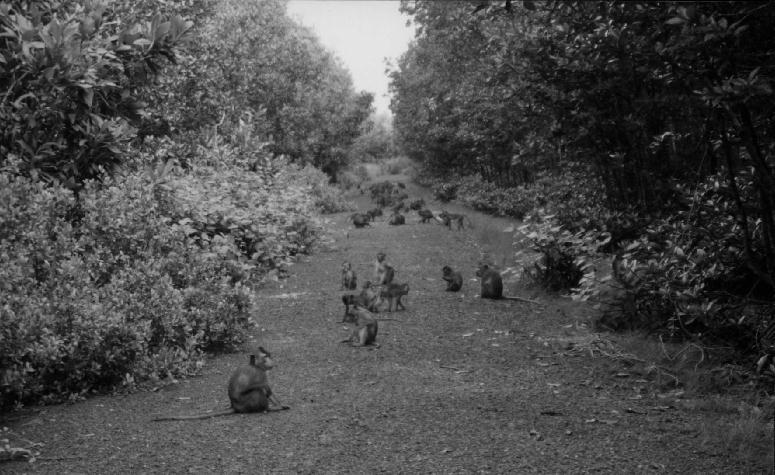
Picture of macaques at Can Gio Mangrove Park.
A number of reports have been published concerning the normal hematological values of both captive and wild-ranging crab-eating macaques. This appears to be the first report on hematological parameters of mangrove-living crab-eating macaques, with age-related changes.
The objective of this study was to obtain preliminary information concerning normal hematological values, which can be useful for estimating natural infection among this population. The blood characteristics are compared to those of captive macaques and to crab-eating macaques in two other free-ranging populations, on Mauritius and Angaur, Palau.
Materials and Methods
Study area: This study was carried out at Can Gio Mangrove Park from July, 1999, to January, 2000. The study area, 22.15 km2, is located at approximately latitude 10° 23’ N and longitude 106° 51’ E, about 45 km east of Ho Chi Minh City. Annual rainfall in the area was 1923.6 mm in 2000. There are two clearly defined seasons: the rainy season from May to October and the dry season from November to April. The altitude of the area ranges from 0 m to 1.8 m above sea level. The forest consists mainly of evergreen mangrove species of Avicenniaceae and Rhizophoraceae (Nam et al., 1994).
Methods: Boiled rice and fruits were provided to attract macaques to researchers. A blow pipe was used to anesthetize macaques with approximately 7 mg/kg body weight of Zoletyl (titelamine and zolazepam, Virbac Co.).
After inspection, including body measurements, up to three ml of blood were collected from a femoral vein. The macaques were released after they had recovered completely. Blood drawn was mixed with EDTA to prevent clotting, placed in a cool box, and sent to the Pasteur Institute in Ho Chi Minh City for analysis. Hematological values were determined by Cell Dyn 3200 Analyzer (Abbott Labs).
About 500 crab-eating macaques were estimated to live in Can Gio mangrove forest. Ninety-four of them were examined. Ages were estimated by tooth eruption, as described in captive crab-eating macaques by Honjo & Cho (1977). A t-test was used to compare the means of hematological values.
Results and Discussion
Table 1 shows the means and standard deviations of red blood cell (RBC), hemoglobin (Hb) and hematocrit (Ht) values of 89 macaques by age and sex.
| Age in years | 1 | 2 | 3 | 4 | Adult | ||||||
| Sex | F | M | F | M | F | M | F | M | F | M | |
| n | 7 | 2 | 6 | 9 | 3 | 5 | 2 | 4 | 28 | 23 | |
| RBC x 10¬6/mm3 |
X SD | 5.2 0.376 | 4.67 0.367 | 4.9 0.7 | 4.97 0.3 | 4.53 0.12 | 4.88 0.412 | 4.74 0.084 | 4.48 0.30 | 4.57** 0.413 | 4.88 0.361 |
| Hb (g/dl) |
X SD | 12.16 0.91 | 10.47 1.315 | 11.35 1.88 | 11.62 0.97 | 10.46 0.378 | 11.38 1.09 | 11.25 0.494 | 11.2 1.03 | 10.85 1.02 | 11.355 0.916 |
| Ht (%) | X SD | 42.29* 3.3 | 35.5 2.12 | 40.17 6.24 | 40.11 2.93 | 36.67 2.08 | 40 3.39 | 39.5 0.71 | 38.5 2.52 | 37.96** 3.33 | 40.26 3.078 |
Significant differences between females and males (*: P < 0.05, **: P < 0.01)
Notes: n: number of macaques examined; adult : 5 years old or older
Table 1: Mean RBC, Ht, and Hb values by age and sex of 89 Crab eating macaques.
The average values of RBC range from 4.48 x 10⁶ /mm3 (four-year-old males) to 5.2 x 10⁶/mm3 (one-year-old females). The average values of RBC within age did not differ between sex (P>0.05) except for adults, where males’ values exceeded those of females (P<0.01).
The average of Hb ranged from 10.46 g/dl to 12.16 g/dl and there was no significant difference between males and females within age groups (P > 0.05). One-year-old macaques showed the highest value.
For Ht, there were significant differences between mean values of males and females of two age groups. The difference at one year was P<0.05 and at adult is P<0.01.
In both sexes, for animals aged 1 year to adult, the average of white blood cells (leukocytes, WBC) ranged from 8.71 x 10³ /mm3 to 14.85 x 10³ /mm3 (Table 2).
| Age in years | 1 | 2 | 3 | 4 | Adult | ||||||
| Sex | F | M | F | M | F | M | F | M | F | M | |
| n | 7 | 2 | 6 | 9 | 3 | 5 | 2 | 4 | 28 | 23 | |
| WBC (leukocyte) mean x 10¬3/mm3 |
X SD | 10.79 3.7 | 11.4 1.13 | 10.89 2.43 | 12.42 3.76 | 10.87 3.06 | 9.378 2.26 | 11.65 4.454 | 14.85 4.15 | 8.71 2.89 | 9.41 2.54 |
| Lymphocyte (%) | X SD | 48.57 12.38 | 40.7 2.12 | 45.5 20.02 | 50.1 20.51 | 66.67 6.02 | 51.6 10.91 | 68 2.83 | 65.75 14.66 | 39.42 16.05 | 36.24 13.99 |
| Monocyte (%) |
X SD | 4.5 1.52 | 7 7.07 | 5.1 2.07 | 4.25 3.69 | 1 0 | 3 3.46 | 3 2.83 | 1.33 0.57 | 3.535 2.33 | 2.1 2.38 |
| Neutrophil (%) |
X SD | 42.57 13.46 | 48.8 12.02 | 46 23.45 | 42.1 20.97 | 28.67 7.64 | 38.2 7.56 | 25.1 12.02 | 27.75 13.4 | 49.25 13.98 | 55.2 15.75 |
| Eosinophil (%) |
X SD | 4.29 3.35 | 3 2.82 | 3.2 2.17 | 3.33 1.58 | 3.67 2.51 | 7.2 5.5 | 3.5 1.41 | 4.75 1.82 | 7.33 4.02 | 6.11 5.03 |
| Basophil (%) | X | <1 | <1 | <1 | <1 | <1 | <1 | <1 | <1 | <1 | <1 |
Table 2: Total and differential leucocyte values by age and sex.
Among leukocytes, the proportions for monocytes and eosinophils varied according to age and sex: 1% to 7% and 3% to 7.2%; compare to values for captive macaques: 1.7% to 5% and 0.7% to 3% (Table 3). The proportion of basophils was less than 1%.
| Can Gio | M F | 23 28 | 4.88+/-0.36 4.57+/-0.41 | 11.3+/-0.9 10.8+/-1 | 40.2+/-3 37.9+/-3.3 | 9.4+/-2.5 8.7+/-2.8 | This study |
| Mauritius | M F | 49 70 | 4.23+/-0.72 4.03+/-1.00 | 10.9+/-1 10.9+/-1 | 36.9+/-3.8 36.7+/-4 | 8.69+/-2.58 8.14+/-2.85 | Matsubayashi et al.(1991) |
| Angaur (Palau) | M F | 21 10 | 4.03+/-0.36 3.76+/-0.24 | 12.8+/-1.3 11.8+/-0.7 | 39.7+/-3.8 37.8+/-2.2 | 17+/-6.5 17.1+/-7.4 | Gotoh et al. (1987) |
Table 3: The hematological values (mean ± S.D.) of RBC, Hb, Ht, and WBC of adult crab-eating macaques inhabiting the islands of Mauritius and Angaur are listed for comparison with data from adult Can Gio mangrove macaques.
Comparison with captive macaques
Comparing the hematological values of Can Gio macaques to the normal hematological values of captive crab-eating macaques reported by Sugimoto et al. (1986) revealed that RBC densities were significantly smaller than those of captive macaques (P<0.001). Most values of Hb and Ht of our population showed no differences from those of the captive macaques, with the exception of Ht values of male macaques aged 1, 3, and 4 years, and Hb values of 3-year-old females and adults of both sexes.
For WBC values, there were no differences between the two populations, but WBC values of Can Gio adults (male and female) and 3-year-old males were smaller than those of same-aged captives. The combined percentage of lymphocytes and neutrophils was over 88% in all macaques. This combined percentage in captive macaques was 90%.
Generally, hematological values of Can Gio macaques by age and sex were within normal ranges of healthy captive macaques reported previously by Sugimoto et al. (1986).
| Animal number | Sex | Age | RBCx106/mm3 | Hb (g/dl) | Ht(%) | WBC mean x103/mm3 | Lymphocyte (%) | Monocyte (%) | Neutrophil (%) | Eosinophil (%) | Basophil (%) |
| 15 | M | 1 | 4.41 | 9.9 | 35 | 76.8 | 94 | 0 | 3 | 0 | 3 |
| 11 | F | 4 | 5.58 | 13.6 | 48 | 41.3 | 74 | 4 | 12 | 9 | 1 |
| 3 | F | 1 | 5.13 | 11.9 | 42 | 12.7 | 96 | 1 | 3 | 0 | 0 |
| 45 | M | 3 | 4.65 | 10.6 | 37 | 9 | 90 | 1 | 3 | 6 | 0 |
| 51 | F | Adult | 4.3 | 10.2 | 36 | 5.9 | 92 | 0 | 8 | 0 | 0 |
Table 4: Five Can Gio macaques with abnormal values of WBC and lymphocytes
Comparison with other free-ranging populations
As seen in Table 3, the values of RBC of Can Gio macaques are significantly higher than those of Angaur and Mauritius (P<0.001). According to Gotoh et al. (1987), the low RBC values of the macaques on Angaur may be caused by insufficient nutrition in their habitat.
The average WBC numbers of adult macaques in Can Gio were higher than those of macaques in Mauritius but lower than animals of Angaur. Gotoh et al. (1987) suggested that the high WBC value in Mauritius macaques might be caused by the stress of capture.
The health of wild macaques is affected by conditions in their habitat, such as shortages of food or water. It is convenient to evaluate the health condition of macaques by examining hematological values (Gotoh et al., 2001). Takenaka (1986) reported that blood characteristics of crab eating macaques of Bali were affected by water deficiency during the dry season.
We caught the Can Gio macaques for blood examination during the dry season. Without fresh water for drinking, the macaques seemed to depend completely on water from food. The present hematological values showed no evidence of water deficiency in this population. The mangrove forest is rich in Macrobentos such as crabs - with species belonging to the Grapsidae and Ocypodidae families such as Helice tridens, Metaplax longipes, Sesarma bidens, and Ucra arculata - favorite foods of mangrove macaques (Nhuong, 1996). These may provide sufficient water and nutrition for macaques.
In addition to the 89 macaques with the hematological values above, we captured five macaques with markedly elevated values of WBC and/or lymphocytes. These leukocyte values are apparently abnormal compared to the average values of the other 89 macaques in this study (Table 2) and to the averages in the previous reports (Sugimoto et al., 1986, Takenaka, 1981). Macaque #15 exhibited elevated values of both WBC (76.8 x 10⁴/mm3) and lymphocytes (94%), macaque #11 had high numbers of WBC (41.3 x 10³/mm3), and macaques #3, #45, and #51 had very high proportions of lymphocytes.
These abnormal values may be caused by natural infections of pathogenic agents, although leucocytosis can have many causes.
Conclusion
Eighty-nine of 94 macaques examined showed hematological values that were within the normal ranges for healthy macaques. Most of these hematological values were higher than those of free-ranging macaques on the islands of Mauritius and Angaur. The results also showed that mangrove macaques can survive by depending completely on fresh water from food in mangrove forests.
Five of the 94 macaques we examined had abnormal leukocyte counts. It is necessary to investigate possible natural infection by pathogenic agents in this population.
References
Fooden, J. (1995). Systematic review of Southeast Asian longtail macaques, Macaca fascicularis. (Raffles, [1821]). Fieldiana Zoology, 81.
Fooden, J. (1996). Zoogeography of Vietnamese primates. International Journal of Primatology, 17, 845-899.
Gotoh, S., Matsubayashi, K., & Nozawa, K. (1987). Reports on the crab-eating monkey in Angaur. II. Result of clinical examination. Kyoto University Overseas Research Reports of Studies on Asian Non-Human Primates, 6, 91-95.
Gotoh, S., Takenaka. O., Watanabe. K., Hamada,Y., Kawamoto, Y., Watanabe, T., Suryobroto, B., & Sajuthi, D. (2001). Hematological values and parasite fauna in free-ranging Macaca hecki and the M. hecki/M. tonkeana hybrid group of Sulawesi Island, Indonesia. Primates, 42, 27-34.
Honjo, S., & Cho, F. (1977). Macaques (genus Macaca). In T. Yoshio (Ed.), Laboratory Animal Science, Vol. 3 (pp. 312-346). Tokyo: Asakurashoten (in Japanese).
Matsubayashi, K., Gotoh, S., Kawamoto, Y., Nozawa, K., Watanabe, T., Takasaka, M., Narita, T., Griffiths, O., & Stanley, M. A. (1991). Hematological, parasitological and microbiological examinations on crab-eating macaques in Mauritius. Kyoto University Oversea Research Report of Studies on Asian Non-human Primates, 8, 1-10.
Matsumura, S., & Son, V. D. (1997). Comments on crab eating macaques (Macaca fascicularis) in Can Gio Mangrove Park (p. 378). Khoa hoc Pho Thong. Ho Chi Minh City: Le Quang Loc Press (in Vietnamese).
Nam, V. N., Thuy, N. S., & Thao, H. C. (1994). Report on vegetational cover and mangrove forest resources of Quarter 17, Can Gio mangrove forest. Ho Chi Minh City: Association of Forestry Technology Science (in Vietnamese).
Nhuong, N. V. (1996). Preliminary data of the composition of mangrove macrofauna in Cangio, Ho Chi Minh City. Scientific Information, College of Education, Vietnam National University, Hanoi, 5, 32-41.
Sugimoto, Y., Hanari, K., Narita, H., & Honjo, S. (1986). Normal hematological values in the cynomolgus monkeys aged from 1 to 18 years. Experimental Animals, 34[4], 443-447.
Takenaka, O. (1981). Blood characteristics of the crab-eating monkeys (Macaca fascicularis) in Bali and Sumatra. Kyoto University Overseas Research Reports of Studies on Indonesian Macaque, 1, 41-46.
Takenaka, O. (1986). Blood characteristics of crab eating monkeys (Macaca fascicularis) in Bali Island, Indonesia: Implication of water deficiency in West Bali. Journal of Medical Primatology, 15, 97-104.
Van Peenen, P. F. D., Ryan, P. F., & Light, R. H. (1969). Preliminary Identification Manual for Mammals of South Vietnam (pp. 91-108). Washington, DC: Smithsonian Institution.
----------
Author’s address: Saigon Zoo, Nguyen Binh Khiem, Q.1, Ho Chi Minh City,Vietnam [e-mail: [email protected]].
The author thanks the Directorate and macaque keepers of Can Gio Mangrove Park for permission to capture macaques in carrying out this study and for their assistance in the field. The author also expresses his gratitude to Dr. Shuichi Matsumura and Dr. Shunji Gotoh, Primate Research Institute, Kyoto University, for their comments on an earlier version of the manuscript.
----------
* * *
Positions Available
Chimpanzee Sanctuary in West Africa
The New York Blood Center is developing a sanctuary for 78 chimpanzees to be retired from a medical research facility (Vilab II) in Liberia. The sanctuary will consist of a series of islands, each housing 20-30 chimpanzees. Two islands are already occupied. They are seeking a person to work with experienced chimpanzee caregivers and collaborate with the Liberian conservation community to develop a program of conservation education in Liberia. Development of the sanctuary will be in collaboration with an existing established chimpanzee sanctuary, which will, hopefully, assume full responsibility and management once Vilab has closed.
Qualifications for this position include at least two years’ experience in primate resocialization, preferably of adult chimpanzees; and preferably experience working in Africa. Salary will be dependent on education and experience. The position will provide free housing, local transportation, medical insurance and contribution to retirement, six weeks’ paid holiday, one round-trip airfare to place of hire, and attendance at relevant meetings. Applicants for this position should send a CV, a letter indicating career goals, and contact information for three references to Dr. Alfred M. Prince, The New York Blood Center, 310 East 67th St, New York, NY 10021 [212-570-3279; fax: 212-570-3180; e-mail: [email protected]]. For background on Vilab II see <www.heprf.org/vilab2introduction.htm> or <www.nybloodcenter.org/slideshow/slide1.html>.
Animal Caretaker, Experienced with Primates
The Bionetics Corporation announces immediate and future job openings in the Washington, D.C. area. Responsibilities include performing basic husbandry tasks, cage washing, and sanitation duties for a variety of nonhuman primates. Tasks include health and environmental monitoring and daily room checks, as well as expert care and handling. The applicant should be cooperative when working with others and able to work well independently in a conflict-free environment.
Minimum qualifications include ALAT/AALAS certification and at least two years’ experience caring for rhesus monkeys. Experience with Aotus monkeys would be a plus. This person must be able to perform tasks with minimal supervision and to lift 50 pounds. Good “people skills” are an absolute must.
Contact Lindsay Barnes, Project Manager, The Bionetics Corporation, WRAIR/Forrest Glen Annex/Division of Veterinary Medicine, Bldg 503, Rm GE-20, Silver Spring MD 20910 [fax: 301-319-9219; e-mail: [email protected]].
* * *
Awards Granted: Spider Monkey Conservation in El Salvador
A proposal written by El Salvador student Karenina Morales and Community Conservation, Inc.’s Rob Horwich has received funding from the Margot Marsh Biodiversity Foundation and Primate Conservation, Inc. This will allow Ms. Morales to census one of the few remaining spider monkey populations in El Salvador. The scattered groups are on the Pacific coast and Morales has already been working to enlist help from the villagers of Chaguantique and Tercio, some local NGOs, and the Ministry of the Environment. Horwich will go to El Salvador to assist Morales and the villagers. - From CC Update, Spring/Summer 2002, 13[1]
* * *
From Laboratory to More Natural Enclosures:
Maintaining the Well-Being of Captive Chimpanzees (Pan troglodytes)
Sue Howell, Melanie Schwandt, Jo Fritz, and Sandy Walker
Primate Foundation of Arizona and Rolling Hills Zoo
Introduction
With the advent of the Chimpanzee Health Improvement, Maintenance and Protection Act (HR 3514) (signed into law in December, 2000), many chimpanzees may move from indoor/outdoor laboratory housing to more natural environments. While we hypothesize that the well-being of chimpanzees will be maintained and/or enhanced in a more natural environment, there have been relatively few studies that document the behavioral effects of this type of housing change (Pfeiffer & Koebner, 1978; Clarke et al., 1982; Goerke et al., 1987). However, these few studies do report an increase in the relative proportions of positive behavior patterns and a significant decline in the relative proportions of negative behavior patterns following a move from a laboratory to a more natural environment. In 1997 the Primate Foundation of Arizona (PFA) sent four adult males on long-term loan to Rolling Hills Zoo (RHZ) in Salina, Kansas. While both facilities provide social housing and environmental enrichment, the RHZ facility includes more space and more natural features, i.e. grass, trees, and boulders. This study, a collaboration of both facilities, evaluates the effects of this change in environment on the behavior of the four males.
Methods
Subjects: The subjects were four adult male chimpanzees: Coc (ISIS #2723), Shu (ISIS #3904), Toh (ISIS #4333), and Aul (ISIS #4426), ranging in age from 15 to 25 years at study onset. All subjects were well socialized to group living and displayed normal behavior patterns. Three of the four chimpanzees had participated in biomedical research at another facility for a one- to two-year period. Upon their return to PFA, in the early to mid 1980’s, they were socially housed. During the PFA data collection period (June 1996 to August 1997) for this study, the four males were housed in either bachelor groups of 2-5 individuals (Aul and Toh) or mixed-sex social groups of 2-7 individuals (Coc and Shu). The four males were introduced to each other following the PFA Introduction Protocol (Fritz & Howell, 2001). They were then housed all together for six months to ensure group compatibility prior to their transfer from PFA to RHZ. During the RHZ data collection period (June 1998 to August 1999) the four males were housed together in a single social group.
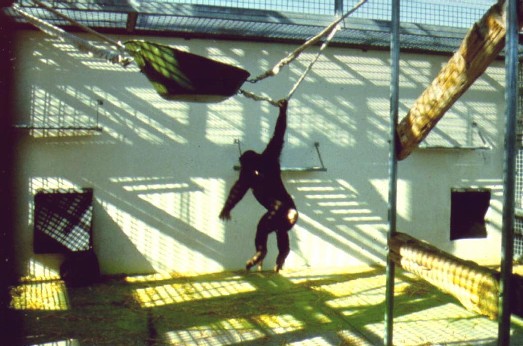
Housing: At PFA, chimpanzees were housed in indoor-outdoor cages. Indoor cages include a series of three interconnected cages (~17.5 m2 of floor space and 2.8 m in height) with access every other day to adjoining outdoor cages (67.9 to 249.7 m2 of floor space and 4.8 to 6.3 m in height). Cages were constructed of woven wire mesh with cement floors and furnished with multiple benches and climbing devices (ropes, vertical and horizontal poles, fire hoses, swinging tires; see Figure 1).
Figure 1: Primate Foundation of Arizona chimpanzee enclosures.
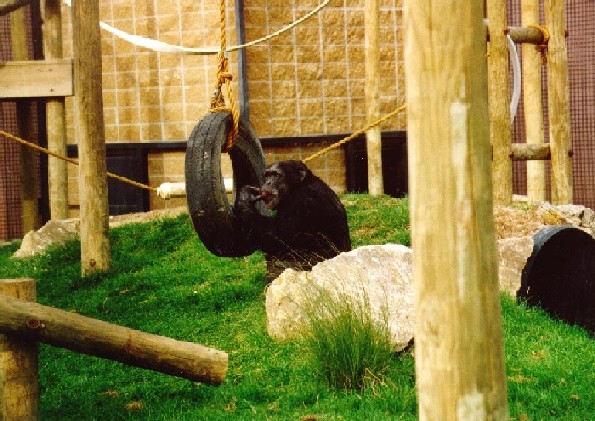
At RHZ, the chimpanzees were housed in public viewing areas that included daily access to an outdoor yard (222 m2 of “floor” space and 6.1 m in height) and an indoor day room (66.4 m2 of floor space and 6.1 m in height). Except on cold or rainy days, the chimpanzees spent the majority of their time in the outdoor yard. The enclosure was furnished with ropes, fire hoses, and swinging tires, and horizontally and vertically oriented poles (similar to PFA’s; see Figure 2), along with grass, boul ders, and trees (in contrast to PFA’s).
Figure 2: Rolling Hills Zoo chimpanzee enclosures.
Chimpanzees at PFA and RHZ were fed an omnivorous diet that included seasonal fruits, vegetables, and a commercial monkey chow. At both institutions, forage (e.g., chicken scratch, air-popped popcorn, sunflower seeds) or browse (leaves, branches) was broadcast into bedding (straw or shredded paper) and destructible and indestructible objects were provided to encourage manipulatory behavior.
Data Collection: Data collection at both institutions followed procedures outlined in the PFA Chimpanzee Wellness Program (Fritz & Howell, 1993). Each chimpanzee was scored daily, using a one-zero recording method (Martin & Bateson, 1993), for the presence or absence of 12 species-typical behaviors, considered “positive”, and 12 nontypical or “negative” behaviors (see Appendix A for an ethogram). At the end of each month, the total number of occurrences for each behavior in that month was tallied for each subject and entered into a computer database. For this study, we include data collected at PFA from June, 1996, to August, 1997. Data were collected at RHZ from June, 1998, to August, 1999, to be comparable with data from PFA. Inter-observer reliability was tested at both facilities using either a written exam or inter-observer reliability testing on a similar study (inter-observer reliability was assessed at 85% agreement; a passing exam score was 85% correct).
Data Management and Analysis: Monthly totals for each behavior at each institution were summed across the 15-month observation period. Although data collection procedures were the same at both institutions, the amount of time spent observing the subjects differed. During the PFA study period, 82 chimpanzees were scored each day, limiting the amount of time that could be spent observing each individual. We estimate total observation time was 1/3 to 1/2 hours per individual across an 8-hour day. At RHZ, only 4 chimpanzees were scored each day. We estimate total observation time was 1.5 to 2 hours per individual across a 12-hour day. The disparity in the amount of time each subject was observed likely resulted in a greater number of behavioral scores at RHZ. At RHZ, each animal had from 454 to 457 scores totaled across all months and behaviors. At PFA, each animal had from 425 to 450 scores totaled across all months and behaviors. To control for this difference, we converted the 15-month score totals for each behavior to proportions. The 15-month score total for each behavior at each institution was divided by the total scores across all months and behaviors for that animal at that institution, respectively.
A Wilcoxon signed rank test (Siegel & Castellan, 1988) was used to test for significant differences in behavior between the two institutions. Separate tests were run for each behavior at an alpha level of p < 0.002 (using a Bonferroni adjustment for multiple comparisons, 0.05/22 comparisons = 0.002). We made no prediction about the direction of effects - for example, that animals might groom more at RHZ than at PFA. So, all tests were two-tailed to assess whether there was a general difference in scores (Siegel & Castellan 1988). Analyses were performed using SAS version 8.0, which adjusts the significance level of the Wilcoxon signed rank statistic for sample sizes less than or equal to 20 (N = 4 in this case). In addition, some behaviors scored as part of the wellness assessment do not apply to certain individuals or certain social situations. In this case two behaviors, “copulating” and “showing parental skills”, were not applicable to four adult males housed in an all-male group. These behaviors were not included in the analysis. In addition, three behaviors (self-mutilation, self-aggression, and adverse reaction to stress) were never scored at either institution and were not included in the analysis.
Results
Wilcoxon signed rank tests revealed no significant difference between institutions for any of the behaviors tested (Tables I and II) (p < 0.002). With p-values ranging between 0.125 and 1.0, we also found no strong trends toward differences between institutions. However, it is important to keep in mind that it is difficult to achieve significance with the small subject sample, even if we hadn’t chosen to adjust the alpha level for multiple comparisons.
| Behavior | Sum of Signed Ranks | p-value | PFA Mean (SD) | RHZ Mean (SD) |
| Grooming | -5.0 | 0.125 | 0.0525 (0.0202) | 0.0992 (0.0005) |
| Playing | -5.0 | 0.125 | 0.0063 (0.0003) | 0.0990 (0.0008) |
| Locomoting | 5.0 | 0.125 | 0.1525 (0.0038) | 0.0994 (0.0005) |
| Using Vertical Structures | 5.0 | 0.125 | 0.1525 (0.0038) | 0.0993 (0.0006) |
| Building Nests | -5.0 | 0.125 | 0.0629 (0.0092) | 0.0985 (0.0006) |
| Foraging | 2.0 | 0.625 | 0.1027 (0.0067) | 0.0993 (0.0006) |
| Initiating Interaction | 5.0 | 0.125 | 0.1349 (0.0040) | 0.0994 (0.0005) |
| Participating in Interactions | 5.0 | 0.125 | 0.1513 (0.0035) | 0.0994 (0.0005) |
| Coping | -5.0 | 0.125 | .0006 (0.006) | 0.0995 (0.0004) |
| Interacting with Nonconspecifics | 5.0 | 0.125 | 0.1525 (0.0038) | 0.0995 (0.0004) |
Table I. Wilcoxon signed rank test results and mean and standard deviation (SD) proportions for positive behaviors.
| Behavior | Sum of Signed Ranks | p-value | PFA Mean (SD) | RHZ Mean (SD) |
| Rocking | -0.5 | 1.000 | 0.0075 (0.0148) | 0.0003 (0.0005) |
| Coprophagy | -2.0 | 0.500 | 0.0015 (0.0013) | 0.0027 (0.0024) |
| Urophagy | -3.0 | 0.250 | 0.0000 (0.0000) | 0.0029 (0.0037) |
| Regurgitation | 1.0 | 0.750 | 0.0052 (0.0102) | 0.0007 (0.0009) |
| Increased Aggression | 5.0 | 0.125 | 0.0013 (0.0010) | 0.0002 (0.0002) |
| Increased Fear | -5.0 | 0.125 | 0.0002 (0.0002) | 0.0009 (0.0004) |
| Increased Frustration | 3.0 | 0.250 | 0.0008 (0.0012) | 0.0000 (0.0000) |
| Self-Clinging | -0.5 | 1.000 | 0.0000 (0.0000) | 0.0001 (0.0001) |
Table II. Wilcoxon signed rank test results and mean and standard deviation (SD) proportions for negative behaviors.
A general comparison of the mean scores for positive and negative behaviors between PFA and RHZ does suggest that further research is this area is warranted. For positive behaviors, proportions of interactions with other chimpanzees and with nonconspecifics and proportions of use of vertical structures were similar across facilities. In contrast, while differences were not significant, proportions of foraging, nesting, grooming, and playing were higher at RHZ. For negative behaviors, proportions were similar and low at both locales. While not significant, proportions of negative behavior patterns varied by locale: rocking and regurgitation were higher at PFA, while coprophagy and urophagy were higher at RHZ.
Discussion
Our results support the hypothesis that chimpanzee well-being, as expressed through species-typical behaviors, was maintained in the transfer from a laboratory to a more natural zoo environment. In contrast to past studies, we found no significant increase in the relative proportions of positive behavior patterns or significant decline in the relative proportions of negative behavior patterns (Pfeiffer and Koebner, 1978; Clarke et al., 1982; Goerke et al., 1987). This result may be explained by both institutions’ emphasis on providing an enriched and complex environment. Furthermore, the chimpanzees were already well socialized to group life and had relatively low levels of abnormal behavior patterns prior to the transfer.
U.S. chimpanzees that are no longer needed for biomedical research will be transferred from laboratories to more natural sanctuaries in greater numbers in the future. The implications of the present study for these animals are not clear. Behavioral well-being may be achieved in both laboratory and more natural zoo enclosures. In both locales, chimpanzees benefit from social housing in a complex and enriched environment with outdoor access. A general comparison of the proportions of positive behavior patterns does suggest an increase in social and manipulative behaviors in the more natural locale, but further research is needed.
References
Clarke, A. S., Juno, C. J., & Maple, T. L. (1982). Behavioral effects of a change in the physical environment: A pilot study of captive chimpanzees. Zoo Biology, 1, 371-380.
Fritz, J., & Howell, S. M. (1993). Psychological wellness for captive chimpanzees: An evaluative program. Humane Innovations and Alternatives, 7, 426-434.
Fritz, J., & Howell, S. (2001). Captive chimpanzee social group formation. In L. Brent (Ed.), The Care and Management of Captive Chimpanzees (pp. 173-203). San Antonio: American Society of Primatologists.
Goerke, B., Fleming, L., & Creel, M. (1987). Behavioral changes of a juvenile gorilla after a transfer to a more naturalistic environment. Zoo Biology, 6, 283-295.
Martin, P., & Bateson, P. (1993). Measuring Behaviour: An Introductory Guide. Cambridge: Cambridge University Press.
Pfeiffer, A. J., & Koebner, L. J. (1978). The resocialization of single-caged chimpanzees and the establishment of an island colony. Journal of Medical Primatology, 7, 70-81.
Siegel, S., & Castellan, N. J. (1988). Nonparametric Statistics for the Behavioral Sciences. New York: McGraw-Hill.
* * *
Positive Behaviors
Grooming: Scored as “social groom” or “self-groom”. Self-grooming keeps the body free of dirt. During self-grooming the chimp frequently intersperses grooming movements with slow, deliberate scratching movements against the direction of hair growth; the area scratched is then groomed. Parts of the body not readily accessible to self-grooming, such as the head, are typically scratched slowly and thoroughly. The chimp then inspects nails of fingers. After heavy rain (or if they have become wet during cage cleaning), chimps frequently scratch downward over the body, pulling hair between their fingers. Or they may shake themselves, rub their backs against vertical structures or the ground/floor, rub their bodies with objects (e.g., leaves, straw, paper), or lick off drops of water.
In social grooming chimpanzees groom each other. The movements are the same as in self-grooming except that the skin of the partner is groomed. During social grooming a chimp often scratches a part of his own body, which is then immediately groomed by his partner. Such scratching often serves to start a session up again after a temporary lull.
Like self-grooming, brief grooming of another frequently occurs in a variety of contexts when chimps are anxious or excited.
Playing: A broad term to describe many types of nonaggressive actions. It is never accompanied by pilo-erection. It may be accompanied by a play-face and laughing. It can be solitary (performed by a lone individual) or social (involves two or more individuals).
Locomoting: Utilizes multiple areas of the enclosure across the day.
Using Vertical Structures: Locomotes above the ground by climbing, swinging, brachiating. May utilize vertical structures (e.g., vertical poles, cage mesh), or horizontal structures above the ground (e.g., rope “vines” that are hung horizontally, platforms).
Building Nests: Methodical construction of a bedded area. Animals are usually seated and surround their bodies with nest material and/or tuck the nest material under themselves. Most nests are constructed of straw, paper, or cardboard, although toys may be incorporated into nests (particularly by infants and juveniles).
Foraging: Hunts for food, food remnants, or forage (chicken scratch, seeds, popcorn, etc.).
Initiating Interactions: Enlists others in social activities in which each of two (or more) animals has an effect on the other. An animal may initiate play with another, initiate a social grooming session, solicit copulation, or exhibit greeting behaviors (the latter usually occur between individuals meeting after a separation and may include touching, kissing, embracing, inspection, and hand-holding). An animal may take the initiative to aid another during a fight, provide reassurance to a fearful animal, calm an upset animal (by grooming, open mouth kisses, initiating play, etc.). In all of these instances, the animal takes the initiative (is the first to start the action) in interacting with another or enlists another to engage in a social activity.
Participating in Interactions: Participates in nonaggressive social activities whereby each of two (or more) animals has an effect on another. For example, an animal may actively participate in a grooming session, a social play bout, or permit copulation. An animal may take a passive role in interactions such as permitting another to embrace, to groom, or to rest near them (in close contact). An animal that avoids or ignores others in the social group does not “participate in interactions”. However, an animal that responds to others in the social group “participates in interactions”.
Adapting to Stresses (Coping): This category is not to be considered a derogatory score for the animal. It gives care staff the clue that special attention may need to be paid and/or housing adjustments made for that individual. To adapt to stresses or “cope” means to struggle or contend successfully or to “give in gracefully”, whichever is appropriate to the situation. When struggles arise, animals that “cope” react with species-typical behavioral patterns. A particularly good time to assess coping “skills” is immediately prior to feeding.
Animals that do not easily adapt to stresses react passively to struggles. Solitary, self-directed, and self-comforting responses are common for animals that cannot “cope”. Instead of reacting with expected chimpanzee behavior responses, abnormal or negative behavioral patterns predominate and may include: nonresponsive rocking (see below), screaming (for little or no reason), wounding self, self-sucking, sucking another, embracing another (for an extended period), increased hair plucking (by the handful), and self-assurance activities (clinging to or patting self).
Interacting with Nonconspecifics: Participates in activities with nonconspecifics (e.g., caregivers, research staff, etc.). Chimpanzees are attentive to greetings made by most humans. In addition, adult chimps should approach and take vitamins from a caregiver. If a chimp ignores a particular person or refuses vitamins from a particular person, it is probably a personality conflict. However, if a chimp ignores all nonconspecifics, and is nonresponsive to all greetings, and refuses vitamins from any caregiver, then he does not “interact with nonconspecifics”. In addition, some animals are very attentive to humans and love to play (e.g., chase), while others do not. Play with humans is the animal’s personal choice and should not be used as an indicator of the ability to “interact with nonconspecifics”. Remember: these animals come from different social backgrounds. If an animal had few or bad experiences with people he may not be as willing to interact. However, if he does not respond to his name, then he does not “interact with conspecifics”.
Negative Behaviors
Gluttony: Consumes an excess amount of food or water. Diets are determined according to age and weight; individuals are carefully monitored to prevent an animal from eating more food than is required or appropriate. However, some animals may take food from other animals and consume large amounts of food. In this case, they are gluttons. A “water glutton” exhibits an insatiable thirst for water. (Note: Pregnant females often drink a great deal more water when nearing term. Marked as “gluttony” as a clue for the veterinarian.)
Rocking (Nonresponsive): Rhythmic movement of the body, either side-to-side or forward and backward. May occur while standing bipedally, quadrupedally, sitting, crouching, or in a hanging position. In infants, frequently occurs while holding or clutching an object. Does not include rocking as the result of apprehension, anger, or frustration (as evident by other behaviors). There should be no pilo-erection (such as occurs during pre-display rocking behavior), no direct eye contact with nonconspecifics or social group members (expression is blank), and no fear grin - animals should show no emotion.
Coprophagy: Active oral contact with feces.
Urophagy: Active oral contact with urine.
Regurgitation: Vomits food for the purpose of manipulating vomited material. Manipulation may include reingestion, spitting, or examination of vomited material.
Increased Aggression: An individual’s aggressive behavior exceeds that which is appropriate to the situation.
Increased Fear: An individual’s amount of fear shown exceeds that which is appropriate to the situation.
Increased Frustration: An individual’s amount of frustration shown exceeds that which is appropriate to the situation.
Self-Clinging: Individual holds onto itself. Arms may circle torso, or hand may hold the crotch or scrotum. Casual contact with the body should not be scored as “self-clinging”. “Self-clinging” is scored when an animal is intensely holding onto itself.
Adverse Reaction to Stress: When confronted with a stressful situation, the animal reacts severely and negatively. Behaviors may include extended crying/whining/ screaming, lethargy, refusal of food or water, or withdrawal and inattention to surroundings.
----------
First author’s address: PFA, P.O. Box 20027, Mesa, AZ 85277-0027 [e-mail: [email protected]].
The authors are grateful to PFA and RHZ care staff members. The care staff are the ones in the trenches who make all of this happen for the benefit of the chimpanzees. We would also like to thank James Murphy, PFA Assistant Director/Colony Manager, and Kelly Carbone, PFA Assistant Colony Manager, for their assistance in data collection and editorial revision; and Kimberly Neu for her assistance in data management and analysis for this project. This study was supported in part by the National Institutes of Health, Division of Research Resources grant 2 U42 RR03602-13 to the Primate Foundation of Arizona.
----------
* * *
Meeting Announcements
The Australasian Primate Society will be holding its annual meeting and conference at Melbourne Zoo (Melbourne, Australia) on December 6-8, 2002. For details and to download a registration form, please visit <www.primates.on.net>.
The Xth Brazilian Primate Congress, originally scheduled for August 25-30, 2002, has been delayed until November 15-20, 2002. For information, contact Secretária Geral: Vanner Boere, CFS/IB, Univ. de Brasília, 70910-900 Brasília, DF, Brasil [(0)61 3072294/3072887; Fax: (0)61 2741251; e-mail: [email protected]].
Science in the Service of Animal Welfare, a Universities Federation for Animal Welfare (UFAW) symposium, will be held April 2-4, 2003, in Edinburgh, Scotland. The aim of the symposium is to bring together leading authorities from around the world to present papers on the current state of knowledge and thinking in a variety of key areas, and to stimulate discussion with a view to identifying crucial areas for new or further research, education, or policy development. For further details, or if you would like to present a paper/poster, or wish to register interest in attending, please contact the Scientific Officer, UFAW, The Old School, Brewhouse Hill, Wheathampstead, Herts, AL4 8AN, U.K. [+44 (0) 1582 831818; fax: +44 (0) 1582 831414; e-mail: [email protected]]; or see <www.ufaw.org.uk>.
The Scientists Center for Animal Welfare (SCAW) Annual Winter Meeting will be held December 8-9, 2003, in San Antonio, Texas. For more information, visit <www.scaw.com>; or contact SCAW [301-345-3500; e-mail: [email protected]].
The XXth Congress of the International Primatological Society will be held in Torino, Italy, at a date yet to be determined in 2004.
* * *
Primates de las Américas...La Página
Para el presente número les ofrecemos las contribuciones sobre un comportamiento poco usual de monos capuchinos en cautiverio. Asimismo, les presentamos el resumen de la investigación que obtuvo el premio a la mejor presentación oral por estudiantes en el pasado Congreso mexicano de primatología y que ahora se ha consolidado para la obtención de su grado universitario. Felicidades por ambos logros. Les enviamos un cordial saludo y estamos a sus órdenes Juan Carlos Serio Silva y Elva Mathiesen, División Académica de Ciencias Biológicas, Universidad Juárez Autónoma de Tabasco, calle Ucase no. 117, Fracc. Bosques de Villahermosa, CP 86035, Villahermosa, Tabasco, México [e-mail: [email protected]].
Corte innovador de frutas por el mono capuchino pardo (Cebus apella) en cautiverio
Bernardo Urbani, Depto. Biología de Organismos, Universidad Simón Bolívar, Apartado 47.028, Caracas 1041-A, Venezuela [urbani@cantv]; y
Tania Urquiza-Haas, School of Environmental Sciences, University of East Anglia, Norwich NR4 7TJ, Gran Bretaña [[email protected]]
La presente observación se realizó en la sección de primates del Parque Zoológico El Pinar, Caracas (Venezuela), a las 11:52 a.m. del 8 de abril de 2002. Un macho adulto de mono capuchino pardo (Cebus apella) tomó un trozo de manzana equivalente a un cuarto de ella. Lo manipuló y se dirigió a la reja frontal del recinto, cuyo diámetro de barras es de 4 mm. El pedazo de manzana fué presionado contra una barra, formando dos nuevos trozos. Uno fué consumido inmediatamente, mientras que el segundo fué simultáneamente presionado contra la barra formando otros dos nuevos que se sostenían allí por la presión de la pulpa apretada y la piel de la fruta que mantenía tenuemente unida ambas partes. Procedió a tomar este trozo ya precortado, y bastó sólo con desgarrar la delgada piel de la manzana, que apenas lo mantenía unido. Comió el trozo más pequeño y el otro lo presionó nuevamente de la forma como se indicó previamente para formar dos pequeños pedazos que ingirió rápidamente. Todo el proceso de múltiples cortes de la manzana duró aproximadamente 6 minutos. Lo anterior representa una forma poco usual del alimento que manejan estos primates en cautiverio.
Prevalencia de parásitos gastroentéricos en primates (Alouatta pigra y Ateles geoffroyi yucatanensis) localizados en hábitat conservado y fragmentado de Quintana Roo, México
Martha Bonilla Moheno, Facultad de Ciencias UNAM, México, DF [[email protected]]
Las dos especies de monos silvestres que se distribuyen en la Península de Yucatán, el mono aullador negro (Alouatta pigra) y el mono araña (Ateles geoffroyi yucatanensis), enfrentan condiciones contrastantes en cuanto a la conservación de su hábitat. Particularmente, en el estado de Quintana Roo, México, es cada vez más frecuente localizar grupos de primates silvestres que habitan áreas selváticas que han sufrido importantes reducciones en su tamaño original (fragmentadas), sin embargo aún es posible encontrar poblaciones en áreas extensas de selvas (conservadas). Entre las consecuencias de la fragmentación del hábitat se encuentra el aumento a la expo-sición de los monos silvestres con núcleos humanos cercanos y con los animales mascota o de granja de estos, así como entre ellos mismos. Eventualmente esta exposición podría favorecer el incremento en la prevalencia parasitaria de estas poblaciones de primates en zonas con este tipo de características.
Diversos trabajos han demostrado el impacto negativo de la incidencia de parásitos sobre las poblaciones silvestres de primates. Este estudio presenta la prevalencia así como la riqueza e intensidad de parásitos gastroentéricos (protozoarios) que presentan las poblaciones de primates (Alouatta pigra y Ateles geoffroyi yucatanensis) en zonas conservadas y fragmentadas así como las variaciones en prevalencia según la especie de primate y la estación climática (húmeda/seca), en el estado de Quintana Roo. Asimismo, se realizó un estudio paralelo con primates encontrados en cautiverio o como mascota en el mismo estado con la misma especie de mono araña y una especie de aullador de distribución no natural en la zona (Alouatta palliata). Los resultados obtenidos muestran que en cuanto a riqueza de especies parasitarias gastroentéricas, la diferencia entre estaciones climáticas ha sido significativamente mayor para la estación húmeda. De igual forma, en la interacción de primate versus hábitat, se encontró una diferencia significativa. También encontramos una fuerte tendencia en la interacción entre estación y especie de primate, sin que resultaran significativas las diferencias. En cuanto a la intensidad se observó que existió diferencia sólo cuando se relacionaban la especie de parásito y el tipo de estación climática. Por otra parte, cuando se realizaron los análisis de riqueza de parásitos entre ambas especies de primates “mascotas”, se observó una clara diferencia significativa entre las especies de monos; sin embargo, esto no sucedió cuando se comparó la intensidad de los parásitos entre los monos. Nuestros resultados sugieren que la prevalencia de protozoarios gastroentéricos en poblaciones silvestres de primates en Quintana Roo, pudiera estar determinada principalmente por el tipo de estación climática y por la interacción entre hábitat y la especie de primate.
Los estudios de parasitosis gastroentéricas en primates silvestres de nuestro país son escasos y resultan de extrema importancia sobretodo para las poblaciones que habitan en sitios fragmentados con el fin de tomar acciones de conservación.
* * *
Grants Available
Complementary and Alternative Medicine (CAM)
The National Center for Complementary and Alternative Medicine (NCCAM) invites research grant applications to help stimulate the amount and elevate the quality of basic, mechanistic, and preclinical research in all domains of CAM in order to provide a stronger foundation for ongoing and planned clinical studies. The NCCAM desires to encourage the most rigorous CAM and conventional researchers to focus on the opportunities in CAM research, and to employ the most current and emerging technologies to strengthen the biomedical research knowledge bases needed to elevate clinical practice. The National Cancer Institute (NCI), the National Institute of General Medical Sciences (NIGMS), and the National Institute of Mental Health (NIMH) share programmatic interests in some areas of CAM research with the NCCAM.
NCCAM’s Five-Year Strategic Plan can be accessed at <nccam.nih.gov/strategic>; see especially Appendix I. The individual systems and treatments within CAM are numerous, so the following examples demonstrate the broad range of research contemplated by this initiative, and are not meant to be exclusive. We include here only those that may involve animal models: * Immunomodulatory mechanisms underlying CAM therapeutics, such as basic and animal model studies aimed at determining whether and what changes are induced in immune response pathways by CAM therapeutics, and whether any such changes might be relevant to resolving a disorder or preventing one. * Neurophysiological, neuroendocrinological, and biochemical pathways in massage therapy, including studies utilizing animal models, and instrumentation-based approaches including imaging. * Basic biological mechanisms and processes underlying acupuncture, including investigations using animal models, and studies employing imaging. * Mechanisms of action of saw palmetto, PC-SPES, Pygeum africanum, and other complex botanicals on the male reproductive tract, and of black cohosh, red clover, and other complex botanicals on the female reproductive tract. The studies are expected to focus on the cellular, molecular, endocrinological, and metabolic changes induced in vitro, in animal models, and in human subjects treated with these botanicals.
Direct your questions about scientific/research issues to: Neal B. West, Program Officer, NCCAM, Two Democracy Plaza, Suite 401, 6707 Democracy Blvd, Bethesda, MD 20892-5475 [301-402-5867; fax: 301-480-3621; e-mail: [email protected]]; Wendy B. Smith, Program Director, Office of Cancer CAM, NCI, 6130 Executive Blvd, EPN, Suite #102, MSC 7302, Bethesda, MD 20892-7302 [301-435-7980; fax: 301-480-0075; e-mail: [email protected]]; Michael E. Rogers, Director, Pharmacology, Physiology, and Biological Chemistry Division, NIGMS, Rm. 2As.49c, Natcher Bldg, Bethesda, MD 20892-6200 [301-594-3827; fax: 301-480-2802; e-mail: [email protected]]; or Linda Brady, Div. of Neuroscience and Basic Behavioral Science, NIMH, 6001 Executive Blvd, Room 7185, Bethesda, MD 20892 [301-443-5288; fax: 301-402-4740; e-mail: [email protected]].
Applications in response to this Program Announcement will be accepted at standard application deadlines; see <grants.nih.gov/grants/dates.htm>.
Age-Related Changes in Tissue Function
The Biology of Aging Program, Neuroscience and Neuropsychology of Aging Program, and Geriatrics and Clinical Gerontology Program at the National Institute of Aging (NIA) have issued a Program Announcement encouraging applications that will elucidate the basic biological causes and consequences of changes in tissue and organ function related to aging and will identify commonalities, distinguishing features, and interactions between them. The Biology of Aging Program supports work through the Cardiovascular Biology, Endocrinology, Immunology, Musculoskeletal Biology, and Physiology Programs. These programs encompass most tissues and organs of the body, outside of the nervous system. The Neuroscience and Neuropsychology of Aging Program supports work on the nervous system, including fundamental neuroscience, integrative neurobiology, motor and sensory systems, cognition, and the dementias of aging, particularly Alzheimer’s disease. The Geriatrics and Clinical Gerontology Program supports research on health and preventing and treating disease in the aged, as well as research on aging over the human life span and its relationship to health outcomes. As all of these programs cover a broad spectrum of research, the National Institutes on Deafness and Other Communication Disorders (NIDCD), Dental and Craniofacial Research (NIDCR), and Diabetes and Digestive and Kidney Diseases (NIDDK) also support research in their respective areas of interest. Projects are encouraged that significantly advance basic biology research to understand how and why changes take place in tissues with age and how those changes relate to altered tissue and organ function. Research that takes maximal advantage of emerging genetic, genomic, and proteomic information on humans and other animals to understand changes that occur with aging is particularly encouraged. Research projects that focus on various aging tissues or physiological systems, including skin; liver; and cardiovascular, musculoskeletal, immune, urogenital, endocrine, gastrointestinal, and nervous systems are of interest. Basic biology studies on aging that use animal models or human tissue are also of interest.
Direct questions about scientific/research issues to: Frank L. Bellino, Endocrinology/Physiology [e-mail: [email protected]]; Jill L. Carrington, Chief, Systems Branch, Biology of Aging Program/Musculoskeletal Biology [e-mail: [email protected]]; David B. Finkelstein, Cardiovascular Biology [e-mail: [email protected]]; Rebecca A. Fuldner, Immunology [e-mail: [email protected]] (“snail” address for all of above is NIA, 7201 Wisconsin Ave, Suite 2C231, MSC 9205, Bethesda, MD 20892-9205 [301-496-6402; fax: 301-402-0010]); or to Stanley Slater, Geriatrics and Clinical Gerontology Program, same address, Suite 3E327 [301-496-6761; fax: 301-402-1784; e-mail: [email protected]]; Bradley C. Wise, Neuroscience and Neuropsychology of Aging Program, same address, Suite 3C307 [301-496-9350; fax: 301-496-1494; e-mail: [email protected]]; or to Lana Shekim, Scientific Programs Branch, NIDCD, 6120 Executive Blvd., Room 400C, Bethesda, MD 20892-7180 [301-496-5061; fax: 402-402-6251; e-mail: [email protected]]; Yasaman Shirazi, Program Director, Epithelial Cell Regulation and Transformation Program, Div. of Basic and Translational Sciences, NIDCR, NIH, 45 Center Dr., Rm 4AN-18C, Bethesda, MD 20892-6402 [301-594-4812; fax: 301-480-8318; e-mail: [email protected]]; or Kristin M. Abraham, Div. of Diabetes, Endocrinology and Metabolic Diseases, NIDDK, 6707 Democracy Blvd, Rm. 607, MSC 5460, Bethesda, MD 20892-5460 [301-51-8048; fax: 301-80-3503; e-mail: [email protected]]. Applications submitted in response to this Program Announcement will be accepted at the standard application deadlines, as above.
Dyskinesias in Parkinson’s Disease
The National Institute of Neurological Disorders and Stroke (NINDS) invites research grant applications that address the development and treatment of dopamine-induced dyskinesias, a major complication of current pharmacotherapy of Parkinson’s disease (PD). The purpose of this initiative is to * support the study of the pathophysiologic basis of dopamine-induced dyskinesias; and * support the study of non-dopaminergic pharmacologic agents for the treatment of dopamine-induced dyskinesias.
A systematic review of the literature indicates that a set of focused studies on dyskinesias in PD should be undertaken. There is a need to investigate the pathogenesis, pathophysiology, and treatment of dyskinesias in PD patients and primate models. The research plan must be soundly developed in the context of the current knowledge/research base, with well-defined and clear objectives. Applicants should elaborate on innovative aspects of the proposed research and special attributes of the resources and environment.
Direct questions about scientific/research issues to Paul Sheehy, Program Director, Neurodegeneration Cluster, NINDS, Neuroscience Center, Rm 2214, 6001 Executive Blvd, MSC 9525, Bethesda, MD 20892-9525 [301-496-5680; fax: 301-480-1080; e-mail: [email protected]].
Fyssen Foundation Research Grants
The aim of the Fyssen Foundation is to “encourage all forms of scientific inquiry into cognitive mechanisms, including thought and reasoning, which underlie animal and human behavior; their biological and cultural bases, and phylogenetic and ontogenetic development”. The Foundation supports research in ethology, psychology, neurobiology, anthropology, ethnology, human paleontology, and archeology.
The Foundation will award research grants to support postdoctoral researchers, under 35 years of age in the biological sciences and under 40 years of age in the human sciences, who wish to work independently by establishing around them a research team to achieve a collective scientific operation in a laboratory in France, and who will work in keeping with the Foundation’s goals. Priority will be given to researchers who will develop their project in a laboratory other than those in which they received their doctorate and are presently working.
The grant can range from 15,000 to 30,000 euros without renewal. Financing for equipment above 7500 euros is excluded. One year after the award, the researchers will have to provide a detailed financial report about the use of the grant and a short scientific report in French.
Applications should consist of: * applicant’s CV and list of publications; * description of the research project; * description of the budget; * names of people who have been approached about working on the project; * list of other financial requests; * a letter from the inviting laboratory, including the original copy; and * recommendation letters from two senior scientists outside the inviting laboratory, including original copies. Send 15 copies of the proposal to: Secrétariat de la Fondation Fyssen, 194 rue de Rivoli, 75001 Paris, France. Proposals must be received by October 31, 2002.
Primate Core Immunology-Virology Laboratories
The Division of Acquired Immune Deficiency Syndrome (DAIDS) of the National Institute of Allergy and Infectious Diseases (NIAID), National Institutes of Health (NIH), is re-competing their current contract with Beth Israel Deaconess Medical Center, Contract Number N01-AI-85343. This solicitation will be a Full and Open Competition, NAICS Code 541710, 500 employees. Proposals are solicited for laboratories to support the vaccine and prevention research program of the Preclinical Research and Development Branch, DAIDS. The Government has a need to continue this effort and expand laboratory support as part of the AIDS vaccine research agenda. The Primate Core Immunology and Virology Laboratories will provide resources in support of AIDS vaccine studies in nonhuman primates by conducting standardized assays to assess cellular and humoral immune responses of nonhuman primates to HIV and SIV vaccines and will also measure viral replication levels in the animals after viral infection. The new Primate Core Immunology-Virology Laboratories also will serve as reference laboratories for quality assurance and quality control of immune and virology-based assays, to aid in the standardization of assays across the nonhuman primate AIDS research field. Separate proposals are solicited for separate parts of this solicitation: Part A: Cellular Immunology Laboratory; Part B: Humoral Immunology Laboratory; and Part C: Quantitative Viral Laboratory. An offeror may respond to either Part A, Part B, or Part C, or may submit proposals for any combination of two or three parts. It is anticipated that one to four cost-reimbursement, completion-type contracts will awarded for a period of seven years. Part A will focus on the conduct of assays for viral (SIV, HIV, SHIV) antigen-specific cellular immune responses, such as ELISPOT, Intracellular Cytokine Staining, CTL, and T cell proliferation assays. Part B will focus on the conduct of viral (SIV, HIV, and SHIV) neutralization assays, with an increasing focus on assays able to assess the ability of sera to neutralize infection with primary isolates of HIV-1. Part C will focus on the conduct of assays to quantitatively measure, with a high degree of sensitivity and accuracy, the plasma levels of SIV, SHIV, or HIV viral RNA in infected nonhuman primates. Contractors for each Part A, B, and C will be expected to continue to develop and improve assays in order to maintain state-of-the-art capability in each area.
Any responsible Offeror may submit a proposal that will be considered by the Government. This advertisement does not commit the Government to award a contract. No collect calls will be accepted. No facsimile transmissions will be accepted.
For information, contact Lois Eaton, Contract Specialist [301-496-0611; fax: 301-480-5253; e-mail: [email protected]]; or Jacqueline Holden, Senior Contracting Officer [301-496-7119; fax: 301-402-0972; e-mail: [email protected]], NIH, NIAID, 6700-B Rockledge Dr., Rm 2230, MSC 7612, Bethesda, MD 20892-7612; or see <www.niaid.nih.gov/contract> or <www.fedbizopps.gov>. Receipt date is October 23, 2002.
Assessment of Cocaine Treatment Modifications
The National Institute on Drug Abuse (NIDA) is soliciting proposals from qualified businesses to perform pharmacology studies of potential pharmacotherapies for cocaine dependence by evaluating compounds in drug discrimination and self-administration paradigms in nonhuman primates. Specifically, the contractor tests compounds for: * potency in substituting or blocking the discriminative stimulus effects of cocaine; and * potency for altering cocaine self-administration or the propensity for self-administration in nonhuman primates. The contractor is blinded to the identity of proprietary test compounds; the compounds are evaluated in established assays; and the resulting data is utilized by NIDA’s Division of Research and Development. In order to handle substances under the Controlled Substances Act of 1970, offerors must possess a Drug Enforcement Administration (DEA) research registration for Schedules II through V and demonstrate the capability to obtain a DEA registration for Schedule I Controlled Substances. For details, see No. N01DA-3-8831 at <www.nida.nih.gov/RFP/RFPList.html>. Responses will be due on or about November 4, 2002. For more information, contact Teneshia G. Alston, Contract Specialist, NIDA, NIH, Contracts Management Branch, OPRM, 6001 Executive Blvd., Rm. 3105 (NSC), Bethesda, MD 20892-9543 [301-435-1364; fax: 301-443-7595; e-mail: [email protected]].
Dissertation Improvement Grants - Biological Sci.
The National Science Foundation awards Doctoral Dissertation Improvement Grants in selected areas of the biological sciences. These grants provide partial support of doctoral dissertation research in order to improve the overall quality of the research, to allow doctoral candidates to conduct research in specialized facilities or field settings away from the home campus, and to provide opportunities for greater diversity in collecting and creativity in analyzing data than would otherwise be possible using only locally available resources.
For more information contact the Division of Environmental Biology [703-292-8480; e-mail: [email protected]] or the Division of Integrative Biology and Neuroscience [703-292-7875; e-mail: [email protected]]. The deadline for applications is November 26, 2002. In future years, the deadline will be the third Friday in November. A student must have advanced to candidacy for a PhD degree to be eligible to submit a proposal. A statement that the student has advanced to candidacy for a PhD signed by the department chairperson, graduate dean, or similar administrative official is required. The student must be enrolled at a U.S. institution, but need not be a U.S. citizen. Institutions should limit applications to outstanding dissertation proposals with unusual financial requirements that cannot be met otherwise. Preference may be given to projects that are underway and for which feasibility is demonstrated.
* * *
Information Requested or Available
Conservation Information Service
Individuals or groups whose projects relate to primate conservation or the preservation of primate habitats are invited to provide descriptions of their projects for posting on the Conservation Information Service (CIS) Website, <www.primate.wisc.edu/pin/cis/>. These project descriptions will be available to potential donors. Because it is important to understand primates in their ecological setting, the emphasis of CIS is on maintaining primates in their natural habitats, not on propagating endangered species in captivity. To be listed, proposed projects must be reviewed and endorsed by CIS.
It is hoped that public access to a combination of information and evaluation will encourage philanthropists and foundations to increase their support at this critical time when many primates face the threat of extinction. Postings from non-governmental organizations, local organizations, and individuals in developing countries where conservation efforts are underway are especially encouraged.
Please visit the CIS Website where you will find instructions for submitting proposals. For questions or further information contact Max Snodderly, CIS Steering Committee Chair, Schepens Eye Research Inst. and Harvard Medical School, 20 Staniford St., Boston, MA 02114 [e-mail: [email protected]].
Guidelines for NHP Reintroductions
The Re-introduction Specialist Group of the World Conservation Union Species Survival Commission has prepared a 29-page booklet, Guidelines for Nonhuman Primate Reintroductions, edited by Lynn Baker. It has been published as part of a special issue, on primates, of the Re-introduction NEWS [c/o: ERWDA, P.O. Box 45553, Abu Dhabi, United Arab Emirates]. It is also available, in PDF format, at <www.iucn.org/themes/ssc/programs/rsg.htm>, subheading: “Promoting viable re-introductions”.
E-Mail Lists
The Primate Enrichment Forum (PEF) has been reformulated and is now hosted by the Wisconsin Primate Research Center as part of the Primate Info Net family of services. PEF is an e-mail list devoted to discussion of social and environmental enrichment for laboratory housed-primates. The list is open to personnel who directly care for and do research with nonhuman primates in biomedical facilities. Animal caretakers, veterinary, research, and behavioral technicians, veterinarians, research scientists, behaviorists/enrichment coordinators, and colony managers are all encouraged to apply by visiting the Primate Enrichment Forum's new website at: <www.primate.wisc.edu/pin/pef/> and clicking on the link to the application form. For more information, you may also write the list administrator, David Seelig [e-mail: [email protected]].
ComparativePsychNews sends links to news stories and features that are relevant to comparative psychology. To subscribe, send an e-mail to <[email protected]>. Michael Renner wrote on ABSnet, “You are welcome to suggest stories, but I don’t promise comprehensive or even daily coverage. You’re stuck with my biases; I’ll send things if I think they are interesting, but my perceptual system is biased to pick up animal cognition stories most easily!” For more information, contact him at Dept of Psychology, West Chester University, West Chester, PA 19383 [610-436-2925; fax: 610-436-2846; e-mail: [email protected]].
Animal Research News & Analysis is distributed periodically by The Humane Society of the United States (HSUS) “to provide interested parties with up-to-date news stories and interpretive analyses pertaining to the use of animals in research, testing, and education.” To subscribe, send an e-mail to <[email protected]> with the words, “subscribe - Animal Research News” in the subject line. Please include your first and last name. Animal Research News & Analysis is a source for information, not a discussion list. Please direct questions or comments to <[email protected]>; and see <www.hsus.org/research>.
More Interesting Websites
* * *
Change in PHS Policy on Humane Care and Use of Laboratory Animals
In the March 28, 2002, Federal Register (and the April 5, 2002, NIH Guide for Grants and Contracts), the National Institutes of Health announced that it was considering a change in the Public Health Service (PHS) Policy on Humane Care and Use of Laboratory Animals to allow institutions to provide IACUC approval in a “just-in-time” fashion prior to award, as is now permitted for Institutional Review Board approval. The comment period ended on May 28, 2002, and responses from the research community and institutional officials were overwhelmingly in favor of this change. Consequently, the NIH now announces that beginning with applications submitted for the October 1, 2002, receipt date (and any other receipt dates that result in applications being reviewed for May/June 2003 Councils), IACUC “just-in-time” will be in effect. That is, institutions will be permitted flexibility in the timing of IACUC review relative to submission of an application.
The NIH wants to emphasize certain principles and expectations of the “just-in-time” process for IACUC review and approval: * The fundamental PHS Policy requirement that no award may be made without an approved Animal Welfare Assurance and without verification of IACUC approval remains in effect. This change only affects the timing of the submission of the verification of that review. * This change is intended to permit flexibility and discretion on the part of the institution. It is not a requirement that IACUC approval be deferred. Institutional officials retain the discretion to require IACUC approval prior to peer review in certain circumstances of their choosing if they so desire. * Under no circumstances may an IACUC be pressured to approve a protocol, or be overruled on its decision to withhold approval. NIH peer review groups will continue to address the adequacy of animal usage and protections in their review of an application, and will continue to raise concerns about animal welfare issues. However, in no way is peer review intended to supersede or serve as a replacement for IACUC approval. An institution that elects to use IACUC “just-in-time” bears the responsibility for supporting the role of the IACUC. * It remains incumbent upon investigators to be totally forthcoming and timely in conveying to their IACUCs any modifications related to project scope and animal usage that may result from the NIH review and award process. Should an institution find that one of its investigators disregards his/her responsibilities, the institution may, for example, determine that all animal protocols from that investigator be subject to IACUC approval before it will permit submission of an application from that investigator. * The existing PHS Policy requirement that modifications required by the IACUC be submitted to the NIH with the verification of IACUC approval remains in effect, and it remains the responsibility of institutions to communicate any IACUC-imposed changes to NIH staff. * The NIH understands its responsibility to ensure that institutions are given adequate notice to allow for timely IACUC review prior to award, and will take appropriate internal measures to fulfill its responsibility to establish timely feedback.
For precise language change and citation in the PHS Policy, see <frwebgate.access.gpo.gov/cgi-bin/getdoc.cgi?dbname=2002_register&docid=fr07au02-108>. For questions or further information, contact Anthony Demsey, Senior Advisor for Policy, Office of Extramural Research, NIH, Bldg 1, Rm 154, Bethesda, MD 20892 [301-496-5127; fax: 301-496-3469; e-mail: [email protected]]. - NIH Notice Number NOT-OD-02-064, released August 8, 2002, superceding NOT-OD-01-008
* * *
Address Changes
American Federation for Aging Research, 70 West 40th St., New York, NY 10018.
Institute for Laboratory Animal Research, National Academy of Sciences, 500 Fifth Street, NW, Rm 5-687, Washington, DC 20001 [e-mail: [email protected]].
* * *
Resources Available
Methods and Welfare in Behavioral Research
The National Institutes of Health (NIH) have created a handbook, Methods and Welfare Considerations in Behavioral Research with Animals, to assist Institutional Animal Care and Use Committees (IACUC) in evaluating protocols that employ various means to manipulate the behavior and health of laboratory animals. The handbook may be useful to the researcher who is considering different methodologies for behavioral experiments. The report contains chapters on manipulation of access to food or fluids; experimental enclosures and physical restraint; pharmacological studies; aversive stimuli; social variables; ethological approaches; and teaching with animals. An introductory chapter reviews the contributions of behavioral research to understanding a variety of medical and psychological problems, such as stress, cognitive deficits with aging, behavioral problems stemming from early deprivations, sleep disorders, and pain.
NIH convened a group of leading behavioral scientists and laboratory animal veterinarians to map out a report that would provide expert advice. Throughout the process of creating the document, laboratory animal veterinarians were asked to review written materials and suggest modifications in methodologies consistent with appropriate animal care. After the report had reached its final stage, the editors asked a wide variety of other scientists and veterinarians to suggest final adjustments and to participate in completing this document.
Limited numbers of printed copies are available upon request [301-443-4513; e-mail: [email protected]]; or see <ww.nimh.nih.gov/research/animals.cfm> for a free Adobe Acrobat PDF file. Ask for NIH Publication No. 02-5083, March, 2002.
2nd Edition of ARENA/OLAW IACUC Guidebook
The Office of Laboratory Animal Welfare (OLAW) and the Applied Research Ethics National Association (ARENA) are pleased to announce the second edition of the ARENA/OLAW Institutional Animal Care and Use Committee Guidebook. The updated 2002 IACUC Guidebook is the product of a joint effort between ARENA and OLAW, led by an Editorial Board and with the assistance of numerous contributing authors from the community. It addresses multiple issues facing IACUCs in their oversight of institutional animal care and use programs, and contains valuable guidance based on the collective judgment and experience of the authors as well as OLAW precedent and interpretation of PHS policy.
The Guidebook is not a regulatory document and neither establishes nor reflects a change in PHS policy on Humane Care and Use of Laboratory Animals. Following the recommendations of the Guidebook will facilitate implementation of institutional animal care and use programs, but is not required. PHS Policy does require compliance with the ILAR Guide for the Care and Use of Laboratory Animals and Animal Welfare Act regulations.
One copy will be mailed to the IACUC Chairperson of each institution holding a PHS Animal Welfare Assurance. To order additional copies send an e-mail to: <[email protected]>; or get them from the Web at <grants.nih.gov/grants/olaw/GuideBook.pdf>. - From the AWIC Bulletin, 11[3-4]
Project Primate, Inc.
Project Primate, Inc., is a United States 501C (3) not-for-profit organization dedicated to the protection and preservation of chimpanzees, chiefly through the support and rehabilitation of chimpanzees who have been orphaned or otherwise taken from the wild, and through local public education. Project Primate supports the Chimpanzee Conservation Center, a sanctuary for 32 orphaned chimpanzees (Pan troglodytes verus) in the National Park du Haut Niger, Guinea, West Africa. Many of the chimps were confiscated from the illegal pet trade or orphaned by poachers seeking bushmeat. Information regarding this program and the chimpanzees cared for may be found at <www.projectprimate.org>, along with numerous photographs and facts about the location, staff, and related topics. - posted to Primate-Science, September 8
* * *
Research and Educational Opportunity: Animal Behavior Internship
The Department of Behavior and Research at the Sedgwick County Zoo invites applications for a semester-long internship on Applied Animal Behavior. The program, which runs every semester, is open to upper-level undergrads and graduate students in the various fields of animal behavior.
Students will have the opportunity to develop enrichment and evaluate its effectiveness; learn animal training techniques; and collect data for a variety of animal behavior projects. Students can work with a variety of animals - from Aldabra tortoises to orangutans.
Students must have a GPA of 3.3 or higher. If you would like to apply for an internship, send a copy of your transcript and two letters of reference to Emily Weiss, Curator of Behavior and Research, Sedgwick County Zoo, 5555 Zoo Blvd, Wichita, KS 67212 [316-942-2212, ext. 257; e-mail: [email protected]].
* * *
News Briefs
British-Born Gorillas’ New Life in Indonesia
Four male gorillas born in captivity in England are settling into their new home in Indonesia despite security fears and a row over funding, a zoo director said today. Five-year-olds Kumau and Kijou and seven-year-olds Kihi and Kumbi are in good health but will remain in quarantine for one month at Ragunan Zoo in Jakarta, said director Ismianto.
The lowland African gorillas are the first of their kind to be kept in a Southeast Asian zoo. Their transfer from Howletts and Port Lympne Wild Animal Parks in Kent was delayed because of street protests in the Indonesian capital over U.S. military strikes against Afghanistan last year. The allocation of hundreds of thousands of pounds in municipal funds for the one-acre enclosure and for their upkeep sparked controversy in a country still suffering from a prolonged economic crisis. A private international animal organization, the Gibbon Foundation, built the enclosure in the zoo - the largest primate facility in Southeast Asia. - Posted to Alloprimate by Jane Dewar, July 12, 2002
Hyde Appointed Director of Primate Center
Dr. Dallas Hyde has been named the new director of the California National Primate Research Center. Located at the University of California, Davis, the California NPRC is one of eight National Center for Research Resources (NCRR)-funded Primate Centers, which provide researchers with access to nonhuman primates for use in biomedical and behavioral studies. Dr. Hyde is an expert on the biology of lung diseases, particularly asthma and pulmonary fibrosis. In a recent study conducted at the California Center, Dr. Hyde and his colleagues showed for the first time that exposing young monkeys to ozone, a component of smog, causes a disease similar to childhood asthma in humans. In other NCRR-funded research, Dr. Hyde has examined the role of immune cells in repairing ozone-induced lung injury and has helped develop a computer program that rapidly analyzes images of lung structures. Dr. Hyde is a professor of anatomy, physiology, and cell biology in the university’s School of Veterinary Medicine and has been serving as interim director of the Center since 2000. - From the Summer 2002 NCRR Reporter
Thomas R. Insel New Director of NIMH
Elias Zerhouni, Director of the National Institutes of Health (NIH) has announced the appointment of Thomas R. Insel, M.D., as Director of the National Institute of Mental Health (NIMH). Dr. Insel, who is currently Professor, Department of Psychiatry, and Director of the Center for Behavioral Neuroscience at Emory University School of Medicine, Atlanta, Georgia, is expected to begin his appointment in mid-November. - NIH news release, September 10, 2002
Monkeys Seized from Van Roosmalen
July 27 (AP) - Authorities have seized 27 rare monkeys from a widely respected Dutch scientist working in the Amazon, accusing him of violating Brazilian wildlife laws. The raid, which occurred Wednesday, shocked Marc Van Roosmalen, who has gained international renown for documenting five new monkey species over the past six years.
Brazil has some of the most stringent, if spottily enforced, environmental regulations in the world, and the seizure of the monkeys highlights a growing conflict between scientific research and the country’s conservation efforts. Under Brazil’s 1998 environmental crimes law it is a crime punishable by heavy fines and even imprisonment to hunt, capture, transport or even maintain native species in captivity without explicit permission from the federal government. This applies to all researchers, even those who work for governmental bodies like the Institute for Amazon Research, as does Van Roosmalen. But because Brazil’s environmental protection agency, IBAMA, is seriously underfunded and understaffed, obtaining those permissions can drag on for months, even years.
Van Roosmalen says he applied for permissions from IBAMA in 1996, 1998, and 2000 and has yet to hear back from them. It is generally accepted that those permissions are granted by default if IBAMA doesn’t respond within 45 days. Wildlife officials concede Van Roosmalen applied for permission but say those applications were “flawed,” and that the 45-day rule is “not explicit in the legislation.”
So, despite an international reputation as a leading conservationist - Time magazine named him one of its “Heroes of the Planet” in 2000 - and a local reputation for caring for orphaned monkeys, IBAMA fined Van Roosmalen 5,000 reals ($1,667) and placed the future of his scientific work in jeopardy.
“I am charged with enforcing the laws, not creating them,” explains Enio Cardoso, in charge of enforcing environmental laws in Amazonas state. “IBAMA cannot tolerate animal trafficking.”
Roberto Cavalcante, a zoology professor at the University of Brasilia, says that while it’s essential that scientists adhere to IBAMA’s regulations, the bureaucratic backlog hampers important research. He thinks, however, that Van Roosmalen’s high profile may help to hasten much-needed change. “The kind of work done by Van Roosmalen and government institutes is serious and deserves support,” he explains. “If this means that the administrative procedures must be changed then that’s got to happen.”
Van Roosmalen’s troubles actually began a week earlier when state environmental authorities seized four small monkeys from him while traveling on an Amazon river tributary. Roosmalen says he got them from backwoodsmen who were planning to eat them, a common practice in the region. “I never take animals out of natural environment even for scientific purposes,” Roosmalen explains. “If I see what I think is new species in the wild I wait until I find a baby orphaned by a hunter and swap it for a frozen chicken or talk them into giving it to me.”
But IBAMA officials say Van Roosmalen’s apparent care only promotes animal trafficking. “If they are orphans it’s because someone killed them. If no one wanted to trade them they’d still be alive,” Cardoso argues. “We have data that show for every animal taken from nature, nine more die. For every animal he has in his house, nine died.”
In the meantime, two of the four monkeys seized by state authorities have died in captivity. - By Michael Astor, Associated Press Writer; © 2002 Associated Press
Spain’s First Primate Rescue Center
After spending eight years in tiny, squalid cages and almost total darkness, seven chimpanzees inaugurated Spain’s first primate rescue center. Before being rescued and put in transitional cages last August, the chimps lived in a derelict truck owned by a circus trainer and were only taken out to appear in advertisements and commercials. One chimp had experience riding motorbikes and others starred in advertisements.
“The conditions they lived in were terrible,” said Olga Feliu, the founder of the Mona Foundation, the nonprofit organization running the center with support from the World Society for the Protection of Animals, an international charity organization. Now the chimps live in the newly completed sanctuary with tall grass, a pond, ropes and wooden structures for climbing. The sanctuary also includes indoor sleeping quarters, where the chimps are kept at night for their own protection, smaller cages where they can be observed, and an educational center where visitors can learn about the chimps and the Mona Foundation’s efforts to rescue primates in Spain.
Spain currently has minimal animal welfare laws. The foundation is working to rescue at least 20 other chimps living in poor conditions in Spain and says there are countless others who need help as well. - Associated Press, posted to Alloprimate July 4
U.N. - World’s Apes at Risk
The rapid destruction of the world’s rain forests could force at least 13 ape species to go extinct within 30 years, a U.N. Environment Program (UNEP) study found. The majority of gorillas, chimpanzees and bonobos in Africa and orangutans in Asia could be wiped out as their natural habitat is destroyed by logging and human settlement, said the UNEP study released Wednesday on the sidelines of the World Summit on poverty and the environment. Hunting also threatens the ape populations.
“The fate of the great apes will be the litmus test of whether the world succeeds in this important goal or not,” UNEP head Klaus Toepfer said. UNEP is coordinating a program aimed at preserving the world’s forests to ensure the great apes’ survival. “By conserving the great apes, we will also protect the livelihoods of the many people that rely on forests for food, medicine and clean water,” Toepfer said. The full report is available at <www.globio.info>. - Associated Press, September 4
CWU Chimp Moja Dies at 29
Moja, one of the “talking” chimps at Central Washington University who communicated with humans by means of sign language, died on June 6 at the age of 29 of complications from an abdominal hernia. She was one of five chimps at the university’s Chimpanzee and Human Communication Institute, a sanctuary for adult chimpanzees who communicate with humans and each other using American Sign Language. Moja was born at the Laboratory for Experimental Medicine and Surgery in Primates at Tuxedo, N.Y. For more information, see <www.cwu.edu/~cwuchci/>. - An Associated Press notice, posted to Alloprimate June 27, 2002
Building Evacuation at Emory
Five people were taken to the hospital and a building was briefly evacuated after white powder spilled from an envelope in the Woodruff Health Sciences building at Emory University Monday afternoon. An Emory office worker opened the envelope around 1:20 p.m. She and four co-workers were taken to Emory University Hospital for observation, a school spokeswoman said. All are said to be in good condition, and none were expected to be admitted, officials said.
The woman who opened the envelope reported swelling of her hand and difficulty breathing. The envelope was opened on the ground floor of the four-story building. The second, third, and fourth floors of the building were reopened at 3:40 p.m., and the entire building was reopened at 4. The Woodruff building houses Emory’s School of Medicine administrative offices. - Atlanta Journal-Constitution, September 9
Prague’s Flood-Hit Zoo Re-Opens
PRAGUE, Czech Republic - Prague Zoo has reopened to the public for the first time since being hit by record flooding which claimed the lives of many of its animals. About 90 animals died in last month’s flood waters, some by drowning, others from trauma, injuries, or stress of being evacuated. The zoo’s losses include an elephant, two hippos, a bear, a lion, and dozens of birds.
Employees and up to 100 volunteers have worked to get the zoo reopened and on Saturday the first customers were allowed in. But with many roads still closed due to the damage inflicted by water and mud, the zoo is still difficult to reach by car. Many cages remain empty - a sign of the loss suffered when zookeepers caught off guard by rising waters were unable to save all those creatures in their care. The world’s attention became focused on the battle by the zoo to save the animals.
Four of the gorillas who once lived at the zoo were so traumatized that they remain in another zoo some 100 kilometers away in the town of Dvur Kralove nad Labem. “Our four gorillas still keep moving to higher ground because of the shock from rising waters,” zoo spokesman Vit Kahle said. “It would be too dangerous for them to come back. They certainly remember the shock they suffered here.” - From the CNN Website, September 7
* * *
Workshop Announcements
Primate Training and Enrichment
A Primate Training and Enrichment Workshop (PTEW) is tentatively scheduled for February, 2002, at the Department of Veterinary Sciences of The University of Texas M. D. Anderson Cancer Center (UTMDACC) in Bastrop, Texas. Enrollment is limited to 30 participants. The four-day workshop emphasizes two areas of concentrated study that are of interest to personnel caring for nonhuman primates in zoos and laboratories: (1) enriching the environment, and (2) training nonhuman primates. For both areas, we will focus on a problem-solving approach, addressing issues and problems identified in participants’ pre-workshop questionnaires.
An eight-hour Primate Enrichment and Training Workshop will also be conducted at the National Meeting of AALAS in San Antonio on October 28-29, 2002.
For additional information, please contact Steve Schapiro, PTEW Coordinator, Dept. of Veterinary Sciences, UTMDACC, 650 Cool Water Dr., Bastrop, TX 78602 [512-321-3991; fax: 512-332-5208; e-mail: [email protected]].
IACUC-Advanced
The Scientists Center for Animal Welfare has developed a new program to train members of Institutional Animal Care and Use Committees (IACUC): IACUC-Advanced. This workshop is for experienced IACUC members and others who work with laboratory animals. The format will let small groups discuss specific, complex topics that are relevant to IACUC functions. For registration and program information on this and future IACUC-Advanced workshops, please visit <www.scaw.com> or call 301-345-3500.
* * *
Addendum to the Directory of Graduate Programs in Primatology
and Primate Research
TAIWAN
* National Sun Yat-sen University, Department of Biological Sciences, Kaohsiung 80424, Taiwan.
PROGRAM DESCRIPTION: Students are encouraged to study the ecology, social behavior, demographic patterns, and reproduction of Formosan macaques, Macaca cyclopis, leading to Master’s and Doctoral degrees. Long-term field studies on Formosan macaques have been carried out at the Mt. Longevity study site at Kaohsiung for over a decade.
FACULTY AND THEIR SPECIALTIES: Minna J. Hsu (life history parameters, sexual selection, reproductive strategies and behavioral ecology of macaques; field sites in Taiwan and India); and Govindasamy Agoramoorthy (behavioral ecology, sociobiology and population studies of monkeys and apes; field sites in Borneo, Taiwan, and India).
FOR FURTHER INFORMATION: Dept of Biological Sciences, National Sun Yat-sen University, Kaohsiung 80424, Taiwan [e-mail: [email protected] or [email protected]].
* * *
Resolution on Gibbon Conservation
The ape closest to extinction, with less than 50 individuals, is a black crested gibbon hanging on in tiny forest fragments in Vietnam and China. This exemplifies the crisis facing the most diverse and endangered of the apes. The unique songs of these spectacular acrobats are fast fading from Asia’s disappearing forests.
Considering that the gibbons include the most critically endangered primates in the world, we, the gibbon specialists within the International Primatological Society at its 19th congress at Beijing, China, resolve that:
“If you haven’t heard of some of the gibbon species listed, you’ll find them all, and be able to hear their songs, on Dr. Geissman’s comprehensive Website: <www.gibbons.de>.”
* * *
Announcements from Publications: Dispersal and Philopatry in Primates
Papers are solicited for a Special Issue of Primate Report (German Primate Center) on the topic, “Dispersal and Philopatry in Primates”. Both full-length articles and “brief communications” will be considered. Topics may include genetic and demographic aspects of dispersal and/or philopatry, methods of estimating dispersal parameters, the influence of parasitism and predation on primate dispersal, theoretical aspects of primate dispersal and/or philopatry, physiological correlates of primate dispersal (e.g., body condition and hormones), habitat selection by dispersers, “artificial dispersal” (translocation), primate dispersal and phenotypic plasticity, dispersal and conservation biology, and other related topics. Articles may be theoretical or empirical, including case studies.
Potential contributors will be provided with “Instructions for Contributors”. Editorial and other correspondence (including the submission of tables and figures) will be conducted electronically in MS-Word and in (American) English. Final drafts of papers will be due December 15, 2002.
For further information, including discussion of ideas and/or possible contributions, please contact Clara B. Jones, Associate, Community Conservation, Inc., Gays Mills, WI 54631; and Chair, Department of Psychology, Livingstone College, School of Liberal Arts, Salisbury, NC 28144 [704-216-6059 or 704-642-1406; fax: 704-216-6829; e-mail: [email protected]]. - Posted to Primate-Science, August 7, 2002
* * *
Tropical Ecology, Assessment and Monitoring - The TEAM Initiative
Despite decades of conservation action, there is no comprehensive effort underway to track large-scale changes in tropical forest ecosystems. Consequently, the conservation community has been significantly handicapped in its ability to identify, design, and implement successful interventions. In order to build biodiversity conservation programs that are based on science, a guiding principle for Conservation International (CI), scientists and conservationists must be armed with current data that has been collected over time using standardized scientific methods. With this up-to-the-minute information in hand, researchers and planners can distinguish the effects of human disturbance from the natural ebb and flow of biological processes, and design conservation actions to address the most urgent and real conservation needs.
The Tropical Ecology, Assessment and Monitoring (TEAM) initiative, created by CI’s Center for Applied Biodiversity Science (CABS), is now positioned to become a catalyst for achieving conservation goals worldwide. Specifically over the next ten years, TEAM will be establishing a network of field stations in tropical biodiversity hotspots and major wilderness areas. Existing field stations will be the foundation for this network, drawing on the expertise and infrastructure of partner organizations.
The TEAM network will provide the conservation and scientific communities with the first standardized set of data on biodiversity collected at key sites across tropical forest ecosystems, effectively becoming the first global-level system to track the behavior of biodiversity over time. The TEAM network will complement CABS’ Remote Sensing Monitoring Program to establish the first fully operational early warning system for global biodiversity that will identify emerging threats to populations, species, and communities, as well as changes in ecosystems before key areas for biodiversity are severely altered.
Because of its global coverage, and the quality of the data that will be collected through standardized scientific methods, the TEAM effort will become one of the most important research endeavors ever conducted on the ecology, assessment, and monitoring of tropical ecosystems. Participating institutions will be strengthened by being part of the network, in part by becoming respected sources of expertise regarding conservation of biodiversity and sustainable economic development in the tropics.
TEAM advantages: Institutions participating in the TEAM initiative will receive funding for data collection that will contribute to global biodiversity monitoring. TEAM stations will serve as central locations for training and building the capacity for local conservation efforts, and will receive further support for building their technical and computational capabilities, which in turn will enhance their ability to add to the global database resource. In addition, staff at TEAM stations will receive support to participate in regional and international workshops on biodiversity monitoring and conservation planning, and stations will be eligible to receive block grants to enhance infrastructure or other self-determined needs.
Joining the TEAM initiative: Field stations interested in participating in the TEAM network must submit a proposal in response to a Request for Proposals (RFP) that outlines a set of basic criteria that each station in the network will have to meet. These criteria range from specifics about the station’s scientific and educational capabilities to broader parameters concerning, for example, the conservation status and ecological importance of the sites where the station is located. A panel of experts will review each proposal and select stations to become part of the TEAM network on a competitive basis.
TEAM member obligations and responsibilities: Field stations that are part of the TEAM network will include in their operations the use of standardized protocols for collecting, assessing, and monitoring biodiversity. The data collected through these efforts will become part of the global database that will be available to scientists and conservation practitioners. Each year, a team of CABS scientists will analyze the collected data, looking for short-term trends in indicators and identifying possible cycles in these indicators. TEAM data will always be available to the member stations, and summaries of analyzed data will be made available to the scientific community through the Web and other means.
Team Initiative Oversight Committee: Edward O. Wilson (Chairman), Sandy Andelman, David Clark, Gustavo Fonseca, Adrian Forsyth, Claude Gascon, Thomas E. Lacher, Jr., Elizabeth Losos, Dan Martin, and Russell A. Mittermeier. TEAM Initiative Staff: Gustavo Fonseca (Senior V.P. for Science - CI and Executive Director of CABS); Thomas E. Lacher, Jr. (Senior Director); Jim Sanderson (Research Scientist); Puja Batra (Program Manager); Caroline Kuebler (Project Coordinator); and Ariel Bailey (Administrative Assistant).
To receive more information about the TEAM initiative or how to apply to become part of the TEAM network, contact the Center for Applied Biodiversity Science, Conservation International, 1919 M Street NW, Suite 600, Washington, DC 20036 [202-912-1000; e-mail: [email protected]]; or see: <www.biodiversityscience.org>
* * *
Recent Books and Articles
(Addresses are those of first authors unless otherwise indicated)
Books
* Eat or Be Eaten: Predator Sensitive Foraging Among Primates. L. E. Miller (Ed.). New York: Cambridge University Press, 2002. [Price: $110 (hardcover); $40 (paper)]
. . .Predator-sensitive foraging represents the strategies that animals employ to balance the need to eat against the need to avoid being eaten. This volume brings together primary data from a variety of primate species living in both natural habitats and experimental settings, and explores the variables that may play a role in primates’ behavioral strategies. Contributors are S. K. Bearder, J. C. Bicca-Marques, H. M. Buchanan-Smith, C. A. Buzzell, N. G. Caine, M. Cords, G. Cowlishaw, A. di Fiore, K. L. Enstam, P. A. Garber, T. M. Gleason, R. A. Hill, L. A. Isbell, L. E. Miller, K. A. I. Nekaris, M. A. Norconk, D. J. Overdorff, M. J. Prescott, M. L. Sauther, R. G. Seltzer, V. Sommer, E. H. M. Sterck, S. G. Strait, A. Treves, & N. L. Uhde.
* The Primate Fossil Record. Cambridge Studies in Biological and Evolutionary Anthropology, No. 33. W. C. Hartwig (Ed.). New York: Cambridge University Press, 2002. [Price: $175.00]
. . .Contents: Introduction, by W. C. Hartwig; The origin of primates, by D. T. Rasmussen.
. . .The earliest fossil primates and the evolution of prosimians: Introduction, by H. H. Covert; Adapiformes: Phylogeny and adaptation, by D. L. Gebo; Tarsiiformes: Evolutionary history and adaptation, by G. F. Gunnell & K. D. Rose; Fossil lorisoids, by E. M. Phillips & A. Walker; Quaternary fossil lemurs, by L. R. Godfrey and W. L. Jungers.
. . .The origin and diversification of anthropoid primates: Introduction, by M. Dagosto; Basal anthropoids, by K. C. Beard; Platyrrhine paleontology and systematics: The paradigm shifts, by A. L. Rosenberger; Early platyrrhines of southern South America, by J. G. Fleagle & M. F. Tejedor; Miocene platyrrhines of the northern Neotropics, by W. C. Hartwig & D. J. Meldrum; Extinct Quaternary platyrrhines of the Greater Antilles and Brazil, by R. D. E. MacPhee & I. Horovitz; Early Catarrhines of the African Eocene and Oligocene, by D. T. Rasmussen; The Pliopithecoidea, by D. R. Begun; The Victoriapithecidae, Cercopithecoidea, by B. R. Benefit & M. L. McCrossin; Fossil Old World monkeys: The late Neogene radiation, by N. G. Jablonski; Perspectives on the Miocene Hominoidea, by D. R. Pilbeam; Late Oligocene to middle Miocene catarrhines from Afro-Arabia, by T. Harrison; European hominoids, by D. R. Begun; The hominoid radiation in Asia, by J. Kelley; Middle and late Miocene African hominoids, by S. C. Ward & D. L. Duren; Introduction to the fossil record of human ancestry, by H. M. McHenry; Earliest hominids, by T. D. White; Early Genus Homo, by H. Dunsworth & A. Walker; and Migrations, radiations and continuity: Patterns in the evolution of Middle and Late Pleistocene humans, by F. H. Smith.
* Nutrition and Aging. Nestlé Nutrition Workshop Series. Clinical & Performance Program, Vol. 6. I. H. Rosenberg, & A. Sastre (Eds.). Farmington, CT: Karger, 2002. [Price: $198.25]
* A Guide to Careers in Physical Anthropology. A. S. Ryan (Ed.). Westport CT: Greenwood Publishing Group, Inc., 2002. [Price: $69.95]
. . .Contents include “Primatology as a career”, by K. D. Hunt.
* Hand-Rearing Wild and Domestic Mammals. L. J. Gage (Ed.). Ames: Iowa State Press, 2002. [Price: $59.99]
. . .This book is designed to help veterinary practitioners, technicians, wildlife rehabilitators, and zoo personnel to raise healthy infant mammals. It includes chapters on lemurs, by C. V. Williams; tamarins, by L. Hrdlicka & C. Stringfield; macaques, by L. Summers, L. Brignolo, & K. Christe; and great apes, by D. Strasser.
* Introduction to Conservation Genetics. R. Frankham, J. D. Ballou, & D. A. Briscoe. New York: Cambridge University Press, 2002. [Price: $130 (hardcover); $50 (paper)]
Bibliographies
* Bibliography on Research Papers of Primates in China. Compiled by Wang Yingxiang et al. Beijing: Primate Specialist Group, 2002. Order from the Mammalogical Soc. of China, Inst. of Zoology, Chinese Acad. of Sciences, 19 Zhongguancun Rd, Haidian Dist., Beijing 100080, China [e-mail: [email protected]].
Magazines and Newsletters
* African Primates: The Newsletter of the Africa Section of the IUCN/SSC Primate Specialist Group, 1999-2000, 4[1-2]. [D. Forthman, Zoo Atlanta, 800 Cherokee Ave S.E., Atlanta, GA 30315-1440]
. . .Contents: A survey of nocturnal prosimians at Moca on Bioko Island, Equatorial Guinea, by L. Ambrose & A. W. Perkin; Primates of the Comoé National Park, Ivory Coast, by F. Fischer, M. Gross, & B. Kunz; The endemic primates of the Udzungwa Mountains, Tanzania, by C. Ehardt; Conservation of Thollon’s red colobus Piliocolobus tholloni, Democratic Republic of Congo, by J. A. M. Thompson; Increasing threats to the conservation of endemic endangered primates and forests of the lower Tana River, Kenya, by J. Wieczkowski & D. N. M. Mbora; Darting, individual recognition and radio-tracking in grey-cheeked mangabeys Lophocebus albigena of Kibale National Park, Uganda, by W. Olupot; Survey of the Angolan black-and-white colobus monkey Colobus angolensis palliates in the Diani Forests, Kenya, by E. M. Kanga & C. M. Heidi; Anti-predator behaviour of male hamadryas baboons Papio hamadryas in Eritrea, by D. Zinner & F. Peláez; Death of a chimpanzee Pan troglodytes schweinfurthii in a trap in Kasokwa Forest Reserve, Uganda, by J. Munn & G. Kalema; MtDNA, primate phylogenies, and potential problems caused by Numts, by A. Greenwood & E. Sarmiento; The taxonomic status of Cercopithecus dryas and Cercopithecus solango, by E. Sarmiento; Use of the name “bilia” for Pan paniscus, by J. A. M. Thompson; New distribution record for the Southern talapoin Miopithecus talapoin, by J. A. M. Thompson; Régression de la distribution et statut actuel du babouin Papio papio en limite d’aire de repartition au Senegal, by A. Galat-Loung, G. Galat, I. Ndiaye, & Y. Keita; Underwater swimming by baboons Papio anubis in Nigeria, by R. Phyffers; Note on water-“play” by an olive baboon Papio anubis in Gilgil, Kenya, by D. Forthman; Leopard’s pursuit of a lone lowland gorilla Gorilla gorilla gorilla within the Dzanga-Sangha Reserve, Central African Republic, by L. Watson; Encounter in Uganda between chimpanzees Pan troglodytes and a leopard Panthera pardus, by C. J. Poppenwimer; and Clive Marsh (1951-2000) and the Tana River: A tribute, by T. T. Struhsaker.
* Animal Welfare Information Center Bulletin, Winter 2001-Spring 2002, 11[3-4].
. . .Contents include “Guidelines for police officers when responding to emergency animal incidents”.
* Asian Primates: A Newsletter of the IUCN/SSC Primate Specialist Group. 20002, 8[1-2]. [A. A. Eudey, 164 Dayton St, Upland, CA 91786-3120]
. . .Includes: A preliminary survey of lorises (Nycticebus spp.) in northern Vietnam, by H. Fitch-Snyder & V. N. Thanh; Assessment of the sale of primates at Indonesian bird markets, by N. Malone, A. R. Purnama, M. Wedana, & A. Fuentes; Diet and feeding behavior of Assamese macaque (Macaca assamensis), by S. Mitra; Sleeping trees and survival of langurs in Kumbhalgarh Wildlife Sancturay in Aravalli Hills, India, by A. K. Chhangani; Massive habitat loss for primates in Assam’s Sonitpur district, by A. Choudhury; and The primates of China: Biogeography and conservation status, by Y. Zhang, L. Chen, W. Qu, & C. Coggins.
* Boletín de la Asociación Primatológica Española, January, 2002, 9[1]. [Depto. de Psicobiología, Buzón 150, Facultad de Psicología, Universidad Complutense de Madrid, Campus de Somosaguas, 28223 Madrid, Spain]
. . .Contents include “World Heritage status for the great apes”, by M. Martín Esteban, a progress report on an initiative begun at the 18th meeting of the IPS in Adelaide, in January, 2001; “Campaign to abolish experimentation with chimpanzees in the European Union”; and a summary of a dissertation, by M. Martín Esteban, about the effects of postpartum estrus and the birth of a sibling on mother-offspring relationships in Papio hamadryas and Macaca mulatta.
* Boletín de la Asociación Primatológica Española, May, 2002, 9[2]. [Address same as above]
. . . Contents include “Chimfunshi, a chimpanzee sanctuary in Zambia”, a letter to the editor by F. Turmo; and a summary of a dissertation, “An analysis of the behavior of Cebus apella in [two Argentine] zoos”, by A. M. Giudice.
* CC Update, Spring/Summer 2002, 13[1]. [Community Conservation Inc., 50542 One Quiet Lane, Gays Mills, WI 54631]
* IPPL News, November, 2002, 29[1]. [IPPL, P.O. Box 766, Summerville, SC 29484]
. . .Includes a report on Sumatra’s primate meat trade.
* The Newsletter, 2002, 13[3]. [Primate Foundation of Arizona, P.O. Box 20027, Mesa, AZ 85277-0027]
. . .Includes “The history of the Primate Foundation of Arizona”, by J. Fritz.
* Primatologie, 2001, 4. [Price: 65 EUR US$63.70 from ADRSC, CNRS-CRNC, 31 ch. Joseph Aiguier, 13402 Marseille cedex 20, France]
. . .Contains special sections on Communication (J.-J. Roeder, Ed.); “Locomotion”, (C. Berge, Ed.); and “Emergent diseases”; as well as the articles: “The black lemur (Eulemur macaco macaco): A protected species, but still endangered?” by H. Gachot-Neveu & Y. Rumpler; and “Helminths in Mauritian crab-eating macaques (Macaca fascicularis): A survey”, by S. Bonnotte.
Manuals
* African Forest Biodiversity: A Field Survey Manual for Vertebrates, G. Davies (Ed.). Oxford: Earthwatch Institute, 2002. [Julian Laird, Director of Programmes, Earthwatch Inst. (Europe), 57 Woodstock Rd, Oxford, OX2 6HJ, U.K. [+44 (0) 1865 318800; Fax: +44 (0) 1865 311383; e-mail: [email protected]; or see <www.earthwatch.org/europe>]
. . .Authors: L. Bennun, G. Davies, K. Howell, H. Newing, and M. Linkie. The manual is designed to be carried into the field to guide survey work, and enable the user to consider the full range of vertebrates, excluding fish, found in African forests. It explains basic techniques and standards needed for the development of essential inventory and monitoring programs, and is particularly aimed at people carrying out short reconnaissance surveys and expeditions; undergraduate and graduate students carrying out project and thesis work; researchers of forest, wildlife, and national parks departments; and forest and wildlife managers and technicians monitoring biodiversity.
* AATA Manual for the Transportation of Live Animals, 2nd Ed. Animal Transportation Association. [Price: £45 from Harris Associates Ltd., P.O. Box 251, Redhill, RH1 5FU England <e-mail: [email protected]>]
. . .A digest of all regulations in place around the world. It covers all aspects of legislation concerning documentation, vehicle construction, specific requirements for certain species, advance arrangements, marking and labeling, and handling procedures. Due regard is also given to CITES (Convention on Trade in Endangered Species of Wild Fauna and Flora) and OIE (Office International des Epizooties) regulations.
Special Journal Issues
* Animal Cognition, 2001, 4[3-4].
. . .This issue of Animal Cognition is one of the two volumes of Proceedings of a Center of Excellence (COE) International Symposium on “Phylogeny of Cognition and Language” held in Inuyama, Japan, on March 2-5, 2000. The other volume was published in a special issue of the journal Psychologia: An International Journal of Psychology in the Orient (published by the Psychologia Society, [e-mail: [email protected]]). The symposium was financially supported by the Ministry of Education, Science, Sports and Culture of Japan.
* The Evolution of Intelligence: Brain, Behavioral and Computational Approaches. 21st Annual Krost Symposium. Seguin, Tex., March 22-23, 2001. Brain, Behavior and Evolution, 2002, 59.
. . .Contents include: Evolution of human intelligence: The roles of brain size and mental construction, by K. R. Gibson; Convergence of complex cognitive abilities in cetaceans and primates, by L. Marino; and Psychological diversity in chimpanzees and humans: New longitudinal assessments of chimpanzees’ understanding of attention, by D. J. Povinelli, S. Dunphy-Lelii, J. E. Reaux, & M. P. Mazza.
* What are Friends For? The Adaptive Value of Social Bonds in Primate Groups. Behaviour, 2002, 139[2/3].
. . .Symposium held during the meetings of the XVIIIth Congress of the IPS, Adelaide, Australia, January 7-12, 2001. Contents: Introduction, by J. B. Silk; Ecological models of female social relationships in primates: Similarities, disparities, and some directions for future clarity, by L. A. Isbell & T. P. Young; How adaptive or phylogenetically inert is primate social behaviour? A test with two sympatric colobines, by A. H. Korstjens, E. H. M. Sterck, & R. Noë; An expanded test of the ecological model of primate social evolution: Competitive regimes and female bonding in three species of squirrel monkeys (Saimiri oerstedii, S. boliviensis and S. sciureus), by S. Boinski, K. Sughrue, L. Selvaggi, R. Quatrone, M. Henry, & S. Cropp; Constraints on relationship formation among female primates, by L. Barrett & S. P. Henzi; Friendship among adult female blue monkeys (Cercopithecus mitis), by M. Cords; Social dynamics of male muriquis (Brachyteles arachnoides hypoxanthus), by K. B. Strier, L. T. Dib, & J. E. C. Figueira; Reciprocity and interchange in the social relationships of wild male chimpanzees, by D. P. Watts; Affiliation and aggression among adult female rhesus macaques: A genetic analysis of paternal cohorts, by A. Widdig, P. Nürnberg, M. Krawczak, W. J. Streich, & F. Bercovitch; Relationship assessment through emotional mediation, by F. Aureli & C. M. Schaffner; and Using the ‘F’-word in Primatology, by J. B. Silk.
* Primate Issue. Re-introduction NEWS: Newsletter of the IUCN/SSC Re-introduction Specialist Group, 2002, No. 21 <194.158.18.4/intranet/DocLib/Docs/IUCN965.pdf>.
. . .Contents: Introduction by RSG Primate Section Chair, D. G. Kleiman; Note from the Editors, P. S. Soorae & L. R. Baker; Re-introduction and translocation as conservation tools for golden lion tamarins in Brazil; Translocation of black howler monkeys in Belize; Translocation of three wild troops of baboons in Kenya; Habitat Ecologique et Liberté des Primates: A case study of chimpanzee re-introduction in the Republic of Congo; The release of captive-bred black and white ruffed lemurs into the Betampona Reserve, eastern Madagascar; Preparing for re-introduction: 10 years of planning for drills in Nigeria; Re-introduction of orang-utans in Indonesia; Release of golden langurs in Tripura, India; and the IUCN/SSC Re-introduction Specialist Group’s Guidelines for Nonhuman Primate Re-introductions, edited by L. Baker.
* 49th Annual Meeting of the Japanese Association for Laboratory Animal Science. Experimental Animals, 2002, 51[3, Supplement].
* Gorilla Gazette, Special Edition-July 2002, 15[1]. [P.O. Box 210, Morganton, GA 30560; also available by e-mail from [email protected]]
. . .Includes a complete CD archive of the first 14 volumes; International and U.S. Keeper/Curator Directories; a table of “Gorilla numbers and ranges”; an “Unofficial list of captive gorillas in non-range countries”; and a number of articles on gorilla conservation and care.
* Evolutionary Theory and Primate Behavior. International Journal of Primatology, 2002, 23[4].
. . .Contents: Evolutionary theory and primate behavior, by D. Maestripieri & P. Kappeler; Evolution of primate social systems, by P. M. Kappeler & C. P. van Schaik; Avoiding predators: Expectations and evidence in primate antipredator behavior, by C. B. Stanford; Competition for resources and its behavioral consequences among female primates, by A. Koenig; Modelling primate behavioral ecology, by R. I. M. Dunbar; Primate communication: By nature honest, or by experience wise? by H. Gouzoules & S. Gouzoules; Kin selection in primate groups, by J. B. Silk; Sexual selection and mate choice, by A. Paul; Sex-biased parental investment in primates, by F. B. Bercovitch; and Parent-offspring conflict in primates, by D. Maestripieri.
Studbooks
* European Studbook for the Lion-Tailed Macaque (Macaca Silenus). W. Kaumanns & E. Krebs. Edition 2001. (This document may be borrowed from the Wisconsin PRC. Contact Joanne Brown [608-263-3512; e-mail: [email protected]])
* North American Regional Studbook for White-Cheeked Gibbon Nomascus Leucogenys and Golden-Cheeked Gibbon Nomascus Gabriellae. A. Varsik. Santa Barbara Zoological Gardens, 2002. Data up to August 1, 2001. (See information above)
Supplements
* A Taxonomic Review of the Titi Monkeys, Callicebus Thomas 1903. A. B. Rylands & E. Rodriguez-Luna (Eds.). Neotropical Primates: A Journal of the Neotropical Section of the IUCN/SSC Primate Specialist Group, June, 2002, 10[Supplement]. [Jill Lucena, Conservation International, 1919 M St, NW, Suite 600, Washington, DC 20036]
Anatomy and Physiology
* Acoustic features of male baboon loud calls: Influences of context, age, and individuality. Fischer, J., Hammerschmidt, K., Cheney, D. L., & Seyfarth, R. M. (J. F., Max-Planck Institute for Evolutionary Anthropology, Inselstr. 22, 04103 Leipzig, Germany [e-mail: [email protected]]). Journal of the Acoustical Society of America, 2002, 111, 1465-1474.
. . .The acoustic structure of loud calls (“wahoos”) recorded from free-ranging male baboons (Papio cynocephalus ursinus) in the Moremi Game Reserve, Botswana, was examined for differences between and within contexts, using calls given in response to predators (alarm wahoos), during male contests (contest wahoos), and when a male had become separated from the group (contact wahoos). Calls were recorded from adolescent, subadult, and adult males. In addition, male alarm calls were compared with those recorded from females. Despite their superficial acoustic similarity, the analysis revealed a number of significant differences between alarm, contest, and contact wahoos. Contest wahoos are given at a much higher rate, exhibit lower frequency characteristics, have a longer “hoo” duration, and a relatively louder “hoo” portion than alarm wahoos. Contact wahoos are acoustically similar to contest wahoos, but are given at a much lower rate. Both alarm and contest wahoos also exhibit significant differences among individuals. Some of the acoustic features that vary in relation to age and sex presumably reflect differences in body size, whereas others are possibly related to male stamina and endurance. The finding that calls serving markedly different functions constitute variants of the same general call type suggests that the vocal production in nonhuman primates is evolutionarily constrained.
* Does the milk of callitrichid monkeys differ from that of larger anthropoids? Power, M. L., Oftedal, O. T., & Tardif, S. D. (Nutrition Lab., Dept of Conservation Biology, National Zoological Park, Washington, DC 20008 [e-mail: [email protected]]). American Journal of Primatology, 2002, 56, 117-127.
. . .The generalization that anthropoid primates produce dilute milks that are low in protein and energy is based primarily on data from large monkeys of the families Cebidae and Cercopithecidae, as well as humans. The marmosets and tamarins (Callitrichidae) are not only much smaller in body size, but also typically raise multiple offspring during a relatively brief lactation. It is hypothesized that selection for small body size and high reproductive rate might favor secretion of milk of higher energy and protein concentrations. To test this hypothesis, milk samples collected from 10 common marmosets (Callithrix jacchus, weighing ca. 350 g), five samples from three golden lion tamarins (Leontopithecus rosalia, ca. 700 g) and six samples from a single pygmy marmoset (Cebuella pygmaea, ca. 150 g) over two lactation periods were assayed for dry matter (DM), crude protein (CP), fat, and sugar; and gross energy (GE) was calculated from these constituents. All samples were collected between days 10 and 57 post partum, representing mid-lactation for these species. The milks of these three species were similar, with energy values that were within the range reported for large anthropoids, albeit with slightly higher protein concentration. However, milk composition did vary substantially among individual common marmoset females, especially in the proportion of milk energy derived from fat. Callitrichid milk appeared to be similar to that of larger anthropoid primates in GE, but was higher in CP and in the proportion of GE from CP. The small sample sizes for the golden lion tamarin and the pygmy marmoset, and the wide variation in milk composition found among common marmoset females, caution against definitively characterizing the milks of callitrichids from these data.
* An unexpected specialization for horizontal disparity in primate primary visual cortex. Cumming, B. G. (Lab. of Sensorimotor Research, National Eye Inst., NIH, Bethesda, MD 20982 [e-mail: [email protected]]). Nature, 2002, 418, 633-636.
. . .Horizontal separation of the eyes means that objects nearer or farther than the fixation point project to different locations on the two retinae, differing principally in their horizontal coordinates (horizontal binocular disparity). Disparity-selective neurons have generally been studied with disparities applied in only one direction (often horizontal), which cannot determine whether the encoding is specialized for processing disparities along the horizontal axis. It is therefore unclear if disparity selectivity represents a specialization for naturally occurring disparities. Random dot stereograms were used to study disparity-selective neurons from the primary visual cortex (V1) of awake fixating monkeys. Many combinations of vertical and horizontal disparity were used, characterizing the surface of responses as a function of two-dimensional disparity. The response surface usually showed elongation along the horizontal disparity axis, despite the isotropic stimulus. Thus these neurons modulated their firing rate over a wider range of horizontal disparity than vertical disparity. This demonstrates that disparity-selective cells are specialized for processing horizontal disparity, and that existing models of disparity selectivity require substantial revision.
* Excretion and measurement of estradiol and progesterone metabolites in the feces and urine of female squirrel monkeys (Saimiri sciureus). Moorman, E. A., Mendoza, S. P., Shideler, S. E., & Lasley, B. L. (S. E. S., ITEH, University of California, One Shields Ave-Old Davis Rd, Davis, CA 95616 [e-mail: [email protected]]). American Journal of Primatology, 2002, 57, 79-90.
. . .The first objective of the present study was to determine the metabolic form and rate of excretion of ovarian hormone metabolites in the urine and feces of female squirrel monkeys injected with radiolabeled progesterone (Po) and estradiol. The major portion of the urinary metabolites of both hormones was excreted within 16-24 hr post-injection. Estrogen and Po isotopes in feces exhibited an excretion peak at 16 hr post-injection. The majority of recovered radiolabel of both hormones was excreted in feces. Chromatographic separation of fecal extractions indicated that the major estrogen metabolites in feces are in the free as opposed to the conjugated form. The radioactivity and immunoreactivity for estrone and estradiol (E1 and E2, respectively) in eluates of fecal samples subjected to celite co-chromatography indicated that both free E1 and E2 exist as excretion products in the feces of female squirrel monkeys. The major radioactive peaks for Po metabolites showed peaks in the elution profile at or very near the Po standard, and corresponded with the celite co-chromatography elution profile of Po standard when subjected to enzyme immunoassay (EIA). The second objective was to validate the application of EIA systems to measure fecal metabolites. Reproductive events of one female squirrel monkey across one annual reproductive cycle are described using the endocrine profile generated from fecal steroid assays. Examination of this profile confirmed that longitudinal fecal sampling and steroid hormone metabolite measurement in feces was not only feasible and practical, but accurately detected known reproductive events as well.
Animal Models
* Overlap of internal models in motor cortex for mechanical loads during reaching. Gribble, P. L., & Scott, S. H. (Dept of Anatomy and Cell Biology, Centre for Neuroscience Studies, Queen’s Univ., Kingston, ON K7L 3N6, Canada (S.H.S. [e-mail: [email protected]]). Nature, 2002, 417, 938-941.
. . .A hallmark of the human motor system is its ability to adapt motor patterns for different environmental conditions, such as when a skilled ice-hockey player accurately shoots a puck with or without protective equipment. Each object (stick, shoulder pad, elbow pad) imparts a distinct load upon the limb, and a key problem in motor neuroscience is to understand how the brain controls movement for different mechanical contexts. This issue was addressed by training nonhuman primates to make reaching movements with and without viscous loads applied to the shoulder and/or elbow joints, and then examining neural representations in primary motor cortex (MI) for each load condition. Even though the shoulder and elbow loads are mechanically independent, it was found that some neurons responded to both of these single-joint loads. Furthermore, changes in activity of individual neurons during multi-joint loads could be predicted from their response to subordinate single-joint loads. These findings suggest that neural representations of different mechanical contexts in MI are organized in a highly structured manner that may provide a neural basis for how complex motor behavior is learned from simpler motor tasks.
* Relationship between body weight and hematological and serum biochemical parameters in female cynomolgus monkeys (Macaca fascicularis). Chen, Y., Ono, F., Yoshida, T., & Yoshikawa, Y. (Tsukuba Primate Ctr, NIID, Hachimandai 1, Tsukuba-shi, Ibaraki 305-0843, Japan). Experimental Animals, 2002, 51, 125-131.
. . .Obesity is a risk factor triggering a variety of metabolic diseases. Cynomolgus monkeys exhibit spontaneous onset of obesity in adulthood, similar to humans. To clarify the characteristics accompanying obesity in female cynomolgus, simple and multiple regression analyses were used to determine the relationship between body weight and hematological and serum biochemical parameters as well as leptin and insulin. Results indicate that female cynomolgus monkeys are good models for obesity in humans.
* Biomarkers of caloric restriction may predict longevity in humans. Roth, G. S., Lane, M. A., Ingram, D. K., Mattison, J. A., Elahi, D., Tobin, J. D., Muller, D., & Metter, E. J. (National Inst. of Aging, 5600 Nathan Shock Dr., Baltimore, MD 21224). Science, 2002, 297, 811.
. . .The most robust intervention for slowing aging and maintaining health and function in animals is dietary caloric restriction (CR). Although most studies of this phenomenon have been conducted in rodents and lower animals, data accumulating from rhesus monkeys suggest that CR may also be relevant for primates, including humans. These findings include CR-induced attenuation of age changes in plasma triglycerides and melatonin as well as oxidative damage and glucose tolerance. Current mortality data from our ongoing studies in rhesus monkeys, although not yet statistically significant, reveal that mortality in CR monkeys is about half of that observed in controls (15% compared with 24%, respectively).
Behavior
* Spontaneous tool use in captive, free-ranging golden lion tamarins (Leontopithecus rosalia rosalia). Stoinski, T. S., & Beck, B. B. (TECHlab, Zoo Atlanta, 800 Cherokee Ave, Atlanta, GA 30315 [e-mail: [email protected]]). Primates, 2001, 42, 319-326.
. . .Two types of tool use were observed in eight captive, free-ranging golden lion tamarins. All individuals used twigs and/or radio collar antennae to pry bark from trees and probe crevices, presumably for invertebrates. Three individuals used tools for grooming. In two animals antennae were used as grooming tools while the third used a stick. The complexity of the free-ranging environment may have played a role in the expression of tool use behavior in these animals, as tool use has never been observed in captive tamarins living in traditional enclosures nor in wild tamarins. Social transmission may be a mechanism responsible for the acquisition of tool use - six of the users resided in two social groups, and the only two that used antennae as grooming tools were a bonded pair.
* A neural correlate of response bias in monkey caudate nucleus. Lauwereyns, J., Watanabe, K., Coe, B., & Hikosaka, O. (O. H., Lab. of Sensorimotor Research, Nat. Eye Inst., Bldg 49, Rm 2A50, NIH, Bethesda, MD 20892 [e-mail: [email protected]]). Nature, 2002, 418, 413-417.
. . .Primates are equipped with neural circuits in the prefrontal cortex, the parietal cortex, and the basal ganglia that predict the availability of reward during the performance of behavioral tasks. It is not known, however, how reward value is incorporated in the control of action. Here neurons are identified in the monkey caudate nucleus which create a spatially selective response bias depending on the expected gain. In behavioral tasks, the monkey had to make a visually guided eye movement in every trial, but was rewarded for a correct response in only half of the trials. Reward availability was predictable on the basis of the spatial position of the visual target. Caudate neurons change their discharge rate systematically, even before the appearance of the visual target, and usually fire more when the contralateral position is associated with reward. Strong anticipatory activity of neurons with a contralateral preference is associated with decreased latency for eye movements in the contralateral direction. It is concluded that this neuronal mechanism creates an advance bias that favors a spatial response when it is associated with a high reward value.
* Fur-rubbing behavior of capuchin monkeys. DeJoseph, M., Taylor, R. S. L., Baker, M., & Aregullin, M. (Exponent, 420 Lexington Ave, Suite 408, New York, NY 10170). Journal of the American Academy of Dermatology, 2002, 46, 924-925.
. . .The capuchin monkey (Cebus capuchinus) has a specialized behavior known as fur rubbing. They break up plants, both manually and orally, and rub the material over their bodies. The authors believe that the capuchins use these plants to rid themselves of lice, mites, and ticks. Capuchins were observed in the rainforests of Costa Rica, and plant specimens were gathered and analysed chemically. Capuchins rubbed their fur with materials from four plants: seedpods from Sloanea ternifolia (Elaeocarpaceae), leaves from Piper marginatum Jacq. (Piperaceae), Clematis dioica L. (Ranunculaceae), and the rind and juice of citrus fruits. The seedpods of Sloanea are covered with minute firm spines and it was inferred that the monkeys could use the seedpods physically, as tools to comb out ectoparasites, rather than chemically as medicine. Citrus fruits were not analyzed at this time. Plant extracts were tested for antibacterial, antifungal, and insecticidal properties. On the basis of these observations of the capuchins’ behavior and the results of our bioactivity studies, it is proposed that the monkeys intentionally select and use these plants and that they may benefit from their antibacterial, antifungal, and antiarthropodal properties. Our phytochemical investigations suggest that the monkeys recognize these plants for their medicinal properties.
* Why do cotton-top tamarin female helpers carry infants? A preliminary study. Sánchez, S., Fernando Peláez, F., & Gil-Bürmann, C. (Universidad Autónoma de Madrid, Cantoblanco, 28049 Madrid, Spain [e-mail: [email protected]]). American Journal of Primatology, 2002, 57, 43-49.
. . .Shortly after giving birth, cotton-top tamarin mothers frequently attack the eldest female helpers. Sometimes this aggression leads to the eviction of the eldest daughters from their natal groups 3-4 months after the birth of infants. It is proposed that daughters, during the act of carrying infants, may receive less aggression from mothers than when they are not carrying. On the other hand, given that mothers benefit from having others carry their infants, overall aggression received by female helpers from their mothers might be lower in those female helpers with a larger relative contribution to this activity. Four groups were observed during the first nine weeks following the birth of infants, and aggression received was recorded for symmetrical as well as nonsymmetrical interactions. There was a positive correlation between contribution to infant carrying by female helpers and the overall aggression received from their mothers. Furthermore, the two eldest daughters with highest values of carrying contribution were evicted from their natal groups 3-4 months after the birth of infants. Although mothers do not appear to be more tolerant of female helpers that contribute the most to infant carrying, daughters do benefit from reduced aggression during the act of carrying, and remain in their natal group while infants must be carried.
* Attachment and social preferences in cooperatively-reared cotton-top tamarins. Kostan, K. M., & Snowdon, C. T. (C. T. S., Dept of Psychology, Univ. of Wisconsin, 1202 W. Johnson St., Madison, WI 53706-1696 [e-mail: [email protected]]). American Journal of Primatology, 2002, 57, 131-139.
. . .In many primate species a close attachment between mother and infant provides a secure base for the infant when the infant is frightened or under stress. In cooperatively breeding primates infant carrying is divided among several individuals in the group, with the mother often doing little more than nursing. In these species it is not clear which individual would best serve as a secure base for the infant. We studied eight infant cotton-top tamarins from birth through 20 weeks of age, noting who carried the infant during the first 100 days, who transferred food with the infants, and, as infants became independent, with whom they associated during social play and affiliative behavior. From week 9 to week 20, when infants were independent of carriers most of the time, we presented families with six trials (once every 2 weeks) with a threatening stimulus (a human dressed in a lab coat and wearing an animal mask). Infants played primarily with their twin or youngest sibling and had affiliative interactions with many family members. However, in fearful situations, infants ran to those who had carried them and transferred food with them the most - their father or oldest brother (never to the mother). Although adults increased rates of mobbing calls in response to the threat, infants significantly reduced their vocalization rate. For these cooperatively breeding monkeys, the attachment object for infants is the family member that invested the most effort in carrying the infant and transferring food with the infant. These results parallel and extend results from bi-parental infant care species in which the father serves as the primary attachment figure.
Care
* Survival, growth, health, and reproduction following nursery rearing compared with mother rearing in pigtailed monkeys (Macaca nemestrina). Sackett, G. P., Ruppenthal, G. C., & Davis, A. E. (Regional Primate Center, Univ. of Washington, Box 357330, Seattle, WA 98195 [e-mail: [email protected]]). American Journal of Primatology, 2002, 56, 165-183.
. . .Nursery-reared primates do not experience psychological maternal bonding or immunological benefits of breast milk, so they are expected to be inferior to mother-raised monkeys in growth, health, survival, reproduction, and maternal abilities. Studies of nursery-reared monkeys support aspects of this prediction for infants deprived of social contact or raised in pairs. We present colony record data on 1,187 mother- and 506 nursery-raised monkeys, 2-10 years of age, living in mixed groups. We found no group differences in survival, growth, clinical treatments for disease or bite wounds, or pregnancy outcome and neonatal deaths. Nursery males given breeding opportunities produced an average of 24 offspring. In addition to 24-hr personnel present on every day of the year, we believe that three of our procedures account for differences between our results and other reports. Our infants received 1) intensive human handling, 2) daily social interaction in a playroom, and 3) success and failure experience during learning and cognitive testing. We do not advocate rearing primates without mothers, but we conclude that these procedures are sufficient for producing physical health and adaptive juvenile and adult social skills in nursery-raised monkeys.
* Cage use and feeding height preferences of captive common marmosets (Callithrix j. jacchus) in two-tier cages. Buchanan-Smith, H. M., Shand, C., & Morris, K. (Dept. of Psychology, Univ. of Stirling, Scotland). Journal of Applied Animal Welfare Science, 2002, 5, 139-149.
. . .Determining appropriate feeding regimes has important welfare implications for captive primates. This study examined the preference of food bowl heights in six pairs of common marmosets housed in a two-tier cage system. Given that marmosets are arboreal and spend most of their time in the upper half of their cages, we predicted that the marmosets would prefer a food bowl positioned at the top of the cage over one positioned at the bottom. We further predicted that this would be more apparent for the marmosets housed in lower tier than upper tier cages. Given a choice regarding where to feed, marmosets did prefer the top bowl to the bottom bowl; however, when only one food bowl was presented, its position had no significant effect on the marmosets’ feeding behavior. In addition, contrary to the prediction, there were few differences in the marmosets’ feeding behavior in the upper and lower tier cages. Feeding the marmosets in a bowl at the bottom of their cage did not result in greater cage use. On the basis of this study, we recommend positioning captive marmosets’ food bowls high in the cage.
* Artificial weaning of Old World monkeys: Benefits and costs. Reinhardt, V. (6014 Palmer Dr., Weed, CA 96094 [e-mail: [email protected]]). Journal of Applied Animal Welfare Science, 2002, 5, 151-156.
. . .Permanent mother-infant separation prior to natural weaning is a common husbandry practice in monkey breeding colonies. However, scientific findings do not support the perceived benefits of permanent, preweaning mother-infant separation. The only study that compared reproductive performance of mothers with naturally weaned infants versus mothers with artificially weaned infants provides data-supported evidence that noninterference in the natural weaning process enhances rather than inhibits the maternal reproductive system, presumably because it avoids the intrinsic stress that is associated with mother-infant separation.
Conservation
* Primate population decline in response to habitat loss: Borajan Reserve Forest of Assam, India. Srivastava, A., Das, J., Biswas, J., Buzarbarua, P., Sarkar, P., Bernstein, I. S., & Mohnot, S. M. (Indo-US Primate Project, N.E. Centre, P.B. No. 152, Guwahati, 781001, Assam, India). Primates, 2001, 42, 401-406.
. . .Systematic studies of the Borajan Reserve Forest were conducted in 1995, 1997, and 1998. Initially this 5 km2 forest was inhabited by substantial numbers of five species of diurnal primates and the forest was typical of Reserve Forests in northwest upper Assam. Civil unrest, political problems, and a lack of resources for Forest Department personnel, however, resulted in rapid degradation of the area. After three years all primate populations had declined dramatically and the small percentage of juveniles in each species indicated that all were in imminent danger of local extinction. There was no evidence of hunting or trapping, nor any large scale logging. Forest degradation was due primarily to small scale harvesting of forest products, selective cutting, and collection of firewood. Although only hand tools were used, the forest inexorably declined in response to these steady pressures.
* Survey of the black howler monkey, Alouatta pigra, population at the Mayan site of Palenque, Chiapas, Mexico. Estrada, A., Castellanos, L., Garcia, Y., Franco, B., Muñoz, D., Ibarra, A., Rivera, A., Fuentes, E., & Jimenez, C. (Estación de Biología “Los Tuxlas”, Inst de Biología, Univ. Nacional Autónoma de México, Apt. Postal 176, San Andrés Tuxtla, Veracruz, México [e-mail: [email protected]]). Primates, 2001, 43, 51-58.
. . .A total of 911 man-hours, spread over 112 days, was spent surveying 600 ha of pristine forest. The presence of 136 individuals was detected, of which 131 were members of 20 troops; the rest were three solitary adult males and two adult males traveling as a pair. Protection of a large perimeter area (about 170 ha) around the archeological site by the Mexican government ensures conservation of the forest and of the monkey population there.
* Mantled howler population of Hacienda La Pacifica, Costa Rica, between 1991 and 1998: Effects of deforestation. Clarke, M. R., Crockett, C. M., Zucker, E. L., & Zaldivar, M. (Dept. of Anthropology, Tulane University, New Orleans, LA 70118 [e-mail: [email protected]]). American Journal of Primatology, 2002, 56, 155-163.
. . .A survey of the mantled howler (Alouatta palliata) population on Hacienda La Pacifica, Guanacaste, Costa Rica, was done in July and August, 1998, to determine population parameters following deforestation due to major canal construction between 1990 and 1994. The survey was carried out in a manner identical to our 1991 survey and consisted of a single pass and two re-surveys of all forested areas of the farm. As canal construction effectively increased fragmentation of the habitat, we predicted decreased population and group size over this time. Results indicated that between the 1991 and 1998 survey, group size decreased but not significantly, and there were significantly fewer adult males and adult females per group. Population size, however, remained unchanged as there was an increase in animals in the immature age classes. An increase in the infant to adult female ratio suggests a stable or even expanding population, which could represent recovery from the initial disturbance of deforestation. Thus, despite changes in the forest and land use patterns, the area now appears to support the same number of howlers as found in previous surveys.
* Geographic distribution and abundance of woolly (Lagothrix cana) and spider (Ateles chamek) monkeys in southwestern Brazilian Amazonia. Iwanaga, S., & Ferrari, S. F. (Caixa Postal 8607, 66.075-900 Belém-PA, Brazil [e-mail: [email protected]]). American Journal of Primatology, 2002, 56, 57-64.
. . .Two species of frugivorous atelids occur in southwestern Brazilian Amazonia. Populations were surveyed at 36 sites in the state of Rondônia. Ateles chamek is widespread, but the distribution of Lagothrix cana is limited by a combination of riverine barriers and ecological factors, possibly including competition with A. chamek. Groups of L. cana were generally larger and more abundant than those of A. chamek, even in syntopy. The transitional forest that predominates in the extreme south of Rondônia (Hylea-cerrado) is not a barrier to either species, with both species being tolerant of habitat disturbance when hunting pressure is low.
* Cognitive approaches to great ape conservation. International Journal of Primatology, 2002, 23, 459-554.
. . .Five papers (and an introduction) which were presented at the XVIIth Congress of the International Primatological Society, 1998. The titles are: Introduction: Cognitive approaches to great ape conservation, by A. E. Russon; Return of the native: Cognition and site-specific expertise in orangutan rehabilitation, by A. Russon; Social learning and primate reintroduction, by D. M. Custance, A. Whiten, & T. Fredman; Patterns of gazing in orangutans (Pongo pygmaeus), by G. Kaplan & L. J. Rogers; Fragility of traditions: The disturbance hypothesis for the loss of local traditions in orangutans, by C. P. van Schaik; and Effects of manual disability on feeding skills in gorillas and chimpanzees, by R. W. Byrne & E. J. Stokes.
Development
* Male orangutan subadulthood: A new twist on the relationship between chronic stress and developmental arrest. Maggioncalda, A. N., Czekala, N. M., & Sapolsky, R. M. (Dept of Anthropological Sciences, Bldg 360, Stanford Univ., Stanford, CA 94305-2117 [e-mail: [email protected]]). American Journal of Physical Anthropology, 2002, 118, 25-32.
. . .Both in the wild and in captivity, a marked and enduring arrest of secondary sexual developmental occurs in some male orangutans. Researchers have hypothesized that chronic stress, perhaps related to aggression from mature males, causes endocrine changes altering growth and maturation rates in these males. In this study, urine samples were collected over a 3-year period from 23 captive male orangutans to test the hypothesis that developmentally arrested male orangutans have an endocrine profile consistent with chronic stress. Three study males were juveniles, seven were arrested adolescents, six were developing adolescents, and seven were mature adults. Morning samples were analyzed by radioimmunoassay for levels of the stress hormones cortisol and prolactin, and group hormone profiles were compared by analysis of variance. Results indicate that developing adolescent male orangutans have a significantly higher stress hormone profile than juvenile, developmentally arrested adolescent, or adult males. These results imply that the arrest of secondary sexual development in some male orangutans is not stress-induced, but instead perhaps an adaptation for stress avoidance during the adolescent or subadult period. These data, together with previously reported data on levels of gonadotropins, testicular steroids, and growth-related hormones, define endocrine profiles associated with alternative reproductive strategies for males with and males without secondary sexual features.
Disease
* Chronological and spatial analysis of the 1996 Ebola Reston virus outbreak in a monkey breeding facility in the Philippines. Miranda, M. E. G., Yoshikawa, Y., Manalo, D. L., Calaor, A. B., Miranda, N. L. J., Cho, F., Ikegami, T., & Ksiazek, T. G. (Y. Y., Dept of Biomed. Science, Grad. School of Agricultural and Life Sciences, Univ. of Tokyo, Yayoi 1-1-1, Bunkyo-ku, Tokyo 113-8657, Japan). Experimental Animals, 2002, 51, 173-179.
. . .Over a period of three months, 14 of 21 occupied units were contaminated with antigen-positive animals. A large number of wild-caught monkeys were involved in this outbreak, suggesting they have high susceptibility to EBO-R virus infection. In this outbreak, morbidity patterns for individual animal units were very different regardless of type and size of cages, and individual or gang cages. Results suggest that not only the cage size but also poor animal husbandry practices may be risk factors for the spread of the infection.
* Cross-species retroviral transmission from macaques to human beings. Brooks, J. I., Ruda, E. W., Pilon, R. G., Smith, J. M., Switzer, W. M., & Sandstrom, P. A. (Bureau of HIV/AIDS, STD, and TB, Centre for Infectious Disease Prevention and Control, Health Canada, Ottawa, ON K1A 0L2, Canada). The Lancet, 2002, 360, 387-388.
. . .Cross-species transmission of simian foamy virus (SFV) to human beings from chimpanzees, baboons, and African green monkeys has been described. Although macaques are the nonhuman primate most often handled in research, human infection with SFV from macaques has not been reported. Two of 46 primate-facility workers tested positive for antibodies that reacted with an immunoblot that contained macaque foamy virus antigens. Phylogenetic assessment of a 96-bp fragment of amplified proviral DNA isolated from peripheral-blood mononuclear cells from one infected individual was consistent with SFV infection of macaque origin. Frequent use of macaques in biomedical research, and identification of persistent retroviral infection from macaques to human beings, could have implications for public health policy and occupational health and safety.
* Evidence for an ancient selective sweep in the MHC class I gene repertoire of chimpanzees. De Groot, N. G., Otting, N., Doxiadis, G. G. M., Balla-Jhagjhoorsingh, S. S., Heeney, J. L., van Rood, J. J., Gagneux, P., & Bontrop, R. E. (R. E. B., Depts of Immunobiology and Virology, Biomedical Primate Research Centre, P.O. Box 3306, 2280 GH, Rijswijk, Netherlands [e-mail: [email protected]]). Proceedings of the National Academy of Sciences, USA, 2002, 99, 11748-11753.
. . .MHC class I molecules play an essential role in the immune defense against intracellular infections. The hallmark of the MHC is its extensive degree of polymorphism at the population level. However, the present comparison of MHC class I gene intron variation revealed that chimpanzees have experienced a severe repertoire reduction at the orthologues of the HLA-A, -B, and -C loci. The loss of variability predates the (sub)speciation of chimpanzees and did not affect other known gene systems. Therefore the selective sweep in the MHC class I gene may have resulted from a widespread viral infection. Based on the present results and the fact that chimpanzees have a natural resistance to the development of AIDS, it is hypothesized that the selective sweep was caused by the chimpanzee-derived simian immunodeficiency virus (SIVcpz), the closest relative of HIV-1, or a closely related retrovirus. Hence, the contemporary chimpanzee populations represent the offspring of AIDS-resistant animals, the survivors of a HIV-like pandemic that took place in the distant past.
* Intestinal parasites in gorillas, chimpanzees, and humans at Mondika Research Site, Dzanga-Ndoki National Park, Central African Republic. Lilly, A. A., Mehlman, P. T., & Doran, D. (Dian Fossey Gorilla Fund International, B.P. 6149 Kacyiru, Kigali, Rwanda [e-mail: [email protected]]). International Journal of Primatology, 2002, 23, 555-573.
. . .We report prevalences and eggs/protozoa per g (EPG; PPG) of helminths and protozoa in gorillas, chimpanzees, agile mangabeys, indigenous Ba’Aka and Bantu, and Western researchers at a remote field site in the Central African Republic. We examined fecal samples for eggs, larvae, proglottids, cysts, amoebae, trophozoites, and flagellates. For helminths, strongyles were most prevalent, infecting 82-94% of nonhuman primates (NH) and 30-93% of human (H) groups, followed by ascaroids (14-88% NH; 0-15% H), and threadworms (0-22% NH; 0-29% H). For protozoa, Entamoeba histolytica (2-100% NH; 33-52% H) and trichomonads (11-88% NH; 0-54% H) were most prevalent. Among gorilla samples (n = 156) there were significant age/sex differences in EPG/PPG for strongyles, threadworms, Entamoeba histolytica, and trichomonads, with infants exhibiting the highest mean EPG/PPG for all parasites except trichomonads. Between-group analyses revealed that the Ba’Aka had significantly higher mean EPG of strongyles, ascaroids and threadworms than all other primate groups, except the mangabeys. For Entamoeba histolytica, Escherichia coli, Balantidium coli, and Iodamoeba butschlii, the agile mangabeys had significantly higher mean PPG than other groups; for trichomonads, the chimpanzees and mangabeys had the highest mean PPG. Relative to other African ape sites, the gorillas and chimpanzees at Mondika appear to have high prevalences of intestinal parasites. This may be the result of the high proportion of swamp and seasonally flooded areas, which provide optimal viability for parasite eggs and ova. At Mondika, the significantly higher parasite levels of Ba’Aka probably result from more traditional methods of hygiene and lack of available medical treatment. All workers at research sites should be monitored and treated to minimize cross-transmission between humans and local fauna.
* Risk to human health from a plethora of simian immunodeficiency viruses in primate bushmeat. Peeters, M., Courgnaud, V., Abela, B., Auzel, P., Pourrut, X., Bibollet-Ruche, F., Loul, S., Liegeois, F., Butel, C., Koulagna, D., Mpoudi-Nhole, E., Shaw, G. M., Hahn, B. H., & Delaporte, E. (Lab. Retrovirus, UMR036, IRD, 911 Ave Agropollis, BP5045, 34032 Montpellier Cdx 1, Montpellier, France [e-mail: [email protected]]. Emerging Infectious Diseases, 2002, 8
<www.cdc.gov/ncidod/eid/vol8no5/01-0522.htm>.
. . .“To assess human exposure to Simian immunodeficiency virus (SIV) in west central Africa, we looked for SIV infection in 788 monkeys that were hunted in the rainforests of Cameroon for bushmeat or kept as pets. Serologic reactivity suggesting SIV infection was found in 13 of 16 primate species, including 4 not previously known to harbor SIV. Overall, 131 sera (16.6%) reacted strongly and an additional 34 (4.3%) reacted weakly with HIV antigens. Molecular analysis identified five new phylogenetic SIV lineages. These data document for the first time that a substantial proportion of wild monkeys in Cameroon are SIV infected and that humans who hunt and handle bushmeat are exposed to a plethora of genetically highly divergent viruses.”
Evolution, Genetics, and Taxonomy
* The subspecies concept in primatology: The case of mountain gorillas. Stanford, C. B. (Dept of Anthropology, Univ. of Southern California, Los Angeles, CA 90089-0032 [email: [email protected]]). Primates, 2001, 42, 309-318.
. . .One of the most critically endangered primates is the mountain gorilla, Gorilla gorilla beringei, of which 600 animals exist in east-central Africa. Recently taxonomists have proposed splitting these populations into two subspecies as part of a revised taxonomy of the genus Gorilla. This paper reviews the application of the subspecies concept in primatology, using the gorillas of Bwindi Impenetrable National Park and the Virungas as case studies. An examination of genetic, morphological, biogeographic, ecological, and behavioral evidence indicates that reclassifying Bwindi gorillas as taxonomically distinct from those in the Virungas is not well supported and needs further study. Because taxonomy provides the basis of conservation management policies, a cautious and conservative approach is warranted in the case of endangered primates.
* Remains of Homo erectus from Bouri, Middle Awash, Ethiopia. Asfaw, B., Gilbert, W. H., Beyene, Y., Hart, W. K., Renne, P. R., Woldegabriel, G., Vrba, E. S., & White, T. D. (Rift Valley Research Service, P.O. Box 5717, Addis Ababa, Ethiopia [e-mail: [email protected]]). Nature, 2002, 416, 317-320.
. . .The genesis, evolution and fate of Homo erectus have been explored paleontologically since the taxon’s recognition in the late nineteenth century. Current debate is focused on whether early representatives from Kenya and Georgia should be classified as a separate ancestral species (“H. ergaster”), and whether H. erectus was an exclusively Asian species lineage that went extinct. Lack of resolution of these issues has obscured the place of H. erectus in human evolution. A hominid calvaria and postcranial remains recently recovered from the Dakanihylo Member of the Bouri Formation, Middle Awash, Ethiopia, bear directly on these issues. These ~1.0-million-year (Myr)-old Pleistocene sediments contain abundant early Acheulean stone tools and a diverse vertebrate fauna that indicates a predominantly savannah environment. The “Daka” calvaria’s metric and morphological attributes center it firmly within H. erectus. Daka’s resemblance to Asian counterparts indicates that the early African and Eurasian fossil hominids represent demes of a widespread paleospecies. Daka’s anatomical intermediacy between earlier and later African fossils provides evidence of evolutionary change. Its temporal and geographic position indicates that African H. erectus was the ancestor of Homo sapiens.
* Morphological variation within a macaque hybrid zone. Bynum, N. (Org. for Tropical Studies, Box 90630, Durham, NC 27708-0630 [e-mail: [email protected]]. American Journal of Physical Anthropology, 2002, 118, 45-49.
. . .A hybrid zone exists between Macaca tonkeana and Macaca hecki (Primates: Cercopithecidae), centered along the Tawaeli-Toboli road in the narrow isthmus that connects North and Central Sulawesi, Indonesia. The current study demonstrates morphological substructure from north to south across the hybrid zone. Macaques to the northwest of the Tawaeli-Toboli road more closely resemble M. hecki, and macaques to the southeast of the road resemble M. tonkeana. While morphology shifted for both males and females over a distance of 1,500-2,000 m, adult males were significantly more M. tonkeana-like across the morphological gradient. This suggests that in the study area, males of M. tonkeana-like morphology are dispersing into hybrid groups at the expense of M. hecki-like males. A permutation analysis of diagnostic character states indicated that associations existed among several morphological traits. This could be due to the operation of one or several nonexclusive evolutionary processes, including recent secondary contact, pleiotropic effects, physical linkage of loci, natural selection against hybrids, the influx of parental types, or assortative mating. Continued environmental perturbation associated with the Tawaeli-Toboli road is likely to be a significant factor in the future of the M. tonkeana/M. hecki hybrid interaction.
* A map of the common chimpanzee genome. Wildman, D. E. (Center for Molecular Med. and Genetics, Wayne State Univ. Sch. of Med., 540 E. Canfield Ave., Detroit, MI 48201 [e-mail: [email protected]]). BioEssays, 2002, 24, 490-493.
. . .The completion of the chimpanzee genome will greatly help us determine which genetic changes are unique to humanity. Chimpanzees are our closest living relatives, and a recent study has made considerable progress towards decoding the genome of our sister taxon. Over 75,000 common chimpanzee (Pan troglodytes) bacterial artificial chromosome end sequences were aligned and mapped to the human genome. This study shows the remarkable genetic similarity (98.77%) between humans and chimpanzees, while highlighting intriguing areas of potential difference. If we wish to understand the genetic basis of humankind, the completion of the chimpanzee genome deserves high priority.
* Mammalian mitogenomic relationships and the root of the eutherian tree. Arnason, U., Adegoke, J. A., Bodin, K., Born, E. W., Esa, Y. B., Gullberg, A., Nilsson, M., Short, R. V., Xu, X., & Janke, A. (Div. of Evolutionary Molecular Systematics, Univ. of Lund, S-223 62 Lund, Sweden [e-mail: [email protected]]). Proceedings of the National Academy of Sciences, USA, 2002, 99, 8151-8156.
. . .The strict orthology of mitochondrial (mt) coding sequences has promoted their use in phylogenetic analyses at different levels. This paper presents the results of a mitogenomic study (i.e., analysis based on the set of protein-coding genes from complete mt genomes) of 60 mammalian species. This number includes 11 new mt genomes. The sampling comprises all but one of the traditional eutherian orders. The previously unrepresented order Dermoptera (flying lemurs) fell within Primates as the sister group of Anthropoidea, making Primates paraphyletic. This relationship was strongly supported.
* A new hominid from the Upper Miocene of Chad, Central Africa. Brunet, M., Guy, F., Pilbeam, D., Mackaye, H. T., Likius, A., Ahounta, D., Beauvilain, A., Blondel, C., Bocherens, H., Boisserie, J.-R., de Bonis, L., Coppens, Y., Dejax, J., Denys, C., Duringer, P., Eisenmann, V., Fanone, G., Fronty, P., Geraads, D., Lehmann, T., Lihoreau, F., Louchart, A., Mahamat, A., Merceron, G., Mouchelin, G., Otero, O., Campomanes, P. P., Ponce de Leon, M., Rage, J.-C., Sapanet, M., Schuster, M., Sudre, J., Tassy, P., Valentin, X., Vignaud, P., Viriot, L., Zazzo, A., & Zollikofer, C. (Fac. Sciences et CNRS UMR 6046, Univ. de Poitiers, 40 Ave du Recteur Pineau, 86022 Poitiers Cedex, France [e-mail: [email protected]]). Nature, 2002, 418, 145-151.
. . .The search for the earliest fossil evidence of the human lineage has been concentrated in East Africa. The discovery of six hominid specimens from Chad, central Africa, 2,500 km from the East African Rift Valley, is reported here. The fossils include a nearly complete cranium and fragmentary lower jaws. The associated fauna suggest the fossils are between 6 and 7 million years old. The fossils display a unique mosaic of primitive and derived characters, and constitute a new genus and species of hominid. The distance from the Rift Valley, and the great antiquity of the fossils, suggest that the earliest members of the hominid clade were more widely distributed than has been thought, and that the divergence between the human and chimpanzee lineages was earlier than indicated by most molecular studies.
* Analysis of cDNA coding MHC class II beta chain of the chimpanzee (Pan troglodytes). Hatta, Y., Kanai, T., Matsumoto, Y., Kyuwa, S., Hayasaka, I., & Yoshikawa, Y. (Dept of Biomed. Science, Univ. of Tokyo, 1-1-1 Yayoi, Bunkyo-Ku, Tokyo 113-8657, Japan). Experimental Animals, 2002, 51, 133-142.
. . .This is the first report to describe complete cDNA sequences of Patr DP and DQ molecules. The nucleotide sequence data of Patr MHC class II genes obtained will be useful for the genotyping of those genes in individual chimpanzees.
* Molecular evolution of FOXP2, a gene involved in speech and language. Enard, W., Przeworski, M., Fisher, S. E., Lai, C. S. L., Wiebe, V., Kitano, T., Monaco, A. P., & Pääbo, S. (S. P., Max Planck Inst. for Evolutionary Anthropology, Inselstr. 22, D-04103 Leipzig, Germany [e-mail: [email protected]]). Nature, 2002, 418, 869-872.
. . .“Language is a uniquely human trait likely to have been a prerequisite for the development of human culture. The ability to develop articulate speech relies on capabilities, such as fine control of the larynx and mouth, that are absent in chimpanzees and other great apes. FOXP2 is the first gene relevant to the human ability to develop language. A point mutation in FOXP2 co-segregates with a disorder in a family in which half of the members have severe articulation difficulties accompanied by linguistic and grammatical impairment. This gene is disrupted by translocation in an unrelated individual who has a similar disorder. Thus, two functional copies of FOXP2 seem to be required for acquisition of normal spoken language. We sequenced the complementary DNAs that encode the FOXP2 protein in the chimpanzee, gorilla, orang-utan, rhesus macaque and mouse, and compared them with the human cDNA. We also investigated intraspecific variation of the human FOXP2 gene. Here we show that human FOXP2 contains changes in amino-acid coding and a pattern of nucleotide polymorphism, which strongly suggest that this gene has been the target of selection during recent human evolution.”
* A lost Neanderthal neonate found. Maureille, B. (UMR 5809 CNRS, Lab. d’Anthropologie des Populations du Passé, Univ. Bordeaux, 1 ave. des Facultés, 33405 Talence, France [e-mail: [email protected]]). Nature, 2002, 419, 33-34.
. . .Fossil remains of adult Neanderthals are well documented, but juvenile specimens are rare and information about them is scant. A beautifully preserved skeleton that has been lost to science for almost 90 years has been identified as the Neanderthal neonate known as “Le Moustier 2”, which was originally found at Le Moustier in the Dordogne, southwest France. This find will be a rich source of data for studying the evolution of human ontogeny as well as the phylogenetic relationship between these extinct hominids and anatomically modern humans.
* Genetics and caging type affect birth weight in captive pigtailed macaques (Macaca nemestrina). Ha, J. C., Ha, R. R., Almasy, L., & Dyke, B. (Primate Center, Univ. of Washington, Box 357330, Seattle, WA 98195-7330 [e-mail: [email protected]]). American Journal of Primatology, 2002, 56, 207-213.
. . .The heritability of birth weight was estimated in 3,562 captive pigtailed macaques using 30 years of breeding and pedigree records. Based on a pedigree of over 12,000 animals, quantitative genetic analyses were performed using statistical variance decomposition methods. The model included additive genetic effects, cytoplasmic genetic effects, birth environment, shared maternal environment, and unmeasured environmental effects. The results demonstrated a strong (h2 = 0.51) heritable component of birth weight overall, and included significant additive genetic heritability (h2 = 0.23), and cytoplasmic heritability (h2 = 0.09). In addition, a significant effect of birth location and cage type was identified, explaining an additional 6% of birth weight variance. The use of a nonhuman primate model for studying the effects of genes on birth weight eliminated many of the problems associated with confounding variables in human studies, and allowed for the quantification of a heritable component of birth weight.
Field Studies
* Demography of Lemur catta at Berenty Reserve, Madagascar: Effects of troop size, habitat and rainfall. Jolly, A., Dobson, A., Rasamimanana, H. M., Walker, J., O’Connor, S., Solberg, M., & Perel, V. (School of Biological Sciences, University of Sussex, Falmer, Brighton, BN1 9RH, U.K. [e-mail: [email protected]]). International Journal of Primatology, 2002, 23, 327-353.
. . .“We censused Lemur catta within a 1 km2 study area at Berenty Reserve, Madagascar, during the September-October birth season for 19 years between 1963 and 2000, a total of 290 troop counts (266 with age and sex). The non-infant population was 155 in 1972-5, fell to 105 in 1985, and rose to a maximum of 282 in 1997, while troops increased from 12 in 1972-1985 up to 25 in 1998-2000. Local density varies between habitat types from 1 per ha to ca. 6 per ha. Troops fission at ca. 15-25 individuals, or 6-10 females. Adult sex ratio has no apparent correlation with fissions, birth rate or survival. Birth rate falls steeply with number of adult females, from 80-100% in 2-female troops to about 50% in 8- to 10-female troops. The penalty for large troop size is greater in the dense, rich areas, but nonetheless troops there are also larger. One-year survival does not vary with troop size, and is lower in the sparse, dry zone. Troop size is too large for optimal birth rate, but fissioning to much lower size might make troops too small for optimal adult survival, given the intense intertroop competition. This reflects Sibley's (1983) conjecture that troop sizes may not reach stable optima. Rainfall per lemur-year (beginning Oct 1) varied from 265 to 894 mm. Drought followed by rain can eliminate >90% of a cohort, especially in the dryest zone. Possibly this results from fruit failure in years following drought. It is unknown whether food supplementation of some Berenty troops is dangerous for the forest, or helpful for an isolated and vulnerable ring-tailed lemur population.”
* Responses to deforestation in a group of mantled howlers (Alouatta palliata) in Costa Rica. Clarke, M. R., Collins, D. A., & Zucker, E. L. (Department of Anthropology, Tulane University, New Orleans, LA 70118 [e-mail: [email protected]}). International Journal of Primatology, 2002, 23, 365-381.
. . .“To evaluate the effects of partial deforestation of the home range of a group of free-ranging howlers on Hacienda La Pacifica, Costa Rica, we compared activity patterns, social interactions, daily travel lengths, group sizes and migration patterns before, during, and after habitat destruction. Immediate responses were a decrease in social interactions and an increase in ‘start to travel’. Long-term responses included an increase in feeding time and longer daily path length. The long-term responses were associated with adjustment to a new home range, which was longer and narrower, with the patchiest resources at the furthest end points. Group size decreased due to a significant decrease in adults and a significant increase in infant deaths between the predeforestation period and the deforestation/postdeforestation periods. Significant increase in adult female deaths/emigration continues, although emigration of immatures remains unchanged. Reduced group size could be due to reduced resources or disturbed migration routes throughout the farm due to the construction of a major canal system.”
* Impact of translocation, provisioning and range restriction on a group of Macaca thibetana. Berman, C. M., & Li, J.-H. (Dept of Anthropology, State Univ. of New York, 380 MFAC, Ellicott Complex, North Campus, Buffalo, NY 14261 [e-mail: [email protected]]). International Journal of Primatology, 2002, 23, 383-397.
. . .“We examined the possible long-term impact of translocation and subsequent provisioning and range restriction on recruitment rates in a group of rare Tibetan macaques in Anhui Province, China. We compared demographic data recorded in the group (and in its fission products) during the six years before and after translocation and in a group with no history of management. We also compared preliminary data related to nutritional condition, habitat characteristics, and group activities. Infant losses markedly increased following translocation and management. Estimated measures of nutritional condition varied more among adults in the managed group than among those in the never managed group, suggesting that members of the managed group may have experienced higher levels of intragroup competition. We hypothesize that increased levels of intragroup competition for provisioned food may have put infants at increased risk.”
Instruments and Techniques
* Monitoring the reproductive status of female gorillas (Gorilla gorilla gorilla) by measuring the steroid hormones in fecal samples. Miyamoto, S., Chen, Y., Kurotori, H., Sankai, T., Yoshida, T., & Machida, T. (Tsukuba Primate Center, NIID, 1 Hachimandai, Tsukuba, Ibaraki 305-0843, Japan [e-mail: [email protected]]). Primates, 2001, 42, 291-299.
. . .Fecal samples from three female gorillas were collected daily for about 55 days, and fecal estradiol-17ß (E2) and progesterone (P) were assayed to clarify the fluctuation patterns of these steroids in the feces. Fecal sampling from one female was repeated for another 50 days (starting 75 days after the end of the first observations) and assayed to confirm whether the menstrual cycle of this subject was ovulatory. Two of the four fluctuation patterns observed throughout the menstrual cycle for the three animals were typical for normal ovulatory cycles. In the subject observed for two periods, one pattern was typical and the other atypical. This noninvasive method is practical for monitoring reproductive status of great apes.
* Monitoring the reproductive status of Japanese monkeys (Macaca fuscata) by measurment of the steroid hormones in fecal samples. Yoshida, T., Matsumuro, M., Miyamoto, S., Muroyama, Y., Tashiro, Y., Takenoshita, Y., & Sankai, T. (Address same as above [e-mail: [email protected]]). Primates, 2001, 42, 367-373.
. . .Menstrual cycles and pregnancies in female Japanese monkeys were monitored by measuring the fecal estradiol concentrations and relative amounts of fecal progesterone. Steroids from fecal samples were extracted using a previously developed simplified two-step method and then measured by radioimmunoassay. This method is effective and convenient for use with Japanese monkeys.
* Single-copy nuclear DNA sequences obtained from noninvasively collected primate feces. Surridge, A. K., Smith, A. C., Buchanan-Smith, H. M., & Mundy, N. I. (N. I. M., Inst. of Biological Anthropology, Univ. of Oxford, 58 Banbury Road, Oxford OX2 6QS, U.K. [e-mail: [email protected]]). American Journal of Primatology, 2002, 56, 185-190.
. . .Noninvasively collected primate feces have been shown to provide a useful source of mitochondrial DNA for sequencing and nuclear microsatellite DNA for size analysis. In this study, single-copy nuclear DNA sequences were obtained from noninvasively collected fecal samples from two species of wild tamarins, Saguinus fuscicollis and S. mystax, in the context of a project on the functional utility of color vision. Noninvasive genotyping of the X-linked opsin gene is important for future studies of selection and adaptation at this locus in a number of primate species. The wide range of techniques that can now be applied successfully to DNA extracted from feces introduces a broad spectrum of potential genetic studies that can be undertaken on primates, without the need for intrusive or invasive methods.
* Assessing habitat utilization by Neotropical primates: A new approach. Warner, M. D. (26, St Mary’s Rd, Sawston, Cambridge, CB2 4SP, England [e-mail: [email protected]]). Primates, 2001, 43, 59-71.
. . .Habitat variation was described by structural and indicator variables collected in quadrats along transects through a study area. Variables were grouped into “factors” accounting for most of the variation by means of a Principal Components Analysis. Presence or absence of primates within the quadrats, assessed by repeat transect surveys, was taken to indicate habitat preferences. Discrimination between the habitat and forest structure in areas of primate presence as opposed to absence was carried out by Discriminant Function Analysis. This highlighted patterns in most utilized habitat.
* A novel method using hair for determining hormonal levels in wildlife. Koren, L., Mokady, O., Karaskov, T., Klein, J., Koren, G., & Geffen, E. (E.G., Inst. Nature Conservation Research, Tel-Aviv Univ., Tel Aviv 69978, Israel [e-mail: [email protected]]). Animal Behaviour, 2002, 63, 403-406.
. . .Hair can be collected stress-free from sleeping sites, or by using sticky hair traps. A large sample can usually be taken from an individual, for efficient DNA and hormone extractions. Repeated shaving and resampling patches of hair can allow one to monitor hormone levels over periods of weeks or months. Hair is insensitive to the stress of trapping and handling wild animals. Nevertheless, this method is not suitable for studies requiring short-term monitoring of hormone levels.
* Simple method for assaying serum oxytocin and changes of serum oxytocin level during parturition in cynomolgus monkeys. Kawasaki, K., Mitsui, Y., Ono, T., Ogawa, H., Takano, I., Sankai, T., & Terao, K. (K. T., Tsukuba Primate Center, NIID, Hachimandai-1, Tsukuba, Ibaraki 305-0843, Japan). Experimental Animals, 2002, 51, 181-185.
. . .A novel and simple assay system using a 96-well ELISA plate was established for measuring serum oxytocin in cynomolgus monkeys. This method omits the centrifuge for B/F separation because the second anti-rabbit IgG antibody-coated ELISA plate can easily separate the first anti-oxytocin rabbit antibody-bound radiolabeled oxytocin. Changes of serum oxytocin level in relation to delivery were determined in 11 female monkeys, four of which accepted their infants, and seven of which rejected them. Differences imply the possibility of a different pattern of oxytocin secretion between infant-accepting and infant-rejecting mothers during parturition.
* Sex identification assay useful in great apes is not diagnostic in a range of other primate species. Ensminger, A. L., & Hoffman, S. M. G. (S. M. G. H., Dept of Zoology, Miami Univ., Oxford, OH 45056 [e-mail: [email protected]]). American Journal of Primatology, 2002, 56, 129-134.
. . .The ability to identify the sex of individuals from noninvasive samples can be a powerful tool for field studies. Amelogenin, a nuclear gene proximate to the pseudoautosomal region of mammalian sex chromosomes, has a six base-pair (bp) size difference between human X and Y chromosomes that can be PCR-amplified and sized to distinguish male from female DNA. We examined whether this test can be used to identify sex from different DNA sources across a number of nonhuman primate taxa. Using human amelogenin primers, we were able to amplify diagnostic products from the four great ape species tested, but products from five other primate species were not sexually dimorphic.
* Effectiveness of human microsatellite loci for assessing paternity in a captive colony of vervets (Chlorocebus aethiops sabaeus). Newman, T. K., Fairbanks, L. A., Pollack, D., & Rogers, J. (NIAAA, NIH Animal Center, Lab. of Clinical Studies, Primate Section, P.O. Box 529, Bldg 112, Poolesville, MD 20837 [e-mail: [email protected]]). American Journal of Primatology, 2002, 56, 237-243.
. . .Microsatellite polymorphisms are playing an increasingly vital role in primatological research, and are particularly useful for paternity exclusion in both wild and captive populations. Although vervet monkeys are commonly studied in both settings, few previous studies have utilized microsatellite markers for assessing genetic variation in this species. In a pilot project to assess paternity in the UCLA-VA Vervet Monkey Research Colony (VMRC), 55 commercially available human microsatellite markers chosen from a panel of 370 that have been shown to be polymorphic in baboons (Papio hamadryas) were screened. Using a standard PCR protocol, 43 (78%) loci produced amplifiable product. Of these, 14 were polymorphic and 11 were genotyped in 51 individuals, including 19 offspring and 14 potential sires. The average heterozygosity across the 11 loci was .719. In all 19 paternity cases all but one male was excluded as the true sire at two or more loci. This includes successfully distinguishing between two maternal half-sib brothers who were potential sires in most of the paternity cases. Given that the colony is descended from 54 wild-caught founders trapped between 1975 and 1987 from an introduced population on St. Kitts, West Indies, these values imply high microsatellite variability in natural vervet populations. These results provide a panel of markers derived from the human genome that is suitable for assessing genetic variation and paternity in vervets.
Reproduction
* Life in the slow lane? Demography and life histories of male and female sifaka (Propithecus verreauxi verreauxi). Richard, A. F., Dewar, R. E., Schwartz, M., & Ratsirarson, J. (Dept of Anthropology, Yale Univ., P.O. Box 208277, New Haven, CT 06520). Journal of Zoology, 2002, 256, 421-436.
. . .A 16-year study of wild, unprovisioned sifaka at Beza Mahafaly in southwest Madagascar provides estimates of age-specific fertility, mortality, and dispersal in a population of 426 marked animals, and longitudinal records of individual life histories. Sifaka females give birth for the first time later and live longer, for their size, than mammals in other orders; they also give birth later and continue reproducing longer, for their size, than other primates. Theory postulates that these features, commonly referred to as bet-hedging, evolve in unpredictable environments in association with widely varying infant survival and a trade-off between reproductive effort and adult survival. The climate of southwest Madagascar is highly unpredictable compared to almost all other regions in the tropics with similar average rainfall, and it is argued that sifaka females are bet-hedgers par excellence. Male sifaka, in contrast, become reproductively active at an earlier age than females, and are less likely to have long lives than females. The atypical direction of this asymmetry between males and females reflects a “slowing down” of female life histories rather than a “speeding up” of male ones. Two other unusual features of sifaka biology and behavior may be linked to the unpredictability of the climate: intense local competition between females, and a sex ratio at birth strongly biased in favor of males in most years. In drought years, reproductive females must cope with suddenly intensified resource constraints. This, in turn, may strongly limit the number of “breeding slots” available over the long term for females.
* Analysis of tufted capuchin (Cebus apella) courtship and sexual behavior repertoire: Changes throughout the female cycle and female interindividual differences. Carosi, M., & Visalberghi, E. (Ist. di Psicologia, CNR, Via Aldrovandi 16 b, 00197 Rome, Italy [e-mail: [email protected]]). American Journal of Physical Anthropology, 2002, 118, 11-24.
. . .Sexual solicitations and initiative are important components of the sexuality of females of many primate species. In the tufted capuchin, female proceptivity characterizes the species’ mating system. Study 1 defined and discussed 20 behavioral patterns based on the observation of 6 females and 5 males living in two social groups. In study 2, each behavior, including mounting activity, was quantitatively assessed during the periovulatory and nonperiovulatory cycle phases of 4 females, detected on the basis of urinary progestin levels (N = 20 ovulatory cycles, 5 for each female); moreover, changes in females’ social interactions (agonism, grooming activity, and play) were monitored. Nine of the behaviors typically used by the female during courtship and in sexual interactions showed a dramatic increase during the periovulatory phase. Though males mounted females at an apparently higher rate during the periovulatory than the nonperiovulatory phase, the difference was not significant. However, when adult male mounting is separated into play and nonplay contexts, there is a significant periovulatory phase effect for mounts not associated with play. Females groomed adult males at the same rate throughout the cycle. Agonism and play did not show any phase effect; however, females’ avoidance of adult males significantly increased during the periovulatory phase. Finally, each female made a statistically different use of the behavioral repertoire by performing some behaviors more than others. This variability among females during courtship calls for further research into whether it affects mating success.
* Female reproductive parameters and fruit availability: Factors determining onset of estrus in Japanese macaques. Takahashi, H. (Primate Research Inst., Kyoto Univ., Inuyama, Aichi, 484-8506, Japan [e-mail: [email protected]]). American Journal of Primatology, 2002, 57, 141-153.
. . .This study examined the onset of estrus, nutritional conditions during the mating season, and female reproductive parameters in a troop of unprovisioned Japanese macaques (Macaca fuscata fuscata). The mean interbirth interval (IBI) was 25.1 mo, suggesting a 2-yr birth cycle. The mean IBI following the death of an infant before the mating season was only 19.8 mo, whereas the mean IBI was 27.8 mo when the infant survived. Estrus occurred during the time of the greatest food quality, in the autumn (i.e., mating season). A female whose infant did not survive the mating season tended to come into estrus more readily than one with a surviving infant. Only one of the 19 females whose infants survived came into estrus, whereas 43 of the 58 (74.1%) females whose infants did not survive came into estrus. Fruit conditions during the mating season each year were evaluated by the seed crop of the two species (Fagus crenata and Zelkova serrata) that constituted the main food source for the macaques; fruiting levels were classified as high-fruit or low-fruit. Females came into estrus more often during high-fruit mating seasons than during low-fruit mating seasons: 36 (97.3%) of 37 females came into estrus during high-fruit mating seasons, whereas eight (20%) of 40 females came into estrus during low-fruit mating seasons. Although females came into estrus under both high- and low-fruit conditions during the mating season, estrus seldom occurred when females had a surviving infant, and it appears that the absence of a surviving infant is an almost essential variable for the onset of estrus. When females with a surviving infant were excluded from the analysis because they were unlikely to come into estrus, all 35 remaining females (100%) came into estrus during high-fruit mating seasons, whereas only eight (34.8%) of 23 females came into estrus during low-fruit mating seasons. Therefore, the onset of estrus is strongly affected not only by the survival of infants through the mating season, but also by fruiting conditions, especially the availability of high-quality food.
* * *
----------
We would like to acknowledge Primate-Science as a source for information about new books.
----------
All correspondence concerning the Newsletter should be addressed to:
Judith E. Schrier, Psychology Department, Box 1853, Brown University
Providence, Rhode Island 02912. [401-863-2511; FAX: 401-863-1300]
e-mail address: Judith_Schrier@brown.edu
Current and back issues of the Newsletter are available on the World Wide Web at
http://www.brown.edu/primate
The Newsletter is supported by U. S. Public Health Service Grant RR-00419 from the Comparative Medicine Program, National Center for Research Resources, N.I.H.
Cover illustration of a gibbon (Hylobates lar) by Anne M. Richardson
Copyright (c) 2002 by Brown University
Assistant Editor: Elva Mathiesen
Last updated: September 18, 2002