 Laboratory Primate Newsletter
Laboratory Primate Newsletter
Laboratory Primate Newsletter VOLUME 42 NUMBER 4 OCTOBER 2003
Printable (PDF) Version of this issue
Articles and Notes
Diet of Macaca fascicularis in a Mangrove Forest, Vietnam, by Vo Dinh Son......1
An Inversion in the Timing of Reproduction of Captive Macaca mulatta in the Southern Hemisphere, by Daniela F. Gomes & Júlio César Bicca-Marques......6
News, Information, and Announcements
Announcements from Publications......5
. . .
Gorilla Gazette Goes Electronic; New Magazine for GPS Users; AJP Interim Editors Named
2004 Primate Calendars: Monkeys, Apes and Lemurs; ASP's Primate Calendar......6
Information Requested or Available......8
. . .
USDA Annual Animal Use Report; Primate Fact Sheets; Whistle-Blowing Site; More Interesting Websites
Meeting Announcements......8
Award Announcements ......9
. . .
Lawrence Jacobsen Education Development Award; Animal Alternatives Award; Debbie McGuire Gorilla Keeper Grant Awarded; Teaching Honor for Russell Tuttle
Grants Available......10
. . .
Student Research Grant for Conservation; Fyssen Foundation Research Grants; Age-Related Changes in Tissue Function; Aging Musculoskeletal and Skin Extracellular Matrix; Extramural Research Facilities Improvement; Animal Welfare Enhancement Awards
News Briefs......13
. . .
New Wisconsin NPRC Library Director Appointed; Protected Animals Stolen from Research Institute; Surrogate Parenting in Panama; ALDF, AWI File Suit Against Dept of Agriculture; Orangutan Escapes from Rochester, New York, Zoo; "Taiping Four" Fate Still Unsettled; End of Life for Loon; National Primate Liberation Week; Brazil Announces Six New Protected Areas
Workshop Announcements......15
. . .
Gorilla Workshop - Calgary; ARENA IACUC 101; Science-Based Guidelines for Laboratory Animal Care; Human Biology: An Evolutionary Perspective
Chimpanzee: An Acrostic Poem by Sophia D’Ambrosio......15
Symposia: Nonhuman Primate Models for AIDS; Alternative Reproductive Tactics in Primates......16
Planned 2004 Revision of Directory of Graduate Programs in Primatology and Primate Research......16
Research and Educational Opportunities......19
. . .
Study Site for Masters and PhD Students - Peru; Field Research for Students; Neuroscience Postdoc - Harvard; Program to Enhance Base of DVM-PhDs; Residency Training in Laboratory Animal Medicine
NIH Design Policy and Guidelines Update......20
Another Silly Cartoon......20
Resources Wanted and Available......21
. . .
Environmental Enrichment & Refinement Database; Gorilla Enrichment Notebook; AALAS Online Training Resource; The Primate Malarias CD-ROM now available; Primate Supply Information Clearinghouse; IPPL Archives Available
Departments
Primates de las Américas...La Página......7
Positions Available ......17
. . .
Environmental Enrichment - Washington State; Research Animal Technician Positions; Research Director - Primate Foundation of Arizona; Campus Veterinarian, NHLBI; NIH Facility Veterinarian - Bethesda, Maryland; Ecology and Evolutionary Biology
Recent Books and Articles......22
Table of Contents of Volumes 40-42.
* * *
Diet of Macaca fascicularis in a Mangrove Forest, Vietnam
Vo Dinh Son
Saigon Zoo
Introduction
Studies of the diet and feeding behavior of wild animals are necessary to understand species’ ecological adaptation to their environment and may also contribute to understanding their ecology and behavioral problems.
The foods of animals can be studied in several ways. The most obvious way is to watch and record what they are eating. Another way is to examine the stomach contents of dead animals; or feces can be collected and examined for plant and insect fragments, seeds, and other evidence of food eaten (National Research Council, 1981). In most studies of primates’ diet, observational data have been used to calculate the proportion of time used to consume different foods.
Studies of the diet of crab-eating macaques (Macaca fascicularis) were carried out by, for example, Wheatley (1989); Lucas and Corlett (1991); and Yeager (1996). Fooden (1995) reviewed the diets of M. fascicularis living in Bangladesh, Malaysia, and Indonesia and concluded that at least 185 species of fruits are the main food of these macaques.
The objective of this study is to describe the diet of crab-eating macaques living in Can Gio Mangrove Forest, southern Vietnam, and the role of provisioning by the Park staff and tourists. For more information about the study area and macaques, see Son (2002; 2003).
Methods
I observed three groups (Lam Vien, Khe Doi, and Khe Dinh) of crab-eating macaques in Can Gio Mangrove Forest Park. Group size varied from 26 to 170 members.
I used an observational method approximating that used in several previous studies (Nakagawa, 1997; Hill, 1997; Rose, 2000). Behavioral data were collected using focal animal sampling (Altmann, 1974). One monkey was followed for 12 hours each day, from 0600 h to 1800 h. Observations were recorded at 30-second intervals. The number of observations during which an animal fed on a food item is referred to as “time fed” on that food. Diet therefore is measured in terms of time spent feeding (Newton-Fisher, 1999). If I lost contact with the focal subject, I located another of the same age/sex class until I was able to reestablish contact with the first one.
Each day the group and the age/sex class of the subject were changed; observations were equally distributed among the classes.
The data presented here were collected over 22 months from January, 2000, to October, 2001. The contact time with 105 individuals belonging to the three groups was 105 days; a total of 1260 hours.
The time spent feeding on each food was calculated using the following method: Feeding was calculated by summing the total number of observations for each food species or plant part and expressing it as a percentage of the total number of feeding observations. These proportions are estimates of the proportions of time the animal spent feeding on each food species.
Daily percentage of time spent feeding on each food was calculated by dividing the total time spent eating each food by the total feeding time that day. For monthly percentage of time feeding on each food I averaged the time spent feeding on each food over the days of each month.
Identification of mangrove macrobenthos (organisms, e.g., insect larvae, living in or on aquatic substrates and large enough to be seen with the naked eye) was conducted by Dr. Do Van Nhuong of the Faculty of Agro-Biology, Hanoi University of Education. The Rhizophora stem borer (Zeuzera sp.) was identified by Dr. Nguyen Thi Thu Cuc of the Department of Entomology, Can Tho University.
Nutritional analysis of food items (Table 4) was conducted at the Dept of Animal Nutrition, University of Agriculture and Forestry, Ho Chi Minh City.
Results
During the study period, the crab-eating macaques used at least 14 plant species and 14 animal species, as well as some grasses and fungi (Table 1).
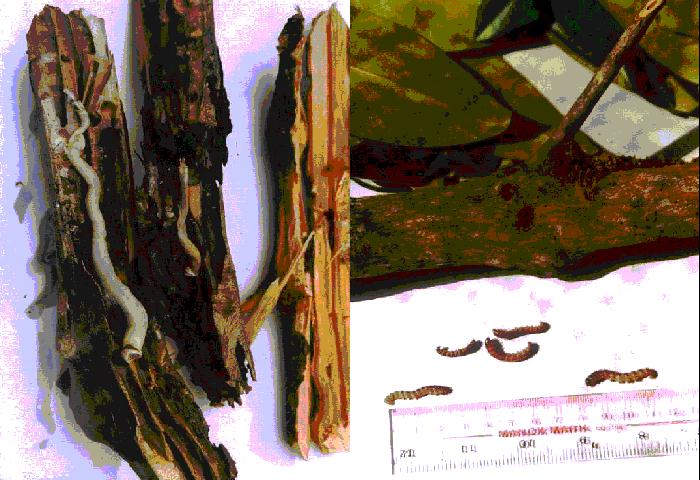
The macaques spent most time eating parts of mangrove trees, such as Rhizophora spp. (red mangrove), Avicennia spp. (black mangrove), and Ceriops spp. (yellow mangrove), which account for 33% of total feeding time. They spent a high percentage of time feeding on animals: Brachyura (crab suborder) species (11.17%), Bankia saulii (shipworm) (6.72%), and Zeuzera (wood-boring caterpillar) spp: (6.77%; see Figure 1). The proportion of food from human sources is 25%: 20.9% from Can Gio Mangrove Park staff; 4.1% from tourists.
Figure 1: Bankia saulii (left) and Rhizophora stem borer (Zeuzera sp.; right).
The macaques fed on crabs of two families: Grapsidae and Ocypodidae. At least six species are eaten: Helice tridens, Metaplax longipes, Sesarma bidens, Uca lactera, U. arculata, and U. crassipes. Macaques waded into the mud to look for Solen gouldi (razor clams), which occur intensively under mangrove leaf canopy (Nhuong, 1996).
| Food | X ± Sd |
| Rhizophora red mangrove: 2 spp. | 23.38 ± 14.57 |
| Avicennia (black mangrove: 3 spp.) | 5.38 ± 6.83 |
| Ceriops (yellow mangrove: 2 spp.) | 4.44 ± 10.02 |
| Lumnitzera racemosa (sandy mangrove) | 0.10 ± 0.51 |
| Pluchea indica (Indian fleabane) | 0.13 ± 1.06 |
| Phoenix paludosa (mangrove date palm) | 0.11 ± 0.84 |
| Acacia magium (brown saiwood) | 0.12 ± 0.75 |
| Psychotria serpens (Chinese serpent vine) | 0.43 ± 1.67 |
| Acanthus ebracteatus (sea holly) | 0.15 ± 0.82 |
| Sesuvium ortulacastrum (sea purslane) | 2.02 ± 3.89 |
| Grass species | 3.91 ± 5.57 |
| Fungi | 0.32 ± 1.42 |
| Bankia saulii (shipworm) | 6.72 ± 10.81 |
| Brachyura (crab: 6 spp.) | 11.17 ± 8.93 |
| Solen gouldii (razor clam) | 1.87 ± 5.16 |
| Zeuzera sp. (Rhizophora stem borer) | 6.77 ± 8.4 |
| Frogs | 0.42 ± 1.43 |
| Octopus | 0.17 ± 0.87 |
| Shrimp | 0.04 ± 0.4 |
| Insects | 6.18 ± 7.13 |
| Phascolosoma arcuatum (peanut worm) | 0.05 ± 0.57 |
| Provisioned food | 25.07 ± 11.74 |
| Unidentified food | 0.96 ± 2.4 |
Table 1: Yearly average proportion (X) and standard deviation (Sd) as percentage of time spent feeding on each food.
Macaques fed on some Rhizophora (R. apiculata and R. mucronata) and Avicennia spp. (A. alba, A. lanata, and A. officinalis), but there were differences in feeding time between different parts (Table 2).
| - | Rhizophora spp. | Avicennia spp. |
| Leaves | 7.73 ± 8.53 | 4.03 ± 5.21 |
| Buds | 0.96 ± 3.02 | 0.18 ± 1.19 |
| Flowers | 1.44 ± 3.08 | 0.15 ± 0.78 |
| Fruits | 9.93 ± 7.87 | 0.76 ± 3.02 |
| Roots | 2.84 ± 3.73 | 0.12 ± 0.7 |
| Bark | 0.48 ± 1.5 | 0.15 ± 0.66 |
| Total | 23.38 ± 14.57 | 5.38 ± 6.83 |
Table 2: Percentage of time spent feeding on mangrove parts.
They gouged out the thin, soft, moist bark of Rhizophora spp. with their teeth, leaving scars on the trunks. Bark can also provide water (Richard, 1967, pp. 82-94). Macaques never fed on any part of Excoecaria agallocha, a small tree that has poisonous latex sap.
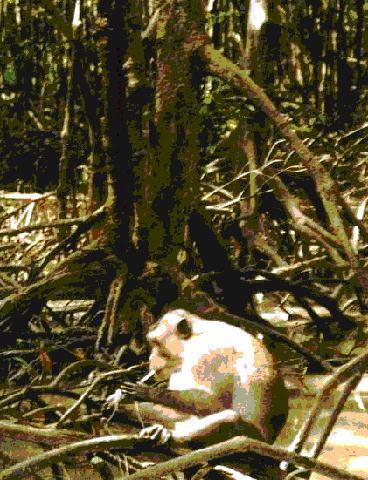
Figure 2: Male eating an octopus.
Identification of frogs, shrimp, and octopus that were eaten was difficult because most of them were “rare food”, eaten completely and quickly (Figure 2).
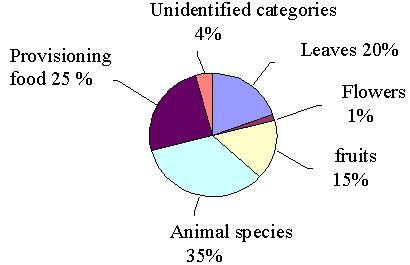
Figure 3: Percent diet composition
Figure 3 indicates the Can Gio Mangrove Forest macaques are omnivorous rather than frugivorous.
Monthly diet
In 2000 and 2001 the macaques spent from 14% to 33.2% of monthly feeding time on Rhizophora mangroves, and throughout the year feeding time was concentrated on a few species: Rhizophora spp., Avicennia spp., Ceriops spp., grasses, Zeuzera sp., Bankia saulii, Brachyura spp., and insects. Time spent feeding on provisioned food fluctuated between months, because the number of tourists visiting the Park changed monthly. There were monthly variations in time spent feeding on each food but there was no period of time in which the macaques fed on other foods or spent much time concentrating on some kinds of food. (For detailed monthly differences, contact the author.)
Differences among the three macaque groups
As seen in Table 3, there was no Solen gouldii in the diet of the Lam Vien group. Rare food such as octopus and frog constituted less than 1% of the diets of the Khe Doi and Khe Dinh groups.
| - | Khe Dinh (n=49) | Khe Doi (n=29) | Lam Vien (n=27) |
| Rhizophora spp. | 20.39 ± 10.07 | 23.91 ± 13.19 | 27.57 ± 33 |
| Avicennia spp. | 4.99 ± 6.15 | 2.37 ± 4.08 | 9.01 ± 16.35 |
| Ceriops spp | 0.52 ± 1.43 | 0.52 ± 1.58 | 16.76 ± 14.68 |
| Lummtzera racemora | - | - | 0.39 ± 0.98 |
| Pluchea indica | 0.2 ± 1.42 | 0.15 ± 0.84 | - |
| Phoenix paludosa | - | - | 0.43 ± 1.64 |
| Psychotria serpens | 0.32 ± 1.28 | 0.24 ± 0.96 | 0.84 ± 2.63 |
| Acanthus ebracteaus | 0.19 ± 1.02 | - | 0.23 ± 0.84 |
| Sesuvium ortulacastrum | 3.02 ± 4.91 | 0.64 ± 1.7 | 1.82 ± 3 |
| Grass | 4.11 ± 6.12 | 3.69 ± 4.12 | 3.28 ± 5.77 |
| Fungi | 0.42 ± 1.87 | 0.13 ± 0.74 | 0.33 ± 0.97 |
| Bankia saulii * | 6.66 ± 9.78 | 10.04 ± 15.57 | 4.07 ± 4.13 |
| Brachyura spp. * | 14.37 ± 10.73 | 9.45 ± 8.66 | 6.49 ± 6.31 |
| Solen gouldii * | 2.11 ± 5.59 | 2.91 ± 6.27 | - |
| Zeuzera sp.* | 4.49 ± 6.92 | 11.89 ± 10.04 | 5.57 ± 6.58 |
| Frogs * | 0.35 ± 1.21 | 0.94 ± 2.15 | - |
| Octopus * | 0.26 ± 1.05 | 0.17 ± 0.92 | - |
| Shrimp * | 0.08 ± 0.59 | - | - |
| Insects * | 6.61 ± 8.33 | 6.6 ± 7.2 | 5.74 ± 7.95 |
| Phascolosoma arcuatum* | - | 0.2 ± 1.09 | - |
| Provisioned food | 30.01 ± 10.08 | 25.06 ± 10.28 | 16.45 ± 9.57 |
| Unidentified food | 0.82 ± 2.35 | 0.54 ± 1.39 | 1.95 ± 3.39 |
Table 3: Average proportion (X) and standard deviation (Sd) of time spent feeding on each food category by the three groups of Can Gio macaques.
Monkeys of the Khe Doi group spent the largest proportion of time feeding on animal species (42.15%, compared to Khe Dinh: 34.93%, and Lam Vien: 21.87%). The percentage of feeding time spent on plant species by the Lam Vien group was considerably higher (60.65%) than the Khe Doi (31.66%) or Khe Dinh (34.16%) groups.
Generally speaking, the diets of the groups were similar but the percentage of time spent on each food category was different.
Besides food from the Park, the Khe Doi and Khe Dinh groups fed on food from tourists, so the time spent feeding on human-provided food of these two groups were higher than that of the Lam Vien group.
Provisioning and tourists’ feeding
The number of tourists visiting the “Monkey Park” has increased continuously from 70,000 people in 1999 to 224,000 people in 2001.
The Can Gio Mangrove Forest Park provided about 30 kg of boiled rice for about 500 macaques each day except weekends and holidays. Each monkey ate a daily average of 60 g of boiled rice, which could not meet their nutritional requirements; therefore they went into the mangrove forest to search for natural foods rich in protein, such as Brachyura species (11.9% protein), Zeuzera sp. (4.68% protein), and Rhiziphora or Avicennia leaves (> 3% protein; see Table 4).
More than 30 different types of fresh fruit, such as bananas, grapes, mangos, and oranges, were fed to the macaques by tourists. Feeding by tourists has caused “strange behavior” in crab-eating macaques. They beg or grab foods from tourists. Adult males even threaten tourists when they are not fed.
| - | Rhizophora leaves | Rhizophora fruit | Avicennia leaves | Brachyura spp. | Bankia saulii |
| Crude protein (%) | 3.27 | 2.13 | 3.89 | 11.97 | 4.68 |
| Crude fat (%) | 2.14 | 0.66 | 1.22 | 1.29 | 0.79 |
| Crude fiber (%) | 5.60 | 8.28 | 6.66 | 2.67 | 2.59 |
| Calcium (%) | 0.37 | 0.14 | 0.20 | 3.32 | 2.68 |
| Phosphorus (%) | 0.11 | 0.33 | 0.10 | 0.51 | 0.32 |
| NaCl (%) | 1.72 | 0.57 | 2.94 | 0.71 | 0.78 |
Table 4: Chemical composition of mangroves, crabs, and worms eaten by the macaques of Can Gio Mangrove Forest.
Discussion
The focal animal sampling method (Altmann, 1974) was used to collect feeding records of mangrove crab-eating macaques. This method cannot measure the amount of different foods ingested but it provides an estimate by the proportion of time animals spend feeding on each food item (Maruhashi, 1980).
Supriatna et al. (1988) used both focal animal sampling and scan sampling methods (Altmann, 1974) in their study of mangrove monkey diets in Maura Gembong, Indonesia. They found ten species of mangrove trees in the diets of crab-eating macaques and ebony langurs (Trachypithecus auratus). These mangrove trees are: Avicennia alba, Rhizophora mucronata, R. apiculata, Bruguiera gymnorrhiza, Sonneratia alba, S. acida, Nypa fruticans, Avicennia marina, A. officinalis, and Aegicera cornicula. The first five species occur in Can Gio Mangrove forest, but Can Gio mangrove macaques only fed on A. alba, R. mucronata, and R. apiculata.
Crab-eating macaques in Supriatna et al.’s study spent a high percentage of time feeding on fruits (50%), leaves (16.7%), bark (8.3%), cambium (8.3%), and roots (16.7%). It is surprising that their diet included no animal species, while Can Gio Mangrove forest macaques spent 35% of feeding time feeding on animal species.
Crab-eating macaques at Bukit Timah Nature Reserve in Singapore spent 14% of all feeding observations on human-supplied foods, 44% on fruits, 7% on flowers, and 8% on vegetative parts; 27% of dietary observations could not be identified (Lucas et al., 1991). Provisioned foods comprised 22% of the diet of Can Gio macaques; this was high compared with macaques living in Singapore.
According to Yeager (1996), during times of low fruit availability, the diet of crab-eating macaques in Kalimantan Tengah, Indonesia, became eclectic. They were opportunistic in their exploitation of other food sources.
For Can Gio mangrove macaques, the monthly variations in feeding time and dietary diversity seem to show that they were not subjected to periods of food shortage.
Kumara et al. (2000) reported that dietary patterns may also influence several other behavior patterns such as ranging. It is difficult to exactly classify animals into categories according to dietary preferences. Crabs have been documented as mangrove pests in Malaysia, Brazil, and Indonesia. According to Mwangi (2002), in central Java seedlings of Rhizophora mucronata have been attacked by Sesarma crabs, which cut off the roots of young seedlings. Can Gio macaques fed on crab species and on the Rhizophora wood borers, e.g. Zeuzera sp., that cause extensive defoliation on Rhizophora mucronata. Thus the macaque-flora interactions play an important role in keeping ecological balance in the mangrove forest.
Before 2000, macaques only picked up foods left on the ground. Since contacting tourists, macaques catch foods thrown by tourists. Feeding by tourists should be stopped because it damages the health and natural behavior of the monkeys.
The dietary composition of crab-eating macaques presented in this report is important for the following reasons: · This is the first time that dietary composition of crab-eating macaques living in a Vietnam mangrove forest has been reported. · This information is necessary for management of crab-eating macaques living in semi-natural conditions in mangrove forests, as well as of those in captivity.
References
Altmann, J. (1974). Observational study of behavior: Sample methods. Behaviour, 49, 227-267.
Fooden, J. (1995). Systematic review of Southeast Asian longtailed macaques, Macaca fascicularis (Raffles [1821]). Fieldiana Zoology, 81.
Hill, D. A. (1997). Seasonal variation in the feeding behavior and diet of Japanese macaques (Macaca fuscata yakui) in lowland forest of Yakushima. American Journal of Primatology, 43, 305-322.
Kumara. H. N., Singh, M. E., Singh, M. R., & Kumar, A. M. (2000). Faunal component in the diet of lion-tailed macaque. Primate Report, 58, 57-65.
Lucas, P. W., & Corlett, R. T. (1991). Relationship between the diet of Macaca fascicularis and forest phenology. Folia Primatologica, 57, 201-215.
Maruhashi, T. (1980). Feeding behavior and diet of the Japanese monkey (Macaca fuscata yakui) on Yakushima Island, Japan. Primates, 21, 141-160.
Mwangi, J. G. (2002). A new pest causing decline of mangrove forest in Kenya. Website: <www.easternarc.org/html/NewpestK.html>
Nakagawa, N. (1989). Bioenergetics of Japanese monkey (Macaca fuscata) on Kinkazan Island during winter. Primates, 30, 441-460.
National Research Council (1981). Techniques for the study of primate population ecology. Washington, DC: National Academy Press.
Newton-Fisher, N. E. (1999). The diet of chimpanzees in the Budongo Forest Reserve, Uganda. African Journal of Ecology, 37, 344-354.
Nhuong, N. V. (1996). Preliminary data of the composition of mangrove macrofauna in Cangio, Ho Chi Minh City. Scientific Information, College of Education, Vietnam National University, Hanoi, 5, 32-41.
Richard, A. F. (1967). Behavioural variation: Case study of a Malagasy lemur. Lewisburg, PA: Bucknell University Press.
Rose, L. M. (2000). Behavioral sampling in the field: Continuous focal versus focal interval sampling. Behaviour, 137, 153-180.
Son, V. D. (2002). Hematological values of Macaca fascicularis in a Mangrove forest, Vietnam. Laboratory Primate Newsletter, 41[4], 1-4; and <www.brown.edu/primate/lpn41-4.html#son>.
Son, V. D. (2003). Intestinal Parasites of Macaca fascicularis in a mangrove forest, Ho Chi Minh City. Laboratory Primate Newsletter, 42[2], 4-5; and <www.brown.edu/primate/lpn42-2.html#son>.
Supriatna, J., Adimuntja, C., Mitrasetia, T., Willy, E, Rufendi, D., & Manullang, B. (1989). Chemical analysis of food plant parts of two sympatric monkeys: Presbytis aurata and Macaca fascicularis in the mangrove forest of Muara Gembong, West Java. Biotrop Special Publication, 37, 161-169.
Wheatley, B. P. (1989). Diet of Balinese temple monkeys, Macaca fascicularis. Kyoto University Overseas Research Report of Studies on Asian Non-Human Primates, 7, 62-75.
Yeager, C. P. (1996). Feeding ecology of the long-tailed macaque (Macaca fascicularis) in Kalimantan Tengah, Indonesia. International Journal of Primatology, 17, 51-62.
-------------------------------------------
Author’s address: Saigon Zoo, 2 Nguyen Binh Khiem Str. Q.1, Ho Chi Minh City, Vietnam [084 9100885; fax: 084 8228309; e-mail: [email protected]].
The author is grateful to Dr. Shuichi Matsumura, Primate Research Institute, Kyoto University, for his comment on an earlier version of the manuscript. Thanks also go to staff members of Can Gio Mangrove Park for their help with the field study.
-------------------------------------------
* * *
Announcements from Publications
Gorilla Gazette Goes Electronic
Complimentary hard copies of the Gorilla Gazette are provided for each institution housing gorillas and any researchers or individuals working with gorillas. Electronic and printed versions are available by providing the following information to J. Dewar, P.O. Box 210, Morganton, GA 30560 [e-mail: [email protected]]: · your name; · affiliation (i.e., Zoo, Institution, University, etc); · position (i.e., Keeper, Researcher, Docent, Student, etc.); · mailing address and e-mail address, if available. If electronic version is requested, indicate if you prefer full text and graphics or text versions only.
New Magazine for GPS Users
GPS User Magazine is a new, Web-based, monthly publication for people who use Global Positioning System technology in their work. It is available free at <www.gpsuser.com>. The Editors are looking for potential authors and editorial advisors. Information for authors can be found on the Website, or contact Gail Elber, Senior Editor, P.O. Box 51475, Eugene, OR 97405 [541-543-0525; e-mail: [email protected]].
AJP Interim Editors Named
The Board of Directors of the American Society of Primatologists (ASP) announces the appointment of Drs. Melinda Novak and Randy Kyes as Interim Editors of the American Journal of Primatology. Dr. Novak is Professor and Chair of the Psychology Department at the University of Massachusetts, Amherst, and Dr. Kyes is a Staff Scientist and Head of the Division of International Programs at the Washington National Primate Research Center. Dr. Novak will coordinate the review of manuscripts in the broad areas of biomedical models, cognition and behavior, and laboratory studies, and Dr. Kyes in the broad areas of ecology, conservation, and anthropology. The Interim Editors invite scientists to submit manuscripts in all areas of primatology relevant to the mission of the ASP - “to promote and encourage the discovery and exchange of information about primates.”
Manuscripts should be submitted electronically as attachments (Microsoft Word or Adobe PDF formats) to Dr. Novak [e-mail: [email protected]]. See <www.interscience.wiley.com/jpages/0275-2565/> for further information on manuscript preparation and submission.
The Board of Directors of ASP has appointed a Search Committee for a permanent Editor, and invites applications and nominations for this position. ASP seeks an individual with a broad perspective on primatology, proven organizational abilities, and a strong commitment to excellence in research. Contact any member of the Search Committee: Jeanne Altmann [e-mail: [email protected]]; Carol Berman [e-mail: [email protected]]; Matt Kessler [e-mail: [email protected]]; Jeff Rogers [e-mail: [email protected]]; or Toni Ziegler [e-mail: [email protected]].
* * *
An Inversion in the Timing of Reproduction of Captive Macaca mulatta in the Southern Hemisphere
Daniela F. Gomes & Júlio César Bicca-Marques
Pontifícia Universidade Católica do Rio Grande do Sul
The rhesus macaque, Macaca mulatta, is a seasonal breeder (Coimbra-Filho & Maia, 1977; Lehman et al., 1994; Vandenbergh, 1973), whose mating season appears to be triggered by a reduction in length of daylight (Vandenbergh, 1973; see also Lancaster & Lee, 1965; Lehman et al., 1994). The importance of photoperiod for M. mulatta reproduction is reinforced by an inversion in the timing of their mating and birth seasons in the Southern Hemisphere. Whereas in the species’ natural range in the Northern Hemisphere births occur from March to September, in the Southern Hemisphere semi-captive rhesus macaques give birth from October to March (Coimbra-Filho & Maia, 1977).
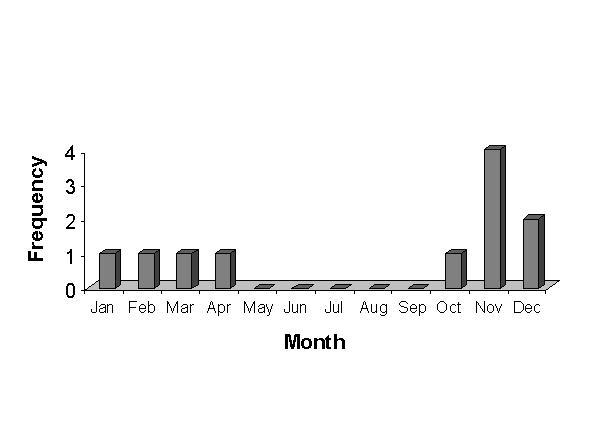
In this report we confirm this inversion with birth data from captive rhesus macaques in Brazil. Eleven births of M. mulatta occurring from 1987 to 2000 were reported, in response to a questionnaire, by four zoos: Parque Zoológico de Sapucaia do Sul, Rio Grande do Sul (approx. 29o50’S, 51o10’W, n=6); Jardim Botânico e Zoológico Municipal de Cachoeira do Sul, Rio Grande do Sul (approx. 30o03’S, 52o55’W, n=1); Fundação Rio-Zoo, Rio de Janeiro (approx. 22o55’S, 43o10’W, n=1); and Parque Zoo Arruda Câmara, Paraíba (approx. 7o05’S, 34o50’W, n=3). These births were clustered from October to April (Figure 1). Thus, there was a strong difference in the frequency of births between October-March and April-September (chi-sq = 7.36, d.f .= 1, p < 0.01).
Figure 1: Monthly distribution of births of captive Macaca mulatta in Brazil (N=11).
References
Coimbra-Filho, A. F., & Maia, A. A. (1977). As fases do processo reprodutivo de Macaca mulatta Zimmermann, 1780, na Ilha do Pinheiro, Rio de Janeiro, Brasil (Cercopithecidae, Primates). Revista Brasileira de Biologia, 37, 71-78.
Lancaster, J. B., & Lee, R. B. (1965). The annual reproductive cycle in monkeys and apes. In I. DeVore (Ed.), Primate Behavior. Field Studies of Monkeys and Apes (pp. 486-513). New York: Holt, Rinehart and Winston.
Lehman, S. M., Taylor, L. L., & Easley, S. P. (1994). Climate and reproductive seasonality in two free-ranging island populations of rhesus macaques (Macaca mulatta). International Journal of Primatology, 15, 115-128.
Vandenbergh, J. G. (1973). Environmental influences on breeding in rhesus monkeys. In C. H. Phoenix (Ed.), Symposia of the Fourth International Congress of Primatology: Vol. 2: Primate Reproductive Behavior (pp. 1-19). Basel: Karger.
-------------------------------------------
Corresponding author: J. C. Bicca-Marques, Pontifícia Universidade Católica do Rio Grande do Sul, Faculdade de Biociências, Porto Alegre, Rio Grande do Sul, Brazil [e-mail: [email protected]].
We thank the zoos that shared primate birth records with us, and the Pontifícia Universidade Católica do Rio Grande do Sul for logistical support.
-------------------------------------------
* * *
2004 Primate Calendars
Monkeys, Apes and Lemurs
Shirley McGreal, of the International Primate Protection League, tells us that a 2004 calendar titled “Monkeys, Apes and Lemurs”, with “photos of wild primates - no ‘freaky’ stuff”, is available at <www.browntrout.com>. The calendars cost $11.99 if mailed within the U.S.
ASP’s Primate Calendar
The American Society of Primatologists’ 2004 Calendar, featuring a primate for every month of the year, can be ordered using the form at <www.asp.org/conservation/aspcalendars/ aspcalendar2004orderform.html>. Proceeds ($15 each copy) go to the ASP General Fund and to the Conservation Fund. There is also a shipping and handling charge of $3.95 per calendar. Checks should be made out to the American Society of Primatologists and mailed to Evan L. Zucker, Treasurer, ASP, Department of Psychology, Box 194, Loyola University, 6363 St. Charles Ave., New Orleans, LA 70118 U.S.A. [504-865-3255; fax: (504) 865-3970; e-mail: [email protected]].
* * *
Primates de las Américas... La Página
Estimados lectores, en esta edición tenemos el resumen de una tesis de maestría desde México y el comienzo de una revisión de libros que esperamos sean de interés para la comunidad primatológica hispanoparlante. Saludos, Tania Urquiza-Haas <[email protected]> y Bernardo Urbani <[email protected]>.
Patrones de utilización de fragmentos de selva por el mono araña Ateles geoffroyi vellerosus en el sur de Veracruz, México.
Arturo González-Zamora, Maestría en Ciencias (Manejo de Fauna Silvestre), Instituto de Ecología A. C. <[email protected]>; y Salvador Mandujano, depto. Ecología y Comportamiento Animal, Instituto de Ecología A. C. <[email protected]>. Señas de ambos: Km 2.5 Carret. Ant. a Coatepec No. 351, Congregación del Haya, Xalapa 91070, Ver., México.
Se estudió el patrón de utilización de fragmentos por Ateles geoffroyi en un paisaje altamente fragmentado en el sur de “Los Tuxtlas”, Veracruz, México. El paisaje de estudio abarca 3,980 ha pero únicamente el 8% es hábitat para los primates repartido en 64 fragmentos la mayoría (90%) menor a 5 ha. En el paisaje de estudio existen seis grupos de monos araña y un individuo solitario habitando fragmentos distintos, con un total de 60 a 70 individuos. Para el presente estudio se seleccionaron dos fragmentos: uno de 24 ha habitado por 21 individuos de monos araña y otro de 4.6 ha con 5 individuos. Los muestreos se hicieron de octubre del 2001 a abril del 2002, acumulando un total de 292 horas de observación. Además, se muestreó la composición del estrato arbóreo de los fragmentos para conocer posibles relaciones entre la calidad del fragmento y los movimientos de los monos.
Se encontró que los fragmentos tienen una vegetación perturbada. La disponibilidad de alimento en los fragmentos es relativamente alto (30% de las especies e individuos arbóreos) y se distribuye de manera irregular al interior de estos. Se observó que el uso del fragmento difiere entre sexos ya que subgrupos de hembras usan frecuentemente solo algunas partes del fragmento, mientras que los machos lo usan indistintamente y se sobreponen con las áreas de actividad de las hembras. Las variables que explicaron la presencia de A. geoffroyi en los sectores de los fragmentos fueron la abundancia y el área basal de Ficus y otras especies arbóreas de talla grande. La distancia media de desplazamiento al interior del fragmento fue menor a 0.5 km al día y fue similar entre sexos. Los subgrupos más observados fueron de entre 2 y 6 individuos y todos incluyeron machos y hembras adultas, juveniles e infantes. Se observó baja frecuencia de movimientos de individuos entre fragmentos. Para el fragmento grande se recomienda incrementar su tamaño reforestando con especies de regeneración rápida típicas de selva y que sirvan para el consumo de los monos. Mientras que en el fragmento pequeño se recomienda la traslocación del grupo hacia un fragmento de mayor superficie. En conclusión, el número reducido de grupos e individuos de monos araña, el tamaño reducido de los fragmentos, la distancia de aislamiento entre los grupos y la carencia de corredores entre fragmentos, son factores que disminuyen la posibilidad de sobrevivencia de esta especie en el paisaje de estudio.
Listado de publicaciones primatológicas en español, Parte I: A-G.
Bernardo Urbani. Dept of Anthropology, Univ. of Illinois, 109 Davenport Hall, Urbana, IL 61801, U.S.A. [[email protected]]; y Tania Urquiza-Haas, School of Environmental Sciences, Univ. of East Anglia, Norwich NR4 7TJ, G.B. [[email protected]]
La presente es una revisión bibliográfica donde se incluyen exclusivamente libros y monografías sobre primates publicados en lengua española. Sólo se agregaron libros científicos y de divulgación científica, excluyendo novelas, narrativas y libros infantiles sobre primates o donde los primates sean personajes de los mismos. A continuación la primera parte, de la A a la G.
Álvarez, F. (1973). El comportamiento social y hormonas sexuales en Saimiri sciureus. Monografias de la Estación Biológica de Doñana, 2.
Angulo Parra, M. J. (1998). Los primates no humanos en Bolivia. Santa Cruz, Bolivia: Editorial Universitaria. Edición tambien del autor.
Aquino, R. & Encarnación, F. (1994). Primates of Perú; Los Primates del Perú. Primate Report, 40, 1-107.
Barrett, N. S., Burns, R., & Burns, R. (1991). Monos y simios. Nueva York: F. Watts.
Bloom, S. (1999). Dedicado a los monos. Neue Stalling (Alemania): Könemann Publications.
Bramblett, C. (1984). Comportamiento de los primates. México: Fondo de Cultura Económica (Edic. Orig. 1976).
Braza, F. (1980). El araguato rojo (Alouatta seniculus). Doñana Acta Vertebrata, 7[5], 1-75.
Cavalieri, P. & Singer, P. (1998). El proyecto “Gran Simio”. La igualdad más allá de la humanidad. Madrid: Editorial Trotta, S. A. (Edic. Org. 1993).
De la Torre, S. (2000). Primates de la Amazonia del Ecuador/Primates of Amazonian Ecuador. Quito, Ecuador: SIMBIOE, Serie fauna del Ecuador, 1.
De Waal, F. (1993). La política de los chimpancés. Madrid: Alianza Editorial. (Edic. Orig. 1982).
Eimerl, S. & DeVore, I. (1972). Los primates. México D.F.: Time-Life/Offset Multicolor S. A. (Edic. Orig. 1965).
Estrada, A., López-Wilchis, R., & Coates-Estrada, R. (eds.). (1993). Primatología en México: Comportamiento, ecología, aprovechamiento y conservación de primates. México, D.F.: Universidad Autónoma Metropolitana-Iztapalapa.
Estrada, A., Rodríguez-Luna, E., López-Wilchis, R., & Coates-Estrada R. (eds.). (1989). Estudios primatológicos en México. Volumen 1. Xalapa: Asociación Mexicana de Primatología/Biblioteca Universidad Veracruzana.
Fossey, D. (1988). Gorilas en la niebla. Barcelona: Salvat (Edic. Orig. 1983).
González-Kirchner, J. P. (1994). Ecología y conservación de los primates en Guinea Ecuatorial. San Vicente de la Barquera (Cantabria): Ceiba Ediciones.
Goodall, J. (1986). En la senda del hombre. Barcelona: Salvat (Edic. Orig. 1971).
Goodall, J. (1993). A través de la ventana. Barcelona: Salvat (Edic. Orig. 1990).
Goodall, J. Schaller, G. B., & Smith, M. G. (1993). Grandes simios. Entre dos mundos. Barcelona: National Geographic Society/Ediciones Folio S. A. (Edic. Orig. 1990).
Goustard, M. (1971). Los monos antropoides. Barcelona; Oikos-Tau (Edic. Orig. 1971).
* * *
Information Requested or Available
USDA Annual Animal Use Report
USDA no longer publishes a printed version of its Animal Care Annual Report. However, tables of the animal numbers for FY 2002 can now be accessed at <www.aphis.usda.gov/ac/ar2002.html>. The numbers include those of research animals that are NOT YET used (breeding colonies). As a result of this clarification, the total number of primates “used in research - including not yet used” has increased from about 50,000 to 96,000. - posted by Viktor Reinhardt to the LAREF list
Primate Fact Sheets
Primate Fact Sheets, in the Primate Info Network, <www.primate.wisc.edu/pin/factsheets/>, codify information about extant primate species into a structured format for use by educators, students, and the interested public. The coordinator, Sean Flannery [e-mail: [email protected]], welcomes comments, suggestions, and additional information about the species described.
Whistle-Blowing Site
The Animal Welfare Institute (AWI), a Washington, D.C.-based animal protection organization, announces a new Website, <www.labanimalissues.org>, for reporting specific concerns related to the care and use of animals in research, testing, and education. This is a confidential and secure site for seeking assistance for animals in laboratories who may need improved treatment and care or who may be suffering unnecessarily. Individuals may report their concerns anonymously if they wish. Follow-up by AWI may include inspecting the animal(s) involved, filing a complaint(s) with the appropriate oversight entity, and notifying the media and/or Congress.
More Interesting Websites
* * *
The 16th Congress of the Societé Francophone de Primatologie will be held October 22, 2003, in Brussels, Belgium. The meeting will be held with the Institut Royal des Sciences Naturelles de Belgique, and will focus on evolution in primates. Registration cost is 80 Euros for SFDP members; 40 Euros for students, and 110 Euros for all others. For information, see <www-sfdp.u-strasbg.fr/ancolloque.html> or contact Regine Vercauteren [e-mail: [email protected]].
The 2003 Winter Meeting of the Association for the Study of Animal Behaviour will be held at the Zoological Society Meetings Room, London Zoo, December 4-5, 2003. The topic will be “Hormones, brain and behaviour: Which comes in first?” For information, see <www.asab.org>.
* * *
Award Announcements
Lawrence Jacobsen Education Development Award
Anne Savage, Vice-President for Education, International Primatological Society, wrote to Primate-Science: “In honor of Larry Jacobsen’s commitment to providing resources, expertise, and guidance to the numerous students and researchers in the field of primatology, the Education Committee of the International Primatological Society is pleased to announce that the Education Award will now carry his name to recognize his outstanding contribution to the field of education and career development. “The Lawrence Jacobsen Education Development Award supports the initiation and long-term support of primate conservation education programs. This education award supports field conservation programs, work with local community and/or schools, or training in conservation education techniques. “I am pleased to announce the first recipient of this award: Dr. Gigi Joseph, Extension Education Officer of the Periyar Tiger Reserve in Kerala, India. His program, entitled “Education and awareness programs to conserve lion-tailed macaques (Macaca silenus) in Periyar Tiger Reserve, Kerala, India”, was awarded $1000 to support teacher and student training workshops on the conservation needs of the lion-tailed macaque.”
Animal Alternatives Award
Dr. Hilton Klein and his colleague Dr. Thomas Nolan have won the Animal Alternatives Award from Merck Research Laboratories (MRL), in recognition of a paper titled “Methods in Vascular Infusion Biotechnology in Research with Rodents”, which was published in The ILAR Journal, 2002, 43[3]. In this paper Drs. Klein, Senior Director of Comparative Medicine-Laboratory Animal Resources at MRL, and Nolan, retired from MRL in 1998 as Senior Research Veterinarian, described miniaturized animal models to facilitate drug discovery and development. This novel technology is being used to benefit Merck research areas including obesity, diabetes, cancer, and vaccines. The MRL Animal Alternatives Award recognizes Merck employees worldwide for developing and publishing on the reduction, refinement, or replacement of animals in their drug discovery efforts.
Debbie McGuire Gorilla Keeper Grant Awarded
Gorilla Haven/The Dewar Wildlife Trust are pleased to announce the first winner of the Debbie McGuire Gorilla Keeper Grant. There were six applications from literally around the world, listed in the order the applications were received: Mysore, India; Miami, Florida; Madrid, Spain; Johannesburg, South Africa; Jakarta, Indonesia; and Buffalo, New York. All six applications were reviewed by the Gorilla Haven Board of Advisors and some special friends, including a zoo director, an American Zoo and Aquarium Association official, an animal protection activist, and a lawyer. Twenty-nine people, of the 35 asked, rated each applicant from first to sixth choice. Applicants sought help to travel to Africa, or to other zoos and/or conferences, to print educational materials or provide enrichment equipment for gorillas at their zoos, and/or to further their education. It was a difficult decision and we’d like to thank the voters for taking time from their busy schedules to make thoughtful choices. Votes were tallied and assigned numerical values based on ranking. Since the two top vote recipients had such close numbers, we decided to call it a tie. Each gorilla keeper was awarded $500. Within 120 days but not later than November 1, 2003, each keeper will provide a written report on how the money was used, which will then be featured in a subsequent Gorilla Gazette. Congratulations to C. Shankara (Mysore Zoo) and Juan Vicente Martinez Santana (Madrid Zoo).
Applications for the 2004 Debbie Maguire Grant should be sent to Gorilla Haven, P.O. Box 210, Morganton, GA 30560, and received by September 1, 2003. The 2004 winner will be announced by November 2, 2003. Applicants should provide name, address, contact information, zoo and/or affiliation, and a brief essay (500 words) explaining why you believe you should receive the award, including your work experience, the animals you work with, and how, where, when or why the money will be spent. The grant is for $1,000, which may be awarded to one individual or split between two. For more information, contact Jane Dewar [e-mail: [email protected]] or see <www.gorilla-haven.org>.
Teaching Honor for Russell Tuttle
Russell Tuttle, Professor in Anthropology at the University of Chicago, has been awarded the American Anthropological Association/McGraw-Hill Award for Excellence in Undergraduate Teaching. Tuttle studies the evolution of human and primate morphology, locomotion, and other behavior. He also is an expert in paleoanthropology, particularly the evolution of bipedalism and of the human hand, and the history of theories of hominoid evolution and of social prejudice in physical anthropology. The Award “was established in 1997 to recognize teachers who have contributed to and encouraged the study of anthropology.” - From The University of Chicago Chronicle, July 17, 2003, posted to Primate-Science July 23
* * *
Grants Available
Student Research Grant for Conservation
The Animal Behavior Society (ABS) and its Conservation Committee announce the creation of the Student Research Grant for Conservation Award. This award seeks to encourage students of animal behavior to participate in meaningful conservation-related research. The award will be part of the ABS Student Research Grant Program and it will support a proposal considered meritorious for its science and its conservation component. This funding opportunity will become available for the 2003-2004 period. For additional information contact Guillermo Paz-y-Miño C., Chair ABS Conservation Committee, School of Biological Sciences, University of Nebraska-Lincoln, 348 Manter Hall, P.O. Box 880118, Lincoln, NE 68588-0118 [402-472-1283; fax 402-472-2083; e-mail: [email protected]].
Fyssen Foundation Research Grants
The aim of the Fyssen Foundation is to “encourage all forms of scientific inquiry into cognitive mechanisms, including thought and reasoning, which underlie animal and human behavior; their biological and cultural bases, and phylogenetic and ontogenetic development.” The Foundation supports research in ethology, psychology, neurobiology, anthropology, ethnology, human paleontology, and archeology.
The Foundation will award research grants to support postdoctoral researchers, under 35 years of age in the biological sciences and under 40 years of age in the human sciences, who wish to work independently by establishing around them a research team to achieve a collective scientific operation in a laboratory in France, and who will work in keeping with the Foundation’s goals. Priority will be given to researchers who will develop their project in a laboratory other than those in which they received their doctorates and are presently working.
The grant can range from 15,000 to 30,000 Euros without renewal. Financing for equipment above 7500 Euros is excluded. One year after the award, the researchers will have to provide a detailed financial report about the use of the grant and a short scientific report in French.
Applications should consist of: · applicant’s CV and list of publications; · description of the research project; · description of the budget; · names of people who have been approached about working on the project; · list of other financial requests; · a letter from the inviting laboratory, including the original copy; and · recommendation letters from two senior scientists outside the inviting laboratory, including original copies. Send 15 copies of the proposal to: Secrétariat de la Fondation Fyssen, 194 rue de Rivoli, 75001 Paris, France. Proposals must be received by October 31, 2003.
Age-Related Changes in Tissue Function
Applications are solicited on biological mechanisms of aging in tissues and organs. Projects are encouraged that significantly advance basic biology research to understand how and why changes take place in tissues with age and how those changes relate to altered tissue and organ function. Projects that focus on molecular aspects, as well as cellular aspects, of tissue aging are encouraged. Projects that emphasize molecular and cellular changes that are common among tissues with aging are also encouraged, as are projects that compare mechanisms of aging change in different tissues. Projects must have a clear relevance to aging to be considered.
This Program Announcement is intended to encourage basic research into processes that lead to altered function of tissues and organs as a result of aging. Research that takes maximal advantage of emerging genetic, genomic, and proteomic information on humans and other animals to understand changes that occur with aging is particularly encouraged. The following examples illustrate areas of research that are of interest, but serve as examples only, and are not exclusive. Research projects that focus on various aging tissues or physiological systems, including skin and liver, cardiovascular, musculoskeletal, immune, renal and urogenital, endocrine, gastrointestinal, and nervous systems are of interest. Basic biology studies of aging that use animal models or human tissue are of interest. For complete details, see <grants.nih.gov/ grants/guide/pa-files/PA-03-147.html>.
Direct questions about scientific/research issues to:
Frank L. Bellino, Endocrinology/Physiology [301-496-6402; fax: 301-402-0010; e-mail: [email protected]];
Jill L. Carrington, Chief, Systems Branch, Biology of Aging Program, Musculoskeletal Biology [301-496-6402; fax: 301-402-0010; e-mail: [email protected]];
David B. Finkelstein, Cardiovascular Biology [301-496-6402; fax: 301-402-0010; e-mail: [email protected]];
Rebecca A. Fuldner, Immunology [301-496-6402; fax: 301-402-0010; e-mail: [email protected]]; all at NIA, NIH, DHHS, 7201 Wisconsin Ave, Suite 2C231, MSC 9205, Bethesda, MD 20892-9205.
Stanley Slater, Geriatrics & Clinical Gerontology Program [301-496-6761; fax: 301-402-1784; e-mail: [email protected]] (same address, but Suite 3E327).
Bradley C. Wise, Neuroscience & Neuropsychology of Aging Program [301-496-9350; fax: 301-496-1494; e-mail: [email protected]] (same address, but Suite 350).
Suresh Mohla, Chief, Tumor Biology & Metastasis Branch, Division of Cancer Biology, NCI, NIH, DHHS, EPN, Suite 5000, Bethesda, MD 20892 [301-435-1878; fax: 301-480-0864; e-mail: [email protected]];
Lana Shekim, Director, Voice and Speech Programs, Division of Scientific Programs, NIDCD, NIH, DHHS, 6120 Executive Blvd., Rm 400C, Bethesda, MD 20892-7180 [301-496-5061; fax: 402-402-6251; e-mail: [email protected]];
Yasaman Shirazi, Program Director, Epithelial Cell Regulation & Transformation Program, Div. of Basic & Translational Sciences, NIDCR, NIH, DHHS, 45 Center Dr., Rm 4AN-18C, Bethesda, MD 20892-6402 [301-594-4812; fax: 301-480-8318; e-mail: [email protected]]; or
Catherine M. Meyers, Program Director of Inflammatory Kidney Diseases, Division of Kidney, Urologic & Hematologic Diseases, NIDDK, 6707 Democracy Blvd., Rm 641, Bethesda, MD 20892-5458 [301-594-7717; fax: 301-480-3510; e-mail: [email protected]].
Aging Musculoskeletal and Skin Extracellular Matrix
Grant applications are solicited for basic research projects to investigate how changes in the extracellular matrix with age affect the function of the tissues of the musculoskeletal system and skin. Projects are encouraged that determine how cellular aging processes lead to altered matrix production and maintenance, and how aging-related altered matrix composition and organization affect the function of these tissues. While some descriptive work may be justified to document changes that take place in extracellular matrix with age, studies are especially encouraged to investigate the mechanisms whereby aging leads to these changes and by which altered matrix affects cell and tissue function.
Basic biology studies on aging that use animal models or human tissues are of interest. The following examples illustrate areas of research that are of interest, but are not exclusive. · The mechanisms by which altered composition of the matrix seen with age affects mechanotransduction and the response of cells to loading. · Effect of age-related changes in matrix structure/function on the susceptibility of cells to altered apoptosis. · Effect of age-related changes in matrix structure/function on cell proliferation. · Interactions between cells and matrix that lead to characteristic alterations in cell or tissue mor-phology and function with age. For example, thinning of epidermis or change in fiber type in muscle. · How cell senescence affects matrix synthesis, secretion, assembly, or turnover. · How altered matrix composition or structure may predispose tissues to diseases commonly associated with aging, such as Paget’s disease or osteoarthritis. · How alterations in matrix composition or structure with age affect normal tissue repair or cell turnover, including involvement of stem cells in these processes. · How the changing extracellular matrix environment with age affects the local bioavailability of growth factors or hormones that influence tissue health and function. · Mechanisms by which changes in one tissue lead to altered structure and function in another tissue. For example, how muscle weakness of sarcopenia affects the structure and integrity of the associated bone. Such interaction could be effected through mechanotrans-duction, through soluble factors such as IL-6, or through other mechanisms. · How alterations in activity levels or function affect matrix structure and function, particularly in the context of disabling conditions; this may include studies of muscle atrophy and contractures or osteoporosis.
Direct your questions to:
Jill L. Carrington, Director, Musculoskeletal Biology, Biology of Aging Program, NIA, 7201 Wisconsin Ave, Suite 2C231, Bethesda, MD 20892 [301-496-6402; fax: 301-402-2210; e-mail: [email protected]];
William J. Sharrock, Musculoskeletal Diseases Branch, National Institute of Arthritis and Musculoskeletal and Skin Diseases, NIH, DHHS, One Democracy Plaza, 6701 Democracy Blvd., Suite 800, Bethesda, MD 20892-4872 [301-594-5055; fax: 301-480-4543; e-mail: [email protected]]; or
Ralph Nitkin, National Center for Medical Rehabilitation Research, National Institute of Child Health and Human Development, 6100 Executive Boulevard, Room 2A03, MSC 7510, Bethesda, MD 20892-7510 [301-402-4206; fax: 301-402-0832; e-mail: [email protected]].
Extramural Research Facilities Improvement
The National Center for Research Resources (NCRR) is authorized to “make grants or contracts to public and nonprofit private entities to expand, remodel, renovate, or alter existing research or animal facilities or construct new research or animal facilities.” The facilities will be used for basic and clinical biomedical and behavioral research and research training.
The principal objective of this program is to facilitate and enhance the conduct of PHS-supported biomedical and behavioral research by supporting the costs of designing and constructing non-federal basic and clinical research facilities to meet the biomedical or behavioral research, research training, or research support needs of an institution or a research area at an institution.
Matching funds ($1 to $1) will be required for the specific project awarded. Matching funds must be non-federal funds set aside for this project and must be “in hand” at the time the award is made. National Primate Research Centers will be required to provide matching funds in a ratio of 1 to 4.
Applications proposing a federal share of less than $1 million or more than $4 million will not be accepted. Because the nature and scope of the activities proposed in response to this announcement may vary, it is anticipated that the size of awards will vary also. Foreign institutions are not eligible to apply. Applications are encouraged from institutions of emerging excellence, which are defined as recipients of a “Center of Excellence” award in the fiscal year preceding the fiscal year in which an application is submitted in response to this announcement. Centers of Excellence awards are made by the Division of Health Professions Diversity, Bureau of Health Professions, Health Resources and Services Administration, Department of Health and Human Services. A list of the Centers of Excellence, and further information about this program, can be found at <bhpr.hrsa.gov/diversity/coe/default.htm>. The telephone number for additional information on these awards is 301-443-2982. The needs of smaller and developing institutions will be given special consideration.
Facility construction that may be supported under this program includes construction of new facilities, additions to existing buildings, completion of uninhabitable “shell” space in new or existing buildings, and major alterations and renovations. The acquisition and installation of fixed equipment such as casework, fume hoods, large autoclaves, or biological safety cabinets are allowed. Support for instrumentation or equipment that usually would be requested as part of a research project grant will not be provided. Note: The use of these federal funds to build “shell” space or acquire land or make off-site improvements is not allowed.
Direct inquiries to: Willie D. McCullough, Division of Research Infrastructure, NCRR, NIH/DHHS, 6701 Democracy Blvd., Room 940, Bethesda, MD 20892-4874 [301-435-0766; fax: 301-480-3770; e-mail: [email protected]]. Direct inquiries regarding technical programmatic issues (engineering and architectural) to: Esmail Torkashvan, at the same address, Room 928 [301-435-0766; fax: 301-480-3770; e-mail: [email protected]]. Application receipt dates are November 13, 2003, and February 18, 2004.
The facility must be used for the biomedical or behavioral research purposes for which it was constructed for at least 20 years, beginning 90 days following completion of the construction project. Any lease agreement must cover a time period sufficient for the usage requirement and be at least 20 years in length from the completion of the facility. An annual progress report is required for the 20 years’ federal interest in the facility as a condition of this award and must include a list of publications “originating from the use” of this project facility. This list should be limited to those scientific papers acknowledging NCRR support including grant numbers. Failure to comply with the 20-year utilization requirement will result in recovery of the federal share of the value of the facility.
Animal Welfare Enhancement Awards
Attention lab techs, animal techs, and all who work with laboratory animals: The Animal Welfare Institute (AWI) and the Johns Hopkins Center for Alternatives to Animal Testing (CAAT) have issued a call for proposals for Animal Welfare Enhancement Awards. An anonymous donor has provided funds to award up to twelve applicants with funds for proposals intended to improve laboratory animal welfare.
The focus of these awards is to improve housing, handling and/or experimental situations for laboratory animals. This program is not species limited. Studies may, for example, examine · how physiological and behavioral stress responses to common husbandry (e.g., capture) and traditional treatment procedures (e.g., gavage, injection, blood collection) can be reduced or eliminated (e.g., by training the subjects to cooperate rather than resist); · whether animals caged at different tier levels show different physiological and behavioral stress responses when being approached by personnel, and how these responses can be minimized or avoided; · whether the presence of a compatible companion buffers physiological and behavioral stress responses to experimental situations (e.g., enforced restraint).
Any studies to be undertaken must be noninvasive, with the possible exception of obtaining blood for biochemical measurements (which if possible should use animals who have been trained to cooperate during venipuncture). Objective measures might include behavior, coat appearance, body weight, analysis of feces, urine, or blood. Each award will be for $6,000. In the case of successful completion of the application, some individuals may be invited to present their papers at a national symposium. Additional funds will be provided for travel to these meetings.
This award is limited to North American applicants. The proposal itself should be in the form of a letter clearly stating the objectives of the study and the anticipated outcomes. It should provide sufficient detail so that reviewers can understand what is being proposed, how it will be achieved, and how the data will be evaluated. Each proposal must be approved by the Animal Care and Use Committee of the applicant’s institution, and the proposal itself must be co-signed by the Head of Animal Services at the institution.
Applications should be sent via e-mail to <[email protected]>. Any parts of the application that cannot be sent by e-mail must be sent in multiples of 10 copies each to Alan M. Goldberg, Ph.D., The Johns Hopkins University School of Hygiene and Public Health, 111 Marketplace, Suite 840, Baltimore, MD 21202-6709. The deadline for submission is December 10, 2003. Successful applicants will be funded by February 28, 2004.
It is hoped that successful applicants will be able to submit a manuscript of their project and its outcome to an appropriate journal. Final reports provided by the applicant will be posted on Websites such as the Animal Welfare Information Center Website, the Altweb site, the Animal Welfare Institute Website, and other places as appropriate.
* * *
News Briefs
New Wisconsin NPRC Library Director Appointed
Joseph W. Kemnitz, Director of the National Primate Research Center at the University of Wisconsin - Madison, wrote to Primate-Science: We are delighted to welcome Cynthia Robinson as the new director of the Center’s internationally recognized Library and Information Service. Cynthia will be joining us from the Bio-Medical Library at the University of Minnesota in Minneapolis where she is currently the Associate Director for Public Services. She brings a wealth of experience in reference, instructional, and outreach services. She will be working with our current outstanding librarians, Ray Hamel, Joanne Brown, and Matt Hoffman, and our graduate and undergraduate student assistants. Larry Jacobsen has generously agreed to be available to assure a smooth transition in leadership of the Center Library. We are confident that Cynthia will continue our long-standing commitment to serving Center staff and providing Internet-based services to the international primatological community. A special note of thanks is due to the Search Committee headed by Toni Ziegler for their excellent work on this important appointment.
Protected Animals Stolen from Research Institute
Rare lemurs and tortoises were stolen from a research institute in Tokyo’s Setagaya Ward on two occasions in May, the police and officials of the institute said. On May 15, a researcher who arrived in the morning at the Research Institute of Evolutionary Biology discovered that a ring-tailed lemur and three radiated tortoises had been stolen.
Sometime between the afternoon of May 22 and the following morning, a brown lemur, a ruffed lemur and two black lemurs were also taken from the facility. In both cases, the locks on the doors to the animals’ cages had been forced, they said. Police are investigating the incidents as theft. Commercial trade in the lemurs and tortoises is prohibited under the Convention on International Trade in Endangered Species of Wild Fauna and Flora. The institute, which has close ties with the Tokyo University of Agriculture, raises animals, including about 100 monkeys, for research into their evolution. The institute was unmanned when the two incidents occurred. - Posted to Primfocus June 30, 2003
Surrogate Parenting in Panama
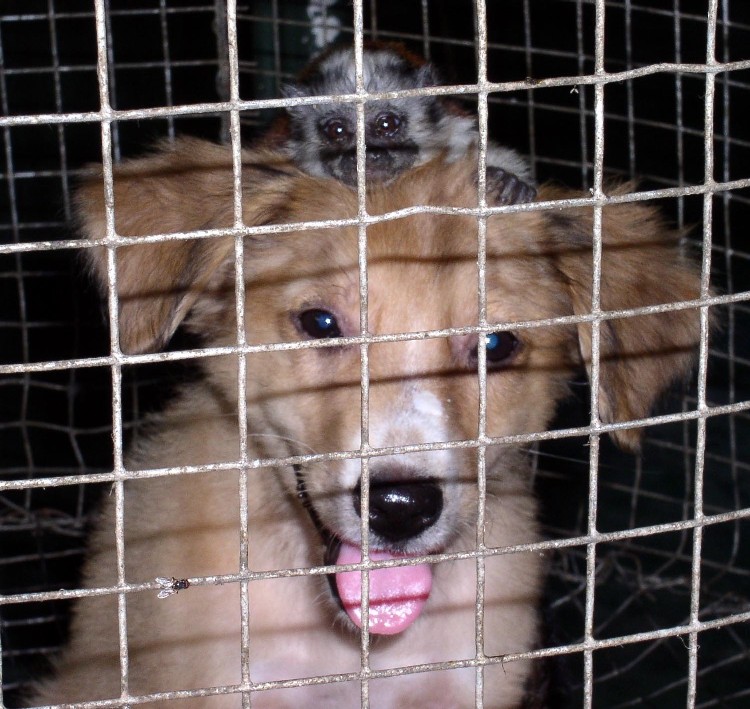
Dennis Rasmussen (Primate Foundation of Panama, Metropolitan Nature Park, Panama City, Panama [e-mail: [email protected]]) writes: “I’m happy to say that our surrogate-training program at the Primate Rescue Center in the Metropolitan Nature Park seems to be moving ahead. As you know, a monkey reared in isolation in a cage has a poor prognosis for normal behavior as an adult. It seems that holding, grooming, warmth, etc. are important components for the normal development of individuals in the order Primates. This means that, when we have gotten a baby monkey in the past, one of the staff of the Primate Foundation generally has had to pretty much ‘wear’ the monkey if there are no other young monkeys at the Rescue Center with whom we may pair it. We are now training a puppy to ‘wear’ baby monkeys. Mocha has a very calm disposition and seems to like it or, at least, not be annoyed by it.” See <www.PrimatesofPanama.org/> for more information on the PFP.
ALDF, AWI File Suit Against Dept of Agriculture
The Animal Legal Defense Fund (ALDF) and the Animal Welfare Institute (AWI) have sued in U.S. District Court, challenging the U.S. Department of Agriculture’s “failure to fulfill its obligation under the federal Animal Welfare Act (AWA) to ensure the humane treatment of primates in captivity. In 1985, Congress amended the AWA to require that standards be established to promote the psychological well-being of nonhuman primates in zoos, laboratories and other facilities. Though regulations aimed at fulfilling that obligation were finally issued in 1991, USDA itself determined seven years ago that the standards are inadequate and that its own inspectors did not know how to judge compliance. Yet despite years of study and review - including issuing a 108-page scientific report - USDA still has failed to act to correct this problem.” - From a ALDF press release, July 21
Orangutan Escapes from Rochester, New York, Zoo
Lowell, the Seneca Park Zoo’s 300-pound orangutan, briefly escaped the confines of his cage and embraced the volunteer busy cleaning his home. “I turned around and he was standing behind me,” Paul Louis said. “I wasn’t nervous at first. But he put his arms around me and picked me up, and he would not put me down.”
Lowell escaped from his cage at about 10 a.m. Zoo officials are not sure how. The public was never in danger because the orangutan was confined to a glass containment area that separates the animals from the public. Louis was not injured, but he did have a wild ride in the arms of a 300-pound orangutan. He said Lowell carried him a little down the passageway but never tried to hurt him. Louis, a volunteer at the zoo since May, said he patted Lowell’s head and even grabbed his hand to try to keep Lowell calm. The kidnapping ended when Lowell climbed back into his cage and pushed Louis out.
The zoo has procedures in place for situations like Tuesday’s escape. When animals make a break, all visitors are evacuated, and the facility is locked down. Also, an ambulance was called, although no one was injured. Lowell was out of his cage for about 15 minutes, said Larry Sorel, zoo director. The zoo reopened shortly after the incident. Sorel said this latest break would be investigated in hopes of determining how Lowell escaped from his cage. - Rochester Democrat and Chronicle, August 27
“Taiping Four” Fate Still Unsettled
At press time, the Government of Malaysia was sticking to its decision to transfer four confiscated gorillas currently being held at the Taiping Zoo to the National Zoo in Pretoria, South Africa, if it does not receive new information advising otherwise from the CITES secretariat. Malaysian Science, Technology and Environment Minister Datuk Seri Law Hieng Ding said that despite calls from certain quarters to have the animals sent to the Limbe Sanctuary in Cameroon, the government was not convinced that the sanctuary was a better option than a zoo. “Our prime concern is the welfare of the animals and we are trying to make sure that they end up in a place where they will be given the proper care and protection. We are skeptical of the sanctuary’s idea of returning the animals to the wild, especially with the unresolved bush meat problem in countries like Cameroon and Nigeria. These infants are likely to fall prey to poachers,” he said in an interview with The Star newspaper.
Limbe Sanctuary, however, does not “return animals to the wild,” but has an excellent record of keeping rescued gorillas in groups in safe, nearly-natural conditions.
End of Life for Loon
23-year-old Loon was euthanized at the San Diego Zoo in June. Loon, a drill, had diabetes, once a death sentence because monkeys aren’t inclined to offer up an arm and get stuck with a needle several times a day. But Loon helped pioneer a form of behavior training called operant conditioning. The technique has a number of applications, including medical management. For the last decade, Loon allowed his keepers to test his blood glucose three times a day, and to give him twice-daily insulin injections. The story of his training, by Gary Priest, the Zoo’s animal behaviorist, was featured in the January, 1991, issue of the LPN (“Training a diabetic drill (Mandrillus leucophaeus) to accept insulin injections and venipuncture,” 30[1], 1-4).
The lessons learned from operant conditioning with Loon have been used at the zoo and at the San Diego Wild Animal Park, Priest said. The technique is used for veterinary access, scientific investigation, and keeper safety, and has helped prolong the life of many animals. “[Loon’s] contributions to animal welfare to other zoos have been incredible,” Priest said. For a few years Loon was even a role model for young human diabetes patients, who were brought to the zoo to overcome their reluctance to be jabbed with needles several times day.
But he also suffered from arthritis recently. He was on massive amounts of arthritis painkillers, doses far too strong for long-term management, but permissible because he only had a short time left. “He’s the most successful long-term-care case to be medically managed,” said Karen Killmar, the zoo’s Associate Curator of Mammals. “He definitely has become part of history. He’s a special guy. But we came to the conclusion that it was time for him to go.”
Loon was given a sedative to relax him, then an immobilizing drug used on all animals during physical exams. Another drug stopped his heart. One of his keepers was with him the whole time. - Edited from the San Diego Union-Tribune, June 16, 2003
National Primate Liberation Week
Michael Budkie of Stop Animal Exploitation NOW has intensified his appeals to activists to participate in the annual “National Primate Liberation Week” scheduled this year for October 25 to November 2. He envisions demonstrations, vigils, leafleting, and other events, designed to attract media attention, at primate research facilities across the country.
Brazil Announces Six New Protected Areas
The state government of Amazonas, Brazil, announced today the creation of six new protected areas covering 3.8 million hectares of the world’s most biodiversity-rich territory. The new areas cover a region the size of Belgium or Costa Rica and bring the state’s overall protected area coverage to more than 40 percent. The six new areas are: the Rio Urubú State Forest, the Cuieiras and Samaúma State Parks, the Cujubim and Piagaçu-Purus Sustainable Development Reserves, and the Catuá-Ipixuna Extractive Reserve. - From a September 10 press release by Conservation International
* * *
Workshop Announcements
Gorilla Workshop - Calgary
The Calgary Zoo will host a Gorilla Workshop June 25-28, 2004. “With the opening of our new ‘Destination Africa’ pavilion and its huge new living quarters for our troop of nine gorillas, we thought it only appropriate to host a workshop to celebrate! There will be round-table forums, guest speakers, and plenty of time for keepers to exchange ideas and husbandry experience. Please bring a favorite gorilla treat recipe, your enrichment ideas, and any photos or videos that demonstrate these.” For more information contact: Calgary Zoo Gorilla Workshop Committee, 1200 Zoo Rd NE, Calgary, Alberta T2E 7V6 Canada [403-232-9300; e-mail: [email protected] or [email protected] or [email protected]].
ARENA IACUC 101
The Applied Research Ethics National Association (ARENA) co-sponsors one-day workshops, aimed at new Institutional Animal Care and Use Committee (IACUC) members, administrators, veterinarians, IACUC trainers, animal care staff, researchers, regulatory personnel, and others interested in IACUC roles and responsibilities. These are full day “didactic and interactive” courses. The materials and information provided during the morning course will be applied during the later afternoon session when students will be challenged to consider, deliberate, and develop action plans for a variety of potential IACUC scenarios. Participation of women, racial/ethnic minorities, persons with disabilities, and others who have been traditionally underrepresented in science, is encouraged.
Sessions will be held on October 9, 2003, in Portland, Oregon, cosponsored by Oregon Health and Science University, the University of Oregon, and the Northwest Association for Biomedical Research; and November 4, 2003, in Nashville, Tennessee, with Vanderbilt University.
More information can be found at <www.lawte.org>; or contact Mary Lou James, Consultant, Regulatory Compliance, Research Animal Welfare, 427 Graeser Rd, St. Louis, MO 63141 [314-997-6896; e-mail: [email protected]].
Science-Based Guidelines for Laboratory Animal Care
The National Institutes of Health’s Office of Laboratory Animal Welfare (OLAW) will join the Institute for Laboratory Animal Research of the National Academy of Sciences, the Medical Research Council of the United Kingdom, the Federation of European Laboratory Animal Science Associations, and the Canadian Council on Animal Care in co-sponsoring an International Workshop on Development of Science-Based Guidelines for Laboratory Animal Care, November 17-19, 2003. This seminar will bring together experts from around the world to assess the available scientific knowledge and identify gaps in current and pending guidelines for laboratory animal welfare. It will be held at the Georgetown University Conference Center, 3800 Reservoir Rd NW, Washington, DC 20057. The agenda, list of speakers, and hotel and registration information are posted at <dels.nas.edu/ilar/SBG_agenda2.asp>. For further information, contact Margaret C. Quinlan, Animal Welfare Program Specialist, OLAW, Office of Extramural Research, NIH, 6705 Rockledge Dr., RKL 1, Suite 360, Bethesda, MD 20892-7982 [301-401-4325; fax: 301-402-2803; e-mail: [email protected]].
Human Biology: An Evolutionary Perspective
A workshop will be held at the University of Montpellier II, France, December 1-3, 2003, “to present an up-to-date view of…human topics,” which are “experiencing breakthroughs due to reconsideration in an evolutionary perspective... This is particularly true for the scientific study of man: sociology, anthropology, ethnology, medicine, etc…. It will be particularly devoted to scientists and graduate students already familiar with evolutionary biology. It is also addressed to everyone interested in stimulating ideas on human biology and ecology.”
For information, contact Charlotte Faurie, Genetique de l’Adaptation, Univ. Montpellier II - CC 065, F 34095 Montpellier cedex 05, France [(033) 4.67.14.46.32l; fax: (033) 4.67.14.36.22; e-mail: [email protected]]; or see <www.isem.univ-montp2.fr /GE/meeting_site/human_biology.htm>.
* * *
CHIMPANZEE
Chimpanzees
High in the trees
In a tree it sleeps
Making its life so easy
Playing hide and seek all day
Anywhere you want to hide
Now it is time to go to bed
Zany in the morning and night
Eating fruit for lunch,
Eating playing having fun.
It’s what chimpanzees are all about!
Sophia D’Ambrosio, Second Grade,
Kennedy School, Providence
* * *
Symposia
Nonhuman Primate Models for AIDS
The 21st Annual Symposium on Nonhuman Primate Models for AIDS will be held October 22-25, 2003, at the Bell Harbor International Conference Center, Seattle, Washington, hosted by the Washington National Primate Research Center and sponsored by the National Institutes of Health’s National Center for Research Resources, National Cancer Institute, National Institute of Allergy and Infectious Diseases, and Office of AIDS Research. “The global public health impact of HIV/AIDS and important advances in AIDS-related research being conducted at primate research facilities dictate the need for periodic opportunities to exchange information, data, and ideas. The principal objective of this symposium is to serve as a scientific forum for the dissemination and exchange of new research findings, ideas and directions by an international group of scientists whose research focuses on the study of experimental immunodeficiency virus infections in nonhuman primates.”
For detailed information, contact Pamela Silimperi, Conference Coordinator, National Primate Research Center, University of Washington, Box 357331, Seattle, WA 98195 [206-543-0909; fax: 206-221-2820; e-mail: [email protected]]; or see <www.wanprc.org/NHPM2003>.
Alternative Reproductive Tactics in Primates
Joanna M. Setchell wrote to Primate-Science: “I am planning to organize a symposium on ‘Alternative reproductive tactics in primates’ for the XX Congress of the International Primatological Society in Turin next August. I’d like to hear from anyone working on ‘ART’ in male or female primates who would like to take part. Contact me at the Centre for Evolutionary Anthropology, School of Life & Sport Sciences, University of Surrey Roehampton, West Hill, London SW15 3SN, U.K. [e-mail: [email protected]].” Here is her abstract for the symposium:
“Intraspecific variation in reproductive tactics is expected to occur due to the adaptive adjustment of individuals to differences in their social and ecological environment. Where consistent and discrete variation occurs in the reproductive behavior of one sex within a population, and the tactics serve the same functional end, they are referred to as Alternative Reproductive Tactics (ART). Alternative behavioral tactics may occur with no associated morphological differences, but often co-occur with specific morphological, physiological, and life-history differences. A variety of ART have been described for male and female primates. Perhaps because the effects of male-male competition can be dramatic, intra-specific variation in male mating strategies has received far more attention than flexibility of reproductive behavior in female primates. However, females may also employ ART with important implications for lifetime reproductive success (e.g. callitrichids). Furthermore, interactions between the sexes play an important role in the expression and evolution of reproductive strategies. This symposium will examine the diversity of ART in primates, and the circumstances under which alternatives have evolved, with the aim of reaching some general conclusions regarding the study of ART in primates. Specific areas of interest include (but are not limited to): investigation of patterns of expression, behavior, morphology, physiology, and underlying life-history pathways; the influence of development on life-time strategies; how ART may change over a lifetime; and the relative fitness pay-offs of alternative phenotypes.”
* * *
Planned 2004 Revision of Directory of Graduate Programs in Primatology and Primate Research
An updated Directory will be published in the January, 2004, issue of the Laboratory Primate Newsletter. If you wish your program to be represented in this Directory or to revise your present entry, please send us the necessary information, following the format shown here as closely as possible. Return the information as soon as possible, but not later than December 1, 2003, to the Laboratory Primate Newsletter, Psychology Department, Box 1853, Brown University, Providence, RI 02912 [e-mail: [email protected]]. Please note that the Directory is not intended for postdoctoral programs, though any such sent to us will be listed separately.
For examples, see the 2002 Directory in the LPN, 38[1], 31-33; or see <www.brown.edu/Research/Primate/directory.html>.
Recommended format:
* * *
Positions Available
Environmental Enrichment - Washington State
SNBL USA, a contract research organization north of Seattle, is seeking an associate to implement their environmental enrichment plan for various animal species, including nonhuman primates. Maintaining good laboratory practices, this person will prepare and distribute enrichment items, document compliance, assist with data management and record keeping, perform behavioral observations and assessments, and train animals for procedures. A BA/BS degree in a related field, with at least 1-2 years’ experience working with animals, is preferred. Experience working with primates is a plus. Equivalent education and experience may substitute for these requirements. This is a full-time position. Contact Human Resources, SNBL USA, Ltd, Everett WA; fax a letter of interest and CV to 425-407-8601 [or e-mail: [email protected]]. Mention “EE Associate position”.
Research Animal Technician Positions
BIOQUAL, Inc., an established research facility in Rockville, Maryland, has available several laboratory animal technician positions at their nonhuman primate facilities. Duties include daily care, examinations, and technical procedures such as collecting and processing of blood and tissue samples for a variety of species; recording, maintaining, and compiling research data; preparing equipment and instruments for specimen collection and surgery; assisting the veterinarians in surgery, endoscopy, ultrasonography, and radiology for therapeutic and experimental procedures; preparing samples for shipment; communicating with NIH investigators or other research collaborators; supervising animal caretaker staff members; and other duties as assigned. Experience working with research animals in a laboratory setting and occasional weekend and on-call duty is required. AALAS Technician certification and experience with nonhuman primates is preferred. BIOQUAL, Inc., offers a competitive compensation and benefits package, including medical insurance, paid vacation and sick leave, a 401(k) retirement plan, professional membership dues, training opportunities leading to AALAS certification, and is an Equal Opportunity Employer. Salary will be commensurate with experience and credentials. Contact Jim Edwards, Facilities Manager, Division of Primate Biology and Medicine, BIOQUAL, Inc., 2501 Research Blvd, Rockville, MD 20850 [301-948-9565; e-mail: [email protected]].
Research Director - Primate Foundation of Arizona
The Primate Foundation of Arizona (PFA), a biomedical research institution, federally funded through the M.D. Anderson Cancer Center, University of Texas, Bastrop, is recruiting a Research Director to manage PFA’s research program. The program is focused on captive chimpanzee (Pan troglodytes) management, psychological well-being, and environmental enrichment. PFA maintains a colony of 74 chimpanzees that are socially housed in an enriched indoor/outdoor caged environment. The PFA psychological well-being program is dynamic and includes the provision of environmental enrichment to encourage species-typical behavior patterns, daily behavioral assessment of all colony animals, and continued scientific study to improve captive management. PFA’s educational programs include public outreach, K-12 community education, and undergraduate and graduate internship programs designed to provide an introduction to chimpanzee behavior, research methods, and environmental enrichment. The Research Director directs the above continuing programs and is responsible for design of new studies, as well as grant and manuscript writing. In addition, the Research Director acts as the PFA staff liaison to the PFA Institutional Animal Care and Use Committee, presents reports at each IACUC meeting, and is responsible for recognition and knowledge of all regulations pertaining to primate research.
Qualifications include a PhD in anthropology, psychology, or zoology with concentration in primate behavior; at least two years’ postdoctoral experience, primate behavioral research expertise, and management experience; experience in data management and analysis of large, longitudinal databases; excellent communication and organizational skills; and knowledge of data collection, computer management, and statistical analyses methods. Knowledge of IACUC protocol and regulations regarding the care and use of nonhuman primates in research is preferred.
PFA is an EOE Employer, and provides excellent benefits. Contact Jo Fritz, PFA, P.O. Box 20027, Mesa, AZ 85277-0027 [480-832-3780; fax 480-830-7039; e-mail: [email protected]].
Campus Veterinarian, NHLBI
The National Heart, Lung and Blood Institute (NHLBI), NIH, is seeking applicants for the position of Campus Veterinarian for NHLBI activities conducted on the NIH campus in Bethesda, Maryland. This position offers an exciting opportunity for making substantial contributions to the NHLBI’s Division of Intramural Research (DIR) program. The DIR currently utilizes a wide variety of laboratory animals including macaques, tamarins, and squirrel monkeys; farm animals (swine and sheep); dogs; rabbits; and rodents in its research program. As a key member of the Laboratory of Animal Medicine and Surgery team, the successful applicant will have responsibilities for planning, directing, coordinating, and evaluating all aspects of animal care and use activities on the NIH campus.
Responsibilities include: · supervision of animal care personnel, · providing veterinary clinical care and surgical support services to NHLBI investigators, · providing guidance in the development and implementation of animal use protocols to researchers, · maintaining the animal health surveillance program, · participating in the IACUC activities, · participating in the on-campus surgical support program, · representing NHLBI in central animal holding facility committees, · assisting in the education and training of animal care personnel, · advising the Chief, Laboratory of Animal Medicine and Surgery, and other intramural Laboratory and Branch Chiefs and research investigators on animal care, use, and welfare issues, · assuring compliance with all Federal and State animal care and use laws and regulations, and · maintaining AAALAC accreditation.
Salary will depend upon experience. Officers in the Commissioned Corps of the U.S. Public Health Service may also apply. Minimum qualifications are a DVM or equivalent degree from an AVMA-accredited school of veterinary medicine (board eligibility or certification by ACLAM is desirable), licensure in at least one state, experience in the AAALAC-accreditation process, and five years of progressively responsible experience in an animal research program. Experience with mouse breeding colonies and/or research-oriented surgical experience is also desirable. U.S. citizenship is required.
For additional information, contact J. “Buster” Hawkins, NHLBI, NIH, 14 Service Road South, Bldg 14E, Rm 105A, Bethesda, MD 20892-5570 [301) 451-6743; e-mail: [email protected]]. The submission deadline is November 1, 2003, or until the position is filled. To apply, submit CV and the names, addresses and telephone numbers of four professional references. NIH is an Equal Opportunity Employer.
NIH Facility Veterinarian - Bethesda, Maryland
The Division of Veterinary Resources (DVR), Veterinary Medicine Branch at the National Institutes of Health (NIH), is accepting applications for a Facility Veterinarian. The DVR contributes to the advancement of NIH research by consultative and collaborative interaction with NIH intramural researchers; provision of professional and technical support services related to the care and use of animals, including the provision and care of research animals; and providing disease control and diagnostic services.
The Veterinary Medicine Branch provides veterinary medicine and technical support to research animals; consults and collaborates with the intramural research community and their veterinary staff on the veterinary aspects of protocol design; provides pharmacy and nutrition services for the NIH laboratory animal community; provides environmental enrichment professional services and consultations to the NIH community; and manages and maintains a centralized surgical, intensive care and radiology service to support NIH intramural animal protocols.
This position requires expertise in laboratory animal medicine and knowledge of regulatory requirements for the care and use of animals in research. Responsibilities include provision of clinical care, direction of technical staff, protocol review, facility operation, strong working knowledge of laboratory animal medicine, and the ability to work with a wide spectrum of individuals in a number of capacities. The incumbent will have attending veterinarian responsibilities for an average census of 650 primates and oversight of veterinary staff. Practical experience with primate medicine is essential.
Candidates must have a DVM or equivalent degree from an AVMA-accredited school and one year of progressively responsible professional veterinary experience. Graduates of veterinary schools not AVMA-accredited must have Education Commission for Foreign Veterinary Graduates certification. Board eligibility or certification by the ACLAM is preferred.
Salary will depend on qualifications and experience. Interested candidates should submit a current CV, bibliography, and the names and addresses of three references, by October 31, 2003, to: Connie Williams, ORS Human Resources Branch, 31 Center Dr., MSC 2157, Bldg 31, Rm 4B41, Bethesda, MD 20892-2157 [301-402-1057; e-mail: [email protected]].
Ecology and Evolutionary Biology
The Department of Ecology and Evolutionary Biology at the University of Arizona invites applications for tenure-track positions. We hope to hire at the Assistant Professor level, but appointment at a higher rank is a possibility. The successful candidates will be expected to teach at the undergraduate and graduate levels and to develop externally-funded research programs of originality and depth. A PhD in a related field is required. Send CV, research and teaching statements, and three letters of recommendation to the search committee chair at Dept of Ecology & Evolutionary Biology, Biological Sciences West 310, Univ. of Arizona, Tucson, AZ 85721-0088.
Ecology: We are interested in candidates in all areas of ecology who perform research at any level of biological organization from organisms to ecosystems. Candidates working with any taxon and any combination of lab, field or theory-based methods will be considered. Dr. Larry Venable, Search Committee Chair. Organismal Biology: We seek an individual who studies the behavior, physiology, biomechanics, functional morphology, or neurobiology of organisms. Dr. Daniel Papaj, Search Committee Chair.
See <eebweb.arizona.edu> for updated information. The University of Arizona is an EEO/AA Employer.
* * *
Research and Educational Opportunities
Study Site for Masters and PhD Students - Peru
IKAM PERU, an organization centered in Moyobamba, Peru, that is working to promote conservation in the Alto Mayo region of Peru, invites students who are beginning their masters or doctoral work to consider the area of Alto Mayo, Peru, located in the district of San Martín, and home to 13 species of primates, including the endemic and threatened wooly (Lagothrix flavicauda) and titi (Callicebus oenanthe) monkeys. IKAM PERU is willing to provide housing in the city of Moyobamba, Peru, as well as to assist in establishing local contacts. IKAM PERU is also currently involved in establishing a free-ranging reserve for rescued Lagothrix lagotricha on 43 hectares of land on the banks of the Río Mayo. The organization is especially interested in students who would like to conduct studies on the behavior and/or health of L. lagotricha in this setting. Familiarity with Spanish is recommended. Contact Carlos Palomino, IKAM PERU, Moyobamba, Peru [e-mail: [email protected]].
Field Research for Students
The School for Field Studies is one of the country’s oldest and largest environmental study-abroad programs. Through our network of field stations, we work on a diverse range of critical environmental issues in resource-dependent communities around the world. Our goals are to: · Provide students with a unique and challenging interdisciplinary education and life experience as a step toward advancing their careers as skilled professionals and globally aware citizens; and to · Work with local communities to develop models for sustainably managing natural resources. By joining our programs, students will have the opportunity to study in some of the most beautiful and threatened ecosystems in the world while gaining hands-on field experience, cross-cultural learning, environmental knowledge, and personal growth. Our work has included helping save sea turtles in Mexico, monitoring coral reefs in the Turks and Caicos Islands, exploring human/wildlife conflicts in Kenya, restoring rainforest in Australia, testing organic farming protocols in Costa Rica, and more. Note: our facilities are also available for use by scientific researchers and short-term school groups.
Undergraduate students (semester and summer programs) or high school seniors (summer programs only) pay a program fee to participate in these programs, which are ideal for those planning careers in field research. However, any student interested in environmental and/or international studies will enjoy and benefit from our programs. For more information contact Kristin Hegazy, School for Field Studies, 10 Federal St, Salem, MA 01970 [978-741-3544; fax: 978-741-3551; e-mail: [email protected]]; or see <www.fieldstudies.org>.
Neuroscience Postdoc - Harvard
Marc Hauser, of the Primate Cognitive Neuroscience Lab at Harvard, announces that he has three years of funding for a postdoc interested in working on two aspects of nonhuman primate communication and cognition: 1) the natural vocal communication of both cotton-top tamarins and common marmosets; and 2) the perceptual and computational mechanisms that nonhuman primates share with humans vis a vis our capacity for language. Interested candidates should have a strong background in acoustics and expertise in one or more of the following areas: psycholinguistics, animal communication, neuroethology, animal cognition. Applicants should first look at <www.wjh.harvard.edu/~mnkylab> for recent publications on these topics and then contact Marc Hauser, Dept of Psychology, Primate Cognitive Neuroscience Lab, Harvard Univ., 33 Kirkland St, 10th Floor, William James Hall, Cambridge, MA, 02138 [617-495-3886 or 617-496-7077; e-mail: [email protected]].
Program to Enhance Base of DVM-PhDs
The Agricultural Research Service (ARS) is launching a pilot program that will pay for tuition, books and laboratory fees of a selected veterinarian who wants to obtain a PhD in order to conduct animal disease research. ARS is the chief scientific research agency of the U.S. Department of Agriculture.
“The research area could benefit from more doctors of veterinary medicine who also have PhDs,” said Roric E. Wells, ARS Deputy Director of Human Resources. “This educational combination is needed because we want to combine the veterinarian’s knowledge of animal medicine with the PhD training necessary to conduct research.”
The program participant must earn a PhD in a scientific discipline such as virology or microbiology that will prepare them to conduct animal disease research. The participant must maintain a B average while in the program and receive no grades lower than a C. It is anticipated that the participant will complete the PhD program within four years. The participant must agree to work for ARS for three years as a full-time research scientist after receiving a PhD.
Applicants for the pilot program must have earned their doctor of veterinary medicine (DVM) degree before beginning the PhD program, must be U.S. citizens, and must meet eligibility requirements established by the cooperating university. Applications will be reviewed by a panel that includes a representative of the university and ARS personnel including the agency’s South Atlantic Area Director, a research leader, the National Program Leader for Animal Health, and a human resources representative. The panel will be chaired by the ARS Associate Deputy Administrator for Animal Production, Product Value and Safety. Interested parties can obtain more information by calling Roric Wells [301-504-1479]. - from an ARS News Service news report, September 8, 2003
Residency Training in Laboratory Animal Medicine
The University of California-Davis, Center for Laboratory Animal Science (CLAS), and the California National Primate Research Center (CNPRC) seek qualified candidates for a three-year ACLAM-approved residency training program in Laboratory Animal Medicine. The Laboratory Animal Medicine residency program at UC-Davis is designed to prepare veterinarians for a career in laboratory animal medicine and to fulfill eligibility requirements for the certifying examination of the American College of Laboratory Animal Medicine.
The CLAS is one of the largest and most diverse vivaria in the United States. The CNPRC is the second largest national primate center supported by the NIH: a population of 4600 nonhuman primates provides exposure to an impressive clinical case load, including neonatal and geriatric care. The first year of the residency provides general training in the multiple disciplines of laboratory animal medicine including rotations through the CLAS Veterinarian Services, Comparative Pathology Laboratory, CNPRC, and the animal care and use committee. The second and third year allow residents to pursue specialized training and research in their areas of interest.
Interested individuals should contact Dr. Lon Kendall, CLAS [530-752-5836; e-mail: [email protected]]; or Dr. Kari Christe, CNPRC [530-752-2514; e-mail: [email protected]]. Applications will be accepted for positions beginning January 2004 until September 15, and until December 15, 2003 for positions beginning July 1, 2004.
* * *
NIH Design Policy and Guidelines Update
The Office of Research Facilities (ORF), Division of Policy and Program Assessment, National Institutes of Health (NIH), has updated the NIH Design Policy and Guidelines, the primary document used to design and construct facilities for the NIH.
The NIH Design Policy and Guidelines represents a large body of knowledge gathered from many sources within the Office of Research Facilities, the Office of Research Services, various Institutes and Centers throughout the NIH, other federal agencies, and the private sector. Its purpose is to provide guidance to the architect and engineer contractor and ORF staff in the preparation of NIH construction contract documents and to promote excellence in the process of planning, programming, designing, and constructing NIH facilities.
The NIH Design Policy and Guidelines establishes policy, design standards, and technical criteria for use in programming, designing, and constructing new buildings, and major and minor alterations for the NIH, but other people involved in animal facility or laboratory design planning may find them useful. The Spring, 2003, edition and the 1996-2000 edition of the guidelines are available: <des.od.nih.gov/eWeb/policy/html/index.html>.
* * *
Resources Wanted and Available
Environmental Enrichment & Refinement Database
<www.awionline.org/lab_animals/biblio/Laball.htm>, Viktor Reinhardt’s Environmental Enrichment & Refinement database, contains many articles on primate and nonprimate laboratory animals. If you know of any missing articles (especially those that you wrote yourself!), please send the references to Viktor Reinhardt, Animal Welfare Inst., P.O. Box 3650, Washington, DC 20007 [e-mail: [email protected]], so that he can include them in the database.
Gorilla Enrichment Notebook
Based on discussions on the gorilla keeper e-mail forum, Hope Walker has offered to put together a notebook with enrichment ideas from zoos and sanctuaries around the world. Please send your ideas and suggestions to her at P.O. Box 2101, Port Townsend, WA 93868 [e-mail: [email protected]].
AALAS Online Training Resource
The American Association for Laboratory Animal Science’s (AALAS) new online training resource, AALAS Learning Library, now open and ready for enrollment, lets you and your staff document training. Features include courses, testing, transcripts, Continuing Education Units (CEUs), and CEU certificates. There are courses for technicians, researchers, and IACUCs. Courses in management and safety topics will be available also later this month. Individuals or groups can enroll. Each group account includes a free Group Coordinator, who has access to courses and exams, manages group members, and has access to members’ transcripts. Course and lesson titles can be viewed on all courses in the site’s Animal Care and Use Library. Selected courses are open for free viewing. Go to <www.aalaslearninglibrary.org>. See also <www.aalas.org>. - Posted to CompMed by Nicole Duffee, July 9
The Primate Malarias CD-ROM now available
The Division of Parasitic Diseases (DPD) at the Centers for Disease Control and Prevention (CDC), Atlanta, Georgia, has prepared a CD-ROM version of The Primate Malarias, originally published in 1971. This now out-of-print book, by G. Robert Coatney, William E. Collins, McWilson Warren, and Peter G. Contacos, summarized the knowledge (up to that time) on the different species of Plasmodium that develop in nonhuman primates. It has served as a foundation for subsequent investigations on these parasites, their primate hosts, and their mosquito vectors. CDC is making this electronic version available to the scientific community free, in hopes that it will stimulate and support continued interest in these parasites and in the understanding and control of malaria. Order at <www.dpd.cdc.gov/dpdx/HTML/Training.htm>. Orders may be placed by e-mail or from DPDx Team, Centers for Disease Control and Prevention, MS F-36, 4770 Buford Hwy NE, Atlanta, GA 30341-3724. If you have fast internet access, such as a T3, T1, DSL, cable, or ISDN connection, you may want to simply download The Primate Malarias.
Primate Supply Information Clearinghouse
The purpose of the Primate Supply Information Clearinghouse (PSIC) is to promote conservation of nonhuman primates by facilitating their sequenced use in biomedical research, thereby minimizing the number of animals used and reducing laboratory demands on wild populations. PSIC matches research needs for nonhuman primates and primate materials - such as blood samples, tissues, and cadavers - with resources available from other institutions. Any needs and availabilities that are not immediately matched are published in New Listings, a twice-monthly newsletter. Other publications include Continuing Listings, published quarterly, listing long-term or continuous availability, and the Annual Resource Guide, which lists commercial primate suppliers and programs. The Clearinghouse also maintains a database of colonies, primates, and primate materials to which notices of availability and need can be referred. The Clearinghouse Website, <www.wanprc.org/psic/>, includes program information, subscription forms, primate taxonomy, and links to other Websites concerning regulations, laws, and primate trade. Services are available without charge to government-supported researchers and to other scientists in the United States using primates in their work. Services are also available to scientists in other countries by subscription. Contact PSIC, Washington RPRC, Box 357330, Univ. of Washington, Seattle, WA 98195-7330 [206-543-5178; fax: 206-616-1710; e-mail: [email protected]].
IPPL Archives Available
“The International Primate Protection League is 30 years old this year. A student volunteer (Hollis Woodard) has completed an index of all IPPL Newsletters from Number 1, with key words for each article. Please feel free to request a copy of the index, which is available as an Excel spread sheet. Anyone wanting back articles can obtain copies at cost. We hope this history focusing on the vile slave trade in our primate cousins will be a useful resource for students of the history of the animal protection movement.” - Dr. Shirley McGreal, Chairwoman, IPPL, P.O. Box 766, Summerville SC 29484-0766 [843-871-2280; fax: 843-871-7988; e-mail: [email protected]]; and see <www.ippl.org>.
* * *
Recent Books and Articles
(Addresses are those of first authors unless otherwise indicated)
Books
* Tarsiers: Past, Present, and Future. P. C. Wright, E. L. Simons, & S. Gursky (Eds.). Piscataway, NJ: Rutgers University Press, 2003. 328 pp. [Price: $75.00]
. . .Contents: Introduction, by P. C. Wright, E. L. Simons, & S. Gursky.
. . .PAST: Origins, Phylogeny, Anatomy, and Genetics. The fossil record of tarsier evolution, by E. L. Simons; The evolution of the tarsiid niche, by N. G. Jablonski; How close are the similarities between Tarsius and other primates? by J. H. Schwartz; Morphometrics, functional anatomy, and the biomechanics of locomotion among tarsiers, by R. L. Anemone & B. A. Nachman; The axial skeleton of primates: How does genus Tarsius fit? by F. A. Ankel-Simons & C. Simons; Phylogenetic position of tarsiers within the order primates: Evidence from y-giobin DNA sequences, by C. M. Meireles, J. Czelusniak, S. L. Page, D. E. Wildman, & M. Goodman; and The phylogenetic position of genus Tarsius: Whose side are you on? by A. D. Yoder.
. . .PRESENT: Taxonomy, Behavioral Ecology, and Vocalizations. The tarsiers of Sulawesi, by C. P. Groves; Outline of the vocal behavior of Tarsius spectrum: Call features, associated behaviors, and biological functions, by A. Nietsch; Territoriality in the spectral tarsier, Tarsius spectrum, by S. Gursky; The natural history of the Philippine tarsier (Tarsius syrichta), by M. Dagosto, D. L. Gebo, & C. N. Dolino; and Can we predict seasonal behavior and social organization from sexual dimorphism and testes measurements? by P. C. Wright, S. T. Pochron, D. H. Haring, & E. L. Simons.
. . .FUTURE: Conservation. History of captive conservation of tarsiers, by H. M. Fitch-Snyder; and Are tarsiers silently leaping into extinction? by P. C. Wright.
* Natural Pathogens of Laboratory Animals: Their Effects on Research. D. G. Baker. Herndon, VA: ASM Press, 2003. 397 pp. [Price: $119.95]
* The Design of Animal Communication. M. D. Hauser & M. Konishi (Eds.). Cambridge: MIT Press, 1999. [Price: $40.00]
. . .Contents include: Production, usage, and response in nonhuman primate vocal development, by R. M. Seyfarth & D. L. Cheney; The evolution of a lopsided brain: Asymmetries underlying facial and vocal expressions in primates, by M. D. Hauser; Mechanisms underlying the vocalizations of nonhuman primates, by D. L. Cheney & R. M. Seyfarth; and Communication and tool use in chimpanzees: Cultural and social contexts, by T. Matsuzawa.
Journal Contents
* Primate Conservation, 2003, Number 19.
. . .Contents include: Neotropical Region: New data on the distribution and abundance of Saimiri oerstedii citrinellus, by C. Sierra, I. Jiménez, M. Altrichter, M. Fernández, G. Gómez, J. González, C. Hernández, H. Herrera, B. Jiménez, H. López-Arévalo, J. Millán, G. Mora, & E. Tabilo; Conservation priorities for Colombian primates, by T. R. Defler, J. V. Rodríguez-M., & J. I. Hernández-Camacho; Distribution and conservation status of the primates of Trinidad, by K. A. Phillips & C. L. Abercrombie; and Translocation as a metapopulation management tool for the black lion tamarin, Leontopithecus chrysopygus, by E. P. Medici, C. B. Valladares-Pádua, A. B. Rylands, & C. S. Martins.
. . .Madagascar: A survey of the habitat of Lemur catta in southwestern and southern Madagascar, by R. W. Sussman, G. M. Green, I. Porton, O. L. Andrianasolondraibe, & J. Ratsirarson.
. . .Africa: Coprophagy and intestinal parasites: Implications to human-habituated mountain gorillas (Gorilla gorilla beringei) of the Virunga Mountains and Bwindi Impenetrable Forest, by T. K. Graczyk and M. R. Cranfield; The Cross River gorilla: The most endangered gorilla subspecies, by E. E. Sarmiento; and Primates of Guinea-Bissau, West Africa: Distribution and conservation status, by S. Gippoliti and G. Dell’Omo.
. . .Asia: Distribution and demography of the Nilgiri langur (Trachypithecus johnii) in Silent Valley National Park and adjacent areas, Kerala, India, by G. K. Joseph & K. K. Ramachandran; Pilot study and conservation status of the slender loris (Loris tardigradus and L. lydekkerianus) in Sri Lanka, by K. A.-I. Nekaris & J. Jayewardene; The pig-tailed macaque (Macaca nemestrina) in India: Status and conservation, by A. Choudhury; and Assamese macaques (Macaca assamensis) in Nepal, by M. K. Chalise.
Magazines and Newsletters
* Boletín de la Asociación Primatológica Española, January, 2003, 10[1]. [Depto. de Psicobiología, Buzón 150, Fac. de Psicología, Univ. Complutense de Madrid, Campus de Somosaguas, 28223 Madrid, Spain; also <www.uam.es/ape>]
. . .Contents include two articles about Fundación Mona and its Primate Recuperation and Rehabilitation Center, Spain’s first (and so far, only) primate sanctuary; see <www.fundacionmona.org>. This issue also includes a summary of a doctoral thesis by M. S. Ascunse: “Nucleotide variation in the mitochondrial DNA of Alouatta caraya in northeastern Argentina”.
* CC Update, Spring/Summer 2003, 14[1]. [Community Conservation Inc., 50542 One Quiet Lane, Gays Mills, WI 54631]
. . .Includes “Coalition to protect golden langurs”, “Exploring new projects and roles in Belize”, and “International Wildlife Conservation Congress in Colombia”.
* The Conservation Behaviorist, May 2003, 1[1],
<pazymino.freeyellow.com/TheConservationBehaviorist.html>.
. . .This biannual electronic resource informs Animal Behavior Society members about the Conservation Committee’s activities, research trends in behavior and conservation, and related scientific news.
* Gorilla Gazette, June, 2003, 16[1]. [Contact J. Dewar, P.O. Box 210, Morganton, GA 30560 <e-mail: jdewar@ gorilla-haven.org>, to subscribe]
. . .Includes articles on the tragic flood at the Prague Zoo; “Hormonal assessment of sexual maturation in four captive lowland gorilla males”; by A. Bellisari & J. A. French; an “African sanctuary contact list”; and the results of an African ape sanctuary survey; as well as many other items.
* ILAR Journal, 2003, 44[3].
. . .Includes the recommendations of the National Center for Research Resources and Office of AIDS Research/NIH-sponsored workshop panel “Demands for Rhesus Monkeys in Biomedical Research”, held April 19-20, 2002.
* IPPL News, August, 2003, 30[2]. [International Primate Protection League, P.O. Box 766, Summerville, SC 29484]
Reports
* Statut des populations de Gorilles (Gorilla gorilla gorilla) et de Chimpanzés (Pan troglodytes troglodytes) dans le sanctuaire á Gorilles de Mengamé, Province du Sud, Cameroun. T. Halford, H. Ekodeck, B. Sock, M. Dame, & P. Auzel. Ministry of Environment and Forests and the Jane Goodall Institute, 2003, 57 pp. (French with English Executive Summary). [Available at: <www.janegoodall.net/news/assets/RapportGrandsingesMengamefinal2003.pdf>]
* Occupational Health and Safety in the Care and Use of Nonhuman Primates. National Research Council. Washington, DC: National Academies Press, 2003. 184 pp. [Available at <www.nap.edu>]
. . .Intended as a reference for vivarium managers, veterinarians, researchers, safety professionals, and any other persons who are involved in developing or implementing an Occupational Health and Safety Program (OHSP) dealing with nonhuman primates, this report attempts to list the important features of an OHSP and to provide the tools necessary for informed decision-making in developing an optimal program that meets all particular institutional needs.
Special Journal Issues
* 20th Annual Symposium on Nonhuman Primate Models for AIDS. Journal of Medical Primatology, 2003, 32[4].
. . .Introduction, by P. A. Marx, M. Gardner, & T. R. Secrist; Simian AIDS: An historical perspective, by M. B. Gardner; Mother-to-infant transmission of SIV via breast-feeding in rhesus macaques, by A. M. Amedee, N. Lacour, & M. Ratterree; Dynamics of Simian immunodeficiency virus-specific cytotoxic T-cell responses in tissues, by R. S. Veazey, J. D. Lifson, J. E. Schmitz, M. J. Kuroda, M. Piatak, I. Pandrea, J. Purcell, R. Bohm, J. Blanchard, K. C. Williams, & A. A. Lackner; Transient early post-inoculation anti-retroviral treatment facilitates controlled infection with sparing of CD4+ T cells in gut-associated lymphoid tissues in SIVmac239-infected rhesus macaques, but not resistance to rechallenge, by J. D. Lifson, M. Piatak, A. N. Cline, J. L. Rossio, J. Purcell, I. Pandrea, N. Bischofberger, J. Blanchard, & R. S. Veazey; Antigenic variations in the CD4-induced sites of the CCR5-tropic, pathogenic SHIVsf162p3 gp120 variants, by M. Hsu, C. Buckner, J. Harouse, A. Gettie, J. Blanchard, J. E. Robinson, & C. Cheng-Mayer; Multigene DNA prime-boost vaccines for SHIV89.6P, by N. A. Doria-Rose, C. C. Pierce, M. T. Hensel, W. F. Sutton, N. Sheikh, P. Polacino, L. R. Kuller, Y.-D. Zhu, S.-L. Hu, D. Anderson, & N. L. Haigwood; Microarray analysis of cytokine and chemokine genes in the brains of macaques with SHIV-encephalitis, by Y. Sui, R. Potula, D. Pinson, I. Adany, Z. Li, J. Day, E. Buch, J. Segebrecht, F. Villinger, Z. Liu, M. Huang, O. Narayan, & S. Buch; Comparison of virology and immunology in SHIV 89.6 proviral DNA and virus-inoculated rhesus macaques, by M. Busch, D. Lu, L. Fritts, J. D Lifson, & C. J Miller; Expression of IFN-gamma induced CXCR3 agonist chemokines and compartmentalization of CXCR3+ cells in the periphery and lymph nodes of rhesus macaques during simian immunodeficiency virus infection and acquired immunodeficiency syndrome, by S. Sarkar, V. Kalia, M. Murphey-Corb, R. C. Montelaro, & T. A. Reinhart; and Abstracts -- 20th Annual Symposium on Nonhuman Primate Models for AIDS; September 8-11, 2002 Monterey, California.
* Non-Human Primates of India. Envis Bulletin: Wildlife and Protected Areas, 2001, 1[1]. (Wildlife Institute of India, Post Box #18, Chandrabani, Dehradun 248 001, India) [May be downloaded from <www.wii.gov.in/ envis/primates/downloads/index.htm>.]
. . .Sections include an Introduction, Species profiles, Status reports, Ex-situ initiatives in conservation, Primate-human interface, and Trade in primates.
* Ape and Human Evolution. Primates, 2003, 44[2].
. . .Contents: Preface, by O. Takenaka; How fruit abundance affects the chimpanzee party size: A comparison between four study sites, by C. Hashimoto, S. Suzuki, Y. Takenoshita, J. Yamagiwa, A. Kanyunyi Basabose, & T. Furuichi; Seasonal variation in association patterns of wild spider monkeys (Ateles belzebuth belzebuth) at La Macarena, Colombia, by Y. Shimooka; Mother-infant relationships and maternal estrogen metabolites changes in macaques (Macaca fuscata, M. mulatta), by M. Bardi, K. Shimizu, & S. M. Borgognini-Tarli; Long-term study of the social dynamics of patas monkeys (Erythrocebus patas): Group male supplanting and changes to the multi-male situation, by H. Ohsawa; Birth-season variation in Japanese macaques, Macaca fuscata, by J. Fooden & M. Aimi; Life history of male Japanese macaques living on Koshima Islet, by A. Mori & K. Watanabe; Scaling of lumbar vertebrae in anthropoids and implications for evolution of the hominoid axial skeleton, by M. Nakatsukasa & Y. Hirose; Endocranial cast and morphology of the olfactory bulb of Amphipithecus mogaungensis (latest middle Eocene of Myanmar), by M. Takai, N. Shigehara, N. Egi, & T. Tsubamoto; Extraordinarily low bone mineral density in an old female chimpanzee (Pan troglodytes schweinfurthii) from the Mahale Mountains National Park, by H. Gunji, K. Hosaka, M. A. Huffman, K. Kawanaka, A. Matsumoto-Oda, Y. Hamada, & T. Nishida; Bone mineral density in chimpanzees, humans, and Japanese macaques, by Y. Kikuchi, T. Udono, & Y. Hamada; Visual preference by chimpanzees (Pan troglodytes) for photos of primates measured by a free choice-order task: Implication for influence of social experience, by M. Tanaka; Levels of serum brain-derived neurotrophic factor in primates, by T. Mori, K. Shimizu, & M. Hayashi; Behavioral evidence of color vision deficiency in a protanomalia chimpanzee (Pan troglodytes), by A. Saito, A. Mikami, T. Hasegawa, K. Koida, K. Terao, S. Koike, A. Onishi, O. Takenaka, M. Teramoto, & Y. Mori; Perception of shape-from-motion in macaque monkeys and humans, by S. Unno, R. Kuno, M. Inoue, Y. Nagasaka, & A. Mikami; Comparative study of urinary reproductive hormones in great apes, by K. Shimizu, T. Udono, C. Tanaka, E. Narushima, M. Yoshihara, M. Takeda, A. Tanahashi, L. van Elsackar, M. Hayashi, & O. Takenaka; A model of the biogeographical journey from Proto-pan to Pan paniscus, by J. A. Myers Thompson; and A case report of a novel type of stick use by wild chimpanzees, by T. Nishimura, N. Okayasu, Y. Hamada, & J. Yamagiwa.
* Program for the 50th Annual Meeting of the Japanese Association for Laboratory Science. Experimental Animals, 2003, 52[3].
* Program and abstracts of the 26th annual meeting of the American Society of Primatologists, July 29-August 2, 2003. American Journal of Primatology, 2003, 60[Suppl. 1].
* Science & Society. EMBO reports, 2003, 4[Suppl. 1]. Free at [<www.nature.com/cgi-taf/DynaPage.taf?file=/embor/journal/v4/n6s/index.html>.]
. . .Includes reports on infectious diseases such as malaria, AIDS, and tuberculosis.
* Modern Trends in Malaria: Abstracts of an International Symposium held in New Delhi, 13-15 February, 2003. Bioscience Reports, 2003, 23[1].
Anatomy and Physiology
* Visual response properties of neurons in the parahippocampal cortex of monkeys. Sato, N., & Nakamura, K. (K. Nakamura, Department of Behavioral Brain Sciences, P.R.I., Kyoto Univ., Kanrin, Inuyama, Aichi 484-8506, Japan [e-mail: [email protected]]). Journal of Neurophysiology, 2003, 90, 876-886.
. . .“We examined visual response properties of single neurons in the parahippocampal (PH) cortex of alert monkeys using various visual stimuli (bars, geometrical shapes such as a circle, and images such as a human face) while the monkey fixated a spot for a juice reward. Of the investigated PH neurons 104 of 359 (29%) were found to be visually responsive. The investigation was focused on spatial and object aspects of visual processing. We investigated a visual receptive field (RF) property and a direction selectivity for a moving bar with respect to spatial processing. For half of these PH neurons (53%), the optimal stimulus position, where a visual stimulus elicited the maximal response, located peripherally, that is, with an eccentricity of more than 10 deg. More than 20% of these PH neurons had an RF that does not include the center of gaze. There were neurons in the PH cortex that appeared to convey motion signals. In addition, some PH neurons showed eye-position-dependent activity. With respect to object processing, we investigated selectivities for images, geographical shapes, orientations of a bar, and colors. For comparison purposes, we also examined responses of perirhinal (PR) neurons. PH neurons showed selective responses to these stimuli, but PR neurons were found to be more selective for images than PH neurons. These results suggest that the PH cortex is involved in both spatial and object processing, but less involved than the PR cortex in processing of complex images.”
* Reward-dependent gain and bias of visual responses in primate superior colliculus. Ikeda, T., & Hikosaka, O. (O. H., Lab. of Sensorimotor Research, NEI, NIH, 49 Convent Drive, Building 49, Rm 2A50, Bethesda, MD 20892 [e-mail: [email protected]]). Neuron, 2003, 39, 693-700.
. . .“Eye movements are often influenced by expectation of reward. Using a memory-guided saccade task with an asymmetric reward schedule, we show that visual responses of monkey SC neurons increase when the visual stimulus indicates an upcoming reward. The increase occurred in two distinct manners: (1) reactively, as an increase in the gain of the visual response when the stimulus indicated an upcoming reward; (2) proactively, as an increase in anticipatory activity when reward was expected in the neuron’s response field. These effects were observed mostly in saccade-related SC neurons in the deeper layer which would receive inputs from the cortical eye fields and the basal ganglia. These results, together with recent findings, suggest that the gain modulation may be determined by the inputs from both the cortical eye fields and the basal ganglia, whereas the anticipatory bias may be derived mainly from the basal ganglia.”
* Perirhinal and parahippocampal cortices of the macaque monkey: Cytoarchitectonic and chemoarchitectonic organization. Suzuki, W. A., & Amaral, D. G. (Center for Neural Science, New York University, 6 Washington Pl., Rm 809, New York, NY 10003 [e-mail: [email protected]]). Journal of Comparative Neurology, 2003, 463, 67-91.
. . .“Findings from recent tract-tracing studies examining the cortical and subcortical connectivity of the medial temporal lobe showed that the pattern of connections of areas TH and TF of the parahippocampal cortex were consistent with previous boundary demarcations of this region. In contrast, the connections of the perirhinal cortex (areas 35 and 36) indicated that the border of area 36 should be placed several millimeters more lateral than in earlier descriptions in the literature. The connections of this region also suggested that the perirhinal cortex extends rostrodorsally to include the medial portion of what is typically referred to as the temporal pole (areas TG, 38, or Pro). To determine if cyto- and chemoarchitectonic characteristics are consistent with the boundary scheme suggested by our tract-tracing studies, we carried out a detailed analysis of Nissl- and SMI-32-stained material throughout the perirhinal and parahippocampal cortices of the macaque monkey. The staining patterns seen in both these preparations are in excellent agreement with the boundaries defined by earlier connectional studies. Based on these studies, we recognize areas 35 and area 36 of the perirhinal cortex and area 36 contains five subdivisions. The parahippocampal cortex is composed of areas TH and TF and area TF contains two subdivisions. For both the perirhinal and parahippocampal cortices, we provide descriptions of the cytoarchitectonic and chemoarchitectonic features that are most useful for defining each cortical subdivision, as well as the features most useful for defining the boundaries with adjacent cortical regions. We discuss these findings in the context of the results of previous tract-tracing studies.”
Animal Models
* Distribution of high affinity choline transporter immunoreactivity in the primate central nervous system. Kus, L., Borys, E., Chu, Y. P., Ferguson, S. M., Blakely, R. D., Emborg, M. E., Kordower, J. H., Levey, A. I., & Mufson, E. J. (E. J. M., Dept of Neurological Science, 2242 W Harrison St, Suite 200, Chicago, IL 60612 [e-mail: [email protected]]). Journal of Comparative Neurology, 2003, 463, 341-357.
. . .A mouse monoclonal antibody (clone 62-2E8) raised against a human recombinant high-affinity choline transporter (CHT)-glutathione-S-transferase fusion protein was used to determine the distribution of immunoreactive profiles containing this protein in the monkey central nervous system (CNS). Within the monkey telencephalon, CHT-immunoreactive perikarya were found in the striatum, nucleus accumbens, medial septum, vertical and horizontal limb nuclei of the diagonal band, nucleus basalis complex, and the bed nucleus of the stria terminalis. Dense fiber staining was observed within the islands of Calleja, olfactory tubercle, hippocampal complex, and amygdala; moderate to light fiber staining was seen in iso- and limbic cortices. CHT-containing fibers were also present in sensory and limbic thalamic nuclei, preoptic and hypothalamic areas, and the floccular lobe of the cerebellum. In the brainstem, CHT-immunoreactive profiles were observed in the pedunculopontine and dorsolateral tegmental nuclei, the Edinger-Westphal, oculomotor, trochlear, trigeminal, abducens, facial, ambiguus, dorsal vagal motor, and hypoglossal nuclei. In the spinal cord, CHT-immunoreactive ventral horn motoneurons were seen in close apposition to intensely immunoreactive C-terminals at the level of the cervical spinal cord. CHT immunostaining revealed a similar distribution of labeled profiles in the aged human brain and spinal cord. Dual fluorescent confocal microscopy revealed that the majority of CHT immunoreactive neurons contained the specific cholinergic marker, choline acetyltransferase, at all levels of the monkey CNS. The present observations indicate that the present CHT antibody labels cholinergic structures within the primate CNS and provides an additional marker for the investigation of cholinergic neuronal function in aging and disease.
* Single neurons in the monkey hippocampus and learning of new associations. Wirth, S., Yanike, M., Frank, L. M., Smith, A. C., Brown, E. N., & Suzuki, W. A. (W. A. S., Center for Neural Science, New York University, New York, NY 10003 [e-mail: [email protected]]). Science, 2003, 300, 1578-1581.
. . .The medial temporal lobe is crucial for the ability to learn and retain new declarative memories. This form of memory includes the ability to quickly establish novel associations between unrelated items. To better understand the patterns of neural activity during associative memory formation, the activity of hippocampal neurons of macaque monkeys was recorded as they learned new associations. Hippocampal neurons signaled learning by changing their stimulus-selective response properties. This change in the pattern of selective neural activity occurred before, at the same time as, or after learning, which suggests that these neurons are involved in the initial formation of new associative memories.
* Chronic hepatitis associated with GB virus B persistence in a tamarin after intrahepatic inoculation of synthetic viral RNA. Martin, A., Bodola, F., Sangar, D. V., Goettge, K., Popov, V., Rijnbrand, R., Lanford, R. E., & Lemon, S. M. (S. M. L., Dept of Microbiology & Immunology, Univ. of Texas Med. Branch, 301 University Blvd, Galveston, TX 77555-1019 [e-mail: [email protected]]). Proceedings of the National Academy of Sciences, U.S.A., 2003, 100, 9962-9967.
. . .Progress in understanding the pathogenesis of hepatitis C virus (HCV) has been slowed by the absence of tractable small animal models. Whereas GB virus B (GBV-B, an unclassified flavivirus) shares a phylogenetic relationship and several biologic attributes with HCV, including hepatotropism, it is not known to cause persistent infection, a hallmark of HCV. Here, we document persistent GBV-B infection in one of two healthy tamarins (Saguinus oedipus) inoculated intrahepatically with infectious synthetic RNA. High-titer viremia (108 to 109 genome equivalents per ml) and transiently elevated serum alanine transaminase activities were present from weeks 4 to 12 postinoculation in both animals. However, whereas GBV-B was eliminated from one animal by 20 weeks, the second animal remained viremic (103 to 107 genome equivalents per ml) for >2 years, with alanine transaminase levels becoming elevated again before spontaneous resolution of the infection. A liver biopsy taken late in the course of infection demonstrated hepatitis with periportal mononuclear infiltrates, hepatocellular microvesicular changes, cytoplasmic lipid droplets, and disordered mitochondrial ultrastructure, findings remarkably similar to chronic hepatitis C. GBV-B-infected hepatocytes contained numerous small vesicular membranous structures resembling those associated with expression of HCV nonstructural proteins, and sequencing of GBV-B RNA demonstrated a rate of molecular evolution comparable to that of HCV. We conclude that GBV-B is capable of establishing persistent infections in healthy tamarins, a feature that substantially enhances its value as a model for HCV. Mitochondrial structural changes and altered lipid metabolism leading to steatosis are conserved features of the pathogenesis of chronic hepatitis caused by these genetically distinct flaviviruses.
* Spreading and synchronization of intrinsic signals in visual cortex of macaque monkey evoked by a localized visual stimulus. Liu, G. B., Zhang, Y., Pettigrew, J. D., Xu, W. F., & Li, C.-Y. (C.-Y. L., Inst. of Neuroscience, Shanghai Inst. of Biol. Sciences, Chinese Acad. of Sciences, Shanghai 200031, China [e-mail: [email protected]]). Brain Research, 2003, 985, 13-20.
. . .Spatio-temporal maps of the occipital cortex of macaque monkeys were analyzed using optical imaging of intrinsic signals. The images obtained during localized visual stimulation (IS) were compared with the images obtained on presentation of a blank screen (IB). We first investigated spontaneous variations of the intrinsic signals by analyzing the 100 IBs for each of the three cortical areas. Slow periodical activation was observed in alternation over the cortical areas. Cross-correlation analysis indicated that synchronization of spontaneous activation only took place within each cortical area, but not between them. When a small, drifting grating (2°×2°) was presented on the fovea, a dark spot appeared in the optical image at the cortical representation of this retinal location. It spread bilaterally along the border between V1 and V2, continuing as a number of parallel dark bands covering a large area of the lateral surface of V1. Cross-correlation analysis showed that during visual stimulation the intrinsic signals over all of the three cortical areas were synchronized, with in-phase activation of V1 and V2 and anti-phase activation of V4 and V1/V2. The significance of these extensive synergistic and antagonistic interactions between different cortical areas is discussed.
* Pathology of human influenza A (H5N1) virus infection in cynomolgus macaques (Macaca fascicularis). Kuiken, T., Rimmelzwaan, G. F., Van Amerongen, G., & Osterhaus, A. D. M. E. (Inst. of Virology, National Influenza Center, Erasmus Med. Ctr, P.O. Box 1738, 3000 DR Rotterdam, The Netherlands [e-mail: [email protected]]). Veterinary Pathology, 2003, 40, 304-310.
. . .“Infection with influenza A (H5N1) virus, which has not been associated with respiratory disease in humans previously, caused clinical signs of acute respiratory distress syndrome and multiple-organ dysfunction syndrome with high mortality in humans in Hong Kong in 1997. To study the pathogenesis of this disease, we infected four cynomolgus monkeys with 2.5 x 10⁴ median tissue culture infectious dose (TCID50) of influenza virus A/Hong Kong/156/97 (H5N1) and euthanatized them 4 or 7 days after infection. The main lesion was a necrotizing broncho-interstitial pneumonia (4/4) similar to those found in primary influenza virus pneumonia in humans, with desquamation of respiratory epithelium (4/4), intra-alveolar hemorrhage (4/4), hyaline membrane formation (2/4), and infiltration with neutrophils and macrophages (4/4). Lesions in other organs consisted of a suppurative tonsillitis (2/4) and necrosis in lymphoid organs (1/4), kidney (1/4), and liver (1/4). By immunohistochemistry, influenza virus antigen was limited to pulmonary tissue (4/4) and tonsils (2/4). Based on these results, we suggest that the cynomolgus monkey is a suitable animal model for studying the pathogenesis of human H5N1 virus infection and that multiple-organ dysfunction syndrome in this disease may be caused by diffuse alveolar damage from virus replication in the lungs alone.”
* Cholesterol-fed ovariectomized monkeys are good animal models for human atherosclerosis of postmenopausal women. Torii, R., Shiomi, M., Ito, T., Tamada, S., Eguchi, Y., & Ikeda, N. (Research Center for Animal Life Science, Shiga University of Medical Science, Tsukinowa-cho, Seta Ohtsu 520-2192, Japan). Primates, 2003, 44, 247-252.
. . .Although it is well known that the incidence of atherosclerosis is markedly increased in postmenopausal women, antiatherosclerotic effects of estrogen replacement therapies are not clear. One of the reasons for this is due to the lack of appropriate animal models for atherosclerosis of postmenopausal women. Therefore, we attempted to develop an animal model for atherosclerosis of postmenopausal women and examined the antiatherosclerotic effects of estrogen replacement therapy. Adult ovariectomized Japanese monkeys were fed 2% cholesterol diet alone (C-group) or in combination with conjugated estrogen (CE-group) for 30 months. The serum estradiol-17ß levels of the CE-group were varied between 10 and 204.5 ng/dl during treatment. In the C-group, the serum total cholesterol levels were increased from 110 to 270 mg/dl, and atheroma was first observed after 3-months' treatment with angioscopy. In the CE-group, the levels of the serum total cholesterol during treatment were 30% lower than those of the C-group, and the aortic lesions were first observed after 12-months' treatment with angioscopy. The aortic intimal thickness of the CE-group was 58% of the C-group. This finding showed good agreement with the angioscopic observation. The aortic lesions were of a fibromuscular type in both groups. In conclusion, a cholesterol-fed ovariectomized monkey is an appropriate animal model for atherosclerosis of postmenopausal women. Furthermore, angiofiberscopic and histopathological observations suggested that estrogen replacement therapy was valid for atherosclerosis of postmenopausal women.
Behavior
* Benzoquinones from millipedes deter mosquitoes and elicit self-anointing in capuchin monkeys (Cebus spp.). Weldon, P. J., Aldrich, J. R., Klun, J. A., Oliver, J. E., & Debboun, M. (J. R. A., Chemicals Affecting Insect Behavior Laboratory, USDA-ARS, Beltsville, MD, 20705 [e-mail: [email protected]]). Naturwissenschaften, 2003, 90, 301-304.
. . .Neotropical monkeys of the genus Cebus anoint themselves by rubbing arthropods and plants against their pelage. A recent study has shown that free-ranging wedge-capped capuchin monkeys (C. olivaceus) in Venezuela self-anoint with a benzoquinone-secreting millipede, an activity by which they are hypothesized to appropriate chemical deterrents of mosquitoes. To evaluate the plausibility of this hypothesis, female yellow fever mosquitoes (Aedes aegypti) were presented with two millipede secretory compounds, 2-methyl-1,4-benzoquinone and 2-methoxy-3-methyl-1,4-benzoquinone, on nylon-reinforced silicone membranes placed over wells filled with human blood, a highly preferred food. Mosquitoes exhibited fewer landings, fed less frequently, and flew more frequently (a possible indication of repellency) in the presence of membranes treated with benzoquinones than with controls. These compounds also elicit self-anointing in captive male and female tufted (C. apella) and white-faced (C. capucinus) capuchin monkeys.
* Facial expressions linked to monkey calls. Ghazanfar, A. A., & Logothetis, N. K. (Max Planck Inst. for Biological Cybernetics, 72076 Tübingen, Germany [e-mail: [email protected]]. Nature, 2003, 423, 937-938.
. . .“The perception of human speech can be enhanced by a combination of auditory and visual signals. Animals sometimes accompany their vocalizations with distinctive body postures and facial expressions, although it is not known whether their interpretation of these signals is unified. Here we use a paradigm in which ‘preferential looking’ is monitored to show that the rhesus monkey (Macaca mulatta), a species that communicates by means of elaborate facial and vocal expression, is able to recognize the correspondence between the auditory and visual components of their calls. This crossmodal identification of vocal signals by a primate might represent an evolutionary precursor to humans’ ability to match spoken words with facial articulation.”
* Numerity of a socially housed hamadryas baboon (Papio hamadryas) and a socially housed squirrel monkey (Saimiri sciureus). Smith, B. R., Piel, A. K., & Candland, D. K. (Program in Animal Behavior, Bucknell Univ., Lewisburg, PA 17837). Journal of Comparative Psychology, 2003, 117, 217-225.
. . .To extend a study conducted by E. M. Brannon and H. S. Terrace (1998, 2000), the authors trained a hamadryas baboon and a squirrel monkey to respond to stimuli representing the numerosities 1-4 in ascending order. When tested with novel stimuli of the same numerosities, both subjects’ performance appeared to be based on the numerical attributes of stimuli. Subjects were then tested on their ability to order pairs of numerosities derived from the values 1-9. Both subjects successfully ordered pairs that included the untrained numerosities 5-9 regardless of the total surface area of numerosities. Accuracy and latency of responding also showed numerical distance and magnitude effects. Numerosity was a salient cue to both subjects, suggesting that these two families of primates perceive ordinal relations. The outcome shows that cognitive studies of this type can be effectively conducted with socially housed animals.
* True paternal care in a multi-male primate society. Buchan, J. C., Alberts, S. C., Silk, J. B., & Altmann, J. (S. C. A., Dept of Biology, Duke Univ., Box 90338, Durham, NC 27708 [e-mail: [email protected]]). Nature, 2003, 425, 179-181.
. . .“Although male parental care is rare among mammals, adult males of many cercopithecine primate species provide care for infants and juveniles. This care is often in the form of grooming, carrying, support in agonistic interactions, and protection against infanticide. For these behaviors to be interpreted as true parental care, males must selectively direct care towards their own offspring and this care must result in fitness benefits. With the exception of males defending probable offspring from infanticide, male primates living in multi-male, multi-female social groups have not been shown to selectively direct care towards their own offspring. We determined paternity for 75 juveniles in a population of wild savannah baboons (Papio cynocephalus) and collected data on interventions in agonistic disputes by adult males on behalf of juveniles as a form of male care. Here we show that adult males differentiate their offspring from unrelated juveniles and selectively support their offspring in agonistic disputes. As support in agonistic disputes is likely to contribute to rank acquisition and protect juveniles from injury and stress, this can be considered true parental care.”
* Scrounging facilitates social learning in common marmosets, Callithrix jacchus. Caldwell, C. A., & Whiten, A. (School of Psychology, Washington Singer Laboratories, University of Exeter, Exeter EX4 4QG, U.K.). Animal Behaviour, 2003, 65, 1085-1092.
. . .“We investigated the effect of close social interaction on the ability to learn a new behaviour via observation. The task chosen involved sliding a small door horizontally to gain access to a food reward. We divided 59 common marmosets into five groups that received different pretest experience: observation of a trained demonstrator through wire mesh (O); joint interaction with a trained demonstrator allowing the possibility of scrounging (S); individual interaction with the apparatus (I); joint interaction with another naïve individual (J); and no prior experience (control, C). Significantly more individuals from the scrounging group learned the new behavior, compared with the group (O) that had purely observational experience. When animals from group O were later allowed to interact jointly with a trained demonstrator, the success rate of this group significantly increased. Social interaction with the demonstrator may have facilitated learning because it allowed subjects to understand the relation between the apparatus and the food or because social support facilitated interaction with the apparatus. However, results from the other conditions suggest that these factors alone do not account for the size of the effect. Thus, contrary to previous investigations of this phenomenon, scrounging facilitated social learning. This result probably depended on a complex interaction of a number of factors, including individual learning opportunities, social support and closer attention to the demonstrator.”
* Gestural communication in young gorillas (Gorilla gorilla): Gestural repertoire, learning, and use. Pika, S., Liebal, K., & Tomasello, M. (Max Planck Institute for Evolutionary Anthropology, Deutscher Platz 6, 04103 Leipzig, Germany [e-mail: [email protected]]). American Journal of Primatology, 2003, 60, 95-111.
. . .“The subjects were 13 gorillas (1-6 years old) living in two different groups in captivity. Our goal was to compile the gestural repertoire of subadult gorillas, with a special focus on processes of social cognition, including attention to individual and developmental variability, group variability, and flexibility of use. Thirty-three different gestures (six auditory, 11 tactile, and 16 visual gestures) were recorded. We found idiosyncratic gestures, individual differences, and similar degrees of concordance between and within groups, as well as some group-specific gestures. These results provide evidence that ontogenetic ritualization is the main learning process involved, but some form of social learning may also be responsible for the acquisition of special gestures. The present study establishes that gorillas have a multifaceted gestural repertoire, characterized by a great deal of flexibility with accommodations to various communicative circumstances, including the attentional state of the recipient. The possibility of assigning Seyfarth and Cheney's [1997] model for nonhuman primate vocal development to the development of nonhuman primate gestural communication is discussed.”
Care
* The effects of caretaker-primate relationships on primates in the laboratory. Waitt, C., Buchanan-Smith, H. M., & Morris, K. (Dept of Psychology, University of Stirling, Stirling FK9 4LA, Scotland). Journal of Applied Animal Welfare Science, 2002, 5, 309-319.
. . .As contact with caretakers is likely to make up the majority of human-primate interactions in laboratories, caretakers represent an important influence in the lives of captive primates. The aim of this study was to determine how caretaker-primate relationships affected the behavior of primates in the laboratory. We examined whether stump-tailed macaques (Macaca arctoides) who were evaluated by caretakers as being either friendly or unfriendly differed in the quality and quantity of interactions with their caretakers during husbandry procedures and in their behavior at times of high and low levels of caretaker activity. Results revealed that animals who had friendly relationships with caretakers were less disturbed by routine husbandry procedures, approached caretakers more often, and were willing to accept food offered by caretakers compared with animals considered unfriendly toward their caretakers. The study concluded that the quality of the primate-caretaker relationship may have an important impact on behavior and may have implications for the well-being of animals and caretakers, as both can benefit from positive feedback from one another.
* The myth of the aggressive monkey. Viktor Reinhardt (Animal Welfare Inst., P.O. Box 3650, Washington, DC 20007 [e-mail: [email protected]]). Journal of Applied Animal Welfare Science, 2002, 5, 321-330.
. . .Captive rhesus macaques are not naturally aggressive, but poor husbandry and handling practices can trigger their aggression toward conspecifics and toward the human handler. The myth of the aggressive monkey probably is based on often not taking into account basic ethological principles when managing rhesus macaques in the research laboratory setting.
* Legal loophole for subminimal floor area for caged macaques. Reinhardt, V. (Address same as above). Journal of Applied Animal Welfare Science, 2003, 6, 53-56.
. . .Macaques are biologically adapted to an arboreal or semiarboreal lifestyle. They spend much or most of the day and all of the night in elevated locations well off the ground as a safeguard against predators including humans. When they are on the ground during an alarming situation, they inevitably flee upward on trees, roofs, and other elevated, safe places. Free access to an elevated refuge is an essential security factor for them and, hence, a precondition for their emotional well-being. When they are kept in laboratories without proper access to the vertical dimension of their enclosure, macaques “might perceive the presence of humans above them as particularly threatening”. Given the choice, captive macaques will prefer high over low resting surfaces, and dominant animals will be privileged to occupy high ones whereas subordinate individuals have to be content with low ones.
* Compassion for animals in the laboratory: Impairment or refinement of research methodology? Reinhardt, V. (Address same as above). Journal of Applied Animal Welfare Science, 2003, 6, 123-130.
. . .There are now signs in the United States as well as in Europe that the importance of a positive human-nonhuman animal relationship in research laboratories is appreciated more seriously. In addition to knowledge and skills, primary attributes of animal research personnel must be feelings of compassion and sensitivity toward animals to safeguard the reliability of scientific research data.
* A note on enrichment for spontaneous tool use by chimpanzees (Pan troglodytes). Morimura, N. (Hayashibara Biomedical Laboratoriess Inc., Great Ape Research Institute, Nu 952-2, Tamano, Okayama 706-0316, Japan [e-mail: [email protected]]). Applied Animal Behavior Science, 2003, 82, 241-247.
. . .In the wild, decisions as to “when”, “where”, and “how” an animal acts are made based on the individual’s own choice; in contrast, the behavior of wild animals in captivity may be under human control. To improve the physical and psychological well-being of captive animals, we should ensure that animals act on their own will, by ascertaining the voluntary nature of their behavior. So far, most feeding enrichments permit an animal to use only one type of processing for each food item. This study was designed to permit voluntary tool-using behavior by chimpanzees. Tube feeders from which chimpanzees could access orange juice using either tools or their hands were presented. Results showed that chimpanzees opted to use tools to access the juice in the feeders, even though the use of the mouth and the hands to obtain juice continued to occur intermittently. This finding demonstrated that when chimpanzees have the option to access juice through a variety of methods, they employ all available choices. It also supported the hypothesis that the behavior of captive chimpanzees may come to resemble that of their wild counterparts as a function of behavioral freedom.
* Case report of a possible familial predisposition to metabolic bone disease in juvenile rhesus macaques. Wolfensohn, S. E. (Vet. Services, Univ. of Oxford, Parks Rd, Oxford OX1 3PT, U.K.). Laboratory Animals, 2003, 37, 139-144.
. . .Deficiencies of dietary calcium and/or vitamin D will cause hypocalcemia, leading to metabolic bone disease. The disease commonly affects young rapidly growing animals; this is a report of the condition in a colony of rhesus macaques (Macaca mulatta). A clinical problem of metabolic bone disease was seen in 1993, when it was treated and resolved satisfactorily. However it recurred in 1999 following changes in management and husbandry of the colony, at which time the clinical manifestations were more serious. The animals had bowed tibia, fibula, radius and ulna and enlarged epiphyses, were reluctant to climb and jump, had a “hopping” gait and poor growth. The syndrome had a multifactorial etiology involving a combination of staff and management changes, a borderline nutritional deficit, a lack of daylight for production of vitamin D, and a possible familial predisposition.
Conservation
* Wilderness and biodiversity conservation. Mittermeier, R. A., Mittermeier, C. G., Brooks, T. M., Pilgrim, J. D., Konstant, W. R., da Fonseca, G. A. B., & Kormos, C. (Conservation International, 1919 M St. NW, Suite 600, Washington, DC 20036 [e-mail: [email protected]]). Proceedings of the National Academy of Sciences U.S.A., 2003, 100, 10309-10313.
. . .“Human pressure threatens many species and ecosystems, so conservation efforts necessarily prioritize saving them. However, conservation should clearly be proactive wherever possible. In this article, we assess the biodiversity conservation value, and specifically the irreplaceability in terms of species endemism, of those of the planet’s ecosystems that remain intact. We find that 24 wilderness areas, all >1 million hectares, are >70% intact and have human densities of less than or equal to five people per km-sq. This wilderness covers 44% of all land but is inhabited by only 3% of people. Given this sparse population, wilderness conservation is cost-effective, especially if ecosystem service value is incorporated. Soberingly, however, only 18% of plants and 10% of terrestrial vertebrates are endemic to individual wildernesses, the majority restricted to Amazonia, Congo, New Guinea, the Miombo-Mopane woodlands, and the North American deserts. Global conservation strategy must target these five wildernesses while continuing to prioritize threatened biodiversity hotspots.”
Disease
* Hybrid origin of SIV in chimpanzees. Bailes, E., Gao, F., Bibollet-Ruche, F., Courgnaud, V., Peeters, M., Marx, P. A., Hahn, B. H., & Sharp, P. M. (P. M. S., Univ. of Nottingham, Nottingham NG7 2UH, U.K. [e-mail: [email protected]]). Science, 2003, 300, 1713.
. . .Evidence is presented that SIVcpz (chimpanzee simian immunodeficiency virus) arose through successive cross-species transmission and recombination events of SIVs infecting monkeys on which chimpanzees prey. The finding of a hybrid origin of SIV in chimpanzees has important implications. First, it provides evidence that, in addition to humans, another ape species acquired SIV by cross-species transmission under natural conditions. Second, the endemic infection of two chimpanzee subspecies indicates substantial secondary spread of the initial hybrid. Third, the recombinant chimpanzee virus was capable of spreading to humans. It will be important to examine whether chimpanzee predation on monkeys has led to other SIV acquisitions and whether the resulting chimpanzee-adapted SIVs are more likely to infect humans.
* Accelerated vaccination for Ebola virus haemorrhagic fever in non-human primates. Sullivan, N. J., Geisbert, T. W., Geisbert, J. B., Xu, L., Yang, Z.-Y., Roederer, M., Koup, R. A., Jahrling, P. B., & Nabel, G. J. (G. J. N., Vaccine Research Center, NIAID, NIH, Bldg. 40, Rm 4502, MSC 3005, 40 Convent Dr., Bethesda, MD 20892-3005, [e-mail: [email protected]]). Nature, 2003, 424, 681-684.
. . .Containment of highly lethal Ebola virus outbreaks poses a serious public health challenge. Although an experimental vaccine has successfully protected nonhuman primates against disease, more than six months was required to complete the immunizations, making it impractical to limit an acute epidemic. The development of accelerated vaccination against Ebola virus in nonhuman primates is reported here. The antibody response to immunization with an adenoviral (ADV) vector encoding the Ebola glycoprotein (GP) was induced more rapidly than with DNA priming and ADV boosting, but it was of lower magnitude. To determine whether this earlier immune response could nonetheless protect against disease, cynomolgus macaques were challenged with Ebola virus after vaccination with ADV-GP and nucleoprotein (NP) vectors. Protection was highly effective and correlated with the generation of Ebola-specific CD8+ T-cell and antibody responses. Even when animals were immunized once with ADV-GP/NP and challenged 28 days later, they remained resistant to challenge with either low or high doses of virus. This accelerated vaccine provides an intervention that may help to limit the epidemic spread of Ebola, and is applicable to other viruses.
* Spontaneous T-cell-rich B-cell lymphoma in a cynomolgus monkey (Macaca fascicularis). Michishita, M., Nakamura, S., Sakakibara, I., Ono, F., Fujimoto, F., Kamiya, K., Ishii, Y., Hayashi, K., Yoshikawa, Y., & Takahashi, K. (K. T., Dept of Vet. Pathology, Nippon Vet. Animal & Science Univ., 1-7-1 Kyonan-cho, Musashino-shi, Tokyo 180-8602, Japan). Experimental Animals, 2003, 52, 339-344.
. . .A spontaneous T-cell-rich B-cell lymphoma (TCRBCL) occurred as a subcutaneous mass in the buccal region and enlarged submandibular lymph node in a 6-year-old female cynomolgus. The constituent cells were examined by histology, immunohistochemistry, and the double labeled-immunofluorescence method (dl-IF). Further, in situ hybridization (ISH) was employed to detect the gene expression of Epstein Barr virus (EBV). Histologically, the mass was comprised mainly of neoplastic large lymphoid cells and reactive small mononuclear cells. Immunohistochemically, the neoplastic large lymphoid cells were positive for CD20, CD79a, MHC class II, and either IgG, IgM, or IgA. Polyclonal Ig production by the neoplastic large lymphoid cells was demonstrated by dl-IF, although IgG-positive ones predominated in number. On the other hand, most of the small mononuclear cells were positive for CD3 and were regarded as reactive T lymphocytes, while the remaining cells appeared to be histocytes or reactive B-cells. Transcripts of EBV gene were not demonstrated in these neoplastic or reactive cells by ISH.
* Fatal Herpes simplex infection in a group of common marmosets (Callithrix jacchus). Mätz-Rensing, K., Jentsch, K. D., Rensing, S., Langenhuyzen, S., Verschoor, E., Niphuis, H., & Kaup, F.-J. (German Primate Center, Dept of Vet. Med. & Primate Husbandry, Kellnerweg 4, D-37077 Göttingen, Germany [e-mail: [email protected]]). Veterinary Pathology, 2003, 40, 405-411.
. . .An outbreak of classical herpetic infection causing vesicoulcerative stomatitis in a family group (eight animals) of Callithrix jacchus is described. In all eight infected animals, human herpesvirus 1 (HHV-1) was identified as the causative agent. This was confirmed by histologic, immunohistologic, and molecular biologic investigations, as well as by virus isolation. The clinical picture, the macroscopic appearance, and the histologic results indicated a herpes infection as the cause of mortality. Alterations of the oral mucous membranes were erosive to ulcerative with typical intranuclear inclusions. Immunohistologic and molecular biologic techniques clearly identified the HHV-1 virus and excluded other possible primate herpesviruses such as B-virus, SA8, HVP-2, and Herpes tamarinus. The significance of this herpesvirus infection for colony management is discussed.
* Cardiomyopathy associated with angiomatous pheochromocytoma in a rhesus macaque (Macaca mulatta). Vogel, P., & Fritz, D. (D. F., USAMRIID, 1425 Porter Street, Fort Detrick, MD 21702-5011). Veterinary Pathology, 2003, 40, 468-473.
. . .A 24-year-old female rhesus macaque presented with a clinical history of chronic heart disease and prolonged recovery from sedation and anesthesia. At necropsy, the heart was markedly enlarged, with thinned ventricular walls, dilated chambers, and severe left atrioventricular valvular insufficiency. The ventricular walls contained numerous narrow, pale, often coalescing streaks that often extended along vessels into the deeper myocardium. Histologically, bands of interstitial fibrosis in the heart were associated with areas of myofiber atrophy, myofibril degeneration and loss, and inflammation. The left adrenal gland contained a 2 x 1 x 0.5 cm tumor with an unusual angiomatous pattern consisting largely of blood-filled sinusoids lined by one to four layers of low cuboidal to polyhedral tumor cells. In most sinusoids, the tumor cells appeared to be in direct contact with blood, although endothelial cells lined some sinusoids. Ultrastructurally, the tumor cells contained abundant electron-dense cytoplasmic granules. These granules were argyrophilic by Sevier-Munger staining and intensely immunoreactive for synaptophysin, chromogranin A, neuron-specific enolase, and S-100. These findings help confirm the diagnosis of angiomatous pheochromocytoma. The heart lesions match those reported for catecholamine cardiomyopathy in other species.
* Anemia, myopathy, and pansteatitis in vitamin E-deficient captive marmosets (Callithrix spp.). Juan-Sallés, C., Prats, N., Resendes, A., Domingo, M., Hilton, D., Ruiz, J. M., Garner, M. M., Valls, X., & Marco, A. J. (A. R., UD Histol. í Anat. Patològ., Fac. De Vet. (Univ. Autònoma de Barcelona), E-08193 Bellaterra, Barcelona, Spain [e-mail: [email protected]]). Veterinary Pathology, 2003, 40, 540-547.
. . .Five young adult pet marmosets were presented with weight loss (5/5); fecal retention (3/5); diarrhea (2/5); impaired locomotion (3/5); anemia (4/4); hypoproteinemia or hypoalbuminemia (3/4); elevations of creatine phosphokinase, lactic dehydrogenase, and alanine aminotransferase (3/4); and renal failure with hypercholesterolemia (2/4). All anemic marmosets had low serum vitamin E levels. The anemia responded to vitamin E and selenium therapy in two marmosets. One of the five marmosets died before presentation, and two others died despite therapy. The two marmosets necropsied had degenerative myopathy, pyogranulomatous pansteatitis, and increased erythrophagocytosis and hemosiderosis. The striated muscle and adipose tissue of both marmosets were negative for coxsackievirus ribonucleic acid by in situ hybridization. Thus, vitamin E deficiency may be involved in the development of anemia, myopathy, and steatitis in callitrichids; however, in some marmosets, underlying diseases such as chronic colitis may have influenced the development of anemia and impaired vitamin E status.
* Gastritis associated with Helicobacter-like organisms in baboons. Mackie, J. T., & O’Rourke, J. L. (IDEXX-Veterinary Pathology Services, P.O. Box 1119, Coorparoo DC, Qld 4151, Australia [e-mail: [email protected]]). Veterinary Pathology, 2003, 40, 563-566.
. . .Subclinical gastritis was observed in 10 of 10 baboons (Papio spp.) from a toxicity study in a research facility. The lesions were similar in xenobiotic-treated and control animals, suggesting a spontaneous rather than chemical-induced disease. Histologic examination revealed lymphoplasmacytic gastritis in the antral mucosa. The fundic mucosa contained minor, scattered aggregates of lymphocytes and plasma cells. A Warthin-Starry silver stain and ultrastructural examination revealed numerous spiral-shaped bacteria morphologically resembling Helicobacter pylori in antral glands and numerous spiral-shaped bacteria morphologically consistent with H. heilmannii-like organisms in fundic glands. Polymerase chain reaction assay of paraffin-embedded antral and fundic tissue using primers for the urease gene and 16S ribosomal ribonucleic acid gene amplified deoxyribonucleic acid fragments with a high degree of sequence homology for H. pylori and H. heilmannii. This is the first report of gastritis associated with _Helicobacter_-like organisms in baboons.
* Polyarteritis nodosa in a cynomolgus macaque (Macaca fascicularis). Porter, B. F., Frost, P., & Hubbard, G. B. (G. B. H., Southwest NPRC, P.O. Box 760549, San Antonio, TX 78245-0549 [e-mail: [email protected]]). Veterinary Pathology, 2003, 40, 570-573.
. . .Polyarteritis nodosa (PAN) is an idiopathic necrotizing vasculitis affecting small- to medium-sized arteries. The disease is well recognized in humans, and PAN-like syndromes have been described in a number of other species. This report describes a case of PAN in a 6-year-old male cynomolgus macaque. The animal had necrotizing arteritis affecting vessels in the kidney, small intestine, colon, heart, spleen, mesentery, urinary bladder, and pancreas. The lesions were segmental in distribution and of varying severity and stage of development. A transmural mixed inflammatory cell infiltrate was present, often accompanied by fibrinoid necrosis of the tunica media and loss of the internal elastic lamina. Immunohistochemical staining showed that many of the infiltrating cells were T lymphocytes and histiocytes, suggesting a cell-mediated component to the pathogenesis.
Evolution, Genetics, and Taxonomy
* Descent of the larynx in chimpanzee infants. Nishimura, T., Mikami, A., Suzuki, J., & Matsuzawa, T. (Primate Research Institute, Kyoto University, Inuyama, Aichi 484-8506, Japan [e-mail: [email protected]]). Proceedings of the National Academy of Sciences, USA, 2003, 100, 6930-6933.
. . .The human larynx descends during infancy and the early juvenile periods, and this greatly contributes to the morphological foundations of speech development. This developmental phenomenon is believed to be unique to humans. This concept has formed a basis for paleoanthropological studies on the origin and evolution of human speech. Magnetic resonance imaging was used to study the development of three living chimpanzees and showed that their larynges also descend during infancy, as in human infants. This descent was completed primarily through the rapid descent of the laryngeal skeleton relative to the hyoid, but it was not accompanied by the descent of the hyoid itself. The descent is possibly associated with developmental changes of the swallowing mechanism. Moreover, it contributes physically to an increased independence between the processes of phonation and articulation for vocalization. Thus, the descent of the larynx and the morphological foundations for speech production must have evolved in part during hominoid evolution, and not in a single shift during hominid evolution.
* Implications of natural selection in shaping 99.4% nonsynonymous DNA identity between humans and chimpanzees: Enlarging genus Homo. Wildman, D. E., Uddin, M., Liu, G., Grossman, L. I., & Goodman, M. (M. G., Center for Molecular Medicine and Genetics, Wayne State Univ. School of Med., 540 E. Canfield Ave, Detroit, MI 48201 [e-mail: [email protected]]). Proceedings of the National Academy of Sciences, USA, 2003, 100, 7181-7188.
. . .“What do functionally important DNA sites, those scrutinized and shaped by natural selection, tell us about the place of humans in evolution? Here we compare about 90 kb of coding DNA nucleotide sequence from 97 human genes to their sequenced chimpanzee counterparts and to available sequenced gorilla, orangutan, and Old World monkey counterparts, and, on a more limited basis, to mouse. The nonsynonymous changes (functionally important), like synonymous changes (functionally much less important), show chimpanzees and humans to be most closely related, sharing 99.4% identity at nonsynonymous sites and 98.4% at synonymous sites. On a time scale, the coding DNA divergencies separate the human-chimpanzee clade from the gorilla clade at between 6 and 7 million years ago and place the most recent common ancestor of humans and chimpanzees at between 5 and 6 million years ago. The evolutionary rate of coding DNA in the catarrhine clade (Old World monkey and ape, including human) is much slower than in the lineage to mouse. Among the genes examined, 30 show evidence of positive selection during descent of catarrhines. Nonsynonymous substitutions by themselves, in this subset of positively selected genes, group humans and chimpanzees closest to each other and have chimpanzees diverge about as much from the common human-chimpanzee ancestor as humans do. This functional DNA evidence supports two previously offered taxonomic proposals: family Hominidae should include all extant apes; and genus Homo should include three extant species and two subgenera, Homo (Homo) sapiens (humankind), Homo (Pan) troglodytes (common chimpanzee), and Homo (Pan) paniscus (bonobo chimpanzee).”
* Pleistocene Homo sapiens from Middle Awash, Ethiopia. White, T. D., Asfaw, B., Degusta, D., Gilbert, H., Richards, G. D., Suwa, G., & Howell, F. C. (Dept of Integrative Biology, Univ. of California, Berkeley, CA 94720-3160 [e-mail: [email protected]]). Nature, 2003, 423, 742-747.
. . .“The origin of anatomically modern Homo sapiens and the fate of Neanderthals have been fundamental questions in human evolutionary studies for over a century. A key barrier to the resolution of these questions has been the lack of substantial and accurately dated African hominid fossils from between 100,000 and 300,000 years ago. Here we describe fossilized hominid crania from Herto, Middle Awash, Ethiopia, that fill this gap and provide crucial evidence on the location, timing and contextual circumstances of the emergence of Homo sapiens. Radioisotopically dated to between 160,000 and 154,000 years ago, these new fossils predate classic Neanderthals and lack their derived features. The Herto hominids are morphologically and chronologically intermediate between archaic African fossils and later anatomically modern Late Pleistocene humans. They therefore represent the probable immediate ancestors of anatomically modern humans. Their anatomy and antiquity constitute strong evidence of modern-human emergence in Africa.”
* Stratigraphic, chronological and behavioural contexts of Pleistocene Homo sapiens from Middle Awash, Ethiopia. Clark, J. D., Beyene, Y., Woldegabriel, G., Hart, W. K., Renne, P. R., Gilbert, H., Defleur, A., Suwa, G., Katoh, S., Ludwig, K. R., Boisserie, J.-R., Asfaw, B., & White, T. D. (T. D. W., address above). Nature, 2003, 423, 747-752.
. . .Clarifying the geographic, environmental and behavioural contexts in which the emergence of anatomically modern Homo sapiens occurred has proved difficult, particularly because Africa lacked adequate geochronological, palaeontological and archaeological evidence. The discovery of anatomically modern Homo sapiens fossils at Herto, Ethiopia, changes this. Here we report on stratigraphically associated Late Middle Pleistocene artifacts and fossils from fluvial and lake margin sandstones of the Upper Herto Member of the Bouri Formation, Middle Awash, Afar Rift, Ethiopia. The fossils and artifacts are dated between 160,000 and 154,000 years ago by precise age determinations using the 40Ar/39Ar method. The archaeological assemblages contain elements of both Acheulean and Middle Stone Age technocomplexes. Associated faunal remains indicate repeated, systematic butchery of hippopotamus carcasses. Contemporary adult and juvenile Homo sapiens fossil crania manifest bone modifications indicative of deliberate mortuary practices.
* Abundant gene conversion between arms of palindromes in human and ape Y chromosomes. Rozen, S., Skaletsky, H., Marszalek, J. D., Minx, P. J., Cordum, H. S., Waterston, R. H., Wilson, R. K., & Page, D. C. (D. C. P., Dept of Biology, MIT, 9 Cambridge Ctr, Cambridge, MA 02142 [e-mail: [email protected]]). Nature, 2003, 423, 873-876.
. . .“Eight palindromes comprise one-quarter of the euchromatic DNA of the male-specific region of the human Y chromosome, the MSY. They contain many testis-specific genes and typically exhibit 99.97% intra-palindromic (arm-to-arm) sequence identity. This high degree of identity could be interpreted as evidence that the palindromes arose through duplication events that occurred about 100,000 years ago. Using comparative sequencing in great apes, we demonstrate here that at least six of these MSY palindromes predate the divergence of the human and chimpanzee lineages, which occurred about 5 million years ago. The arms of these palindromes must have subsequently engaged in gene conversion, driving the paired arms to evolve in concert. Indeed, analysis of MSY palindrome sequence variation in existing human populations provides evidence of recurrent arm-to-arm gene conversion in our species. We conclude that during recent evolution, an average of approximately 600 nucleotides per newborn male have undergone Y-Y gene conversion, which has had an important role in the evolution of multi-copy testis gene families in the MSY.”
* Genera of the human lineage. Cela-Conde, C. J., & Ayala, F. J. (F. J. A., Dept of Ecology and Evolutionary Biology, University of California, Irvine, CA 92697 [e-mail: [email protected]]). Proceedings of the National Academy of Sciences, USA, 2003, 100, 7684-7689.
. . .“Human fossils dated between 3.5 and nearly 7 million years old discovered during the last 8 years have been assigned to as many as four new genera of the family Hominidae: Ardipithecus, Orrorin, Kenyanthropus, and Sahelanthropus. These specimens are described as having morphological traits that justify placing them in the family Hominidae while creating a new genus for the classification of each. The discovery of these fossils pushed backward by >2 million years the date of the oldest hominids known. Only two or three hominid genera, Australopithecus, Paranthropus, and Homo, had been previously accepted, with Paranthropus considered a subgenus of Australopithecus by some authors. Two questions arise from the classification of the newly discovered fossils: (i) Should each one of these specimens be placed in the family Hominidae? (ii) Are these specimens sufficiently distinct to justify the creation of four new genera? The answers depend, in turn, on the concepts of what is a hominid and how the genus category is defined. These specimens seem to possess a sufficient number of morphological traits to be placed in the Hominidae. However, the nature of the morphological evidence and the adaptation-rooted concept of what a genus is do not justify the establishment of four new genera. We propose a classification that includes four well defined genera: Praeanthropus, Ardipithecus, Australopithecus, and Homo, plus one tentative incertae sedis genus: Sahelanthropus.”
* Evolutionary deterioration of the vomeronasal pheromone transduction pathway in catarrhine primates. Zhang, J., & Webb, D. M. (Department of Ecology and Evolutionary Biology, University of Michigan, 3003 Natural Sciences Building, 830 North University Avenue, Ann Arbor, MI 48109 [e-mail: [email protected]]). Proceedings of the National Academy of Sciences, USA, 2003, 100, 8337-8341.
. . .Pheromones are water-soluble chemicals released and sensed by individuals of the same species to elicit social and reproductive behaviors or physiological changes; they are perceived primarily by the vomeronasal organ (VNO) in terrestrial vertebrates. Humans and some related primates possess only vestigial VNOs and have no or significantly reduced ability to detect pheromones, a phenomenon not well understood at the molecular level. Here we show that genes encoding the TRP2 ion channel and V1R pheromone receptors, two components of the vomeronasal pheromone signal transduction pathway, have been impaired and removed from functional constraints since shortly before the separation of hominoids and Old World monkeys 23 million years ago, and that the random inactivation of pheromone receptor genes is an ongoing process even in present-day humans. The phylogenetic distribution of vomeronasal pheromone insensitivity is concordant with those of conspicuous female sexual swelling and male trichromatic color vision, suggesting that a vision-based signaling-sensory mechanism may have in part replaced the VNO-mediated chemical-based system in the social/reproductive activities of hominoids and Old World monkeys (catarrhines).
* Leopard predation and primate evolution. Zuberbühler, K., & Jenny, D. (School of Psychology, University of St Andrews, Fife, KY16 9AJ, Scotland [e-mail: [email protected]]). Journal of Human Evolution, 2002, 43, 873-886.
. . .Although predation is an important driving force of natural selection, its effects on primate evolution are still not well understood, mainly because little is known about the hunting behavior of the primates’ various predators. Data is presented on the hunting behavior of the leopard (Panthera pardus), a major primate predator in the Taï forest of Ivory Coast and elsewhere. Radio-tracking data showed that forest leopards primarily hunt for monkeys on the ground during the day. Fecal analyses confirmed that primates accounted for a large proportion of the leopards’ diet and revealed in detail the predation pressure exerted on the eight different monkey and one chimpanzee species. Species-specific predation rates are related to various morphological, behavioral and demographic traits that are usually considered adaptations to predation (body size, group size, group composition, reproductive behavior, and use of forest strata). Leopard predation was most reliably associated with density, suggesting that leopards hunt primates according to abundance. Contrary to predictions, leopard predation rates were not negatively, but positively, related to body size, group size, and the number of males per group, suggesting that predation by leopards did not drive the evolution of these traits in the predicted way. These findings are discussed in light of some recent experimental data and suggest that the principal effect of leopard predation has been on primates’ cognitive evolution.
* Sexual dimorphism in Australopithecus afarensis was similar to that of modern humans. Reno, P. L., Meindl, R. S., McCollum, M. A., & Lovejoy, C. O. (C. O. L., Div. of Basic Med. Science, School of Medicine, Mercer College, Macon, GA 31207 [e-mail: [email protected]]). Proceedings of the National Academy of Sciences, USA, 2003, 100, 9404-9409.
. . .The substantial fossil record for A. afarensis includes both an adult partial skeleton [Afar Locality (A.L.) 288-1, “Lucy”] and a large simultaneous death assemblage (A.L. 333). Here we optimize data derived from both to more accurately estimate skeletal size dimorphism. Postcranial ratios derived from A.L. 288-1 enable a significant increase in sample size compared with previous studies. Extensive simulations using modern humans, chimpanzees, and gorillas confirm that this technique is accurate and that skeletal size dimorphism in A. afarensis was most similar to that of contemporary Homo sapiens. These data eliminate some apparent discrepancies between the canine and skeletal size dimorphism in hominoids, imply that the species was not characterized by substantial sexual bimaturation, and greatly increase the probability that the reproductive strategy of A. afarensis was principally monogamy.
* Commentary: Equality for the sexes in human evolution? Early hominid sexual dimorphism and implications for mating systems and social behavior. Larsen, C. S. (Dept of Anthropology, 244 Lord Hall, 124 W. 17th Avenue, Ohio State Univ., Columbus, OH 43210-1364 [e-mail: [email protected]]). Proceedings of the National Academy of Sciences, USA, 2003, 100, 9103-9104.
Field Studies
* Orangutan population density, forest structure and fruit availability in hand-logged and unlogged peat swamp forests in West Kalimantan, Indonesia. Felton, A. M., Engström, L. M., Felton, A., & Knott, C. D. (Dept of Zoology & Tropical Ecology, School of Tropical Biology, James Cook Univ., Townsville, 4811 QLD, Australia [e-mail: [email protected]]. Biological Conservation, 2003, 114, 91-101.
. . .“We investigated the population density of Bornean orangutans Pongo pygmaeus pygmaeus and aspects of habitat quality in a selectively hand-logged peat swamp forest in West Kalimantan, Indonesia, and in a comparable unlogged forest nearby. We conducted orangutan nest surveys, measured different parameters of forest structure, recorded monthly changes in fruit availability, and noted the sex and the stage of maturity of orangutans encountered. Nest density, an index of orangutan population density, was 21% lower in the logged area. The forest, logged 2 years previously, had fewer large food trees and a greater number of canopy gaps. We discuss these differences in relation to the lower orangutan nest density in the logged forest. Significantly fewer adult orangutans were observed in the logged study area. We hypothesize that fully adult orangutans, particularly females, are the most severely affected by hand-logging.”
* Rapid assessment of orangutan density. Buij, R., Singleton, I., Krakauer, E., & van Schaik, C. P. (C. P. S., Dept of Biological Anthropology & Anatomy, Duke Univ., P.O. Box 90383, 3705 B Erwin Rd, Durham NC 27708-0383 [e-mail: [email protected]]. Biological Conservation, 2003, 114, 103-113.
. . .In order to design effective conservation measures for the orangutan, accurate information on their distribution and densities are needed. Nest counts along line transects allow for fairly accurate assessment of orangutan density. However, large sample sizes are needed to obtain accurate estimations of the decay rate of nests, preventing a rapid estimate. Moreover, due to the structure of tropical forests, nest numbers above and near the trail are underestimated. In this study, a rapid assessment method for the estimation of orangutan density is developed, allowing estimation of density with a single survey. Procedures are provided for estimating a correction factor which adjusts for underestimating nest numbers near the transect trail. Furthermore, we provide a shortcut to rapidly assess nest decay rate without the need for consecutive surveys. Finally, recommendations are made for determining orangutan density using two different techniques. These techniques incorporate correction factors and a shortcut to accurately assess orangutan density with only one or two visits to an area.
Instruments and Techniques
* New method to census primate groups: Estimating group density of Japanese macaques by point census. Hanya, G., Yoshihiro, S., Zamma, K., Kubo, R., & Takahata, Y. (Primate Research Inst., Kyoto Univ., Inuyama, Aichi, 484-8506, Japan [e-mail: [email protected]]). American Journal of Primatology, 2003, 60, 43-56.
. . .“We devised a new method to estimate the density of primate groups in habitats that preclude the use of a line-transect census because the ground is too steep. We combined point census and group follows. From the number of groups counted at a fixed point for an hour, n, group density D was calculated: D = ?n/p. ?, the detectability constant, was a constant when distance-dependent detectability g(y) was regressed on a half-normal model: g(y) = e-?y2 and can be estimated by combining the information of group follow and point census. Using this method, we estimated the group density of Japanese macaques in Yakushima. A census area of 7 km2 was divided into 28 grid squares (500 m × 500 m). One observer was positioned at a point in each grid square, and those points were censused simultaneously for 4-6 days from 0600-0700 to 1500-1600 hr. Four troops were followed for 144 hr during the point census. Distance-dependent detectability closely correlated with the half-normal model. The detectability constant varied with the time of day, but it was not influenced by troop identity or topography. Group density was calculated to be 1.48±0.61 and 0.701±0.432 groups/km2 in the disturbed and undisturbed areas, respectively (95% confidence limit). True group density estimated by home range data was within the confidence limit calculated by a point census in the home range of the troops for two troops, suggesting that this method was valid. This method is applicable to other species as long as at least one group can be followed, because it satisfies the fundamental assumptions of point census, and the detectability does not seem to be biased by troop or topography.”
* Noninvasive technique for the repeated sampling of salivary free cortisol in awake, unrestrained squirrel monkeys. Teifenbacher, S., Lee, B., Meyer, J. S., & Spealman, R. D. (New England PRC, Harvard Med. School, One Pine Hill Dr., Southborough, MA 01772 [e-mail: [email protected]]). American Journal of Primatology, 2003, 60, 69-75.
. . .The use of noninvasive measures of hypothalamic-pituitary-adrenal (HPA) axis function is of growing interest among preclinical and clinical investigators. This report describes a method for the repeated assessment of salivary free cortisol in awake, unrestrained squirrel monkeys (Saimiri sciureus) based on a saliva sampling technique previously developed for rhesus monkeys. Individually housed adult male squirrel monkeys were trained to chew on dental rope attached to a pole, from which saliva was extracted by centrifugation and analyzed for cortisol by radioimmunoassay (RIA). Eight of nine monkeys readily acquired the task, reliably providing adequate saliva samples for the assay. Salivary free cortisol levels were examined in these subjects under basal conditions and in response to two types of neuroendocrine challenge. Levels of salivary free cortisol showed relatively low intra- and interindividual variability, with mean individual morning levels ranging between 17.1 and 37.9 µg/dl. Squirrel monkeys demonstrated a consistent daily rhythm in salivary free cortisol ranging from a high of 27.4 ± 5.2 µg/dl (mean ± SEM) at 12 P.M. to a low of 7.5 ± 1.6 µg/dl at 6 P.M. Intravenous (IV) challenges with 1 µg/kg ACTH, or 10 and 50 µg/kg CRF resulted in significant increases in salivary free cortisol. The described sampling technique provides a reliable and sensitive means for repeated measurement of HPA activity in unrestrained, awake squirrel monkeys. In addition, findings illustrate several features of HPA system rhythmicity and reactivity using salivary cortisol instead of blood plasma or serum.
* Ratio of leptin to adiponectin as an obesity index of cynomolgus monkeys (Macaca fascicularis). Chen, Y., Ogawa, H., Narita, H., Ohtoh, K., Yoshida, T., & Yoshikawa, Y. (Tsukuba Primate Ctr, NIID, Hachimandai 1, Tsukuba-shi, Ibaraki, 305-0843, Japan). Experimental Animals, 2003, 52, 137-143.
. . .Obesity is responsible for inducing various metabolic diseases. Laboratory-bred cynomolgus monkeys exhibit spontaneous onset of obesity. However, to date, no blood chemistry index to identify the state of obesity in cynomolgus monkeys has been determined. To determine such an index, the serum levels of two adipocyte-derived hormones, leptin and adiponectin, were measured, and the relationship between these hormones and other serum energy metabolic factors (i.e., insulin, total protein, glucose, total cholesterol and triglyceride) were evaluated, as well as the percentage of body fat (%Fat) in mature cynomolgus monkeys. Both in females and males, leptin was positively correlated with insulin and %Fat, and adiponectin was negatively correlated with them. In females, leptin, adiponectin, and glucose were selected as the most important determinants for %Fat in multiple regression analysis, and in males, leptin was selected. The ratio of leptin to adiponectin (L/A ratio) was significantly elevated in animals with %Fat over 40 (P<0.01). The results indicated that L/A ratio is a potential index for comprehensively identifying obesity in cynomolgus monkeys.
Reproduction
* Queuing and queue-jumping: Long-term patterns of reproductive skew in male savannah baboons, Papio cynocephalus. Alberts, S. C., Watts, H. E., & Altmann, J. Dept of Biology, Duke Univ., P.O. Box 90338, Durham, NC 27708 [e-mail: [email protected]]). Animal Behaviour, 2003, 65, 821-840.
. . .“In many animals, variance in male mating success is strongly correlated with male dominance rank or some other measure of fighting ability. Studies in primates, however, have varied greatly in whether they detect a relationship between male dominance rank and mating success. This variability has led to debate about the nature of the relation between rank and mating success in male primates. We contribute to the resolution of this debate by presenting an analysis of the relationship between dominance rank and male mating success over 32 group-years in a population of wild savannah baboons. When data were pooled over the entire period, higher-ranking males had greater access to fertile females. However, when we examined successive 6-month blocks, we found variance in the extent to which rank predicted mating success. In some periods, the dominance hierarchy functioned as a queue in which males waited for mating opportunities, so that rank predicted mating success. In other periods, the queuing system broke down, and rank failed to predict mating success when many adult males were in the group, when males in the group differed greatly in age, and when the highest-ranking male maintained his rank for only short periods. The variance within this single population is similar to the variance observed between populations of baboons and between species of primates. Our long-term results provide strong support for the proposition that this variance is not an artifact of methodological differences between short-term studies, but is due to true variance in the extent to which high-ranking males are able to monopolize access to females.”
* A longitudinal study of age-specific reproductive output and body condition among male rhesus macaques, Macaca mulatta. Bercovitch, F. B., Widdig, A., Trefilov, A., Kessler, M. J., Berard, J. D., Schmidtke, J., Nürnberg, P., & Krawczak, M. (CRES, Zoological Society of San Diego, PO Box 551, San Diego, CA, 92112-0551 [e-mail: [email protected]]). Naturwissenschaften, 2003, 90, 309-312.
. . .“In many mammalian species, male reproductive success appears to climb sharply at young adulthood, form a brief plateau during prime ages, and decline among older animals, a pattern often attributed to reduced physical condition with aging. However, solid evidence to either substantiate or refute this profile among nonhuman primates is lacking. Here, we combine a decade of genetic analysis of paternity among free-ranging rhesus macaques with information about body condition in order to evaluate how changes in morphology might govern age-specific reproduction among males. We show that age-specific reproductive success traverses the same life history profile as found in other mammals, but reductions in reproductive output with advanced age were associated with reduced chances of survivorship rather than diminished body condition. We demonstrate that variance in male age at onset of reproduction is three times greater than variance in female age at onset of reproduction. We provide the first evidence from primates that age-specific reproductive output among males is not a consequence of age-related changes in body condition, but reflects social and demographic factors.”
* Annual reproductive behavior of Rhinopithecus roxellana. Ren, B.-P., Zhang, S.-Y., Xia, S.-Z., Li, Q.-F., Bing, L., & Lu, M.-Q. (L. B., College of Life Sciences, Beijing Normal University, Beijing 100875). International Journal of Primatology, 2003, 24, 575-589.
. . .Ren conducted year-round observations on sexual behaviors of Sichuan snub-nosed monkeys in Shanghai Wild Animal Park from May 2000 to May 2001, which confirmed quantitatively that the species is a rigorous seasonal breeder with a single birth season between late March and early June. Lactation continues until the infant reaches about 1.5 years or it dies. Accordingly, the interbirth interval is ~18-20 mo. The results also confirm that females regulate the timing of reproduction. To avoid mating competition their conception times differ from one another, and they conceive between October and December. Three focal females maintained proceptive activities with significant durations due to their different ages and mating choice. If new babies died in the same year the mothers resumed sexual activity on different days. Apart from female peak mating times there is no significant difference among them regarding the regularity of their sexual activities. Temporal differences in birth peaks at different locations might be due to latitude.
* Infant mortality after takeovers in wild Ethiopian hamadryas baboons. Swedell, L., & Tesfaye, T. (Dept of Anthropology, Queens College, CUNY, Flushing, NY 11367-1597 [e-mail: [email protected]]). American Journal of Primatology, 2003, 60, 113-118.
. . .“In this work we report the first observational evidence of infanticide in wild hamadryas baboons. The study group inhabits the lowlands of the northern Rift Valley in Ethiopia and has been under observation for over 1,200 hr, on and off, since October 1996. Here we report observations from August and September 2002 of the consequences of two takeovers of known females with black infants. After the first takeover, the respective infant disappeared and was presumed dead within 11 days of the takeover. After the second takeover, the infant incurred repeated severe aggression from its mother's new leader male and eventually died 4 days after the takeover. We interpret these findings as support for the sexual selection hypothesis regarding male infanticide. We suggest that hamadryas leader males usually protect infants born into their units, but may withhold this protection - or even directly attack and kill infants - after takeovers.”
* Impact of male takeovers on infant deaths, births and conceptions in Cebus capucinus at Santa Rosa, Costa Rica. Fedigan, L. M. (Dept of Anthropology, Univ. of Calgary, Calgary, Alberta, Canada T2N 1N4; [e-mail: [email protected]]). International Journal of Primatology, 2003, 24, 723-741.
. . .“Male takeovers are associated with infant wounding and death in three of four capuchin species. In this paper, I analyze the effects of male takeovers on infant mortality and the subsequent conceptions and interbirth intervals of their mothers over an 18-yr period and test predictions of the sexual selection model of infanticide for white-faced capuchins. Major findings are that infants are significantly more likely to die in the 3- and 12-mo periods following a takeover than in times of peace and that a female whose infant dies experiences a significantly shorter interbirth interval before her next infant is born than she would have had the former infant survived. In the vast majority of cases, the invading males become resident in the group and are present during the subsequent conceptions of the females in the group. However, overall conception rates do not rise significantly in the year after a takeover, there is no relationship between the age of the infant at death and the length of the mother's subsequent interbirth interval, and it is not yet clear if male infants are preferentially targeted by invading males. Most takeovers occur during the 6-mo dry season and most conceptions occur in the wet season, 3-6 mo later. My findings support the major predictions of the sexual selection model of infanticide in primates and demonstrate that male takeovers of social groups have substantial effects on infant survival and maternal parturition patterns in Cebus capucinus.”
------------------------------
We would like to acknowledge Primate-Science as a source for information about new books.
------------------------------
* * *
Contents of Volumes 40-42 (2001-2003)
* * *
All correspondence concerning the Newsletter should be addressed to:
Judith E. Schrier, Psychology Department, Box 1853, Brown University
Providence, Rhode Island 02912. [401-863-2511; FAX: 401-863-1300]
e-mail address: [email protected]
Current and back issues of the Newsletter are available on the World Wide Web at
http://www.brown.edu/primate
The Newsletter is supported by U. S. Public Health Service Grant RR-00419 from the Comparative Medicine Program, National Center for Research Resources, N.I.H.
Cover illustration of an infant rhesus monkey (Macaca mulatta) by Penny Lapham
Copyright (c) 2003 by Brown University
Assistant Editor: Elva Mathiesen
Last updated: September 19, 2003