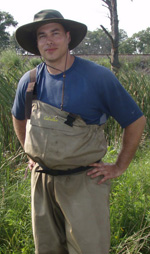
Dov Sax
Professor
Email: [email protected]
Office: (401) 863-9676
CV Publication PDFs
Dov's work examines species’ responses to climate change, the impacts of species invasions, the timing of species extinctions, and the mertis of alternative conservation strategies.
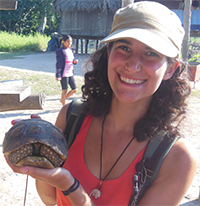 Laura Nunes Laura Nunes
Postdoctoral Fellow
Laura's work in the Sax Lab examines how data on the climate conditions of species native, naturalized and horticultural ranges can be combined to better understand how plant species will respond to changes in climate. She has strong interests and expertise in understanding how to measure and charactize niche conservatism.
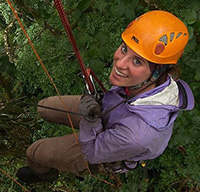 Emily Heyne Emily Heyne
PhD Student
Emily's dissertation explores whether tropical species can mitigate the effects of climate change through elevational range shifts. She is studying epiphytic species along climatic and elevational gradients in Monteverde, Costa Rica. Her work integrates biogeographic and local scale data to investigate the controls on species' niche boundaries, with an aim of predicting species' risks from climate change.
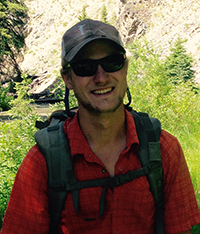
Donny Perret
PhD Student
Donny is interested broadly in global change ecology. He has a special interest in understanding how species geographic distributions will shift in response to changes in climate.
For more information on Donny's research, see his website
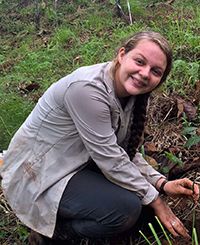
Bailey McLaughlin
Research Technician
Bailey is interested in the conservation challenges associated with global change. Her senior thesis investigated the evidence that tree species in North America that were once dispersed by megafauna (such as now extinct mastodons, giant ground sloths and camels) have native range extents that underrepresent the climatic conditions in which these species can thrive.
Lab Alumni
Postdoctoral Associates
Dr. Kathryn Amatangelo
Assistant Professor,
State Univesity of New York, Brockport
Dr. Regan Early
Senior Lecturer,
University of Exeter
Dr. Sarah Ivory
Assistant Professor
Penn State University
Dr. Heinke Jaeger
Research Scientist,
Charles Darwin Foundation
Dr. Jacquelyn Gill
Assistant Professor,
University of Maine
Dr. John Zinda
Assistant Professor,
Cornell University
PhD Student
Matt Heard
Assistant Professor,
Belmont University
Research Technician
Samantha vanDeurs
Masters student, University of Copenhagen
Undergraduate Thesis Students
Ada Bersoza Hernandez
High School Science Teacher, Mexico
Erin Capra
High School Science Teacher, Utah
Kenji Hayashi
PhD student, University of California, Los Angeles
Phoebe Hopkins
High School Science Teacher, Massachusetts
Maddie Johnston
Sustainable Farming and Education
Emily Longman
PhD student, University of California, Davis
Birch Malotky
Science education and youth outreach, Colorado
Bailey McLaughlin
Research Technician, Brown University
Madison Miketa
PhD student, Georgetown University
Clare Peabody
Ocean Lifeguard, California (& current Sax Lab collaborator)
Elizabeth Purington
Science research TBD
Kyle Rosenblad
Tutor & Musician (& current Sax Lab collaborator)
Liz Ryan
PhD student, Univ. of California, San Diego
Emma Suchland
Research Technician, Univ. of Washington
Ariana Spawn
Legislative Aide, Enviornmental Policy, US Senator Cory Booker
Yesenia Valverde
Research Technician
Alexis van Pernis
Science Policy work TBD
Megan Whelan
Golden Gate National Parks Conservancy
|
| |
|