 Laboratory Primate Newsletter
Laboratory Primate Newsletter
Laboratory Primate Newsletter VOLUME 43 NUMBER 2 APRIL 2004
Printable (PDF) Version of this issue
Articles and Notes
Callitrichid Monkey Branch Preference, by A. S. Chamove & S. Goldsborough......1
Helminth Parasites of Callithrix geoffroyi, by A. Lane de Melo......7
Enrichment for Owl Monkeys: A Discussion......10
Self-injurious Biting in Laboratory Animals: A Discussion......11
News, Information, and Announcements
Lawrence Jacobsen Education Development Award......6
Silent Auction at IPS Torino Meeting......10
Workshop Announcements......13
. . .
IACUC 101 Calendar; Laboratory Animal Medicine Workshop; Chimpanzee Care and Management Workshop; Gorilla Workshop
Grants Available......14
. . .
Simian Models for AIDS-Related Oral Complications; Centers of Excellence in Basic Biology of Aging
Awards Granted......15
. . .
2004 Debbie McGuire Gorilla Keeper Grant; Tuttle Receives Teaching Honor
Information Requested or Available......15
. . .
"What's New at ILAR" E-Newsletter; More Interesting Websites
News Briefs......16
. . .
Expansion of Chimpanzee Center Approved; Frederick Coulston Dies at 89; Artificial Breeding of Golden Monkeys - China; Boston Zoo's Gorilla Exhibit to Reopen; Monkey Research Institute to Open by End of 2004; World Lab Day - Atlanta 2004; Primate Research Lab Plans Axed; UC Davis Primate Center Expanding; Virunga Mountain Gorilla Population Increases; First Gelada Baboons Born at British Zoo; Year of the Monkey U.S. Postal Stamp; Monkey Researcher to Connect with Public; Macaque Revival Raises Ecological Questions; Nepal Activists Say No Monkey Exports for Lab Tests; Twenty People Jailed for Poaching Rhesus Monkeys; European Activist Infiltrates German Laboratory; Liberia to Protect 155,000 Acres of Forest; Sight Restored to Blind Chimpanzee at Sanaga-Yong; Zoo gorillas to be given TVs; Elderly Orangutan Dies of Pneumonia at Zoo; Court Dismisses Primate Case
Resources Wanted and Available......20
. . .
Chimp Genome Assembled by Sequencing Centers; Science-Based Guidelines Workshop Presentations; Westergaard Puchases LABS of Virginia
Research and Educational Opportunities......21
. . .
Lab Animal Medicine Postdoc - Michigan; Continuing Education for Animal Technicians; Lab Animal Practice Exam; Behavioral Research Internship - Los Angeles Zoo; Chimpanzee Behavioral Research Internship
Announcements from Publications ......23
. . .
Special Issue, IJCP; Training Using Positive Reinforcement Techniques; LPAG Newsletter; Linda Fedigan Heads AJP
ASP Small Research Grants and Conservation Grants......23
Meeting Announcements......23
Departments
Positions Available ......24
. . .
Animal Biotechnology and Conservation; Clinical Veterinarian / Deputy Director - Louisiana; Job Listings in Nature; Senior Veterinary Position at NIH
Primates de las Am�ricas...La P�gina......25
Recent Books and Articles......26
* * *
Callitrichid Monkey Branch Preference
Arnold S. Chamove and Sharon Goldsborough
Massey University Psychology Department, New Zealand
Introduction
All of the marmosets and tamarins (Callitrichidae) are both arboreal and diurnal, with a natural diet consisting of approximately equal parts insects, fruits, and tree and plant exudates (Garber & Sussman, 1984; Epple, 1975), suggesting that the distribution of branches might be important to their activity and feeding patterns. There are few studies describing locomotion in callitrichids (Dettling & Pryce, 1998), and these have mainly been in conjunction with feeding and foraging behaviors in Geoffroy's tamarin (Saguinus oedipus geoffroyi) in the wild (Garber & Sussman, 1984; Garber, 1984). We have found no studies carried out specifically on locomotion patterns in captive colonies, other than a pilot of our own (Dollins & Chamove, 1987).
The work of Garber (1980, 1984) has shown that there appear to be characteristic preferences for branch size and branch orientation in wild tamarins, and that they exhibit certain behavior patterns on particular branch types (see also Miller & Paciulli, 2002). Feeding and foraging is time-consuming, with as much as 70%, but more commonly about 50%, of the time spent in that activity in Geoffroy's tamarins, and this is done primarily on branches under 3 cm in diameter; "75% of all climbing and 87% of jumping occurs in pursuit of insects" (Garber, 1984, p.124). Most (27%) feeding is on supports around 2.5 cm, but some (25%) feeding on exudates such as gum involves ventral clinging, mostly on branches over 32 cm.
Locomotor behavior shows quite a different pattern. Most travel in wild callitrichids involves horizontal branches and oblique supports on which they move up and down. Tamarins avoid vertical supports during travel, carrying out only about 4% of their locomotor activities on vertical branches (Garber, 1980). When they do use vertical branches, they favor those between 2.5 and 12 cm, ascending three times as often as descending on vertical branches. Most ranging is accomplished by long leaps beginning and ending on thin branches.
On supports similar to the size that we used (2.5 cm), in comparison with the smallest or largest branches, there is "a marked increase in the use of horizontal branches" during feeding, foraging, and travelling in the wild (Garber, 1980, p. 119). Over 75% of feeding and foraging take place on branches of this size or smaller. The predominant behavior in the wild during feeding and foraging on branches of the thickness we used was sitting or lying down, while "jumping" was of low frequency. This may be because the animals often were feeding and foraging in dense vegetation where leaping is not necessary. Observations of free-ranging common marmosets (in semi-natural conditions; Chamove & Rohrhuber, 1989) revealed that they prefer to travel and to forage through the densest of vegetation, in dense networks of thin, flexible, non-woody tangles wherever these were located. Dense tangles are important too in the ecology of the Geoffroy's tamarin (Garber, 1984). It is likely that the presence of protective cover is important for small diurnal primates (Chamove, 1996).
Generally, locomotive behaviors can be seen as activities in which "body mass, rather than limb mass, is displaced relative to its physical surroundings" (Prost, 1965, p. 1200) and is usually associated with movement and travel (Garber, 1984). The "claw-like" nails possessed by both tamarins and marmosets (Garber, 1980, p. 186) allow these primates to move along supports ranging from under 1 cm to over 32 cm in diameter (Garber, 1984) and through all orientations (Cartmill, 1974). However, the orientation, spacing, and size of the branches would be expected to have important effects on energy expenditure in these monkeys. Although metabolic costs of locomotion are relatively high in small primates (Martin, 1979), it is much easier for smaller animals to climb than larger ones if one considers the maximum muscle pull and tendon stressors (Collins, 1983).
While we have some idea of what primates do in unenclosed areas, we have less knowledge when they are enclosed and when the presence or absence of certain branch types is presumably of more importance. This study attempts to catalogue the pattern of arboreal locomotion in captive callitrichids to improve design of captive quarters for these monkeys.
Several predictions were generated and tested with regard to callitrichid locomotion patterns, using three comparison conditions: one manipulating the number of branches in the cages, a second manipulating branch spacing, and a third varying the regularity of branch spacing. The relative use of branches and different types of locomotor behavior on them was used as a measure of preference. Predictions were based on the idea that it would be energetically less costly to move between closely or evenly spaced branches than to have to adjust energy expenditure when moving between unevenly or widely spaced branches. On the other hand, there is considerable evidence that in captive conditions with a superabundance of food, energy considerations may be less important (Chamove & Anderson, 1988; Neuringer, 1970).
On the basis of energy considerations alone, it was expected (a) that the monkeys would show a preference for the greatest number of branches; (b) that they would prefer the most clumped spacing of branches; (c) that regular spacing would be preferred to irregular spacing; and (d) that older and heavier individuals would show stronger preferences for the all of the above than smaller animals (Traylor-Holzer & Fritz, 1985).
Method
Subjects: The 18 subjects in this study were chosen from 42 animals living in three family groups all housed in Stirling University Psychology Primate Unit, Scotland. Six animals were selected from each of the three families as the focal animals, the two parents, two oldest adult offspring, and the two youngest independent offspring. Two families were cotton-top tamarins (Saguinus o. oedipus) and one was common marmosets (Callithrix j. jacchus). Weights and ages are presented in Table 1.
| . | . | Juvenile | Young Adult | Parent | MEAN |
| Callithrix jacchus | weight | 298 276-334 | 365 313-402 | 468 440-485 | 376 |
| . | age | 14 9-21 | 37 31-43 | 124 100-148 | 58 |
| Saguinus oedipus | weight | 404 400-408 | 491 489-493 | 531 495-567 | 475 |
| . | age | 10 10-10 | 36 36-36 | >75* . | |
| MEAN | weight age | 351 12 | 447 35 | 480 . |
Table 1: Mean ages (mo) and the mean weight (gm) (range in italics) for the three categories and two species of Callitrichidae observed. * Importation records suggest these wild-born adults were at least 6.25 years old.
The animals were chosen so that the different ages of the subjects could be compared with the patterns of locomotion performed; older animals were expected to be less active (Traylor-Holzer & Fritz, 1985; Baker, 2000). Since the oldest offspring and the lighter parent in each family were approximately the same weight, we hoped to examine the effect of age on locomotion while the weight was constant (see Table 1).
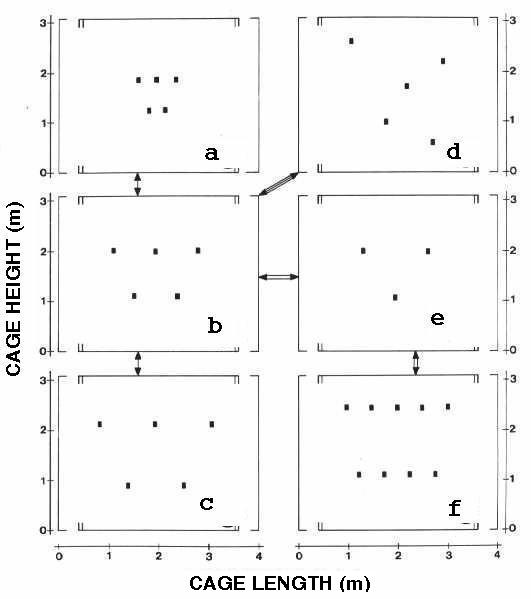
Apparatus: All testing was carried out in the 33 m3 home cages of the subjects, which measured approximately 310 x 320 x 333 cm. Precise dimensions of the three enclosures can be seen in Figure 1 (also Price & McGrew, 1990). The enclosures also contained nest boxes, feeding platforms, and some small mesh cages, which were sited against the back wall of the enclosure. These structures were counted as "other" parts of the cage for the purpose of data collection and totalled approximately 4 m-sq in horizontal surface area per enclosure. All of the home cages had a full, 10.3 m-sq vertical mesh front. The other three walls were made of smooth concrete and could not be climbed by the monkeys. Details of husbandry can be found elsewhere (McKenzie, Chamove, & Feistner, 1986).
Figure 1: Branch placement for the 6 experimental conditions described below. Arrows indicate the 3 major comparisons of branch spacing distance (narrow, intermediate, wide), branch number (3,5,9), and branch spacing regularity (regular, irregular). Slight variations in enclosure sizes are shown by the size of the enclosing rectangle. Floors are at bottom of drawings.
Each family was presented with six different branch conditions over a six-week period, the conditions rotated randomly. The positions of the branches for each condition are shown in Figure 1, drawn to scale. The black squares represent the ends of the branches, which stretched across the cage, parallel to the floor and to each other. These "branches" were straight rectangular pieces of wood 5 cm high x 2.5 cm wide and spanned almost the full width of the cage, leaving only about 15 cm between the wall and the end of the branch. The 2.5-cm wide branches were sufficiently spacious to allow an animal to run along the branch with ease. They were of "medium" size according to Garber (1984). The 6 branch conditions were: (a) FIVE branches, which were EVENLY and narrowly distributed in the middle of the cage, with a spacing of 35 cm, called the five-even-narrow condition (5En). (b) FIVE branches, which were EVENLY and intermediately distributed in the cage, spacing of 86 cm (5Ei). (c) FIVE branches, which were EVENLY and widely distributed in the cage, spacing 110 cm (5Ew). (d) FIVE branches, which were UNEVENLY and intermediately distributed throughout the cage, spacing averaged 86 cm (5Ui). (e) THREE branches, with the same EVEN and inter-mediate spread (i.e., standard deviation) as "b" (3Ei). (f) NINE branches, with the same EVEN and intermediate spread as "b" (9Ei).
The similar arrows between the conditions in Figure 1 show which conditions' data were compared to test the three hypotheses. These comparisons were: (1) Comparing the number of branches, that is, the 3-, 5-, 9-branch conditions which have a similar standard deviation of distances (i.e., 3Ei, 5Ei, 9Ei); (2) comparing the evenness of spread, that is, the 5-branch evenly intermediate-spaced condition with the 5 unevenly intermediate-spaced condition (i.e., 5Ei, 5Ui); (3) comparing the spacing, that is, conditions with 5 branches either narrow-, intermediate-, or wide-spaced (i.e., 5En, 5Ei, 5Ew). Holding constant the standard deviation of distances with different numbers of branches meant that the spread area of the branches would be constant over the three conditions. If instead the spacing had been held constant, the 9-branch condition would have covered a wider area than the 3-branch condition.
The branches were supported by thin nylon cords 3 mm in diameter, which hung vertically between the ceiling and each end of the branches, and they were anchored at each end to the mesh, thus allowing limited movement of the branches. When there were 9 branches, there were 28 linear meters of branches in all. In comparison, their normal housing condition had a total of 44 linear meters of branches, 36 linear meters of which were over 10 mm in width, and 24 meters of which were both non-vertical and over 10 mm wide.
Procedure: Data were recorded verbally using a tape recorder, and the order of testing subjects was strictly random. The type of motor activity seen on the branches was recorded. These activities were classified into seven types: (1) Jump - to move from one branch to another by means of leaping, where at some point no part of the subject was in contact with either branch; (2) Climb - to move between branches while always having some contact with one, another, or both branches. In some conditions the branch spacing was too wide to allow this activity to take place; (3) Hang - to be supported by 2, 3, or 4 limbs underneath any given branch but not moving; (4) Swing - to be supported ventrally as in "hang" but to be moving along the branch; (5) Sit / Lie - to be immobile on the branch with some part of the body, other than the limbs, resting on it; (6) Run - to move along the branch so that at some part of each step there was no physical contact with it; (7) Walk - to move along the branch, always maintaining some contact with it.
Data were collected to ascertain the subjects' preference for and use of the 6 different branch conditions, by measuring both the frequency and time spent on the branches. On the first day of each period of testing, one of the conditions was set up in each of the subject families' home cages. The families were then left for 8 full days before the start of data recording, more than sufficient time for the animals to become habituated to the new layout (Chamove, 1996). Data were then collected 1-3 hours after feeding, over 4 consecutive days before the conditions were changed and the procedure repeated. Data collection lasted for 6 minutes per focal animal for each of the 4 days of testing, giving a total of 144 minutes of observation per family for each of the 6 conditions. Records were made of the frequency and duration that the animals spent on the branches and in the other areas of the cages. When the focal animal moved onto the branches its position was noted, as was the direction of any subsequent change of branch. The motor activity seen on the branches was recorded as one of the seven types described above.
For analysis all frequency behavior was converted into frequency per 1 minute of observation, and duration behavior converted into percent of total possible time. These data were then subjected to a series of analyses of variance. The factors of the analyses were Species (2) by Age (3) by Behavior; because of the exploratory nature of the study, alpha was set at 0.05 throughout.
Results
In summary, monkeys spent more time on branches and moved and leapt between branches more when there were a greater number of branches in the cage. The animals, especially younger ones, spent more time on uneven branches but leapt between evenly spaced branches more. And the monkeys, especially smaller ones, spent more time on widely spaced branches, but moved more often between clumped branches.
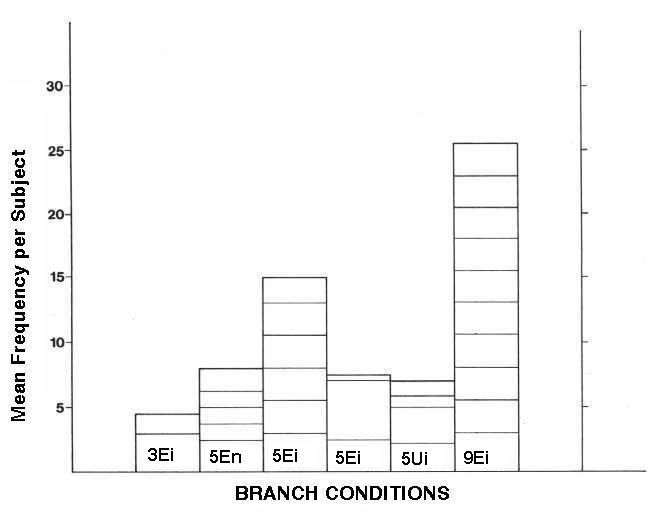
Number: There was a clear preference for the 9-branch condition over the 5- and the 3-branch conditions. The monkeys spent almost twice as much time on the 9 branches (189 sec out of 360 sec) as on the others (109 sec and 92 sec) (F = 7.31, df = 2,24, P < 0.01), and the frequency of branch use showed an even stronger three-fold preference (26, 9, and 4 per animal per minute). These preferences were strongest for young adults, with the older and larger parents and the younger and smaller juveniles showing less of a preference (F = 2.71, df = 4,24, P < 0.05). Figure 4, showing the frequency of the behavior "jump," also illustrates a similar preference.
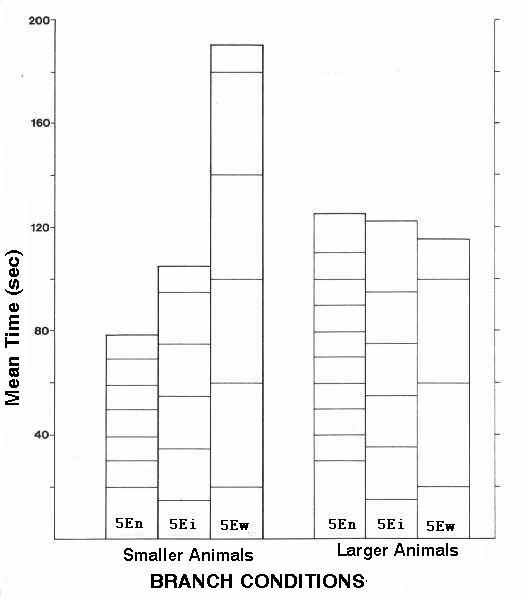
Spacing: The smaller sized animals - all of the marmosets and the smaller tamarins - spent more time on the wider branch spacing, whereas the heavier animals spent, if anything, more time on the narrow branch spacing (see
Figure 2: Mean duration (seconds) on branches in the narrow (histograms with horizontal lines placed closely together), inter-mediate, and wide (histograms with widely spaced horizontal lines) spacing conditions. The smaller animal group is composed of juvenile, young adult, and parent marmosets, and juvenile tamarins (under 490 gm); the larger animal group contains young adult and parent tamarins. Figure 2) (F = 3.28, df = 4,24, P < 0.05). The strongest preference was shown in the juvenile marmosets, the smallest monkeys. This preference was not seen for the behavior "jump" (Figure 4) which showed no interaction with species or age in this comparison.
When the number of branch visits for each condition is considered, it is the clumped branch condition that was visited more often rather than the widely spaced one. It seems the animals spend more time moving between branches in the narrow branch condition, but prefer to spend more overall time on the branches when they are widely separated.
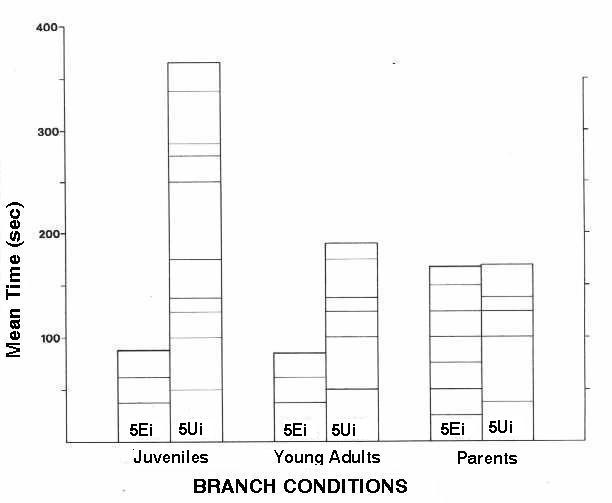
Regularity: Monkeys spent over twice the time on the branches when they were unevenly spaced (236 sec. per animal per minute) than when spaced regularly (109 sec.), although the frequency of branch use did not differ between the conditions (Figure 3). This effect was stronger in the younger animals (F = 4.50, df = 2,12, P < 0.05). However, all monkeys leapt between branches twice as much when the branches were evenly spaced (Figure 4).
Figure 3: Mean duration (sec./animal) on branches in the regular (left of each pair of histograms containing regularly-spaced horizontal lines) and irregular (right of each pair with unevenly-spaced lines) spacing conditions for the 3 age groups.
Other Effects: The juveniles made significantly more branch visits than the two older and heavier categories of monkey. When animals leapt from one branch to another, they most frequently moved horizontally, three times more frequently than either obliquely up or down, (F = 35.4, df = 2,24, P < 0.01). However, in the condition containing 5 unevenly spaced branches where horizontal movement between the branches was not possible, the number of branch visits did not significantly decline from that of other conditions. When they have choices, they show their preferences; when they do not, they make do with what is available (also Chamove, 1973).
Figure 4: Frequency of jumping in the 6 experimental branch conditions with letters indicating number, evenness, and distance of branch spacing respectively.
The least differentiation of behavioral categories occurred in the activity "walk", where all age categories of monkey appeared to show similar frequencies of walking (2-4 times per animal per minute) for all branch formats. Closely following was "run", little seen in parents (1-2 per animal per minute) or young adults (1-3) compared with juveniles (2-5), but similar in most branch conditions, except in the condition with only three branches when running was only observed once in the juvenile group and not at all in the others. "Sit" begins to show some discrimination between conditions: more sitting with 9 branches for young adult (20) and juvenile (14) cotton-top tamarins. "Jump" showed the biggest differentiation (plotted in Figure 4). While the cotton-top parents showed little difference except an avoidance of the 3-Even-irregular condition, all categories of the smaller marmosets and the smaller and younger cotton-tops exhibited much jumping in the 9- and 5-irregular configurations, which shows in the aggregate of all animals (see Figure 4). A high level of activity in the 5-Even-irregular condition is characteristic of all subgroups except the adult cotton-tops, while the level of activity is lowest for all subgroups in all 3-branch configurations. The most frequent activity on the branches was "jump" (1.8 times per animal per minute) followed by "sit / lie" (1/animal/minute), with "walk", "run", and the others infrequent (only 1 per 6 minutes; F = 90.1, df = 6,72, P < 0.001).
Discussion
The results of this study show that there are significant differences in the amount of time that captive callitrichid monkeys spend on the cage branches, depending on the number and distribution of these branches. In general the animals spend more time on branches when they cover a wider area of the enclosure, and move between them most when the branches cover a wide area but are also narrowly spaced. The three preference measures chosen gave somewhat different results. The duration measure showed that monkeys spent most time on nine (especially older monkeys), widely spaced (especially smaller animals), uneven (especially younger monkeys) branches. The results of measuring the frequency of running and walking on the branches and of jumping between branches were similar to one another, showing the monkeys moving and jumping most upon and between a greater number of, narrowly and evenly spaced, branches.
Despite the differences in the two species, there were few differences that could be attributed solely to species differences and not to differences in size.
Holding the standard deviation of the distances between the branches constant over the three branch-number conditions meant that with more branches, the distances between the branches were shorter and the spread of branches greater. It is unlikely that the reduced spacing was the reason for the preference for more branches, as at least the smaller monkeys preferred the widely spaced branches when that choice was offered.
The results of the analysis of different behavior categories showed that across all groups the jumping occurred significantly more often than any of the other activities. Moreover, this held true for both species and all three age groups. Although this ability to jump between branches is an important part of the behavioral repertoire of callitrichids (Garber & Sussman, 1984; Neyman, 1977), its high frequency in this study is likely to be an artifact of the parallel spacing and possibly the lack of vertical branches; although wild callitrichids rarely use vertical supports for locomotion (Garber, 1980).
There was no difference in relative frequency or duration of visits to the highest versus the lowest branches (F = 4.88, df = 1,5, P < 0.10), perhaps because of the low number of branches. Although recent studies of wild callitrichids suggest they prefer height (Garber & Sussman, 1984; Neyman, 1977), an earlier study suggests that callitrichids are rarely seen above 6 m (Thorington, 1968). Where wild Colombian cotton-top tamarins live, the canopy below the level at which the tamarins are seen is particularly sparse, consisting mainly of supports over 50 cm in circumference, possibly accounting for infrequent observations of the animals in that area (S. G., personal observation).
References
Baker, K. C. (2000). Advanced age influences chimpanzee behavior in small social groups. Zoo Biology, 19, 111-119.
Cartmill, M. (1974). Pads and claws in arboreal locomotion. In F. A. Jenkins (Ed.), Primate Locomotion (pp. 45-83). New York: Academic Press.
Chamove, A. S., & Anderson, J. R. (1988). Food distribution and behaviour in stumptailed monkeys. In J. E. Fa & C. H. Southwick (Eds.), The ecology and behavior of food-enhanced primate groups (pp. 214-229). New York: Liss.
Chamove, A. S., & Moodie, E. J. (1991). Objective criteria for enrichment. In A. Ehara, T. Kimura, O. Takenaka, & M. Iwamoto (Eds.), Primatology today (pp. 663-665). Oxford: Elsevier.
Chamove, A. S., & Rohrhuber, B. (1989). Moving callitrichid monkeys from cages to outside areas. Zoo Biology, 8, 151-163.
Chamove, A. S. (1996). Cage cleaning: Interest or intrusion? Australasian Primatology, 11, 2-5.
Chamove, A. S. (1996). Predator (Mustela nivalis) responses in captive-bred Callithrix jacchus. Neotropical Primates, 4, 56-57.
Chamove, A. S. (1973). Rearing infant rhesus together. Behaviour, 47, 48-66.
Coimbra-Filho, A., & Magnanini, A. (1972). On the present state of Leontepithecus and some data about new behavioral aspects and management. In D. A. Bridgewater (Ed.), Saving the lion marmoset (pp. 59-69). Wheeling, WV: Wild Animal Propagation Trust.
Collins, B. H. (1983). Climbing and some effects of arboreality on the natural history of primates. Unpublished doctoral dissertation, University College, London.
Dettling, A., & Pryce, C. R. (1998). Physical environment and its influence on behaviour in captive common marmosets (Callithrix jacchus). In European Marmoset Research Group (Ed.), Marmosets: A handbook for fundamental and applied research (pp. 139-150). New York: Academic Press.
Dollins, E., & Chamove, A. S. (1987). Substrate use and locomotory behaviour in captive cotton-top tamarins (Saguinus oedipus). International Journal of Primatology, 8, 548-549.
Epple, G. (1975). The behavior of marmoset monkeys (Callithricidae). In L. A. Rosenblum (Ed.), Primate Behavior, Vol. 4 (pp. 194-239). New York: Academic Press.
Garber, P. A., & Sussman, R. W. (1984). Ecological distinctions between sympatric species of Saguinus and Sciurus. American Journal of Physical Anthropology, 65, 135-146.
Garber, P. A. (1984). Use of habitat and positional behavior in a neotropical primate, Saguinus oedipus. In P. S. Rodman & J. G. H. Cant (Eds.), Adaptations for foraging in nonhuman primates: Contributions to an organismal biology of prosimians, monkeys, and apes (pp. 112-133). New York: Columbia University Press.
Garber, P. A. (1980). Locomotor behavior and feeding ecology of the Panamanian tamarin (Saguinus oedipus geoffroyi, Callitrichidae, Primates). International Journal of Primatology, 1, 185-201.
Martin, R. D. (1979). Phylogenetic aspects of prosimian behavior. In G. A. Doyle & R. D. Martin (Eds), The study of prosimian behaviour (pp. 307-357). New York: Academic Press.
McKenzie, S. M., Chamove, A. S., & Feistner, A. T. C. (1986). Floor coverings and hanging screens alter arboreal monkey behavior. Zoo Biology, 5, 339-348.
Miller, C. T., & Paciulli, L. M. (2002). Patterns of lateralized hand use in an arboreal primate, Simias concolor. American Journal of Primatology, 56, 231-236.
Neuringer, A. J. (1970). Animals respond for food reward with free food present. Science, 166, 399-401.
Neyman, P. F. (1977). Aspects of the ecology and social organization of free-ranging cotton top tamarins (Saguinus oedipus) and the conservation status of the species. In D. G. Kleiman (Ed.), The biology and conservation of the Callitrichidae (pp. 3971-3972). Washington, DC: Smithsonian Institution Press, 1977.
Price, E. C., & McGrew, W. C. (1990). Cotton-top tamarins (Saguinus o. oedipus) in a semi-naturalistic captive colony. American Journal of Primatology, 20, 1-12.
Prost, J. H. (1965). A definitional system for the classification of primate locomotion. American Anthropologist, 67, 1198-1214.
Thorington, R. W. (1968). Observations of the tamarin, Saguinus midas. Folia Primatologica, 9, 95-98.
Traylor-Holzer, K., & Fritz, P. (1985). Utilization of space by adult and juvenile groups of captive chimpanzees (Pan troglodytes). Zoo Biology, 4, 115-127.
-------------------------------------------
First author's address: Massey University Psychology Dept, P.O. Box 11-222, Palmerston North 5331, New Zealand [e-mail: [email protected]_].
-------------------------------------------
* * *
Lawrence Jacobsen Education Development Award
The Education Committee of the International Primatological Society solicits applications for grants of up to $1000 to support the development of primate conservation education programs. These initiatives should support field conservation programs or work with local communities and/or schools, or be used to provide training in conservation education techniques. Please provide: * introduction to the conservation program; * methods to be used to implement the program; * methods to be used to evaluate the program; * potential conservation impact; * budget in a 2-page application; * timeline; and * a 1-page CV of the principal investigator. The deadline for applications is May 1st of each calendar year. Send applications to Dr. Anne Savage, Vice-President for Education, IPS; c/o Disney's Animal Kingdom, P.O. Box 10000, Lake Buena Vista, FL 32830 [e-mail: [email protected]].
* * *
Helminth Parasites of Callithrix geoffroyi
Alan Lane de Melo
Universidade Federal de Minas Gerais
The family Callitrichidae are the small, clawed, Neotropical primates commonly known as marmosets and tamarins. A number of species are kept in captivity either in zoo colonies or for use in biomedical research, and their use as laboratory animals is increasing. However, many are decreasing in numbers in the wild, and some are threatened. Geoffroy's marmoset, Callithrix geoffroyi, occurs in the Atlantic forest and was formerly considered a subspecies of C. jacchus. Populations of this species are declining, and while the common marmoset (C. jacchus) and the black-tufted-ear marmoset, C. penicillata, for example, adapt well to captive conditions, C. geoffroyi has been less well-studied. Research is needed, for example, on its natural parasite infections.
Numerous species of helminths occur in wild-caught marmosets (Kuntz & Meyers, 1972; Orihel, 1970; Potkay, 1992). Melo and Pereira (1986) reported on a survey of natural parasitism in a colony of C. penicillata. The most common nematode encountered is the pinworm Primasubulura jacchi, adult parasites of which inhabit the digestive tract, mainly the large intestine and cecum. Here we report finding this parasite and other helminths in a group of 52 C. geoffroyi that had been illegally captured in different regions of the state of Minas Gerais, confiscated by the Forest Police, and sent to the Brazilian Institute of the Environment (IBAMA).
The marmosets were in very poor physical condition so they were transferred to the breeding marmoset colony of the Federal University of Minas Gerais (UFMG), where they were treated with a diet enriched with vitamins and proteins, using the methods described by Pereira et al. (1986). Some arrived dead or moribund, but our treatment resulted in the recovery of many. Eighteen were later returned to IBAMA in better health; 10 were kept at the UFMG colony for further biomedical studies.
During quarantine, fecal samples and blood smears were examined following Melo and Pereira (1986) and Resende et al. (1994). The samples were examined for intestinal and extra-intestinal helminth parasites and also for protozoa, following Hoffman et al. (1934) and Ritchie (1948). Many had diarrhea, and tests revealed infection by rotaviruses (Cisalpino et al., 1991).
Some of the marmosets died during quarantine and, whenever possible, they were necropsied to estimate the parasite loads. Careful inspection was made of the viscerae and other organs from the bodies of 19 C. geoffroyi, 14 of which were found dead in their cages.
Macroscopic examination was carried out by removing the organs and placing them separately in Petri dishes with saline. Fragments of viscerae were transferred to a Bouin's fixative solution and processed for histological sectioning. The helminths were fixed in 70-deg C Railliet-Henry solution, and transferred to Amann lactophenol for microscopic examination, or stained by acetocarmine for posterior studies. Considering the short period between capture in the wild and the necropsies, we believe that the parasite infections were not acquired in captivity, and are common infections of C. geoffroyi in the wild.
Trematodes (counts: 78, 69, 67, 52, 50, 44, 31, 12 and 7) were found in nine C. geoffroyi, associated mainly with the biliary ducts, which showed signs of chronic inflammation and hypertrophy (although this was not believed to be the main cause of death). These parasites belonged to the family Dicrocoeliidae. Nineteen genera have been found to parasitize mammals (Yamaguti, 1958). Several species in five genera have been reported in primates from Africa, Japan and Borneo (Brodenia, Concinnum, Dicrocoelium, Eurytrema, and Leipertrema). Only the genera Athesmia, Controrchis, Platynosomum, and Zonorchis have been reported from New World primates.
Platynosomum amazonensis (Kingston & Cosgrove, 1967; treated by Travassos et al. [1969] as Conspicuum conspicuum), of the family Dicrocoeliidae, was initially described as a parasite of Callimico goeldii and Saguinus nigricollis. It was also found in C. jacchus maintained in captivity in Oak Ridge, Tennessee (Porter, 1972; and see Potkay, 1992). Although similar, the morphological characteristics of the species we found in C. geoffroyi did not agree with the description by Travassos et al. (1969), nor that by Kingston & Cosgrove (1967). It is probably Platynosomum fastosum, a parasite described originally from the Bengal cat, Felis minuta (also called Prionailurus bengalensis minuta). This is the first record of Trematoda from the family Dicrocoeliidae for C. geoffroyi.
Two males probably died of severe peritonitis following intestinal perforation by the acanthocephalan Prosthernorchis elegans. Eleven parasites were attached to the intestinal wall of one marmoset and 32 in the other. Signs of inflammation, necrosis and fibrosis were verified at the attachment sites. There were abscesses where the intestines were perforated.
Adults of Trichospirura leptostoma (Smith & Chitwood, 1967) were found in the lumen of the excretory ducts of the pancreas in two females (two and three parasites respectively). No sign of inflammation was found. Resende et al. (1994) observed fibrous productive chronic pancreatitis with exudate of mononuclear cells caused by hypotrophy of exocrine parenchyma in one C. penicillata with the same parasite. T. leptostoma infections have been previously recorded for C. jacchus and Saguinus oedipus (see Smith & Chitwood, 1967), S. fuscicollis (see Cosgrove et al., 1970), Saimiri sciureus, Aotus trivirgatus, Callicebus moloch, and Callimico goeldii (see Orihel, 1970), and Callicebus nigrifrons (Pacheco et al., in press). This is the first record for C. geoffroyi.
An adult male Dipetalonema, probably D. graciliformis, was found in another marmoset, in the peritoneal cavity but without signs of inflammation. No microfilariae were seen. This is the first record of Dipetalonema for C. geoffroyi. Another species, D. gracile, has been recorded in C. jacchus (see Potkay, 1992).
Eberhard and Lowrie, Jr. (1987), reported that 70% of the known species of Neotropical primates have been found to be naturally infected by two, three, or four species of microfilariae. Neri et al. (1997) examined 16 specimens of C. nigrifrons maintained in captivity for a reintroduction program, and verified that eight (50%) were positive for microfilariae. Judging by the morphological characteristics of the microfilariae, Neri et al. believed they were Mansonella (Tetrapetalonema; Eberhard & Orihel, 1984) in three animals and Dipetalonema in five animals. We note, however, that the taxonomy of these genera is still confused. Webber (1955) recognized only one genus (Dipetalonema) for all known simian filariid species, but Yeh (1957) recognized two (Dipetalonema and Tetrapetalonema). Yamaguti (1961) placed Tetrapetalonema as a synonym of Dipetalonema. Orihel and Eberhard (1982) suggested that Mansonella is a synonym of Tetrapetalonema, and Eberhard and Orihel (1984) placed Tetrapetalonema as a subgenus of Mansonella.
The gut contents of all 19 marmosets contained Primasubulura jacchi. The numbers of nematodes counted in each ranged from 5 to 250 (mean 98.1; total parasites: 1864). Worm counts in the eight males (7, 11, 42, 47, 115, 191, 214 and 250 parasites) and the 11 females (5, 10, 32, 33, 41, 73, 104, 121, 161, 170, 237 parasites) were generally high. The main site of infection was the large intestine, and although this parasite probably resulted in lowered host resistance with increased susceptibility to other diseases, no tissue reactions were observed.
Cosgrove et al. (1968) reported finding more than 40 species of parasites in 455 necropsies of Saguinus fuscicollis and S. nigricollis. Among them, Primasubulura jacchi was found in 15% of the cases, with numbers ranging from 1 to 17 per animal, mainly in the small intestine and colon. Melo and Pereira (1986), on the other hand, found P. jacchi in 40% of 17 necropsies of C. penicillata, with the main sites being the large intestine and the cecum. When infections were severe, Primasubulura worms were seen in the entire intestine. The host-parasite relationship has yet to be clarified, especially regarding the pathogenesis of infection. The reports of Deinhardt et al. (1967), Cosgrove et al. (1968), Melo and Pereira (1986) and Ximenes (1997) present data only on parasite prevalence without mentioning possible symptoms. Deinhardt et al. (1967) and Cosgrove et al. (1968) reported low numbers of these parasites, whereas we found high numbers (see also Melo & Pereira, 1986). This discrepancy may reflect the fact that this worm has a short cycle in the host, so after a short time in captivity the numbers decline so long as reinfection is unlikely (Resende et al., 1994).
From this report and previous observations (Cosgrove et al., 1968; Melo & Pereira, 1986; Resende et al., 1994), it would seem that parasitism by P. jacchi, although frequent and sometimes involving large numbers of worms, does not induce a significant pathology. It must be emphasized, however, that it does not have a lung phase in the host, it is not blood-sucking, and is spontaneously eliminated over a short period in captivity. Intestinal perforation has been associated with this helminth and, in the wild, this infection would appear to be acquired continuously. When C. penicillata is maintained on a diet without insects (necessary for the life cycle of the worm), the parasite is gradually lost. It is possible that acquired immunity against P. jacchi is weak and non-protective.
References
Cisalpino, E. O., Pereira, L. H., Carvalho, A. C. T., Melo, A. L., & Cisalpino, P. S. (1991). Rotavirus em Callithrix geoffroyi Humboldt, 1812. In: A. B. Rylands & A. T. Bernardes (Eds.), A Primatologia no Brasil - 3 (pp. 111-118). Belo Horizonte: Funda��o Biodiversitas and Sociedade Brasileira de Primatologia.
Cosgrove, G. E., Nelson, B., & Gengozian, N. (1968). Helminth parasites of the tamarin Saguinus fuscicollis. Laboratory Animal Science, 18, 654-656.
Cosgrove, G. E., Humanson, G., & Lushbaugh, C. C. (1970). Trichospirura leptostoma, a nematode of the pancreatic ducts of marmosets (Saguinus spp.). Journal of the American Veterinary Medical Association, 157, 696-698.
Deinhardt, F., Holmes, A. W., Devine, J., & Deinhardt, J. (1967). Marmosets as laboratory animals. IV. The microbiology of laboratory kept marmosets. Laboratory Animal Care, 17, 48-70.
Eberhard, M. L., & Lowrie, Jr., R. C. (1987). Laboratory studies on Mansonella marmosetae in the squirrel monkey, Saimiri sciureus. Journal of Parasitology, 73, 233-234.
Eberhard, M. L., & Orihel, T. C. (1984). The genus Mansonella (syn. Tetrapetalonema): A new classification. Annales de Parasitologie Humaine et Compar�e, 50, 483-496.
Hoffman, W. A., Pons, J. A., & Janer, J. L. (1934). The sedimentation-concentration method in schistosomiasis mansoni. Puerto Rico Journal of Public Health, 9, 281-289.
Kingston, N., & Cosgrove, G. E. (1967). Two new species of Platynosomum (Trematoda: Dicrocoeliidae) from South American monkeys. Proceedings of the Helminthological Society of Washington, 34, 147-151.
Kuntz, R. E., & Meyers, B. J. (1972). Parasites of South American primates. International Zoo Yearbook, 12, 61-68.
Melo, A. L., & Pereira, L. H. (1986). Sobre o parasitismo por Primasubulura jacchi em Callithrix penicillata (Primates, Callitrichidae). In: M. T. de Mello (Ed.), A Primatologia no Brasil - 2 (pp.483-487). Brasilia: Sociedade Brasileira de Primatologia.
Neri, F. M., Fraiha, V. T., & Melo, A. L. (1997). Presen�a de microfil�rias em sangue perif�rico de Callicebus personatus nigrifrons (Spix, 1823, Primates: Cebidae) coletados em resgate faun�stico durante a constru��o da usina hidrel�trica Nova ponte-MG. In: M. B. C. Souza & A. L. L. Menezes (Eds.), A Primatologia no Brasil - 6 (pp.199-204). Natal: EDUFRN and Sociedade Brasileira de Primatologia.
Orihel, T. C. (1970). The helminth parasites of nonhuman primates and man. Laboratory Animal Care, 20, 395-401.
Orihel, T. C., & Eberhard, M. L. (1982). Mansonella ozzardi: A redescription with comments on its taxonomic relationships. American Journal of Tropical Medicine and Hygiene, 31, 1142-1147.
Pacheco, L. R., Neri, F. M., Frahia, V. T., & Melo, A. L. (in press). Parasitismo natural em sau�s, Callicebus nigrifons (Spix, 1823): Varia��o na elimina��o de ovos de Nematoda e Cestoda. Neotropical Primates.
Pereira, L. H., Melo, A. L., & Resende, D. M. (1986). Gelatin as a vehicle for food and drug administration to marmosets. Laboratory Animal Science, 36, 189-191.
Porter, J. A. (1972) Parasites of marmosets. Laboratory Animal Science, 22, 503-506.
Potkay, S. (1992). Diseases of the Calltrichidae: A review. Journal of Medical Primatology, 21, 189-236.
Resende, D. M., Pereira, L. H., Melo, A. L., Tafuri, W. L., Moreira, N. I. B., & Oliveira, C. L. (1994). Parasitism by Primasubulura jacchi (Marcel, 1857) Inglis, 1958 and Trichospirura leptostoma Smith and Chitwood, 1967 in Callithrix penicillata marmosets, trapped in the wild environment and maintained in captivity. Mem�rias do Instituto Oswaldo Cruz, 89, 123-125.
Ritchie, L. S. (1948). An ether sedimentation technique for routine stool examination. Bulletin of the U.S. Army Medical Department, 8, 326.
Smith, W. N., & Chitwood, M. B. (1967). Trichospirura Leptostoma gen. et sp. n. (Nematoda: Thelaziodea) from the pancreatic ducts of the white-eared marmoset Callithrix jacchus. Journal of Parasitology, 53, 1270-1272.
Travassos, L., Freitas, J. F. T., & Khon, A. (1969). Tremat�deos do Brasil. Mem�rias do Instituto Oswaldo Cruz, 67, 1-886.
Webber, W. A. F. (1955). The filarial parasites of primates: A review. I. Dirofilaria and Dipetalonema. Annals of Tropical Medicine and Parasitology, 49, 123-141.
Ximenes, M. F. F. M. (1997). Parasitismo por helmintos e protozo�rios no sag�i comum (Callithrix jacchus). In M. B. C. Souza & A. L. L. Menezes (Eds.), A Primatologia no Brasil - 6 (pp. 249-256). Natal: EDUFRN and Sociedade Brasileira de Primatologia.
Yamaguti, S. (1958). Systema helminthum 1. The digenetic trematodes of vertebrates. (Parts 1 and 2). New York: Interscience Publishers.
Yamaguti, S. (1961). Systema Helminthum 3. The nematodes of vertebrates (Part 1). New York: Interscience Publishers.
Yeh, L. S. (1957). On a filarial parasite, Deraiophoronema freitaslenti n. sp. from the giant anteater, Myrmecrophaga tridactyla from British Guiana and a proposed reclassification of Dipetalonema and related genera. Parasitology, 47, 196-205.
-------------------------------------------
Author's address: Laboratorio de Taxonomia e Biologia de Invertebrados, Departamento de Parasitologia, Instituto de Ciencias Biologicas, Universidade Federal de Minas Gerais, 30123-970 Belo Horizonte, Minas Gerais, Brazil, e-mail: <[email protected]>.
Thanks to Dr. Anthony B. Rylands of the Center for Applied Biodiversity Science for comments and reviewing the text. This study was supported in part by the Brazilian National Science Council (CNPq) and the Financing Agency for Research and Projects - FINEP [_Financiadora de Pesquisas e Projetos_].
-------------------------------------------
* * *
Enrichment for Owl Monkeys: A Discussion
This January, Lisa Abbuhl [e-mail: [email protected]], an Environmental Enrichment Technician at the University of South Alabama, wrote to the Laboratory Animal Refinement & Enrichment Forum e-list: "I just wanted to know if anyone out there works with owl monkeys and if so what types of enrichment do you use? Thanks in advance!!"
Autumn Sorrells [e-mail: [email protected]], the Enrichment Coordinator at UCSF-LARC, responded: "We work with these very timid guys. We give them hammocks and nest boxes as structural enrichment. Then we provide forage mix (Harlan Sani-Chips(r), wax worms [Galleria mellonella], raisins, pumpkin seeds) inside a closed up toilet paper roll, or peanuts and grapes in a hanging whiffle ball feeder, and we hand feed dates (which they LOVE!). We have just started providing pinecones that we allow mealworms to burrow into so the owls have to pick them out. Some enjoy this and some are not too sure about it!"
Lisa wrote: "Autumn, thank you so much for the information. In your cages do you provide both the hammock and the hide box? If so, do they use each equally?"
And Autumn replied: "We tried to provide different levels of elevation, so the hammock hangs high in the cage and the nest box is below it. They use their nest boxes often to hide in, as they are very shy animals. But when they are just hanging out uninterrupted during the day, they will use the hammocks. Be patient when introducing ANYTHING new to these guys, as they require a long acclimation period. They may not use something you provide them for a long while but eventually warm up to it as their trust builds."
Mary Feurtado [e-mail: [email protected]] wrote: "We have owl monkeys here at Vanderbilt. Some are pair-housed and some are singly housed. We provide pair housing when possible and nesting 'tubes' in each cage (they are made of PVC about 16-18 inches tall, 8 inches in diameter, with a 4-inch 'peep' hole cut out of the upper third of one side for them to peek out of). We adapted this from a design in Baer et al. (1994). The owl monkeys utilize these tubes frequently.
"We provide a varied diet, move their cages around for variety, and provide small round mirrors in each cage along with a large door-sized mirror hung on an IV stand that we roll around to different cages. I hang seed bells (the kind you buy for birds) in each cage and occasionally give them clumps of straw to pick at. I give them juice (Prang Electrolyte Replenisher from Bio-Serv) in a small bowl a couple of times a week, a chewable children's vitamin once a week, and occasional Primatreats. Our owl monkeys have never cared for mealworms but do like sunflower seeds and peanuts and all kinds of fruit -especially bananas (and especially overripe ones). They also like sweet potatoes and yogurt (the latter is good for hiding medicine in).
"We have had some health problems (cardiomyopathy) with our owl monkeys, which have influenced our choices in food enrichment. Maintaining hydration by giving Prang seems to help. I give about two ounces at a time. Almost all monkeys will consume this in 24 hours."
Lisa then wrote: "Thank you so much for the information!! We also give lots of fruit and veggies throughout the week, as well as biscuits for a balanced diet. Also they get prima treats. I was looking for non-food enrichment ideas. So I am definitely going to look into the seed bells and straw. Thank you again."
[Editor's Comment: The food being varied so much certainly makes the diet for individuals variable and difficult to ensure that animals are getting their essential proteins and vitamins and minerals in a balanced diet. When animals are fed a pelleted food that is properly formulated, it is obvious that the animals get all the nutrients they need in proper quantities. When animals are fed a variety of supplements, their diet can be distorted while they get enrichment. One has to be careful about being anthropomorphic about what is "good" based on human needs and desires. An example is the consumption of soft drinks by school age kids, which contribute to obesity when consumed "free choice." I am all for enrichment, as long as it is confined to foods that add nutrients which contribute to a balanced diet. - Morris Povar]
Reference
Baer, J., Weller, R., & Kakoma, I. (Eds.). (1994). Aotus: The Owl Monkey. San Diego: Academic Press.
* * *
Silent Auction at IPS Torino Meeting
Katie Leighty [e-mail: [email protected]], Vice President for Communications of the International Primatological Society, has announced that there will be a silent auction at the 2004 Congress this August. You may bring donations with you, or they may be mailed in advance to IPS 2004 Auction Donations, c/o Prof. Cristina Giacoma, Dipartimento di Biologia Animale e dell 'Uomo, Via Accademia Albertina 13, 10123 Torino, Italy.
* * *
Self-injurious Biting in Laboratory Animals: A Discussion
This discussion took place on the Laboratory Animal Refinement & Enrichment Forum [LAREF] e-mail list in January, 2004. The participants were Kate Baker, Tulane NPRC, Covington, Louisiana; Sonja Banjanin, University of Toronto, Canada; Jas Barley, Southampton General Hospital, England; Lorraine Bell, University of Colorado-Health Science Center, Denver; Ernie Davis, NIH Animal Center, Poolsville, Maryland; Joseph Garner, University of California, Davis; Ann Lablans, Queen's University, Kingston, Canada; Viktor Reinhardt, Animal Welfare Institute, Washington, D.C.; and Chris Sherwin, University of Bristol, England. Viktor Reinhardt, moderator of LAREF, edited the responses.
Reinhardt: "Self-injurious biting is probably the most serious example of self-injurious behavior (SIB). It occurs primarily in singly-caged laboratory primates, about 10% of which are affected (Platt et al., 1996). Transferring the subject to compatible social housing is currently the most effective therapy for this pathology (Line et al., 1990; Reinhardt, 1999; Alexander & Fontenot, 2003).
"Self-injurious biting is occasionally also seen in socially housed primates. Do group/pair-housed animals show this behavioral pathology spontaneously or is it triggered by specific events? I remember two individually caged rhesus males who required surgical care of self-inflicted bite wounds on several occasions. After they were paired with compatible partners, the self-biting stopped, until the two 'had' to be separated for research reasons. Both inflicted serious injuries on themselves in the first hour of separation. Needless to say, they were released from the research protocols and reunited with their buddies. From then on, no more self-biting was observed."
Baker: "I have videotaped rhesus macaques and have the impression that self-injurious biting occurs more often in singly-housed than in socially-housed animals. Among pair-housed individuals, unfortunately, the primary trigger for self-injurious biting appears to be mildly aggressive behavior from cagemates who occasionally supplant or swat subordinate partners. In this context, self-biting does not result in visible injuries, so I accept it for the sake of keeping pairs together. Also, no telling how much worse it could get if such animals were transferred to single-housing. Pair-housed animals occasionally self-bite when one of the partners is removed for whatever reason. It is my experience that most animals can cope with that extremely disturbing situation, but a few cannot, and those need to be re-paired as quickly as possible."
Lablans: "We have a male rhesus who has always been paired but once in a while he will 'chase' and bite his own leg. He typically does that upon being returned to his cage after a short chair-restraint procedure."
Reinhardt: "Monkeys may look relaxed and 'okay' while being chaired, but this does not necessarily mean that the whole situation is not experienced as frustration, discomfort, or distress. Returning to the home cage may be such a relief for this male that he vents some of the built-up tension in a behavioral pathology that he developed for whatever reason when he was a kid. Do you know his rearing history?"
Lablans: "He came to us as a very unusual animal to begin with. When I released him from his cage to have the run of the room, he would come over and sit with me on the floor. This makes me believe he had more contact with humans than the average rhesus we receive here."
Reinhardt: "Perhaps he was a pet? There is a very interesting old article that describes self-injurious biting in such an individual (Tinklepaugh, 1928)."
Davis: "I have observed self-injurious biting in group-housed, nursery-reared rhesus. This behavior doesn't appear to be spontaneous within the social context, as often found in singly housed animals. It is usually elicited by some negative event or state of arousal during a stressful situation. However, there are exceptions. For example, I recently saw one animal bite himself while playing with companions. It appeared to be normal rough and tumble play, which he seemed to enjoy. Yet, he would bite one of his wrists and sometimes an ankle during these play bouts. This case, however, is probably not typical since the animal was nursery reared, which is likely to affect normal neurological development."
Garner: "Self-biting is a classical SIB that falls into two basic categories, stereotypical or impulsive/com-pulsive behaviors. Both are 'inappropriate' repetitive activities, which involve different areas of the brain, have different prognoses, and respond to different drugs. Movements are always oriented to the same target [e.g., eye-poking] in the case of stereotypies, while they have flexible goals in the case of impulsive/compulsive behaviors [e.g., hair-pulling-and-eating]. I wonder, under which category does the self-injurious biting of monkeys fall? What does this behavior actually look like?"
Reinhardt: "In my own experience with rhesus and stump-tailed macaques, self-biting occurs in the following two sequences of events and circumstances:
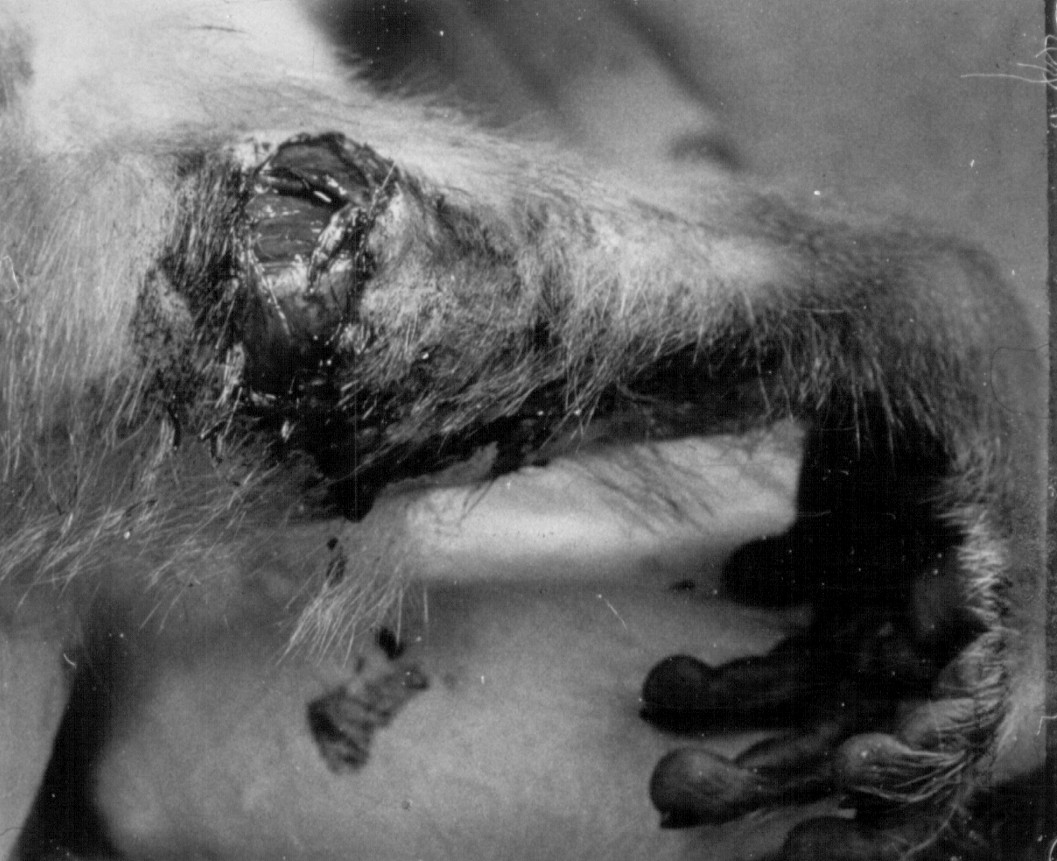
Figure 1: Individually caged rhesus macaque with laceration on elbow resulting from self-injurious biting.
Baker: "In my institutions self-biting seems to be triggered more often when attending personnel leave rather than enter the room. For this reason I think a lot of thought needs to go into what kind of relationship is established between staff and an animal that self-bites in their presence. Perhaps we all have biases, but I like to believe that the visits, at least from enrichment personnel, are positive! If they aren't, I'm going home right now..."
Garner: "Behaviors that occur when you leave the room might have been suppressed by your presence. For instance if the animal sees you as an interesting and fun thing to interact with, it might suppress other behaviors, such as self-biting, in order to give you all his/her attention while you are there. Once you leave the room, the suppressed behavior will rebound.
"The impression that I get from the information shared on this forum is that primate self-biting behaviors are directed identically to one point on the body and therefore constitute stereoypical SIB."
Self-injurious biting is not restricted to primates. Sherwin: "I remember seeing a video of a mixed breed domestic pet dog that would suddenly behave towards its left rear leg as if it were another dog trying to steal its food. It would growl, snarl and then eventually bite its own leg, very hard. An abnormal dog for sure and only one example, but I don't think SIB is limited to primates."
Banjanin: "Large dogs who do not get enough exercise can end up chewing on their hind extremities, to such an extent as to expose the bone. Although I was not a witness to this myself, it has come up a couple of times from different vets."
Bell: "During my two years working with dogs and cats in a research laboratory I never saw an animal display self-injurious behavior, but when I worked in small animal veterinary practices I saw several cats requiring tail amputation as a result of self-injurious biting, and dogs biting their own feet repeatedly."
Obviously, companion animals, including primates, do not necessarily enjoy more species-appropriate living conditions than laboratory animals. Barley: "Having seen how some people keep their pets and the cruelty inflicted through, at best, ignorance but often indifference, I don't think it's safe to take it as a given that animals at home are having a good time. In a lot of cases they would be much better off in the lab, at least as far as regular food, cleanliness, and caring goes."
References
Alexander, S., & Fontenot, M. B. (2003). Isosexual social group formation for environmental enrichment in adult male Macaca mulatta. American Association for Laboratory Animal Science 54th National Meeting Official Program, 141.
Line, S. W., Morgan, K. N., Markowitz, H., Roberts, J., & Riddell, M. (1990). Behavioral responses of female long-tailed macaques (Macaca fascicularis) to pair formation. Laboratory Primate Newsletter, 29[4], 1-5. <www.brown.edu/primate/lpn29-4.html#line>
Platt, D. M., Kinsey, J. H., Jorgenson, M. J., & Novak, M. A. (1996). Factors affecting the expression of self-injurious behavior in rhesus monkeys (Macaca mulatta). XVIth Congress of the International Primatological Society/XIXth Conference of the American Society of Primatologists, Madison, Abstract No. 768.
Reinhardt, V. (1999). Pair-housing overcomes self-biting behavior in macaques. Laboratory Primate Newsletter, 38[1], 4. <www.brown.edu/primate/lpn38-1.html#pair>
Tinklepaugh, O. L. (1928). The self-mutilation of a male Macacus rhesus monkey. Journal of Mammalogy, 9, 293-300.
Editor's Note: A Self-Injuring Primate Reports: Several years ago I read that sometimes self-inflicted injuries on primates are on both sides of the body and on bilaterally symmetrical places, and that this might have something to do with acupuncture points and pathways. If true, this might explain why repeated stimulation of these areas, while injuring the tissue on the surface, paradoxically rewards the animal or helps it feel better.
At about the same time that I read this, I was undergoing a lot of stress, and developed patches of eczema on my wrists. I've never had eczema before or since. I'd find myself scratching the eczema, and if I wasn't paying attention to what I was doing, I'd scratch the patch on my left wrist to the point where it would bleed. In a curious, perverse way, the scratching felt good and relieved some of the stress (but only momentarily). The stressor was a big pile of stuff in one of the rooms of my house, and every time I entered the room, I'd find myself scratching.
I wondered whether this eczema and self-injury of mine would show this bilateral symmetry, and it did. The two patches of eczema were the same size, on the inner edge of each wrist. I don't know if this location lines up with acupuncture pathways. However, I scratched the left side more, and that's the only one that bled. Could it be that I was scratching the left side more because I'm right handed? Or does the acupuncture theory not hold up?
With hindsight, I wonder if displacement was one of the motivations for scratching. Whenever I went into the cluttered room, I perceived (subconsciously, perhaps) the pile of clutter as a physical and psychological barrier to the rest of the room, a room that was important to me - I felt blocked. Frustrated from taking direct action to solve the problem, I took some action - against myself.
One weekend my husband and I tackled the pile of stuff and cleared the room. The eczema and scratching disappeared almost overnight. - Elva Mathiesen
* * *
Workshop Announcements
Gorilla Workshop
The Rocky Mountain Gorilla Workshop will be held June 25-28, 2004, in Calgary, Alberta, Canada. For details, see <2004gorillaworkshop.tripod.com>.
IACUC 101 Calendar
* May 13: Fairbanks, Alaska - hosted by the University of Alaska Fairbanks (in conjunction with a May 14 one-day course addressing IACUC-wildlife research issues); * June 28: Detroit, Michigan - hosted by the Michigan Society for Medical Research and the University of Michigan (in conjunction with an OLAW-FDA-NIH-USDA-AAALAC-ICCVAM-sponsored conference on June 29-30; see <grants.nih.gov/grants/olaw/westin_062904.doc>); * July 13-14: Research Triangle Park, North Carolina - hosted by the North Carolina Association for Biomedical Research; * September 14: Irvine, California - hosted by the California Biomedical Research Association and UC Irvine; * November 2: University Park, Pennsylvania - hosted by Pennsylvania State University.
For more information, contact Mary Lou James, Consultant, Regulatory Compliance, Research Animal Welfare, 427 Graeser Rd, St. Louis, MO 63141 [314-997-6896; fax: 314-569-5841 (with notice); e-mail: [email protected]].
Laboratory Animal Medicine Workshop
The Charles Louis Davis, D.V.M. Foundation for the International Advancement of Education in Veterinary and Comparative Pathology will present a Laboratory Animal Medicine Workshop May 20-23, 2004, at the College of Veterinary Medicine, North Carolina State University, Raleigh, North Carolina, cosponsored by Charles River Laboratories and GlaxoSmithKline. The May 20-21 agenda will include sessions on primates, equipment, literature review, and laws and regulations. On Saturday and Sunday, May 22 and 23, the 2x2 slide collection, established by the team at the National Institute of Environmental Health Sciences, will be available for review in the NCSU library area. This collection of approximately 25 carousels of slides includes biology and diseases of many laboratory animal species. Also available will be much of the Foundation's video collection . Slide projectors and VCRs will be available. The library will remain open for regular business from 8 a.m.-5 p.m. Monday through Friday.
For more information, contact the Charles Louis Davis Foundation, 6245 Formoor Lane, Gurnee, IL 60031-4757 [847-367-4359; fax: 847-247-1869].
Chimpanzee Care and Management Workshop
The Chimpanzee Species Survival Plan presents The 2004 Chimpanzee Care and Management Workshop, June 18-20, 2004, at the St. Louis Zoo, St. Louis, Missouri. This is a comprehensive three-day course covering all aspects of progressive chimpanzee husbandry. Topics include managing complex social groups, operant conditioning training, social introductions, contraception strategies, and enrichment programs. Registration is $65 and includes program materials and lunches. Limited space is available. For information and registration material, contact Steve Ross, Chimpanzee SSP Coordinator [e-mail: [email protected]].
The Chimpanzee Species Survival Plan is an intergrated management plan for chimpanzees living in AZA-accredited zoos across North America. The program assists institutions with population planning, research projects, conservation initiatives, education plans, and husbandry strategies. Learn more about SSPs at <www.aza.org/ConScience/#ssp>.
* * *
Grants Available
Simian Models for AIDS-Related Oral Complications
The National Institute of Dental and Craniofacial Research (NIDCR) has issued a Program Announcement with set-aside funds (PAS), soliciting applications that will use nonhuman primate models to study the oral biology of HIV infection and the oral complications associated with AIDS. This is an exploratory/developmental award with limited funding that is designed to maximize the use of animals currently involved in ongoing studies. Studies that will increase our knowledge of the basic biology, pathogenic mechanisms, immunology, diagnosis, treatment, and prevention of oral HIV/AIDS in macaque models are requested. Exploratory projects in emerging areas of importance for oral manifestations of AIDS and other acquired immunodeficiencies are of particular interest. It is expected that investigators will base their studies on recent developments in the field and will make use of the new and emerging state-of-the-art technologies.
Examples, by no means inclusive, of research responsive to this PAS include: * Characterize the oral complications of AIDS in macaques; * Determine the immunological, virological and biochemical basis of lesions induced by chronic viral infections of the oral cavity (e.g. papilloma virus, Kaposi sarcoma herpes virus, cytomegalovirus, etc.) in the context of SIV/SHIV infection; * Determine the structural, biological and functional properties of oropharyngeal mucosa that makes it resistant to HIV but susceptible to other viral pathogens; * Compare the structural, biological and functional properties of oral mucosa from infants and adults to define the developmental impact on the susceptibility to HIV infection; * Determine the early events occurring in the oral mucosa and oropharyngeal lymphoid tissues following acute infection with SHIV and investigate whether the oral mucosa permits entry, transcytosis, harboring and shedding of SHIV; * Characterize and compare the genetic and protein profiles of oral epithelial cells in healthy macaques and the SIV macaque-model of immunodeficiency; * Investigate and compare innate and adaptive immune networks of oral, vaginal, and rectal mucosal epithelial surfaces as they relate to SIV/SHIV infection; * Identify and compare salivary components from infant and/or adult macaques that interact with SHIV and possibly control susceptibility of oral epithelium to SIV infection; * Determine the impact of co-infections, inflammatory diseases, and tissue injury on mucosal susceptibility to SIV and development of AIDS; and * Apply genomic and/or proteomic approaches to determine gene expression in control and infected animals.
It is expected that the applicants will establish collaborations with investigators using the simian model for AIDS in ongoing studies. The applicants should submit evidence of the collaborative agreements to use the animals and perform the studies. Abstracts of current NIH-funded projects using macaque models are available from the CRISP Database: <crisp.cit.nih.gov/>.
Exploratory/developmental grant support is for new projects only; competing continuation applications will not be accepted. Direct your questions about scientific/research issues to Mostafa Nokta, Div. of Basic & Translational Sciences, NIDCR, 45 Center Dr. MSC 6402, Bldg 45, Rm 4AN-18H, Bethesda, MD 20892-6402 [301-594-7985; fax: 301-480-8319; e-mail: [email protected]].
Centers of Excellence in Basic Biology of Aging
The National Institute on Aging (NIA) invites applications for support of centers, known as Nathan Shock Centers of Excellence in Basic Biology of Aging. These Center grants will provide funding for research and training activities related to basic biology of aging. They are intended for institutions with a substantial investment in and commitment to aging research, but they are not intended to directly support clinical research or clinical trials.
The goal of this program is to enhance the ability of institutions with well-developed research programs in basic research on aging to utilize state-of-the-art research resources to provide the strongest environment for the conduct of research on aging. Thus, this Request for Applications is intended to enhance the quality of research in the basic biology of aging; facilitate the planning and coordination of aging research activities; provide support and a suitable environment for investigators new to aging research to acquire research skills and experience at institutions that have demonstrated commitment to, and expertise in, basic biology of aging research; and develop potential regional and/or national resource centers. Thus, each application must include: 1) a core to support administrative functions, advisory committee expenses and staff travel; 2) at least two research core activities such as animal facilities, biometric support, molecular/cell biology and/or equipment, etc. which must be utilized by three or more projects on aging research that are already funded; and 3) a research development core to support pilot/feasibility projects and provide temporary salary support for investigators just entering the research on aging arena to a point where they can compete for independent support. Each core must be directed by an appropriately qualified investigator.
Centers are encouraged to develop resources that will also be available for collaborative research projects with investigators from other institutions. A plan must be presented to describe how such access to Center resources will be managed, so as not to overwhelm the personnel and resources of the Center. The requirement that resources support at least three basic research projects may be partially met by projects at institutions other than the grantee institution.
Applicants must request a project period of five years, and a budget for total (direct plus facilities and administrative) costs up to $1.2 million per year. Applications with budget requests exceeding this amount will not be accepted by the NIA and will be returned to the applicant. Budget increments for subsequent years will be limited to no more than three percent.
Direct questions about scientific/research issues to: Huber R. Warner, Associate Director, Biology of Aging Program, NIA, 7201 Wisconsin Ave, Gateway Bldg, Suite 2C231, Bethesda, MD 20892-9205 [301/496-4996; fax: 301/402-0010; e-mail: [email protected]]. Letter of intent receipt date is April 16, 2004; application receipt date is May 20, 2004.
* * *
Awards Granted
2004 Debbie McGuire Gorilla Keeper Grant
The Dewar Wildlife Trust is pleased to announce the winners of the 2004 Debbie McGuire Gorilla Keeper Grant. Each year a total of $1,000 is awarded to a gorilla keeper (past or present) whose application demonstrates the desire to use the funds to help them help the gorillas in their care.
This year six applications were received. The 2003 Debbie McGuire Grant was a tie between C. Shankara of Mysore Zoo, India, and Juanvicente Santana of Madrid Zoo, Spain, each receiving $500. In 2004, we have another tie, with the $1,000 Debbie McGuire grant being split and awarded to Marcela Chekova, gorilla keeper at Lesna Zoo in the Czech Republic, and Jean-Damascene Hakizimana, gorilla tracker and park guard in Rwanda.
Applications for the 2005 Debbie McGuire Grant are due by November 1, 2004. For details, please contact Jane Dewar, Gorilla Haven <www.gorilla-haven.org>.
Tuttle Receives Teaching Honor
Russell Tuttle, Professor of Anthropology, University of Chicago, has been awarded the American Anthropological Association/McGraw-Hill Award for Excellence in Undergraduate Teaching. Tuttle studies the evolution of human and primate morphology, locomotion, and other behavior. He also is an expert in paleoanthropology, particularly the evolution of bipedalism and of the human hand, and the history of theories of hominoid evolution and of social prejudice in physical anthropology. Currently he serves as editor-in-chief of the International Journal of Primatology.
* * *
Information Requested or Available
"What's New at ILAR" E-Newsletter
ILAR sends a quarterly e-newsletter to inform readers of upcoming laboratory animal science workshops, conferences, publications, and news from various laboratory animal science organizations. To subscribe send e-mail to <[email protected]> and type SUBSCRIBE in subject line.
More Interesting Websites
* * *
News Briefs
Expansion of Chimpanzee Center Approved
More than 260 former research chimpanzees soon will have a home in St. Lucie County, Florida. St. Lucie County commissioners have approved the expansion of the Center for Captive Chimpanzee Care. The Center plans to build 11 island homes for the research chimps, which currently are in Alamogordo, New Mexico. Since the center opened in 2001, it has housed more than 20 chimpanzees formerly owned by the Air Force and used for space research.
Each of the islands will house about 25 chimpanzees and will include shelters and recreation areas, according to plans submitted to the county. The Center now has one such island. Its directors eventually plan to construct a historical museum with a space chimp exhibit, a public education facility, and research cottages on the 200-acre campus. The center currently is not open to the public, but visitors will be allowed in the museum and education center once they're completed. The chimpanzees will be seen through a video monitoring system. - From Stuart (Florida) News, posted December 18, 2003
Frederick Coulston Dies at 89
Dr. Frederick Coulston, a researcher who helped develop tests for malaria, AIDS and hepatitis through animal research, died December 15 in Alamogordo, New Mexico, where he had run his nonprofit Coulston Foundation. It was there that he performed animal research for many years with nonhuman primates, and was often the target of animal activists. Coulston turned over his 288 chimpanzees and 90 monkeys to Carole Noon and her Florida-based Center for Captive Chimpanzee Care in September, 2002. - NABR UPDATE, 23[19]
Artificial Breeding of Golden Monkeys - China
WUHAN, Sept. 16 - China plans to increase the number of golden monkeys, a rare species native to China, by artificial breeding. Sources with the Shennongjia Nature Reserve in central China's Hubei Province said the Nature Reserve administration has designated a 166-hectare area in the Reserve for artificial breeding. About 10 to 15 golden monkeys will be put into captivity for scientific study, which serves the purpose of increasing the number of the rare animal species, the sources said. Zhong Ran, deputy director of the Reserve, said that construction on the 30-million-yuan (3.6 million U.S. dollars) project was expected to begin next year and to be completed within two to three years.
Shennongjia is now home to more than 900 golden monkeys belonging to eight groups. More than 20 technicians in the Nature Reserve and scientists and researchers from the Chinese Academy of Sciences, Beijing University, and Wuhan University will join in the planned research program. - Xinhua News Agency
Boston Zoo's Gorilla Exhibit to Reopen
BOSTON (AP) - Little Joe may one day be reintroduced to the public. The Franklin Park Zoo took all six of its gorillas off public display after Little Joe broke out in September and injured two people. The gorilla exhibit will reopen by the end of January, but without the 11-year-old escape artist and another young male, Okie, also deemed unpredictable. The apes have been spending their time in a holding pen watching cartoons, banging on plastic drums, listening to music, and dangling from rope swings. Zoo officials are installing surveillance cameras, more powerful shock wires, and slippery rocks around the exhibit to ensure that none of the gorillas escape.
In August, Little Joe got a brief taste of freedom but returned on his own ten minutes later. On Sept. 28, he crossed a moat and scaled a 3.5-metre wall lined with electric wires - either avoiding or ignoring the shocks - and broke through two sets of doors to win his freedom. The 147-kilogram gorilla roamed the city's Roxbury neighborhood for two hours, picking at trash cans and drinking from soda bottles. He attacked an 18-year-old zoo volunteer and a two-year-old girl, both of whom had minor injuries and a major fright.
Joe absorbed four tranquillizer darts before zoo officials finally brought him down.
"He's a highly intelligent individual, curious and self-confident," said John Linehan, chief executive of Zoo New England, which runs the Franklin Park Zoo. "He was testing his environment just like they do in the wild." - Associated Press, December 5, 2003
Monkey Research Institute to Open by End of 2004
Choe Jae-chun, professor of biological science at Seoul National University, is to open the first primate research institute in the country this year and plans to enhance the level of primate studies while providing chimpanzees with good facilities and helping the public understand and love animals. The plan took shape when Jane Goodall, chimpanzee researcher, visited Korea in 1996. Also known as an environmentalist, she suggested that she would donate some primates if an institute that provides a comfortable life for them would be built. Prof. Tetsuro Matsuzawa of the Primate Research Institute at Kyoto University, Japan, also promised to help. With a number of local governments suggesting that the institute be built in their province, Choe is now in negotiations about specific terms and details.
Choe says that the Institute of Primate Research and Conservation (IPRC) will be an institute open to the public, providing totally new types of programs. Students will have opportunities to participate in the research at the institute. By filling out an application on the IPRC Website, students can observe primates and their behavior at the institute. Observations will be put into the computer system, and the data gathered from each visitor's observation will be used for research. Thus, students will have fun and take pride by contributing to scientific research. For more information, see <www.iprc.or.kr>. - from the Korea Times, January 5, 2004
World Lab Day - Atlanta, 2004
Plans are underway for April's World Week for Animals in Laboratories, which will be held in Atlanta. The Primate Freedom Project announces that their special guest speaker this year is PeTA founder and president, Ingrid Newkirk. See <www.PeTAAtlanta2004.com>.
Primate Research Lab Plans Axed
Plans to build a controversial center for experiments on monkeys have been shelved by Cambridge University. It has decided the costs, including measures needed to protect the facility from animal rights militants, would make the project uneconomical. The center had become a focus for the growing battle between medical researchers and anti-vivisectionists. Research scientists vowed to continue their work to find cures for brain disorders.
Both the Medical Research Council and Wellcome Trust, which were to put money into the facility, said they were looking for ways to continue to fund brain research. There has been much speculation that the government may try to relocate primate research to its military research center at Porton Down, in Wiltshire.
UC Davis Primate Center Expanding
Davis Enterprise, January 27 - Through the years, the California National Primate Research Center has grown and studied many diseases ranging from asthma to Alzheimer's disease, AIDS and other infectious diseases. Now $8 million worth of construction and renovation, slated for completion in 2005 or 2006, is expected to meet the center's needs for the next ten years. Projects now under way include new field corrals and indoor housing for primates and new lab and office space for researchers.
Virunga Mountain Gorilla Population Increases
National park authorities of Uganda, Rwanda, and the Democratic Republic of Congo (DRC) are pleased to announce that a recent census of the Virunga Volcanoes mountain gorilla population has shown a significant increase in population size. The results of the census show that there are now a total of 380 gorillas in 30 social groups. Due to insecurity in the area, no complete census had been carried out since 1989, when the population was estimated at 324 individuals. The current figure represents a 17% increase since then. The Virunga mountain gorilla population inhabits three adjacent national parks covering the Virunga Volcanoes range along the borders of the three countries: the Parc National des Virunga in DRC, the Parc National des Volcans in Rwanda, and Mgahinga Gorilla National Park in Uganda. These gorillas are the focus of a unique gorilla ecotourism program. During the 1990s, the gorillas' habitat was threatened by the impact of civil unrest, and several gorillas are known to have been killed as a result of this conflict. The national parks authorities and conservation NGOs in the three countries have worked hard to ensure the protection of the forest and the gorillas throughout this period, and it is thanks to their perseverance and dedication that the gorilla population has survived and even increased.
The Virunga gorilla census was carried out during September and October, 2003, thanks to the close collaboration of the conservation authorities in the three countries. The work was supported by the International Gorilla Conservation Programme (a coalition of AWF, WWF and FFI), the Wildlife Conservation Society, the Dian Fossey Gorilla Fund - International, the Institute of Tropical Forest Conservation (Mbarara University of Science and Technology), the Dian Fossey Gorilla Fund - Europe, Berggorilla und Regenwald Directhilfe, the Mountain Gorilla Veterinary Project, and the Max Planck Institute for Evolutionary Anthropology.
The census was conducted by six teams traversing the entire gorilla habitat range, searching for fresh signs of gorilla groups. Each gorilla makes a fresh nest to sleep in each night, and these are used to establish the number of gorillas in each group. A total of 100 team members participated in the census, drawn from the staff of the protected area authorities and their partners. - from a press release on <allafrica.com>, January 16
First Gelada Baboons Born at British Zoo
LONDON, January 16 - Two gelada baboons have been born at Colchester Zoo in eastern England, the first geladas to be born in captivity in Britain and a boost for efforts to conserve the threatened creature, officials said Friday. The first baby made its appearance in November and the second the following month, zoo officials said. They have different mothers, Mena and Sereba, but share a father, Junior.
A zoo spokesman said, "We are not sure what sex they are. We are waiting for the mothers to hold them in such a way that we can tell. We have the only colony of gelada baboons in England - we have nine. And these are the first to be born in captivity in the U.K."
The babies are now about one foot long. Males grow to about four feet (1.2 meters) in height and females about three feet. The males have a large mantle, or mane, of fur around their heads.
Year of the Monkey U.S. Postal Stamp
To commemorate the Year of the Monkey, which began on Jan. 22, 2004, stamp designer Clarence Lee created an intricate paper-cut design of a monkey for the final stamp in the U.S. Postal Service's Lunar New Year stamp series. The award-winning Lunar New Year series began in 1992 with the issuance of the Year of the Rooster stamp, followed by stamps for the Years of the Dog, Boar, Rat, Ox, Tiger, Hare, Dragon, Snake, Horse, and Ram.
Lively, witty, inventive, intelligent, and good at problem solving, the Monkey is the sign of the inventor, the improviser, and the motivator in the Chinese zodiac. Legend says a person born during the Year of the Monkey is fated for success at whatever he or she chooses to do. No challenge will be too great. The stamp design includes grass-style calligraphy by Lau Bun that translates into English as "Year of the Monkey". The greeting "Happy New Year!" is in English. - From a USPS news release
Monkey Researcher to Connect with Public
The new owner of a monkey research facility in Yemassee, South Carolina, expects to better connect with the town and provide a small boost to the area's economic development. Greg Westergaard, of Beaufort, bought what area residents have dubbed the "monkey farm" from LABS, a research company based in Newport, Virginia, on Dec. 31. He also purchased LABS' other two local facilities - one in Early Branch and the other on Morgan Island in St. Helena Sound. The "farms" breed rhesus monkeys, which can then be used for scientific research.
"My major intention is to open up the lines of communication between the facility and the town," he told Yemassee Town Council on Tuesday. - From a January 14 article by Omar Ford, Beaufort (South Carolina) Gazette staff writer
Macaque Revival Raises Ecological Questions
The Formosan macaque, Macaca cyclopsis, was the first primate to set foot on Taiwan. Its domain once stretched from the island's plains into the mountains to an altitude of 3,000 meters. Like so many other primate species - about 200 worldwide - their numbers have been drastically reduced at the hands of their junior cousins, Homo sapiens. In 1989, when the Wildlife Conservation Law was enacted, the survival of the Formosan rock monkey was in jeopardy. At least 3,000 monkeys a year used to be killed for food and other uses.
In view of the macaque's uniqueness as the only nonhuman primate in Taiwan living outside zoos, it has become a celebrity of conservation efforts over the past decade. Recently, the Council of Agriculture (COA) conducted a survey to determine how effective those efforts have been in helping the macaque population to rebound, as well as to gain insight into broader questions of ecological balance and relations between human and monkey communities.
The good news is that according to the council's estimate, the Formosan macaque population has increased significantly, now standing at approximately 250,000 grouped in some 10,000 troops. The increasing numbers of the Formosan rock monkey are symbolic of the earnestness of Taiwan's conservation efforts. The not-so-good news is that the survey and other findings have revealed many problems in the complex relationship between monkeys, humans and the environment as the monkey population continues growing.
Fruit farmers whose orchards border on macaque habitats have tried all kinds of stratagems - from dogs to firecrackers to traps - to deal with the furry thieves who invade their orchards. Farmers frequently and vociferously complain that this once-hapless animal has become a threat to their livelihood.
Chen Shu-hui of the Taiwan Forestry Research Institute feels that the tension between humans and monkeys highlights the problem that conservation activities have commonly focused narrowly on reviving a select number of species without considering the wider ecological picture. The Formosan rock monkey is an example of an animal that seemed to be in danger of extinction but whose rapid proliferation has now made it something of a pest in some locales. - From the January 6 Taiwan Journal
Nepal Activists Say No Monkey Exports for Lab Tests
KATHMANDU, February 2 (OneWorld) - Animal rights activists are protesting an agreement between the Nepalese government and a local nongovernmental organization, the Natural History Society of Nepal (NHSN), to breed thousands of rhesus monkeys, allegedly for supply to U.S. laboratories. According to the letter of intent, the government will deliver 150 monkeys to the U.S. as soon as NHSN establishes basic infrastructure to breed them.
Activists have demanded an immediate halt to the breeding and capture of animals for export. Government officials defend the agreement, saying it is in accordance with Nepal's recent Working Policy on Wildlife Farming, Breeding and Research 2003. The policy stipulates that the government can permit breeding of endangered species and other common species for commercial purposes.
Rhesus monkeys have lived alongside humans for centuries. Of late, they have come into conflict with humans, leading to the trapping and killing of more than 1,000 monkeys by farmers last year.
Nepal's neighbor, India, banned the export of rhesus monkeys in 1977. China is the biggest exporter of monkeys for biomedical research, while the U.S. is the biggest importer of primates.
Twenty People Jailed for Poaching Rhesus Monkeys
GUIYANG, Jan. 24 - Twenty people have been sentenced to imprisonment terms ranging from 6 to 14 years for poaching, killing, trafficking, and selling rhesus monkeys, a species under state protection in China.
The court of Leishan county found that in November, 2002, local farmers organized more than 50 villagers to poach 20 rhesus monkeys and sold 19 to traffickers. A Jianhe County court found that local farmers illegally purchased over 30 rhesus monkeys and sold the animals in the eastern province of Anhui in 1999. A Danzhai County court found that six farmers caught 19 rhesus monkeys on a state-owned forest farm in the county in December, 2002, and sold the monkeys to a couple, who resold the monkeys to traffickers from Anhui. - China View, January 24
European Activist Infiltrates German Laboratory
In December a German TV station showed covert film taken at the laboratory in M�nster, Germany, of the contract research company Covance. The film had been obtained by an infiltrator working for the British Union for the Abolition of Vivisection (BUAV), who had worked at the laboratory for about 15 weeks earlier in 2003. BUAV made allegations about poor handling of macaques, inadequate housing and environment, and also questioned the scientific basis of the toxicity tests being carried out. However, it appears that BUAV has used very carefully edited film to give the worst possible impression.
Covance states that careful scrutiny of one sequence shows that short clips have been edited together showing different technicians working in different buildings carrying out different tasks. The result is a sequence of events that did not take place. BUAV's allegation that most primates are single-housed at the M�nster facility is not true: it chose not to show the group housing and pair housing in its film. Covance has plans to upgrade primate accommodations with a view to meeting future EU guidelines. No studies have been compromised, nor is Covance aware that any client or confidential data has been stolen. There do not seem to have been any violations of German law. Moreover, the facility has been inspected by the German authorities several times this year and showed full compliance with the appropriate regulations. The authorities have visited the M�nster site since the TV program aired and have made a report, but this has not yet been made public.
The clear aim of the infiltration is to increase pressure against primate research in Europe. Covance is treating the allegations seriously and is conducting a full review. When the review is complete, the company will take any action that is shown to be necessary. - From the Research Defence Society
Liberia to Protect 155,000 Acres of Forest
Liberia has announced the protection of more than 155,000 acres of mostly intact forest. The increased protection helps safeguard the world's largest known population of the critically endangered western chimpanzee.
The head of Liberia's interim government, Gyude Bryant, published three bills that represent a 60 percent increase in protected areas and a dramatic reform of its natural resource conservation policies. The Sapo National Park will expand by 123,550 acres, and the creation of the Nimba Nature Reserve will protect an additional 33,350 acres. The Nimba Nature Reserve borders a World Heritage Site in neighboring Guinea and C�te d'Ivoire.
The Center for Applied Biodiversity Science at Conservation International and Fauna and Flora International worked together to co-implement the Liberia Forest Reassessment (LFR) project. The two groups used sophisticated technologies including satellite imagery and geographic information systems, as well as field surveys, to help the government demarcate the new borders of these protected areas, and also provided substantial technical input for the preparation of the new laws. - Conservation International press release, November 13, 2003
Sight Restored to Blind Chimpanzee at Sanaga-Yong
In January, 2004, cataract removal surgery was successfully performed on a chimpanzee for the first time. The two-stage procedure took place at In Defense of Animals (IDA)-Africa's Sanaga-Yong Chimpanzee Rescue Center, in a remote forest in Cameroon, West-Central Africa. Jacky, a 40-year-old male chimpanzee, can now see clearly again after degenerative cataracts robbed him in 2002 of vision in both eyes. IDA-Africa rescued Jacky in 1999 from a small cage where he had been living for 30 years. At the Rescue Center, staff became aware of Jacky's failing eyesight when he was no longer able to act as alpha male, a role he had assumed over a family of other chimpanzees.
The cataract-removal surgery was identical to that performed on humans. It was carried out by medical ophthalmologist Dr. James Tidwell, a U.S. Navy Commander who takes part in humanitarian efforts around the world. He was assisted by Dr. Sheri Speede, a U.S. veterinarian and director of the Rescue Center.
Safety protocols would not permit administration of eye-drops after each operation to control possible infection, so antibiotics were given to Jacky in his milk. Back to his old self, Jacky is now enjoying life with other resident chimpanzees, all of whom were rescued as orphans of the illegal bushmeat trade and currently have a second chance at life. - From an IDA-Africa press release
Zoo Gorillas To Be Given TVs
Moscow Zoo keepers will install televisions in the cages of their gorillas in a bid to make them "think more". Zoo Director Vladimir Spitsyn said that the gorillas will be able to watch films about the life of monkeys and great apes in the wild, among other subjects. He said that similar projects had shown that by allowing animals to watch television, their cognitive abilities improved. The TVs will be introduced into the gorillas' cages this summer, reports Pravda. - Ananova, February 16, 2004
Elderly Orangutan Dies of Pneumonia at Zoo
One of the oldest Bornean orangutans in the country died of severe pneumonia at the Pittsburgh Zoo & PPG Aquarium. The 43-year-old female became ill several days before her death and was being treated for a bacterial infection, said Barbara Baker, zoo President and Chief Executive Officer. The zoo's eight other orangutans seem fine but will be monitored for signs of illness. Wild orangutans live an average of 35 years.
The orangutan was born at the Detroit Zoo in February, 1961, and arrived in Pittsburgh in September, 1990, initially as a loan from the Baltimore Zoo. She was one of the first animals in a newly built Tropical Forest exhibit.
Baker explained that the animal's remains, including organs, tissues and hair and skin samples, will be sent to researchers around the country so more can be learned about the biology of the endangered species. - Pittsburgh Post-Gazette, Feb. 11, 2004
Court Dismisses Primate Case
On March 2 the U.S. District Court in Northern California issued a ruling agreeing with the National Association for Biomedical Research (NABR) and the U.S. Department of Agriculture that the lawsuit filed by the Animal Legal Defense Fund and the Animal Welfare Institute in San Francisco lacks merit and must be dismissed in its entirety. The suit sought to have the court force USDA to issue new Animal Welfare Act regulations allegedly needed to promote the psychological well-being of primates by addressing physical environment, social grouping, enclosures, and other issues. Contact NABR [e-mail: [email protected]] for the complete release.
* * *
Resources Wanted and Available
Chimp Genome Assembled by Sequencing Centers
BETHESDA, Maryland - The National Human Genome Research Institute (NHGRI), one of the National Institutes of Health (NIH), has announced the first draft version of the genome sequence of the chimpanzee and its alignment with the human genome. All of the data have been deposited into free public databases and are now available for use.
The sequence of the chimpanzee, Pan troglodytes, based on four-fold sequence coverage of the chimp genome, has been deposited into the public database, GenBank <www.ncbi.nih.gov/Genbank>. In turn, GenBank will distribute the sequence data to the European Molecular Biology Laboratory's Nucleotide Sequence Database, EMBL-Bank <www.ebi.ac.uk/embl>, and the DNA Data Bank of Japan, DDBJ <www.ddbj.nig.ac.jp>.
To facilitate biomedical studies comparing regions of the chimp genome with similar regions of the human genome, the researchers also have aligned the draft version of the chimp sequence with the human sequence. Those alignments can be scanned using the University of California - Santa Cruz's Genome Browser <genome.ucsc.edu/cgi-bin/hgGateway>; the National Center for Biotechnology Information's Map Viewer <www.ncbi.nlm.nih.gov/mapview>; and the European Bioinformatics Institute's Ensembl system, <www.ensembl.org>. An international team of scientists is currently comparing the chimp and human genome sequences and plans to publish results of its analysis in the next several months.
For additional information on the chimp genome assembly, contact the National Human Genome Research Institute, Geoff Spencer [301-402-0911; The Eli & Edythe L. Broad Institute, MIT/Harvard, Lisa Marinelli [617- 252-1967]; Washington University School of Medicine, Joni Westerhouse [314- 286-0120]; and University of Washington, Walter Neary [206- 685-3841]. - From a December 10 press release
Science-Based Guidelines Workshop Presentations
Speakers' presentations from the November, 2003, International Workshop on Development of Science-Based Guidelines for Laboratory Animal Care are available at <www.national-academies.org/ilar>, in Microsoft PowerPoint; click on workshop title.
Westergaard Puchases LABS of Virginia
Greg Westergaard has announced that he has purchased LABS of Virginia, Inc., and renamed it Alpha Genesis, Inc. (AGI). AGI specializes in providing the highest quality nonhuman primates and nonhuman primate services to the research community. A complete listing of products and services is available at <www.alphagenesisinc.com>. For further information, contact AGI [843-589-5190; e-mail: ask-alphagenesisinc.com]. (See also News item on p. 18.)
* * *
Research and Educational Opportunities
Lab Animal Medicine Postdoc - Michigan
Postdoctoral training opportunities in Laboratory Animal Medicine are offered through a program sponsored by Pfizer Global Research Development's (PGRD) Laboratory Animal Resource Department, in cooperation with the University of Michigan's Unit of Laboratory Animal Medicine (ULAM). Formally recognized by the American College of Laboratory Animal Medicine (ACLAM) as providing the training requirement for candidacy eligibility, this program is intended to span three years with yearly renewals based on performance. It will provide the successful candidate with experience in clinical laboratory animal medicine in both an academic and industrial setting; didactic instruction through seminar and conference attendance at ULAM; and research experience in collaboration with PGRD scientists.
PGRD's Pharmaceutical Research Division offers an AAALAC-accredited animal facility with a diverse animal population of more than twenty species, including three species of nonhuman primates. Research program areas include cardiovascular pharmacology, neuroscience, immunotherapy, molecular biology, pharmacokinetics, and laboratory animal science, among others. Support services include a fully staffed research library, a biometrics department, and administrative assistance.
The Laboratory Animal Resource Department consists of four veterinarians who are Diplomates of ACLAM, a board-eligible clinical veterinarian, eight Licensed Veterinary Technicians and several support staff. Facilities include necropsy and clinical laboratories, sterile surgery suites, and radiography and treatment areas.
ULAM offers interaction with a faculty and staff consisting of Diplomates of ACLAM and the American College of Veterinary Pathologists, research scientists, and several veterinary residents. The ULAM program includes seminars on an extensive range of subjects concerning the biology, disease, and management of laboratory animals. In addition, weekly conferences cover clinical medicine and pathology cases of interest.
We offer a competitive salary and benefits package with yearly opportunities for review and increase. Qualified applicants must be graduates of an AVMA-accredited institution of veterinary medicine and hold a license to practice in any U.S. state.
Pfizer offers an exceptional work environment complete with training opportunities designed to develop your professional talents. Please apply by visiting <www.Pfizer.com> and submitting your information profile for Job Requisition # 21NOV0325525. An Equal Opportunity Employer, Pfizer offers a workplace rich with diversity and potential.
Continuing Education for Animal Technicians
Continuing education for clinical and laboratory animal technicians will be offered again at SUNY Delhi, College of Technology, Delhi, New York, by the Veterinary Technology Program during 2004. The following list of courses will be offered - more may be added later. Up-to-date course information, registration forms, etc. are at <www.vetsci.delhi.edu>. Registration will be held in Farnsworth Hall, on the SUNY Delhi campus. There is an additional $25 ($50 for the LAT Review) for registration postmarked later than two weeks prior to start of course. For more information, contact Jackie Howard [607-746-4305; e-mail: [email protected]].
* Basic Surgical Skills for Laboratory Animal Technicians: June 22, 6 to 9 p.m. and June 23, 9 a.m. to 4 p.m.
. . This course will provide students with a review of aseptic technique and an opportunity to perform two abdominal surgeries on rats. Day one will include a review and practice of scrubbing and gloving, gowning, patient prep and instrument pack preparation. An introduction to suture technique and practice will be provided. Day two will include rat anatomy review and a splenectomy demonstration. Each attendee will then perform a splenectomy via a ventral mid-line incision. Saturday afternoon will include demonstration and performance of a dorsal approach ovariectomy on a rat. The course fee is $150, for 0.9 Continuing Education Unit (CEU).
* Basic Clinical Bacteriology: June 12, 9 a.m. to 5 p.m.
. . This laboratory course will review procedures that will allow veterinary technicians working in a practice setting to culture and identify bacterial organisms from clinical specimens. The class will include instruction in aseptic collection and microbiological techniques, culture and identification media, and performing antibiotic sensitivity testing. The course fee is $100, for 0.6 CEU.
* Laboratory Animal Technologist Review: May 23 at 8 p.m. to May 28 at 5 p.m.
. . The 23rd annual offering of this formal lecture and demonstration course is designed to aid the qualified candidate in preparing for the national AALAS Certification Examination for Laboratory Animal Technologists. The candidate is encouraged to take the exam as soon as possible after completion of the review class. The goal of the course is to embellish the course outline for the Technologist certification level and to concentrate on those areas where the candidate feels an academic weakness. The candidate must submit his/her application to AALAS according to protocol. Reference study material will be mailed to participants when Delhi College receives registration for the review class. Minimum enrollment is 12, maximum 30. Instruction will be by Ken Pyle, LATG, and staff. Course fee is $500, including materials, for 6 CEU.
* Applied Primatology: June 2, 2004, 9 a.m. to 5 p.m.
. . This is an introduction to the biology and husbandry of nonhuman primates used in biomedical research. It includes hands-on experience in catching and restraining primates, administering drugs and compounds, and collecting samples, plus a description of different housing regimes, anesthesia, TB testing and physiological data collection, i.e. ECG, blood pressure and pulse oximetry. Registrants must provide evidence of a current (within one year) negative TB test (P.P.D.). Minimum enrollment is 3 and maximum is 4. The instructor will be Ken Pyle, LATG, and the course fee is $225 for 0.7 CEU.
* Veterinary Dentistry: June 10, 2004, 9 a.m. to 3 p.m.
. . "Brush up" on your skills, or learn the basics of dental prophylaxis and periodontal therapy. Ultrasonic techniques for cats, dogs, and primates will be used. The minimum enrollment is 4, with a maximum of 8. The instructor will be Cheryl Peletz, LVT, and the course fee is $125, for 0.5 CEU.
Lab Animal Practice Exam
The U.S. Army Laboratory Animal Medicine Residency Program will conduct a laboratory animal medicine practice exam on Monday, June 7, 2004, for laboratory animal medicine residents preparing for the ACLAM board exam. The practice exam will be held at the Uniformed Services University of the Health Sciences in Bethesda, Maryland. It will begin at 8:00 a.m. with a written portion and review during the morning and a practical portion and review in the afternoon. Since the exam site is located on a U.S. government base, attendees will need two forms of photo identification to gain access. Contact LTC Rebecca Wiltshire [301-295-0580; e-mail: [email protected]] if you are interested in attending this exam. More information will be made available as final arrangements are completed. - Posted to CompMed
Behavioral Research Internship - Los Angeles Zoo
The Los Angeles Zoo is looking for an upper division college student or recent graduate with strong interests in primatology, animal behavior, and/or conservation biology to assist in observational research at the Zoo. Previous experience is desirable but not required if the applicant is perceptive, careful, consistent, patient and reliable.
Studies currently underway include: * evaluating the effects of different forms of enrichment on the activity of mandrills, * documenting differences in behavior of uakaris as a function of enclosure location, and * quantifying chimpanzee play as a function of physical surroundings and group composition, as well as * studies of elephants and goat antelopes. Duties include collecting quantitative data, entering the data into a portable computer, transferring the data to a PC, checking the transferred data for accuracy, and making descriptive entries into observer log books. The intern will participate in biweekly research staff meetings where research design and protocol are discussed, and may also become involved in a variety of short-term projects involving other mammals and/or birds. The intern will be paid $2000 for working at least 25 hours/week for 10 weeks. The application deadline is April 15, 2004, and work should start June 14, though there is some flexibility in that starting date. To apply for a research internship, send a statement describing your background, research interests, and how the internship fits into your future plans. Include a copy of your resume as well as a copy of your transcripts (need not be stamped by your university) and the names, phone numbers and e-mail addresses of three references who may be contacted. Note: if your university does not eval-uate performance on the 5-point scale (A through F) used in North America, enclose a statement from the university that tells how the grades shown on your transcript would be evaluated on such a scale. Contact Cathleen R. Cox, Los Angeles Zoo, 5333 Zoo Dr., Los Angeles, CA 90027 [23-644-4204; fax: 323-662-9786; e-mail: [email protected]].
Chimpanzee Behavioral Research Internship
The Primate Foundation of Arizona is currently accepting applications for its 10-week Summer Behavioral Research Internship Program. The Behavioral Research Internship provides college students in the behavioral and biological sciences the opportunity for behavioral research experience. It includes three basic components: 1) an introduction to chimpanzee behavior and behavioral observation data collection, 2) participation in chimpanzee psychological wellness program and environmental enrichment training, and 3) research support tasks such as data entry. The introduction to chimpanzee behavioral observation is primary and includes data collection on an assigned project, entering the data into a spreadsheet program, conducting preliminary analysis, and completion of a background literature review. Students are welcome to incorporate their internship into their college curricula for research credit, independent study, or similar course work. However, PFA remains the supervisor for all internship-related activities. Internship project topics focus on environmental enrichment, but other projects may be considered as requested by academic advisors or to meet academic requirements.
Students should have completed at least two years of a four-year program (junior level standing) in the behavioral or biological sciences. Both undergraduate and graduate students are encouraged to apply. Previous course work and/or experience in primatology/animal behavior is required for all students.
Applications are due April 15, 2004. Contact Elaine Videan, Research Director, P.F.A., P.O. Box 20027, Mesa, AZ 85277-0027 [480-832-3780; fax 480-830-7039; e-mail: [email protected]].
* * *
Announcements from Publications
Special Issue, IJCP
A special issue of the International Journal of Comparative Psychology is under preparation. Contact a guest editor if you are interested in submitting a paper on development, evolution, or comparative psychology. Guest Editors: Robert Lickliter [e-mail: [email protected]] and Susan M. Schneider [e-mail: [email protected]].
Training Using Positive Reinforcement Techniques
Papers presented at an August, 2002, symposium at the 19th Congress of the International Primatological Society in Beijing, China, by individuals experienced and active in the area of primate training in zoos and laboratories, have been published in the Journal of Applied Animal Welfare Science (6[3], November, 2003). The symposium papers present methods showing that positive reinforcement training with captive primates is a useful method in a wide variety of laboratory and zoo settings. In addition to reducing the stress experienced by primates during procedures, the guest editors also suggest that the training procedure can lead to closer, richer relationships between the human and nonhuman primates involved, including the improvement of staff attitudes towards the animals. For the table of contents, see page 28.
LPAG Newsletter
The Laboratory Primate Advocacy Group announces that their first newsletter is ready for distribution. For a copy, send your mailing address to <[email protected]>.
Linda Fedigan Heads AJP
The American Journal of Primatology (AJP), now under the editorial leadership of Executive Editor Linda M. Fedigan of the University of Calgary, is seeking man-uscripts on new and developing studies, as well as all areas of primatology such as: * Behavioral Ecology * Conservation * Evolutionary Biology * Life History * Demography * Paleontology * Physiology * Endocrinology * Genetics * Molecular Genetics and * Psychobiology.
AJP publishes original research and review articles, as well as invited book reviews, commentaries, and plenary addresses. Original research may be submitted for consideration as Research Articles or as Brief Reports. Proposals for special issues on a particular theme are also welcomed, and may be guest edited. AJP is the official journal of the American Society of Primatologists. See <www.wiley.com/trackthrough?urlcode=452669> for more information about the Journal and complete author instructions.
* * *
ASP Small Research Grants and Conservation Grants
The American Society of Primatologists announces that applications are now being accepted for the 2004 ASP Small Research Grants and Conservation Grants. Complete details about both grant categories as well as instructions for submitting proposals online are now available at <www.asp.org/grants>. The deadline for both grant categories is April 15th, 2004.
Small Research Grant proposals are invited for either captive or wild primate-oriented research projects. Preference is given to training initiatives, start-up funds, supplementary funding for students, and innovations in animal care and research technology. Award amounts range from $500 to $1500, and will be for a period of one year. Note that the Small Research Grant is limited to studies with clear independent and dependent measures. We strongly encourage senior researchers to sponsor their graduate and postdoctoral students and to encourage them to apply; last year there were no applicants from laboratory settings and only one from a zoo setting.
Conservation Small Grant proposals are solicited for conservation research or related projects, including conservation education. ASP members working in habitat countries are especially urged to apply or to help someone from a habitat country submit a proposal.
In addition to the Conservation Grant proposals, the Conservation Committee welcomes nominations for its AJP Subscription Awards and the ASP Conservation Award.
* * *
The inaugural meeting of the Marmoset Research Group of the Americas (MaRGA) will be held June 13-14 in Madison, Wisconsin, immediately following the 2004 ASP meeting. MaRGA is an organization designed to bring together primatologists, biomedical researchers, and veterinarians with an interest in marmosets and tamarins. The theme of the meeting, "Marmosets in Life Span Research", will be introduced by keynote speaker Steve Austad, an international figure in aging research. The meeting will include four half-day sessions focused on nutrition, clinical care and pathology, physiology and immunology, and behavior and neuroscience. Other invited speakers include Craig Ferris (Univ. of Massachusetts), Claude Genain (UC-San Francisco), Michael Power (Dept of Zool. Research, the National Zoo), and Keith Mansfield (New England NPRC).
For further information, registration and abstract forms: <www.unomaha.edu/~marga/marga_index.html>.
The VI International Conference on Wildlife Management in Amazonia and Latin America will be held in the City of Iquitos, Peru, September 5-10, 2004. For further information about the conference; submission of abstracts, workshops, and courses; registration; and hotels, see <www.vicongreso.com.pe>. If you have questions, contact the conference organizers [e-mail: [email protected]].
The 7th International Conference on Environmental Enrichment, hosted by the Wildlife Conservation Society, will be held in August, 2005, in New York City. See <www.enrichment.org/ICEE7.html>.
* * *
Positions Available
Animal Biotechnology and Conservation
Delaware Valley College, a private, co-educational, four-year college located in scenic Bucks County, Pennsylvania, invites applications for a tenure-track faculty appointment in the Department of Animal Biotechnology and Conservation. Qualifications: a DVM or PhD in either animal science or biology and a commitment to teaching excellence. Responsibilities will include courses in the fields of wildlife management and/or zoo biology and other duties as assigned. Experience working with wildlife or exotic animals is preferred.
Review of applications will continue until the position is filled; the appointment will begin on August 30, 2004. Salary is commensurate with qualifications and experience. To apply, please send a CV, statement of teaching philosophy, and the names of three references to: Animal Biotechnology and Conservation Search Committee, Human Resources Office, Delaware Valley College, 700 East Butler Ave, Doylestown, PA 18901. EEOE.
Clinical Veterinarian / Deputy Director - Louisiana
Chimp Haven, Inc., is seeking a veterinarian to provide clinical care and management for colony of chimpanzees retired from medical research. Responsibilities include routine and emergency health care, supervision of technical staff, oversight of the Occupational Health and Safety program, and assistance with facility management operations. A veterinary degree from an accredited university, license to practice, and experience with nonhuman primates, zoo animals, or exotic species are required. Management experience and knowledge of relevant regulations and policies are also required. Experience with safety and biohazard procedures and board certification by ACLAM or ACZM are preferred.
Please send a cover letter with salary requirement, resume, references and any other supporting documentation to the Director, Chimp Haven, Inc., 710 Spring St, 2nd Floor, Shreveport, LA 71101 [318-425-0002; fax: 318-425-4250; e-mail: [email protected]] as soon as possible.
Chimp Haven employees receive competitive salary and benefits, and work in a team atmosphere. Chimp Haven is an equal opportunity employer.
Job Listings in Nature
The journal Nature reminds us that "successful scientists go to Naturejobs for hot jobs." Search <naturejobs.nature.com/js.php>; or sign up for job e-alerts: <naturejobs.nature.com/texis/ jobseeker/profile.html>.
Senior Veterinary Position at NIH
The National Institute of Mental Health (NIMH, a major research component of the National Institutes of Health and the Department of Health and Human Services) is seeking a Supervisory Veterinarian to be Chief, Veterinary Medicine and Resources Branch. Candidate must have a DVM/VMD degree and mastery of veterinary medical arts and sciences to organize and direct a comprehensive program of animal medicine, care, and use. Knowledge of recent developments in the specialty fields of laboratory animal medicine, veterinary pathology, physiology, toxicology, parasitology, microbiology, and other sciences is necessary to maintain the health of different species of animals, including nonhuman primates, in a program of research on the brain and central nervous system, and to review knowledgeably research protocols to determine their suitability regarding use of animals. Board certification by the American College of Laboratory Animal Medicine plus extensive post-graduate experience is highly desired. Candidate must have the ability to supervise state-of-the-art critical care of post-surgical animals, including nonhuman primates with extensive brain surgery. In addition, the candidate must have the ability to analyze recent findings on animal research to design and conduct courses of instruction for investigators on the proper conduct of animal research.
Salary is commensurate with experience and accomplishments, and a full Civil Service package of benefits (including retirement, health, life, and long-term care insurance, Thrift Savings Plan, etc.) is available.
Interested candidates should send resume and three reference letters by April 1, 2004, to: Chair, VMRB Search Committee, NIMH, Bldg. 10, Rm. 4N-222, 9000 Rockville Pike, Bethesda, MD 20892; [e-mail: [email protected]].
* * *
Primates de las Am�ricas...La P�gina
Para este n�mero les ofrecemos informaci�n sobre tres centros primatol�gicos hispanoparlantes en Chile, Colombia, y Espa�a dedicados al cuidado de primates recuperados. Aprovechamos la oportunidad para agradecer sus comunicaciones. Cordiales saludos, Tania Urquiza-Haas ([email protected]) y Bernardo Urbani ([email protected]).
En Chile: Centro de Rescate y Rehabilitaci�n de Primates Pe�aflor
Historia: El centro comenz� en el a�o 1994 con la llegada de Crist�bal, un Lagothrix de 8 meses de edad. Se tom� cuidado de �l y comenzamos a buscar otros monos, d�ndonos cuenta que en Chile muchos primates hab�an sido comprados como animales dom�sticos. Nos vimos en la necesidad de luchar contra el comercio ilegal y decidimos comenzar un centro de rescate y de rehabilitaci�n de monos lanudos. Considerando que en los �ltimos a�os, los chilenos tienen m�s dinero, ha aumentado el comercio ilegal de animales. Esto es el porqu� decidimos comenzar. Puede visitarnos en la p�gina: <www.macacos.cl/>.
Objetivos: 1) Luchar contra el comercio ilegal de animales; 2) Educar sobre el cuidado y la preservaci�n de primates; 3) Rehabilitar f�sica y psicol�gicamente de los primates confiscado de circos, de due�os privados y de otros sitios para vivir en una colonia; 4) Entrar en contacto con otras instituciones internacionales que tengan igual inter�s que nuestro centro; 5) Reintegrar a los primates en su habitat natural; 6) Promover la modernizaci�n de las leyes de protecci�n animal.
En Colombia: Centro de Primatolog�a Araguatos
Historia: El Centro de Primatolog�a Araguatos busca llegar a ser un centro de investigaci�n aplicada para la medicina de la conservaci�n que aglutine instituciones y personas con disciplinas diferentes y que sirva como modelo a otras instituciones en Latinoam�rica. Queremos llegar a ser una empresa l�der en Latinoam�rica en la consultor�a, investigaci�n y desarrollo de acciones que promuevan la salud de los ecosistemas. Buscamos contribuir a la conservaci�n de la fauna colombiana por medio de acciones que nos permitan una mayor comprensi�n de los elementos que podr�an contribuir o amenazar su futuro, y desarrollar, implementar y recomendar aquellas tendientes a mejorar su manejo y uso para su preservaci�n y conservaci�n. Puede visitar la p�gina de internet: <www.araguatos.org/>.
Objetivos: 1) Entender el estatus de las especies de pri-mates colombianas e identificar los factores que podr�an contribuir o amenazar su conservaci�n, incluyendo aspectos como intervenci�n de h�bitats, din�mica de enfermedades, uso y tr�fico ilegal, disposici�n de animales decomisados y relaciones humano-animal; 2) Desarrollar programas educativos y apoyar a las universidades; 3) Prestar asesor�a a empresas privadas y estatales en el diagn�stico, planeaci�n y manejo en situaciones que conciernen los recursos naturales in situ y ex situ.
En Espa�a: Fundaci�n Mona
Historia: La Fundaci�n Mona nace de manos de personas dedicadas a proteger a los primates que han entrado de contrabando en Espa�a. Somos personas que hemos trabajado de manera desinteresada para conseguir encontrar un lugar mejor para los primates que han sido arrancados de su medio natural y son explotados por el hombre. Esta fundaci�n se crea en nuestro pa�s gracias a la colaboraci�n de la organizaci�n internacional IPPL (International Primate Protection League). IPPL es la primera organizaci�n internacional no gubernamental que desde 1973 vela por el bienestar de los primates, tanto los que quedan en vida salvaje como los que por desgracia est�n en cautividad. Funciona gracias a subvenciones de diferentes entidades y de particulares que se preocupan por estas especies. La sede central est� en Summerville (U.S.A.) con una segunda oficina en Londres. En muchos pa�ses de todo el mundo existe una persona voluntaria que act�a como representante de la organizaci�n. Esta persona informa a la central en caso de problemas con cualquier primate en el pa�s. Una vez estudiado el caso se colabora de una manera u otra. IPPL empieza a actuar en Espa�a a finales de los a�os 70, concretamente desde Breda en la provincia de Girona gracias a un matrimonio ingl�s apellidado Templer. Durante todos los a�os que estuvieron trabajando rescataron junto con la Administraci�n m�s de cuarenta chimpanc�s que se utilizaban de manera ilegal como atractivo tur�stico en nuestras costas, as� como otras especies de primates, aves y peque�os mam�feros. Gracias a ellos hoy en d�a los turistas que nos vienen a visitar no se llevan tan mala imagen de nosotros. La persona promotora de este proyecto, Olga Feliu, es la actual representante en Espa�a de la IPPL. Puede conocer m�s sobre esta fundaci�n visitando: <www.fundacionmona.org/Esp/>.
Objetivos: 1) Colaborar con las autoridades competentes en el control de especies ex�ticas; 2) Ayuda y acogida a primates que hayan sido abandonados, maltratados o que se encuentren en condiciones extremas; 3) Reintroducci�n de los primates en grupos estables; 4) Programas escolares de educaci�n ambiental; 5) Concientizaci�n de protecci�n de animales; 6) Ayuda a centros de recuperaci�n de primates en los pa�ses donde estos animales son originarios; 6) Formaci�n y mejora social de la gente relacionada con el cuidado de los primates y su h�bitat en los pa�ses de origen; 7) Protecci�n del h�bitat; 8) Estudios de reintroducci�n de primates en su h�bitat.
* * *
Recent Books and Articles
(Addresses are those of first authors unless otherwise indicated)
Books
* Zoonoses and Communicable Diseases Common to Man and Animals. 3rd ed., 3-volume set. P. N. Acha & B. Szyfres. Washington, DC: Pan American Health Organization, 2003. [Price: $80.00; $60.00 in Latin America and Caribbean]
. . . Contents: I. Bacterioses and Mycoses; II. Chlamydioses, Rickettsioses, and Viroses; and III. Parasitoses.
* The Primate Visual System. J. H. Kaas & C. E. Collins, (Eds.). Methods and New Frontiers in Neuroscience. S. A. Simon & M. A. L. Nicolelis (Series Eds.). Boca Raton, FL: CRC Press, 2004. [Price: $139.95]
. . . Contents include: Parallel visual pathways in a dy-namic system, by V. A. Casagrande & D. W. Royal; Com-parative study of the primate retina, by L. Carlos de Lima Silveira; The pulvinar complex, by I. Stepniewska; Normal and abnormal development of the neuronal response properties in primate visual cortex, by Y. M. Chino, H. Bi, & B. Zhang; Modular complexity of area V2 in the macaque monkey, by A. W. Roe; Early visual areas: Vl, V2, V3, DM, DL, and MT, by J. H. Kaas; Plasticity of visual cortex in adult primates, by C. E. Collins & J. H. Kaas; Hierarchies of cortical areas, by J. Bullier; Visual processing in the macaque frontal eye field, by J. D. Schall, K. G. Thompson, N. P. Bichot, A. Murthy, & T. R. Sato; Specializations of the human visual system: The monkey model meets human reality, by T. M. Preuss; Maps of the visual field in the cerebral cortex of primates: Functional organization and significance, by M. G. P. Rosa & R. Tweedale; The functional organization of monkey inferotemporal cortex, by M. Tanifuji; Comparative studies of pyramidal neurons in visual cortex of monkeys, by G. N. Elston; and Feedback connections: Splitting the arrow, by K. S. Rockland.
* The Great Ape Project Census: Recognition for the Un-counted. Portland, OR: Great Ape Project. [Price: $14.95, plus shipping. Order at <www.censusproject.com>]
. . . "Tallies every great ape in the United States, including those at research facilities." Includes an introduction by P. Singer, and essays by R. Fouts, M. Bekoff, and others.
* Animal Bodies, Human Minds: Ape, Dolphin, and Parrot Language Skills. W. A. Hillix & D. M. Rumbaugh. Developments in Primatology: Progress and Prospects. R. H. Tuttle (Series Ed.). Kluwer Academic/Plenum Publishers, 2004. [Price: $135]
. . . Contents: A chronology of events in animal language research; An overview of animal language; Language research with nonhuman animals; Early reports about language in animals; Washoe, the first signing chimpanzee; Signs in Oklahoma and Ellensburg; Koko fine sign gorilla; Chimpanzees can write with plastic symbols; Lana learns lexigrams; A cultural approach to language learning; Chantek the beautiful; AI project: A retrospective of 25 years research on chimpanzee intelligence; Language studies with bottlenosed dolphins; Alex: One small parrot; Evaluations of the ape language research; Where do we stand and where are we going?
* My Family Album: 30 Years of Primate Photography. F. B. M. de Waal. Berkeley: University of California Press, 2003. [Price: $29.95]
* Comparative Vertebrate Cognition: Are Primates Superior to Non-Primates? L. J. Rogers & G. Kaplan (Eds.). Developments in Primatology: Progress and Prospects, Vol. 3. R. H. Tuttle (Series Ed.). Hingham, MA: Kluwer Academic/Plenum Publishers, 2004. [Price: $140.00]
. . . Contents: I: Complex Cognition: Comparing the complex cognition of birds and primates, by N. J. Emery & N. S. Clayton; Visual cognition and representation in birds and primates, by G. Vallortigara.
. . . II: Social Learning: Socially mediated learning among monkeys and apes: Some comparative perspectives, by H. 0. Box & A. E. Russon; Social learning, innovation, and intelligence in fish, by Y. van Bergen, K. N. Laland, & W. Hoppitt.
. . . III: Communication: The primate isolation call: A comparison with precocial birds and non-primate mammals, by J. D. Newman; Meaningful communication in primates, birds, and other animals, by G. Kaplan.
. . . IV: Theory of Mind: Theory of mind and insight in chimpanzees, elephants, and other animals? by M. Nissan; The use of social information in chimpanzees and dogs, by J. Call.
. . . V: Brain, Evolution, and Hemispheric Specialization: Increasing the brain's capacity: Neocortex, new neurons, and hemispheric specialization, by L. Rogers; and The evolution of lateralized motor functions, by M. A. Hook.
* Animal Innovations. S. M. Reader & K. N. Laland (Eds.). Cary, NC: Oxford Univ. Press, 2003. [Price: $85 (hardcover); $34.50 (paperback)].
. . . Chapters based on a symposium held at the 2001 International Ethological Congress in T�bingen, Germany.
Journal Contents
* Journal of Medical Primatology, 2003, 32[4-5].
. . . Contents: Simian AIDS: An historical perspective, by P. A. Marx, M. B. Gardner, & T. R. Secrist; Mother-to-infant transmission of SIV via breast-feeding in rhesus macaques, by A. M. Amedee, N. Lacour, & M. Ratterree; Dynamics of simian immunodeficiency virus-specific cytotoxic T-cell responses in tissues, by R. S. Veazey, J. D. Lifson, J. E. Schmitz, M. J. Kuroda, M. Piatak, I. Pandrea, J. Purcell, R. Bohm, J. Blanchard, K. C. Williams, & A. A. Lackner; Transient early post-inoculation anti-retroviral treatment facilitates controlled infection with sparing of CD4+ T cells in gut-associated lymphoid tissues in SIVmac239-infected rhesus macaques, but not resistance to rechallenge, by J. D. Lifson, M. Piatak, A. N. Cline, J. L. Rossio, J. Purcell, I. Pandrea, N. Bischofberger, J. Blanchard, & R. S. Veazey; Antigenic variations in the CD4 induced sites of the CCR5-tropic, pathogenic SHIVsf162p3 gp120 variants, by M. Hsu, C. Buckner, J. Harouse, A. Gettie, J. Blanchard, J. E. Robinson, & C. Cheng-Mayer; Multigene DNA prime-boost vaccines for SHIV89.6P, by N. A. Doria-Rose, C. C. Pierce, M. T. Hensel, W. F. Sutton, N. Sheikh, P. Polacino, L. Kuller, Y.-D. Zhu, S.-L. Hu, D. Anderson, & N. L. Haigwood; Microarray analysis of cytokine and chemokine genes in the brains of macaques with SHIV-encephalitis, by Y. Sui, R. Potula, D. Pinson, I. Adany, Z. Li, J. Day, E. Buch, J. Segebrecht, F. Villinger, Z. Liu, M. Huang, O. Narayan, & S. Buch; Comparison of virology and immunology in SHIV 89.6 proviral DNA and virus-inoculated rhesus macaques, by M. Busch, D. Lu, L. Fritts, J. D. Lifson, & C. J Miller; and Expression of IFN-? induced CXCR3 agonist chemokines and compartmentalization of CXCR3+ cells in the periphery and lymph nodes of rhesus macaques during simian immunodeficiency virus infection and acquired immunodeficiency syndrome, by S. Sarkar, V. Kalia, M. Murphey-Corb, R. C. Montelaro, & T. A. Reinhart.
* Journal of Medical Primatology, 2003, 32[6].
. . . Occurrence of hepatitis viruses in wild-born non-human primates: A 3 year (1998-2001) epidemiological survey in Gabon, by M. Makuwa, S. Souquire, P. Telfer, E. Leroy, O. Bourry, P. Rouquet, S. Clifford, E. J. Wickings, P. Roques, & F. Simon; Fetal gender determination in early first trimester pregnancies of rhesus monkeys (Macaca mulatta) by fluorescent PCR analysis of maternal serum, by D. F. Jimenez & A. F. Tarantal; Leptin, body composition, adrenal and gonadal hormones among captive male baboons, by M. P. Muehlenbein, B. C. Campbell, R. J. Richards, F. Svec, K. P. Falkenstein, M. A. Murchison, & L. Myers; Characterization of semen from olive baboons, by J. N. O. Amboka & P. G. Mwethera; Genetic analysis of the Saimiri breeding colony of the Pasteur Institute (French Guiana): Development of a molecular typing method using a combination of nuclear and mitochondrial DNA markers, by A. Lavergne, F. Catzeflis, S. Lacte, A. Barnaud, M. Bordier, O. Mercereau-Puijalon, & H. Contamin; A survey for helminth parasites in feral New World non-human primate populations and its comparison with parasitological data from man in the region, by C. Michaud, M. Tantalean, C. Ique, E. Montoya, & A. Gozalo; and Use of a telemetry system to examine recovery of the cardiovascular system after excitement induced by handling stress in a conscious cynomolgus monkey (Macaca fascicularis), by M. Hassimoto & T. Harada.
* Primatologie (French language text), 2002, 5. [CNRS-LNC, 31 chemin Joseph Aiguier, F-13402 Marseille cedex 20, France]
. . . Contents include: Special section on "Face recognition", edited by O. Pascalis; Special section on "Primates and biomedical research", edited by G. Germain; Special section on "Squirrel monkey", edited by H. Contamin; as well as: A preliminary study in captive female olive baboons (Papio anubis): Determination of reproductive parameters, by C. Garcia, P. C. Lee, E. Rousseliere, G. Dubreuil, & L. Rosetta; The terrestrial and arboreal locomotor repertoires in common chimpanzees (Pan troglodytes) moved from captivity to the Conkouati Reserve (Congo): Preliminary results, by E. Bertin & C. Berge; and Primate feeding behavior: The socioecological background of hominid eclectic diet, by C. M. Hladik.
Magazines and Newsletters
* Centerline, Fall/Winter 2003. [Wisconsin RPRC, 1220 Capitol Ct, Madison, WI 53715-1299]
* The Gibbon's Voice, October, 2003, 6[1]. [Gibbon Conservation Center, P.O. Box 800249, Santa Clarita, CA 91380]
. . . Includes Rediscovery of the eastern black crested gibbon Nomascus sp. Cr. N. nasutus in Vietnam, by T. Nadler.
* IPS Bulletin, January, 2004, 30[1]. [K. Leighty, Dept of Psychology, Univ. of Georgia, Athens, GA 30602-3013]
* Neotropical Primates: A Journal of the Neotropical Section of the IUCN/SSC Primate Specialist Group, April, 2003, 11[1]. [Conservation International, 1919 M St, NW, Suite 600, Washington, DC 20036]
. . . Contents include: The description of a new marmoset genus, Callibella (Callitrichinae, Primates), including its molecular phylogenetic status, by M. G. M. van Roosmalen & T. van Roosmalen; On the morphological distinctiveness of Callithrix humilis van Roosmalen et al., 1998, by J. M. Aguiar & T. E. Lacher, Jr.; Chest circumference differs by habitat in Costa Rican mantled howler monkeys: Implications for resource allocation and conservation, by C. B. Jones; and In memoriam: Jos� M�rcio Ayres and Ulysses S. Seal.
* TPP Newsletter, 2003, 1[12, Supplement]. Publication of the Theoretical Primatology Project.
<www.robertwilliams.org/tpp/tppnewsletters.html>
. . . A brief communication, "Strong reciprocity may evolve with or without group selection", by S. Bowles, E. Fehr, & H. Gintis.
Proceedings
* Abstracts from the Spring Meeting of the Primate Society of Great Britain Held at University of St Andrews, Scotland, April 10-11, 2003. Guest Editor: G. Brown. Folia Primatologica, 2004, 75, 42-60.
Reports
* National Need and Priorities for Veterinarians in Biomedical Research. Committee on Increasing Veterinary Involvement in Biomedical Research, NRC, 2004. 102 pp. [Price: $24.75 (paper); $17 (PDF); see <books.nap.edu/catalog/10878.html>]
. . . The report identified various factors that contributed to creating an unfulfilled need for veterinarians in the bio-medical research workforce, including an increase in the number of NIH grants utilizing animals and the burgeoning use of transgenic rodents, without a comparable change in the supply of appropriately trained veterinarians. The committee developed strategies for recruiting more veterinarians into careers in biomedical research.
Special Journal Issues
* Animal models of stroke and rehabilitation. ILAR Journal, 2003, 44[2].
. . . Contents include: Introduction, by R. J. Nudo and R. J. Nelson; Clinical issues in animal models of stroke and rehabilitation, by S. C. Cramer; Models of focal cerebral ischemia in the nonhuman primate, by S. Fukuda and G. J. del Zoppo; Experimental focal ischemic injury: Behavior-brain interactions and issues of animal handling and housing, by T. Schallert, M. T. Woodlee, & S. M. Fleming; Assessment of cognitive and motor deficits in a marmoset model of stroke, by J. W. B. Marshall & R. M. Ridley; and A squirrel monkey model of poststroke motor recovery, by R. J. Nudo, D. Larson, E. J. Plautz, K. M. Friel, S. Barbay, & S. B. Frost.
* Behavioral research outside the laboratory. ILAR Journal, 2003, 44[3].
. . . Contents include: Introduction, by V. A. Hampshire and L.-M. Russow; Ethical issues concerning animal research outside the laboratory, by L.-M. Russow & P. Theran; and Demands for rhesus monkeys in biomedical research: A workshop report.
* Physiological research outside the laboratory. ILAR Journal, 2003, 44[4]. Contents include: Introduction: All of the world is a laboratory, by M. K. Stoskopf; Does the Animal Welfare Act apply to free-ranging animals? by D. M. Mulcahy; Trapping and marking terrestrial mammals for research: Integrating ethics, performance criteria, techniques, and common sense, by R. A. Powell and G. Proulx; Opportunistic research and sampling combined with fisheries and wildlife management actions or crisis response, by D. A. Jessup; Programs for invasive research in North American zoos and aquariums, by K. L. Goodrowe; and 50 years of the Institute for Laboratory Animal Research (ILAR): 1953-2003, by T. L. Wolfle.
* Thirtieth Anniversary Issue. IPPL News, December, 2003, 30[3]. [International Primate Protection League, P.O. Box 766, Summerville, SC 29484].
. . . Contents include: Orangutans found in Thai freezer; Nigerian Wildlife commission denounces smugglers; News of "Taiping Four" gorillas; New gorillas reach Limbe; U.S. proposed changing wildlife laws; Baby monkeys smuggled onto Air Portugal flight; and IPPL's early years, by S. McGreal.
* Training nonhuman primates using positive reinforcement techniques. Journal of Applied Animal Welfare Science, 2004, 6[3].
. . . Contents: Training nonhuman primates using positive reinforcement techniques, by M. J. Prescott & H. M. Buchanan-Smith (Guest Editors); The use of positive reinforcement training techniques to enhance the care, management, and welfare of primates in the laboratory, by G. E. Laule, M. A. Bloomsmith, & S. J. Schapiro; Positive reinforcement training as a technique to alter nonhuman primate behavior: Quantitative assessments of effectiveness, by S. J. Schapiro, M. A. Bloomsmith, & G. E. Laule; Working with rather than against macaques during blood collection, by V. Reinhardt; Training nonhuman primates to cooperate with scientific procedures in applied biomedical research, by L. Scott, P. Pearce, S. Fairhall, N. Muggleton, & J. Smith; Training common marmosets (Callithrix jacchus) to cooperate during routine laboratory procedures: Ease of training and time investment, by J. McKinley, H. M. Buchanan-Smith, L. Bassett, & K. Morris; Effects of training on stress-related behavior of the common marmoset (Callithrix jacchus) in relation to coping with routine husbandry procedures, by L. Bassett, H. M. Buchanan-Smith, J. McKinley, & T. E. Smith; Primate training at Disney's Animal Kingdom, by H. Colahan & C. Breder; and The development of an operant conditioning training program for New World primates at the Bronx Zoo, by G. Savastano, A. Hanson, & C. McCann.
* Primate dispersal: Proximate and ultimate causes and consequences (Part 1). C. B. Jones & M. Schwibbe (Eds.). Primate Report, 2003, 67. <www.dpz.gwdg.de/pr/pr67/content.htm>
. . . Contents: Preface: The proximate and ultimate costs and benefits of dispersal in primates, by C. B. Jones; Dispersal and the inbreeding avoidance hypothesis, by M. Field & D. Guatelli-Steinberg; Males on the move: Evolutionary explanations of secondary dispersal by male primates, by K. Jack; and The effects of dispersal costs on reproductive skew and within-group aggression in primate groups, by R. Hager.
* Primate dispersal: Proximate and ultimate causes and consequences (Part 2). C. B. Jones & M. Schwibbe (Eds.). Primate Report, 2004, 68. <www.dpz.gwdg.de/pr/pr68/content.htm>
. . . Contents: Preface: The proximate and ultimate costs and benefits of dispersal in primates, by C. B. Jones; The number of adult females in groups of polygynous howling monkeys (Alouatta spp.): Theoretical inferences, by C. B. Jones; Male dispersal and philopatry in the Awash baboon hybrid zone, by J. E. Phillips-Conroy & C. J. Jolly; Dispersal and environmental disturbance in Japanese macaques (Macaca fuscata), by F. Fukuda; The biogeographical evolution and phylogeny of the genus Presbytis, by E. Meijaard & C. P. Groves; Book Review: Conceptualizing the causes of dispersal, by I. Bernstein; and Book Review: Monkeys, movement, and math: Can quantitative models help our understanding of primate dispersal patterns? By S. Shultz.
* Marmosets. Comparative Medicine, 2003, 53[4].
. . . Contents: Aspects of common marmoset basic biology and life history important for biomedical research, by D. H. Abbott, D. K. Barnett, R. J. Colman, M. E. Yamamoto, & N. J. Schultz-Darken; Husbandry, handling, and nutrition for marmosets, by D. G. Layne & R. A. Power; Sample collection and restraint techniques used for common marmosets (Callithrix jacchus), by N. J. Schultz-Darken; Reproduction in captive common marmosets (Callithrix jacchus), by S. D. Tardif, D. A. Smucny, D. H. Abbott, K. Mansfield, N. Schultz-Darken, & M. E. Yamamoto; Clinical care and diseases of the common marmoset (Callithrix jacchus), by E. Ludlage & K. Mansfield; and Marmoset models commonly used in biomedical research, by K. Mansfield.
Anatomy and Physiology
* XY female marmoset (Callithrix jacchus). Sanchez-Morgado, J. M., Haworth, R., & Morris, T. H. (Royal Veterinary College, Royal College St., NW1 0TU, London, U.K.). Comparative Medicine, 2004, 53, 539-544.
. . . A marmoset with atypical external genitalia was phenotypically and genetically characterized. Testosterone concentration correlated with that of female marmosets. Externally, there was only one opening for the urethra. Internal genitalia were characteristic of those of female marmosets, and consisted of ovaries, with follicles in various developmental stages, and uterus. Microscopically, a normal vaginal structure was found. An XX/XY chimerism and high steroid hormone values are normally found in common marmosets. Genetic analysis was used for in vivo determination of sex. The Y-linked zinc finger protein gene (ZFY) last intron, and sex-determining region Y gene (SRY) exon were found by use of polymerase chain reaction and posterior sequencing analyses, indicating that this marmoset had Y-linked chromosome sequences. Normal SRY exons can, therefore, be associated with female internal sexual organs in marmosets; this may be the first XY female described in nonhuman primates.
* Normal hematologic and serum clinical chemistry values for captive chimpanzees (Pan troglodytes). Howell, S., Hoffman, K., Bartel, L., Schwandt, M., Morris, J., & Fritz, J. (PFA, P.O. Box 20027, Mesa, AZ 85277-0027). Comparative Medicine, 2003, 53, 413-423.
. . . In the study reported here, reference intervals for hema-tologic and serum clinical chemistry variables in the chimpanzee were developed and characterized. Data were collected longitudinally across a 10-year period for 86 subjects at the Primate Foundation of Arizona (PFA). Variables included nine standard hematologic and 25 standard serum clinical chemistry values. An analysis of variance (ANOVA) was used to test for main effects by age and sex. In addition, PFA mean and range values were compared with those published for humans and six other chimpanzee colonies. The ANOVA results suggest an age effect on hematologic (mean corpuscular hemoglobin, mean corpuscular volume, neutrophils) and serum clinical chemical (creatinine, total protein, globulin, tryglycerides, direct bilirubin, iron, (gamma-glutamyltransferase, alanine transaminase, creatine kinase) values. In addition, sex had a main effect on several variables (red blood cells, hemoglobin concentration, hematocrit, uric acid and sodium concentrations, and aspartate transminase and creatine kinase activities); values for males were greater than those for females. Further, human and chimpanzee mean and range values often were indistinguishable from one another. However, changes in human and chimpanzee values associated with age differ and suggest that hematologic and serum clinical chemistry values may be differentially affected by physical and sexual maturation in humans and chimpanzees.
* Learning-induced improvement in encoding and decoding of specific movement directions by neurons in the primary motor cortex. Paz, R., & Vaadia, E. (Dept of Physiology, Hebrew University-Hadassah Med. School, Jerusalem, Israel [e-mail: [email protected]]). Public Library of Science/Biology, 2004, 2[2]. <www.plosbiology.org>
. . . "Many recent studies describe learning-related changes in sensory and motor areas, but few have directly probed for improvement in neuronal coding after learning. We used information theory to analyze single-cell activity from the primary motor cortex of monkeys, before and after learning a local rotational visuomotor task. We show that after learning, neurons in the primary motor cortex conveyed more information about the direction of movement and did so with relation to their directional sensitivity. Similar to recent findings in sensory systems, this specific improvement in encoding is correlated with an increase in the slope of the neurons' tuning curve. We further demonstrate that the improved information after learning enables a more accurate reconstruction of movement direction from neuronal populations. Our results suggest that similar mechanisms govern learning in sensory and motor areas and provide further evidence for a tight relationship between the locality of learning and the properties of neurons; namely, cells only show plasticity if their preferred direction is near the training one. The results also suggest that simple learning tasks can enhance the performance of brain-machine interfaces."
Animal Models
* Borrelia burgdorferi transcriptome in the central nervous system of non-human primates. Narasimhan, S., Camaino, M. J., Liang, F. T., Santiago, F., Laskowski, M., Philipp, M. T., Pachner, A. R., Radolf, J. D., & Fikrig, E. (Section of Rheumatology, Dept of Internal Med., Yale Univ. School of Med., New Haven, CT 06520 [e-mail: [email protected]]). Proceedings of the National Academy of Sciences, USA, 2003, 100, 15953-15958.
. . . "Neurological symptoms are common manifestations of Lyme disease; however, the paucibacillary nature of the spirochete in this environment has precluded a molecular analysis of the spirochete in the CNS. We have now adapted differential expression analysis by using a custom-amplified library (DECAL) in conjunction with Borrelia burgdorferi whole-genome and subgenome arrays to examine in vivo gene expression by B. burgdorferi in a non-human primate (NHP) model of neuroborreliosis. The expression profile of B. burgdorferi was examined in the CNS and heart of steroid-treated and immunocompetent NHPs. Eighty-six chromosomal genes and 80 plasmid-encoded genes were expressed at similar levels in the CNS and heart tissue of both immunocompetent and steroid-treated NHPs. The expression of 66 chromosomal genes and 32 plasmid-encoded genes was increased in the CNS of both immunocompetent and steroid-treated NHPs. It is likely that the expression of these genes is governed by physiological factors specific to the CNS milieu. However, 83 chromosomal and 114 plasmid-encoded genes showed contrasting expression profiles in steroid-treated and immunocompetent NHPs. The effect of dexamethasone on the immune status of the host as well as on the host metabolic pathways could contribute to these differences in the B. burgdorferi transcriptome. Results obtained herein underscore the complex interplay of host factors on B. burgdorferi gene expression in vivo. The results provide a global snapshot of the spirochetal transcriptome in the CNS and should spur the design of experiments aimed at understanding the molecular basis of neuroborreliosis."
* Activation of neural pathways associated with sexual arousal in non-human primates. Ferris, C. F., Snowdon, C. T., King, J. A., Sullivan, J. M., Jr., Ziegler, T. E., Olson, D. P., Schultz-Darken, N. J., Tannenbaum, P. L., Ludwig, R., Wu, Z., Einspanier, A., Vaughan, J. T., & Duong, T. Q. (Dept of Psychiatry, Univ. of Massachusetts Med. School, 55 Lake Ave North, Worcester, MA 01655). Journal of Magnetic Resonance Imaging, 2004, 19, 168-175.
. . . To evaluate brain activity associated with sexual arousal, fully conscious male marmoset monkeys were imaged during presentation of odors that naturally elicit high levels of sexual activity and sexual motivation. Male monkeys were lightly anesthetized, secured in a head and body restrainer with a built-in birdcage resonator and positioned in a 9.4-Tesla spectrometer. When fully conscious, monkeys were presented with the odors of a novel receptive female or an ovariectomized monkey. Both odors were presented during an imaging trial and the presentation of odors was counterbalanced. Significant changes in both positive and negative blood oxygen level-dependent (BOLD) signal were mapped and averaged. Periovulatory odors significantly increased positive BOLD signal in several cortical areas: the striatum, hippocampus, septum, periaqueductal gray, and cerebellum, in comparison with odors from ovariectomized monkeys. Conversely, negative BOLD signal was significantly increased in the temporal cortex, cingulate cortex, putamen, hippocampus, substantia nigra, medial preoptic area, and cerebellum with presentation of odors from ovariectomized marmosets as compared to periovulatory odors. A common neural circuit comprising the temporal and cingulate cortices, putamen, hippocampus, medial preoptic area, and cerebellum shared both the positive response to periovulatory odors and the negative response to odors of ovariectomized females. These data suggest the odor-driven enhancement and suppression of sexual arousal affect neuronal activity in many of the same general brain areas. These areas included not only those associated with sexual activity, but also areas involved in emotional processing and reward.
* Differential representation of perception and action in the frontal cortex. Schwartz, A. B., Moran, D. W., & Reina, G. A. (Dept of Neurobiology, Univ. of Pittsburgh, 3025 E. Carson St, Pittsburgh, PA 15203 [e-mail: [email protected]]). Science, 2004, 303, 380-383.
. . . A motor illusion was created to separate human subjects' perception of arm movement from their actual movement during figure drawing. Trajectories constructed from cortical activity recorded in monkeys performing the same task showed that the actual movement was represented in the primary motor cortex, whereas the visualized, presumably perceived, trajectories were found in the ventral premotor cortex. Perception and action representations can be differentially recognized in the brain and may be contained in separate structures.
* Development of a GB virus B marmoset model and its validation with a novel series of hepatitis C virus NS3 protease inhibitors. Bright, H., Carroll, A. R., Watts, P. A., & Fenton, R. J. (Dept of Virology, GlaxoSmithKline Med. Res. Ctr, Gunnels Wood Rd., Stevenage, Herts. SG1 2NY, U.K. [e-mail: [email protected]]). Journal of Virology, 2004, 78, 2062-2071.
. . . GB virus B (GBV-B), a flavivirus closely related to hepatitis C virus (HCV), has previously been shown to infect and replicate to high titers in tamarins (Saguinus spp.). This study describes the use of GBV-B infection and replication in the common marmoset (Callithrix jacchus) for the successful development and validation of a surrogate animal model for HCV. Infection of marmosets with GBV-B produced a viremia that peaked at 108 to 109 genome copies/ml for a period of 40 to 60 days followed by viral clearance at 60 to 80 days postinfection. Passage of the initial tamarin-derived GBV-B in marmosets produced an infectious stock that gave a more reproducible and consistent infection in the marmoset. Titration of the virus stocks in vivo indicated that they contained 1 infectious unit for every 1,000 genome copies. Cultures of primary marmoset hepatocytes were also successfully infected with GBV-B, with high levels of virus detected in supernatants and cells for up to 14 days postinfection. Treatment of GBV-B-infected hepatocyte cultures with a novel class of HCV protease inhibitor (pyrrolidine 5,5 trans-lactams) reduced viral levels by more than 2 logs. Treatment of GBV-B-infected marmosets with one such inhibitor resulted in a 3-log drop in serum viral titer over 4 days of therapy. These studies provide the first demonstration of the in vivo efficacy of a small-molecule inhibitor for HCV in an animal model and illustrate the utility of GBV-B as a surrogate animal model system for HCV.
* Reversion of CTL escape-variant immunodeficiency viruses in vivo. Friedrich, T. C., Dodds, E. J., Yant, L. J., Vojnov, L., Rudersdorf, R., Cullen, C., Evans, D. T., Desrosiers, R. C., Moth�, B. R., Sidney, J., Sette, A., Kunstman, K., Wolinsky. S., Piatak. M., Lifson, J., Hughes, A. L., Wilson, N., O'Connor, D. H., & Watkins, D. I. (D. I. W., Wisconsin NPRC, Madison, WI 53715 [e-mail: [email protected]]). Nature Medicine, 2004, 10, 275-281.
. . . "Engendering cytotoxic T-lymphocyte (CTL) responses is likely to be an important goal of HIV vaccines. However, CTLs select for viral variants that escape immune detection. Maintenance of such escape variants in human populations could pose an obstacle to HIV vaccine development. We first observed that escape mutations in a heterogeneous simian immunodeficiency virus (SIV) isolate were lost upon passage to new animals. We therefore infected macaques with a cloned SIV bearing escape mutations in three immunodominant CTL epitopes, and followed viral evolution after infection. Here we show that each mutant epitope sequence continued to evolve in vivo, often reestablishing the original, CTL-susceptible sequence. We conclude that escape from CTL responses may exact a cost to viral fitness. In the absence of selective pressure upon transmission to new hosts, these original escape mutations can be lost. This suggests that some HIV CTL epitopes will be maintained in human populations."
* Alzheimer A� vaccination of rhesus monkeys (Macaca mulatta). Gandy, S., DeMattos, R. B., Lemere, C. A., Heppner, F. L., Leverone, J., Aguzzi, A., Ershler, W. B., Dai, J., Fraser, P., Hyslop, P. S.-G., Holtzman, D. M., Walker, L. C., & Keller, E. T. (Farber Inst. for Neurosciences at Thomas Jefferson Univ., 900 Walnut St, Suite 467, Philadelphia, PA 19107 [e-mail: [email protected]]). Alzheimer Disease & Associated Disorders, 2004, 18, 44-46.
. . . Recent preliminary data suggest that vaccination with Alzheimer A� might reduce senile plaque load and stabilize cognitive decline in human Alzheimer disease. To examine the mechanisms and consequences of anti-A�-antibody formation in a species more closely related to humans, rhesus monkeys were vaccinated with aggregated A�1-42. Immunized monkeys developed anti-A� titers exceeding 1:1000, and their plasma A� levels were 5- to 10-fold higher than the plasma A� levels observed in monkeys vaccinated with aggregated amylin. These data support the use of nonhuman primates to model certain phenomena associated with vaccination of humans with aggregated Alzheimer A�.
Behavior
* The influence of temperature on the behavior of captive mother-infant baboons. Brent, L., Koban, T., & Evans, S. (Dept of Comp. Med., SFBR, P. O. Box 760549, San Antonio, TX 78245 [e-mail: [email protected]]). Behaviour, 2003, 140, 209-224.
. . . The influence of climatic condition on behavior is especially important in the study of primate mother-infant interactions, because thermoregulatory requirements may influence contact between individuals. However, weather conditions are not often considered in the interpretation of data. This study examined the relationship between ambient temperature and the behavior of 135 captive mother-infant baboon pairs living in outdoor social groups. We analyzed several measures of contact (ventroventral contact, making and breaking contact, contact index), mother-infant interactions, and general activity. A total of 7230 fifteen-minute observations were collected during the first 8 weeks of the infants' lives, during which temperatures ranged from -2.2 to 41.1deg C (average 23.3deg C). Partial correlations between temperature and the mean frequency or duration per hour of each behavior category, while controlling for the effect of infant age, indicated that temperature had a significant overall effect on several behaviors related to contact and proximity. Ventroventral contact and huddling the infant were significantly negatively related to temperature, while the frequency of making and breaking contact with the infant were positively related to temperature. In addition, temperature was related to other behaviors at particular weeks of infant age. This study indicates that temperature should be considered as an important variable in understanding nonhuman primate mother-infant behavior.
* Computational constraints on syntactic processing in a nonhuman primate. Fitch, W. T., & Hauser, M. D. (School of Psychology, University of St. Andrews, St. Andrews, Fife, KY16 9AJ, Scotland [e-mail: [email protected]]). Science, 2004, 303, 377-380.
. . . The capacity to generate a limitless range of meaningful expressions from a finite set of elements differentiates human language from other animal communication systems. Rule systems capable of generating an infinite set of outputs ("grammars") vary in generative power. The weakest possess only local organizational principles, with regularities limited to neighboring units. We used a familiarization/discrimination paradigm to demonstrate that monkeys can spontaneously master such grammars. However, human language entails more sophisticated grammars, incorporating hierarchical structure. Cotton-top tamarins (Saguinus oedipus) tested with the same methods, syllables, and sequence lengths were unable to master a grammar at this higher, "phrase structure grammar" level.
* The development of mother-infant interactions after neonatal amygdala lesions in rhesus monkeys. Bauman, M. D., Lavenex, P., Mason, W. A., Capitanio, J. P., & Amaral, D. G. (D. G. A., MIND Inst., UC-Davis, 2825 50th St, Sacramento, CA 95817). The Journal of Neuroscience, 2004, 24, 711-721.
. . . "As part of ongoing studies on the neurobiology of socioemotional behavior in the nonhuman primate, we examined the development of mother-infant interactions in 24 macaque monkeys who received either bilateral amygdala or hippocampus ibotenic acid lesions or a sham surgical procedure at 2 weeks of age. After surgery, the infants were returned to their mothers and reared with daily access to small social groups. Behavioral observations of the infants in dyads (mother-infant pairs alone), tetrads (two mother-infant pairs), and social groups (six mother-infant pairs and one adult male) revealed species-typical mother-infant interactions for all lesion conditions, with the exception of increased physical contact time between the amygdala-lesioned infants and their mothers. Immediately after permanent separation from their mothers at 6 months of age, the infants were tested in a mother preference test that allowed the infants to choose between their mother and another familiar adult female. Unlike control and hippocampus-lesioned infants, the amygdala-lesioned infants did not preferentially seek proximity to their mother, nor did they produce distress vocalizations. Given the normal development of mother-infant interactions observed before weaning, we attribute the behavior of the amygdala-lesioned infants during the preference test to an impaired ability to perceive potential danger (i.e., separation from their mother in a novel environment), rather than to a disruption of the mother-infant relationship. These results are consistent with the view that the amygdala is not essential for fundamental aspects of social behavior but is necessary to evaluate potentially dangerous situations and to coordinate appropriate behavioral responses."
Care
* Assessment of preference for grid-flooring and sawdust-flooring by captive-bred marmosets in free-standing cages. Hardy, A., Windle, C. P., Baker, H. F., & Ridley, R. M. (H. F. B., School of Clinical Veterinary Medicine, University of Cambridge, Innes Building, Madingley Road, Cambridge CB3 0ES, U.K.). Applied Animal Behaviour Science, 2004, 85, 167-172.
. . . Marmosets (Callithrix jacchus) in a captive breeding colony living in metal caging, with wooden shelves and perches, were assessed by video recording for the time spent on the floor of the cage when that floor was a wire grid above a sawdust-filled tray and when it had been changed to a sawdust-filled tray several days previously. Quantitative analysis of these videos indicated that marmo-sets made more visits to the floor when it comprised a wire grid than when it comprised a sawdust-filled tray. They also tended to spend more time on the floor when the floor was a wire grid. These results suggest that this arboreal species does not necessarily share the need or preference for contact with a particle-covered solid floor which might be considered appropriate for a terrestrial species.
* The need for a cross-species approach to the study of pain in animals. Paul-Murphy, J., Ludders, J. W., Robert-son, S. A., Gaynor, J. S., Hellyer, P. W., & Wong, P. L. (J. W. L., Dept of Clinical Sciences, College of Vet. Med., Cornell Univ., Ithaca, NY 14853). Journal of the American Veterinary Medical Association, 2004, 224, 692-697.
. . . "This report was intended to outline the consensus position of the participants at a recent workshop on pain research and treatment and to serve as a call to allied professional associations and societies to join us by both endorsing the consensus statement outlined here and developing similar position statements concerned with the study and treatment of pain. We need to work together to achieve a future in which the study of pain and analgesia is truly a collaborative, multidisciplinary effort that recognizes that animals experience pain."
* ACLAM position statement on animal experimentation. Comparative Medicine, 2003, 53, 472. <www.aclam.org/ PDF/pub_animal_experimentation.pdf>
Conservation
* Adaptation of a captive-raised gibbon to the wild. Cheyne, S. M., & Brul�, A. (Wildlife Research Group, Dept of Anatomy, Univ. of Cambridge, Cambridge CB2 3DY, U.K. [e-mail: [email protected]]). Folia Primatologica, 2004, 75, 37-39.
. . . A gibbon that entered captivity as an infant and was housed for 6 years in a small cage has returned to the wild and found a mate.
* Loss of forest cover in Kalimantan, Indonesia, since the 1997-1998 El Ni�o. Fuller, D. O., Jessup, T. C., & Salim, A. (Dept of Geography & Regional Studies, Ferr� Bldg, Univ. of Miami, Coral Gables, FL 33124 [e-mail: dofuller @miami.edu]). Conservation Biology, 2004, 18, 249-254.
. . . "Deforestation in Indonesia poses a significant threat to the region's biodiversity. We mapped forest cover in Kalimantan, Indonesia, in 2002, with imagery provided by the Moderate Resolution Imaging Spectrometer (MODIS). The MODIS-based forest and nonforest map showed good agreement with other sources of recent data on forest cover. Comparison with Indonesian government data from 1996 revealed that almost 3 million ha of forest were lost in Kalimantan since the major El Ni�o event of 1997-1998, when a drought produced unprecedented biomass burning in the region. Over two-thirds of the deforestation occurred in proposed and existing protected areas, especially those of 100,000-250,000 ha. The loss of forest in proposed and existing protected areas suggests that Kalimantan's protected-area network is no longer viable and that alternative conservation strategies, such as timber certification and improved monitoring and enforcement, are needed to preserve remaining forest habitats there."
Development and Aging
* Age-related decline in striatal volume in rhesus monkeys: Assessment of long-term calorie restriction. Matochik, J. A., Chefera, S. I., Lane, M. A., Roth, G. S., Mattison, J. A., London, E. D., & Ingram, D. K. (Neuroimaging Research Branch, Intramural Research Program, NIDA, 5500 Nathan Shock Dr., Baltimore, MD 21224 [e-mail: [email protected]]). Neurobiology of Aging, 2004, 25, 193-200.
. . . "Using magnetic resonance imaging, we measured striatal volume in 22 male rhesus monkeys undergoing calorie restriction (CR) for 11-13 years and 38 monkeys who were fed ad libitum (CON). CR delays the onset of many age-related processes, and this study tested whether it would alter the age-related decline in striatal volume. The CON and CR groups were sub-divided into middle age (less than 24 years old) and old age groups. Contrary to expectation, volumes of the putamen (not the caudate nucleus) were larger bilaterally in the CON than in the CR group both at middle age and senescence. Regression analysis (region volume versus age) indicated bilateral age-related declines in putamen and caudate nucleus volumes in the old CON monkeys, but only for the putamen in the old CR monkeys. Because tests for slopes found no differences between the groups, the data do not establish an effect of CR. Further study, involving sequential imaging, is warranted in order to clarify the possible effects of CR on age-related changes in striatal volume."
* Changes in the expression of the NR2B subunit during aging in macaque monkeys. Bai, L., Hof, P. R., Standaert, D. G., Xing, Y., Nelson, S. E., Young, A. B., & Magnusson, K. R. (K. R. M., Program in Molecular, Cellular, and Integrative Neurosci., Dept of Biomedical Sciences, College of Vet. Med. & Biomed. Sci., Colorado State Univ., Fort Collins, CO 80523 [e-mail: [email protected]]). Neurobiology of Aging, 2004, 25, 201-208.
. . . Humans, nonhuman primates and rodents show declines in spatial memory abilities with increased age. Some of these declines in mice are related to changes in the expression of the epsilon2 (NR2B) subunit of the N-methyl-D-aspartate (NMDA) receptor. The purpose of this study was to determine whether primates show changes during aging in the mRNA expression of the NR2B subunit. In situ hybridization was performed on tissue sections from three different ages of rhesus monkeys (Macaca mulatta: 6-8, 10-12, and 24-26 years). There was a significant decrease in the mRNA expression of the NR2B subunit overall in the prefrontal cortex and in the caudate nucleus between young and old monkeys. There were no significant changes in NR2B mRNA expression in the hippocampus or the parahippocampal gyrus. The results in the prefrontal cortex, caudate and hippocampus were similar to those seen previously in C57BL/6 mice during aging, which suggests that mice may be useful as a model for primates to further examine the age-related changes in the expression of the NR2B subunit of the NMDA receptor in several important regions of the brain.
* Baby-transfer and other interactions between its mother and grandmother in a captive social group of lowland gorillas. Nakamichi, M., Silldorff, A., Bringham, C., & Sexton, P. (Lab. of Ethological Studies, Fac. of Human Sciences, Osaka Univ., Suita 565-0871, Japan [e-mail: [email protected]]). Primates, 2004, 45, 73-77.
. . . This report describes the responses of an experienced gorilla mother to inappropriate maternal behavior displayed by her young adult daughter toward a newborn baby and repeated acts of baby-transfer between these two females in a captive social group of lowland gorillas (Gorilla g. gorilla). The quality of infant care by the young adult daughter clearly improved during the first 4 days after birth, and this improvement was at least partly based on her mother's encouragement. Thus, the mother's activities can be considered scaffolding for her daughter with regard to maternal infant care.
Disease
* Multiple Ebola virus transmission events and rapid decline of Central African wildlife. Leroy, E. M., Rouquet, P., Formenty, P., Souqui�re, S., Kilbourne, A., Froment, J.-M., Bermejo, M., Smit, S., Karesh, W., Swanepoel, R., Zaki, S. R., & Rollin, P. E. (Inst de Recherche pour le D�veloppement, UR034, Centre International de Recherches M�dicales de Franceville, BP 769, Franceville, Gabon [e-mail: [email protected]]). Science, 2004, 303, 387-390.
. . . Several human and animal Ebola outbreaks have occurred over the past 4 years in Gabon and the Republic of Congo. The human outbreaks consisted of multiple simultaneous epidemics caused by different viral strains, and each epidemic resulted from the handling of a distinct gorilla, chimpanzee, or duiker carcass. These animal populations declined markedly during human Ebola outbreaks, apparently as a result of Ebola infection. Recovered carcasses were infected by a variety of Ebola strains, suggesting that Ebola outbreaks in great apes result from multiple virus introductions from the natural host. Surveillance of animal mortality may help to predict and prevent human Ebola outbreaks.
* Abdominal cysticercosis in a rhesus macaque (Macaca mulatta). Hobbs, T. R., Colgin, L. M., Maginnis, G. M., & Lewis, A. D. (Oregon NPRC, 505 NW 185th Ave, Beaverton, OR 97006). Comparative Medicine, 2003, 53, 545-547.
. . . A mid-abdominal mass was discovered during routine physical examination of a rhesus macaque. Further diag-nostics and exploratory laparotomy were performed, revealing a fluid-filled cyst attached to the caudal free margin of the greater omentum. Formation and pulsatile movement of white-colored circumferential bands within the wall of the cyst were observed during surgery. The cyst was removed and later was dissected. The discovery of a single invaginated scolex identified the cyst as a cysticercus. The location and characteristics of the cysticercus were consistent with the larval form of Taenia hydatigena.
Evolution, Genetics, and Taxonomy
* A euprimate skull from the early Eocene of China. Ni, X., Wang, Y., Hu, Y., & Li, C. (Institute of Vertebrate Paleontology and Paleoanthropology, Chinese Academy of Sciences, Beijing 100044, China [e-mail: [email protected]]). Nature, 2004, 427, 65-68.
. . . The debut of undoubted euprimates (primates of modern aspect) was in the early Eocene, about 55 Myr ago. Since their first appearance, the earliest euprimates can be distinguished as Cantius, Donrussellia, and Teilhardina. Nonetheless, the earliest euprimates are primarily known from isolated teeth or fragmentary jaws. Here we describe a partially preserved euprimate skull with nearly complete upper and lower dentition, which represents a new species of Teilhardina and constitutes the first discovery of the genus in Asia. The new species is from the upper section of Lingcha Formation, Hunan Province, China, with an estimated age of 54.97 Myr ago. Morphology and phylogeny analyses reveal that the new species is the most primitive species of Teilhardina, positioned near the root of euprimate radiation. This discovery of the earliest euprimate skull known to date casts new light on the debate concerning the adaptive origin of euprimates, and suggests that the last common ancestor of euprimates was probably a small, diurnal, visually oriented predator.
* Genetic comparison of two populations of Hapalemur simus inferred from D-Loop mitochondrial DNA sequences. Fausser, J.-L., Andriaholinirina, N., Rabarivola, C., & Rumpler, Y. (Y. R., Universit� Louis Pasteur, Fac. de M�decine, Inst. d'Embryologie, EA 3428 11, rue Humann, FR.67085 Strasbourg Cedex, France [e-mail: [email protected]]). Folia Primatologica, 2004, 75, 19-22.
. . . Within the genus Hapalemur, three species are currently recognised: Hapalemur griseus, Hapalemur simus (HSI) and Hapalemur aureus. The last is rare and sparsely distributed in small areas around Ranomafana and Kianjavato. The populations of both H. simus and H. aureus are threatened by habitat destruction and hunting, except in Ranomafana, a protected area. In a previous report, RAPD and cytochrome b sequences were used to compare two groups of HSI from Ambolomavo and another one originating from Ranomafana. The group from Ranomafana was apparently homogenous, in contrast to that from Ambolomavo. In this study, D-loop sequences of these HSI populations were compared to detail the relationship in each group more accurately.
* Loss of olfactory receptor genes coincides with the ac-quisition of full trichromatic vision in primates. Gilad, Y., Wiebe, V., Przeworski, M., Lancet, D., & P��bo, S. (Max Planck Institute for Evolutionary Anthropology, Leipzig, Germany [e-mail: [email protected]]). Public Library of Science/Biology, 2004, 2[1]. <www.plosbiology.org>
. . . Olfactory receptor (OR) genes constitute the molecular basis for the sense of smell and are encoded by the largest gene family in mammalian genomes. Previous studies suggested that the proportion of pseudogenes in the OR gene family is significantly larger in humans than in other apes and significantly larger in apes than in the mouse. To investigate the process of degeneration of the olfactory repertoire in primates, we estimated the proportion of OR pseudogenes in 19 primate species by surveying randomly chosen subsets of 100 OR genes from each species. We find that apes, Old World monkeys and one New World monkey, the howler monkey, have a significantly higher proportion of OR pseudogenes than do other New World monkeys or the lemur (a prosimian). Strikingly, the howler monkey is also the only New World monkey to possess full trichromatic vision, along with Old World monkeys and apes. Our findings suggest that the deterioration of the olfactory repertoire occurred along with the acquisition of full trichromatic color vision in primates.
* A new orang-utan relative from the late Miocene of Thailand. Chaimanee, Y., Suteethorn, V., Jintasakul, P., Vidthayanon, C., Marandat, B., & Jaeger, J.-J. (Paleontology Section, Geological Survey Div., Dept of Mineral Resources, Bangkok-10400, Thailand [e-mail: [email protected]]). Nature, 2004, 427, 439-441.
. . . The fossil record of the living great apes is poor. New fossils from undocumented areas, particularly the equatorial forested habitats of extant hominoids, are therefore crucial for understanding their origins and evolution. Two main competing hypotheses have been proposed for orangutan origins: dental similarities support an origin from Lufengpithecus, a South Chinese and Thai Middle Miocene hominoid; facial and palatal similarities support an origin from Sivapithecus, a Miocene hominoid from the Siwaliks of Indo-Pakistan. However, materials other than teeth and faces do not support these hypotheses. Here we describe the lower jaw of a new hominoid from the Late Miocene of Thailand, Khoratpithecus piriyai gen. et sp. nov., which shares unique derived characters with orangutans and supports a hypothesis of closer relationships with orangutans than other known Miocene hominoids. It can therefore be considered as the closest known relative of orangutans. Ancestors of this great ape were therefore evolving in Thailand under tropical conditions similar to those of today, in contrast with Southern China and Pakistan, where temperate or more seasonal climates appeared during the Late Miocene.
* Neanderthal taxonomy reconsidered: Implications of 3D primate models of intra- and interspecific differences. Harvati, K., Frost, S. R., & McNulty, K. P. (Dept of Anthropology, New York University, 25 Waverly Pl., New York, NY 10003 [e-mail: [email protected]]). Proceedings of the National Academy of Sciences, USA, 2004, 101, 1147-1152.
. . . The taxonomic status of Neanderthals lies at the center of the modern human origins debate. Proponents of the single-origin model often view this group as a distinct species with little or no contribution to the evolution of modern humans. Adherents to the regional continuity model consider Neanderthals a subspecies or population of Homo sapiens, which contributed significantly to the evolution of early modern Europeans. Paleontologists generally agree that fossil species should be equivalent to extant ones in the amount of their morphological variation. Recognition of fossil species therefore hinges on analogy to living species. A previous study by one of the authors and recent work by other researchers have supported specific status for Neanderthals based on analogy to chimpanzees and Sulawesi macaques, respectively. However, these taxa may not be the most appropriate models for Pleistocene humans. Here we test the hypothesis that Neanderthals represent a subspecies of H. sapiens by comparing the degree of their morphological differentiation from modern humans to that found within and between 12 species of extant primates. The model taxa comprised >1,000 specimens, including phylogenetic (modern humans and African apes) and ecological (eight papionin taxa) models for Pleistocene humans. Morphological distances between model taxon pairs were compared to the distances between Neanderthals and modern humans obtained by using a randomization technique. Results strongly support a specific distinction for Neanderthals.
* Multivariate analysis of organismal and habitat parameters in two neotropical primate communities. Youlatos, D. (Dept of Zoology, School of Biology, Aristotle Univ., GR-54124 Thessaloniki, Greece [e-mail: [email protected]]). American Journal of Physical Anthropology, 2004, 123, 181-194.
. . . This paper investigates the interrelations of some organismal and habitat parameters in two platyrrhine primate communities in French Guiana and Ecuadorian Amazonia. Sixteen parameters for 13 platyrrhine species were used for a series of principal components analyses (PCAs). All PCAs on separate or combined communities provided comparable results. The Atelinae, Ateles, Alouatta, and Lagothrix, were clustered together with Pithecia, associated with canopy, mature forest, frugivory, and (to a lesser degree) climb/suspensory locomotion. On the other hand, the three species of Cebus usually formed a loose cluster, located in the center of the cloud of species. Lastly, the Callitrichinae, involving two species of Saguinus and Cebuella, were relatively dispersed and frequently associated with liana forest, lianas, understory, and faunivory. However, Cebuella was consistently isolated and associated with liana forest, lianas, body weight, understory, and vertical supports. In this way, clusters appeared to conform to the major platyrrhine taxonomic groups, supporting the fact that basic ecological and behavioral adaptations have evolved in a phylogenetic context. In addition, the analyses revealed that body weight, forest type and layer, feeding behavior, and locomotion are the most important variables that have apparently shaped or driven the adaptive zones of extant platyrrhines.
* Asian primate classification. Brandon-Jones, D., Eudey, A. A., Geissmann, T., Groves, C. P., Melnick, D. J., Morales, J. C., Shekelle, M., & Stewart, C.-B. (32a Back Lane, Richmond, Surrey TW10 7LF, U.K). International Journal of Primatology, 2004, 25, 97-164.
. . . In the foreseeable future there is little likelihood of achieving consensus on the number of Asian primate genera and species, and their subspecific composition. There is a more realistic hope of reaching agreement on the number of recognizable subspecies. The latter objective is more urgent because in order to reliably assess generic and specific numbers, it is essential that effective conservation measures be implemented for as many subspecies as possible. This cannot be comprehensively accomplished until their validity is assessed and they are satisfactorily established and defined. The Asian primate classification presented here is the outcome of electronic communication among the co-authors after a workshop, which was convened to attempt to determine the number of recognizable primate subspecies and to identify potentially recognizable subspecies. The generic and specific arrangement is a compromise that does not necessarily reflect the individual views of the co-authors: 183 subspecies in 77 species in 16 genera. The 31 subspecies allotted a low credibility rating are almost balanced by the 22 scientifically unnamed populations that may warrant subspecific status.
* Optical imaging of visually evoked responses in prosimian primates reveals conserved features of the middle temporal visual area. Xu, X., Collins, C. E., Kaskan, P. M., Khaytin, I., Kaas, J. H., & Casagrande, V. A. (V. A. C., Dept of Psychology, Vanderbilt Univ., Nashville, TN 37232 [e-mail: [email protected]]). Proceedings of the National Academy of Sciences, USA, 2004, 101, 2566-2571.
. . . Optical imaging of intrinsic cortical responses to visual stimuli was used to characterize the organization of the middle temporal visual area (MT) of a prosimian primate, the bush baby (Otolemur garnetti). Stimulation with mov-ing gratings revealed a patchwork of oval-like domains in MT. These orientation domains could, in turn, be subdivided into zones selective to directional movements that were mainly orthogonal to the preferred orientation. Similar, but not identical, zones were activated by movements of random dots in the preferred direction. Orientation domains shifted in preference systematically either around a center to form pinwheels or as gradual linear shifts. Stimuli presented in different portions of the visual field demonstrated a global representation of visual space in MT. As optical imaging has revealed similar features in MT of New World monkeys, MT appears to have retained these basic features of organization for at least the 60 million years since the divergence of prosimian and simian primates.
* Females drive primate social evolution. Lindenfors, P., Fr�berg, L., & Nunn, C. L. (Dept of Zoology, Stockholm Univ., 106 91 Stockholm, Sweden [e-mail: [email protected]]). Proceedings of the Royal Society of London Series B, Biology Letters, 2004, B271(Suppl.), S101-S103.
. . . Within and across species of primates, the number of males in primate groups is correlated with the number of females. This correlation may arise owing to ecological forces operating on females, with subsequent competition among males for access to groups of females. The temporal relationship between changes in male and female group membership remains unexplored in primates and other mammalian groups. A phylogenetic comparative method for detecting evolutionary lag was used to test whether evolutionary change in the number of males lags behind change in the number of females. It was found that change in male membership in primate groups is positively correlated with divergence time in pairwise comparisons. This result is consistent with male numbers adjusting to female group size and highlights the importance of focusing on females when studying primate social evolution.
Instruments and Techniques
* Noninvasive endocrine data for behavioural studies: The importance of validation. Buchanan, K. L., & Goldsmith, A. R. (Cardiff School of Biosciences, Cardiff University, Park Place, Cardiff CF10 3TL, U.K. [e-mail: [email protected]]). Animal Behaviour, 2004, 67, 183-187.
. . . There has been a substantial growth recently in the use of noninvasive methods to quantify hormone production, through the measurement of excreted hormones or hormone levels from saliva, sweat or hair. These measures can quantify either current or past levels of hormone production and the data can be used to determine the relations between a range of hormone levels and animal behavior across taxa. Such techniques have been used extensively to examine social stress, the effects of environmental stress, reproductive cycles and social dominance. They may have important applications in conservation science. There are several reasons why noninvasive methods of sampling are highly desirable. Importantly, animal suffering can potentially be reduced. In practical terms there are also several advantages: noninvasive methods allow samples to be obtained retrospectively, which represent average hormone production over a certain time frame; and the time spent handling the animal does not affect the levels obtained, which is advantageous for highly pulsatile hormones such as corticosteroids. In addition, the licensing constraints for noninvasive methods of sampling are less restrictive. However, such techniques also have disadvantages. In particular, fecal, hair or feather samples can indicate only average hormone levels over a considerable, and possibly unknown, period. Compared with plasma levels, noninvasive measures may result in a loss of sensitivity in any further analyses examining the relations between hormone levels and other variables. Furthermore, fecal samples in particular may not be available from known individuals a known amount of time after excretion, preventing reliable determination of individual hormone levels. It is also worth considering that while noninvasive sampling will not cause large increases in pulsatile 'stress' hormones as caused by capture and restraint, some increase may occur merely as a result of the presence of the sampler. In addition, there are a number of validation issues concerning the quantification of steroids from noninvasive samples, which are outlined.
* Which nests to choose: Collecting shed hairs from wild orang-utans. Goossens, B., Abdullah, Z. B., Sinyor, J. B., & Ancrenaz, M. (Biodiversity and Ecological Processes Group, School of Biosciences, Cardiff University, P.O. Box 915, Cardiff CF10 3TL, U.K. [e-mail: [email protected]]. Folia Primatologica, 2004, 75, 23-26.
. . . The use of non-invasive genetics to study great apes has become increasingly common. Apes are known to build a new nest every night and hair shed during the night can be easily found in these platforms but, where nests are built high in trees, shed-hair collection can be both difficult and dangerous. Moreover, DNA extracted from shed hairs can be degraded and in low quantities. Low amounts of DNA can generate unreliable data such as allelic dropout and false alleles during the amplification of genetic markers such as microsatellites. Despite the fact that new techniques and simulation software have been published and can be used for accurate microsatellite genotyping from non-invasive samples, the quality of the samples must not be neglected. DNA is present only in the roots of shed hairs, and previous studies have shown that an increase in the number of roots in a hair sample increases microsatellite genotyping reliability. In this paper, evidence is presented that hairs shed by orangutans should ideally be collected from fresh nests between 1 and 5 nights old. It is suggested that 1-night-old nests are preferable, due to the opportunity to find fresh feces below them.
* Evaluation of living conditions of free-ranging animals by automated chronobiological analysis of behavior. Berger, A., Scheibe, K.-M., Michaelis, S., & Streich, W. J. (Inst f�r Zoo- und Wildtierforschung, Alfred-Kowalke Str. 17, D-10315 Berlin, Germany [e-mail: [email protected]]). Behavior Research Methods, Instruments, & Computers, 2003, 35, 458-466.
. . . A biorhythmical method has been developed to assess behavior patterns and to evaluate the living conditions of animals. All kinds of continuous and equidistant long-term recordings of behavior are suitable for this method. Time functions from an automatic telemetry system (ETHOSYS II) were analyzed macroscopically (comparison of daily levels) and microscopically (autocorrelation function and power spectral analysis). Degrees of functional coupling (DFCs) were calculated to identify and evaluate disturbances in behavior. Hierarchic frequency tuning of complex rhythmic functions of behaviors leads primarily to period lengths that are synchronized with the 24-h period. DFCs, a measure of harmony between internal rhythms and the external 24-h period, were found to be high in well-adapted, healthy, and undisturbed individuals but were lowered during periods of adaptation, sickness, or social interaction. Specific stress conditions could be identified and evaluated in several species, under various conditions, using these biorhythmic analyses.
* The use of ultrasound and computed tomography for the diagnosis of a squamous cell carcinoma of the oesophago-cardial region of the stomach in a rhesus monkey. Schmitz, H. C., Weishaupt, D., Borel, N., Padberg, B., & Bfirki, K. (Inst. of Lab. Animal Science [Biol. Zentral Labor], Univ. of Zurich, Sternwartstr. 6, Stock E, CH-8091 Zurich, Switzerland [e-mail: [email protected]]). Laboratory Animals, 2004, 38, 92-97.
. . . A 5-year-old female rhesus macaque (Macaca mulatta) suddenly began suffering from anorexia, dysphagia, vomiting, diarrhea, and anemia. Clinical examination and conventional radiography were uneventful. Additionally an ultrasound and computed tomography were performed, which revealed a large tumorous mass in the upper abdomen and a lung metastasis. Using sonographic guidance, a biopsy of the abdominal mass was taken. Histopathological analysis revealed the diagnosis of a squamous cell carcinoma. At autopsy, an advanced gastric carcinoma, which originated from the cardia, was found with infiltration of the retroperitoneum, and metastatic involvement of the mesenterial lymph nodes as well as metastasis in the lung parenchyma. This case illustrates the usefulness of modern non-invasive imaging techniques in enabling a quick and accurate diagnosis in laboratory animals.
* Tree climbing strategies for primate ecological studies. Houle, A., Chapman, C. A., & Vickery, W. L. (Groupe de Recherche en �cologie Foresti�re interuniversitaire, D�pt des Sciences Biol., Univ. du Qu�bec � Montr�al, C.P. 8888, Succ. Centre-Ville, Montr�al (QC) H3C 3P8 Canada [e-mail: [email protected]]). International Journal of Primatology, 2004, 25, 237-260. "Primate ecological studies can benefit from accessing the canopy to estimate intra-tree and inter-tree variation in food availability and nutrient value, patch and subpatch depletion, foraging efficiency, as well as nest structure and nesting behaviors, parasitic transmission and predator detectability. We compare several ways to access the canopy and examine their suitability for studies of primates. Two of them-the Single Rope Technique and the Climbing Spur Method-allow people to safely access almost all kinds of trees, regardless of their size, height or shape. Modern climbing gear and contemporaneous safety protocols, derived from rock climbers, speleologists, and industrial arborists, are reliable and appropriate for primate ecological studies. Climbing gear is specialized and still expensive for students, but tree climbing can be dangerous during specific maneuvers. Consequently, formal training and preliminary experience are essential before attempting to collect data. We discuss the physics of falling, risk assessment associated with a fall, knots, gear and safety precautions. Finally, we propose a Tree Climbing Safety Protocol adapted for two climbing methods and primate field ecology. Researchers should be aware that climbing safety depends on their own judgment, which must be based on competent instruction, experience, and a realistic assessment of climbing ability. Therefore, the information we provide should be used only to supplement competent personal instruction and training in situ. Although most primate observations have been and will mostly be done from the ground in the future, canopy information complements those observations. Canopy data will add a significant new dimension to our knowledge of primates by providing strategic information otherwise unavailable."
* Electroporation of cynomolgus monkey embryonic stem cells. Furuya, M., Yasuchika, K., Mizutani, K., Yoshimura, Y., Nakatsuji, N., & Suemori, H. (H. S., Stem Cell Research Ctr, Inst. for Frontier Medical Sciences, Kyoto University, 53 Kawaracho, Shogoin, Sakyo-ku, Kyoto, 606-8507 Japan [e-mail: [email protected]]). Genesis, 2003, 37, 180-187.
. . . "Efficient genetic modification of primate embryonic stem (ES) cells is essential for applications to both basic and preclinical research. The transfection efficiency of primate ES cells is reportedly lower than that of mouse ES cells. Cynomolgus monkey ES cells provide a powerful model for understanding human development and disease. We evaluated electroporation as a method to introduce foreign genes into cynomolgus ES cells. This has allowed us to establish a protocol producing about 100 stably transfected clones from 107 cynomolgus ES cells. Differences in efficiency, however, were observed for other ES cell lines. We compared the transcriptional activities of the PGK-1, CMV, and SV40 promoters in cynomolgus ES cells generating efficient G418 selection. Although the PGK-1 and SV40 promoters efficiently drove neo gene expression, the CMV promoter was significantly less transcriptionally active in cynomolgus ES cells. Using this electroporation method, we established fluorescent cynomolgus ES cell lines. These cells may be useful tools for tracing grafted cells in transplantation studies using a variety of functional cells derived from cynomolgus ES cells."
Reproduction
* Odor familiarity and female preferences for males in a threatened primate, the pygmy loris Nycticebus pygmaeus: Applications for genetic management of small populations. Fisher, H. S., Swaisgood, R. R., & Fitch-Snyder, H. (R. R. S., CRES, Zool. Soc. of San Diego, P.O. Box 120551, San Diego, CA 92112 [e-mail: [email protected]]). Naturwissenschaften, 2003, 90, 509-512.
. . . Sexual selection theory is used to develop a logistically simple, yet effective, method for the manipulation of female reproductive behavior for conservation goals. Mate choice leading to nonrandom mating patterns can exacerbate the loss of genetic diversity in small populations. On theoretical grounds, females should choose high-quality mates. A prediction stemming from chemical communication theory is that competitive males will be better able to saturate an area with scent marks. If this is true, females should mate preferentially with males whose odors they encounter most frequently. We tested this hypothesis with the pygmy loris, a threatened and poorly studied nocturnal prosimian. For several weeks females were exposed repeatedly to the urine from a particular male, and were then allowed to choose between a male whose odors were familiar and one whose odors were novel. Females showed an unusually strong preference for the familiar-odor male, as indicated by several behavioral measures of mate preference. Conservation managers can use this method as a tool to obtain reproductive pairings that will maximize genetic compatibility and diversity. For example, unsuccessful males may be given the opportunity to reproduce. In captive populations, studbook managers often select pairs in order to optimize outbreeding, but these selected pairings may not coincide with the preferences of the individual animals involved. Although several authors have made theoretical arguments for manipulating mate choice for conservation, this is a novel test of a proximate mechanism that can be manipulated, cultivating applications rather than mere implications.
* Reproductive biology of the slender loris (Loris lydekkerianus lydekkerianus). Sindhu R. & Singh, M. (National Inst. of Advanced Studies, Indian Inst. of Science, Bangalore 560 012, India [e-mail: [email protected]]). Folia Primatologica, 2004, 75, 1-13.
. . . The slender loris, a nocturnal prosimian, was studied for 21 months in its natural habitat of scrub jungle in Dindigul, south India. Identified and unidentified lorises were observed for 2,656 h. Reproductive seasonality was seen, with births and estrus observed to be highest in April-June and October-December. The mating system was promiscuous with one female mating successively with 3-4 males. A gestation period of 5.5 months and an inter-birth interval of 7 months were recorded. Adult females had a reproductive potential of 4 infants per year. The findings presented in this paper constitute the first information on the life history parameters of wild slender lorises.
* Factors affecting reproduction in zoo-housed Geoffroy's tamarins (Saguinus geoffroyi). Kuhar, C. W., Bettinger, T. L., Sironen, A. L., Shaw, J. H., & Lasley, B. L. (TECHlab/Zoo Atlanta, 800 Cherokee Ave. SE, Atlanta, GA 30315 [e-mail: [email protected]]). Zoo Biology, 2003, 22, 545-559.
. . . The captive population of Saguinus geoffroyi has suffered a severe decline over the past 10 years. This population decline is attributed not to a failure to produce offspring, but rather to a failure to successfully rear offspring. To date, no studies have quantitatively examined the behaviors and hormones of this tamarin species in captivity. Therefore, this study was conducted to determine whether there were any discernable factors that could be correlated with failure to rear offspring in S. geoffroyi. Fifteen adults at the Cleveland Metroparks Zoo were observed by means of instantaneous sampling on a focal animal. In addition, all instances of social behaviors were recorded. A factorial arrangement of treatments was used, as animals were divided between a colony-housing situation and a non-colony situation with hand-reared and mother-reared animals in both treatments. Repeated-measures analysis of variance (ANOVA) showed no interactions between the treatments, and no differences between rearing histories for the behaviors studied. However, animals housed in a colony setting exhibited higher levels of aggressive behaviors and lower activity levels compared to those in a non-colony setting. There also was a trend for colony-housed animals to huddle, scent-mark, and exhibit sexual behaviors more often than non-colony animals. First-morning-void urine samples were collected once per week, and assays for E1C and PdG indicated that reproduction was not being suppressed. ANOVA conducted on samples assayed for excreted cortisol showed no differences in mean cortisol concentration by rearing histories or housing conditions. While these physiological indicators reveal no signs of stress, high levels of aggressive and territorial behaviors indicate social unrest in the colony-housed condition, which may be contributing to the poor reproductive success of those individuals.
------------------------------
We would like to acknowledge Primate-Science as a source for information about new books.
------------------------------
* * *
Contents of Volumes 40-43 (2001-2004)
* * *
All correspondence concerning the Newsletter should be addressed to:
Judith E. Schrier, Psychology Department, Box 1853, Brown University
Providence, Rhode Island 02912. [401-863-2511; FAX: 401-863-1300]
e-mail address: Judith_Schrier@brown.edu
Current and back issues of the Newsletter are available on the World Wide Web at
http://www.brown.edu/primate
The Newsletter is supported by U. S. Public Health Service Grant RR-00419 from the Comparative Medicine Program, National Center for Research Resources, N.I.H.
Cover illustration is a Chinese print, purchased in a "tourist shop". The inscription reads something like "Monkey, Garden, Pleasure".
Copyright (c) 2004 by Brown University
Last updated: March 17, 2004