 Laboratory Primate Newsletter
Laboratory Primate Newsletter
Laboratory Primate Newsletter VOLUME 46 NUMBER 3 JULY 2007
Printable (PDF) Version of this issue
Articles and Notes
CONTENTS
Update on Studies of Belizean Primates, Emphasizing Patterns of Species Distribution, by C. B. Jones and C. A. Jost ......1
Reduction of Abnormal Behavior in a Gorilla (Gorilla gorilla gorilla) Through Social Interaction with Human Beings, by C. S. Pizzutto, M. Nichi, S. H. Ramiro Corrêa, C. Ades, and M. A. De Barros Vaz Guimarães ......6
A Report on Yersinia-related Mortality in a Colony of New World Monkeys, by J. Bakker, I. Kondova, C. W. de Groot, E. J. Remarque, and P. J. Heidt ......11
News, Information, and Announcements
Veterinary Technician Survey ......5
Call for AWI Refinement Award Proposals ......16
Volunteers Wanted – South Africa ......16
Workshop Announcements ......17
Training and Enrichment Workshop; The Three Ds: Development, Disaster, & Design; APV 35th Workshop – North Carolina; and Orangutan Husbandry
Meeting Announcements ......18
Announcements from Publications ......19
Scientific Journals International – Call for Papers; and Journal of Applied Animal Welfare Science
An Anecdote about a Fussy Monkey, by Sonny Stollenmaier ......19
Research and Educational Opportunities ......20
Graduate Scholarship Announcement; Primate Ethology Course; Mechanisms of Pain: Veterinary Short Course; International Course on Laboratory Animal Science; On-Line Veterinary Professional Education; Animal Behavior Course On-Line
News Briefs ......21
DeHaven New Executive Vice President of AVMA; Barbara Alving Named Director of NCRR; Freed Lab Chimps to Get Own Islands off Africa; Gorillas from Taiping Zoo Are Still in South Africa… Yerkes Awarded $10 Million to Study Mental Decline; Gorilla Escapes at Rotterdam Zoo; and Monkey Dies of Plague in Denver Zoo
Information Requested or Available......22
What’s New at ILAR E-Newsletter; More Interesting Websites
Resources Wanted and Available......23
Ear Morphology Among Primates; Update to APHIS Animal Care Inspection Guide; Hominoid Body Parts Needed; Guidelines for the Euthanasia of Nondomestic Animals; Charles Darwin’s Works Online; Website for Phylogenetic Research; NHP Caging Systems Available; and Seeking Male Campbell’s Monkey
Travelers’ Health Notes......25
Chikungunya Fever Among International Travelers; Association for Medical Assistance to Travelers; and Malaria Surveillance, United States, 2005
Grants Available: Oral Mucosal Vaccination against HIV Infection......27
Departments
Positions Available......27
Free Scientific Job Postings at Nature; Husbandry Program Manager – West Virginia
Recent Books and Articles......28
* * *
Update on Studies of Belizean Primates,
Emphasizing Patterns of Species Distribution
1Clara B. Jones and 2Carolyn A. Jost
1Fayetteville State University and 2Purdue University
Introduction
The threat to primates from bushmeat hunting has been well documented for African species (Wilkie et al., 1998; Cowlishaw & Dunbar, 2000, Chapter 9), especially the charismatic great apes (Wilkie & Carpenter, 1999; Bakarr et al., 2001). Much less attention has been focused upon the causes and consequences of hunting for primate populations and species in the Neotropics, especially Mesoamerica (but see New Scientist, 2007). Several researchers are attempting to document and to assess the severity of hunting of the two Belizean monkey species: the black howler monkey, Alouatta pigra, and the Central American spider monkey, Ateles geoffroyi. Four outcomes are possible: these studies (1) will document the absence of primate hunting by residents of Belize; (2) will demonstrate opportunistic hunting of primates by residents; (3) will provide evidence for the presence of subsistence hunting of primates by Belizean residents; and/or (4) will identify the presence of one or more markets for hunting primates by one or more of the human populations at one or more locations in Belize. In the present note, we describe the results of systematic investigations of non-sustainable hunting and other features of Belizean primates. A significant finding is that the distribution of Alouatta pigra appears to support the view that Alouatta spp. are colonizers, with highly effective mechanisms of dispersal (see Jones, 1995; Crockett, 1998; and Primate Info Net, 2007a); and that Ateles geoffroyi yucatanensis is more restricted, probably because of its dietary dependence upon fruit (Primate Info Net, 2007b).
Study Site and Animals
Belize is a biologically rich nation in Mesoamerica with original forest cover still remaining, estimated from 31% in riparian habitat (Di Fiore, 2002) to approximately 60% for the whole country (FRA, 2000; MNREI, 2003). Belize’s population density is among the lowest in the world, with approximately 250,000 inhabitants occupying 22,960 sq-km (Horwich & Lyon, 1990). Black howlers and Central American spider monkeys, both members of the family Atelidae (Groves, 2001), are the only nonhuman primates inhabiting the forests of Belize (Groves, 2001; Rylands et al., 1995), although populations may be locally endangered or extinct (C. B. Jones, personal observation; Horwich et al., 1993; Crockett, 1998; Pavelka et al., 2003). The welfare of Belizean primates is managed by the Belize Forestry Department, Ministry of Natural Resources and the Environment (Belmopan), and hunting of these animals is a criminal offense in this country (MNREI, 2003). Although neither Alouatta pigra nor Ateles geoffroyi yucatanensis is well known, the former species is better studied than the latter subspecies.
Studying the Hunting of Belizean Primates
Redford (1992) concluded that deforestation is the major cause of population and species extinction in rainforests of the Neotropics although, where forest remains standing, hunting presents the greatest threat to wildlife. We inferred from Redford’s analysis that, if Belizean primates are threatened, hunting is likely to be the primary determinant, since most live in areas that are still-forested (Figures 1 and 2).
We initiated a four-phase program to investigate the hunting of Belizean primates. Phase 1 culminated with the publication of Jones and Young (2004), documenting “hunting restraint” on the part of Creole men at the Community Baboon Sanctuary (CBS). Jones and Young (2004) found no evidence that Creoles at the CBS hunted monkeys. However, the results of this report suggested that Belizean primates may be vulnerable to hunting from British soldiers, loggers, the Chinese population, and other immigrants, possibly Guatemalans crossing the disputed western border between the two countries. Jones & Young (2004) also found that utilitarian factors, in particular economic ones, determine the relative benefits or costs of hunting among men at the CBS. Phase 2 entailed another survey (questionnaire) in an attempt to determine what ethnic groups in Belize hunt monkeys, where the ethnic groups are located in the country, and the nature of the hunting activity, if hunting occurs (e.g., whether sustainable or non-sustainable; for pet trade or for food, etc.). The first author of the present note (CBJ), in collaboration with parties in Belize, initiated this study in the country in June 2006, finding support for the view that the “Xateros” (Guatemalans crossing the border to harvest palm leaves) constitute a significant threat to primates in the Chiquibul region of southwestern Belize (see Bridgewater et al., 2004).
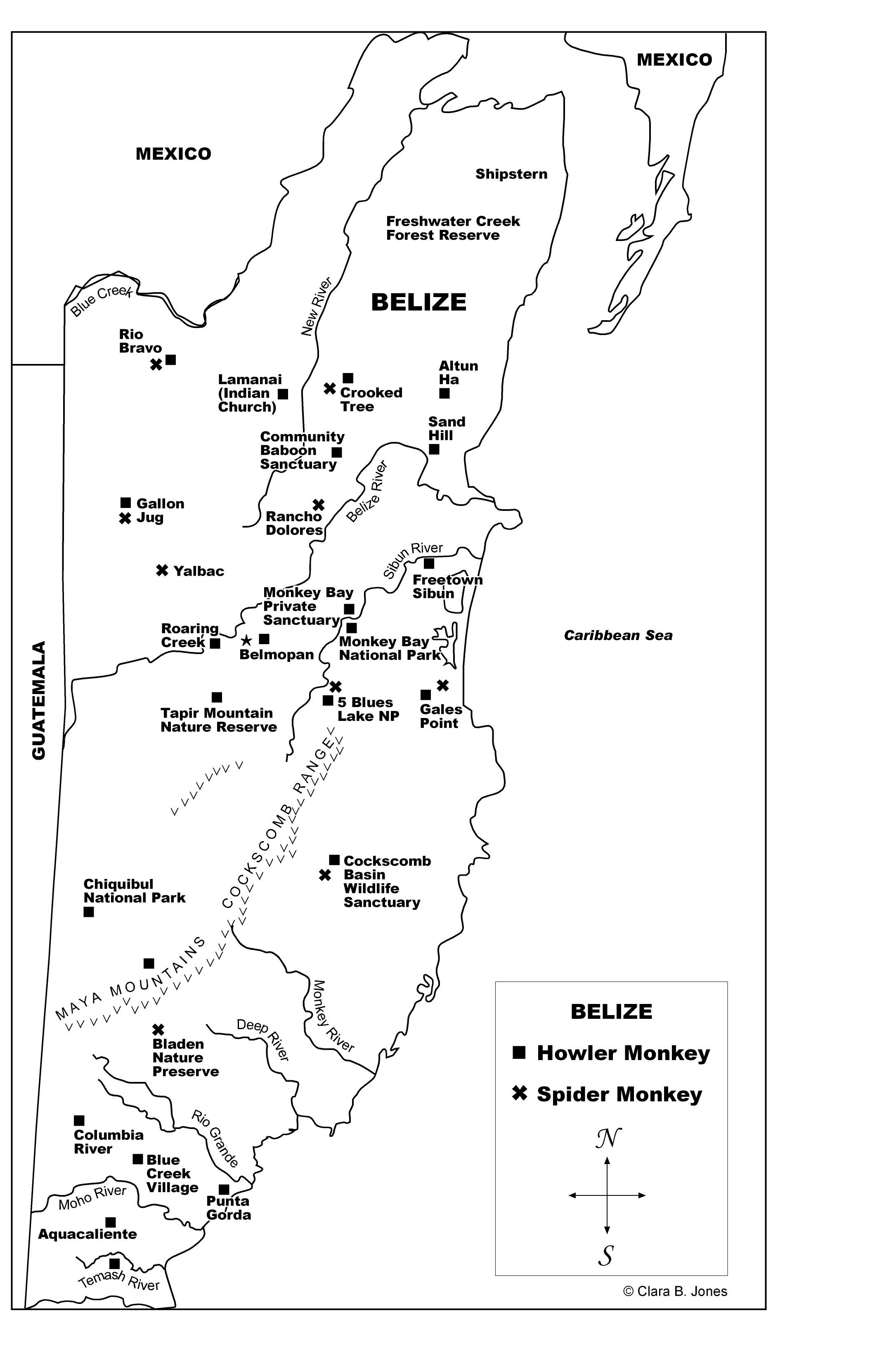
Figure 1: Species distribution map based upon opportunistic surveys conducted by Robert H. Horwich in the 1980s and 1990s. Some data points represent reports by local residents (R.H. Horwich, personal communication). See text for further discussion. ©Clara B. Jones
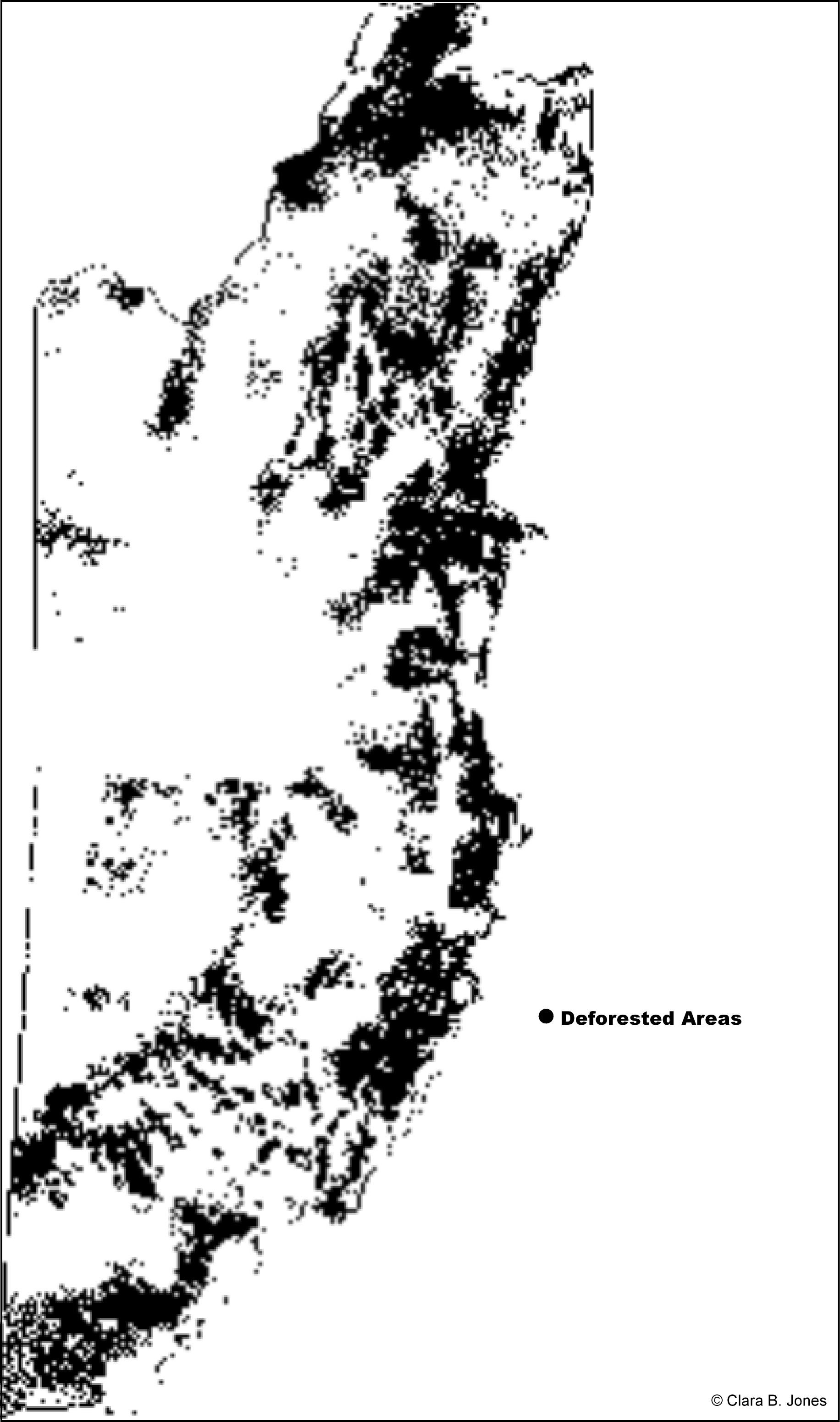
Figure 2: Map of forest cover (black area= deforestation) based upon satellite image (<www.googleearth.com>).
Phase 3 is the primary focus of this communication. These preliminary results were presented as a poster paper at a recent scientific meeting (Fayetteville State University Research Initiative for Scientific Enhancement Symposium, 2006). Figure 1 presents results of surveys of Belizean primates conducted in the 1980s and 1990s by Robert H. Horwich (personal communication, 2006). Briefly, Figure 1 displays a species distribution map of black howler monkeys and spider monkeys. A tentative pattern in these findings is that black howlers, entering Belize from the North, have crossed the Maya Mountains/Cockscomb Range in southern Belize, while the range of spider monkeys, spreading from the south, appears to be restricted by the mountain range. As noted above, the genus Alouatta, comprised of folivorous species, is recognized as a group of colonizers, while Ateles, sensitive to environmental perturbations and predominantly frugivorous, is not.
Folivory is thought to facilitate colonization, providing a relatively accessible food resource in most habitats and allowing relatively flexible “switching” from preferred (e.g., new leaves, flowers, fruits) to less preferred (mature leaves) foods during periods of food scarcity. (See, for example, Milton, 1980; Jones, 1995; Crockett, 1998.) Frugivory, on the other hand, is costly because fruit is patchily distributed and an inferior source of food (Fleming et al., 1987), factors that may limit or slow the geographical spread of species if appropriate food types and/or habitats are not encountered. If the patterns apparent in Figure 1 are supported by additional field surveys, it may have important implications not only for the distribution and abundance of primates in Belize but also for the mechanisms and biogeography of speciation of Alouatta and Ateles and the differential vulnerabilities of these taxa to microhabitat and macrohabitat effects (see Hernández Fernández & Vrba, 2005). In addition, future research on the socioecology of these two genera may yield important information about their vulnerabilities to human exploitation (e.g., variations in vulnerability to hunting). Finally, additional investigations have the potential to yield information permitting empirical assessment of hunting pressure(s) based upon optimal foraging theory.
Figure 2 shows a satellite image of forested areas, permitting the creation of an overlay for Figure 1. As expected, a comparison of the two figures shows that primates are least likely to occur where deforestation is most severe (e.g., the coastline). A. pigra appear to persist in more deforested areas while A. geoffroyi yucatanensis are more limited to larger tracts of forest, possibly required by the patchiness of fruit. One of us (CAJ) has observed a similar species distribution pattern in Costa Rica. Future studies of bushmeat hunting in Belize, in particular, the hunting of primates, should exhibit additional overlay maps, for example, of the distribution of ethnic groups and/or population densities in Belize. These displays will allow an assessment of the relationship between the presence or absence of the two primate taxa, the degree or absence of forest cover, the density of the human population (see Green & Sussman, 1990), and other factors (e.g., clustering of ethnic groups in relation to primate populations and their differential vulnerabilities in space).
Conclusions
It is likely that the incidence of hunting primates, if it occurs to any significant degree, varies from community to community among Belizean ethnic groups, including new immigrants. In Costa Rica, for example, howlers and other monkeys are protected and are generally not hunted by the population. Nonetheless, in Puntarenas, Costa Rica, a seaport, preserved body parts of howlers have occasionally been seen in the tourist market (CBJ, personal observation). Bushmeat hunting, likewise, may vary in frequency, rate, intensity, duration, and quality (e.g., as a result of hunting or habitat destruction) and as a function of spatial, temporal, and other factors (e.g., demographic characteristics of human populations). We look forward to additional descriptive and hypothetico-deductive research as well as theoretical and experimental tests of hypotheses generated by phylogeographic studies of primates in Belize and elsewhere.
References
Bakarr, M. I., da Fonseca, G., Mittermeier, R., Rylands, A. B., & Painemilla, K. W. (Eds.). (2001). Hunting and bushmeat utilization in the African rain forest: Perspectives toward a blueprint for conservation action. Washington, DC: Conservation International.
Bridgewater, S., Garwood, N., Bateman, R., Penn, M., Bol, N., & Quiroz, V. (2004). Preliminary Xaté resource inventory for the Chiquibul Forest Reserve, Belize. Edinburgh: Darwin Initiative. Retrieved June 20, 2006, from <www.chm.org.bz>.
Cowlishaw, G., & Dunbar, R. (2000). Primate Conservation Biology. Chicago: The University of Chicago Press.
Crockett, C. M. (1998). Conservation biology of the genus Alouatta. International Journal of Primatology, 19, 549-578.
Di Fiori, S. (2002). New report finds alarming amounts of deforestation along the Belize River. Retrieved September 4, 2005, from <www.wildlifetrust.org/difiore.htm>.
Fleming, T. H., Breitwisch, R., & Whitesides, G. H. (1987). Patterns of tropical vertebrate frugivore diversity. Annual Review of Ecology and Systematics, 18, 91-109.
FRA (Forest Resources Assessment) Programme. (2000). FRA 2000 annotated bibliography forest cover change, Belize: Working Paper 40. Rome: Food and Agriculture Organization of the United Nations. <www.fao.org/docrep/007/ad677e/ad677e00.htm>.
Green, G. M., & Sussman, R. W. (1990). Deforestation history of the eastern rainforests of Madagascar using satellite images. Science, 248, 212-215.
Groves, C. (2001). Primate taxonomy. Washington, DC: Smithsonian Institution Press.
Hernández Fernández, M., & Vrba, E. S. (2005). Macroevolutionary processes and biomic specialization: Testing the resource-use hypothesis. Evolutionary Ecology, 19, 199-219.
Horwich, R. H., & Lyon, J. (1990). A Belizean rainforest. Gays Mills, WI: Orang-Utan Press.
Horwich, R. H., Koontz, R., Saqui, E., Saqui, H., & Glander, K. E. (1993). A reintroduction program for the conservation of the black howler monkey in Belize. Endangered Species UPDATE, 10, 1-6.
Jones, C. B. (1995). Howler monkeys appear to be preadapted to cope with habitat fragmentation. Endangered Species UPDATE, 12, 9-10.
Jones, C. B., & Young, J. (2004). Hunting restraint by Creoles at the Community Baboon Sanctuary, Belize: A preliminary survey. Journal of Applied Animal Welfare Science, 7, 127-141.
Milton, K. (1980). The foraging strategy of howler monkeys: A study in primate economics. New York: Columbia University Press.
MNREI (Ministry of Natural Resources and the Environment, Commerce, and Industry). (2003). National report to the World Summit on Sustainable Development, Johannesburg, South Africa, 2002, 2003. Belize City: MNREI. New Scientist (2007). Are we eating Latin America’s primate population? Issue 2595, March 16.
Pavelka, M. S. M., Brusselers, O. T., Nowak, D., & Behie, A. M. (2003). Population reduction and social disorganization in Alouatta pigra following a hurricane. International Journal of Primatology, 24, 1037-1055.
Primate Info Net (2007a). Howler monkey, Alouatta sp. <pin.primate.wisc.edu/factsheets/links/alouatta>. Primate Info Net (2007b). Spider monkey, Ateles sp. <pin.primate.wisc.edu/factsheets/links/ateles>.
Redford, K. H., & Robinson, J. G. (1991). Subsistence and commercial uses of wildlife in Latin America. In J. G. Robinson & K. H. Redford (Eds.), Neotropical wildlife use and conservation (pp. 6-23). Chicago: University of Chicago Press.
Rylands, A. B., Mittermeier, R. A., & Rodriguez-Luna, E. (1995). A species list for the New World primates (Platyrrhini): Distribution by country, endemism, and conservation status according to the Mace-Lande system. Neotropical Primates, 3[Supplement], 113-160.
Wilkie, D. S., Curran, B., Tshombe, R., & Morelli, G. A. (1998). Modeling the sustainability of subsistence farming and hunting in the Ituri Forest of Zaire. Conservation Biology, 12, 137-147.
Wilkie, D. S., & Carpenter, J. F. (1999). Bushmeat hunting in the Congo Basin: An assessment of impacts and options for mitigation. Biodiversity and Conservation, 8, 927-955.
-------------------------------------------
First author’s address: Dept of Psychology, College of Basic and Applied Sciences, Fayetteville State Univ., 1200 Murchison Rd, Fayetteville, NC 28301 [e-mail: [email protected]].
We are very grateful to Robert H. Horwich for sharing the results of his surveys of Belizean primates with us. CBJ appreciates the helpful input, information, and logistic assistance received from Marcelo Windsor (Belize Forestry Department), Ivis Chan (Belize Audobon Society), Sharon Matola (Belize Zoo), Colin Young (Community Baboon Sanctuary and Galen University, Belize), Linda K. Price (U.S. Embassy, Belize), and the Ministry of Natural Resources (Belmopan, Belize). Anthony Rylands generously identified the subspecies of Ateles found in Belize. CBJ also thanks her student assistants, Heather Davis and Sarah Ersoz, and her technical assistant, Sarah DiGloria.
-------------------------------------------
* * *
The AALAS Veterinary Technician ad hoc committee (VTC) is asking veterinary technicians who read this announcement to participate in a brief (3-minute) survey. The VTC aims to increase the number of Certified Veterinary Technicians (RVT, CVT, LVT) in the AALAS community. The VTC plans to accomplish this by increasing participation and recognition of veterinary nursing professionals within AALAS. Your feedback will furnish valuable information to assist the committee in developing a means of educating Veterinary Technicians regarding career opportunities available to them in laboratory animal science. Please feel free to pass this invitation on to other Veterinary Technicians within AALAS.
The survey is online at <www.zoomerang.com/recipient/survey-intro.zgi?p=WEB226FWWJDD2G>.
* * *
Reduction of Abnormal Behavior in a Gorilla (Gorilla gorilla gorilla) Through Social Interaction with Human Beings
Cristiane Schilbach Pizzutto¹; Marcílio Nichi¹; Sandra Helena Ramiro Corrêa²; César Ades¹; and Marcelo Alcindo De Barros Vaz Guimarães¹
¹ Universidade De São Paulo, ² Fundação Parque Zoológico De São Paulo.
The considerable diversity of abnormal behaviors in captive primates is directly related to non-ideal environmental conditions in captivity, and may be indicative of poor animal welfare. The subject of this article is Virgulino, a captive male adult gorilla (Gorilla gorilla gorilla), housed at the Fundação Parque Zoológico de São Paulo and kept solitary for twenty-one years. He showed a range of highly intense and sometimes stereotypic behaviors. In an attempt to reduce the abnormal behaviors, Virgulino was exposed to sessions of training and social interaction with a human during a five-and-a-half-year period. Social interaction apparently reduced regurgitation-reingestion (R/R), coprophagy, self-mutilation, and intimidating and aggressive behaviors. These results suggest that the need to maintain social contact, characteristic of this species, may have been partially fulfilled by interaction with a human, which could be the reason for the satisfactory behavioral changes we have observed. These, in turn, suggest a better quality of life.
The behavior of wild animals is significantly influenced by conditions in captivity, which can lead to stereotypic or otherwise abnormal behaviors such as inactivity, pacing, and self-mutilation, among others (Boorer, 1971). According to Boorer, although the specific causes of these behaviors may depend on the species, they all occur as adaptations to an environment. Abnormal behavior associated with either present or past inadequate environments may indicate a lack of animal welfare (Mason, 1991).
For example, food regurgitation and reingestion (R/R) has been observed in white-handed gibbons (Hylobates lar) (Fox, 1971), chimpanzees (Pan troglodytes) (Yerkes, 1943), orangutans (Pongo pygmaeus) (Maple, 1980), gorillas (Gorilla gorilla) (Akers & Schildkraut, 1985; Gould & Bres, 1986), and men (Fleisher, 1979; Kanner 1957). Coprophagic behavior has been found in chimpanzees (Oxnard, 1966) and gorillas (Hladik, 1978; Akers & Schildkraut, 1985).
Although methods for evaluating a program of environmental enrichment are still a matter of debate (Shepherdson, 1998), some standards, such as the reduction of abnormal behaviors (Wilson, 1982) and the occurrence of species-typical behaviors (Novak & Suomi, 1988; Newberry, 1995), are useful indices of animals’ recuperation.
One of the most interesting types of environmental enrichment consists of providing captive animals with appropriate contact with a human being. According to Young (2003, p.116), “There are a number of potential solutions to the effects of solitary housing of animal species when solitary housing is unavoidable. Perhaps the most common solution and the solution of which people are most unaware is human contact. For many species human contact can, to a degree, substitute for contact with conspecifics.” Social interaction is a practical form of enrichment, not only enhancing and improving the human-animal relationship (DeRoo, 1993), but also improving animals’ general social well-being. Training and conditioning are categories of social enrichment that may reduce stress (Reichard et al., 1993) and ease management and clinical procedures (Reichard et al., 1998; Boere, 2001).
Hediger (1950) affirmed that training sessions, as a form of interaction, may act as “occupational therapy” for animals, bringing the possibility of overcoming both physical and mental challenges and giving them better control of situations that may occur in captivity (Laule & Desmond, 1998).
Our subject, Virgulino, showed unwillingness to be on public display, maintaining contact only with his keeper. Measurements of Virgulino’s behavior were taken before and after the social interactions described below. They show an eventual decrease in abnormal behaviors.
Methods
This study took place within a period of five and a half years (from 1998 to 2003) at Fundação Parque Zoológico de São Paulo, and was divided into two periods; the first with no treatments, considered as baseline, and the second, in which training and social interaction were applied.
Nine categories of behaviors, including those commonly considered abnormal, were observed, classified as shown in Table 1.
| Behavior | Description |
| R/R | Regurgitating food immediately after ingestion followed by reingestion of the regurgitate. |
| Coprophagy | Ingesting feces. |
| Self-mutilation | Plucking hair from any part of the body using the hands or the mouth. |
| Intimidation | Running diagonally, beating the wrist against the chest and screaming. |
| Aggressiveness | Striking own body against the wall in the off exhibit area, throwing feces and/or objects at nearby people. |
| Browsing | Walking through the off-exhibit or exhibition areas, searching for food. |
| Feeding | Manipulating and/or ingesting food. |
| Inactivity | Sleeping or remaining in a sitting, lying, or standing position. |
| Others | Walking aimlessly, scratching, grooming, urinating, defecating, yawning, and vocalizing. |
Table 1: Description of the behaviors found in Virgulino. Behaviors considered abnormal have gray background in all tables.
Baseline period: Virgulino’s behaviors, including potential stereotypies, were observed and recorded for six months. During this period, while ethograms were created, there was no contact between animal and researcher. Ethograms were created by sampling every 30 seconds during one-hour daily sessions, three times a week.
After the end of each one-hour session, the researcher came closer to Virgulino, in a submissive attitude (lowered head and eyes), and offered a piece of dehydrated banana, which the animal immediately ate. The aim of these offerings was to establish proximity with Virgulino, and gradually gain his trust.
After six months of observations, no more unnoticed observations were possible; Virgulino started to realize that he was being observed and always looked for the researcher. Although the researcher attempted to stay hidden, Virgulino positioned himself facing the researcher, and remained so until the end of the recording. At any movement of the researcher, Virgulino moved in the same direction, even if the researcher was completely hidden. From this time, the second phase of the work took place.
Social interaction and training period: During these five years, upon seeing the researcher, Virgulino always moved voluntarily towards the place in which the training usually took place. The trainer carried a bag containing all the materials used during the sessions of training and interaction. Virgulino attentively observed each object being removed from the bag.
During the first six months of this period, Virgulino showed a frightened reaction when the video camera was being positioned. He hid and was reluctant to sit next to the equipment. After this time, he showed no concern with filming or photography, as long as the filming was being done by the researcher.
The sessions were divided into two parts: training and social interaction, both taking place in the off-exhibit area, away from public view.
Training was done according to the principles of operant conditioning; sessions took place three times a week, in the morning before Virgulino was sent to the exhibit area. During the 30-minute sessions, a series of short verbal commands were given: sit, mouth (open), hand (present), feet (present), stand, lie down, sit – in this order. A command was repeated up to three times if the animal did not obey, followed by the next command. This sequence was always followed and performed up to three times a session; a food reward (various fruits) was offered after every correct response.
Whenever there was an interruption because of some distraction, the sequence of commands was started again from the beginning.
At the sign of any kind of aggressive behavior, a punishment was applied: the session was interrupted for one minute, while the researcher stood with her back to the animal, in complete silence. Sessions were restarted after the one-minute time-out.
Social interaction: After each training session there was a 10-minute interval during which Virgulino was kept alone. After the interval, a 20-minute “social” session took place, in which the researcher handled objects – toys and dolls, – offered various foods, and played several kinds of music. The food offered during these sessions consisted of fruits, leaves, and sprouts, components of his regular zoo diet.
After the sessions, Virgulino’s behavior was observed and recorded for one hour in the off-exhibit area (the animal could see the researcher), and for three hours while Virgulino was in the exhibit area.
Results
The training sessions took place in a spot which was not free of occasional stimuli capable of distracting Virgulino, who usually lost interest in the training whenever there was a noise. This may have caused some difficulties in the acquisition of appropriate behaviors. However, despite these difficulties, it was possible to obtain correct movements in response to the commands, such as touching the cage with the hands, feet, or arms, and opening his mouth for inspection of the oral cavity and teeth. The commands for sitting, standing, and lying down (Figure 1) also succeeded well.
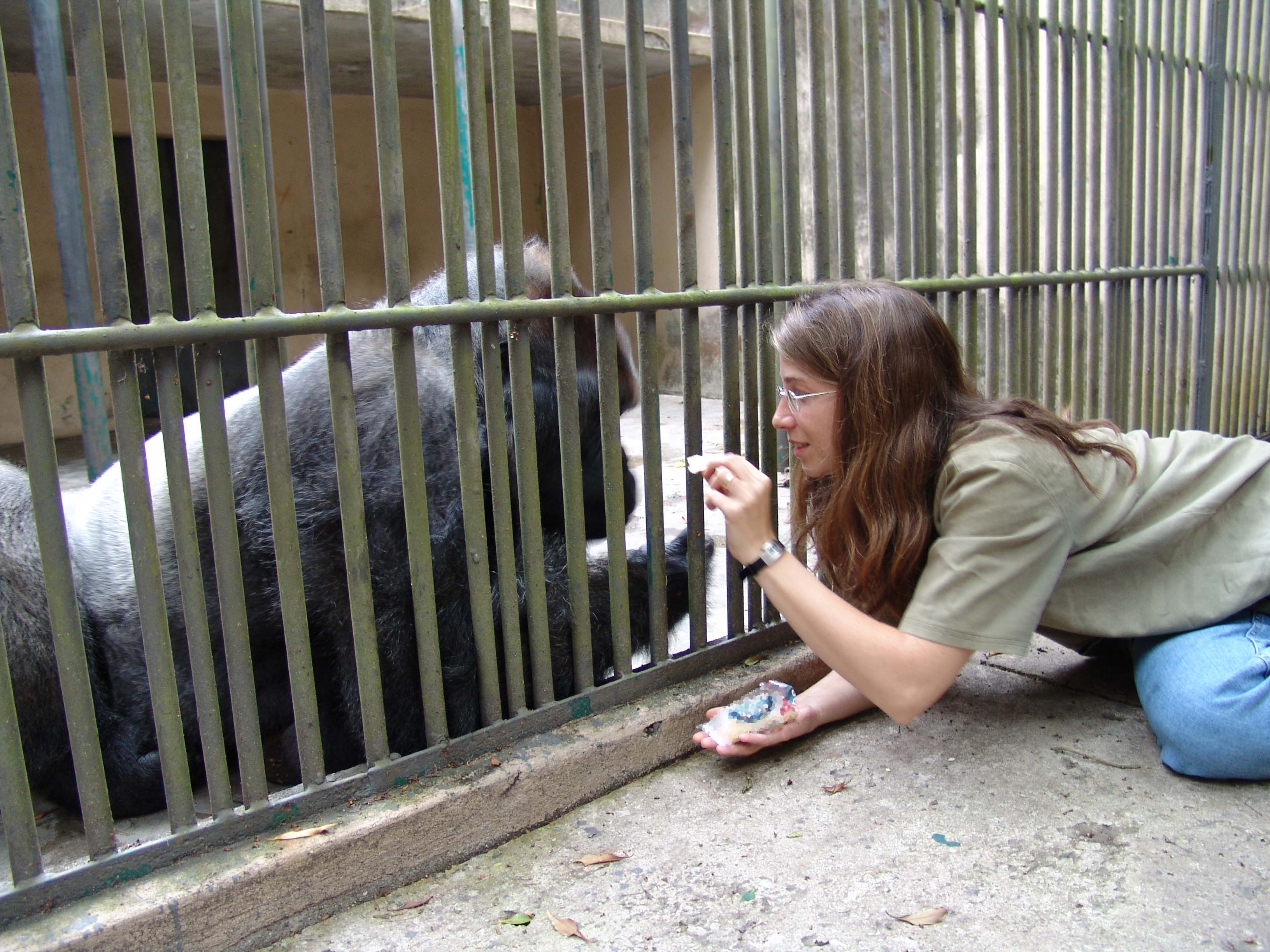
Figure 1: Social interaction between researcher and animal.
The sessions of social interaction were followed with great interest and curiosity by the animal, who positioned himself next to the researcher, carefully observing every new object that was offered.
| Behavior | Baseline period | Training and social interaction period (years) | ||||
|---|---|---|---|---|---|---|
| R/R | 2.30 | 0.42 | 0.18 | 0.29 | 0.25 | 0.23 |
| Coprophagy | 0.49 | 0.05 | 0.04 | 0.03 | 0.06 | 0 |
| Self-mutilation | 4.20 | 0.01 | 0 | 0 | 0 | 0 |
| Intimidation | 10.0 | 0.030 | 0 | 0 | 0 | 0 |
| Aggressiveness | 2.20 | 0.01 | 0.014 | 0 | 0 | 0 |
| Browsing | 0 | 0 | 0 | 0 | 0 | 0 |
| Feeding | 0.80 | 0.36 | 0.47 | 1.09 | 1.18 | 1.47 |
| Inactivity | 76.90 | 97.58 | 97.09 | 94.47 | 93.51 | 93.54 |
| Others | 3.10 | 1.54 | 2.20 | 4.12 | 5.00 | 4.76 |
Table 2: Percentage of various behaviors observed in the gorilla Virgulino, in the off-exhibit area, during a baseline period (6 months; 24,000 observations) and during the following training and social interaction period (5 years; 86,400 observations). Fundação Parque Zoológico de São Paulo (1997-2002).
Tables 2 and 3 show a considerable reduction of the behaviors considered to be abnormal – R/R, coprophagy, self-mutilation, intimidation, and aggression – in both the exhibit and off-exhibit areas. This reduction appeared in the first year after enrichment began, and the lower levels were maintained for the next four years.
Virgulino did not show browsing behavior while in the off-exhibit area throughout the whole experimental period. Browsing, as well as feeding behaviors, showed a decrease in the first two years after enrichment, followed by an increase above the baseline period, both in the off-exhibit and the exhibit areas.
| Behavior | Baseline period | Training and social interaction period (years) | ||||
|---|---|---|---|---|---|---|
| R/R | 2.60 | 0.83 | 0.17 | 0.27 | 0.27 | 0.20 |
| Coprophagy | 0.60 | 0.05 | 0.04 | 0.01 | 0.02 | 0.01 |
| Self-mutilation | 5.00 | 0.52 | 0.20 | 0.004 | 0.01 | 0.003 |
| Intimidation | 7.40 | 0.33 | 0.01 | 0.004 | 0 | 0 |
| Aggressiveness | 0.30 | 0.24 | 0.04 | 0.01 | 0.003 | 0 |
| Browsing | 6.5 0 | 4.93 | 5.10 | 8.02 | 8.71 | 9.990 |
| Feeding | 18.00 | 13.046 | 14.97 | 21.25 | 24.22 | 26.26 |
| Inactivity | 56.90 | 77.90 | 767.37 | 66.68 | 62.86 | 59.46 |
| Others | 2.70 | 2.14 | 3.10 | 3.76 | 3.91 | 4.08 |
Table 3: Percentage of various behaviors observed in the gorilla Virgulino, in the exhibit area, during a baseline period (6 months; 36,000 observations) and during the training and social interaction period (5 years; 259,200 observations). Fundação Parque Zoológico de São Paulo (1997-2002).
The percentage of inactivity increased considerably during the first two years after enrichment.
Discussion
According to Gould and Bres (1986), diets with low concentrations of fibers may be involved in the appearance of R/R behavior. However, in the present study, there were no changes in the composition of the diet.
Despite the striking decrease, the R/R behavior did not completely disappear. The elimination of undesirable behaviors in captive animals is difficult and, in many cases, impossible (Lawrence & Rushen, 1993). Some of those behaviors, such as R/R, are persistent even when animals are submitted to direct treatment interventions (Lukas, 1999; Lukas et al., 1999). Akers and Schildkraut (1985) affirm that R/R occurrence may be due to several factors, such as rapid ingestion of favorite foods, or may even be a reaction to the presence of an audience. Gould and Bres (1986) showed that manipulating different kinds of sprouts, using the hands or mouth, increases the time spent eating, and operates as a form of enrichment and stimulation. According to these authors some zoos, in which sprouts are used in the diet of gorillas, are able to reduce the episodes of R/R – without, however, completely eliminating this behavior.
Gould and Bres (1986) observed that gorillas tend to manipulate regurgitated material before reingestion. In the present study, in all of the R/R episodes, regurgitated material was manipulated and separated, apparently within color categories. This was followed by the reingestion of the material always in the same sequence: yellow, red, and green; ending with the salivary material. The possibility that the animal used color as a parameter to separate the material to be reingested is interesting; however, more studies are necessary to confirm and investigate this hypothesis.
The absence of previous records on coprophagy (Fossey & Harcourt, 1976) and self-mutilation (Weber & Vedder, 2001) in wild gorillas suggests that these behaviors should be considered abnormal. In the present study, during the enrichment procedure, the reduction of coprophagy and self-mutilation suggests that human-animal interaction may lead to reduction of abnormal behaviors in primates.
Intimidating and aggressive behaviors also decreased in the first year of enrichment, which may be directly related to increased socialization between animal and researcher. Virgulino’s behaviors, when seeing the researcher right before the beginning of the training and social interaction sessions, showed great expectation and acceptance.
Behavior is commonly used to evaluate animal welfare by comparing behavioral patterns observed in the wild and in captivity (Shepherdson, 1998). A wild gorilla spends 4 to 5 hours a day browsing, of which 25 to 45% is spent eating (Fossey, 1979). The absence of browsing in the off-exhibit area and its low incidence in the exhibit areas showed that captivity has influenced the behavior of Virgulino. This may reflect directly on the origin of some of his abnormal behaviors. It is interesting to notice that the increase in browsing behavior in the exhibit area, from the third year on, appears to be related to a reduction in the incidence of self-injury, which may indicate that the recurrence of a typical behavior reduced the occurrence of one considered abnormal.
A reduction of feeding behavior was observed when comparing the baseline period and the first two years of enrichment, both off-exhibit and on-exhibit. However, from the third and fourth year on, for both exhibit and off-exhibit areas, there was a large increase in this behavior above the baseline levels. This may have occurred because, throughout the experimental period, the animal received food items as reinforcement for learning behaviors, which may have increased the time of food manipulation before ingestion. Another factor is that, on several occasions, the animal carried the food to the exhibit area. According to Akers and Schildkraut (1985), wild gorillas have access to a large assortment of vegetable matter, leading to increased manipulation periods and allowing them to select food according to color, temperature, texture, taste, appetite, and individual preferences.
Despite the reduction of abnormal behaviors found after the training sessions and social interaction, there was a large increase in inactivity. This may be related to the environment, which had no enrichment, and to the solitary conditions in which the animal was kept for twenty-one years. Inactivity has been associated with poor environments, lethargy, and obesity in gorillas and orangutans (Erwin & Deni, 1979; Maple, 1979). Many studies have shown the influence of several factors on the behavior of a particular animal (Wilson, 1982), such as space (Wilson, 1972), company (Harlow, 1965; Sackett, 1968), and environmental complexity (Markowitz, 1979; Menzel, 1971).
All the behavioral changes observed in Virgulino during the five years of enrichment showed the importance of providing human contact to an animal as a method of enrichment, which is especially important in animals as sociable as gorillas. Operant training may be seen as an opportunity to reinforce the connections between researcher and animal, as well as a condition leading to rewarding interactions.
Due to the impossibility of providing a companion of the same species, social interaction with a human was an alternative means of creating pleasurable, interesting, and effective situations to improve Virgulino’s quality of life. Results of the present work strongly support the theory that social interaction associated with training is effective in reducing abnormal behaviors, improving the quality of life and welfare of many captive animals, and making them more sociable and cooperative with routine procedures of daily management in zoos.
References
Akers, J. S., & Schildkraut, D. S. (1985). Regurgitation/reingestion and coprophagy in captive gorillas. Zoo Biology, 4, 99-109.
Boere, V. (2001). Behavior and environment enrichment. In M. E. Fowler & Z. S. Cubas (Eds.), Biology, Medicine and Surgery of South American Wild Animals. (pp. 263-266). Ames, Iowa: Iowa State University Press.
Boorer, M. K. (1971). Some aspects of stereotyped patterns of movement exhibited by zoo animals. International Zoo Yearbook, 12, 164-168.
DeRoo, M. C. (1993). Training the basics: Getting started. The Zooculturist, 6, 7-9.
Erwin, J., & Deni, R. (1979). Strangers in a strange land: Abnormal behaviors or abnormal environments? In J. Erwin, T. L. Maple, & G. Mitchell (Eds.), Captivity and behavior (pp. 1-28). New York: Van Nostrand Reinhold.
Fleisher, D. F. (1979). Infant rumination syndrome. American Journal of Diseases of Children, 133, 266-269.
Fossey, D., & Harcourt, A. H. (1976). Feeding ecology of free-ranging mountain gorillas (Gorilla gorilla beringei). In T. H. Clutton-Brock (Ed.), Primate ecology: Studies of feeding and ranging behavior in lemurs, monkeys and apes (pp. 415-447). New York: Academic Press.
Fossey, D. (1979). Development of the mountain gorilla (Gorilla gorilla beringei): The first thirty-six months. In D. A. Hamburg & E. R. McCown (Eds.), The great apes (pp. 139-184). Menlo Park, CA: Benjamin Cum-mings.
Fox, M. W. (1971). Psychopathology in man and lower animals. Journal of the American Veterinary Medical Association, 159, 66-77.
Gould, E., & Bres, M. (1986). Regurgitation and reingestion in captive gorillas: Description and intervention. Zoo Biology, 5, 241-250.
Harlow, H. F. (1965). Total social isolation: Effects on macaque monkey behavior. Science, 148, 666.
Hediger, H. (1950). Wild animals in captivity. London: Butterworth.
Hladik, C. M. (1978). Adaptive strategies of primates in relation to leaf-eating. In G. G. Montgomery (Ed.), The ecology of arboreal folivores (pp. 375-395). Washington: Smithsonian Institution Press.
Kanner, L. (1957). Child Psychiatry, 3rd ed. Springfield, IL: Thomas.
Laule, G., & Desmond, T. (1998). Positive reinforcement training as an enrichment strategy. In D. J. Shepherdson, J. D. Mellen, & M. Hutchins (Eds.), Second Nature: Environmental enrichment for captive animals (pp. 302-313). Washington, DC: Smithsonian Institution Press.
Lawrence, A. B., & Rushen, J. (1993). Stereotypic Animal Behaviour. Wallingford: CAB International.
Lukas, K. E. (1999). A review of nutritional and motivational factors contributing to the performance of regurgitation and reingestion in captive lowland gorilla (Gorilla gorilla gorilla). Applied Animal Behaviour Science, 63, 237-249.
Lukas, K. E., Hamor, G., Bloomsmith, M. A., Horton, C. L., & Maple, T. L. (1999). Removing milk from captive gorilla diets: The impact on regurgitation and reingestion (R/R) and other behaviors. Zoo Biology, 18, 515-528.
Maple, T. L. (1980). Orang-utan behavior. New York: Van Nostrand Reinhold.
Markowitz, H. (1979). Environmental enrichment and behavioral engineering for captive primates. In: J. Erwin, T. Maple, & G. Mitchell (Eds.), Captivity and behavior: Primates in breeding colonies, laboratories and zoos (pp. 217-238). New York: Van Nostrand Reinhold.
Mason, G. J. (1991). Stereotypies: A critical review. Animal Behaviour, 41, 1015-1037.
Menzel, E. W. (1971). Group behavior in young chimpanzees: Responsiveness to cumulative novel changes in a large outdoor enclosure. Journal of Comparative and Physiological Psychology, 74, 46-51.
Newberry, R. C. (1995). Environmental enrichment – Increasing the biological relevance of captive environments. Applied Animal Behavior Science, 44, 229-243.
Novak, M. A., & Suomi, S. (1988). Psychological well-being of primates in captivity. American Psychologist, 43, 765-773.
Oxnard, C. E. (1966). Vitamin B-12 nutrition in some primates in captivity. Folia Primatologica, 4, 424-431.
Reichard, T., Shellabarger, W., & Laule, G. (1993). Behavioral training of primates and other zoo animals for veterinary procedures. Proceedings of American Association of Zoo Veterinarians, 65-69.
Reichard, T., Shellabarger, W., & Laule, G. (1998). The veterinarian’s role in enrichment. Journal of Zoo and Wildlife Medicine, 29, 369-370.
Sackett, G. P. (1968). Abnormal behavior in laboratory-reared rhesus monkeys. In: M. W. Fox (Ed.), Abnormal behavior in animals (pp. 293-331). Philadelphia: Saunders.
Shepherdson, D. J. (1998). Tracing the Path of Environmental Enrichment in Zoos. In: D. J. Shepherdson, J. D. Mellen, & M. Hutchins (Eds.), Second Nature: Environmental enrichment for captive animals (pp. 1-12). Washington, DC: Smithsonian Institution Press.
Weber, B., & Vedder, A. (2001). The kingdom of gorilla: Fragile species in a dangerous land. New York: Simon & Schuster.
Wilson, S. F. (1982). Environmental influences on the activity of captive apes. Zoo Biology, 1, 201-209.
Yerkes, R. M. (1943). Chimpanzees: A laboratory colony. New Haven: Yale University Press.
Young, R. J. (2003). Environmental Enrichment for captive animals. U.K.: Blackwell Publishing.
-------------------------------------------
First author’s address: Depto de Reprodução Animal, Fac. de Med. de Veterinária e Zootecnia, Univ. de São Paulo, Av. Prof. Dr. Orlando Marques Paiva, 87, Cidade Universitária, São Paulo, Cep: 05508-000, Brasil (e-mail: [email protected]).
We thank the Fundação Parque Zoológico de São Paulo for the opportunity to work with the only gorilla in their collection.
We also thank the Conselho Nacional de Desenvolvimento Científico e Tecnológico (CNPq, 141626/2002-0) for the PhD scholarship, and Fundação de Amparo à Pesquisa do Estado de São Paulo (FAPESP, 02/13966-6) for financially supporting this experiment.
This work was performed according to Bioethics protocols and Brazilian regulations for animal care.
-------------------------------------------
* * *
A Report on Yersinia-related Mortality in a Colony of New World Monkeys
J. Bakker, I. Kondova, C. W. de Groot, E. J. Remarque, and P. J. Heidt
Biomedical Primate Research Centre, Rijswijk, The Netherlands
The Biomedical Primate Research Centre (BPRC) is an independent nonprofit research organization dedicated to the breeding of nonhuman primates and their use as models to study, prevent, and treat serious human diseases. BPRC houses self-sustaining breeding colonies of rhesus monkeys (Macaca mulatta) and New World monkeys, i.e. cotton top tamarins (Saguinus oedipusOedipus), and common marmosets (Callithrix jacchus).
An outbreak of acute fatal disease with high rates of morbidity and mortality occurred during a limited period of two weeks over three consecutive years (between 2001 and 2003) in the indoor breeding colonies of New World monkeys. When observed, clinical signs were suggestive of infection. Bacteriology and histopathology showed Yersinia spp. to be the causative agent. During the outbreak in 2003, preventive measures were initiated and they appear to have subsequently controlled and prevented the infection.
This paper describes the investigations undertaken to reach the diagnosis of yersiniosis and the significant effects of vaccination as a preventive measure.
Animals: In 1996 BPRC established a breeding colony of cotton-top tamarins obtained from the University of Bristol (U.K.). The colony included only captive-bred animals ranging from infants to adults over 21 years of age. The marmoset colony was formed in 1975, and consisted of animals obtained from various accredited suppliers (only captive-bred animals were included). Ages ranged from neonates to over 26 years.
To prevent inbreeding, new breeding lines were imported into both colonies at regular intervals. These new animals were released into the colony after a 12-week quarantine period, which included monthly bacteriological examinations of rectal swabs, parasitological examinations of feces, tuberculin skin tests, and physical examinations.
Care and housing of the monkeys was carried out in accordance with national and European animal care and welfare guidelines for laboratory animals.
Housing: The different species were housed in separate rooms in the same building, and the New World monkeys were housed in family groups with offspring remaining in the group after birth and after the weaning of at least two successive sets of offspring. The animals were housed in wire-mesh cages measuring 70 x 150 x 180 cm, equipped with wooden perches and a nest box. To enrich the monkeys’ environment, a complex system of branches, ropes, and wooden runways was constructed in each cage, with sawdust used as bedding material. Once a week the sawdust was removed, the cages were cleaned with hot water, and new sawdust was spread on the cage floor. Once a week the building floors were disinfected with Halamid®-d (Chloramine T, Veip B.V., Wijk bij Duurstede, the Netherlands). The temperature in the rooms was maintained between 26° and 28°C with a relative humidity between 50-60%. The light:dark period is 12:12 h, and lights were on from 7:00 until 19:00 h. Lighting was artificial and consisted of full-spectrum fluorescent light close to the cages. The room ventilation rate was eight changes per hour.
Feeding: The monkeys were fed a standard primate pellet diet (Ssniff marmoset®, Ssniff, Soest, Germany) ad lib, supplemented with a variety of fruits, vegetables, nuts, eggs, crickets, grasshoppers, rice, and yogurt. Tap water was provided ad lib in water bottles. The bottles were disinfected three times a week in Halamid®-d and rinsed with clean tap water before re-use.
2001
In April of 2001 a complete physical examination of the marmoset colony was performed, and a general feature was a weight loss of 20-50 grams in the majority of the animals, compared to what they had weighed during the previous year’s physical examination. Freshly collected rectal swabs and stools were submitted to our microbiology department. Yersinia spp. were isolated from rectal swabs from some monkeys. For Yersinia spp. isolation, the samples were incubated in GN enrichment broth (Becton Dickinson GmbH, Heidelberg, Germany [BDG]. See Hajna, 1955, and Taylor & Schelhart, 1968, 1969) at 28°C for 6 to 8 h and subsequently streaked onto Yersinia selective CIN agar (BDG; see Schiemann, 1979). When the complete enrichment procedure could not be completed during regular working hours, specimens were directly plated onto CIN agar as well. CIN agar plates were incubated at 28°C and examined after 24 and 48 h. Suspicious colonies were subcultured on blood agar (BDG) and subsequently screened for urease activity, oxidase reaction, and mobility. 20E API strips (BioMérieux Benelux B. V. ‘s-Hertogenbosch, the Netherlands) were used to identify the isolates as Yersinia spp. Besides Yersinia spp., the samples were also screened for the presence of Salmonella, Aeromonas, Shigella, and Campylobacter spp. In addition, stool specimens were collected and examined microscopically for parasites. The day after the examination most of the marmosets had diarrhea, and a microscopic examination of the fecal material revealed the presence of red blood cells and the absence of inflammatory cells.
Shortly after these examinations, marmosets began to die. One or two died each day for two weeks. The monkeys often died without displaying any clinical signs of illness. In a few cases, diarrhea with or without fresh blood, apathy, anorexia, lameness of the hind limbs, weight loss, depression, dehydration, and hypothermia were observed 24 h prior to death.
Marmosets showing signs of distress received supportive treatment: for example, a heating lamp, fluid therapy, and the administration of vitamins. Antibiotic administration was initiated as soon as bacterial infection was suspected to be causing the mortality. The entire marmoset colony was treated intramuscularly (i.m.) with enrofloxacin (Baytril® 2.5% injectable solution, Bayer AG, Leverkussen, Germany [BAG]), in a dose of 5 mg/kg once daily (s.i.d.) for seven days. Blood samples from some affected monkeys were collected by venipuncture of the vena femoralis into a vacutainer coated with K3E EDTA K3 (Greiner bio-one GmbH, Kremsmünster, Austria [GBG]) and Z serum Sep. Clot Activator (GBG). Standard hematological and biochemical values were determined. The hematological samples were analyzed by a Sysmex SF3000 & R500 (Goffin Meyvis, Etten-Leur, the Netherlands) and the biochemical values by a Cobas Integra® 400 plus (F. Hoffmann-La Roche Ltd, Basel, Switzerland). These samples were collected without the animals being sedated, since most of the affected monkeys were sufficiently docile due to disease. A set of normal values for the colony, obtained by using the same analyzers, was used as a reference.
Blood values of affected monkeys showed an ionic im-balance, increased creatinin (mostly due to dehydration), slight thrombocytosis, and low protein and albumin levels (due to diarrhea). Other hematological and biochemical blood values were within the normal range. Macroscopic pathology revealed enlarged mesenteric lymph nodes and activated lymphoid plaques in the colon. Two clinically ill marmosets were euthanized and a virological examination was performed (Department of Virology, University Medical Center, Rotterdam, the Netherlands). The liver, lung, spleen, brains, kidney, and saliva tested negative for influenza A, influenza B, parainfluenza, and respiratory syncytial virus (RSV).
The problems ended as abruptly as they had begun. The antibiotic and supportive treatment seemed to have a positive effect early in the course of the disease or in mild cases. In severe cases, the marmosets failed to respond to antibiotic and supportive treatment.
2002
In February 2002, the abrupt beginning and ending of the problems – duration period, clinical symptoms, gross pathology, and blood values of affected marmosets – were similar to those observed in 2001. As in 2001, monkeys showing signs of distress received supportive treatment. Antibiotic administration was also initiated immediately after bacterial infection was suspected. All the marmosets were given enrofloxacin (Baytril® 2.5% oral solution, BAG) in a dose of 5 mg/kg (s.i.d.) for five days. The antibiotic and supportive treatment seemed to have a positive effect early in the course of the disease or in mild cases. In severe cases, the marmosets failed to respond to antibiotic and supportive treatment. A viral etiology was excluded on the basis of clinical signs, specific gross findings, and bacteriological results.
2003
During February, 2003, there were many cases of diarrhea due to Trichomonas spp. in the tamarin colony. Because of this, the whole tamarin colony was treated orally with metronidazole (Flagyl®, Rhône-Poulence Rorer B.V., Amstelveen, the Netherlands), at a dose of 20 mg/kg for 7 days, twice daily. Subsequently no diarrhea was noted during the interval between this treatment and the start of the period of high rates of morbidity and mortality in March, 2003.
In March, 2003, we began to notice clinical symptoms, gross pathology, blood values, and deaths in marmosets, similar to those observed in 2001 and 2002. But this year, mortality occurred not only in the marmoset colony but coincided with similar symptoms and mortality in the tamarin colony. Two or three New World monkeys died each day for two weeks.
In 2003, antibiotic administration was initiated as soon as a death due to Yersinia spp. was observed. On the basis of antimicrobial susceptibility testing of the isolated Yersinia spp., enrichment and subsequent plating were the only techniques used for autopsy specimens, and each marmoset and tamarin was treated with enrofloxacin in a dose of 5 mg/kg (s.i.d.) for 10 days. Enrofloxacin was injected i.m. the first day and then given orally.
During this period of morbidity and mortality, hygienic standards were raised to prevent the potential spread of a possible infection to other buildings and animal species. Various other preventive measures were taken, including prohibiting the direct moving of animal caretakers from one building to another, pest control, and the creation of a central kitchen for the storage and distribution of fruit and vegetables. Strict regulations were also enforced regarding the changing of outer garments on entering and leaving buildings.
| 2001 | 2002 | 2003 | 2004 | 2005 | |
| Marmosets | |||||
| Population at risk | 111.3 | 137.9 | 208.2 | 247.6 | 82.3 |
| Yersinia spp. deaths | nd | nd | 13 (6.2%) | 0 | 0 |
| All deaths, February to May | 16 (14.4) | 26 (18.9) | 14 (6.7%) | 1 (0.4) | 2 (2.4%) |
| All deaths, annual | 31. (27.9%) | 38 (27.6%) | 21 (10.1%) | 11 (4.4%) | 3 (3.6%) |
| Tamarins | |||||
| Population at risk | 67.9 | 75.1 | 67.2 | 79.1 | 32.1 |
| Yersinia spp. deaths | nd | nd | 15 (22.3%) | 0 | 0 |
| All deaths, February to May | 2 (2.9%) | 1 (1.3%) | 16 (23.8%) | 0 | 0 |
| All deaths, annual | 3 (4.4%) | 8 (10.7%) | 19 (28.3%) | 2 (2.5%) | 0 |
Table1: Mortality in New World monkeys at the BPRC. The population at risk is displayed in animal years. We defined death as being due to Yersinia spp. when the clinical signs, bacteriological results, specific gross and histopathological findings were consistent with this diagnosis. If only some but not all parameters were present, we recorded the cause of death as no diagnosis (nd). Deaths from Yersinia spp., deaths from all causes from February to May and annual deaths from all causes are presented as well as % per monkey year.
Necropsies were performed using established techniques. Tissue samples from all organs were fixed in 4% buffered formaldehyde, and the tissues were routinely processed for paraffin embedding. Sections 5 microns thick were cut and stained with hematoxylin and eosin for light microscopy examination (Luna, 1968). A post mortem examination revealed gross (Figure 1) and histopathologic lesions suggestive of Yersinia infection.
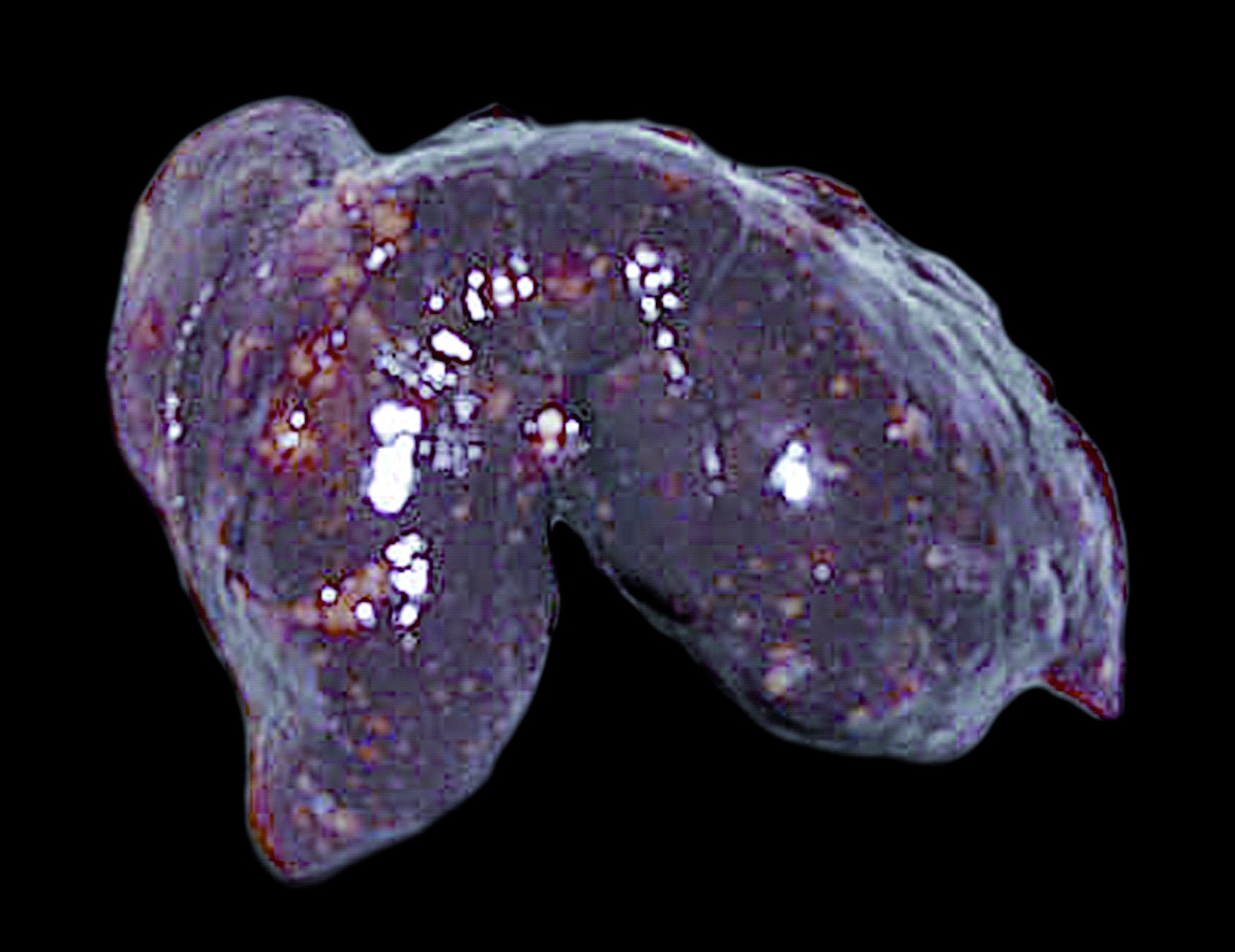
Figure 1: Liver of a marmoset diagnosed with yersiniosis indicating multifocal hepatic necrosis.
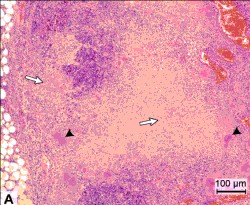
Figure 2: Marmoset diagnosed with yersiniosis. (A) Lymph node: multifocal necrosis (arrows) with central large lobulated colonies of coccobacilli (arrowheads). Hemotoxylin-eosin stain (HE). Bar = 100 µm.
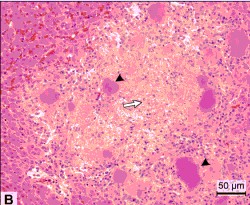
(B) Liver: area of necrosis (arrow) with intralesional large lobulated colonies of coccobacilli (arrowheads). HE. Bar = 50 µm.
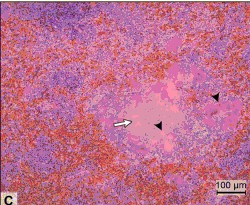
(C) Spleen: area of necrosis (arrow) with central large lobulated colonies of coccobacilli (arrowheads) and marked lymphoid depletion. HE. Bar = 100 µm.
Gross findings were consistent with mild to moderately enlarged liver (hepatomegaly), spleen (splenomegaly), and mesenteric lymph nodes (lymphadenopathy) with multiple randomly scattered white-yellowish foci with a 1-6 mm diameter. The small and large intestines often exhibited transmural, multifocal differently sized red and dark brown foci (hemorrhages and necrosis).
Seen microscopically (Figure 2), in the spleen, liver, lymph nodes, and small and large intestine there were differently sized areas of necrosis characterized by disruption of normal architecture, loss of cellular detail, and abundant eosinophilic cellular and karyorrhetic debris. Necrotic foci were accompanied by moderate numbers of viable and degenerate neutrophils, fewer macrophages, lymphocytes, and few plasma cells. Scattered throughout the parenchyma were large, lobulated, extracellular colonies of coccobacilli. In the surrounding less affected areas there were foci of hemorrhage, edema, fibrin, congestion, inflammatory cells, and fewer bacterial emboli. Lesions in the liver, spleen, and lymph nodes were random and multifocal, and in the large and small intestine they were segmental and transmural (involving lamina propria mucosae, tunica muscularis, submucosa, and serosa).
All together, the clinical signs and the specific gross and histopathological findings were consistent with Yersinia spp. infection. Isolated Yersinia strains were forwarded to a reference laboratory, the Dutch National Institute for Public Health and Environment (RIVM; Bilthoven, the Netherlands). The bacteriological results confirmed the etiologic agents to be Yersinia pseudotuberculosis and Yersinia enterocolitica. A viral etiology was excluded on the basis of clinical signs, specific gross and histopathological findings, and bacteriological results. The antibiotic and supportive treatment did not seem to reduce the mortality rate and/or duration of symptoms. As in the previous years, the infection appeared to be self-limiting since the problems ended abruptly.
Autumn 2003 to the Present
In the autumn of 2003 massive vaccination with Pseudovac® (obtained from the Department of Veterinary Pathology, section Zoo and Exotic Animals, Utrecht University, Utrecht, the Netherlands) was performed in the colonies of both marmosets and tamarins. Pseudovac® is a formalin-killed vaccine that contains different serotypes of Yersinia spp. collected from clinical outbreaks. A dose of 0.25 ml Pseudovac® was administered subcutaneously (s.c.), regardless of the animal’s weight. All animals older then seven weeks were vaccinated. A booster followed the first vaccination three weeks later.
The vaccinations have been repeated every 12 months. No side effects or any clinical reaction to the vaccination have been observed.
In December, 2005, the marmosets were transferred to a new facility with both indoor and outdoor accommodations, and the monkeys are now able to move freely between the two environments when outside temperature permits. The bedding in the inside enclosure consists of wood chips. Once a month the surface is raked and sprinkled with water. The feeding schedule is similar to that in the old housing facilities. In the new marmoset facility, tap water is provided ad lib through drinking nipples.
Since the initiation of a combination of preventive measures, with the main effort focused on vaccination of the whole colony with Pseudovac®, no Yersinia-related cases or mortality have been observed (Table 1).
Discussion
It is intriguing that mortality in the New World monkey colony (two to three monkeys died every day) was restricted to a period of two weeks between February and May during three consecutive years, and that the problems began and ended so abruptly. In 2003 comparable mortality and morbidity rates in the indoor breeding colony of tamarins coincided with those of the marmosets (Table 1). Neither age nor sex appeared to influence mortality or survival rates (data not shown). The survival and mortality rates and/or periods are possibly underestimated because of the increased supportive care provided along with administration of antibiotics in each of the three years (Table 1). Yersinia spp. are considered to be responsible for this significant animal loss. The introduction of preventive measures appears to have controlled the infection since no subsequent Yersinia-related clinical cases and/or mortality have been observed (Table 1).
Although the efficacy of the vaccine Pseudovac® was not studied, we concluded that vaccination was essential for the control of Yersinia spp. outbreaks in marmosets and tamarins, because no periods of high mortality have been observed since the start of the vaccination program. Raised hygienic standards may also have accounted in part for this, but these are less likely to have been effective once the marmosets were moved to their new housing with its outside enclosure. The marmosets are now free to move outdoors with subsequent exposure to indirect contact with wild birds and rodents, the presumed carriers and shedders of the infectious agent.
The manufacturer’s recommendations indicate that the first two vaccinations should be performed within a six-week period, with a booster given annually thereafter. Vaccine-induced protection declines after nine months (manufacturer’s recommendations). We chose to vaccinate only once per year (in the autumn) and to boost after three weeks, as Yersinia spp. were observed to be a problem in our New World monkey colonies during the spring. The reasons for the observed distinct seasonal incidence are unknown, but numerous authors have reported this seasonality of Yersinia spp. infections in a range of domestic and wild mammals, human beings, and birds (Callinan et al., 1988; Fukushima et al., 1990; Slee and Skilbeck, 1992).
Yersinia spp. are widely spread in the environment: for instance, in soil, in water, on the surface of vegetables, and in wild and domestic animals (Kaneko et al., 1979; Fukushima et al., 1989; Fukushima & Gomyoda, 1991; Niskanen et al., 2003). Birds, rats, mice, and other small rodents may become infected without developing disease, but instead may become chronic carriers of Yersinia spp., with fecal shedding of the organism (Tsubokura et al., 1988). These animals are believed to serve as the primary reservoir and source of the infection, which is acquired by the fecal-oral route. Control of these carriers in and around primate colonies can greatly contribute to reducing the number of cases, although primates can also be asymptomatic carriers (Skavlen et al., 1985).
During the outbreak in 2003 we performed random bacteriological tests and detected Yersinia spp. in the stools of two marmosets that were clinically healthy. Neither these two monkeys nor their families have shown clinical signs of Yersinia spp. infection. They were treated with antibiotics after an antibacterial susceptibility test was performed. They tested four times negative for Yersinia spp. during a period of three months after antibiotic treatment. We did not perform a bacteriological survey of our colonies, but we assume that other monkeys in our colony may also have been carriers of the organism.
It is possible that stress and behavioral factors may have precipitated the infection. It is known that Yersinia spp. can cause clinical problems as a result of altered host or other factors (e.g., diet, stress, or antibiotic use), which may impair the immune response (Acheson & Luccioli, 2004). In our case, the factors that could have caused asymptomatic carriage to evolve into a fulminating and fatal infection were most probably the physical examinations (stress factor) in 2001 and the initiating of antiprotozoal (Trichomonas spp.) treatment with metronidazole in 2003. We speculate that the antiprotozoal therapy of the tamarin colony, which is known to also affect the anaerobic bacterial flora (McEvoy, 1995), resulted in bacterial imbalance and provoked the outgrowth of Yersinia spp.
Subsequently, the spread of infection from the tamarin to the marmoset colony was probably due to the connected housing facilities.
Yersiniosis is a zoonotic disease that affects wild and domestic animals, nonhuman primates, and humans (Fukushima et al., 1983; Tsubokura et al., 1988). Personnel can both infect monkeys and be susceptible to infection themselves (Tsubokura et al., 1988); hence, animal caretakers should follow appropriate hygienic precautions when working with primates.
Genetic analyses in our colony of marmosets showed a highly condensed MHC class II repertoire. This specific genetic make-up may have contributed to the common marmosets’ susceptibility to particular bacterial infections, including Yersinia spp. (Antunes et al., 1998; Doxiadis et al., 2006).
References
Acheson, D. W., & Luccioli, S. (2004). Microbial-gut interactions in health and disease: Mucosal immune responses. Best Practice & Research: Clinical Gastroenterology, 18, 387-404.
Antunes, S. G., de Groot, N. G., Brok, H., Doxiadis, G., Menezes, A. A. L., Otting, N., & Bontrop, R. E. (1998). The common marmoset: A new world primate species with limited Mhc class II variability. Proceedings of the National Academy of Sciences, U.S.A.., 95, 11745-11750.
Callinan, R. B., Cook, R. W., Boulton, J. G., Fraser, G. C., & Unger, D. B. (1988). Enterocolitis in cattle associated with Yersinia pseudotuberculosis infection. Australian Veterinary Journal, 68, 8-11.
Doxiadis, G. G. M., van der Wiel, M. K. H., Brok, H. P. M., de Groot, N. G., Otting, N., ‘t Hart, B. A., van Rood, J. J., & Bontrop, R. E. (2006). Reactivation by exon shuffling of a conserved HLA-DR3-like pseudogene segment in a New World primate species. Proceedings of the National Academy of Sciences, U.S.A.., 103, 5864-5868.
Fukushima, H., & Gomyoda, M. (1991). Intestinal carriage of Yersinia pseudotuberculosis by wild birds and mammals in Japan. Applied and Environmental Microbiology, 57, 1152-1155.
Fukushima, H., Gomyoda, M., Ishikura, S., Nishio, T., Moriki, S., Endo, J., Kaneko, S., & Tsubokura, M. (1989). Cat-contaminated environmental substances lead to Yersinia pseudotuberculosis infection in children. Journal of Clinical Microbiology, 27, 2706-2709.
Fukushima, H., Gomyoda, M., & Kaneko, S. (1990). Mice and moles inhabiting mountainous areas of Simane Peninsula as sources of infection with Yersinia pseudotuberculosis. Journal of Clinical Microbiology, 28, 2448-2455.
Fukushima, H., Saito, K., Tsubokura, M., Otsuki, K., & Kawaoka, Y. (1983). Isolation of Yersinia spp. from bovine feces. Journal of Clinical Microbiology, 18, 981-982.
Hajna, A. A. (1955). A new enrichment broth medium for gram-negative organisms of the intestinal group. Public Health Laboratory, 13, 83-89.
Kaneko, K., Hamada, S., Kasai, Y., & Hashimoto, N. (1979). Smouldering epidemic of Yersinia pseudotuberculosis in barn rats. Applied and Environmental Microbiology, 37, 1-3.
Luna, L. G. (1968). Manual of Histologic Staining Methods of the Armed Forced Institute of Pathology. 3nd ed. New York: McGraw-Hill.
McEvoy, G. K. (1995). AHFS 95 Drug Information®. Bethesda: American Society of Health-System Pharmacists, Inc.
Niskanen, T., Waldenström, J., Fredriksson-Ahomaa, M., Olsen, B., & Korkeala, H. (2003). virF-Positive Yersinia pseudotuberculosis and Yersinia enterocolitica found in migratory birds in Sweden. Applied and Environmental Microbiology, 69, 4670-7675.
Schiemann, D. A. (1979). Synthesis of a selective agar medium for Yersinia enterocolitica. Canadian Journal of Microbiology, 25, 1298-1304.
Skavlen, P. A., Stills, H. F., Steffan, E. K., & Middleton, C. C. (1985). Naturally occurring Yersinia enterocolitica septicemia in patas monkeys (Erythrocebus patas). Laboratory Animal Science, 35, 488-490.
Slee, K. J., & Skilbeck, N. W. (1992). Epidemiology of Yersinia pseudotuberculosis and Y. enterocolitica infections in sheep in Australia. Journal of Clinical Microbiology, 30, 712-715.
Taylor, W. I., & Schelhart, D. (1968). Isolation of Shigellae. VI. Performance of media with stool specimens. Applied Microbiology, 16, 1387-1393.
Taylor, W. I., & Schelhart, D. (1969). Isolation of Shigellae. VII. Comparison of Gram-negative broth with Rappaport’s enrichment broth. Applied Microbiology, 18, 393-395.
Tsubokura, M., Otsuki, K., Sato, K., Tanaka, M., Hongo, T., Fukushima, H., Maruyama, T., & Inoue, M. (1988). Special features of distribution of Yersinia pseudotuberculosis in Japan. Journal of Clinical Microbiology, 27, 790-791.
-------------------------------------------
?First author’s address: Biomedical Primate Research Centre, P.O. Box 3306, 2280 GH Rijswijk, the Netherlands [+31 15 284 2579; fax: +31 15 284 2600; e-mail: [email protected]].
We thank Wim Collignon, Tom Haaksma, Fred Batenburg, and Sacha Dumay for their technical support and Donna Devine for editing the manuscript.
-------------------------------------------
* * *
Call for AWI Refinement Award Proposals
The Animal Welfare Institute plans to offer a minimum of six Refinement Awards, each for up to $8,000. Studies aimed at the refinement of the housing and handling conditions of animals assigned to research will be considered for funding. Preference will be given to studies based in North America, but excellent projects conducted in other countries will not be excluded.
Applications should be in the form of a four-page letter:
(a) clearly elaborating how the study is likely to enhance animal welfare;
(b) outlining in detail the methodology that will be applied to achieve this objective;
(c) listing briefly the expected expenses and
(d) giving assurance that the applicant will personally both collect and analyze all data of the proposed study.
Proposals will not be funded if the data collection procedure inflicts avoidable distress, and/or the study implies the killing of animals during or after data collection.
Applications should be sent as Microsoft Word document attachments to < [email protected]> by November 15, 2007. Notification letters will be mailed to all applicants by February 15, 2008. Awardees will receive 80% of the funds at the beginning of their studies and the remaining 20% when they have submitted a satisfactory final report by November 15, 2008. The report must be written in an appropriate fashion for possible publication in the AWI Quarterly. Awardees are encouraged to also submit a manuscript to a scientific journal.
* * *
Volunteers Wanted – South Africa
Monkey Town, near Cape Town, South Africa, is looking for experienced primate keepers (having at least two years of working with primates) to come as volunteers for three months or more (accommodations and food would be provided) to help with over 200 primates. Volunteers are needed for the second half of this year and for next year.
The park has chimps; gibbons; baboons; liontailed macques; whitefaced sakis; squirrel, owl, Goeldi’s, L´Hoest’s, and spider monkeys; marmosets and tamarins; capuchins; black mangabeys; and lemurs. See <www.monkeys.co.za> for more information about Monkey Town. To volunteer, or get more information about volunteering, contact Nina von Boemcken by e-mail at <[email protected]>.
* * *
Training and Enrichment Workshop
A Training and Enrichment Workshop for Zoo and Aquarium Animals will be held July 10-13, 2007, presented by Active Environments and hosted by Moody Gardens Rainforest and Aquarium, in Galveston, Texas. Instructors will be Gail Laule, Margaret Whittaker, and Val Hare.
This four-day workshop will present an array of topics relating to behavioral management with particular emphasis on positive reinforcement training techniques and environmental enrichment. The workshop is designed for keepers, aquarists, managers, supervisors, curators, and veterinarians working with a wide array of animals held in zoos and aquariums.
For further information contact: Active Environments, Inc., 7651 Santos Road, Lompoc, CA 93436 [805-737-3700; e-mail: [email protected]]; Diane Olsen [[email protected]]; or Margaret Whittaker [[email protected]].
The Three Ds: Development, Disaster, & Design
The AWEN Group invites you to join them at the Hawthorne Hotel in Salem, Massachusetts, for the first in its “Three Ds” Conference Series on program development, disaster planning, and facility design, which will be held on September 20-21, 2007. The Conference will highlight areas of animal facility design in which laboratory animal professionals must have knowledge in order to participate effectively in the decision-making process.
Topics will include:
* Introduction to the design and construction process: What does it take to build an animal care facility?
* Cost control vs. value engineering;
* The science of noise and vibration: Creating a sound space for sensitive equipment;
* Basic HVAC drawings: Reading symbols and air flows;
* Basic architectural drawings: Symbols, scales and legends;
* Basic electrical systems and documents;
* Control system basics;
* Basic plumbing and fire protection systems documents;
* Finishes and fixtures: Details that matter;
* Designing VHP (vaporized hydrogen peroxidevery high pressure) into your facility; and
* Facility operations and throughput calculations: How to avoid mistakes in automation and capital equipment sizing.
For information, contact the AWEN Group, Inc., 738 Main St #275, Waltham MA 02451-0624 [888-770-2936; fax: 267-295-7897; e-mail: [email protected]]; or see <www.theawengroup.com>. Early-bird registration ($625) ends July 15; then it’s $725 to August 31; and $795 from September 1 to 12.
APV 35th Workshop – North Carolina
The Association of Primate Veterinarians’ (APV) 35th Annual Workshop will be held October 11-13, 2007, in Charlotte, North Carolina. The deadline for submitting case reports and/or “What’s Your Diagnosis?” is August 1, 2007. Please keep the length of your abstract to one page. If you have time constraints and cannot submit your abstract by this date, please submit your intent to present, presentation title, and author(s). Clearly identify the presenting author and provide a CV of the presenter by the August 1 deadline date. For those requiring additional time, full abstract submission will be required no later than August 15, 2007. Electronic versions (PowerPoint, video) of the case report and/or “What’s Your Diagnosis?” are due no later than October 1, 2007.
Electronic abstracts of case reports can be submitted to Drs. Gwen Maginnis [503-690-5221; e-mail: [email protected]] or Ruth Woodward [301-496-3750; e-mail: [email protected]], who are also available to answer any other submission questions.
If you are not an APV member and are interested in membership, applications are available online at <www.primatevets.org>. Additional information concerning the Workshop can be found at the same Website.
Orangutan Husbandry
Brookfield Zoo, near Chicago, Illinois, is pleased to host the first Orangutan SSP Husbandry Workshop, to be held October 16-18, 2007. This husbandry workshop will focus on the care and management of the orangutan in a zoo setting. Topics will include environmental enrichment, positive reinforcement training, nutrition, medical management, introductions, birth management, public education, conservation, and general orangutan management.
Workshop registration fee ($85) covers all meals except breakfast, including a mixer and a banquet. Please contact Carol Sodaro, Lead Keeper, Brookfield Zoo [708-688-8706; e-mail: [email protected]], for additional information.
* * *
The International Ethological Conference (IEC) will be held in Halifax, Nova Scotia, August 15-23, 2007. From its inception, the IEC has promoted and encouraged the study of all aspects of animal behavior, and has provided an international venue at which scientists working in a wide range of disciplines can forge collaborations and learn about one another’s work. Additional information about the IEC, including the history of its role in the study of animal behavior, can be found at <www.zoo.ufl.edu/ice>. Plenary speakers for this year’s IEC include Elisabetta Visalberghi and Atsushi Iriki. Information (including registration forms) for this year’s IEC can be found at <iec2007.psychology.dal.ca/iec2007/Home.html>.
The 25th Annual Symposium for Nonhuman Primate Models for AIDS will be held September 10-13, 2007, in Monterey, California, sponsored by the California National Primate Research Center, University of California at Davis. For information, see <www.cnprc.ucdavis.edu/NHPM2007>.
The XXI International Bioacoustic Congress will be held September 15-18, 2007, in Italy, in the historical buildings of the University of Pavia, where Spallanzani in the 18th century studied the ability of bats to fly in the dark. The Congress is organized by the Interdisciplinary Center for Bioacoustics and Environmental Research. See <www.unipv.it/cibra/xxi_ibac.html>. The subject of bioacoustics is principally a marriage between the fields of biology and physical acoustics. Given its multidisciplinary nature, the Congress aims to bring together, in informal settings, experts from different areas in biology (ethology, physiology, taxonomy, ecology, etc.) with engineers, acousticians, sound archivists, and sound recorders, to foster discussion and exchange ideas. Selected papers will be published in a special Congress issue of the journal Bioacoustics. Registration should be made by e-mail [[email protected]] no later than June 30th. Fees for participants who register by e-mail are EU80 for full registration; EU60 for students; EU20 for the social dinner. Early registration by e-mail is strongly encouraged: late registration and on-site registration will be EU100.
The 15th Annual Animal Law Conference, “Building Bridges: Strengthening the Animal Advocacy Movement”, sponsored by Lewis and Clark Law School’s Student Animal Legal Defense Fund and the National Center for Animal Law, will be held September 21-23, in Portland, Oregon. See <www.lclark.edu/org/saldf/conference.html>.
The International Veterinary Emergency and Critical Care Symposium (IVECCS 2007), four and one-half days of continuing education, will be held September 26-30, in New Orleans, Louisiana, presented by the Veterinary Emergency and Critical Care Society, the American College of Veterinary Emergency and Critical Care, and the Academy of Veterinary Emergency and Critical Care Technicians. This intense clinical symposium will feature comprehensive programs on small animals, exotics, and equines for veterinarians, technicians and hospital staff. The theme for IVECCS 2007 is “Emergency and Critical Care Pharmacology”, which will emphasize advances in therapeutics for clinical patient care as well as the latest in diagnostics and technology. The American College of Veterinary Anesthesia will hold its Annual Meeting in conjunction with IVECCS this year. It will present a full day of Research Abstracts and conduct its certifying examination. For information and registration, see <2007.iveccs.org> and <www.expotracker.net/iveccs>.
The 58th American Association for Laboratory Animal Science (AAALAS) National Meeting will be held October 14-18, 2007, in Charlotte, North Carolina. For information, see <nationalmeeting.aalas.org>.
The III Congreso Mexicano de Primatología will be held October 24-27, 2007, in Mexico City, Mexico, sponsored by the Asociación Mexicana de Primatología, A.C. and the Instituto de Investigaciones Antropologicas, UNAM. For information, see <www.amp-ac.org.mx>; or contact Rosalía Pastor-Nieto, Dept. of Wildlife Reseach, Dirección General de Zoológicos y Vida Silvestre del Gobierno del Distrito Federal, Chivatito s/n, Col. San Miguel Chapultepec, CP: 11850, México, D.F., México [e-mail: [email protected]].
The 4th International Veterinary Academy of Pain Management (IVAPM) Annual Meeting is being hosted by the Ordre des Médecins Vétérinaires du Québec (OMVQ) and the Faculté Médecine Vétérinaire de l’Université Montréal at the Fairmont Queen Elizabeth Hotel, Montreal, Québec, on November 1-3, 2007. The theme of the Conference is “Unified Against Pain”. The 66th Annual Meeting of OMVQ will also offer a complete panel of continuing education on topics of current interest for veterinary practitioners of every field. Moreover, for the first time, physicians devoting their research and their practice to the comprehension and relief of pain will join veterinarians to share their thoughts, their skills, and the results of their research. The Canadian Pain Society has joined the IVAPM and the 4A-Vet Association to provide simultaneous sessions on basic and applied research. Internationally recognized speakers will offer an attractive and comprehensive approach to topics of recent interest such as genetics of pain, neuropathic and osteoarthritic pain syndromes, pain recognition in humans and animals, role of nutrition in pain, imaging of pain, and transferring knowledge of pain from research to clinics. For details on scientific program, special accomodation rates, on-line registration (reduced rate for students and technicians), etc., see <www.paincongress2007.com>.
The National Association for Biomedical Research will hold its 2008 Leadership Conference and International Forum on Animal Research on June 23-25 at the Mayflower Hotel in Washington, DC. See <www.nabr.org> for more information.
The 14th Biennial Meeting of the International Society for Comparative Psychology will be held October 9-11, 2008, in Buenos Aires, Argentina. For more information, contact Rubén Muzio, Program Chair [e-mail: [email protected]].
* * *
Announcements from Publications
Scientific Journals International – Call for Papers
Scientific Journals International (SJI) has announced that it will be providing an efficient forum for publishing research and creative work from all disciplines. The Editors have assembled an extensive Editorial and Advisory Board. SJI maintains minimal procedural and stylistic rules, and accepts papers that follow any style manual such as APA, MLA, Chicago, etc. A fair peer-reviewed evaluation system is used to select papers for publication. SJI maintains a rapid electronic submission, review, and publication process. SJI does not set strict limitations on the length of articles; it expects its capability for perpetual future accessibility and preservation will be extremely valuable to both authors and readers. Manuscript submission guidelines can be found at <www.scientificjournals.org/submission.htm>.
Current issues can be found at <www.scientificjournals.org/current_issue.htm>.
Journal of Applied Animal Welfare Science
The Journal of Applied Animal Welfare Science (JAAWS) publishes reports and articles on methods of experimentation, husbandry, and care that demonstrably enhance the welfare of all nonhuman animals on farms, in laboratories, in wildlife/zoo settings, and as companions. Feature articles should present particularly significant or provocative contributions to our understanding of animal welfare – new empirical data or reevaluations of available data, or conceptual or theoretical analyses. These feature articles are accompanied by several invited commentaries that critically discuss the contribution – particularly in regard to its implications for animal welfare.
Additionally, the editors encourage submission of brief scientific reports based on less formal studies and observations, as well as literature reviews and conference reports.
For administrative purposes, manuscripts are categorized into animal welfare issues arising in four settings: * farm * companion animal * laboratory * wildlife/zoo.
All submitted manuscripts are peer-reviewed by a panel of section editors who oversee an even more complete review by a distinguished board of editors.
All manuscripts should be a maximum of 8,000 words and written in English; the editors will provide help to authors whose first language is other than English. Because of the international and multidisciplinary source of manuscripts, authors are encouraged to avoid jargon. Prepare manuscripts according to the Publication Manual of the American Psychological Association (5th ed.). All text must be double-spaced. Place tables on separate pages. Include photocopies of all figures. Number all pages consecutively. An abbreviated style and formatting sheet is available from the editors.
Manuscripts should be submitted electronically in Microsoft Word by e-mail attachment to Kenneth J. Shapiro [e-mail: [email protected]]. In a cover letter, authors should state that the findings reported in the manuscript have not been published previously and that the manuscript is not simultaneously under consideration by other publications.
For more information, see <www.leaonline.com/loi/jaws>.
* * *
An Anecdote about a Fussy Monkey
Sonny Stollenmaier
United Kingdom
Mango, a female squirrel monkey, needed daily oral medication for a while. I figured, she’s a monkey, she’ll be happy with anything as long as it is sweet. So, I put the med on a small piece of bread and topped that with some very reasonably priced jelly. She licked it and threw it on the floor and looked at me as if to say, “You’re kidding me? You feed me fresh tropical fruits every day and now you want me to eat this muck?”
So, I went off and bought some of the finest French cherry preserves. It took her less than 30 seconds to gulp her med-spiked bread-and-preserve down. Had she been any faster she would have inhaled it.
I guess she must be a posh primate. ;-)
* * *
Research and Educational Opportunities
Graduate Scholarship Announcement
The Caribbean Primate Research Center is pleased to announce the Louis B. Harris Endowment for Primate Research. The purpose of the endowment is to help to support graduate students engaged in nonhuman primate research. The annual award will consist of a cash stipend of $5,000.
Applicants must submit, by July 15, CVs, grades, GRE scores, and three letters of recommendation. Individuals from racial and ethnic groups underrepresented in primate research are encouraged to apply. For additional information contact < [email protected]>, and in the subject line please indicate that it is for the Louis B. Harris Endowment. Send documents to the Selection Committee, Caribbean Primate Research Center, P.O. Box 1053, Sabana Seca, PR 00952-1053.
Primate Ethology Courses
The Mona Foundation has organized a series of courses, “Introduction to Primate Ethology”. The main goal is studying and understanding nonhuman primate behavior from a theoretical and practical view. Each class is 15 hours (8.5 hours of theory and 6.5 of practice) in two days (Friday and Saturday) from 10:00 a.m. to 6:30 p.m.. The registration fee includes a folder with a field notebook, material on a CD-ROM, and a course diploma. The courses will be in Spanish or Catalan. Dates for this summer’s courses are July 20-21; August 17-18; and September 21-22. For bookings and further information, contact Miquel Llorente [0034-972-477-618; e-mail: [email protected]], and see <www.fundacionmona.org>.
Mechanisms of Pain: Veterinary Short Course
“Mechanisms of Pain: Veterinary Short Course” will be held August 15-18, 2007, at the University of California, San Diego. This four-day intensive course will provide in-depth consideration of basic mechanisms for both veterinary practitioners and scientists interested in a variety of topics in pain research. For 10 years, UCSD’s Dept. of Anesthesiology has put on a well-attended review course about the systems that mediate nociceptive processing in humans. This year, due to growing interest in the veterinary community, the course has expanded to include topics of basic pain mechanisms as they apply in all animals. For more information, see <yakshlab.ucsd.edu/vetpain/vetpain.html>.
International Course on Laboratory Animal Science
A two-week intensive course on laboratory animal science will be organized at the Biomedical Sciences Research Center “Alexander Fleming”, in Vari, Greece, from September 24 to October 5, 2007. The objective of this course is to present basic facts and principles that are essential for the humane use and care of animals and for the quality of research. The contents of the course are in line with recommendations of the Federation of European Laboratory Animal Science Associations regarding the training of the young scientist whose research involves the use of vertebrate animals.
For information and application forms, please contact Marie Kamber, DVM, Head of Animal Facility, B.S.R.C Alexander Fleming, 34 Alexander Fleming, P.O. Box 16672, Vari, Greece [00-30-210-9656310; fax: 00-30-210-9656563; e-mail: [email protected]]; and see <www.fleming.gr>.
On-Line Veterinary Professional Education
The International Veterinary Information Service (IVIS) has teamed up with two global providers of on-line veterinary professional education. Each partner brings to this program specific strengths in areas of veterinary health care that are highly complementary with one another and offer a wide range of courses that will assist the veterinary assistant, manager and practitioner in their continued professional development. The Royal Veterinary College <www.rvc.ac.uk> offers introductory to cutting-edge on-line courses in veterinary medicine and surgery for veterinarians and veterinary nurses who want to combine their busy professional schedule with continuing professional development.
The VetMedTeam <www.rvc.ac.uk> offers on-line free and fee-based courses for technicians and veterinarians, including personal development, client services, medical and clinical continuing education, behavior, practice management, and medical procedures. See <www.ivis.org/shortcourses/toc.asp> for details.
Animal Behavior Course On-Line
Dr. Clara B. Jones will be teaching “Introduction to Animal Behavior” (PSYC 443-D1) online during the Fall, 2007, semester at Fayetteville State University in North Carolina. This is a 3-credit, upper-level undergraduate course including a field component and a “species profile” assignment. The course is appropriate for college students, preprofessionals, nonprofessionals, and others (e.g., veterinary or zoo technicians). Online registration is now being held, and prospective students can get information at <www.uncfsu.edu/onlinecrs.htm>. Contact Clara B. Jones, Dept of Psychology, Fayetteville State University, 1200 Murchison Rd, Fayetteville, NC 28301 [910-672-1575; e-mail: [email protected]] if you have questions.
* * *
DeHaven New Executive Vice President of AVMA
Dr. Ron DeHaven, administrator of the USDA’s Animal Plant Health Inspection Service (APHIS), has been named the new Executive Vice President of the American Veterinary Medical Association (AVMA). The AVMA Executive Board voted unanimously to approve his selection on March 23, 2007. Dr. DeHaven brings to the AVMA his national leadership skills and over 25 years of public service and public health experience. Dr. DeHaven will succeed Dr. Bruce W. Little, the AVMA’s longest serving officer, who has held the position of Executive Vice President since 1996 and is retiring at the end of this year. Dr. DeHaven has more than two decades’ experience with APHIS, and gained national prominence in 2003 and 2004 when chronic wasting disease and bovine spongiform encephalopathy were making headlines.– from an AVMA press release
Barbara Alving Named Director of NCRR
National Institutes of Health (NIH) Director Elias A. Zerhouni, MD, has named Barbara Alving, MD, to be the director of the National Center for Research Resources (NCRR). As Acting Director of NCRR, Alving has overseen the launch of the Clinical and Translational Science Awards (CTSA) program — a new national consortium of academic health centers that will transform the conduct of clinical and translational research to ensure that biomedical discoveries are rapidly translated into prevention strategies and clinical treatments for rare and common diseases. – From an April 2, 2007, NIH press release
Freed Lab Chimps to Get Own Islands off Africa
Six remote African islands are to be turned into sanctuaries for chimpanzees, released from research laboratories after years of experimentation. The islands, off the coast of Liberia, have been taken over by the New York Blood Center (NYBC), which will release more than 70 animals used in its hepatitis research programs. Campaigners hope the example might inspire the creation of other sanctuaries to house retired research animals, especially great apes. The center is one of many research institutes to abandon experiments on chimpanzees because it now considers such work unacceptable on ethical and welfare grounds.
The decision to set up sanctuaries for the animals to live out their lives in semi-natural peace has been widely praised by campaigners. The African sanctuaries are initially being set up for the exclusive use of animals released from NYBC’s Vilab facility at Robertsfield, Liberia. If they succeed they could become a model for similar releases of animals from zoos and laboratories. The Vilab center, set up in the 1970s, made many breakthroughs in blood research, including the development of vaccines to prevent the spread of hepatitis and AIDS viruses.
“Vilab did a great job for a long time, but there are new methods for doing this kind of research so we don’t need to use chimpanzees,” said Betsy Brotman, its director. “Research chimpanzees generally receive little reward for the knowledge we gain.
“Once their work is over their futures are grim. They often live out the rest of their lives, which last an average of 50 years, in cramped cages or laboratories.”
Brotman originally planned to release the animals into national parks in Liberia but abandoned the idea when she realized that the chimps associate humans with food and so might pose a risk to tourists and villagers. – from the April 1 Sunday Times, posted to primfocus by Dr. Shirley McGreal
Gorillas from Taiping Zoo Are Still in South Africa…
Malaysia has said that it is working with South Africa to return four smuggled young gorillas to Cameroon before the end of this year, following delays that have kept the animals in Pretoria in safekeeping since 2004. The lowland gorillas – one male and three females captured by poachers in the wild – were smuggled through South Africa to Malaysia’s Taiping Zoo in 2002. After learning the shipment was illegal, the Malaysian government sent them back to South Africa where they were quarantined at Pretoria Zoo in April, 2004.
Wildlife activists have said Malaysia’s approval is needed for South Africa to send the apes, now around seven years old, to the Limbe Wildlife Center in Cameroon because the Southeast Asian nation has ownership of the animals until they are returned to Cameroon. Aziyah Mohamed, the Malaysian Natural Resources and Environment Ministry’s forestry division undersecretary, said Malaysia and South Africa were cooperating to resolve the issue. Aziyah declined to say why it was taking so long to move the gorillas, but stressed that ministry officials “don’t see any obstacles” to sending them to Cameroon’s Wildlife Center, which has a record of successfully caring for orphaned gorillas.
The South Africa-based International Fund for Animal Welfare (IFAW) has said the gorillas were scheduled to leave for Cameroon last December, but the move was delayed because the South African government said it did not have Malaysia’s consent. “We do remain positive that it is only bureaucracy that is slowing down this process and nothing more sinister than that,” IFAW said in a March 29 statement. “Should the OK come in the next few weeks, then we will be working toward returning them in October, 2007.”
Gorillas are listed as at risk of extinction under the Convention on International Trade in Endangered Species and it is unlawful to kill, capture or export them. According to estimates, as few as 110,000 gorillas remain in the wild in Central Africa, IFAW said last year. – Associated Press – April 9
Yerkes Awarded $10 Million to Study Mental Decline
Emory University’s Yerkes National Primate Research Center has been awarded a $10 million federal grant from the National Institute on Aging to compare how mental abilities decline in aging humans, chimpanzees, and rhesus macaques. The study is designed to help lead to earlier diagnosis of aging-related diseases such as Alzheimer’s and other forms of cognitive impairment. It will enroll about 400 women, 25 female chimps, and 25 female rhesus macaques. The groups will be followed for five years.
The women will undergo problem-solving and memory tests and brain scans, and the chimps and rhesus macaques will get many of the same tests, said Jim Herndon, the lead researcher on the study. The researchers are focusing on women because they believe the greatest differences between people and monkeys in the loss of cognitive abilities may be seen in female subjects. That disparity may be related to the end of menstruation, which for some monkeys does not happen until very old age, Herndon said. – Associated Press – April 24
Gorilla Escapes at Rotterdam Zoo
A 400-pound gorilla escaped from his enclosure and ran amok in a Rotterdam zoo, biting one woman, dragging her around, and causing panic among dozens of visitors before he was finally subdued, officials and a witness said. The Diergaarde Blijdorp Zoo was evacuated and the 11-year-old gorilla, named Bokito, was eventually contained in a restaurant within the park, police spokeswoman Yvette de Rave said. Four people were injured, including the woman who was bitten, zoo director Ton Dorrestijn said.
Bokito was shot with a sedative dart and recaptured. It was not immediately clear how he managed to climb the high stone walls surrounding his enclosure. – Associated Press – May 18
Monkey Dies of Plague in Denver Zoo
Colorado health and zoo officials say a Denver Zoo monkey has died of bubonic plague, apparently after eating a squirrel stricken with the disease. Denver Zoo spokeswoman Ana Bowie said five squirrels and a rabbit found dead on zoo grounds tested positive for the flea-borne disease in recent weeks.
On May 15, zookeepers noticed that the eight-year-old hooded capuchin monkey was lethargic, and the next day found it dead in its enclosure. Zoo veterinarians sent tissue samples to a state laboratory which determined that the animal died of the plague. Zoo veterinarian Dave Kenny said the risk of plague spreading to humans was extremely low, but visitors were being urged to avoid squirrels and rabbits.
Ms. Bowie says none of the 17 other capuchin monkeys in the exhibit – or any other animals at the zoo – have shown plague symptoms. But she says, as a precaution, all the capuchin monkeys have been moved to an inside enclosure and are being treated with a regimen of antibiotics. – Reuters, May 22 – from ABC News Online
* * *
Information Requested or Available
What’s New at ILAR E-Newsletter
What’s New at ILAR is a quarterly e-newsletter to inform readers of new ILAR reports, current and upcoming ILAR Journal issues, laboratory animal science workshops and conferences, and news from various laboratory animal science organizations. To subscribe to What’s New at ILAR, e-mail ILAR at < [email protected]> and type “subscribe” in the subject line.
More Interesting Websites
* * *
Resources Wanted and Available
Ear Morphology Among Primates
John R. Grehan, Director of Science and Collections at the Buffalo Museum of Science, has started a Web page to illustrate ear morphology among primates. “I’ve only a few images, but I hope to scan quite a few line diagrams over the next few days. Photo images will be incorporated over time. I have had some kind contributions that will show the kind of images needed. I prefer to get relatively high resolution images of 300 as I can always reduce while still being able to examine details. But anything will be better than nothing.
“One problem with some monkeys is the presence of hair on the ear itself, which may limit the views. Over time, as I get representative material for the apes and monkeys, I may be in a position to recognize any phylogenetically significant patterns. Already the gorilla shows a feature that seems to be unique to gorillas, but until I have good comparative material of the other great apes, as well as gibbons, I will have to hold off on that conclusion.”
Images can be viewed at <www.sciencebuff.org/externalear.php>. Contact Dr. Grehan at < [email protected]>.
APHIS Animal Care Inspection Guide Update
The Animal Care (AC) program within the U.S. Department of Agriculture’s Animal and Plant Health Inspection Service (APHIS) has announced that it has made revisions to the Research Facility Inspection Guide. The Research Facility Inspection Guide, now available at <www.aphis.usda.gov/animal_welfare/rig.shtml>, is written specifically for AC personnel. Revisions to this guide include the following:
Hominoid Body Parts Needed
Rui Diogo, of the Center for the Advanced Study of Hominid Paleobiology, George Washington University, is undertaking research, together with Bernard Wood, on the comparative myology and phylogeny of primates, with a special focus on hominoids. “The main goal of the research is to elaborate, if possible, a photographic atlas of the muscles of certain nonhuman primates, e.g., orangs, chimps, and gibbons, and then use the myological data obtained to reanalyse the higher-level phylogeny of primates. This will in turn allow discussion of a topic on which we have been working in the past: the contribution of muscular versus osteological features in phylogenetic reconstructions.
“For the purpose of this research, we need to find a considerable number of specimens of nonhuman primates for muscular dissection, especially of the head, neck and upper limbs. We have obtained some chimp specimens, thanks to the courtesy of the Primate Foundation of Arizona, but we need more heads and upper limbs of orangs, gorillas, gibbons, and siamangs for this research. We would be very happy to undertake scientific collaborations with people that could provide such useful specimens for dissection.
“So, if you work in a zoo, in a laboratory where these primates could continue to contribute to science after their death, or in any other institution that might allow you to have specimens or part of specimens of orangs, gorillas, gibbons and/or siamangs, which, we hope, will provide a significant contribution to the study of comparative anatomy, functional morphology, phylogeny, and evolution of primates, consider sending them to us.”
Please contact Dr. Rui Diogo, Center for the Advanced Study of Hominid Paleobiology, Department of Anthropology, The George Washington University, 2110 G St. NW, Washington, DC 20052 [e-mail: [email protected] or [email protected]].
Guidelines for the Euthanasia of Nondomestic Animals
The Guidelines is an official publication of the American Association of Zoo Veterinarians, and has been endorsed by the American Association of Wildlife Veterinarians, the American Board of Veterinary Toxicology, the American College of Zoological Medicine, the Association of Avian Veterinarians, the Association of Reptilian and Amphibian Veterinarians, the Canadian Association of Zoo and Wildlife Veterinarians, and the Wildlife Disease Association.
Twenty-eight authors and fifty-seven reviewers contributed to the production of this 111-page document.
In addition to sections covering Aspects of Euthanasia and a Summary of Euthanasia Methods, there are taxon-specific recommendations for invertebrates, fish, amphibians, reptiles, birds, monotremes, marsupials, bats, nonhuman primates, rodents and small mammals, marine mammals, sea otters, carnivores, hoofstock, swine, and megavertebrates.
Guidelines for the Euthanasia of Nondomestic Animals is available now. Price is $75/copy, plus shipping and handling charges of $10 for North American addresses and $15 for non-North American addresses. Order directly from <www.aazv.org/ displaycommon.cfm?an=1&subarticlenbr=441> by using a credit card or printing an invoice and mailing funds in U.S. dollars.
Charles Darwin’s Works Online
The complete works of one of history’s greatest scientists, Charles Darwin, are being published online, at <darwin-online.org.uk>. The project, run by Cambridge University, has digitized some 50,000 pages of text and 40,000 images of original publications – all of it searchable. Surfers can even access downloadable audio files to use on MP3 players. The resource is aimed at serious scholars, but can be used by anyone with an interest in Darwin and his theory on the evolution of life.
This Website is the largest collection of writings by and about Darwin ever published. It contains Darwin’s complete publications, many handwritten manuscripts, and the largest Darwin bibliography and manuscript catalogue. There are also over 200 supplementary texts, from reference works, reviews, obituaries, biographies, and more.
The majority is online here for the first time, such as the first editions of Voyage of the Beagle, Descent of Man, and Zoology of the Beagle; all editions of Origin of Species; and his complete autobiography. There are newly transcribed manuscripts such as Darwin’s Beagle diary and field notebooks, his pocket diary, and images of his theoretical notebooks.
There is much still to come: more editions, translations, introductions, notes, and thousands of manuscripts. – From The Complete Work of Charles Darwin Online home page
Website for Phylogenetic Research
The Cyberinfrastructure for Phylogenetic Research (CIPRES) project is an open collaboration funded by the National Science Foundation. The group is led by Tandy Warnow and involves researchers (biologists, computer scientists, statisticians, and mathematicians) at thirteen institutions.
CIPRES is a national resource for phyloinformatics and computational phylogenetics. Its goal is to enable large-scale phylogenetic reconstructions on a scale that will enable analyses of huge datasets containing hundreds of thousands of biomolecular sequences by creating new solutions for the difficult computational problems that arise in inferring evolutionary relationships. The project has a five-year development plan (2003-2008) to create a national computational infrastructure for the international systematics community. The group is committed to providing open-source software. See <www.phylo.org> for more information.
NHP Caging Systems Available
Lab4less, at <www.Lab4less.com>, has a large variety of new and used surplus nonhuman primate caging available. Here’s a partial listing.
Seeking Male Campbell’s Monkey
Alban Lemasson, a researcher at Rennes University (in France), works with several colonies of guenons and mangabeys. The laboratory has a large group of Campbell’s monkeys (Cercopithecus campbelli campbelli), but the single adult male recently died. The laboratory has been looking for several months for another male in many European zoos and research centers but could only find two males, both of the other subspecies (C. c. lowei).
“Since we want to avoid hybridization, I am now investigating all around the world to see if there is a captive male C. c. campbelli who could replace ours. Apparently, this species is getting critically rare in captivity. So I would be very grateful if you could help me in finding a place where captive Campbell’s monkeys may live or if you could advise me of someone I could contact.”
If you can help, please contact Alban Lemasson, Université de Rennes 1, UMR 6552, Ethologie-Evolution-Ecologie Station Biologique, 35380, Paimpont, France [33299618159; fax: 33299618188; e-mail: [email protected]].
* * *
Chikungunya Fever Among International Travelers
Chikungunya virus (CHIKV) is a mosquito-borne alphavirus indigenous to tropical Africa and Asia, where it causes endemic and epidemic chikungunya (CHIK) fever, an acute illness characterized by fever, arthralgias, and sometimes arthritis, commonly accompanied by conjunctivitis and rash. Although symptoms of CHIKV infection usually last days to weeks, joint symptoms and signs usually last for months and occasionally for one year or longer; deaths from CHIKV infection are rare. No specific antiviral treatment exists for CHIKV infection; treatment consists of supportive care, including analgesics and anti-inflammatory medication for joint symptoms. During 2005–2006, an epidemic of CHIK fever occurred on islands in the Indian Ocean and in India, resulting in millions of clinically suspected cases, mainly in southern India. In the United States, CHIK fever has been diagnosed in travelers from abroad. The Centers for Disease Control and Prevention (CDC) previously reported 12 imported cases of CHIK fever diagnosed in the United States from 2005 through late September 2006, including 11 with illness onset in 2006. This report of 26 additional imported cases with onset in 2006 underscores the importance of recognizing such cases among travelers. Health-care providers are encouraged to suspect CHIKV infection in travelers with fever and arthralgias who have recently returned from areas with CHIKV transmission. Acute- and convalescent-phase serum specimens can be submitted to CDC for testing through state health departments. Public health officials and health-care providers are encouraged to be vigilant for the possibility of indigenous CHIKV transmission in areas of the United States where CHIKV mosquito vectors are prevalent.
Surveillance for CHIK fever in the United States is passive and laboratory based; the disease is not nationally reportable. In the United States in 2006, diagnostic testing for CHIKV was available at CDC by arrangement through state health departments. Although clinicians were encouraged to submit paired acute- and convalescent-phase serum specimens (ideally separated by 2 weeks), paired specimens were not uniformly available. All serum samples were tested by immunoglobulin M (IgM)-capture enzyme-linked immunosorbent assay (ELISA) and plaque-reduction neutralization (PRNT). IgM-negative acute-phase samples were tested by virus culture. Positive cultures were confirmed by polymerase chain reaction.
Including the previously reported cases, CDC confirmed a total of 37 cases of CHIK fever with both positive IgM and PRNT and/or CHIKV isolation among U.S. travelers with onset in 2006; CHIKV was isolated from the blood of five of these patients. Patients were from 17 states (four southern states, four northeastern states, five midwestern states, and four western states) and the District of Columbia. Median age of patients was 49 years (range: 22–78 years), and 54% were female. In 25 (68%) of the 37 cases, onset occurred during June–October, 2006. The country most commonly visited before traveling to the United States was India, reported by 32 (86%) of the 37 patients; three patients reported visiting Sri Lanka, and one each had visited Zimbabwe and the Indian Ocean island of Réunion. An additional seven travelers returning to the United States in 2006 tested positive for CHIKV antibody by either IgM ELISA or PRNT but not by both. – Reported by: Division of Vector-Borne Infectious Diseases, National Center for Zoonotic, Vector-Borne, and Enteric Diseases; Division of Global Migration and Quarantine, National Center for Preparedness, Detection, and Control of Infectious Diseases; E. Farnon, Epidemic Intelligence Service Officer, CDC.
CDC Editorial Note: The 37 imported cases of CHIK fever in 2006 were unprecedented in the United States; during the preceding 15-year period, 1991–2005, only seven patients had both IgM and PRNT antibody to CHIKV detected by tests at CDC, and only three of these were known to be returning U.S. travelers. Factors contributing to the increase in the number of confirmed cases likely include an increase in the absolute number of infected travelers and the effects of recent CHIK fever publicity on the frequency of clinical diagnosis and submission of samples for laboratory testing.
The five patients with positive cultures for CHIKV in 2006 likely represent a small fraction of CHIKV-viremic travelers who entered the United States, including many with subclinical or milder clinical CHIKV infections that were never documented. Human CHIKV infections typically include transient viremia of sufficient concentration to infect feeding vector mosquitoes, and approximately one fourth of human CHIKV infections are subclinical. Thus, despite the apparent absence of indigenous transmission of CHIKV in the United States or elsewhere in the western hemisphere, the risk for introduction into local vector mosquito populations in 2006 was likely higher than previously observed. In 2007, the risk likely will continue to be higher than usual, especially in tropical and subtropical areas where Aedes aegypti and Aedes albopictus mosquitoes, the main vectors of CHIKV, are seasonally abundant.
Travelers to tropical areas of Asia and Africa should educate themselves regarding CHIK fever and follow CDC recommendations to prevent mosquito bites: see <www.cdc.gov/ncidod/dvbid/chikungunya> and <www.cdc.gov/travel/other/2006/chikungunya_india.htm>. Febrile illness in persons traveling to the United States from Asia and Africa should be reported promptly to local or state public health authorities, and tests for CHIKV infection should be requested. Persons with febrile illness suspected to be caused by CHIKV should avoid mosquito exposure for at least seven days after illness onset to reduce the likelihood of transmitting CHIKV to local mosquitoes, which might then transmit the virus to other humans.
Association for Medical Assistance to Travelers
The International Association for Medical Assistance to Travelers (IAMAT), a volunteer group, compiles an annual list of doctors around the world who meet the organization’s criteria, who speak English or another second language, and who agree to charge a specific fee. The 2007 Directory lists the current schedule of fees as US$80 for an office visit, US$100 for a house (or hotel) call, and US$120 for night, Sunday, and local holiday calls. These fees do not include consultants, laboratory and surgical procedures, hospitalization, or other expenses. The current listing of doctors and centers includes 125 countries and territories, plus a listing of mental health resources in 16 countries (five of which are not listed in the “Medical Resources” section).
IAMAT also publishes and provides to its members pamphlets on immunization, schistosomiasis, and malaria, as well as “World Climate Charts” and a “Traveller Clinical Record” form. IAMAT has a scholarship program for physicians from developing countries to attend travel medicine training courses in North America.
For information, contact IAMAT, 40 Regal Rd, Guelph, Ontario, N1K 1B5, Canada [519-836-0102]; 1623 Military Rd, #279, Niagara Falls, NY 14304-1745, U.S.A. [716-754-4883]; or 206 Papanui Rd, Christchurch 5, New Zealand; or see <www.iamat.org>.
Malaria Surveillance, United States, 2005
The majority of malaria infections in the United States occurs among persons who have traveled to areas with ongoing malaria transmission. This report summarizes cases in persons with onset of illness in 2005 and summarizes trends during previous years. CDC received reports of 1,528 cases of malaria, including seven fatal cases, with an onset of symptoms in 2005 among persons in the United States or one of its territories. This number represents an increase of 15.4% from the 1,324 cases reported for 2004, primarily reflecting the increased number of cases reported from Asia and the Middle East and from the Americas. In the majority of reported cases, U.S. civilians who acquired infection abroad had not adhered to a chemoprophylaxis regimen that was appropriate for the country in which they acquired malaria. U.S. civilians traveling to West Africa had the highest estimated relative case rate. Persons traveling to a malarious area should take one of the recommended chemoprophylaxis regimens appropriate for the region of travel and use personal protection measures to prevent mosquito bites. Any person who has been to a malarious area and who subsequently has a fever or influenza-like symptoms should seek medical care immediately and report his travel history to the clinician. For the complete report, see <www.cdc.gov/mmwr/preview/mmwrhtml/ss5606a2.htm?s_cid=ss5606a2_e>. – Morbidity and Mortality Weekly Report, Surveillance Summaries, 56 [SS-06], June 8, 2007
* * *
Free Scientific Job Postings at Nature
The journal Nature is now offering an online Scientific Jobs Board, which permits free advertising of job availability at <www.nature.com/naturejobs>. To post a vacancy, go to <www.nature.com/naturejobs/ advertisers/nj-postjob.html>, or telephone [Europe: 44-0-20-7843-4961; U.S.: 1-800-989-7718].
Husbandry Program Manager – West Virginia
West Virginia University’s Office of Laboratory Animal Resources is seeking an Assistant Director to be manager of the husbandry program. Under the general direction of the Director, the Assistant Director is responsible for the overall operation and management of the animal facilities to ensure that animal care is provided in accordance with state, federal, and university polices and regulations, and with AAALAC accreditation standards.
The Assistant Director provides oversight and leadership for special animal holding areas such as the Transgenic Animal Core Facility, immunocompromised rodent colonies, and the nonhuman primate program. Details of this position are available at <www.brown.edu/primate/WestVirginiaad.pdf>.
Requirements include: * a bachelor’s degree in laboratory animal science, animal science, or a related field; * at least four years of experience in managing/supervising a laboratory animal facility; and * Laboratory Animal Technologist certification from the American Association of Laboratory Animal Sciences.
NOTE: The person in this position must be available to work during the regular work week, weekends, holidays, or after hours; be on call by pager, cell phone or other phone for facility or operational requirements or emergencies during the regular work week, weekends, holidays, and after hours; and be able to carry out the work of subordinates as needed during the regular work week, weekends, holidays, or after hours to meet operational needs or in emergencies. This position also requires initial and periodic medical monitoring exams through the Occupational Medicine Program.
An interested candidate should send a letter of interest, CV or resume, three letters of reference, and salary requirement to Ms. Debbie Harris, Office of Laboratory Animal Resources, West Virginia University, P.O. Box 9029, Morgantown, WV 26506-9029. WVU is an AA/EEO Employer.
* * *
Grants Available: Oral Mucosal Vaccination against HIV Infection
Oral Mucosal Vaccination against HIV Infection A funding opportunity announcement (FOA) issued by the National Institute of Dental and Craniofacial Research (NIDCR), National Institutes of Health, solicits applications that will focus on harnessing mucosal immune responses in order to facilitate the development of effective HIV vaccines that utilize the oropharyngeal mucosal tissues as the route of inoculation. Specifically, the NIDCR is seeking applications that will further develop already characterized target vaccine antigens and formulations and relevant model antigens for oral delivery, target validation and early preclinical evaluation in relevant animal models. This FOA will not support basic vaccine antigen discovery or therapeutic vaccine research.
The major gaps in our knowledge for the development of a prophylactic oral mucosal vaccine include an understanding of the interaction of innate and adaptive immune responses to HIV/AIDS, adjuvants, delivery systems, and sustained cellular and humoral immune responses to the virus. Research that will address these areas and facilitate the development of an effective oral mucosal vaccine is encouraged. Applications for therapeutic vaccine research and antigen discovery are outside the scope of this initiative. Examples of research topics that this initiative addresses include, but are not limited to, comparing HIV-specific systemic and mucosal immune responses to HIV following parenteral and oral mucosal routes of vaccine delivery in humans and/or nonhuman primate models for AIDS.
Up to $2 million in total costs (direct costs plus facilities and administrative costs) may be awarded in support of this solicitation. Awards issued under this FOA are contingent upon the availability of funds and the submission of a sufficient number of meritorious applications. Four to six new and/or competing renewal grants are anticipated.
For complete information, see <grants.nih.gov/ grants/guide/rfa-files/RFA-DE-08-003.html>; or contact Mostafa Nokta, Center for Integrative Biology and Infectious Diseases, NIDCR, Bldg 45, Rm 4AN-12K, Bethesda MD, 20892-6402 [301-594-7985; fax: 301-480-8319; e-mail: [email protected]].
For general information on electronic submission of grant applications, see <era.nih.gov/ ElectronicReceipt>. The Letter of Intent Receipt Date for this FOA is July 14, 2007, and the Application Submission/Receipt Date is August 14, 2007.
* * *
Recent Books and Articles
(Addresses are those of first authors unless otherwise indicated)
Books
* A Combined MRI and Histology Atlas of the Rhesus Monkey Brain in Stereotaxic Coordinates. K. S. Saleem & N. K. Logothetis. London: Academic Press, 2007. [Paperback. Price: $250]
* Primate Anatomy: An Introduction (3rd Ed.). F. Ankel-Simons. San Diego: Elsevier Academic Press, 2007. [Paperback. Price: $69.95]
Children’s Books
* The Importance of Being a Mouse. A. R. Gernhardt; R. Fisher (Illus.). Foundation for Biomedical Research, <www.fbresearch.org/Education/pdf/importance.pdf>.
Magazines and Newsletters
* Primate Report, November, 2006, 74.
. . . . Contents: Common acoustic features in the vocal expression of emotions in monkeys and man, by U. Jürgens & K. Hammerschmidt; Molecular phylogeny and taxonomic revision of the eastern woolly lemurs (Avahi laniger), by A. Zaramody, J.-L. Fausser, C. Roos, D. Zinner, N. Andriaholinirina, C. Rabarivola, I. Norscia, I. Tattersall, & Y. Rumpler; Cytogenetic and molecular characterization of the newly described sportive lemur Lepilemur jamesi (Louis et al., 2006), by N. Andriaholinirina, C. Rabarivola, A. Zaramody, C. Roos, D. Zinner, J.-L. Fausser, M. Hauwy, & Y. Rumpler; The “Siberut Conservation Project": Field research embedded in a conservation program, by T. Ziegler, C. Abegg, & K. Hodges; and Nonhuman primates as laboratory animals, by F.-J. Kaup.
* CC Update, Winter, 2007, 18 [1], <www.communityconservation.org/newsletter.htm>.
(Community Conservation, Inc., 50542 One Quiet Lane, Gays Mills, WI 54631 [e-mail: [email protected]]).
. . . . Contents: Indian villagers take back the forest; Conservation is contagious in Assam; and Community Baboon Sanctuary: The second generation.
* NIH Extramural Nexus, March, 2007, <grants.nih.gov/grants/partners/0307Nexus.htm>.
. . . . Contents: Update on Fiscal Year 2007 NIH budget and plans for Fiscal Year 2008; No more paper R01s! NIH and the Federal Demonstration Partnership launch an initiative to reduce grants administrative burdens and streamline interactions; Shortened review cycle for new investigators pilot expanded; Animal Enterprise Terrorism Act increases protections for biomedical researchers; The Director of OER responds to your questions; Announcements; and Notices.
* Journal of Medical Primatology, 2007, 36 [2], <www.blackwell-synergy.com/toc/jmp/36/2>.
. . . . Contents: Nevus lipomatosus cutaneus superficialis (Hoffmann-Zurhelle) in a chimpanzee (Pan troglodytes), by R. Klopfleisch, C. Langner, I. von Felbert, J.-C. Rudnick, & J. P. Teifke; Spontaneous neoplasia in the baboon (Papio spp.) by R. E. Cianciolo, S. D. Butler, J. S. Eggers, E. J. Dick, M. M. Leland, M. de la Garza, K. M. Brasky, L. B. Cummins, & G. B. Hubbard; Immunological responses and viral modulatory effects of vaccination with recombinant modified vaccinia virus Ankara (rMVA) expressing structural and regulatory transgenes of simian immunodeficiency virus (SIVmac32H/J5M), by N. Berry, R. Stebbings, S. Brown, P. Christian, R. Thorstensson, R. K. Ahmed, L. Davis, D. Ferguson, N. D’Arcy, W. Elsley, R. Hull, J. Lines, A. Wade-Evans, J. Stott, & N. Almond; The effect of harp music on heart rate, mean blood pressure, respiratory rate, and body temperature in the African green monkey, by S. Bro Hinds, S. Raimond, & B. K. Purcell; Detection of viral agents in fecal specimens of monkeys with diarrhea, by Y. Wang, X. Tu, C. Humphrey, H. McClure, X. Jiang, C. Qin, R. I. Glass, & B. Jiang; Tuberculosis (Mycobacterium tuberculosis) in a pregnant baboon (Papio cynocephalus), by M. Martino, G. B. Hubbard, & N. Schlabritz-Loutsevitch; and Ultrasound-guided follicular aspiration in squirrel monkeys, by A. M. Schuler, J. M. Westberry, V. L. Parks, T. J. Kuehl, & C. R. Abee.
* Journal of Medical Primatology, 2007, 36 [3], <www.blackwell-synergy.com/toc/jmp/36/3>.
. . . . Contents: Acute appendicitis in a chimpanzee (Pan troglodytes), by J. D’Agostino, R. Isaza, R. Fingland, J. Hoskinson, & J. Ragsdale; Alopecia areata in a rhesus monkey (Macaca mulatta), by B. Beardi, F. Wanert, M. Zoller, P. Freyschmidt-Paul, W. Bodemer, & F.-J. Kaup; Preparation and characterization of new challenge stocks of SIVmac32H J5 following rapid serial passage of virus in vivo, by D. Ferguson, A. Wade-Evans, W. Elsley, R. Sangster, P. Silvera, S. MacManus, G. Davis, T. Corcoran, N. Berry, S. Brown, A. Jenkins, J. Cowie, M. Sethi, R. Hull, R. Stebbings, J. Lines, S. Norley, E. J. Stott, & N. Almond; Markers of cartilage and bone matrix metabolism differ between the sera of macaque and squirrel monkeys, by P. Kramer, P. Simkin, L. Newell-Morris, & M. Wener; External cephalic version of the term breech baboon (Papio sp.) fetus, by B. F. Barrier, L. L. Rihl Joiner, J. B. Jimenez, & M. M. Leland; Male-to-male differences in post-thaw motility of rhesus spermatozoa after cryopreservation of replicate ejaculates, by S. P. Leibo, H. Michael Kubisch, R. Dee Schramm, R. M. Harrison, & C. A. VandeVoort; and Development, validation and application of a chemchem.-iluminescent immunoassay for the measurement of circulating chorionic gonadotropin levels in the laboratory macaque, by P. Lohstroh, L. Laughlin, N. Gee, & B. Lasley.
* Tropical Medicine & International Health, 2007, 12[4], and 12[5], <www.blackwell-synergy.com/toc/tmi/12/4> and <www.blackwell-synergy.com/toc/tmi/12/5>.
* Laboratory Animals, 2007, 41[2], <www.lal.org.uk>.
. . . . Contents include: Principles and practice in ethical review of animal experiments across Europe: Summary of the report of a FELASA working group on ethical evaluation of animal experiments, by J. A. Smith, F. A. R. van den Broek, J. Canto Martorell, H. Hackbarth, O. Ruksenas, & W. Zeller.
* Pain & Distress Report, 2007, 7[1]. The Humane Society of the United States: <www.hsus.org/ animals_in_research/pain_distress>.
* From the Desk of the NIH Director, Spring, 2007, <www.nih.gov/about/director/newsletter/ Spring2007.htm>.
* Zoos’ Print Magazine, March 2007, 23[3], <www.zoosprint.org/showMagazine.asp>.
* Folia Primatologica, 2007, 78[3], <www.karger.com/fpr>.
. . . . Contents: Foraging habits of Alouatta palliata mexicana in three forest fragments, by N. Asensio, J. Cristobal-Azkarate, P. A. D. Dias, J. J. Vea, & E. Rodríguez-Luna; Influence of social and environmental factors on nesting behaviour in captive gorillas (Gorilla gorilla gorilla), by I. Weiche & J. R. Anderson; Multimodal communication by male mantled howler monkeys (Alouatta palliata) in sexual contexts: A descriptive analysis, by C. B. Jones & T. E. Van Cantfort; Can a group elicit duets from its neighbours? A field study on the black-crested gibbon (Nomascus concolor jingdongensis) in central Yunnan, China, by P. Fan, C. Liu, W. Luo, & X. Jiang; and Abstracts of the 19th Annual Meeting of the Société Francophone de Primatologie. Strasbourg, October 18-20, 2006.
* Animal Behaviour, 2007, 73[1].
. . . . Contents include: Revisiting translocation and reintroduction programmes: The importance of considering stress, by C. P. Teixeira, C. Schetini de Azevedo, M. Mendl, C. F. Cipreste, & R. J. Young (abstract on p.32); Kin discrimination in juvenile mandrills, Mandrillus sphinx, by M. J. E. Charpentier, P. Peignot, M. Hossaert-McKey, & E. J. Wickings; Triadic postconflict affiliation in captive chimpanzees: Does consolation console? by S. E. Koski & E. H. M. Sterck; and Effects of colour vision phenotype on insect capture by a free-ranging population of white-faced capuchins, Cebus capucinus, by A. D. Melin, L. M. Fedigan, C. Hiramatsu, C. L. Sendall, & S. Kawamura.
* Animal Behaviour, 2007, 73[2].
. . . . Contents include: Lack of orienting asymmetries in Barbary macaques: Implications for studies of lateralized auditory processing, by C. Teufel, K. Hammerschmidt, & J. Fischer; Travel routes and planning of visits to out-of-sight resources in wild chacma baboons, Papio ursinus, by R. Noser & R. W. Byrne; and Chimpanzees differentially produce novel vocalizations to capture the attention of a human, by W. D. Hopkins, J. P. Taglialatela, & D. A. Leavens.
* The Gorilla Gazette, April, 2007, 20[1], (contact < [email protected]> for subscription access).
. . . . Contents include an overview of the oldest gorillas in captivity; Pioneering fertility treatment results in successful gorilla birth, by M. Gage, L. Bugg, & U. L. Bugg; Successfully treating a gorilla with an abdominal abscess, by R. Rousseau; and Intro of a female gorilla into a small group, by T. ter Meulen.
* Reaching Out, 2007, 8 [1]. [Primate Rescue Center, Inc., 5087 Danville Rd, Nicholasville, KY 40356 [e-mail: [email protected];; <www.primaterescue.org>].
Manuals
* Orangutan Husbandry Manual. Carol Sodaro (Ed.). Orangutan Species Survival Plan (Publ.), <www.brookfieldzoo.org/0.asp?nSection= 12&shttplink=../pgpages/pagegen.318.aspx>.
Proceedings
* The Arthur M. Sackler Colloquium of the National Academy of Sciences, ‘‘In the Light of Evolution I: Adaptation and Complex Design’’, held December 1-2, 2006. Proceedings of the National Academy of Sciences, U.S.A., 2007, 104[Suppl. 1].
Reports
* Next of Kin: A Report on the Use of Primates in Experiments. Gill Langley. British Union for the Abolition of Vivisection, 2006, <www.buav.org/primates/ downloads/BUAVNextofKinreport.pdf>.
* Plan National pour la Survie de Grands Singes Congo/Brazzaville. UNEP, Great Apes Survival Project, 2006, <www.unep.org/grasp/docs/ Republic_of_Congo_F.pdf> (in French).
* The Last Stand of the Orangutan: State of Emergency: Illegal Logging, Fire and Palm Oil in Indonesia’s National Parks. C. Nellemann (Ed.-in-chief). United Nations Environment Programme, GRID-Arendal, 2007, <www.grida.no/_documents/orangutan/ full_orangutanreport.pdf>.
Special Journal Issues
* 10. Tagung der Gesellschaft für Primatologie , December 07-08, 2006. Primate Report, December, 2006, 73[1].
* The Rhesus Macaque Genome, Science, 2007, 316[5822].
* Training and Adult Learning Strategies for the Care and Use of Laboratory Animals. ILAR Journal, 2007, 48[1].
. . . . Contents: Introduction: Recent studies, new approaches, and ethical challenges in animal research, by J. C. Gonder; Establishing a culture of care, conscience, and responsibility: Addressing the improvement of scientific discovery and animal welfare through science-based performance standards, by H. J. Klein & K. A. Bayne; Verification of IACUC approval and the just-in-time PHS grant process, by M. D. Mann & E. D. Prentice; A renewed look at laboratory rodent housing and management, by J. C. Gonder & K. Laber; Medical records for animals used in research, teaching, and testing: Public statement from the American College of Laboratory Animal Medicine, by the ACLAM Medical Records Committee; The ethics of animal research: A UK perspective, by P. Perry; and Commentary: Overcoming ideology: Why it is necessary to create a culture in which the ethical review of protocols can flourish, by B. E. Rollin.
Supplements
* The 54th Annual Meeting of Japanese Association for Laboratory Animal Science. Experimental Animals, 2007, 56[3, Supplement].
Anatomy and Physiology
* Sounds and size: Identification of acoustic variables that reflect body size in hamadryas baboons, Papio hamadryas. Pfefferle, D., & Fischer, J. (Res. Group Cog. Ethology, German Primate Ctr, Göttingen, Germany [e-mail: [email protected]]). Animal Behaviour, 2006, 72, 43-51.
. . . . “Numerous animal species produce calls to repel competitors and attract mates. Because body size often determines fighting ability and reproductive success, it is of critical importance to assess the reliability of acoustic variables that may serve as indicators of body size. In mammals, the fundamental frequency (F0) is determined by the subglottal air pressure and the length and tension of the vocal folds, while the location and spacing of the formants (‘formant dispersion’) are related to vocal tract length. Because F0 can be modulated, it has been suggested that formant dispersion but not F0 serves as a reliable predictor of body size. To test this assumption, we examined grunts recorded from hamadryas baboons. We used linear predictive coding to extract the formants, and an autocorrelation method to measure the fundamental frequency. We found that, across age classes and among adult females, the fundamental frequency was more closely related than formant dispersion to most physical measurements. Depending on the call type, and possibly the sex of the caller, the fundamental frequency can thus serve as a reliable indicator of physical characteristics of the caller.”
Animal Models
* Administration in non-human primates of escalating intravenous doses of targeted nanoparticles containing ribonucleotide reductase subunit M2 siRNA. Heidel, J. D., Yu, Z., Liu, J. Y.-C., Rele, S. M., Liang, Y., Zeidan, R. K., Kombrust, D. J., & Davis, M. E. (M. E. D., Div. of Chem. & Chem. Eng., Cal. Inst. of Tech., 1200 E. California Blvd, MC 210-41, Pasadena, CA 91125 [e-mail: [email protected]]). Proceedings of the National Academy of Sciences, U.S.A., 2007, 104, 5715-5721.
. . . . The results of administering escalating, i.v. doses of targeted nanoparticles containing a siRNA targeting the M2 subunit of ribonucleotide reductase to nonhuman primates are reported. The nanoparticles consist of a synthetic delivery system that uses a linear, cyclodextrin-containing polycation, transferrin (Tf) protein targeting ligand, and siRNA. When administered to cynomolgus monkeys at doses of 3 and 9 mg siRNA/kg, the nanoparticles are well tolerated. At 27 mg siRNA/kg, elevated levels of blood urea nitrogen and creatinine are observed that are indicative of kidney toxicity. Mild elevations in alanine amino transferase and aspartate transaminase at this dose level indicate that the liver is also affected to some extent. Analysis of complement factors does not reveal any changes that are clearly attributable to dosing with the nanoparticle formulation. Detection of increased IL-6 levels in all animals at 27 mg siRNA/kg and increased IFN-? in one animal indicate that this high dose level produces a mild immune response. Overall, no clinical signs of toxicity clearly attributable to treatment are observed. The multiple administrations spanning a period of 17–18 days enable assessment of antibody formation against the human Tf component of the formulation. Low titers of anti-Tf antibodies are detected, but this response is not associated with any manifestations of a hypersensitivity reaction upon readministration of the targeted nanoparticle. Taken together, the data presented show that multiple, systemic doses of targeted nanoparticles containing nonchemically modified siRNA can safely be administered to nonhuman primates.
* Comparison of treatment effects between animal experiments and clinical trials: Systematic review. Perel, P., Roberts, I., Sena, E., Wheble, P., Briscoe, C., Sandercock, P., Macleod, M., Mignini, L. E., Jayaram, P., & Khan, K. S. (Crash Trials Coordinating Centre, London School of Hygiene and Tropical Medicine, London WC1E 7HT, England [e-mail: [email protected]]). British Medical Journal, 2007, 334, 163-164, <bmj.com/cgi/content/ full/bmj39048.407928.BE/DC1>.
. . . . To examine concordance between treatment effects in animal experiments and clinical trials, animal studies for interventions with unambiguous evidence of a treatment effect (benefit or harm) in clinical trials were studied. Data were extracted on study design, allocation concealment, number of randomized animals, type of model, intervention, and outcome. Corticosteroids did not show any benefit in clinical trials of treatment for head injury but did show a benefit in animal models (pooled odds ratio for adverse functional outcome 0.58, 95% confidence interval 0.41 to 0.83). Antifibrinolytics reduced bleeding in clinical trials but the data were inconclusive in animal models. Thrombolysis improved outcome in patients with ischaemic stroke. In animal models, tissue plasminogen activator reduced infarct volume by 24% (95% confidence interval 20% to 28%) and improved neurobehavioral scores by 23% (17% to 29%). Tirilazad was associated with a worse outcome in patients with ischaemic stroke. In animal models, tirilazad reduced infarct volume by 29% (21% to 37%) and improved neurobehavioral scores by 48% (29% to 67%). Antenatal corticosteroids reduced respiratory distress and mortality in neonates whereas in animal models respiratory distress was reduced but the effect on mortality was inconclusive (odds ratio 4.2, 95% confidence interval 0.85 to 20.9). Bisphosphonates increased bone mineral density in patients with osteoporosis. In animal models the bisphosphonate alendronate increased bone mineral density compared with placebo by 11.0% (95% confidence interval 9.2% to 12.9%) in the combined results for the hip region. The corresponding treatment effect in the lumbar spine was 8.5% (5.8% to 11.2%) and in the combined results for the forearms (baboons only) was 1.7% (-1.4% to 4.7%). Thus, discordance between animal and human studies may be due to bias or to the failure of animal models to mimic clinical disease adequately.
* In vivo CD8+ T cell control of immunodeficiency virus infection in humans and macaques. Asquith, B., & McLean, A. R. (Dept of Immunology, Imperial College London, London W2 1PG, U.K. [e-mail: [email protected]]). Proceedings of the National Academy of Sciences, U.S.A., 2007, 104, 6365-6370.
. . . . “Forty million people are estimated to be infected with HIV-1. As the epidemic grows there is an urgent need for effective therapeutic and prophylactic vaccines. Nonhuman primate models of immunodeficiency virus infection are essential for the preclinical evaluation of candidate vaccines. To interpret the results of these trials, comparative studies of the human and macaque immune responses are needed. Despite the widespread use of macaques to evaluate vaccines designed to elicit a CD8+ cytotoxic T lymphocyte (CTL) response, the efficiency with which CTL control immunodeficiency virus infections has not been compared between humans and macaques, largely because of difficulties in assaying the functional CTL response. We recently developed a method for estimating the rate at which CTLs kill cells productively infected with HIV-1 in humans in vivo. Here, using the same technique, we quantify the rate at which CTLs kill infected cells in macaque models of HIV infection. We show that CTLs kill productively infected cells significantly faster (P = 0.004) and that escape variants have significantly higher fitness costs (P = 0.003) in macaques than in humans, suggesting that it may be easier to elicit a protective CTL response in macaques than in humans and that vaccine studies conducted in macaques need to be interpreted accordingly.”
* Demonstration of artificial visual percepts generated through thalamic microstimulation. Pezaris, J. S., & Reid, R. C. (Dept of Neurobiol., Harvard Med. School, 220 Longwood Ave, Boston, MA 02115 [e-mail: [email protected]]). Proceedings of the National Academy of Sciences, U.S.A., 2007, 104, 7670-7675.
. . . . “Electrical stimulation of the visual system might serve as the foundation for a prosthetic device for the blind. We examined whether microstimulation of the dorsal lateral geniculate nucleus of the thalamus can generate localized visual percepts in alert monkeys. To assess electrically generated percepts, an eye-movement task was used with targets presented on a computer screen (optically) or through microstimulation of the lateral geniculate nucleus (electrically). Saccades (fast, direct eye movements) made to electrical targets were comparable to saccades made to optical targets. Gaze locations for electrical targets were well predicted by measured visual response maps of cells at the electrode tips. With two electrodes, two distinct targets could be independently created. A sequential saccade task verified that electrical targets were processed not in motor coordinates, but in visual spatial coordinates. Microstimulation produced predictable visual percepts, showing that this technique may be useful for a visual prosthesis.”
* Intrinsic functional architecture in the anaesthetized monkey brain. Vincent, J. L., Patel, G. H., Fox, M. D., Snyder, A. Z., Baker, J. T., Van Essen, D. C., Zempel, J. M., Snyder, L. H., Corbetta, M., & Raichle, M. E. (M. E. R., Washington Univ., St Louis, MO 63110 [e-mail: [email protected]]). Nature, 2007, 447, 83-86.
. . . . “The traditional approach to studying brain function is to measure physiological responses to controlled sensory, motor, and cognitive paradigms. However, most of the brain’s energy consumption is devoted to ongoing metabolic activity not clearly associated with any particular stimulus or behavior. Functional magnetic resonance imaging studies in humans aimed at understanding this ongoing activity have shown that spontaneous fluctuations of the blood-oxygen-level-dependent signal occur continuously in the resting state. In humans, these fluctuations are temporally coherent within widely distributed cortical systems that recapitulate the functional architecture of responses evoked by experimentally administered tasks. Here, we show that the same phenomenon is present in anaesthetized monkeys even at anaesthetic levels known to induce profound loss of consciousness. We specifically demonstrate coherent spontaneous fluctuations within three well known systems (oculomotor, somatomotor and visual) and the ‘default’ system, a set of brain regions thought by some to support uniquely human capabilities. Our results indicate that coherent system fluctuations probably reflect an evolu-tionarily conserved aspect of brain functional organization that transcends levels of consciousness.”
* Can experiments in nonhuman primates expedite the translation of treatments for spinal cord injury in humans? Courtine, G., Bunge, M. B., Fawcett, J. W., Grossman, R. G., Kaas, J. H., Lemon, R., Maier, I., Martin, J., Nudo, R. J., Ramon-Cueto, A., Rouiller, E. M., Schnell, L., Wannier, T., Schwab, M. E., & Edgerton, V. R., (V. R. E., Brain Research Institute, UCLA, Los Angeles, CA 90095 [e-mail: [email protected]]). Nature Medicine, 2007, 13, 561-566.
. . . . “Progress continues in the development of reparative interventions to enhance recovery after experimental spinal cord injury (SCI). Here we discuss to what extent rodent models of SCI have limitations for ensuring the efficacy and safety of treatments for humans, and under what circumstances it would be advantageous or necessary to test treatments in nonhuman primates before clinical trials. We discuss crucial differences in the organization of the motor systems and behaviors among rodents, nonhuman primates and humans, and argue that studies in nonhuman primates are critical for the translation of some potential interventions to treat SCI in humans.”
* Immunization with hepatitis C virus-like particles results in control of hepatitis C virus infection in chimpanzees. Elmowalid, G. A., Qiao, M., Jeong, S.-H., Borg, B. B., Baumert, T. F., Sapp, R. K., Hu, Z., Murthy, K., & Liang, T. J. (T. J. L. Bldg 10, Rm 9B16, 10 Center Dr., NIH, Bethesda, MD 20892-1800 [e-mail: [email protected]]). Proceedings of the National Academy of Sciences, U.S.A., 2007, 104, 8427-8432.
. . . . “Recombinant hepatitis C virus (HCV)-like particles (HCV-LPs) containing HCV structural proteins (core, E1, and E2) produced in insect cells resemble the putative HCV virions and are capable of inducing strong and broad humoral and cellular immune responses in mice and baboons. Here, we present evidence on the immunogenicity and induction of protective immunity by HCV-LPs in chimpanzees. Chimpanzees (two in each group), were immunized with HCV-LPs or HCV-LPs plus AS01B adjuvant. After immunizations, all animals developed an HCV-specific immune response including IFN-+, IL-2+, CD4+, and CD8+ T cell and proliferative lymphocyte responses against core, E1, and E2. Upon challenge with an infectious HCV inoculum, one chimpanzee developed transient viremia with low HCV RNA titers (103 to 104 copies per ml) in the third and fourth weeks after the challenge. The three other chimpanzees became infected with higher levels of viremia (104 to 105 copies per ml), but their viral levels became unquantifiable (<103 copies per ml) 10 weeks after the challenge. After the HCV challenge, all four chimpanzees demonstrated a significant increase in peripheral and intrahepatic T cell and proliferative responses against the HCV structural proteins. These T cell responses coincided with the fall in HCV RNA levels. Four naïve chimpanzees were infected with the same HCV inoculum, and three developed persistent infection with higher viremia in the range of 105 to 106 copies per ml. Our study suggests that HCV-LP immunization induces HCV-specific cellular immune responses that can control HCV challenge in the chimpanzee model.”
* Lassa virus infection in experimentally infected marmosets: Liver pathology and immunophenotypic alterations in target tissues. Carrion, R., Jr., Brasky, K., Mansfield, K., Johnson, C., Gonzales, M., Ticer, A., Lukashevich, I., Tardif, S., & Patterson, J. (J. P., Dept of Virology & Immunology, SFBR, P.O. Box 760549, San Antonio, TX 78245-0549. [e-mail: [email protected]]). Journal of Virology, 2007, 81, 6482-6490.
. . . .
Lassa virus causes thousands of deaths annually in western Africa and is considered a potential biological weapon. In an attempt to develop a small nonhuman primate model of Lassa fever, common marmosets were subcutaneously inoculated with Lassa virus strain Josiah. This inoculation resulted in a systemic disease with clinical and morphological features mirroring those in fatal human Lassa infection: fever, weight loss, high viremia and viral RNA load in tissues, elevated liver enzymes, and severe morbidity between days 15 and 20. The most prominent histopathology findings included multifocal hepatic necrosis with mild inflammation and hepatocyte proliferation, lymphoid depletion, and interstitial nephritis. Cellular aggregates in regions of hepatocellular necrosis were largely composed of HAM56-positive macrophages, devoid of CD3-positive and CD20-positive cells, and characterized by marked reductions in the intensity of HLA-DP, DQ, DR staining. A marked reduction in the major histocompatibility complex class II expression was also observed in the lymph nodes. Immunophenotypic alterations in spleen included reductions in overall numbers of CD20-positive and CD3-positive cells and the disruption of lymphoid follicular architecture. These findings identify the common marmoset as an appropriate model of human Lassa fever and present the first experimental evidence that replication of Lassa virus in tissues is associated with alterations that would be expected to impair adaptive immunity.
Animal Welfare
* Revisiting translocation and reintroduction programmes: The importance of considering stress. Teixeira, C. P., Schetini de Azevedo, C., Mendl, M., Cipreste, C. F., & Young, R. J. (R. J. Y., Conservation, Ecology & Animal Behaviour Group, Mestrado em Zoologia, Pontifíca Univ. Católica de Minas Gerais, Brazil [e-mail: robyoung @pucminas.br]). Animal Behaviour, 2007, 73, 1-13.
. . . . “It is widely known that the adverse effects of stress must be considered in animal conservation programs. However, a full consideration of how and where stress occurs in animal conservation programs has not been undertaken, especially in translocation and reintroduction programs. The literature concerning these types of programs shows high levels of mortality, despite researchers’ consideration of the effects of stress. However, an analysis of the literature shows that many conservation biologists have only a superficial knowledge about stress. For example, most do not understand the importance of subclinical stress or the fact that the effect of successive stressors can be additive or accumulative. While most conservation biologists know that stress is bad for animal health, few have considered its adverse effects on cognitive abilities, which an animal needs to survive in the wild (e.g. memory). In this paper we conclude with suggestions for improving the efficiency of animal conservation programs in terms of the number of animals surviving after reintroduction or translocation. The most important conclusion from this review of the literature is that there needs to be a greater interchange of information between animal welfare and animal conservation scientists.”
* Unusual behaviour of captive-raised gibbons: Implications for welfare. Cheyne, S. M. (Wildlife Research Group, Dept of Anatomy, Univ. of Cambridge, Downing St, Cambridge, CB2 3DY, U.K. [e-mail: [email protected]]). Primates, 2006, 47, 322-326.
. . . . “Unusual behaviors not normally seen in the wild were studied in 52 captive agile (Hylobates agilis albibarbis) and 23 Müllers gibbons (H. muelleri spp.) at three locations within the Kalaweit Gibbon Rehabilitation Project. Unusual behaviors included stereotypic behaviour (SB), and human-directed masturbation and posterior presenting. These data were collected over 18 months as part of an ongoing study into behavioral adaptation of gibbons in a rehabilitation program. Data were also collected on the unusual behaviors observed. I suggest causes of the abnormal behaviors and propose solutions to reduce their incidence in order to improve the gibbons’ progress in rehabilitation. From this study I conclude that most gibbons can be rehabilitated from the point of view of acquiring and maintaining a normal behavioral repertoire once in suitable housing. Encouraging the gibbons to reduce and/or stop these unusual behaviors is key to the welfare of the gibbons while in the rehabilitation program and to successful release into a forest habitat.”
* Principles and practice in ethical review of animal experiments across Europe: Summary of the report of a FELASA working group on ethical evaluation of animal experiments. Smith, J. A., van den Broek, F. A. R., Martorell, J. C., Hackbarth, H., Ruksenas, O., & Zeller, W. (FELASA, 25 Shaftesbury Ave, London W1D 7EG, U.K.). Laboratory Animals, 2007, 41, 143-160, <www.ingentaconnect.com/content/0023-6772>.
. . . . This paper summarizes a more detailed report produced by the Federation of European Laboratory Animal Science Associations (FELASA), which describes and explores a set of principles for the conduct of ethical review of laboratory animal use. It presents a synopsis of results from a questionnaire that elicited information on how each of 20 countries represented in FELASA currently approaches such ethical review. This information suggests that, although local practices differ, there is an emerging consensus on the key elements that any ethical review process should involve. Drawing on the questionnaire findings, this summary also includes a brief discussion to support and amplify a series of recommendations, covering the objectives of ethical review; legal requirements; the scope of work reviewed and the “level” at which review is approached; general principles for the organization of ethical review processes; the factors considered in the review; needs for ongoing review after initial authorization; participants in the review process; wider impacts of the review process; and strategies that can help to ensure quality and consistency of review outcomes.
* Food or fluid restriction in common laboratory animals: Balancing welfare considerations with scientific inquiry. Rowland, N. E. (Dept of Psychology, Univ. of Florida, Gainesville, FL [e-mail: [email protected]]). Comparative Medicine, 2007, 57, 149-160.
. . . .
“Deprivation or restricted access to either food or fluids is a common research procedure in laboratory animals. The purpose of the present review is to present and summarize some of the important physiologic effects of such procedures and to assess their effect on the well-being of the animal. This assessment is presented within a context of the typical research objectives of such procedures. Specific suggestions are made that are intended to strike a balance between meeting these research objectives and ensuring the physiologic and behavioral welfare of the animals under study. Most of the information presented is specifically related to rats and mice but, with appropriate adjustments, the principles likely will generalize to other laboratory species. I present evidence that after 12 to 24 h without access, animals efficiently reduce further fluid or energy losses by a combination of behavioral and physiologic adjustments. These adjustments likely minimize the additional physiologic or psychologic stress of deprivation. Animals have endogenous nycthemeral rhythms that make them particularly adaptable to once-daily occurrences, such as food or water access. Longer periods of acute deprivation or chronic restriction are acceptable procedures, but only with suitable monitoring protocols, such as routine weighing and target weights. In the case of chronic food restriction, the use of species-, age-, and strain-specific target growth rates is more appropriate than using a fraction of age-matched free-fed animal weights as a target.”
* Welfare of apes in captive environments: Comments on, and by, a specific group of apes. Savage-Rumbaugh, S., Wamba, K., Wamba, P., & Wamba, N. (Great Ape Trust of Iowa, Des Moines, IA 50320 [e-mail: [email protected]]. Journal of Applied Animal Welfare Science, 2007, 10, 7-19.
. . . .
Accurately determining the proper captive environment for apes requires adequately assessing the psychological similarities between apes and humans. Scientists currently believe apes lack mental complexity, raising questions concerning the evolution of human culture from ape-like societies. A long-term cultural study with bonobos suggests less intellectual divergence from humans than currently postulated. Because humans view apes as mentally limited, some current captive environments may appear idyllic while offering only an illusion of appropriate care, derived from a simplistic view of what apes are, rather than what they might be. This perception of apes determines their handling, which determines their mental development, which perpetuates the prevailing perception. Only breaking this cycle will allow the current perception of apes to change. Their usual captive environment limits any demonstration of culture. However, the bonobo study reveals what ape culture can become, which should affect future welfare considerations for at least those species genetically close to humans (bonobos and chimpanzees). Development of a languaged bonobo culture allows these nonhuman animals to provide their own responses regarding adequate ape welfare.
Behavior
* Ecological and social influences on the hunting behaviour of wild chimpanzees, Pan troglodytes schweinfurthii. Gilby, I. C., Eberly, L. E., Pintea, L., & Pusey, A. E. (Dept of Anthropology, Harvard Univ., 11 Divinity Ave, Cambridge, MA 02138 [e-mail: [email protected]]). Animal Behaviour, 2006, 72, 169-180.
. . . .
“There has been considerable discussion of the factors that influence the hunting behavior of male chimpanzees. Explanations invoking social benefits hinge upon the potential for males to share meat with sexually receptive females in exchange for mating (‘meat for sex’), or to share meat with other males in exchange for social support (‘male social bonding’). Ecological factors may also affect hunting: chimpanzees may hunt more frequently (1) in re-sponse to food shortages (‘nutrient shortfall’); (2) when energy reserves are high (‘nutrient surplus’); (3) in habitat types with good visibility and increased prey vulnerability; and/or (4) when ecological factors favour cooperative hunting. We used 25 years of data on chimpanzees in Gombe National Park, Tanzania, to examine the relative importance of social and ecological factors in the decision to hunt red colobus monkeys, Colobus badius. The presence of sexually receptive females was associated with a significant decrease in hunting probability, suggesting that males face a trade-off between hunting and mating (‘meat or sex’ rather than ‘meat for sex’). Hunting by specific males did not vary with adult male party size, providing evidence against the male social-bonding hypothesis. After controlling for the effects of party size, diet quality was not associated with the probability of hunting or hunting successfully. Hunts were more likely to occur and to succeed in woodland and semideciduous forest than in evergreen forest, emphasizing the importance of visibility and prey mobility. Finally, per capita meat availability decreased with adult male party size, suggesting that hunting was not cooperative. These results provide evidence against social explanations for hunting in favor of more simple ecological alternatives.”
* The effect of handling time on temporal discounting in two New World primates. Rosati, A. G., Stevens, J. R., & Hauser, M. D. (J. R. S., (Cognitive Evolution Laboratory, Dept of Psychology, Harvard Univ., Cambridge, MA 02138 [e-mail: [email protected]]). Animal Behaviour, 2006, 71, 1379-1387.
. . . .
“Foraging decisions in nonhuman animals often require choosing between small, immediate food rewards and larger, more delayed rewards. Faced with such choices, animals typically discount or devalue the future quite strongly. Although discounting studies often focus on delays to reward access, other temporal intervals contribute to foraging rate, and thus may potentially influence discounting levels. Here, we examine the effect of handling time, the time required to process and consume food, on discounting in cottontop tamarins, Saguinus oedipus, and common marmosets, Callithrix jacchus, two species that differ in levels of temporal discounting. We presented subjects with a discounting task under two conditions. In the first condition, we made the entire reward available after the delay expired. In the second condition, we experimentally increased the minimum length of time required to consume the reward to simulate a longer handling time. We found that tamarins and marmosets showed sensitivity to increases in the time necessary to process food rewards. Both species adjusted their preferences to account for different handling times at long delays to accessing food. Consequently, models of discounting behavior that include handling times may better describe animal choices than models that focus exclusively on delays prior to access.”
* Transfer of metacognitive skills and hint seeking in monkeys. Kornell, N., Son, L. K., & Terrace, H. S. (H. S. T., Columbia Univ., 406 Schermerhorn Hall, 1190 Amsterdam Ave, New York, NY 10027 [e-mail: [email protected]]). Psychological Science, 2007, 18, 64-71.
. . . .
“Metacognition is knowledge that can be expressed as confidence judgments about what one knows (monitoring) and by strategies for learning what one does not know (control). Although there is a substantial literature on cognitive processes in animals, little is known about their metacognitive abilities. Here we show that rhesus macaques, trained previously to make retrospective confidence judgments about their performance on perceptual tasks, transferred that ability immediately to a new perceptual task and to a working memory task. We also show that monkeys can learn to request ‘hints’ when they are given problems that they would otherwise have to solve by trial and error. This study demonstrates, for the first time, that nonhuman primates share with humans the ability to monitor and transfer their metacognitive ability both within and between different cognitive tasks, and to seek new knowledge on a need-to-know basis.”
* Savanna chimpanzees, Pan troglodytes verus, hunt with tools. Preutz, J. D., & Bertolani, P. (Dept of Anthropology, Iowa State Univ., Ames, IA 50010 [e-mail: [email protected]]). Current Biology, 2007, 17, 412-417.
. . . . “Although tool use is known to occur in species ranging from naked mole rats to owls, chimpanzees are the most accomplished tool users. The modification and use of tools during hunting, however, is still considered to be a uniquely human trait among primates. Here, we report the first account of habitual tool use during vertebrate hunting by nonhumans. At the Fongoli site in Senegal, we observed ten different chimpanzees use tools to hunt prosimian prey in 22 bouts. This includes immature chimpanzees and females, members of age-sex classes not normally characterized by extensive hunting behavior. Chimpanzees made 26 different tools, and we were able to recover and analyze 12 of these. Tool construction entailed up to five steps, including trimming the tool tip to a point. Tools were used in the manner of a spear, rather than a probe or rousing tool. This new information on chimpanzee tool use has important implications for the evolution of tool use and construction for hunting in the earliest hominids, especially given our observations that females and immature chimpanzees exhibited this behavior more frequently than adult males.”
* Tolerance allows bonobos to outperform chimpanzees on a cooperative task. Hare, B., Melis, A. P., Woods, V., Hastings, S., & Wrangham, R. (Planck Inst. for Evolutionary Anthropology, D-04103 Leipzig, Germany [e-mail: [email protected]]). Current Biology, 2007, 17, 619-623.
. . . .
“To understand constraints on the evolution of cooperation, we compared the ability of bonobos and chimpanzees to cooperatively solve a food-retrieval problem. We addressed two hypotheses. The ‘emotional-reactivity hypothesis’ predicts that bonobos will cooperate more successfully because tolerance levels are higher in bonobos. This prediction is inspired by studies of domesticated animals; such studies suggest that selection on emotional reactivity can influence the ability to solve social problems. In contrast, the ‘hunting hypothesis’ predicts that chimpanzees will cooperate more successfully because only chimpanzees have been reported to cooperatively hunt in the wild. We indexed emotional reactivity by measuring social tolerance while the animals were cofeeding and found that bonobos were more tolerant of cofeeding than chimpanzees. In addition, during cofeeding tests only bonobos exhibited socio-sexual behavior, and they played more. When presented with a task of retrieving food that was difficult to monopolize, bonobos and chimpanzees were equally cooperative. However, when the food reward was highly monopolizable, bonobos were more successful than chimpanzees at cooperating to retrieve it. These results support the emotional-reactivity hypothesis. Selection on temperament may in part explain the variance in cooperative ability across species, including hominoids.”
* The limited impact of kinship on cooperation in wild chimpanzees. Langergraber, K. E., Mitani, J. C., & Vigilant, L. (Dept of Anthropology, Univ. of Michigan, 101 West Hall, 1085 S. University Ave, Ann Arbor, MI 48109-1107 [e-mail: [email protected]]). Proceedings of the National Academy of Sciences, U.S.A., 2007, 104, 7786-7790.
. . . . “The complex cooperative behavior exhibited by wild chimpanzees generates considerable theoretical and empirical interest, yet we know very little about the mechanisms responsible for its evolution. Here, we investigate the influence of kinship on the cooperative behavior of male chimpanzees living in an unusually large community at Ngogo in Kibale National Park, Uganda. Using long-term field observations and molecular genetic techniques to identify kin relations between individuals, we show that male chimpanzees clearly prefer to affiliate and cooperate with their maternal brothers in several behavioral contexts. Despite these results, additional analyses reveal that the impact of kinship is limited; paternal brothers do not selectively affiliate and cooperate, probably because they cannot be reliably recognized, and the majority of highly affiliative and cooperative dyads are actually unrelated or distantly related. These findings add to a growing body of research that indicates that animals cooperate with each other to obtain both direct and indirect fitness benefits and that complex cooperation can occur between kin and nonkin alike.”
* Ape gestures and language evolution. Pollick, A. S., & de Waal, F. B. M. (F. B. M. de W., Living Links, Yerkes NPRC, Emory Univ., 954 North Gatewood Rd, Atlanta, GA 30329 [e-mail: [email protected]]). Proceedings of the National Academy of Sciences, U.S.A., 2007, 104, 8184-8189.
. . . .
“The natural communication of apes may hold clues about language origins, especially because apes frequently gesture with limbs and hands, a mode of communication thought to have been the starting point of human language evolution. The present study aimed to contrast brachiomanual gestures with orofacial movements and vocalizations in the natural communication of our closest primate relatives, bonobos (Pan paniscus) and chimpanzees (Pan troglodytes). We tested whether gesture is the more flexible form of communication by measuring the strength of association between signals and specific behavioral contexts, comparing groups of both the same and different ape species. Subjects were two captive bonobo groups, a total of 13 individuals, and two captive chimpanzee groups, a total of 34 individuals. The study distinguished 31 manual gestures and 18 facial/vocal signals. It was found that homologous facial/vocal displays were used very similarly by both ape species, yet the same did not apply to gestures. Both within and between species gesture usage varied enormously. Moreover, bonobos showed greater flexibility in this regard than chimpanzees and were also the only species in which multimodal communication (i.e., combinations of gestures and facial/vocal signals) added to behavioral impact on the recipient.”
* Female-led infanticide in wild chimpanzees. Townsend, S. W., Slocombe, K. E., Thompson, M. E., & Zuberbühler, K. (K. E. S., Sch. of Psych., Univ. of St Andrews, St Andrews, Scotland, U.K. [e-mail: [email protected]]). Current Biology, 2007, 17, R355-R356.
. . . .
“Male chimpanzees are well known for their violent behaviour towards conspecifics. In contrast, females are rarely aggressive and lead relatively secluded lives. We report here observations of lethal aggression in the form of infanticide perpetrated by resident females of the Sonso community, Budongo Forest, Uganda. One observed and two inferred cases demonstrate that sex differences in aggressive propensities in our closest living primate relative may be much less pronounced than originally thought.”
Care
* Non-invasive blood sampling from primates using laboratory-bred blood-sucking bugs (Dipetalogaster maximus; Reduviidae, Heteroptera). Thomsen, R., & Voigt, C. C. (Inst. of Zoo & Wildlife Research, Alfred-Kowalke-Str. 17, 10315 Berlin, Germany [e-mail: [email protected]]). Primates, 2006, 47, 397-400.
. . . .
“Primates are easily stressed by the conventional veterinary blood sampling routine and consequently, measured blood parameters may be biased. In this study, we tested blood-sucking bugs (Dipetalogaster maximus) on one lemur and two ape species (Microcebus murinus, Pongo abelii, Pan paniscus) as an alternative, noninvasive technique for bleeding primates. Within time periods of between 6 and 62 min we obtained blood volumes of 0.01–2.4 ml in 11 out of 12 trials from all three species. Therefore, we conclude that these bugs represent a new, gentle, and effective tool for bleeding captive primates without stress.”
Conservation
* Primatology: Peaceful primates, violent acts. Gierstorfer, C. Nature, 2007, 447, 635-636, <www.nature.com/nature/journal/v447/n7145/full/447635a.html>.
. . . .
A news feature about bonobos, which includes a video on the Website.
Disease
* Human herpesvirus 6A accelerates AIDS progression in macaques. Lusso, P., Crowley, R. W., Malnati, M. S., Di Serio, C., Ponzoni, M., Biancotto, A., Markham, P. D., & Gallo, R. C. (Human Virology, San Raffaele Scientific Institute, 20132 Milan, Italy [e-mail: [email protected]]). Proceedings of the National Academy of Sciences, U.S.A., 2007, 104, 5067-5072.
. . . .
“Although HIV is the necessary and sufficient causative agent of AIDS, genetic and environmental factors markedly influence the pace of disease progression. Clinical and experimental evidence suggests that human herpesvirus 6A (HHV-6A), a cytopathic T-lymphotropic DNA virus, fosters the progression to AIDS in synergy with HIV-1. In this study, we investigated the effect of coinfection with HHV-6A on the progression of simian immunodeficiency virus (SIV) disease in pig-tailed macaques (Macaca nemestrina). Inoculation of HHV-6A resulted in a rapid appearance of plasma viremia associated with transient clinical manifestations and followed by antibody seroconversion, indicating that this primate species is susceptible to HHV-6A infection. Whereas animals infected with HHV-6A alone did not show any long-term clinical and immunological sequelae, a progressive loss of CD4+ T cells was observed in all of the macaques inoculated with SIV. However, progression to full-blown AIDS was dramatically accelerated by coinfection with HHV-6A. Rapid disease development in dually infected animals was heralded by an early depletion of both CD4+ and CD8+ T cells. These results provide in vivo evidence that HHV-6A may act as a promoting factor in AIDS progression.”
* Rhesus monkey TRIM5α restricts HIV-1 production through rapid degradation of viral Gag polyproteins. Sakuma, R., Noser, J. A., Ohmine, S., & Ikeda, Y. (Y. I., Molecular Med. Prog., Mayo Clinic College of Med., Rochester, MN 55905 [e-mail: ikeda.yasuhiro @mayo.edu]). Nature Medicine, 2007, 13, 631-635.
. . . .
“Mammalian cells have developed diverse strategies to restrict retroviral infection. Retroviruses have therefore evolved to counteract such restriction factors, in order to colonize their hosts. Tripartite motif-containing 5 isoform-α (TRIM5α) protein from rhesus monkey (TRIM5αrh) restricts human immunodeficiency virus type 1 (HIV-1) infection at a postentry, preintegration stage in the viral life cycle, by recognizing the incoming capsid and promoting its premature disassembly. TRIM5α comprises an RBCC (RING, B-box 2 and coiled-coil motifs) domain and a B30.2(SPRY) domain. Sequences in the B30.2(SPRY) domain dictate the potency and specificity of the restriction. As TRIM5αrh targets incoming mature HIV-1 capsid, but not precursor Gag, it was assumed that TRIM5αrh did not affect HIV-1 production. Here we provide evidence that TRIM5αrh, but not its human ortholog (TRIM5αhu), blocks HIV-1 production through rapid degradation of HIV-1 Gag polyproteins. The specificity for this restriction is determined by sequences in the RBCC domain. Our observations suggest that TRIM5αrh interacts with HIV-1 Gag during or before Gag assembly through a mechanism distinct from the well-characterized postentry restriction. This finding demonstrates a cellular factor blocking HIV-1 production by actively degrading a viral protein. Further understanding of this previously unknown restriction mechanism may reveal new targets for future anti–HIV-1 therapy.”
*
Spontaneous peritoneal malignant mesothelioma in a geriatric Japanese macaque (Macaca fuscata). Yamate, J., Tomita, A., Kuwamura, M., Mitsunaga, F., & Nakamura, S. (Lab. of Vet. Pathology, Life & Environmental Sci., Osaka Prefecture Univ., Gakuencho 1-1, Sakai, Osaka 599-8531, Japan). Experimental Animals, 2007, 56, 155-159.
. . . . A 28.5-year-old female Japanese macaque (Macaca fuscata) was euthanized because of abdominal distension due to severe ascites. Nodular lesions of varying sizes up to 5 mm in diameter were distributed diffusely on the surface of the omentum, mesentery, and parietal peritoneum. No neoplastic masses were detected in any visceral organ. The nodules were composed of proliferation of mono- or multi-layered epithelial-like cells occasionally showing papillary growth and sheets of small round or polygonal cells. Signet ring-like cells and tubular structures were occasionally present. Neoplastic cells were strongly positive to cytokeratin, and occasionally to vimentin. Based on gross and histopathological findings, this tumor was diagnosed as an epithelial type of peritoneal malignant mesothelioma, the first reported case in a nonhuman primate.
Evolution, Genetics, and Taxonomy
* Germ-line chimerism and paternal care in marmosets (Callithrix kuhlii). Ross, C. N., French, J. A., & Orti, G. (Univ. of Texas Health Sci. Ctr, 15355 Lambda Dr., Suite 3.325, S. Texas Ctrs for Biology in Med., San Antonio, TX 78245 [e-mail: [email protected]]). Proceedings of the National Academy of Sciences, U.S.A., 2007, 104, 6278-6282.
. . . .
“The formation of viable genetic chimeras in mammals through the transfer of cells between siblings in utero is rare. Using microsatellite DNA markers, we show here that chimerism in marmoset (Callithrix kuhlii) twins is not limited to blood-derived hematopoietic tissues as was previously described. All somatic tissue types sampled were found to be chimeric. Notably, chimerism was demonstrated to be present in germ-line tissues, an event never before documented as naturally occurring in a primate. In fact, we found that chimeric marmosets often transmit sibling alleles acquired in utero to their own offspring. Thus, an individual that contributes gametes to an offspring is not necessarily the genetic parent of that offspring. The presence of somatic and germ-line chimerism may have influenced the evolution of the extensive paternal and alloparental care system of this taxon. Although the exact mechanisms of sociobiological change associated with chimerism have not been fully explored, we show here that chimerism alters relatedness between twins and may alter the perceived relatedness between family members, thus influencing the allocation of parental care. Consistent with this prediction, we found a significant correlation between paternal care effort and the presence of epithelial chimerism, with males carrying chimeric infants more often than nonchimeric infants. Therefore, we propose that the presence of placental chorionic fusion and the exchange of cell lines between embryos may represent a unique adaptation affecting the evolution of cooperative care in this group of primates.”
* Genetic structure of chimpanzee populations. Becquet, C., Patterson, N., Stone, A. C., Przeworski, M., & Reich, D. (M. P., Dept of Human Genetics, Univ. of Chicago, Chicago, IL 60637 [e-mail: [email protected]]). PLoS Genetics, 2007, 3[4], e66, <dx.doi.org/10.1371%2Fjournal.pgen.0030066>.
. . . .
“Little is known about the history and population structure of our closest living relatives, the chimpanzees, in part because of a very poor fossil record. To address this, we report the largest genetic study of the chimpanzees to date, examining 310 microsatellites in 84 common chimpanzees and bonobos. We infer three common chimpanzee populations, which correspond to the previously defined labels of “western,” “central,” and “eastern,” and find little evidence of gene flow between them. There is tentative evidence for structure within western chimpanzees, but we do not detect distinct additional populations. The data also provide historical insights, demonstrating that the western chimpanzee population diverged first, and that the eastern and central populations are more closely related in time.”
* Pair of lice lost or parasites regained: The evolutionary history of anthropoid primate lice. Reed, D. L., Light, J. E., Allen, J. M., & Kirchman, J. J. (Florida Museum of Natural History, Univ. of Florida, Gainesville, FL 32611 [e-mail: [email protected]]). BMC Biology, 2007, 5[7], <www.biomedcentral.com/1741-7007/5/7>.
. . . . The parasitic sucking lice of primates are known to have undergone at least 25 million years of coevolution with their hosts. For example, chimpanzee lice and human head/body lice last shared a common ancestor roughly six million years ago, a divergence that is contemporaneous with their hosts. In an assemblage where lice are often highly host specific, humans host two different genera of lice, one that is shared with chimpanzees and another that is shared with gorillas. This study reconstructs the evolutionary history of primate lice and infers the historical events that explain the current distribution of these lice on their primate hosts.
* The short legs of great apes: Evidence for aggressive behavior in australopiths. Carrier, D. R. (Dept of Biology, 201 South Biology Bldg, Univ. of Utah, Salt Lake City, UT 84112 [e-mail: [email protected]]). Evolution, 2007, 6, 596-605.
. . . .
“Early hominins, australopiths, were similar to most large primates in having relatively short hindlimbs for their body size. The short legs of large primates are thought to represent specialization for vertical climbing and quad-rupedal stability on branches. Although this may be true, there are reasons to suspect that the evolution of short legs may also represent specialization for physical aggression. Fighting in apes is a behavior in which short legs are expected to improve performance by lowering the center of mass during bipedal stance and by increasing the leverage through which muscle forces can be applied to the ground. Among anthropoid primates, body size sexual dimorphism (SSD) and canine height sexual dimorphism (CSD) are strongly correlated with levels of male–male competition, allowing SSD and CSD to be used as indices of male–male aggression. Here I show that the evolution of hindlimb length in apes is inversely correlated with the evolution of SSD (R2 = 0.683, P-value = 0.006) and the evolution of CSD (R2 = 0.630, P-value = 0.013). In contrast, a sig-nificant correlation was not observed for the relationship between the evolution of hindlimb and forelimb lengths. These observations are consistent with the suggestion that selection for fighting performance has maintained relatively short hindlimbs in species of Hominoidea with high levels of male–male competition. Although australopiths were highly derived for striding bipedalism when traveling on the ground, they retained short legs compared to those of Homo for over two million years, approximately 100,000 generations. Their short legs may be indicative of per-sistent selection for high levels of aggression.”
* A remarkable female cranium of the early Oligocene anthropoid Aegyptopithecus zeuxis (Catarrhini, Propliopithecidae). Simons, E. L., Seiffert, E. R., Ryan, T. M., & Attia, Y. (Duke Lemur Center, Division of Fossil Primates, Duke Univ., 1013 Broad St, Durham, NC 27705 [e-mail: [email protected]]). Proceedings of the National Academy of Sciences, U.S.A., 2007, 104, 8731-8736.
. . . .
The most complete and best-preserved cranium of a Paleogene anthropoid ever found, that of a small female of the early Oligocene (≈ 29-30 Ma) stem catarrhine species Aegyptopithecus zeuxis, was recovered from the Jebel Qatrani Formation (Fayum Depression, Egypt) in 2004. The specimen is that of a subadult and, in craniodental dimensions, is the smallest Aegyptopithecus individual known. High-resolution computed tomographic (microCT) scanning of the specimen’s well preserved cranial vault confirms that Aegyptopithecus had relatively unexpanded frontal lobes and a brain-to-body mass ratio lower than those of living anthropoids. MicroCT scans of a male cranium recovered in 1966 (Egyptian Geological Museum, Cairo (CGM) 40237) reveal that previous estimates of its endocranial volume were too large. Thus, some amount of encephalization evolved independently in platyrrhine and catarrhine anthropoids, and the relative brain size of the last common ancestor of crown Anthropoidea was probably strepsirrhine-like or smaller. A. zeuxis shows extreme sexual dimorphism in craniodental morphology (apparently to a degree otherwise seen only in some highly dimorphic Miocene catarrhines), and the crania of female Aegyptopithecus lack a number of morphological features seen in larger males that have been accorded phylogenetic significance in catarrhine systematics (e.g., a well developed rostrum, elongate sagittal crest, and frontal trigon). Although a unique pattern of craniofacial sexual dimorphism may have characterized advanced stem and basal crown catarrhines, expression of various allegedly “discrete” craniofacial features may have been intraspecifically variable in early catarrhine species due to high levels of dimorphism and so should be treated with caution in phylogenetic analyses.
* A highly divergent microsatellite facilitating fast and accurate DRB haplotyping in humans and rhesus macaques. Doxiadis, G. G. M., de Groot, N., Claas, F. H. J., Doxiadis, I. I. N., van Rood, J. J., & Bontrop, R. E. (Dept of Comp. Genetics & Refinement, Biomedical Primate Research Centre, P.O. Box 3306, 2280 GH, Rijswijk, the Netherlands [e-mail: [email protected]]). Proceedings of the National Academy of Sciences, U.S.A., 2007, 104, 8907-8912.
. . . .
The DRB region of the MHC in primate species is known to display abundant region configuration polymorphism with regard to the number and content of genes present per haplotype. Furthermore, depending on the species studied, the different DRB genes themselves may display varying degrees of allelic polymorphism. Because of this combination of diversity (differential gene number) and polymorphism (allelic variation), molecular typing methods for the primate DRB region are cumbersome. All intact DRB genes present in humans and rhesus macaques appear to possess, however, a complex and highly divergent microsatellite. Microsatellite analysis of a sizeable panel of outbred rhesus macaques, covering most of the known Mamu-DRB haplotypes, resulted in the definition of unique genotyping patterns that appear to be specific for a given haplotype. Subsequent examination of a representative panel of human cells illustrated that this approach also facilitates high-resolution HLA-DRB typing in an easy, quick, and reproducible fashion. The genetic composition of this complex microsatellite is shown to be in concordance with the phylogenetic relationships of various HLA-DRB and Mamu-DRB exon 2 gene/lineage sequences. Moreover, its length variability segregates with allelic variation of the respective gene. This simple protocol may find application in a variety of research avenues such as transplantation biology, disease association studies, molecular ecology, paternity testing, and forensic medicine.
* Origin of human bipedalism as an adaptation for locomotion on flexible branches. Thorpe, S. K. S., Holder, R. L., & Crompton, R. H. (R. H. C., Sch. of Biomed. Sci., Univ. of Liverpool, Sherrington Bldgs, Ashton St, Liverpool L69 3GE, U.K. [e-mail: [email protected]]). Science, 2007, 316, 1328-1331.
. . . .
“Human bipedalism is commonly thought to have evolved from a quadrupedal terrestrial precursor, yet some recent paleontological evidence suggests that adaptations for bipedalism arose in an arboreal context. However, the adaptive benefit of arboreal bipedalism has been unknown. Here we show that it allows the most arboreal great ape, the orangutan, to access supports too flexible to be negotiated otherwise. Orangutans react to branch flexibility like humans running on springy tracks, by increasing knee and hip extension, whereas all other primates do the reverse. Human bipedalism is thus less an innovation than an exploitation of a locomotor behavior retained from the common great ape ancestor.”
Facilities
* Liquid versus gel handrub formulation: A prospective intervention study. Traore, O., Hugonnet, S., Lübbe, J., Griffiths, W., & Pittet, D. (D. P., Infection Control Programme, University of Geneva Hospitals, 24 Rue Micheli-du-Crest, 1211 Geneva 14, Switzerland [e-mail: [email protected]]). Critical Care, 2007, 11, R52, <ccforum.com/content/11/3/R52>.
. . . .
“Hand hygiene is one of the cornerstones of the prevention of health care-associated infection, but health care worker (HCW) compliance with good practices remains low. Alcohol-based handrub is the new standard for hand hygiene worldwide and usually requires a system change for its successful introduction in routine care. Product acceptability by HCWs is a crucial step in this process. We conducted a prospective intervention study to compare the impact on HCW compliance of a liquid (study phase I) versus a gel (phase II) handrub formulation of the same product during daily patient care. All staff (102 HCWs) of the medical intensive care unit participated. Compliance with hand hygiene was monitored by a single observer. Skin tolerance and product acceptability were assessed using subjective and objective scoring systems, self-report questionnaires, and biometric measurements. Logistic regression was used to estimate the association between predictors and compliance with the handrub formulation as the main explanatory variable and to adjust for potential risk factors. Overall compliance (phases I and II) with hand hygiene practices among nurses, physicians, nursing assistants, and other HCWs was 39.1%, 27.1%, 31.1%, and 13.9%, respectively (p = 0.027). Easy access to handrub improved compliance (35.3% versus 50.6%, p = 0.035). Nurse status, working on morning shifts, use of the gel formulation, and availability of the alcohol-based handrub in the HCW’s pocket were independently associated with higher compliance. Immediate accessibility was the strong-est predictor. Based on self-assessment, observer assessment, and the measurement of epidermal water content, the gel performed significantly better than the liquid formulation. Facilitated access to an alcohol-based gel formulation leads to improved compliance with hand hygiene and better skin condition in HCWs.” Editors’ note: This information probably applies to animal care workers as well.
Field Studies
* Large seasonal swings in leaf area of Amazon rainforests. Myeneni, R. B., Yang, W., Nemani, R. R., Huete, A. R., Dickinson, R. E., Knyazikhin, Y., Didan, K., Fu, R., Juárez, R. I. N., Saatchi, S. S., Hashimoto, H., Ichii, K., Shabanov, N. V., Tan, B., Ratana, P., Privette, J. L., Morisette, J. T., Vermote, E. F., Roy, D. P., Wolfe, R. E., Friedl, M. A., Running, S. W., Votava, P., El-Saleous, N., Devadiga, S., Su, Y., & Salomonson, V. V. (R. E. D., School of Earth & Atmospheric Sciences, Georgia Inst. of Tech., 311 Ferst Dr., Atlanta, GA 30332 [e-mail: [email protected]]). Proceedings of the National Academy of Sciences, U.S.A., 2007, 104, 4820-4823.
. . . .
“Despite early speculation to the contrary, all tropical forests studied to date display seasonal variations in the presence of new leaves, flowers, and fruits. Past studies were focused on the timing of phenological events and their cues but not on the accompanying changes in leaf area that regulate vegetation–atmosphere exchanges of energy, momentum, and mass. Here we report, from analysis of 5 years of recent satellite data, seasonal swings in green leaf area of ?25% in a majority of the Amazon rainforests. This seasonal cycle is timed to the seasonality of solar radiation in a manner that is suggestive of anticipatory and opportunistic patterns of net leaf flushing during the early to mid part of the light-rich dry season and net leaf abscission during the cloudy wet season. These seasonal swings in leaf area may be critical to initiation of the transition from dry to wet season, seasonal carbon balance between photosynthetic gains and respiratory losses, and litterfall nutrient cycling in moist tropical forests.”
* Comportamiento alimentario de monos aulladores negros [Alouatta pigra, Lawrence, cebidae) en hábitat fragmentado en Balancán, Tabasco, México (in Spanish). Pozo-Montuy, G., & Serio-Silva, J. C. (Div. Acad. de Ciencias Biol., Univ. Juárez Autónoma de Tabasco, Villahermosa, Tabasco, México [e-mail: [email protected]]). Acta Zoologica Mexicana (n.s.), 2006, 22[3], 53-66.
. . . .
“This report is based on the feeding behavior of one black howler monkey troop. Observations were made during an annual cycle (February 2002 to January 2003) in a highly fragmented habitat (0.164 ha) in the Leona Vicaño ranch, Balancán, Tabasco, MexicoMéxico. The present study is the first systematic report for the state of Tabasco on the diet of this primate species. By means of the Focal Animal method, behavioral observations of the activities of the troop (n=9: 3 adult males, 2 adult females, 2 juveniles, and 2 infants) were recorded (n = 499 h), of which 19.6 % (96 h 55 min) were recorded developing feeding behavior. In the study area we recorded the consumption of 15 spp. (55.5 %) of a total of 27 plant species in the site. The number of species used per month varied from 5 to 12 (mean = nine species). Young leaves and mature fruits were the main vegetal parts consumed by the howlers (70.8 % and 11.4 % respectively). Between the different species consumed by the howlers, only a few were preferred by the troop (Χ2 = 25060, p >> 0.001, gl =14) and these species had low densities in the study site (vgr. Andira inermis with 0.007 ind/ha). Under these disturbance conditions, howlers’ consumption of different plant parts throughout the year shows a high nutritional flexibility. This strategy allows the black howler monkeys to survive in the study site in the short term; nevertheless, it is very important to investigate the consequent population level in the future.”
* Using TreeNet for identifying management thresholds of mantled howling monkeys’ habitat preferences on Ometepe Island, Nicaragua, on a tree and home range scale. Popp, J. N., Neubauer, D., Paciulli, L. M., & Huettmann, F. (Biology Dept., Laurentian Univ., Sudbury, ON, P3E 1C6, Canada [e-mail: [email protected]]). Journal of Medical and Biological Sciences, 2007, 1[1], <www.scientificjournals.org/articles/1096.pdf>.
. . . . Numerous studies have been conducted on mantled howling monkeys (Alouatta palliata), but very few have dealt with explicitly quantifying spatial and habitat preferences. Thus, the exact used and unused habitats of howling monkeys remain neither fully investigated nor quantified. Crucial thresholds for science-based sustainable management programs continue to be unknown. In this paper, the presence and absence of two howling monkey groups in different forest types on the island of Ometepe, Nicaragua, were examined. Data were collected on several variables including the focal animal’s tree location and measurements of that tree. These data were linked with landscape features such as proximity to man-made and natural edges. In order to assess the generalizability and robustness of the findings, the data were analyzed on two scales: (i) the trees the monkeys used were compared to random (pseudo-absence) trees and (ii) home ranges were estimated based on the animals’ locations and compared to unused (absence) areas. Resource Selection Functions (RSFs), which are widely utilized for comparing localities used by wildlife to unused locations, were employed. The powerful TreeNet (Salford Systems Ltd.) algorithm was applied to obtain the resource functions and thresholds. Results indicate that tree diameter at breast height and its derivatives were the most relevant variable explaining where the howling monkeys occurred in the island forest habitats.
General
* What have we learned from the use of animals in scientific research? The Chronicle Review, 2007, 53[29], B17.
. . . . Letters in response to a January guest column by Seth Perry (PhD Candidate in the History of Christianity, Divinity School, University of Chicago), supporting animal research. Letters are by Alka Chandna (Senior Researcher, People for the Ethical Treatment of Animals); Martin L. Stephens (Vice President, Animal Research Issues, Humane Society of the United States); Deborah Runkle (Senior Program Associate, American Association for the Advancement of Science); John J. Pippin (Senior Medical and Research Adviser, Physicians Committee for Responsible Medicine); and Ray Greek (President, Americans for Medical Advancement).
Reproduction
* Estrus cycle asynchrony in wild female chimpanzees, Pan troglodytes schweinfurthii. Matsumoto-Oda, A., Hamai, M., Hayaki, H., Hosaka, K., Hunt, K. D., Kasuya, E., Kawanaka, K., Mitani, J. C., Takasaki, H., & Takahata, Y. (Department of Welfare and Culture, Okinawa University, Naha, Okinawa, 902-8521, Japan [e-mail: [email protected]]). Behavioral Ecology and Sociobiology, 2007, 61, 661-668.
. . . . “Although estrous synchrony has been reported in a number of mammalian species, most often among primates, methodological and analytical problems make it difficult to interpret these results. We developed a novel estrous synchrony index and employed a randomization procedure to analyze long-term observations of female chimpanzee estrous cycles at the Mahale Mountains National Park, Tanzania. Our results revealed that female chimpanzees at Mahale avoid synchronizing their estrous periods with each other. We also found that birthrates decreased as the breeding sex ratio increased. We suggest that estrous asynchrony decreases female–female competition for mates. Asynchrony may also reduce the potential for male sexual coercion by nonpreferred mating partners.”
------------------------------
We would like to acknowledge Primate-Science as a source for information about new books.
------------------------------
* * *
Contents of Volumes 40-42 (2001-2003)
Contents of Volumes 43-45 (2004-2006)
* * *
All correspondence concerning the Newsletter should be addressed to:
Judith E. Schrier, Psychology Department, Box 1853, Brown University
Providence, Rhode Island 02912. [401-863-2511; FAX: 401-863-1300]
e-mail address: Judith_Schrier@brown.edu
Current and back issues of the Newsletter are available on the World Wide Web at
http://www.brown.edu/primate
The Newsletter is supported by Brown University
Cover photograph of a bonobo (Pan paniscus) family at the Jacksonville, Florida, Zoo, by Marian Brickner.
See an article by the photographer on page 12 in the first issue of this volume.
Copyright (c) 2007 by Brown University
Last updated: June 17, 2007