From lab to launch: How Brown research inspired a breakthrough in sustainable building

Derek Stein’s biophysics research at Brown, work with students and support from the University helped him launch Adept Materials and its award-winning new product, the Lilypad paint and primer system.

PROVIDENCE, R.I. [Brown University] — In 2014, a team of Brown University and Rhode Island School of Design students took part in the Solar Decathlon, an international student competition to see who could design and build the most innovative, efficient and livable solar-powered home.

After two years of design and construction, the students unveiled Techstyle Haus, an energy-sipping passive house with a roof and walls made from high-performance textile materials. The house took its place among 19 other entrants on the grounds of France’s Palace of Versailles for a competition that showcased how ingenuity could drive the frontiers of sustainability. For many of the few dozen students involved, the competition became a defining moment in their educational careers. It also became a turning point for one of the students’ advisers, Derek Stein, who at the time was an assistant professor of physics at Brown.

Working with students on the project, Stein realized his expertise in biophysics could be brought to bear in solving critical problems in sustainable design and construction. In 2024, Stein retired from his professorship to dedicate himself full time to a new venture, Adept Materials, which develops sustainable building technologies based in part on his research at Brown.
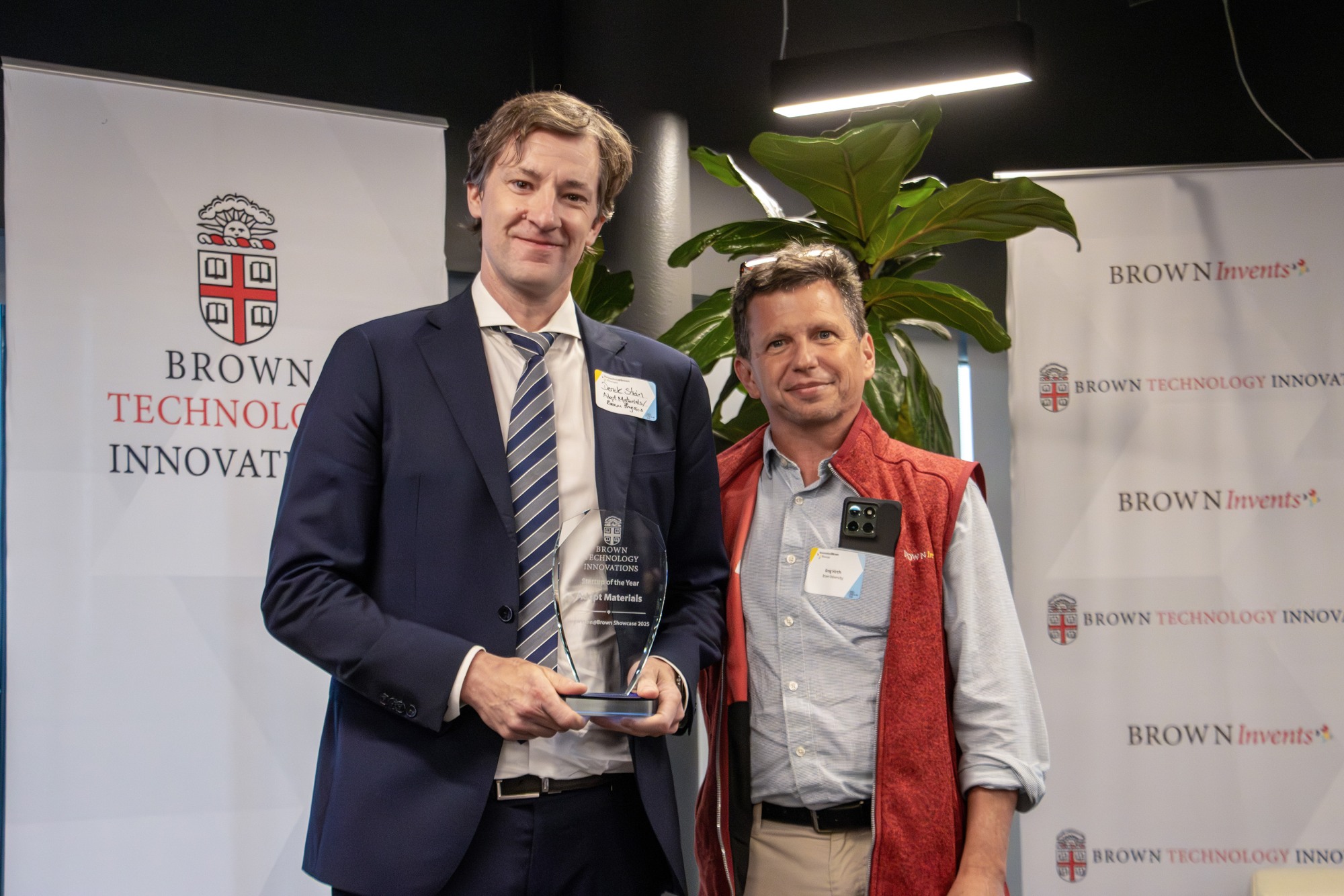
Two people, one holding a trophy, stand together
Derek Stein's Adept Materials was named Startup of the Year at the 2025 Innovations@Brown showcase. Stein (left) stands with Greg Hirth, Brown's vice president for research. 

Earlier this year, Adept rolled out its first consumer product, Lilypad, a paint and primer system designed to manage spikes in indoor humidity to prevent mold and deterioration of wall surfaces. In September, Fast Company named Lilypad a winner in its Innovation by Design Awards. This month, TIME named Lilypad one of its Best Inventions of 2026.  

Despite his retirement from Brown, Stein maintains close ties to the University as an emeritus professor, and works closely with Brown Technology Innovations — Brown’s technology transfer office, which helps researchers commercialize inventions and discoveries — as his company continues to grow. In an interview, Stein spoke about how his research and teaching at Brown contributed to his entrepreneurial venture.

Q: How does Lilypad paint work, and what challenges for consumers does it address?

Simply put, Lilypad is a paint and primer system that absorbs excess water vapor from the air when the humidity spikes and releases it back out into the air when humidity drops. So if you’re taking a shower or doing laundry, the system helps to manage that increase in indoor humidity. The paint is able to take up excess moisture, while the primer sits behind the topcoat and helps keep that moisture from entering and accumulating inside the walls. Then when the humidity goes back down, the water is released into the air again.

Conventional paints contain fillers, which you can think of as ground-up pieces of rock that primarily add bulk to the material. What we have done is replace some of those inert fillers with desiccant materials, similar to the silica gel packets that you find in packaging that keeps your new boots or your vitamins dry. Silica gel has nanopores — tiny nano-scale holes. By incorporating them in our paint, we get the ability to absorb and safely store water. And the process is reversible, so any water that’s absorbed can also be released. We’ve shown that a gallon of Lilypad can hold and release up to a soda can’s worth of water, which is roughly how much water is released as vapor from a 10-minute shower. 

This is really a way to deal with the problems associated with indoor humidity. Excess moisture contributes to aesthetic problems like peeling paint, but you can also get mold growing in walls, and that can become a fairly significant health issue. Those are the kinds of problems we’re aiming to fix. 

Q: It sounds like you are working to adapt this responsive materials approach to other applications. What can you share about other potential uses?

This patented two-layer material technology is about solving moisture problems, and there are tons of applications for it. The near-term step is to protect the outside of buildings in a way that’s similar to how Lilypad protects the inside. Here we are thinking of a building wrap that adds directional control over water vapor. It’s able to shut the door on moisture trying to get in, but can also allow any moisture trying to get out to do so. So that’s one thing we’re working on. 

Beyond buildings, though, we're also interested in a bunch of different moisture challenges. One example is food packaging. Nearly half of all food is wasted somewhere between farm and fork, and some of that waste can be attributed to moisture. That’s a potential application area for us. Another is apparel. You can think of breathable jackets that allow sweat to get out while preventing humidity from getting in. 

Another application I have in mind for the longer term is agriculture. Parts of the planet where we grow things are getting drier. Being able to lock in moisture is something that can be very valuable. There are some ideas of how this could be applied in both exterior and controlled-environment farming.Q: Can you talk about how your physics research at Brown informs your work with Adept Materials?

A lot of my research work revolved around analyzing single biomolecules — things like DNA, RNA and proteins. That might not seem to have a lot to do with building materials, but one intellectual thread that connects these things was nanopores, which we were exploring as a tool for studying those molecules. I also did a lot of work in nanofluidics, which is the study of how water and dissolved ions or molecules behave in really small spaces and channels. So there is this bridge between how water behaves at the nanoscale and how Lilypad paint manipulates water through nanoscale pores. That’s the fundamental connection between my research at Brown and what I’m doing now with Adept Materials. 

Q: How did your experience advising the Solar Decathlon students feed into this?

That experience was pivotal. It gave me a clear idea of where I could make a contribution that was unique. We want to save energy, so we have to make the walls highly insulated. But the realization was that a building that tends to trap heat really well also tends to trap moisture really well. So the same building that's really efficient can actually become less durable. We started to realize that this was an area where biophysics and nanofluidics had something to contribute. That’s when ideas started percolating. 

Q: Adept Materials was named Startup of the Year at the University’s 2025 Innovation@Brown Showcase. How has Brown been supportive of your journey from professor and researcher to entrepreneur?

When I first started ideating inventions for buildings, the first thing I did was start interacting with Brown Technology Innovations. They helped me to pursue patents, which was great. But the most important thing was the mentorship, and Brian Demers [a senior director at Brown Technology Innovations who works with researchers in the physical sciences] deserves special mention for that. He went above and beyond in giving me great advice and showing me what it takes to move something out of the lab and make things happen out in the business world. I also had great conversations with folks like Danny Warshay at the Nelson Center for Entrepreneurship as well as Jason Harry and Angus Kingon in the School of Engineering. They, along with Brian, helped to convince me that this transition was something that I could do. That’s really been incredibly helpful.