Date November 11, 2026
Media Contact

On Veterans Day, Brown honors service, reaffirms commitment to military-affiliated students

U.S. Army veteran and Brown trustee Joseph P. Healey joined University leaders, student veterans and Brown ROTC students in celebrating the service of the nation’s past and current military members.

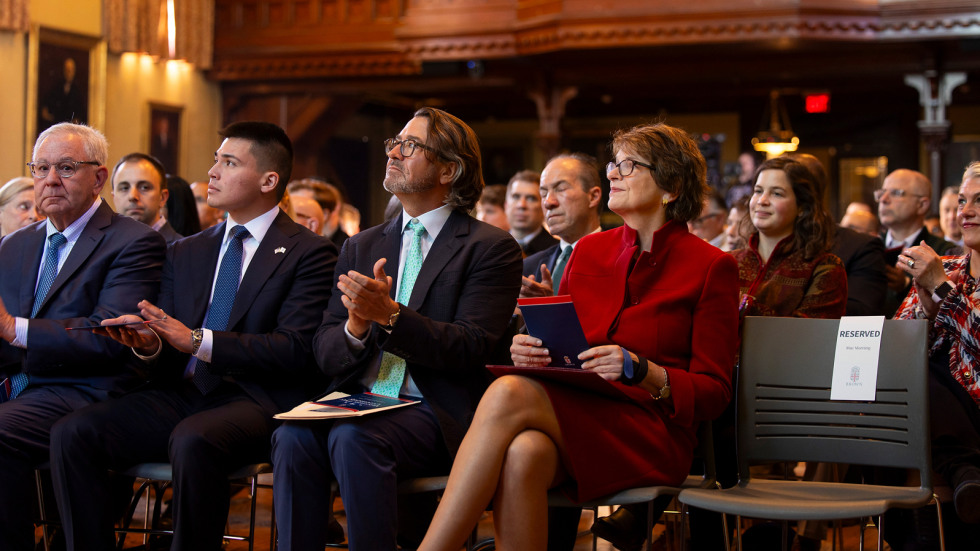
PROVIDENCE, R.I. [Brown University] — Hundreds of Brown University students, faculty, staff and local community members gathered on Brown’s campus on Wednesday, Nov. 11, to commemorate Veterans Day, honor the service of the nation’s veteran and active-duty military, and reaffirm Brown’s commitment to welcoming and supporting military-affiliated students.

The ceremony featured remarks from Brown President Christina H. Paxson, U.S. Army veteran and Brown trustee Joseph P. Healey and Jared Yee, a Marine Corps veteran and Brown University senior. 
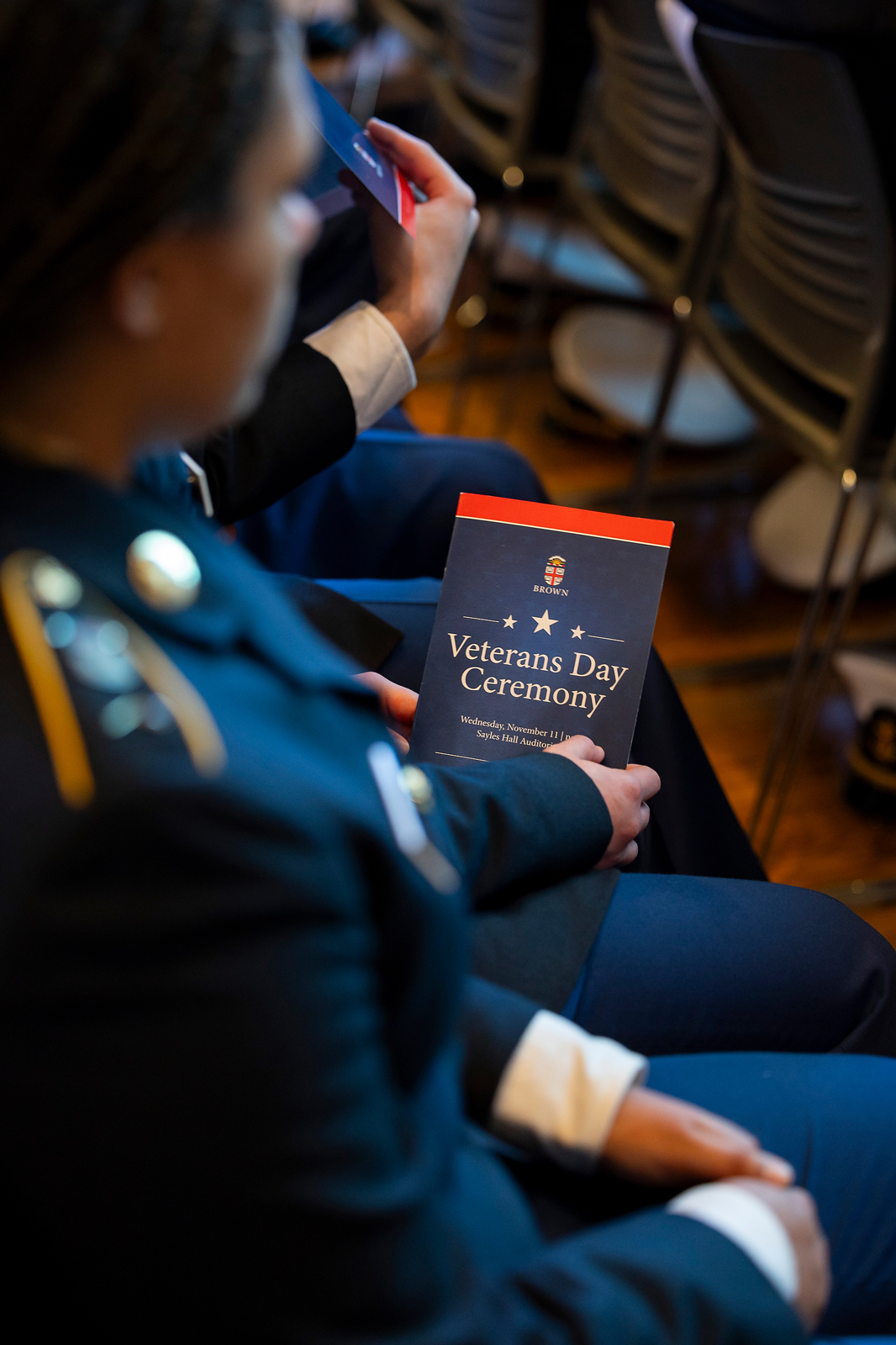
“We honor Brown veterans today because preparing students for lives of public service — including military service — is central to our mission,” said Brown President Christina H. Paxson. “We believe that the U.S. military is stronger and more effective when it includes individuals who have studied a wide range of subjects and been exposed to a wide range of views. We admit talented student veterans not only to recognize their service to our country, but also for all that they bring to Brown.”

Paxson addressed recent actions that have threatened to disrupt elements of Brown’s longstanding relationships with military organizations, including news that the University’s partnerships with the Naval War College in Newport, R.I., are at risk of cancellation. The development comes less than one year after the Pentagon canceled military fellowship programs at 13 colleges and universities, including Brown.

Paxson said the changes are “especially saddening” as Brown has taken significant steps over the past 15 years to deepen its engagement with the military and expand opportunities for veterans. 

Through a sweeping veterans initiative launched in 2019 and renewed ROTC partnerships with U.S. military branches, the University has more than tripled its undergraduate student veteran population; raised scholarship and mentorship support for veterans through gifts from generous alumni; developed a Military Fellows program at the Watson School; and expanded its participation in the federal Yellow Ribbon Program for veterans pursuing graduate degrees at Brown. 

“Taking classes alongside student veterans, learning from military fellows, and engaging with them in discussions and debate  is invaluable to deepening our students’ understanding of complex global issues,” Paxson said.

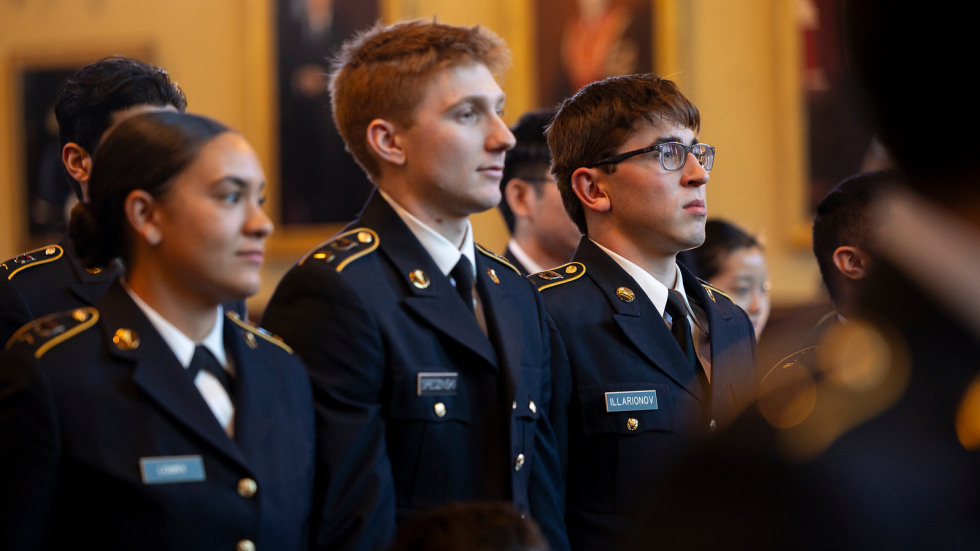
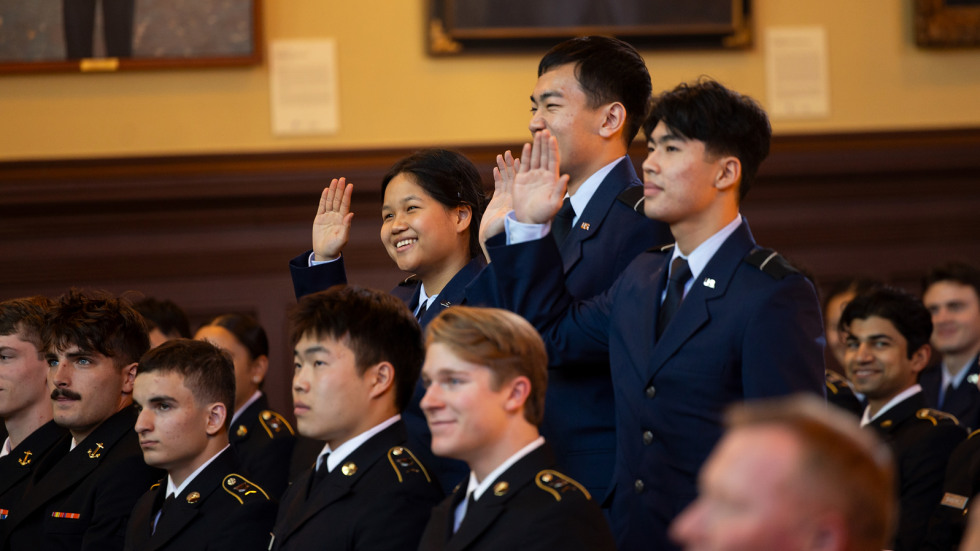
Today, 67 undergraduate and 90 graduate student veterans are enrolled at Brown, alongside 53 ROTC participants preparing to serve in the Army, Navy, Air Force and Marine Corps. Twenty-one of those participants were welcomed during the Veterans Day ceremony’s ROTC contracting event, with 13 Army, five Navy and three Air Force cadets solemnly taking their oaths.
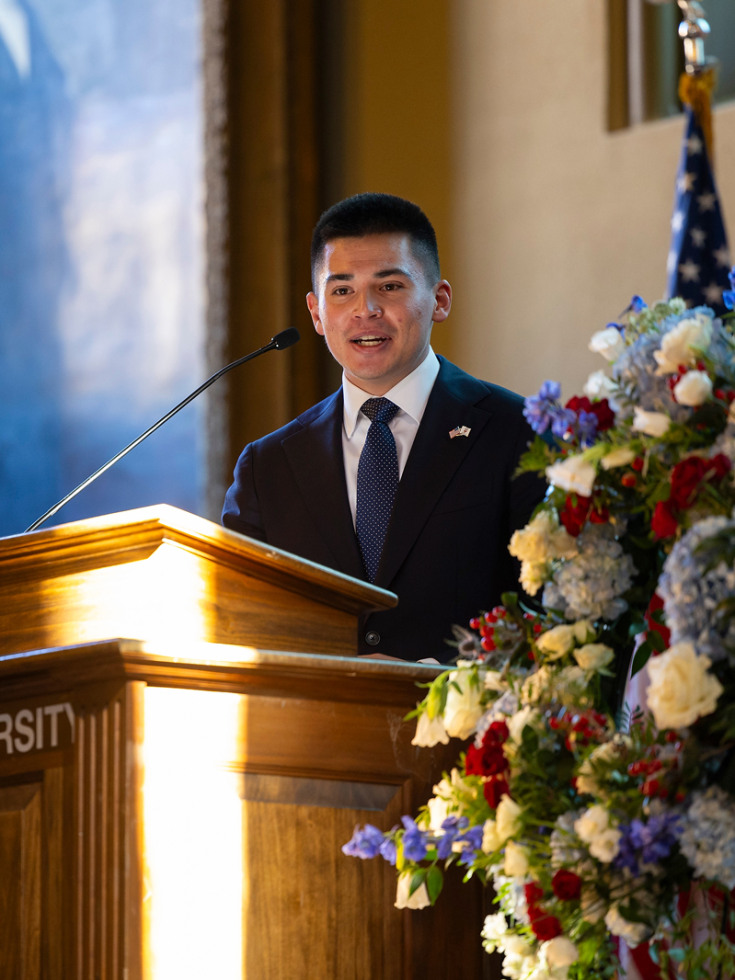
My journey from the Marine Corps to being a fully integrated, welcomed student with a lasting sense of belonging was only possible at an institution like Brown.

Jared Yee Brown University Class of 2027, Marine Corps veteran
 
Jared Yee delivers remarks during ceremony

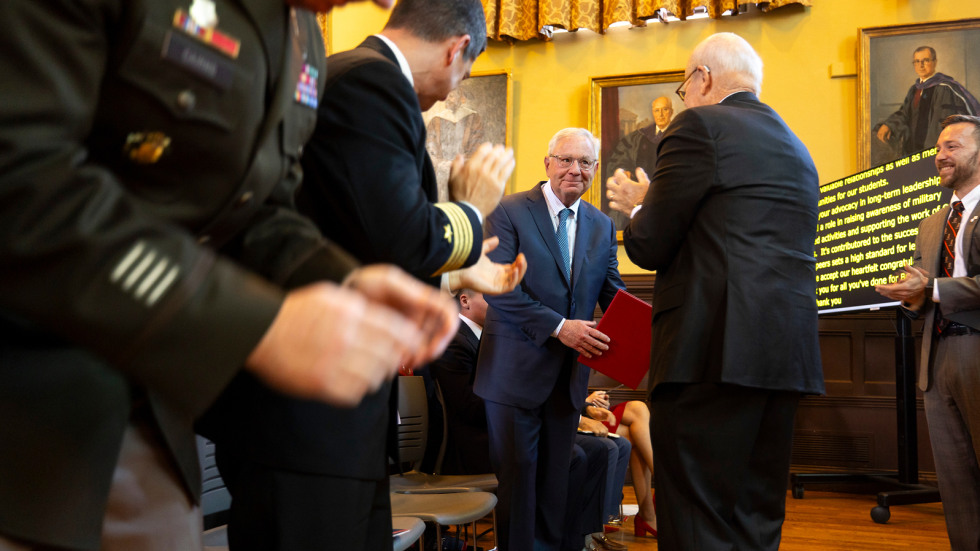
The ceremony also included the presentation of an alumni award to Larry Eichler, founder of the Brown University Veterans Alumni Council; and the announcement of a new award to recognize a graduating student who has demonstrated leadership and service in support of Brown’s military-affiliated community.

A Marine turned mentor

For Marine Corps veteran Jared Yee, the University offered something he was looking for as he considered life after military service: a community that valued both camaraderie and the pursuit of excellence. 

Yee, who is pursuing a double concentration in economics and international public affairs, said Brown’s veterans initiative played a pivotal role in his decision to apply. In 2022, while deployed with a detachment of Marines in the Baltics, he began working on his Brown application during his limited free time, uncertain about what would come next after his discharge.

“I remember receiving that admissions letter that I had gotten into Brown, and that remains one of the best days of my life,” Yee said.

The support continued after his admission. Before arriving on campus, Yee connected with staff in the Office of Military-Affiliated Students who helped ease concerns about transitioning to college life. He was also paired with a fellow veteran who became a close friend and mentor as part of what is now the Cisneros Veterans Scholars Program. 

But Yee still had lingering worries: How would it feel being older than many classmates? Would he be able to keep up after four years away from the classroom? Once he stepped foot on College Hill, those worries vanished. 

“Brown as an institution was so welcoming that I even decided to become an orientation leader for transfers, veterans and resumed undergraduates in the following years,” Yee said. “It also wasn't just me. In the past few years, veteran involvement on campus has grown exponentially.”

Now co-president of the Student Veterans Society, a campus tour guide, peer orientation leader and student leader for the homeless outreach organization HOPE, Yee described how veterans are part of every facet of campus life — serving as teaching assistants, joining varsity and club athletic teams, contributing to the Brown Formula Racing team, enriching classroom discussions and more.

“My journey from the Marine Corps to being a fully integrated, welcomed student with a lasting sense of belonging was only possible at an institution like Brown,” Yee said.

Paying forward a legacy of opportunity

For Army veteran and Brown trustee Joe Healey, Brown's commitment to creating opportunities for veterans is rooted in a family history with the University that has shaped his own dedication to expanding access to education for those who have served.

His mother attended Brown through the University's Resumed Undergraduate Education program, which provides opportunities for adults whose education has been interrupted to complete their undergraduate degrees. Despite limited financial resources, she found a path back to college with Brown's support and graduated with the Class of 1980.

Healey, who earned a degree in biomedical engineering from Boston University on an Army ROTC scholarship before serving in the military, said his mother's experience helped shape his own commitment to expanding educational opportunities for veterans.

“Brown was sensitive to her circumstances and financial situation, something I have always remembered,” Healey said. “That is one of the main reasons I am so honored to have had the privilege of starting the Elaine and Joseph Healey Scholarship for Veterans at Brown. Brown, in essence, paid it forward.”

Healey, a Rhode Island native, recalled spending time on Brown's campus as a kid while his mother attended class. Both of Healey’s children eventually graduated from Brown, drawn in part by the community that had welcomed their grandmother and helped her build a different future. That sense of opportunity, he said, is reflected in the University's military-affiliated community.

“These students bring a sense of discipline and purpose to their studies, along with perspectives shaped by military service,” Healey said.  “What makes me especially proud is how they contribute to life at Brown, with professionalism, respect for others and a commitment to the community at Brown.”

In his remarks, Healey reflected on the meaning of military service, drawing on Gen. Douglas MacArthur's 1962 address to the U.S. Military Academy at West Point, which centered on the principles of duty, honor and country. 

“Duty is more than just carrying out an order — it is showing up for people who depend on it, especially when the work is difficult and the recognition may never come,” Healey said. “Honor is a standard we hold ourselves to when no one else is watching. Country is not only a place on a map, but the people we serve, the freedoms we share and the responsibility we have to one another. These values shape how service members lead and serve, and they remain part of how many veterans live their lives long after their military service ends.”