LZ experiment sets new record in the hunt for dark matter, glimpses neutrinos from the sun’s core

With contributions from Brown faculty and students, the LUX-ZEPLIN experiment analyzed the largest dataset ever collected by a dark matter detector, and the results provide the strongest constraints yet on low-mass WIMPs.

PROVIDENCE, R.I. AND LEAD, S.D. — There is more to the universe than meets the eye. Dark matter, the invisible substance that accounts for 85% of mass in the universe, is hiding all around, and figuring out exactly what it is remains one of the biggest questions about how the universe works.

On Monday, Dec. 8, researchers with the LUX-ZEPLIN (LZ) dark matter experiment announced new results in the search for one of the prime dark matter candidates: weakly interacting massive particles, or WIMPs. While the 417 live days of data taken by the detector in this latest analysis turned up no signs of WIMPs, the new findings put the tightest constraints yet on the energy parameters of low-mass dark matter interactions.

And the detector did pick up signals from another type of weakly interacting particle — solar neutrinos. Neutrinos have been detected previously by other means, but this was the strongest neutrino signal yet from a dark matter experiment, which is a testament to LZ’s sensitivity in this mass range, the research team says.

“We have been able to further increase the incredible sensitivity of the LUX-ZEPLIN detector with this new run and extended analysis,” said Rick Gaitskell, a professor of physics at Brown University and the spokesperson for LZ. “While we don’t see any direct evidence of dark matter events at this time, our detector continues to perform well, and we will continue to push its sensitivity to explore new models of dark matter. As with so much of science, it can take many deliberate steps before you reach a discovery, and it’s remarkable to realize how far we’ve come. Our latest detector is over 3 million times more sensitive than the ones I used when I started working in this field.”

LZ is an international collaboration of 250 scientists and engineers from 37 institutions. The detector is managed by the U.S. Department of Energy’s Lawrence Berkeley National Laboratory and operates nearly a mile below ground at the Sanford Underground Research Facility (SURF) in South Dakota.

The new results use the largest dataset ever collected by a dark matter detector. The analysis, based on data taken from March 2023 to April 2025, probed a mass range between 3 and 9 GeV/c2 (gigaelectronvolts divided by the speed of light squared) — or roughly three to nine times the mass of a proton. It’s the first time LZ has looked for WIMPs below 9 GeV/c2, and the results further narrow the possibilities for what dark matter might be and how it may interact with ordinary matter. The research was presented in a scientific talk at SURF and will be released on the online repository arXiv. The paper will also be submitted to the journal Physical Review Letters. 

Dark matter has never been directly detected, but its gravitational influence shapes how galaxies form and stay together. Without it, the universe as it’s known today wouldn’t exist. Because dark matter doesn’t emit, absorb or reflect light, researchers have to find a different way to “see” it. 
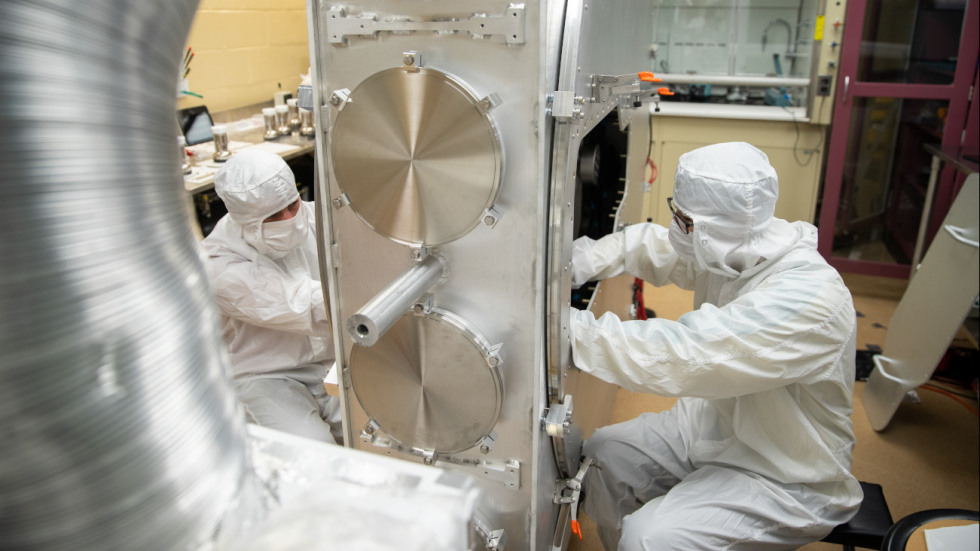
LZ uses 10 tons of ultra-pure, ultra-cold liquid xenon. If a WIMP enters the detector and collides with the nucleus of a xenon atom, it causes the nucleus to recoil and deposits a tiny bit of energy. The recoil produces two signals that the detector’s light sensors can record. The first is a tiny flash of light that occurs when the xenon recoil releases a handful of photons. The second is a small stream of electrons, which is subsequently converted to light inside the detector and becomes visible to the light sensors. The strength of those signals varies depending upon how much energy the particle deposits, giving researchers a means of probing the colliding particle’s mass and other properties.

Deep underground, the detector is shielded from cosmic rays and built from low-radioactivity materials, with multiple layers to block (or account for) other particle interactions, letting the rare dark matter interactions stand out.

Into the “neutrino fog”

LZ’s extreme sensitivity, designed to hunt dark matter, now also allows it to detect neutrinos — fundamental, nearly massless particles that are notoriously hard to catch — in a new way. (Fittingly, LZ sits in the same underground cavern where physicist Ray Davis ran his decades-long, Nobel Prize-winning experiment on neutrinos).

The analysis showed a new look at neutrinos from a particular source: the boron-8 solar neutrino produced by fusion in the sun’s core. This data is a window into how neutrinos interact and the nuclear reactions in stars that produce them. But the signal also mimics what researchers expect to see from dark matter. That background noise, sometimes called the “neutrino fog,” could start to compete with dark matter interactions as researchers look for lower-mass particles.

“To maximize our dark matter sensitivity, we had to reduce and carefully model our instrumental backgrounds, and worked hard in calibrating our detector to understand what types of signals solar neutrinos would produce,” said Ann Wang, associate staff scientist at SLAC National Accelerator Laboratory and co-lead of the analysis. “With this dataset, we have officially entered the neutrino fog, but only when searching for dark matter with these smaller masses. If dark matter is heavier — say, 100 times the mass of a proton — we’re still far away from neutrinos being a significant background, and our discovery power there is unaffected.”

The boron-8 solar neutrinos interact in the detector through a process that was only observed for the first time in 2017: coherent elastic neutrino-nucleus scattering, or CEvNS. In this process, a neutrino interacts with an atomic nucleus as a whole, rather than with just one of the particles inside it (a proton or neutron). Hints of boron-8 solar neutrinos interacting with xenon appeared in two detectors last year: PandaX-4T and XENONnT. Those experiments were shy of the standard threshold for a physics discovery, a confidence level known as “5 sigma,” reporting 2.64 and 2.73 sigma, respectively. The new LZ result improves the significance to 4.5 sigma, passing the 3-sigma threshold that is considered “evidence.”

While the background signal from neutrinos presents challenges for the dark matter detector at low masses (3-9 GeV/c2), its new secondary role as a solar neutrino observatory gives theorists more information for their models of neutrinos, which still hold many mysteries themselves. LZ can provide an independent measurement of how many boron-8 neutrinos are coming from the sun (known as “neutrino flux”), detect future neutrino bursts to better understand supernovae, and help study one of the fundamental parameters that describe how particles interact.

Brown’s role in LZ

Students and faculty at Brown have been active in the search for dark matter for over two decades, helping to lead one of LZ’s predecessors, the LUX experiment, and playing key roles in these latest LZ results. Brown’s LZ contributors, led by Gaitskell, include postdoctoral research Shawn Dubey; Ph.D. students Benjamin Almquist, Chen Ding and Chongwen Lu; master’s students Charles Kong and Yinchen Zhou; and undergraduate student Woody Hulse.

For this latest run of data, the Brown team co-led the detector’s neutron calibration. Scientists expect WIMPs to interact with xenon nuclei in much the same way that neutrons do, so the LZ team uses beams of neutrons to understand the detector’s response to xenon collisions at various energy levels.

“If a dark matter particle hits a xenon atom in our detector and deposits energy, we need to know exactly how much signal our detector produces,” said Ding, who led the calibration work. “Because WIMPs and neutrons interact with xenon through the same mechanism, nuclear recoil, we can use careful neutron experiments to calibrate the detector and understand the signals.”

Almquist said that dark matter researchers at Brown both past and present made important contributions to these new results. “These calibration methods are something that our group has been working on for over a decade, going back to LUX,” Almquist said. “So there has been a lot of work done here at Brown to get us to this point.”

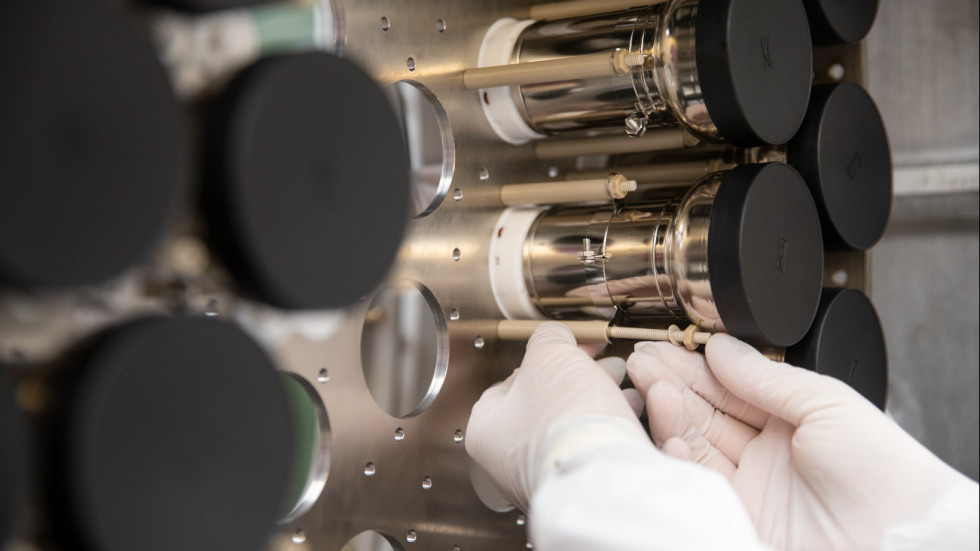
Researchers from Brown also made key contributions to the detector’s hardware components, including the construction and testing of the detector’s photomultiplier tube (PMT) arrays, which play a central role in the device’s operation.

“The PMTs are the eyes of our detector,” said Lu, who helped calibrate the arrays for this run of data in addition to his work on nuclear recoil calibration. “They are what actually see the light signal produced from interactions inside the detector.”

Hulse, Kong and Zhou worked to develop the machine learning algorithms that help the researchers separate detector signals from background noise. All of those efforts have helped LZ to shrink the parameter space where dark matter may be hiding.

“These are LZ’s best results yet for sensitivity at low masses,” Dubey said. “We’ve put some of the world’s best limits on the parameter space for these mass ranges.”

LZ is scheduled to collect over 1,000 days of live search data by 2028, more than doubling its current exposure. With that enormous and high-quality dataset, LZ will become more sensitive to dark matter at higher masses in the 100 GeV/c2 to 100 TeV/c2 (teraelectronvolt) range. Collaborators will also work to reduce the energy threshold to search for low-mass dark matter below 3 GeV/c2, and search for unexpected or “exotic” ways that dark matter might interact with xenon.

LZ is supported by the U.S. Department of Energy and its Office of Science and Office of High Energy Physics, and the National Energy Research Scientific Computing Center. LZ is also supported by the Science and Technology Facilities Council of the United Kingdom; the Portuguese Foundation for Science and Technology; the Swiss National Science Foundation; the Australian Research Council Centre of Excellence for Dark Matter Particle Physics; and the Institute for Basic Science, Korea. Thirty-seven institutions of higher education and advanced research provided support to LZ. The LZ collaboration acknowledges the assistance of the Sanford Underground Research Facility.

Tags