PROVIDENCE, R.I. [Brown University] — For the first time in over 50 years, NASA is sending astronauts back to the Moon. The agency’s giant Moon rocket, the Space Launch System, lifted off on Wednesday, April 1, carrying four astronauts in a loop around the Moon, before returning them to Earth 10 days later.
The Artemis II mission won’t land on the Moon. Much like Apollo 8, which flew in late 1968, this mission will be something of a dress rehearsal for future lunar landings. With the Artemis project, NASA plans progressively more challenging lunar missions, with the aim of establishing a longer-term scientific presence on the Moon, while building capacity for future human missions to Mars.
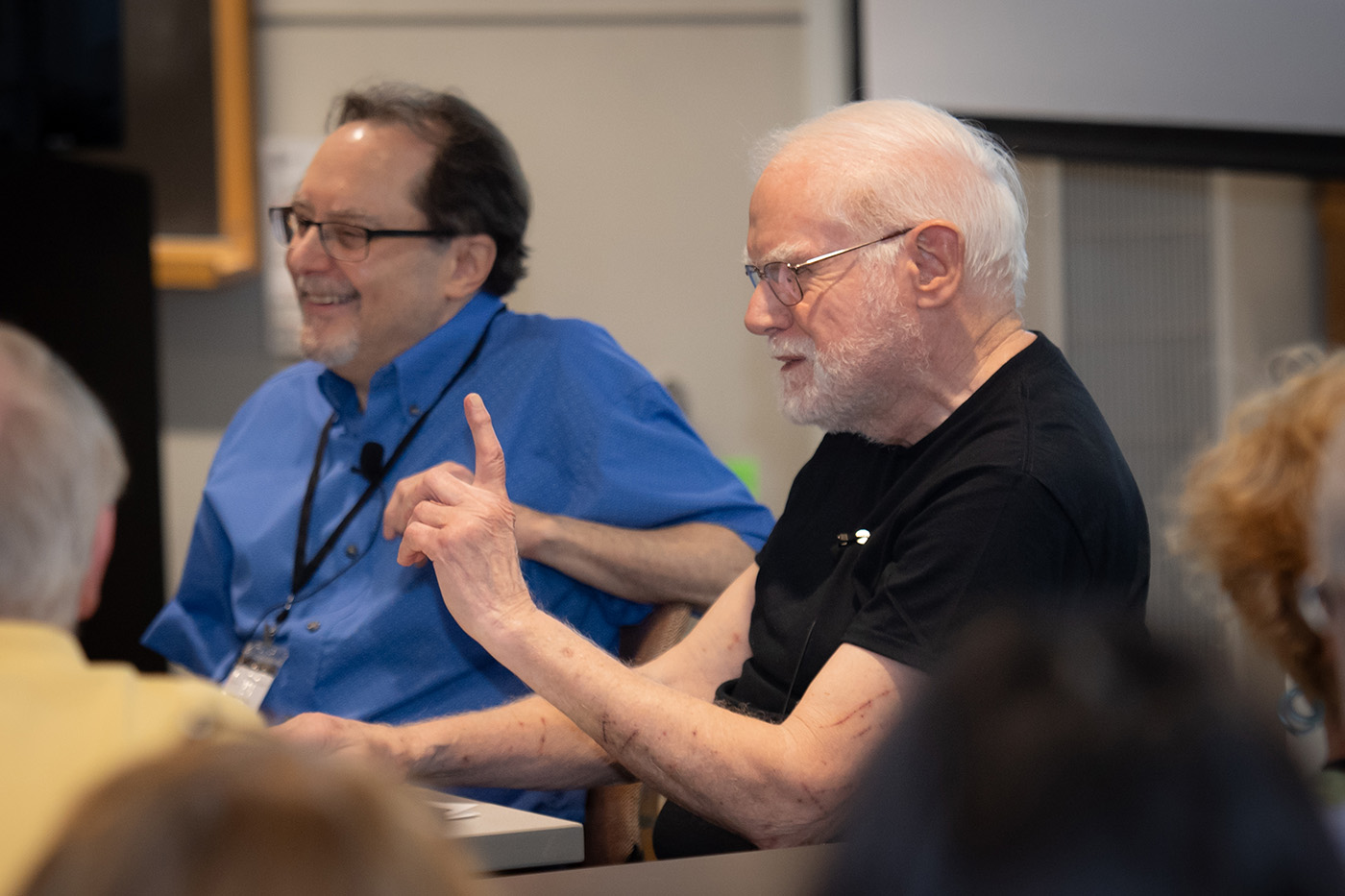
Jim Head, a professor in Brown University’s Department of Earth, Environmental and Planetary Sciences, has a firsthand understanding of what it takes to explore the Moon. Shortly after receiving his Ph.D. from Brown in 1969, Head answered a job ad looking for people to help “think our way to the Moon and back.” In that job at NASA headquarters, Head lent his expertise to the Apollo program, helping to train astronauts in geology, select landing sites and analyze returned samples.
Head is excited to see humans returning to the Moon — he says the Moon is essentially a time capsule of the early Earth, providing scientists a view of the earliest days of the planet’s formation. Shortly before launch, he spoke about the Artemis missions in an interview.
Q: As a scientist, why are you excited that astronauts are returning to the Moon?
It's really important to understand the geological context of the Earth. You might say, ‘Wait, I thought we were talking about the Moon.’ But that's the point. The Earth is a dynamic system with atmospheric weathering, plate tectonics, overturn of the crust, etc. We're missing about 30% to 40% of Earth’s history. It’s like a book with the first 10 or 12 chapters ripped out. But all those early chapters are preserved on the Moon, Mars and Mercury, and that's why we want to go study them. We can find those missing chapters. We learned a lot from Apollo and all the robotic missions that came after, but much of what we learned created more questions. There’s so much more to learn.
And it’s not just about the past — we want to predict the future. The surface of the Earth has never been the way it is today in the past, and it will never be the same in the future. Literally, the only constant is change. But when we understand what forces were at play in the past, we can make better predictions about the future.
Q: Why has it taken so long to go back?
Well, I’m a geologist so time doesn’t really kick in until around 20 million years have passed, so has it really been that long? Truly, though, it’s not like we haven’t been doing anything. We’ve had incredible robotic missions to the Moon, Mars and elsewhere. The International Space Station has been active for years. We've learned a huge amount about how long humans stay in space, for example. That’s all been part of the equation.
Q: This mission will circle the Moon but not land. What kind of science can be done during this kind of mission? Or is it purely a rehearsal for later flights?
.jpg)
There's always science to be done. You know, the Moon, despite its antiquity, is still a changing place. We've discovered just recently a new impact crater that’s about 100 meters across. So there’s always something to observe. But I think back to the last time we did this on Apollo 8. Just looking back at the Earth and seeing it as a singular orb with no borders or boundaries, a lot of people credit that with helping to launch the environmental movement. Apollo 8, and Apollo in general, I think, inspired a lot of young men and women to go into careers of science and technology, and I think that's what this will do, too.
Q: When the Artemis missions do eventually land, what will be different about those compared to Apollo?
First of all, we have over 50 years of technological development, so we ought to be able to do something better, right? NASA is really thinking about longer-term exploration of the Moon and Mars. And we're also going to places where we haven't been before, specifically the lunar poles. There's some evidence that there are volatiles — that is to say, water and other gases in solid form — collected in permanently shadowed regions of the Moon. By that I mean craters near the poles where the sun never shines. If there’s sufficient water there, it could help for later missions to solve the “up-mass” problem — meaning the amount of stuff you have to take with you when you go to the Moon. So seeing if those volatiles are there is critically important.
Q: What recent work have you been doing related to lunar exploration?
What we've been doing here at Brown is working on a 500-day design reference mission for the Moon. This is basically a conceptual mission, and it’s been a lot of fun. It was originally something we were thinking about for Mars. But Dave Scott, the Apollo 15 commander who was working with us, said we should really think about doing this at the Apollo 15 site, which we already know a lot about. Then we can map it onto the lunar poles and to Mars.
We’re thinking about what it takes to live on the Moon for 500 days. We’ve got students working on all aspects of this. We’re thinking about how we could build shelters. We’ve got students working on lunar greenhouses to see what we can grow. We’ve got students thinking about things like the gut microbiome — how are we going to stay healthy up there? Two Brown undergraduates just went to the Lunar and Planetary Science Conference — the premier conference for our field — and gave poster and oral presentations, and just knocked it out of the park.
The best thing was when half a dozen scientists from the Johnson Space Center came up and talked to us about it and said, “Wow this is fantastic.” Dave Scott told us, “You and the Brown students are doing NASA's work for them,” which I take as a huge compliment.