As Brown celebrates Commencement and Reunion Weekend 2026, look no further for complete event details, news, photo, video and social media coverage of the festivities.
Bestselling author and Brown alumna Xochitl Gonzalez: ‘Never forget to keep asking why’
With advice on the power of curiosity from the award-winning writer, the Class of 2026 celebrated the Baccalaureate with a lively service marked by wisdom and hope.
Xochitl Gonzalez, an award-winning writer and Class of 1999 Brown alumna, delivers the Baccalaureate address during the annual ceremony on Saturday, May 23. All photos by Nick Dentamaro/Brown University
PROVIDENCE, R.I. [Brown University] — Growing up in a working-class neighborhood in Brooklyn, Xochitl Gonzalez wasn’t exactly praised for being a nosey, or “compulsively curious,” child.
When she pressed her grandparents on why she had to eat lentils every week, why her uncle was laid off from his job, or why her cousin broke up with her boyfriend, Gonzalez was routinely met with a refrain designed to stanch the flow of constant questions: “Because ‘Y’ is a crooked letter.”
But her grandparents’ approach had the opposite effect on her relentlessly inquisitive young mind.
“All that answer did was make me determined to know what, in fact, had led ‘Y’ astray,” the award-winning author said in the First Baptist Church in America, where she delivered the Baccalaureate address to Brown University’s undergraduate Class of 2026 on Saturday, May 23.
The colorful, multi-faith service celebrates bachelor’s degree recipients and honors the many spiritual and cultural traditions of the University community one day before their degrees are conferred during Brown’s Commencement and Reunion Weekend.
1of6
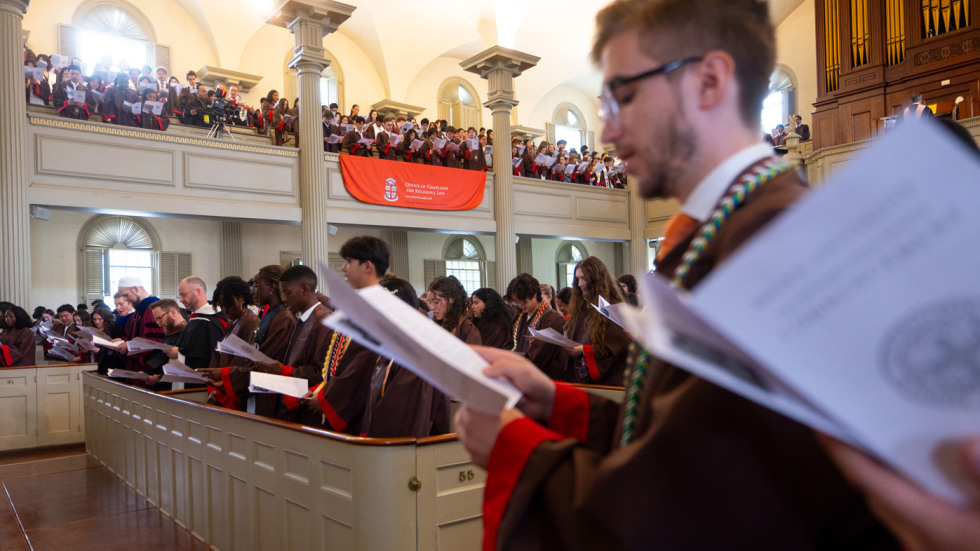
Members of the Class of 2026 sing along to “Hymn to Joy” at the beginning of the Baccalaureate ceremony.
2of6
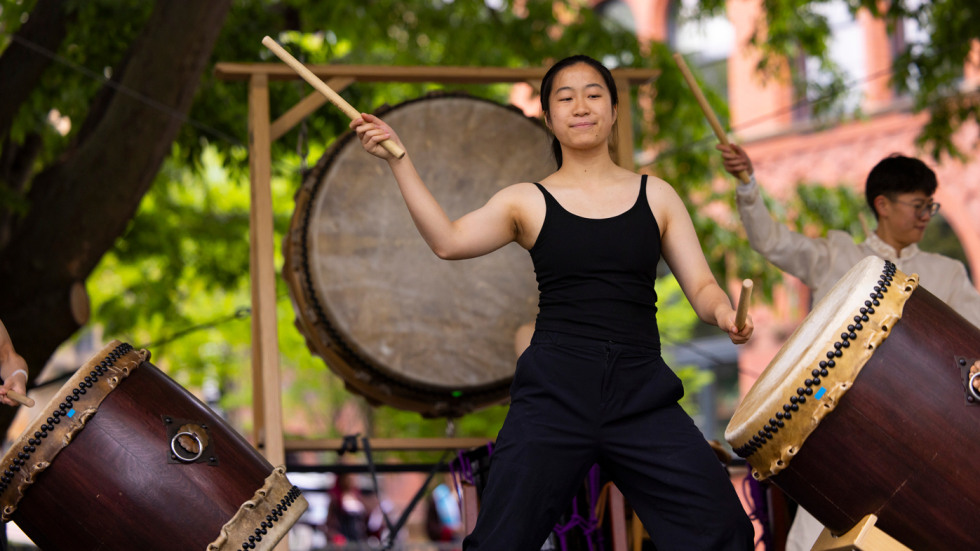
Gendo Taiko performs on the lawn of the First Baptist Church in America, signifying the beginning of the Baccalaureate ceremony.
3of6
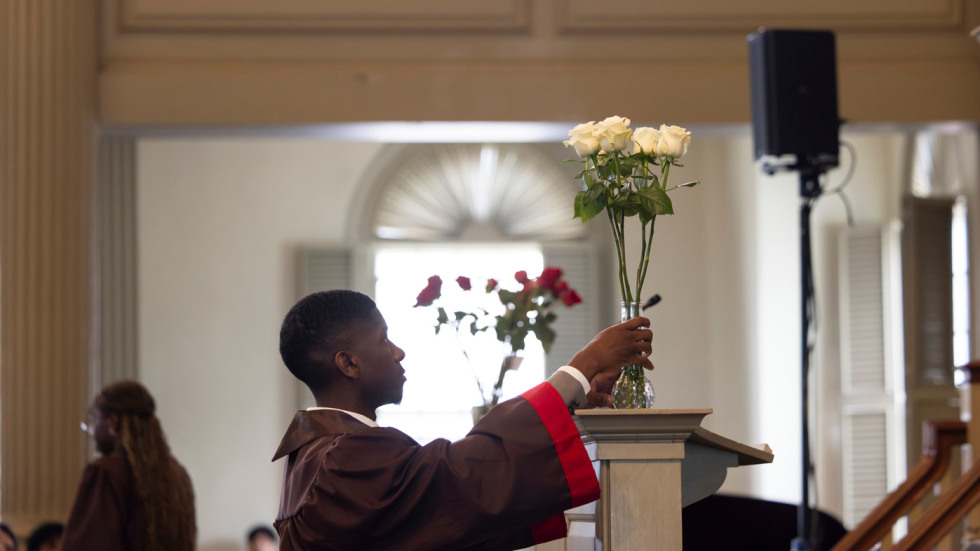
Students carefully place roses of remembrance at the front of the Meeting House in the First Baptist Church in America, honoring the lives of deceased Brown University students, faculty and staff members.
4of6
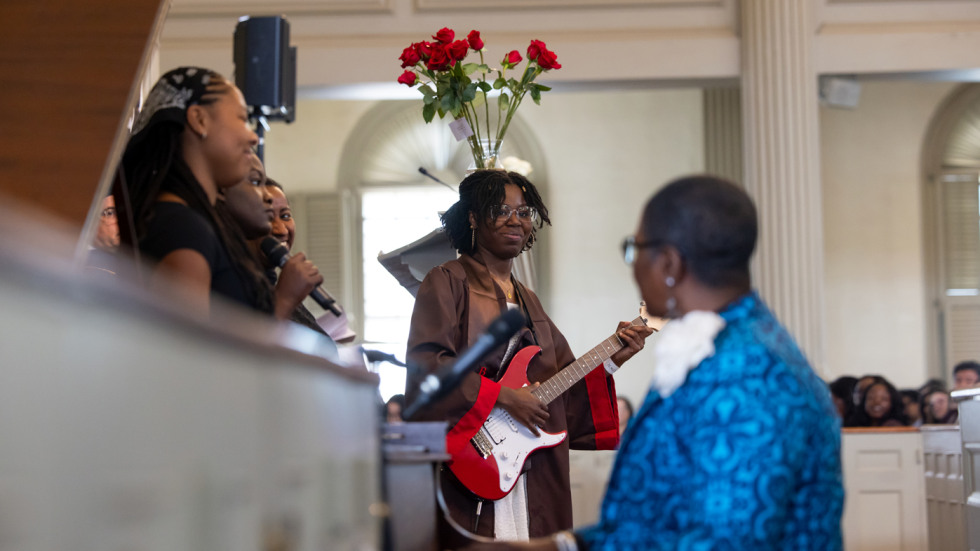
The Harmonizing Grace Gospel Choir performs a rendition of “One Moment in Time,” arranged by Protestant Community Musical Director and Worship Leader Sophia Stone.
5of6
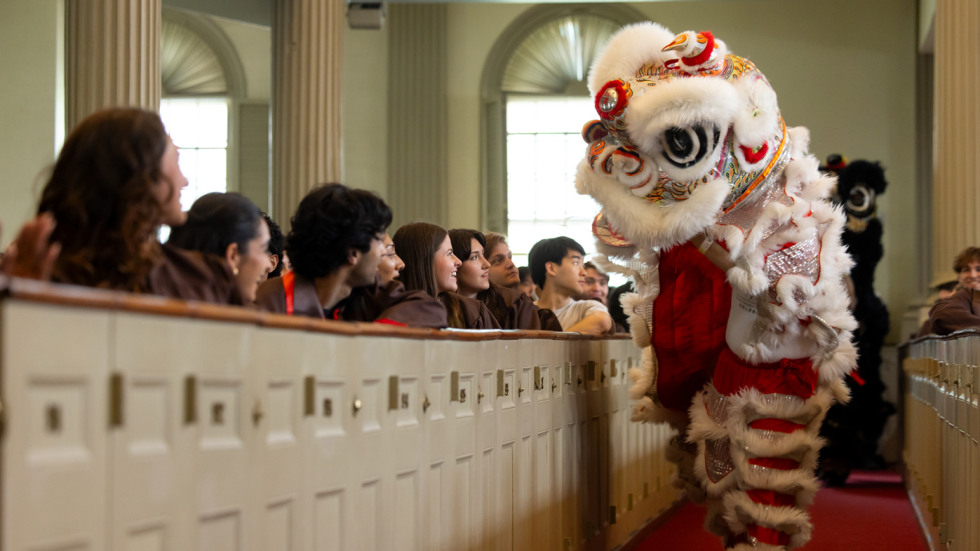
The Baccalaureate honors the vast and varied traditions of the Brown community and includes several cultural performances — like the Chinese lion dance — and prayers from Hindu, Jewish, Christian, Muslim and other traditions.
6of6
The colorful, multi-faith service celebrates bachelor’s degree recipients one day before their degrees are conferred at the College Ceremony on Sunday, May 24.
This year’s ceremony included prayers of worship and thanks from Hindu, Jewish, Christian, Muslim, Sikh and Contemplative traditions, as well as gospel music, Taiko drumming, a cappella singing, a Chinese lion dance and a performance by Fusion Dance Company. The texts were recited, chanted and sung by students in the Class of 2026 who were active in religious life during their four years on campus, as well as faculty and staff members.
Gonzalez is no stranger to the tradition. A graduate of Brown’s Class of 1999, she sat in the pews of the same church 27 years ago — more than two decades before literary stardom as a Pulitzer Prize finalist and the bestselling author of novels “Olga Dies Dreaming,” “Anita de Monte Laughs Last” and “Last Night in Brooklyn.”
“What makes Xochitl’s story so deeply relevant, especially to those of you out there who may still be wondering exactly what your next chapter holds, is that her path was beautifully nonlinear,” said Brown President Christina H. Paxson, introducing Gonzalez. “Your experiences, however varied, are simply gathering material to find your true voice. And once Xochitl decided to fully embrace that voice, the result was nothing short of spectacular.”
In a poignant and celebratory address titled “The Importance of Being Nosey: Curiosity as a Habit,” Gonzalez urged graduating seniors to hold fast to their curiosity, framing it as an essential human compass for navigating an unpredictable world.
The transformative power of the follow-up question
When it came time for college, Gonzalez recalled that Brown felt like the only choice for someone who couldn't stop asking questions — an instinct her high school principal assured her would "fit right in” on College Hill. He was right.
“At Brown, my curiosity was no longer a curiosity, but a common trait,” Gonzalez said.
The Open Curriculum was “catnip for precocious minds,” and the intellectual independence encouraged by her professors allowed her to follow every line of inquiry to satisfaction. Her classmates and friends, meanwhile, taught her the power of the follow-up question — how each one, approached with a sense of openness and eagerness, inevitably led to another.
“Because of this boundless curiosity, conversations often went long and deep,” Gonzalez said. “Such that, when our time on this campus was over, even when people lost touch, what lingered was that deep knowing of one another. The kind of knowing that melts time, even after decades apart.”
That drive to get to know other people — to understand not only what they did, but why they did it — would later become central to Gonzalez’s life and work as a successful writer.
“ Curiosity requires vulnerability. To be openly curious — to ask other humans questions, particularly publicly — is to admit all that we do not know.
”
Xochitl Gonzalez, Class of 1999
Award-winning author and Baccalaureate speaker
It didn’t start off glamorous, though.
When Gonzalez earned her bachelor’s degree in history of art and architecture and visual art in 1999, what is now known as the Lizzie and Jonathan Tisch Center for Career Exploration at Brown was a single room in Pembroke Hall filled with fax machines and binders of entry-level job positions, organized by industry.
“The first paying job I could find ‘in the arts’ was hawking vintage French posters in SoHo,” Gonzalez said.
With low pay, no intellectual challenge and requirements that weren’t relevant to her career aspirations, “it just kinda stunk.”
Yet, her insatiable curiosity gradually transformed the shop into the site of an unlikely education.
Gonzalez asked questions of everyone who walked through the door — interior designers, private art dealers, magazine editors, lawyers, executive assistants, bankers, nightclub promoters and art handlers. She asked them what their jobs were like, what they hated about them, what they loved. She paid attention to how they dressed, the restaurants they raved about and the art they gravitated toward. Through all of her inquiry and observation, she developed another invaluable quality: discernment.
“Bit by bit… this kind of nothing job allowed me a chance to piece together an understanding of the cultural nexus of New York City,” she said.
Shades of Brown, a student a cappella group rooted in the African American tradition, sings “River” by Leon Bridges while members of Fusion Dance Company perform.
After six months, Gonzalez applied for an advertising job and got hired on the spot. What her new employers loved most wasn’t her degree or work experience at the shop. It was that she understood the city and its people and wasn’t afraid to make quick decisions.
“It is the trait that brought me to Brown — that spirit of wanting to know — that has given me a life of joy and surprises,” she said. “A form of success no job can promise and no title can ever encapsulate.”
Curiosity as a compass
Like the members of the Class of 2026, Gonzalez graduated at a time of technological advancement, entering the workforce right when Google’s web search became widely available. The answer to any question she could imagine was just a few keystrokes away, and Gonzalez found the possibilities thrilling.
“But I have also observed, over the ensuing decades, how having such easy access to answers has conflated the retrieving of information with true understanding, and how the certainty of fast facts has replaced the uniquely human wonder of wondering why,” Gonzalez said. “Curiosity requires vulnerability. To be openly curious — to ask other humans questions, particularly publicly — is to admit all that we do not know.”
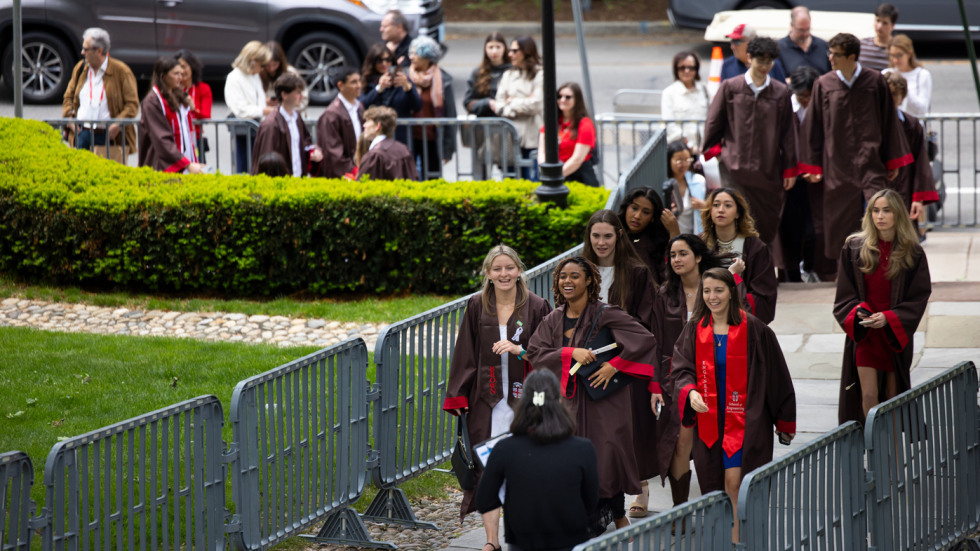
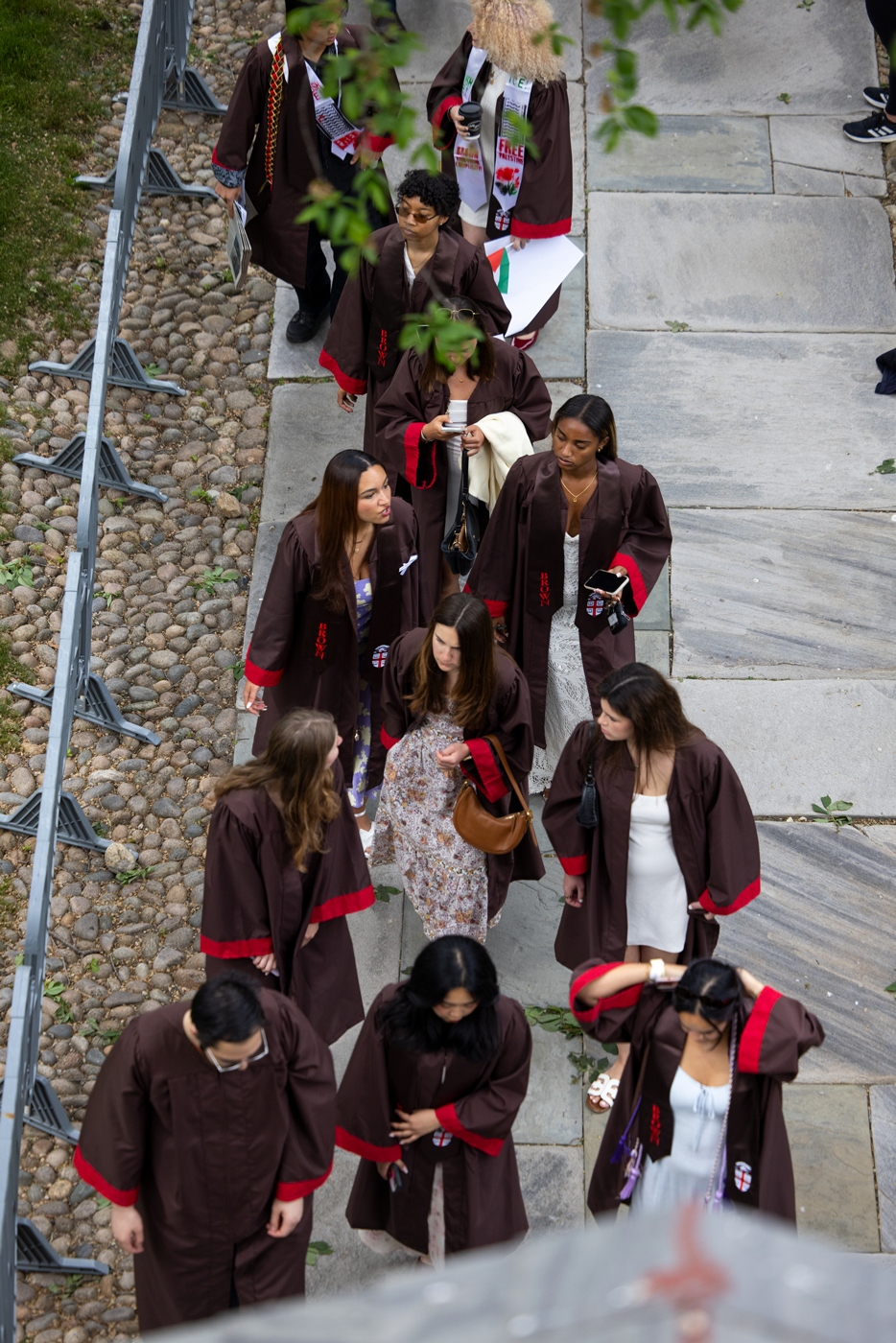
Members of the Class of 2026 make their way into the First Baptist Church in America for the annual Baccalaureate ceremony.
That can be challenging in an era increasingly shaped by artificial intelligence, automation and algorithms. Gonzalez reflected on how many people become less curious as they grow older, not because they have stopped wondering, but because they’re embarrassed to acknowledge that they don’t already have the answer.
“I don’t think it's a coincidence that children are both the most openly inquisitive and the happiest humans we tend to see,” she noted.
Over time, Gonzalez has come to believe that curiosity serves a far deeper purpose than simply acquiring information. True inquiry, she said, leads people toward understanding — of themselves, of others and of the world around them — and that understanding is a deeply human need.
She encouraged Brown’s new graduates to remain defiantly human.
“Learn to discern the quick high of checking a task off of a list from the deep satisfaction that comes from digging deeper and truly knowing,” she said. “And perhaps above all, learn to be cautiously suspicious of certitude: It almost always means enough questions have not been asked.”
Gonzalez said she believes Brown graduates are uniquely equipped to resist that tendency. While alumni of every institution may share affection for their alma mater, the connections at Brown run deeper.
“We’re not just linked by a set of common memories,” she said. “We are linked by this shared trait of intellectual curiosity that Brown’s distinct culture nurtures so brilliantly.”
In closing, Gonzalez offered graduates a piece of advice: Guard that trait fiercely. Protect the willingness to ask questions, remain open to uncertainty and seek genuine understanding.
“It is an unpredictable world out there, full of quickly shifting tectonic plates, but I am not worried about you,” Gonzalez said, speaking directly to the Class of 2026. “Your curiosity can be your compass if you cultivate it. So go forth, and never forget to keep asking why. And always remember the importance of being nosey.”
On Saturday and Sunday, May 23 and 24, the University will confer a total of 3,288 degrees in all categories — undergraduate, graduate, medical and honorary.
Brown’s milestone weekend offers graduation ceremonies, alumni reunions and a vast array of other opportunities for graduates, alumni, family members and friends to honor accomplishments and reunite.
In partnership with the Brown Arts Institute and renowned Tape Art artists, a team of Brown students led the creation of a temporary mural in the University’s Barus and Holley building.
As Brown celebrates Commencement and Reunion Weekend 2026, look no further for complete event details, news, photo, video and social media coverage of the festivities.