Providence high schoolers help design a health program built for them

Through a partnership between Brown researcher Kristine Durkin and Providence nonprofit Young Voices, local teens are shaping an adolescent health program while gaining firsthand experience in research.

PROVIDENCE, R.I. [Brown University] — What if high schoolers could help design health programs meant to serve them while gaining firsthand research experience in the process?

That’s the idea behind a partnership between Brown University researcher and pediatric psychologist Kristine Durkin and Providence nonprofit Young Voices. Since 2022, Durkin and the youth advocacy organization have worked with local teens to co-create a community-based program focused on improving nutrition and physical activity among adolescents. 

Supported by funding from the National Institutes of Health, Durkin’s research addresses gaps in teen health programming — challenges that Wujuudat Balogun experienced firsthand.

After years of struggling with her weight, Balogun remembers leaving a nutritionist’s office overwhelmed by charts, serving sizes and recommendations that didn’t reflect the food available to her. Instead of answers, she left with more questions. So when Balogun, already a participant in Young Voices’ after-school programs, learned about the project in 2023, she immediately got involved. 
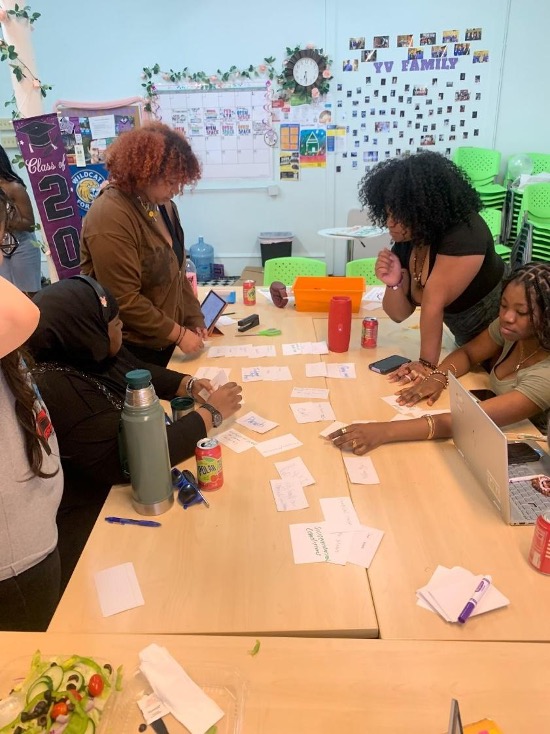
Providence teens discuss covariants on a table
Providence high schoolers have helped to define key study variables like diet quality and physical activity, among other key contributions. Courtesy Young Voices. 

“If I can help build a program that will work for me and maybe work for everyone else, too, then I have to do it,” said Balogun, now a junior at Massachusetts College of Pharmacy and Health Sciences. “For me, the motivation was about, ‘What can I do to make sure it’s better for the next person coming along?’”

Nutrition and physical activity programs are often medically based, geared toward younger children or adults, or housed in schools where teachers already face competing demands, Durkin said. Her goal is to anchor a program where high schoolers already gather — places like libraries, recreation centers and youth organizations — with strategies that reflect the realities of teens’ lives, including limited access to healthy food, safe recreation spaces and culturally relevant health information. 

The intervention, which the research team plans to pilot next year, will take the form of a weekly, peer-led after-school program covering topics such as balanced diets and meal planning while teaching skills including healthy cooking and personal fitness. At the students’ recommendation, it will also help teens identify barriers to nutritious food and physical activity in their communities and advocate for better resources.

Durkin, an assistant professor of psychiatry and human behavior (research) at Brown’s Warren Alpert Medical School, said research is often stronger when the people most affected by an issue play a role. 

Her partnership with Young Voices reflects Brown’s commitment to community-engaged scholarship, where faculty, students and staff work alongside local residents, nonprofits, schools and agencies. Similar collaborations have monitored neighborhood air quality, expanded the capacity of nonprofit organizations and led research aimed at strengthening Rhode Island’s public school funding formula, among other projects. 

“There is evidence that shows when projects include community voices, they are more relevant, more sustainable and more equitable,” Durkin said. “It makes our research better, and it means the programs we’re creating are more likely to work in the communities they’re designed to serve because the people they’re intended to help are involved from the start.”

Introducing Providence teens to research

To structure teens’ participation in the program, Durkin and Young Voices Executive Director Peter Chung created a Youth Advisory Panel, which includes more than two dozen Providence-area high schoolers. The reciprocal model trains and pays students as co-researchers and credits their contributions to the study. 

Panel members have helped to define key study variables like diet quality and physical activity. They also selected covariates — additional factors the research team should consider when analyzing survey data — like sleep and mental health. For Durkin, the panel underscored how much insight, creativity and leadership teenagers can bring as research partners. 

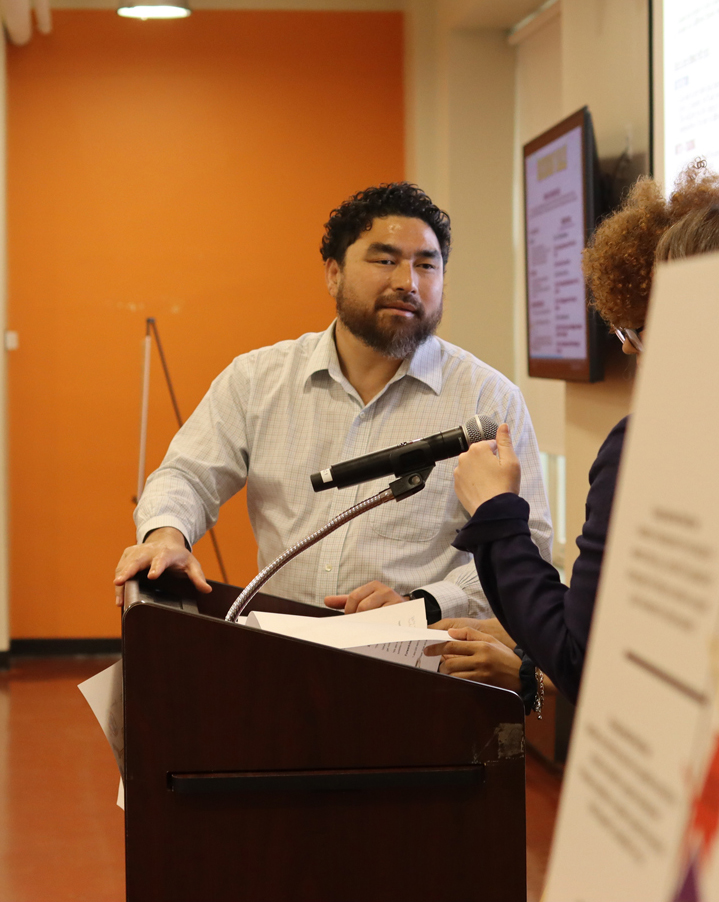
Young Voices exec director Peter Chung stands at a podium
Young Voices Executive Director Peter Chung partnered with Brown researcher Kristine Durkin to create new research and skill-building opportunities for Providence teens.

“People can really underestimate teenagers,” Durkin said. “There’s this assumption of, ‘What would they know about research? What would they know about program development?’ But when you get young people in a room, their perspectives are incredible. They’re thoughtful, they’re thinking long-term, they’re thinking about inclusion, and they understand the real-life barriers affecting their health. They are researchers in this partnership because they are helping us see what the research needs to account for.”

The students’ roles also shaped how the research team communicates with teens. When Durkin drafted discussion prompts for study participants, panel members offered suggestions using language they believed other teens would understand and respond to. 

“I had come up with all these focus prompts, and they immediately were like, ‘They’re too long,’ or ‘Nobody knows what that means,’” Durkin said.

For Lounay Oliver-Camacho, a sophomore at Providence’s Mount Pleasant High School who hopes to become a special education teacher, participating on the panel offered an early look at the world of research. One of the biggest draws, they said, was the chance to complete research ethics training.

“I wanted to experience what that kind of training would look like before I do other training like it later on,” Oliver-Camacho said.

Over two years on the panel, Oliver-Camacho said they have also learned new ways to think about data while connecting with Brown researchers and gaining confidence as a communicator and leader.

For Young Voices, the partnership extends its long-standing work empowering Providence high schoolers to shape decisions that affect their schools, neighborhoods and futures. Chung said the collaboration also reflects the organization’s goal of connecting students with experiences that build practical skills and help them see how those skills can apply to their personal growth, education and future careers.

“If you’re in high school now, you could walk into college already having research experience and you’d be eligible to apply to internships right off the bat,” Chung said. “Those are the kinds of opportunities I seek for our students — and when partnerships are mission-aligned and value-aligned, we can build capacity and expand those opportunities for them.” 


That proved true for Balogun, who hopes to become a surgeon.  

“It added to my bank of knowledge in a way I’ll be able to use forever,” Balogun said. “I learned about presenting, professionalism and how to talk about the skills I’ve gained. Dr. Durkin was always someone I could go to. If I needed help figuring out how to put this experience on my resume, she would sit down with me and help me talk through what I had learned.”

Building a blueprint for community-engaged research

Panel participants also gain experience in research skills beyond the study itself, contributing to grant applications, conference abstracts and presentations at events, including Brown’s annual Mind Brain Research Day. In May, they organized a youth-led research summit hosted on campus with support from the Swearer Center

Durkin has shared the model with clinicians and researchers beyond Brown, including at a Society of Pediatric Psychology’s conference. At Brown, she has expanded the model by creating a consultation group that enables other Brown researchers to bring study materials, recruitment strategies and research ideas directly to Providence teens.

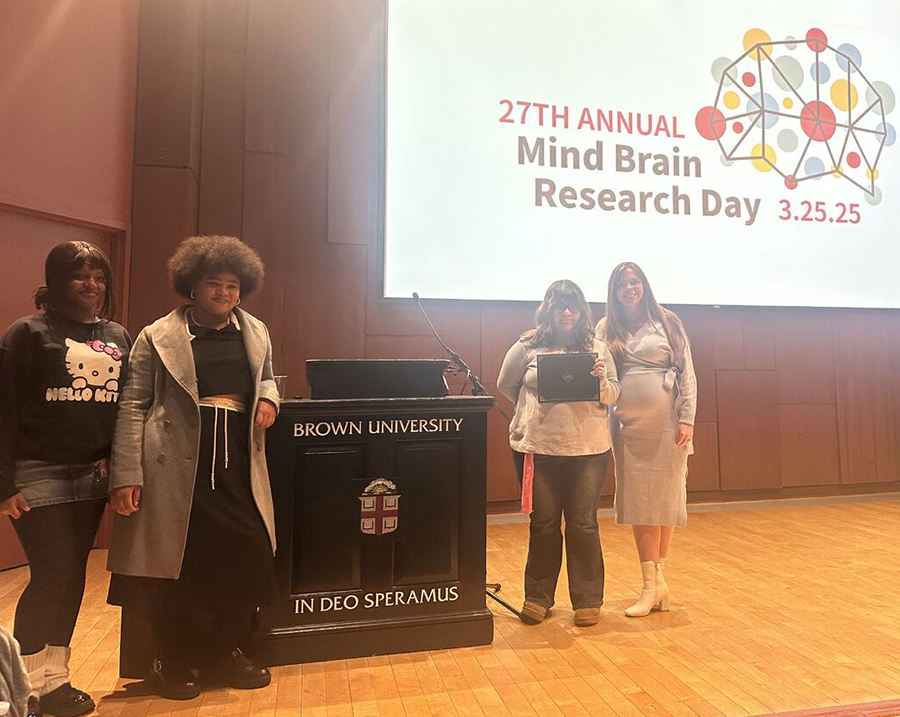
Providene teens pose on a stage at Brown's mind brain research day
Young Advisory Panel members have presented at Brown's Mind Brain Research Day for several years, sharing how they have helped shaped research. Courtesy Young Voices.

For Karen Jennings Mathis, an assistant professor of psychiatry and human behavior at Brown whose research focuses on eating disorder risk among children of color, the group offered immediate, practical value. When she shared recruitment materials for a study, the teens suggested enlarging a QR code, reducing text and replacing research terminology with more accessible language.

After incorporating their recommendations, Jennings Mathis launched the study and was able to recruit the full sample, she said.

“You’re in your research mind, and you think you’re being cognizant of how to make something not sound ‘researchy,’” Jennings Mathis said. “But you’re still a researcher. Those little things can make a big difference.”

This summer, Durkin and the panel will continue refining the health and wellness intervention. Next spring, they plan to share it with focus groups of up to 30 local teens to gather feedback, including on the length, order and clarity of the sessions. That input will guide adjustments before the intervention moves into pilot testing.

As an early-career researcher, Durkin said her experience has reinforced her commitment to community-engaged, participatory research, which she plans to incorporate into future studies on adolescent health conditions including cystic fibrosis and asthma.

“I don’t envision myself doing another research project that doesn’t have an element of community engagement as a part of it,” Durkin said. “The students are incredibly insightful about their community and about what it’s like to be a young person in Providence. They’ve pushed me to consider things I wouldn’t have otherwise. But what stands out most is how invested they are in making change in their community. That’s been really inspiring to see.”

For Chung, the strength of the partnership stemmed from Durkin’s effort to understand Young Voices as an organization, not just as a research partner.

“Dr. Durkin’s approach to meeting students where they were made a huge difference,” Chung said. “She has done a wonderful job engaging us beyond the research partnership and supporting us as an organization. When partners value the work we do and invest in our people, it opens doors that can last far beyond one project.”