Telescope makers at Brown revel in centuries-old craft

Working for months with staff members in the Department of Physics, a group of students and faculty from Brown and RISD learned the art and science of high-precision optics to make their own powerful telescopes by hand.

PROVIDENCE, R.I. [Brown University] — Having recently earned his Ph.D. in astronomy and cosmology at Brown University, Alexis Ortega has cast his gaze through the eyepiece of a telescope hundreds, maybe thousands, of times. But on a recent evening at Brown’s Ladd Observatory, Ortega had a viewing experience like none he has ever had. 

It was the first time he had looked through a telescope that he made himself, from scratch. Astronomers and enthusiasts call it “first light.”

“Absolutely stellar,” Ortega said of the first view through his handmade scope. “Taking in the sight of Jupiter through my telescope was just breathtaking. It was worth all the hard work and made me feel extremely grateful for the people who introduced me to the telescope-making process.”

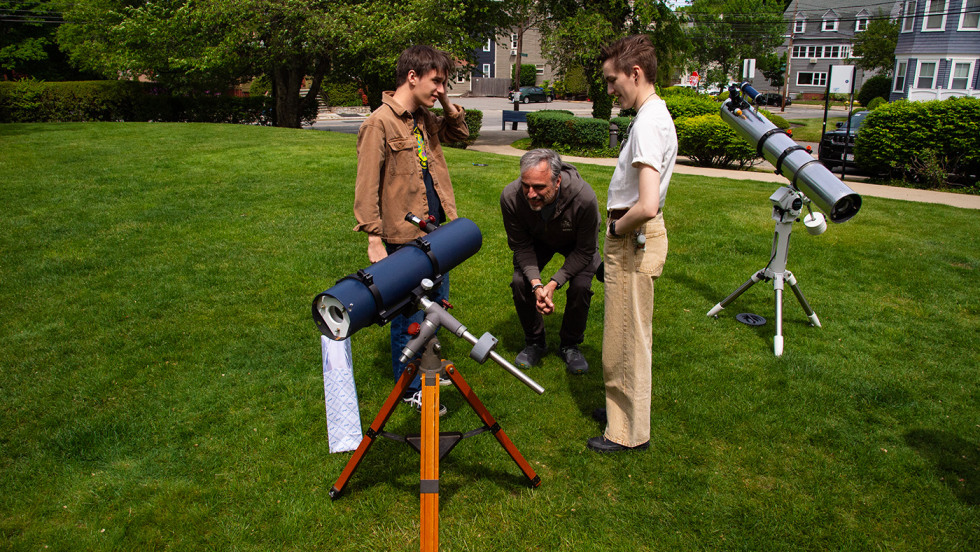
Ortega is one of a half-dozen Brown and Rhode Island School of Design students and employees who made the effort to painstakingly grind and polish mirrors to within nanometers of perfection, assemble optical tubes and create custom mounting systems to create fully operational, handmade telescopes. They say the experience went beyond building a precision tool that can outperform anything someone could buy — in addition to that practical benefit, they were connecting themselves to a craft that is nearly as old as western science itself, and to a community that is eager to keep the practice alive. 

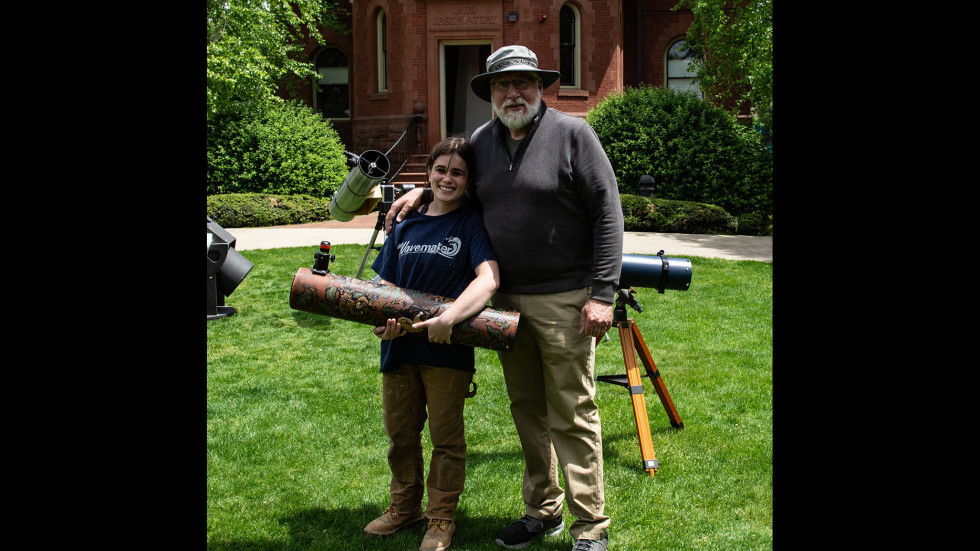
“For me, it’s incredible getting to be a part of this fantastically long tradition making telescope optics by hand,” said Aster Winkler, an astrophysics concentrator who completed their telescope just before earning a bachelor’s degree with Brown’s Class of 2026 in May. “I know it was a fairly popular hobby [in the past], but it is less popular nowadays. I think that’s not because of a lack of interest among our generation… but a lack of the good teachers who are willing to donate their time and materials to help people learn to do this.”

But the Brown group was lucky enough to have two teachers with decades of telescope-making experience in Robert Horton, a lab manager in the Department of Physics, and Dick Parker, a local optical guru whose rural Connecticut home doubles as an optics workshop for telescope enthusiasts. For several months last winter and spring, the group traveled to Parker’s house with Horton early on Saturday mornings to learn the precision technique behind precision glass grinding and polishing. 

“To me this is all about mentorship,” said Mahmoud Hallak, a Class of 2025 Brown graduate who now works closely with Horton as a lab instructional specialist in physics. “To do this, you need to have people who you can look up to and learn from.”

Zen and the art of optics

At the heart of any telescope is focus. Reflecting telescopes have a mirror that gathers light across its surface, and its subtle parabolic contour focuses that light to a specific point, making faint objects millions of miles away visible. Creating that perfectly contoured mirror requires focus of a different kind: a person who grinds and polishes a piece of glass, by hand, to specifications within a fraction of the wavelength of visible light — millionths of a centimeter. 

That’s the skill that the group learned in Connecticut, under the direction of Horton and Parker. 

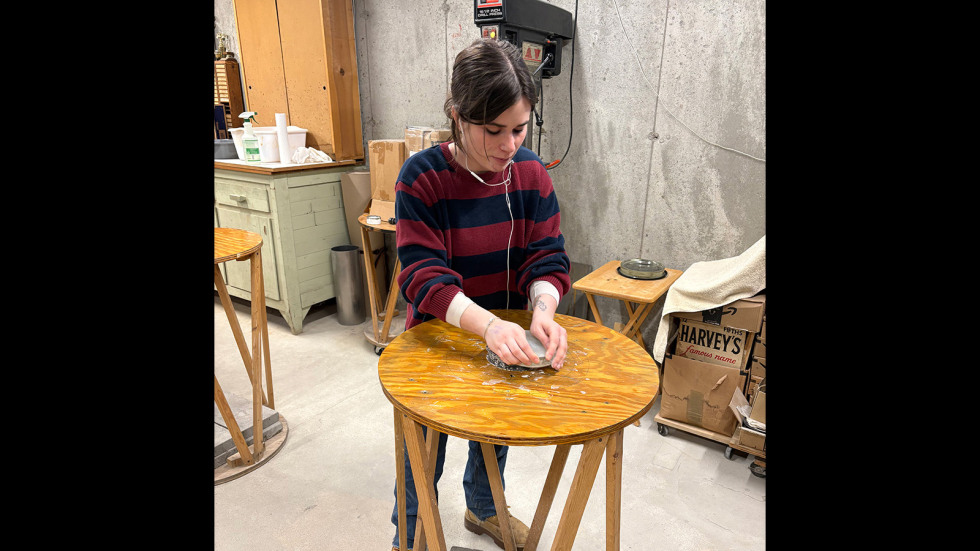
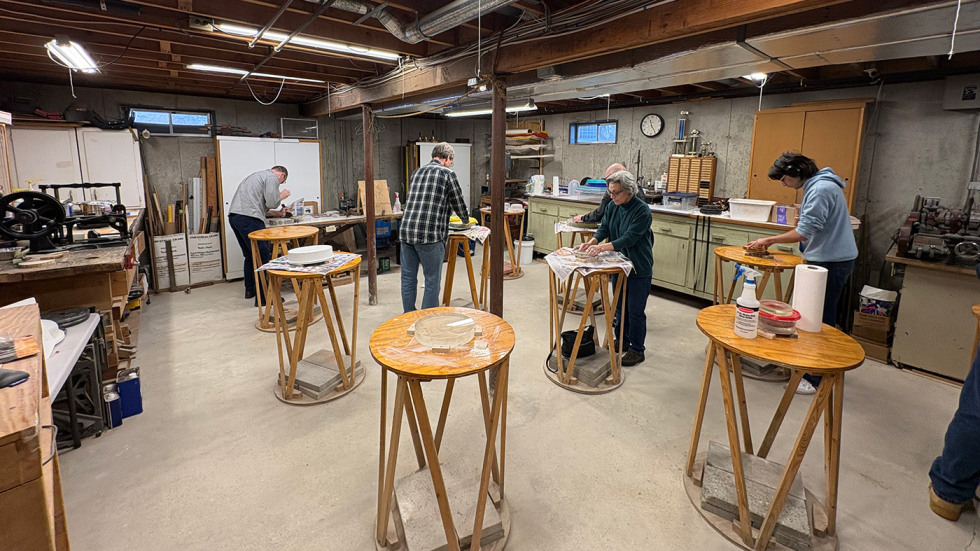
It starts with a thick chunk of glass cut into a circle called a blank, and a grinding tool — a second piece of glass or ceramic that’s as hard or harder than the blank. With the grinding tool sitting flat on a barrel-shaped table, the makers methodically push the blank across the tool with a little sandy grit in between, slowly rotating the glass and circling the barrel. It takes about four or five hours of grinding to get the rough shape of the curve. 

The initial grinding stage is fairly casual and social. 

“People are very talkative,” Horton said. “There’s lots of conversation while people work, and it’s noisy with the sound of all the glass being ground down.”

But after that, the precision work begins. The grinding continues with finer and finer abrasives, and workers must carefully count each stroke, each rotation of the glass, and each orbit around the barrel. At the final stages, each pass across the tool peels away just a few atoms of glass material at a time. And every stroke matters. 

Sean Salstrom, an artist and RISD professor who works with glass, found his own way to maintain focus. 

“I can't listen to music while I’m doing it; I can't talk to people because it will change the cadence,” he said. “Sometimes when I was really getting into it, I would set up a digital metronome… and just go.”

Mirror grinding

Mirror grinding takes hours, as makers hollow out a rough curve then polish the final product to within nanometers of perfection. The early stages are fairly social (and noisy), but the polishing requires complete concentration.

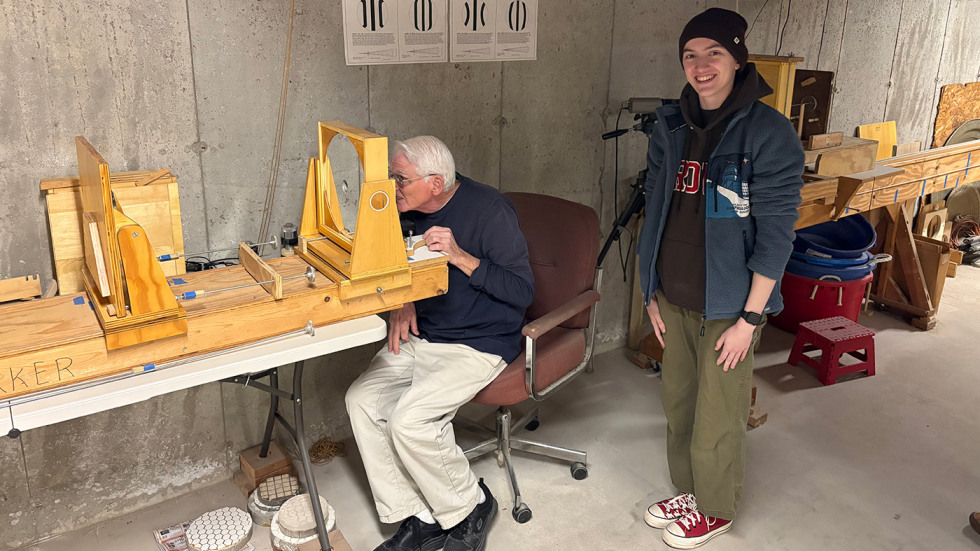
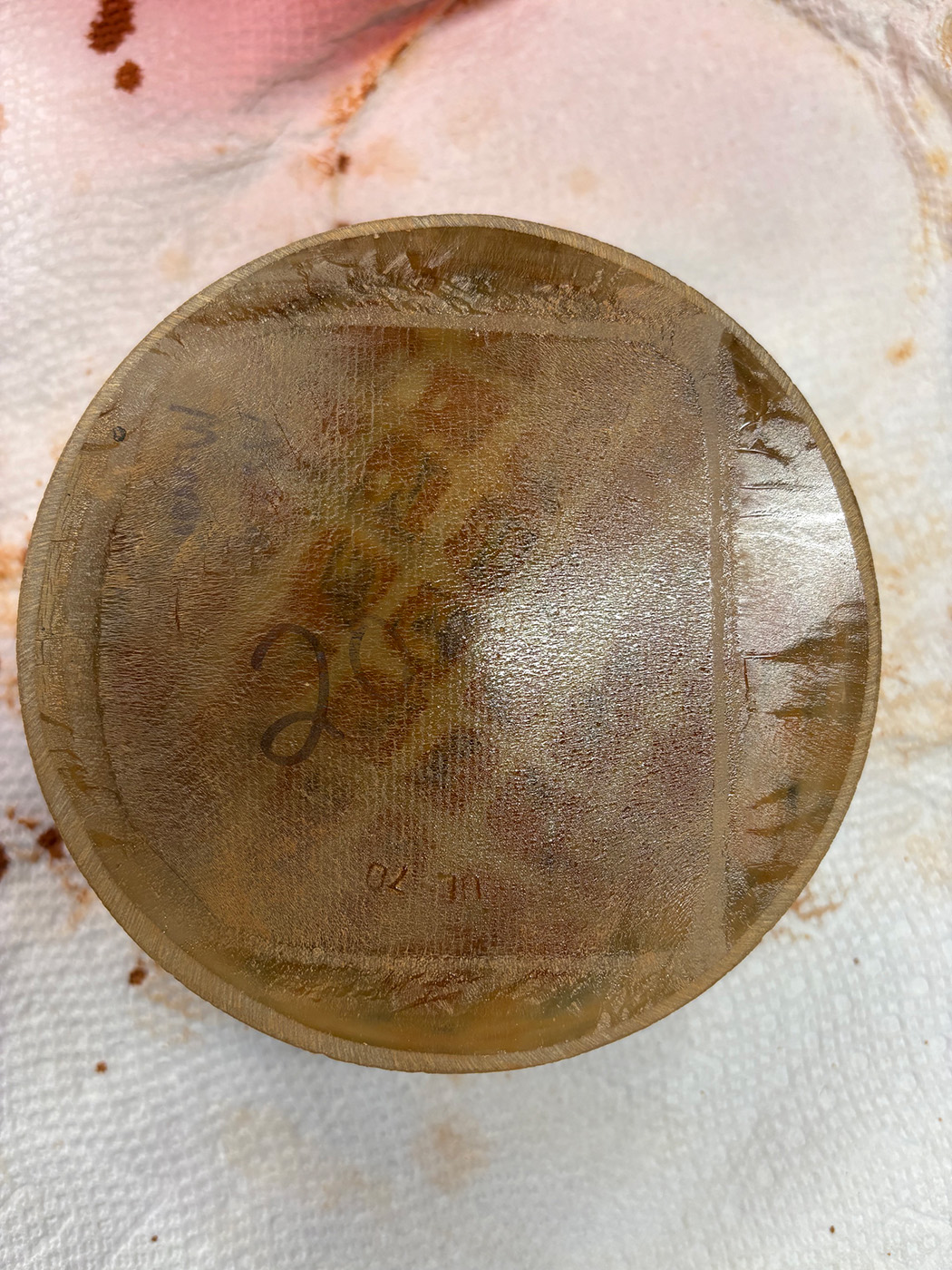
After shaping the mirror, polishing it to a flawless sheen is another labor-intensive project that can take up to eight hours. The grinding tool is covered in soft pine pitch, and a cerium oxide polish is slowly worked into the glass to make it clear. During this process, the mirror is periodically tested on an optical testing stand to perfectly dial in its focal point. 

It’s in these final moments near completion, Aster Winkler said, that the knowledge of experts like Horton and Parker was particularly helpful. 

“The expertise of these people is such that they can look through the testing stand say, ‘You need to go around the barrel two more times,’” Winkler said. “And if you do it three more times, you will have messed up. You better do exactly what they tell you to do, because they know what they're talking about.”

The difference between perfect and “messed up” is incredibly tiny. Horton says it’s an industry standard that the shape of the curve must be precise to within one quarter of the wavelength of visible light. So an eccentricity of just 100 nanometers or so — roughly 1,000 times thinner than a human hair — could render a mirror unusable. 

But Horton wants to do better than just usable. 

a grinding tool covered in pine pitch
A pitch lap, a grinding tool covered in pine pitch,  is used to polish the mirror to a perfect sheen.

“We make every effort to get it down to a tenth of a wave,” he said. “But there's a warning with this. You want to stop when it's really, really good. You might get it a seventh of a wave and be tempted to work for a few more minutes to get it to a tenth. But it’s easy to introduce a problem.” 

Horton knows firsthand. It has happened to him. 

“I've come to learn, and I have mentored them: If it’s really good, you should probably stop,” he said. 

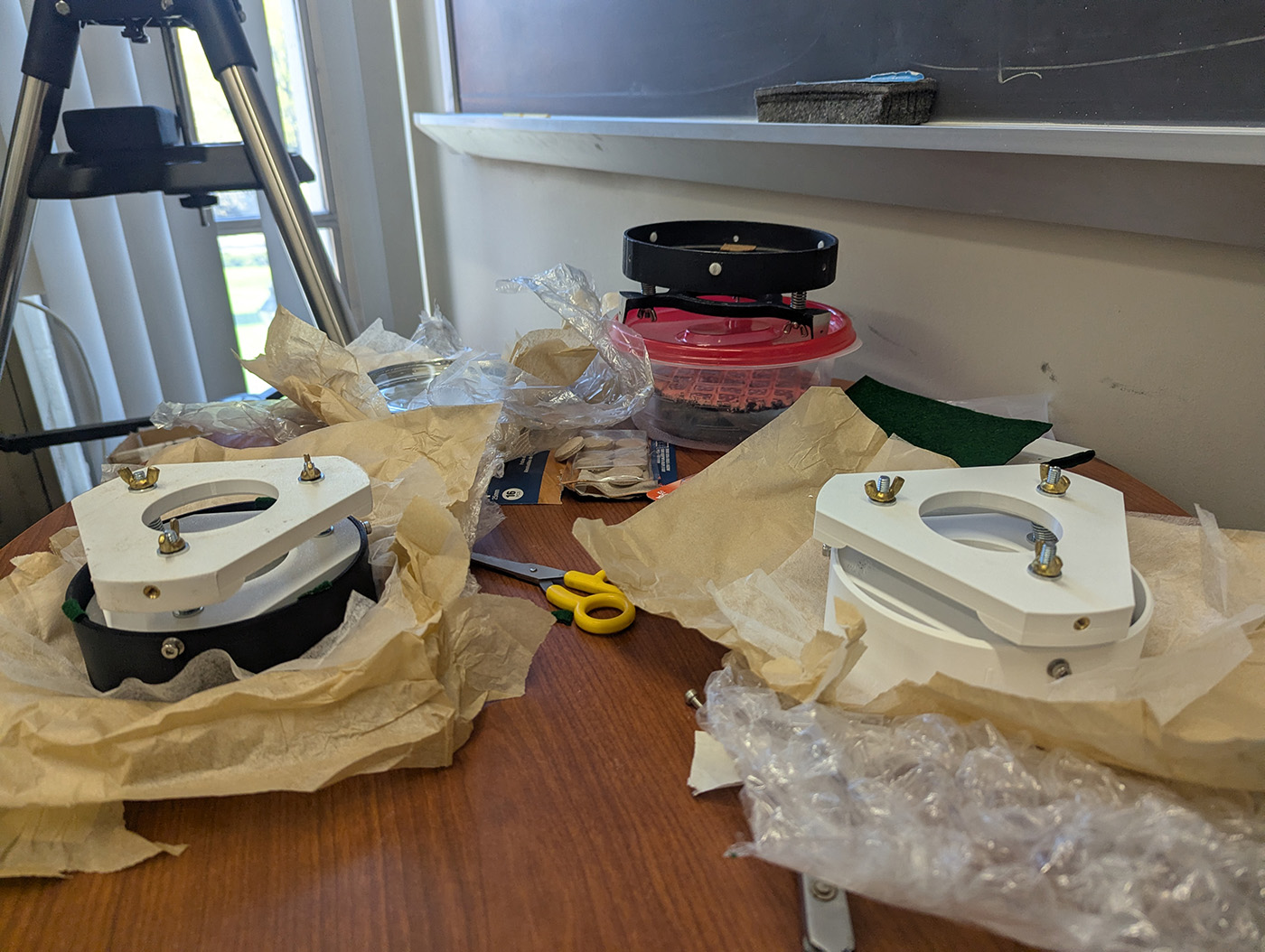
While the mirror is the heart and soul of a telescope, it’s not the only part. Horton helped his mentees to find suitable optical tubes for their mirrors. Hallak designed and 3D-printed mounts to keep the mirrors securely in place. Jamie Carrol, a machinist with the Joint Engineering and Physics Instrument Shop at Brown, volunteered his time to machine parts for several telescopes. Some people built their own mounts for their scopes, while others salvaged mounts from other telescopes. 

But no one had to shell out tons of money for any part of the process. 

“Bob has made this super accessible over the years,” Hallak said. “Most of the people who have done this haven’t had to purchase mirrors or grinding tools or anything. Bob just makes it happen.”

Community and the cosmos

After all those hours of labor and focus comes “first light.” For Winkler, that happened in May at the Ladd Observatory. Winkler’s telescope wasn’t quite finished — it still lacked a mount — but the optics were in place. 

“We took it to a Ladd viewing night, and I just kind of balanced it on my knee and looked at the Moon through it,” they said. “It was crazy. Just surreal. Great image, if I do say so myself.

It’s a feeling that Hallak, who has made several telescopes with Horton, knows well. 

mounts for telescope mirrors sitting on a table
Hallak 3-D printed mounts for telescope mirrors. 

“Nothing compares to the view of the cosmos, of the stars, knowing that this view is through your optics — something made by you,” he said. “It’s truly incredible.”

But for many, building a tool to view the great beyond helped them connect with the here and now. That was particularly true for Horton, who found comfort in working with students and colleagues during the aftermath of the Dec. 13, 2025, shooting at Brown, which happened in the building that houses the physics department.

“The whole process was therapeutic,” Horton said. “After those events in December, it’s really hard to put into words just what I felt. It was an emptiness. It was so painful. I've always enjoyed interacting with students and working on projects. For me, this brought the life back into my soul.”

Sadie Liebo, a rising senior glass major at RISD, said the experience of toiling so intensely on her mirror will inform her work and life moving forward.  

“Glass in general requires so much attention,” Liebo said. “It’s temperamental. It will bug you. Working with it is such a meditative thing. You mess up when you're not being patient enough or you're not paying attention or you're thinking about something else. You have to be completely focused, which I think has actually helped me in even more ways than just in making a telescope. I think it's just a good way to be.” 

After those events in December, it’s really hard to put into words just what I felt. It was an emptiness. It was so painful. I've always enjoyed interacting with students and working on projects. For me, this brought the life back into my soul.

Robert Horton Manager of astronomy labs and outreach
 
a person pouring pitch onto a lens grinding tool

Winkler said they’re grateful for the chance to learn from caring mentors and proud to have the opportunity to carry this tradition into the future. 

“It's not just that I made my own telescope,” they said, “but it's got pieces from people that I look up to and respect and have enjoyed getting to know so much during my time here.

With graduate school on the horizon, Winkler said the experience was among the best in their time at Brown.

“I don't know,” Winkler said, “I think this might be cooler than the diploma.”