Date July 30, 2026
Media Contact

Skye Rosario: Inspiring others to shoot for the Moon

Driven to inspire future space enthusiasts, Brown University student Skye Rosario is designing and installing a new lunar science exhibit at the Museum of Natural History and Planetarium this summer.

PROVIDENCE, R.I. [Brown University] — Skye Rosario can’t remember exactly where or when her interest in space began. 

“The truth is that for as long as I’ve been able to care about things, I’ve cared about space,” said Rosario, a rising Brown University junior. “It’s just so interesting to think about how there’s life here on Earth but nowhere else in the solar system as far we know now, and that we’re in this infinite universe that may be part of many more universes.”

It was that fascination with space, combined with a Pre-College course she took at Brown during her sophomore year of high school, that eventually drew her to College Hill as an undergraduate. The course, called Dynamic Earth, explored the evolution of the planet and the solar system, which deepened her wonder at the cosmos and Earth’s place in it. Rosario says she knew then that Brown was where she wanted to be. 

Now, as a mechanical engineering concentrator with an emphasis in aerospace applications, Rosario is spending her summer working to make sure other young people might find the same inspiration in the cosmos that she’s found. 

Working with LunaSCOPE, Brown’s NASA-funded lunar science research consortium, Rosario is helping to design and install a lunar science exhibit room at the Rhode Island Museum of Natural History and Planetarium. She’s also helping to write and produce a show about the Moon for the museum’s planetarium that will premiere in the fall. 

Under the direction of Andrea Rajšić, a research scientist and deputy principal investigator with LunaSCOPE, Rosario is trying to pack as much lunar science as she can into one room — and do it in a way that captures the excitement of exploring another world. Her work has been supported by an Undergraduate Teaching and Research Award, which provides funding for Brown students collaborating with Brown faculty on projects during the summer or the academic year.
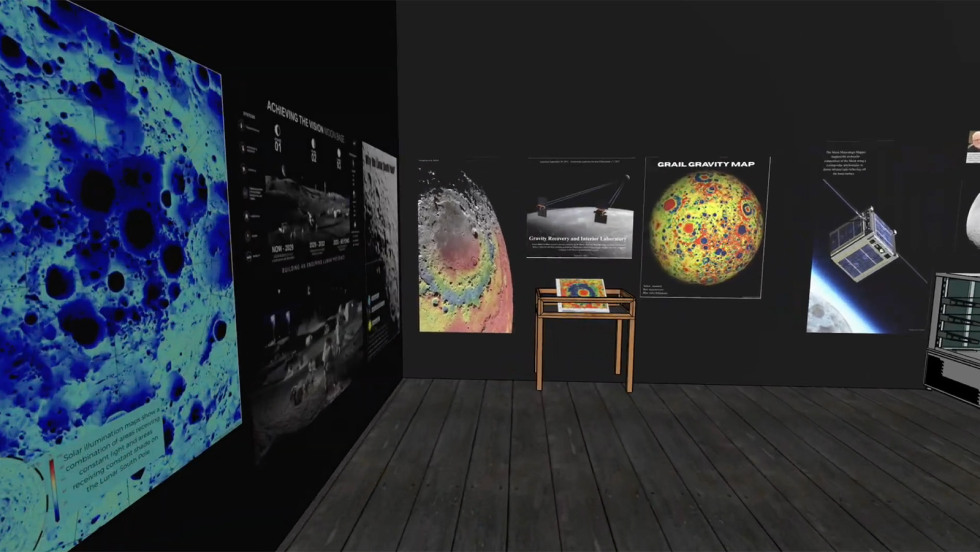
“A lot of it has been making lunar science accessible,” Rosario said. “We want this to be interesting and understandable, not only for people who are already fascinated with the Moon or space, but for someone who's just kind of curious, or for kids who just love museums and field trips.”

Rosario’s lunar science room starts at the most logical place: the very origin of the Moon. A TV screen will run a video depicting a Mars-sized object smashing into the young Earth, the leading theory for how the Earth-Moon system was born. Other exhibits will use infographics and imagery to teach about lunar volcanism, impact cratering and the evolution of the Moon through time. 

There will be exploration exhibits spanning the Apollo missions of the ’60s and ’70s to the modern Artemis campaign, which could return astronauts to the Moon’s surface as soon as next year. There’s an artist’s rendition of NASA’s proposed lunar base, and a 19-foot cyanotype print of the lunar surface created by Brown Class of 2025 graduate Logan Tullai, who served as LunaSCOPE’s artist-in-residence last year. 

Celebrating Brown’s lunar legacy

The exhibit also includes landmark contributions to lunar science made by Brown-affiliated researchers, including Jim Head, a longtime Brown professor who played a key science role in the Apollo program; Carle Pieters, a professor whose work led to the first detection of water on the Moon’s surface; Alberto Saal, a professor who first detected water in returned lunar samples; and alumna Maria Zuber, who led NASA’s GRAIL mission, which revealed new details about the Moon’s interior. 

“There are so many people at Brown who are huge parts of lunar exploration,” Rosario said. “Maybe the most fun I’ve had at LunaSCOPE has just been learning about what we’ve done. It makes me feel so proud.”

She’s also enjoyed learning about the future of lunar exploration, particularly the Artemis campaign. 

“I knew that the goal of Artemis was to get people back to the Moon, but the extent really surprised me,” Rosario said. “I didn’t know that the goal was to have a lunar base with people just going back and forth from Earth to the Moon.” 

As she pursues her engineering degree with dreams of one day working at NASA, Rosario could well be among the next generation of Brunonians to write their names in the stars. While she’s at it, she’s hoping her work this summer will help to inspire generations to come. 

“It’s been very fulfilling to think that maybe there’s going to be a kid like me who goes to the museum and thinks, ‘This is so cool, I hope I can learn more,’” Rosario said. 

The exhibit is set to open in February 2027.