‘Little Rhody is about to become big Rhody’ when it comes to biotechnology

Members of the National Security Commission on Emerging Biotechnology convened in Providence to learn about biotechnology capabilities and potential at Brown University and parter organizations across the state.

PROVIDENCE, R.I. [Brown University] — The fact that Rhode Island is a small state with outsize biotechnology talent, innovation and partnerships across universities, hospitals and the commercial sector means that it has enormous potential to become a hub for biotechnology excellence. That was among the key takeaways from an event held at the Rhode Island Life Science Hub in Providence’s Jewelry District on Friday, Aug. 21.

Members of the National Security Commission on Emerging Biotechnology visited to Rhode Island as part of a roadshow to learn about biotechnology clusters across the nation. The Senate-authorized commission completed a report in 2025 focused on advancing U.S. leadership in biotechnology, and the commissioners embarked upon a national tour to evaluate how local biotechnology ecosystems support U.S. competitiveness, supply chain resilience and national security. With the help of U.S. Sen. Jack Reed, who was also involved with launching the project, Brown University was selected as a co-host.

The visit included presentations, discussions and lab tours at Brown and the University of Rhode Island. 

According to Reed and Brown senior associate provost for life sciences Dr. Mukesh K. Jain, both of whom greeted the commissioners, Rhode Island punches well above its weight when it comes to biotechnology.

“Little Rhody is about to become big Rhody,” Reed said, alluding to the scientific potential of RNA, a major focus of Brown researchers and its biomedical partners. In addition, the senator said, there is enormous intellectual capital within the state’s borders.

Added Jain, who is also Brown’s senior vice president for health affairs and dean of medicine and biological sciences: “What makes Rhode Island distinctive is not simply the quality of any one institution, but the extraordinary density of talent, research, healthcare, defense, industry, entrepreneurship and workforce development within a very small geographic footprint. That creates an opportunity to build connections and move ideas from discovery to application rapidly.”

The National Security Commission on Emerging Biotechnology report includes 49 recommendations (27 of which have been enacted into law) and Brown leaders noted how Rhode Island could serve as an important implementation partner.
According to Dov S. Zakheim, the commission’s executive director, Rhode Island has significant potential to do just that. There are many places in the country where scientists are conducting important basic and applied research, he said, but many struggle to take discoveries beyond their laboratories and develop them into treatments and therapeutics available to people who need them. 

“Rhode Island is almost unique in terms of the biomedical innovation ecosystem, and especially in terms of biomanufacturing,” Zakheim said. “It is a model for what we want to do countrywide.”

Showcasing innovation with impact

Jain noted that Brown sits at the intersection of many of the issues before the commission: basic and translational science; medicine and public health; engineering, data and artificial intelligence; national security; and the education and training of the next generation of scientists and innovators. 

“We see firsthand both the extraordinary promise of biotechnology and the importance of ensuring that the United States has the talent, infrastructure, partnerships and policies needed to translate that promise into national strength,” Jain said.

The commissioners had closed-door conversations with Brown faculty about research, funding and scientific progress in areas where the University is a leader: RNA science, genomics, neuroscience, neurotechnology, healthy aging and more. 

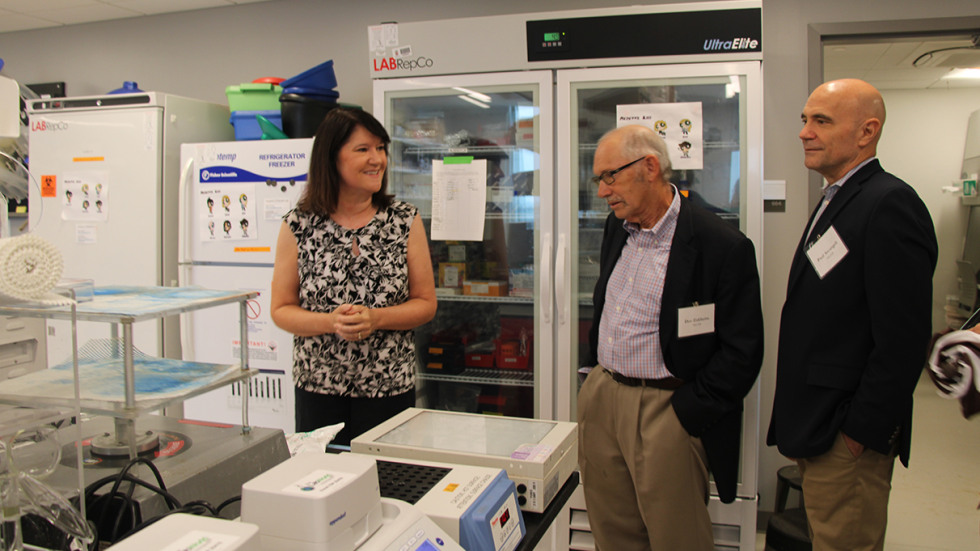
They also toured the labs of Brown’s director of biomedical engineering, Anubhav Tripathi, who started a company that manufactures a platform for identifying and analyzing RNA modifications; and Jill Kreiling, a professor of molecular biology, cell biology and biochemistry (research), whose team focuses on identifying biomarkers of Alzheimer’s and Parkinson’s diseases.

The commissioners said they were impressed by how a relatively modest investment by the National Institutes of Health in work by Brown researchers has the potential to turn into massive health benefits for the general population. They also noted the collaborative nature of the research conducted at Brown, which Kreiling unintentionally underscored when she mentioned running into a colleague while waiting for the commissioners to arrive, engaging in a conversation about recent discoveries, and planning a new research project together.

“It’s not just the collaboration with governments and university,” Zakheim said. “It’s the collaboration within university disciplines. Brown’s multidisciplinary approach here is particularly important when you’re talking about biotech, which is an amalgamation of a variety of different engineering processes and other disciplines. The whole approach of the School of Engineering, and the University, was very exciting.”