PROVIDENCE, R.I. [Brown University] — Following an external review of the Dec. 13, 2025, shooting on its campus, Brown University has launched an additional set of actions to enhance its campus safety and security and respond more effectively to crises in the future. According to the external review, it is highly unlikely that the shooting could have been prevented; however, there are a number of actions the University should take to further strengthen preparedness and response capabilities.
These are the core conclusions arising from the After-Action Review of the events of Dec. 13 conducted by the global consulting firm Teneo Risk to examine the University’s actions before, during and after the shooting, and a comprehensive assessment of Brown’s campus safety and security program. Teneo’s two reviews were launched by a special committee of the Corporation of Brown University, the institution’s governing body, in the months after Dec. 13. A third review conducted by COSECURE, a national firm specializing in physical security, involved a comprehensive assessment of all campus facilities and physical security infrastructure. All the reviews were conducted under the direction and supervision of outside legal counsel.
On Aug. 28, the University issued its report to the Brown community on key outcomes of these reviews. As a reflection of Brown’s commitment to transparency, Brown’s report includes Teneo’s executive summary of its core conclusions about the Dec. 13 tragedy, with the goal of promoting community understanding of the events surrounding the shooting. Brown’s report also features a detailed action plan the University has launched to build on expansive efforts in recent years and months to strengthen safety and security for the campus.
The University’s report, Safety and Security at Brown University: Overview and Action Plan, has been made available to the campus and the public, along with a supplemental FAQ responding to common questions about the shooting. Brown Chancellor Brian T. Moynihan and President Christina H. Paxson discussed key insights in a message emailed to Brown’s faculty, staff, students, alumni and parents.
“More than eight months after the shooting that took the lives of two of our students and devastated our community, Brown has continued to grapple with questions that are natural in the wake of such a tragedy,” Moynihan and Paxson wrote. “A report we are sharing with our community today, Brown’s Safety and Security Overview and Action Plan, seeks to answer these questions. As we continue to mourn the victims and support the recovery of the injured students, we also remain resolute and steadfast in maintaining safety and security at the center of everything we do.”
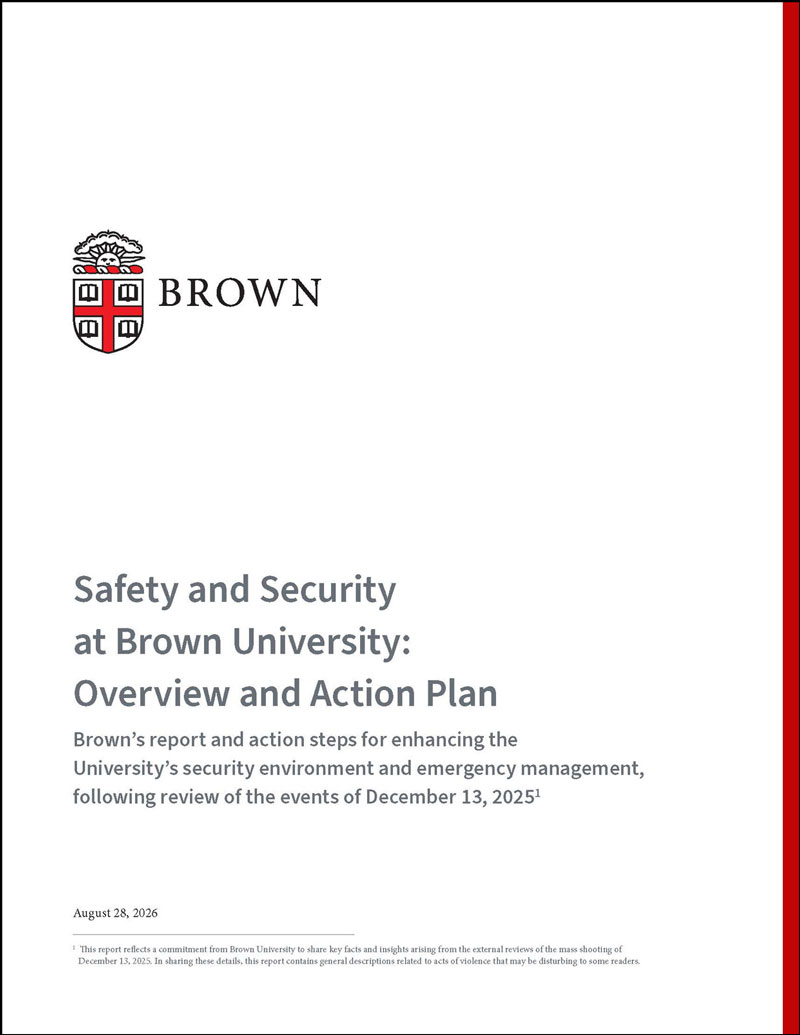
“The report shares lessons learned from the external firms of highly experienced experts who were charged to follow the facts thoroughly, objectively and impartially. We hope it will help our community gain a deeper understanding of the incident, the ways Brown effectively responded to the tragedy, and how our response and level of preparation can be strengthened for the future,” Moynihan and Paxson added. “We know this is important for our community as we navigate the path to recovery.”
On Dec. 13, 2025, two Brown undergraduate students were killed and nine were injured when a perpetrator later identified by law enforcement as Claudio Manuel Neves Valente entered a campus academic building and opened fire in and around a classroom where a coursework review session was taking place.
The core conclusion from Teneo’s external review is that it is “highly unlikely” the attack by Neves Valente at Brown on Dec. 13 could have been prevented. Accordingly, Teneo states in its executive summary that the firm focused its efforts on recommendations relating to “how the organization prepares, works together, and responds to future mass casualty and/or life-safety events.”
The Teneo review team was co-led by William J. Bratton, who previously served as commissioner of the New York City Police Department and chief of the Los Angeles Police Department. Bratton was familiar with public safety at Brown prior to the shooting, having conducted public safety assessments for Brown earlier in his career.
“Teneo focused on providing a thorough, objective and impartial review of the facts surrounding the events of Dec. 13, 2025, at Brown University,” Bratton said. “Teneo reviewed the incident by examining various factors, including organizational preparedness and preventability. Our review concluded that the University responded with commendable resilience and effectiveness. At the same time, a mass casualty incident places remarkable stress on an institution and reveals opportunities to address logistical and operational challenges. Our recommendations outlined how the University can continue to improve its preparedness and response to future emergencies that threaten loss of life.”
The University opens its report with lessons learned from Teneo’s After-Action Review, though Brown’s Safety and Security Overview and Action Plan responds to all the external reviews examining aspects of Brown’s security environment, ranging from physical security infrastructure, staffing and leadership, to policies, emergency management and governance, and training and crisis response.
In addition, the University’s FAQ on the External Reviews of Safety and Security at Brown posted alongside the report reflects extensive fact-finding related to common questions raised on campus and by the public following the events of Dec. 13. Together, the documents address questions in key areas, including Brown’s response to security concerns, emergency notification protocols and practices, information-sharing with external law enforcement, and leadership and organizational issues at the time of the shooting.
Report shares other key findings related to Dec. 13 shooting
The external reviews found that the University had no advance indication that the perpetrator of the shooting posed a threat of violence to Brown.
Neves Valente, a 48-year-old Portuguese national, was not a current student, was not a Brown employee and did not receive a degree from the University, attending for three semesters as a graduate student until taking a leave in 2001 and formally withdrawing, effective July 31, 2003. Neves Valente was found dead from a self-inflicted gunshot wound in a New Hampshire storage facility by law enforcement officers five days after the shooting, on Dec. 18.
“Our review found nothing in Neves Valente’s academic history or records to suggest a propensity for violence or an animus toward the University, nor is there any evidence that he had any contact with Brown personnel prior to the attack,” Teneo wrote in its summary of findings.