Brown University awards $4.5 million in workforce development grants to Rhode Island nonprofits
As part of the University’s $50 million commitment to local workforce development, Brown will invest in four initiatives to expand job training, connect residents to career opportunities and boost the state’s workforce.
PROVIDENCE, R.I. [Brown University] — Brown University has awarded $4.5 million in grants to four local nonprofit organizations to create new opportunities for Rhode Islanders to pursue careers in healthcare and advanced manufacturing.
Genesis Center, Polaris MEP and the University of Rhode Island Foundation will each receive anchor grants of up to $1.5 million to expand established workforce development initiatives across the state. In addition, the Rhode Island Association for Infant Mental Health will receive a $200,000 innovation grant, an award focused on support for new ideas and pioneering programs.
The awards mark the University’s first full funding cycle following an open call in January 2026, advancing Brown’s commitment to invest $50 million over 10 years to workforce development in Rhode Island. The grants build on a track record of Brown support for local workforce development initiatives as part of the University’s service and community engagement mission. They also fulfill a pledge to which Brown committed in its July 2025 voluntary resolution agreement with the federal government, which restored funding for federally sponsored medical and health sciences research at Brown. As part of that agreement, Brown pledged $50 million to support workforce development programs in the state.
A committee of Brown and Providence community members selected the recipients, prioritizing efforts to strengthen Rhode Island’s healthcare sector. Three of the grants will expand the state’s healthcare workforce by creating new pathways for local residents to gain skills, earn professional credentials and pursue careers as certified nursing assistants, medical interpreters, medical and dental assistants, medication aide technicians and mental health professionals.
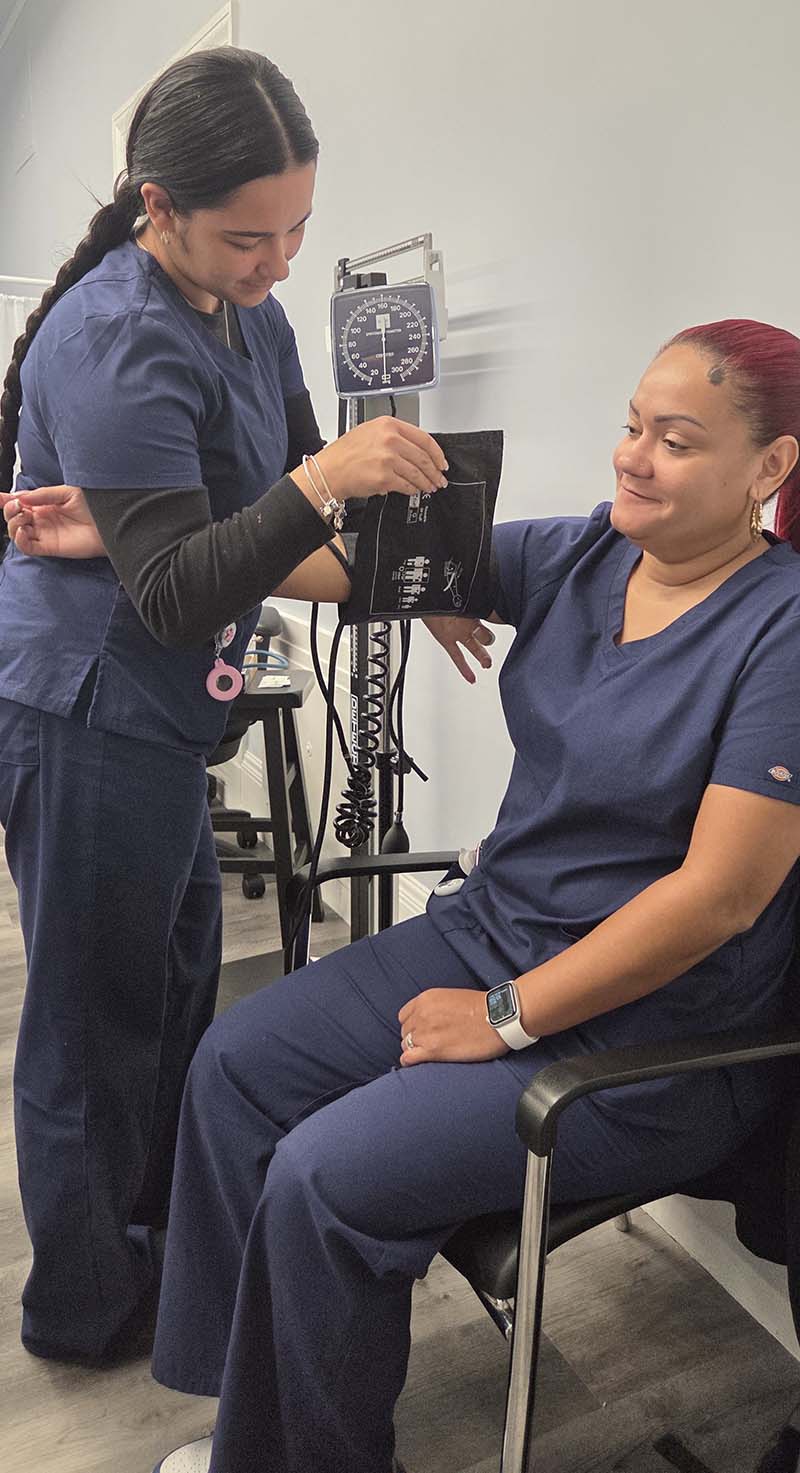
Brown’s support will enable URI to train up to 90 certified nursing assistants to administer medications in long-term care facilities, creating pathways to higher-skilled positions and strengthening Rhode Island’s healthcare workforce. Photo courtesy University of Rhode Island.
The new grants build on the University’s inaugural $3 million investment in January 2026, which supported workforce training programs at the Community College of Rhode Island and Building Futures to prepare Rhode Islanders for careers in early childhood education and the construction trades.
Mary Jo Callan, vice president for community engagement at Brown, said all six grants have funded programs to address worker shortages while opening pathways to careers and greater economic opportunity for Rhode Islanders. Brown’s investments, which total approximately $7.5 million to date, will create job and career growth opportunities for more than 1,200 Rhode Islanders.
“These investments are building a stronger economy by creating real opportunities for Rhode Islanders,” Callan said. “That means working closely with employers to understand their needs and supporting programs that do more than provide training — they offer wraparound services to help participants overcome barriers to success, provide ongoing support as they navigate career paths and connect them to good jobs and opportunities for advancement. We’re investing in initiatives that connect local employers with skilled workers, help Rhode Islanders build successful careers and provide families with greater economic stability.”
Expanding access to job training, career pathways
With a $1.5 million grant from Brown, Genesis Center — a Providence nonprofit that provides education, workforce training and support services to help Rhode Islanders achieve economic independence — will expand three of its healthcare training programs and add a fourth, increasing annual enrollment from 170 to 275 participants. The expansion will empower more Rhode Islanders to earn industry credentials for careers as certified nursing assistants, medical assistants, dental assistants and medical interpreters. Over the past decade, the center has trained more than 1,000 frontline healthcare workers, partnering with employers including Brown University Health, Providence Community Health Centers and the Comprehensive Community Action Program to place students in clinical internships, many leading directly to permanent hires.
We’re investing in initiatives that connect local employers with skilled workers, help Rhode Islanders build successful careers and provide families with greater economic stability.
Mary Jo Callan
Vice President for Community Engagement
“We’re incredibly grateful to Brown University for this investment in Genesis Center and the people we serve,” said Shannon Carroll, president and chief executive officer of Genesis Center. “Every day, we see how hard our students work to build better futures for themselves and their families, often while balancing jobs, children and other responsibilities. We know that a good job can change the trajectory of someone’s life, and this funding will allow us to help more Rhode Islanders gain the skills and credentials they need to build meaningful, lasting careers. It’s an exciting opportunity for our students and for Rhode Island’s healthcare workforce.”
Providence-based Polaris MEP, which partners with Rhode Island manufacturers to strengthen the region’s industrial workforce, will use a $1.37 million anchor grant to expand its career pathways programs, reaching an additional 258 participants through partnerships with JARC Rhode Island, New England Institute of Technology and the Community College of Rhode Island. Over the next three years, Polaris will grow its cohort-based training in CNC machining, welding, industrial maintenance and other high-demand manufacturing fields — preparing aspiring tradespeople for new careers while helping current workers advance their skills. The funding will also strengthen the organization’s partnership with the Rhode Island Department of Corrections, expanding workforce programs that prepare incarcerated individuals for successful reentry and employment.
With the $1.5 million grant from Brown, Genesis Center will expand three of its healthcare programs. Photo courtesy Genesis Center.
The third anchor grant, $1.5 million awarded to the University of Rhode Island Foundation, will allow URI’s College of Pharmacy to train 270 certified nursing assistants (CNAs) over three years to become licensed medication aides. The initiative directly addresses a critical shortage of staff qualified to administer medications safely in local nursing homes, assisted living facilities, rehabilitation centers and adult day programs. As one of the few providers authorized by the Rhode Island Department of Health to offer the program, URI currently provides training to 18 CNAs annually. Brown’s support will allow URI to train up to 90 CNAs across three cohorts each year, opening pathways to higher-skilled, better-paid positions while easing nursing workloads and strengthening the delivery of patient care across Rhode Island’s long-term care facilities.
The $200,000 innovation grant will support the Rhode Island Association for Infant Mental Health in establishing the state’s first early childhood mental health workforce development hub. The funding will expand the use of best-practice diagnostic approaches among local social workers, early interventionists and psychologists, increasing access to therapies for kids and families and strengthening workforce capacity to address growing mental health needs across the state. Within a year, 50 local clinicians will be trained in a nationally recommended behavioral health tool that helps clinicians identify, classify and treat mental health and developmental challenges in infants, toddlers and young children from birth through age five. As more states adopt the national framework, professionals trained in its use can expand their career opportunities and advance into specialized clinical, supervisory and leadership roles.
Selection of programs that meet workforce demands
To prepare for the first open cycle of the grant program, Brown established a two-stage application process informed by input from community members, including the University’s nonprofit partners, among other workforce development leaders. Following an open call for letters of interest in January 2026, a small number of local organizations were invited to submit full proposals for consideration.
The new grants build on the University’s inaugural $3 million investment in January 2026, which supported workforce training programs at the Community College of Rhode Island and Building Futures to prepare Rhode Islanders for careers in early childhood education and the construction trades. Photo by Nick Dentamaro/Brown University.
Proposals were reviewed by a selection committee made up of Brown faculty, staff and students, along with Providence community members, including local nonprofit and business leaders. Committee members assessed proposals evaluating factors such as labor market demand, program design, participant recruitment and retention, and employer hiring or promotion commitments.
As part of the selection process, the committee met throughout the summer to review proposals and reach consensus on the strongest applicants for each grant category. In addition to review scores, members considered the state’s larger workforce development landscape, especially opportunities to complement existing programs and strengthen the state’s workforce development ecosystem.
The University anticipates opening the 2028 funding cycle in Spring 2027. Local nonprofit leaders can learn more about the anticipated timeline on the University’s website.
A concentrator in English, Politano will pursue two graduate degrees at the University of Oxford through one of the most prestigious awards for international study.
U.S. Army veteran and Brown trustee Joseph P. Healey joined University leaders, student veterans and Brown ROTC students in celebrating the service of the nation’s past and current military members.
In remarks at Brown University, National Academy of Engineering President Tsu-Jae Liu underscored the fact that “engineering is all about helping people.”