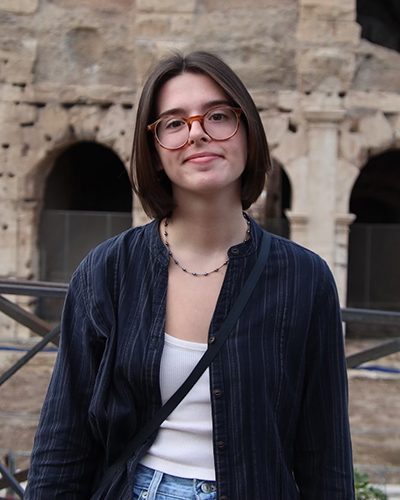
 Lillian Gale
Concentration: Economics and political science
Hometown: Manahawkin, New Jersey
Lillian Gale was getting coffee with her freshman-year high school English teacher when she found out she was selected as a Voyager Scholar.
“She was the first person to give me the space and support to create change in an actionable way,” Gale said. “It was surreal to share that moment with her.”
A first-generation college student from a rural community, Gale said she’s always known that she wanted to pursue a career in public service, and she sees the Voyager Scholarship as the perfect avenue to explore future possibilities.
At Brown, Gale serves as a civic engagement fellow with Brown Votes and as national vice president of Every Vote Counts, a nonpartisan organization dedicated to increasing voter turnout and expanding voter access nationwide. Through her studies, Gale focuses on voting rights and the correlations between ballot access, political participation, civic information and economic justice — work she will continue as a Voyager Scholar.
“I hope to change who feels represented in politics and shift attitudes toward civic engagement in the United States,” Gale said. “My end goal will always be the same: giving voice to those who don’t feel heard.”
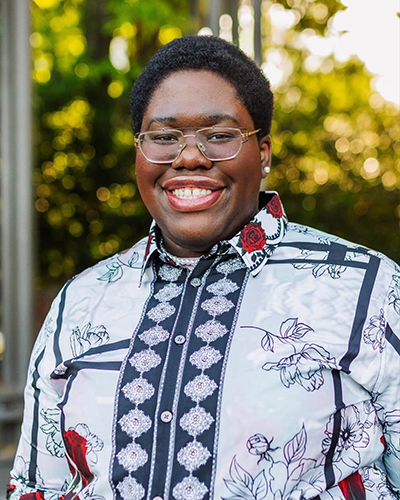 Shine Gerkariah
Concentration: Computational chemistry and chemical physics
Hometown: Grand Prairie, Texas
When Shine Gerkariah received news of his selection as a Voyager Scholar, his immediate instinct was to thank the friends who had encouraged him to apply.
“They made me feel like trying was something worth doing, even when I had no idea where it might lead,” he said.
That encouragement reflects what Gerkariah values most about his experience at Brown: the opportunity to explore his interests while helping others feel supported and included.
In Brown’s School of Engineering, he works in the ReALLMASIC Lab, where he uses signal processing to support bioinstrumentation design. He also serves as an introductory biology teaching assistant, a gender and sexuality peer counselor and president of the Program in Liberal Medical Education’s First Generation Underrepresented in Research in Medicine group.
“A lot of what I love about Brown ultimately comes back to people,” Gerkariah said. “I love building community, helping others feel like they belong and getting excited alongside other people about the things they care about.”
That interest in how people experience emerging technologies also shaped Gerkariah’s work as an AI governance and risk intern at VOCEL, a Chicago nonprofit serving K-12 students and families, where he researched AI policies in K–12 education.
As a Voyager Scholar, Gerkariah hopes to bring together his interests in healthcare, technology, research and policy to shape how AI is used in medicine.
“I want to help build systems that are powerful and innovative while also making people feel safe, respected and confident in the way those systems are being used,” he said.
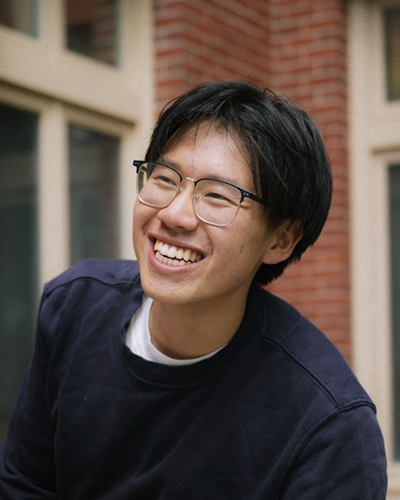 Raymond Hu
Concentration: Economics and health and human biology
Hometown: Coral Springs, Florida
Raymond Hu’s academic interests run the gamut from food and medicine to public policy and business. At Brown, he’s uncovering how they intersect.
As a research assistant at Brown’s Center for Health System Sustainability, Hu studies how health systems in different countries affect individual health, and he researches how the gut microbiome produces vitamin A-related compounds in the lab of Associate Professor of Molecular Microbiology and Immunology Shipra Vaishnava. Outside the lab, Hu is involved with student organizations including the Personal Finance Initiative, the Cooking Club and the Food Recovery Network.
“Brown has given me a lot of freedom to explore the different things I care about,” Hu said.
“I put a lot of time into figuring out how all of my different experiences connected to my goal of serving the community. It was really exciting to see that come together and be recognized through the Voyager Scholarship.”
The award will present Hu with unique opportunities to learn from communities across the globe while helping him figure out what shape his future career might take. Currently, attending medical school is at the top of Hu’s list, but he’s open to any opportunity that allows him to work toward achieving his goal of creating a healthier world.
“Whether that means becoming a physician working in food policy, a chef or an entrepreneur, I want to help people live healthier lives and support the communities I serve,” Hu said.
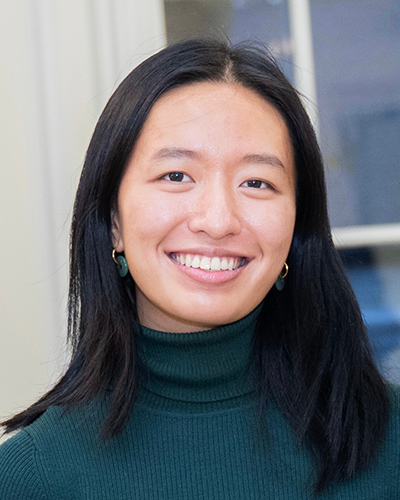 Sophia Leng
Concentration: Cognitive science and science, technology, and society
Hometown: New York City
For Sophia Leng, the Voyager Scholarship represents a natural continuation of her dedication to health equity and patient advocacy.
“When applying, I remember thinking what a dream fellowship this was, providing such unique opportunities that align deeply with my values and future goals,” Leng said.
Through her studies at Brown, Leng has had the opportunity to study healthcare through both an interpersonal and structural lens, which she hopes will advance her goals of improving healthcare systems for all. Among her many roles, Leng serves as a resource coordinator for Connect for Health, a policy analyst on the Brown Initiative for Policy’s Cancer Prevention and Screening Policy team, co-editor-in-chief of the Brown Journal of Medical Humanities, and a volunteer for the Samaritans of Rhode Island helpline.
“My Brown education has been invaluable in getting me to where I am now,” she said. “The interdisciplinary lessons, service, research and other activities that I’ve been able to engage with here will help me wherever I go in my voyage.”
Leng aims to use her Voyager experience, in part, to collect data for an honors thesis in science, technology and society. Long term, she plans to pursue an MD-Ph.D. in medical anthropology or science, technology and society.
“I’m interested in both its structural inequalities that are more in the realm of health policy and practical research intervention, like my current research work, but also in critically interrogating the personal, social and systemic factors that shape the experience and perpetuation of these problems,” Leng said. “Ultimately, I hope to help transform the U.S. health care system and the human experience of it — a really big goal, I know.”