In Brown’s Introduction to Medical Illustration course, the pen is mightier than the scalpel
In a course taught by illustrator and pediatric surgeon Dr. Francois Luks, undergraduate students draw connections between art, anatomy and the power of visual communication.
1of4
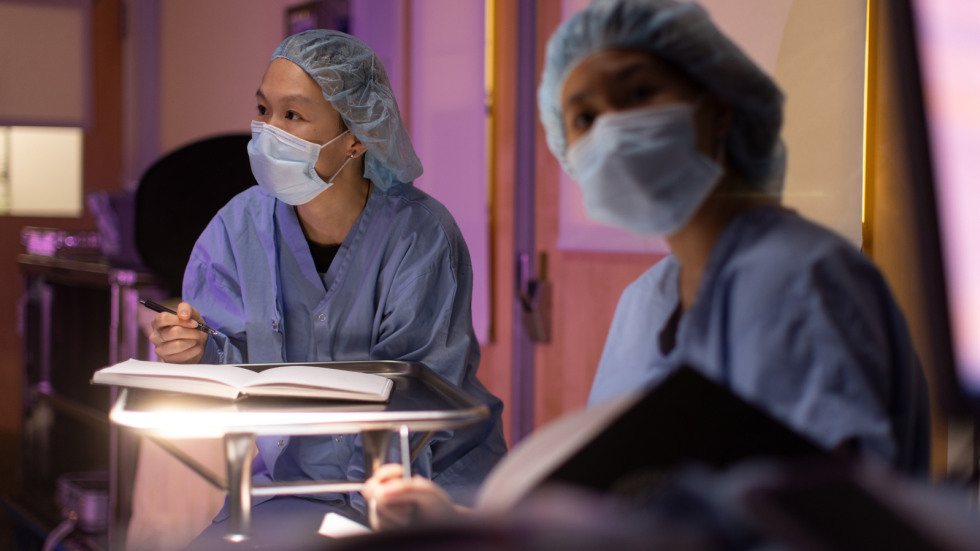
Introduction to Medical Illustration brings together undergraduate scientists, artists and aspiring physicians at Brown to investigate the history and practice of medical illustration and how visual communication makes complex information more accessible. All photos by Nick Dentamaro/Brown University.
2of4
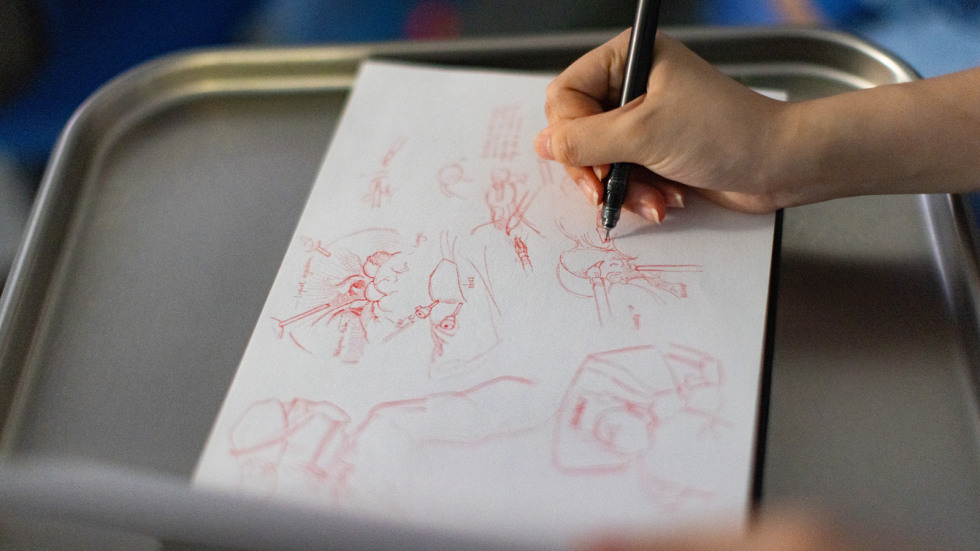
Unlike a camera, which captures everything in frame, a medical illustration can isolate a single body part and clarify surgical steps that a photograph would obscure.
3of4
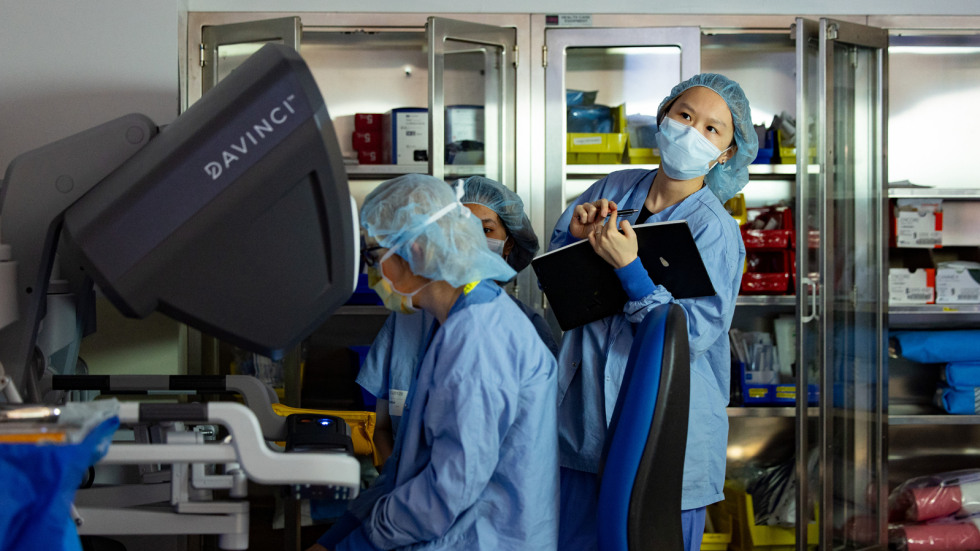
Cross-registered Rhode Island School of Design students enroll alongside Brown undergraduates, and the class travels across Providence to observe surgical procedures, attend live-model figure drawing sessions and visit the RISD Nature Lab to study biological specimens up close.
4of4
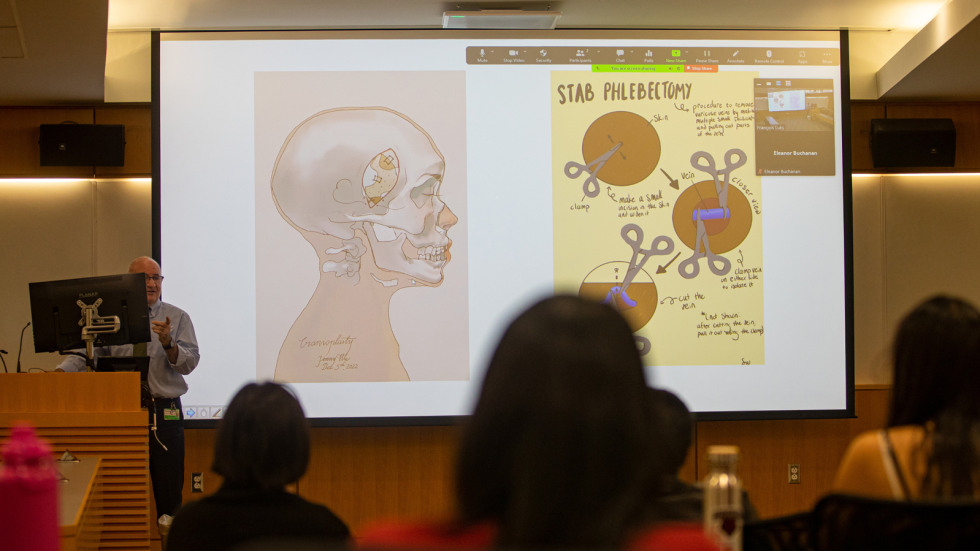
Dr. Francois Luks offers feedback on student-drawn diagrams of a cranioplasty and stab phlebectomy during a homework review.
PROVIDENCE, R.I. [Brown University] — As surgeons prepared to repair a patient’s hernia, Brown University sophomore Sophia Milausnic stood inside the operating room, trying to picture the procedure she was about to witness.
She leaned toward a medical student observing alongside her and asked how the repair would work, but his surgical terminology was unfamiliar.
“He was talking about the inguinal canal and how they’re going to make a lasso, and I was like, ‘I have no idea what that means,’” she said.
Then he took out his notes and began drawing, and Milausnic’s confusion vanished.
“It just clicked — I got it,” she said. “As a provider, being able to recognize when you could use another method of communication is really, really important.”
Milausnic is one of 28 students enrolled in Introduction to Medical Illustration, an undergraduate course at Brown taught by Dr. Francois Luks, pediatric surgeon-in-chief at Hasbro Children’s Hospital in Providence and a professor of surgery, pediatrics and obstetrics and gynecology at Brown’s Warren Alpert Medical School.
It doesn’t matter if it’s a scribble or a masterpiece, because it’s really about communication. It’s about being understood by your patients, your colleagues and your students. A picture is worth a thousand words.
Dr. Francois Luks
Professor of Surgery, Pediatrics and Obstetrics and Gynecology at Brown’s Warren Alpert Medical School
The fall course brings together scientists, artists and aspiring physicians — including students enrolled in Brown’s distinctive eight-year Program in Liberal Medical Education — to investigate the history and practice of medical illustration and how visual communication makes complex information more accessible.
“All doctors, and certainly all surgeons, draw in some way,” Luks said.
Luks’ own path at the crossroads of art and medicine began decades ago in his native Belgium, where he paid his way through medical school by drawing daily comic strips for newspapers. When the demands of surgical residency forced him to set cartooning aside, he turned his sketchbook toward anatomy to illustrate surgical techniques learned from mentors, research papers and eventually dozens of illustrations for a pediatric critical-care textbook.
After nearly 20 years teaching pediatric and fetal medicine at Brown, Luks hosted a medical illustration workshop in 2012 at a medical student’s request. It grew into a preclinical elective at the Warren Alpert Medical School before becoming a full-semester course that has had a waitlist every time it’s been offered since 2017.
For Luks, the goal has never been to turn future physicians into professional artists.
“It doesn’t matter if it’s a scribble or a masterpiece, because it’s really about communication,” he said. “It’s about being understood by your patients, your colleagues and your students. A picture is worth a thousand words.”
Where creative practice meets clinical precision
Unlike a camera, which captures everything in frame, a medical illustrator can isolate a single body part and clarify surgical steps that a photograph would obscure.
For students in the course, learning to draw can also be a way of learning to see.
Students enrolled in Introduction to Medical Illustration work on live drawings while observing a robot-assisted surgery at Rhode Island Hospital.
“Every detail counts, every vein, every artery,” said junior Nicole Marion, who is concentrating in molecular biology, cell biology and biochemistry. “I didn’t think about how those details could make a huge difference for a doctor learning how to do a procedure.”
Guest speakers — including practicing physicians, Brown alumni and professional medical illustrators — introduce students to varied career paths, while class discussions about representation and the use of artificial intelligence in medical imagery prompt them to think more broadly about the responsibilities of future healthcare providers.
“Learning how to think visually not only makes you a more well-rounded person, but it helps you become a better doctor,” said sophomore Rebecca Gashinsky, an aspiring physician studying computational neuroscience. “When you explain something to a patient, you’re able to draw it out, and it makes a lot more sense than long, scary medical words.”
Cross-registered Rhode Island School of Design (RISD) students enroll alongside Brown undergraduates, and the class travels across College Hill for live-model figure drawing sessions and visits to the RISD Nature Lab to study biological specimens up close.
Through hospital observations arranged as part of the course, students connect with surgeons, residents and medical students in the operating room, gaining exposure to clinical settings that can be difficult to find at the undergraduate level.
Expanding career horizons, from the studio to the surgery suite
During one field trip, junior Magnus Gehrke suited up and scrubbed in to watch neurosurgeons open a patient’s skull and remove a brain tumor.
“I had my little notebook, we were drawing and they were explaining things along the way, so it was really educational and really cool,” Gehrke said. “The surgeons were very welcoming. It was very immersive — we got to get up pretty close and see everything happening.”
Through hospital observations arranged as part of the course, students connect with surgeons, residents and medical students in the operating room, gaining exposure to clinical settings that can be difficult to find at the undergraduate level.
Gehrke is studying molecular biology, cell biology and biochemistry but has long maintained an interest in visual art. For a long time, he wondered how he could ever incorporate the two. Now, he’s full of inspiration.
“It’s really opened my eyes to how many careers there are that model medical illustration and how non-linear that path can be,” Gehrke said. “It’s made me less stressed about my own career, because I’ve learned how people change and made additions to their careers to incorporate the things they’re most passionate about.”
For students like Gehrke and Milausnic — a biophysics concentrator who is now considering a second concentration in literary arts — the course offers a way to weave storytelling and visual communication directly into pre-medical studies. For others immersed in demanding science, technology, engineering and mathematics coursework, it provides a welcome creative outlet.
Luks said the course enhances undergraduates’ communication skills that enrich their scientific training, while participating RISD students gain exposure to anatomy and clinical science.
“It’s a nice, intentional mix,” Luks said.
The course also reflects a broader recognition of the role visual communication can play in improving patient care.In a 2024 scoping review published in the Journal of Surgical Education, Luks collaborated with Dr. Stephanie Cohen, a surgical resident at Beth Israel Deaconess Medical Center and frequent Introduction to Medical Illustration guest lecturer, and other researchers to examine 21 clinical studies on visual aids in surgical patient education. They found that illustrated visual aids significantly improved patient comprehension, boosting objective knowledge recall by up to 30% while increasing satisfaction and easing patient anxiety.
In a forthcoming study, Cohen and a former student in the Brown course examine the course’s long-term impact through a 10-year retrospective survey comparing course alumni with students who applied but were unable to enroll due to space limitations. According to Luks, the findings suggest that students who completed the course were more likely to continue using drawing as a form of visual communication and demonstrated a greater interest in medical ethics.
“This class has shown me that medicine’s all about communicating the best with the person that you’re supposed to be helping,” Milausnic said. “It’s finding ways to communicate with people who maybe don’t have the same background knowledge that you do.”
Jennifer Nuzzo, Scott Rivkees and Craig Spencer from Brown University’s School of Public Health explain what the loss reveals about the nation’s ability to fight infectious diseases.
The elimination of race and ethnicity from Medicare's mortality calculations could make thousands of dialysis centers appear to perform better or worse, potentially influencing where patients seek lifesaving care.
A trial of a treatment program led by Brown University researchers that includes both MDMA use and psychotherapy was shown to be safe, tolerable and effective enough to warrant expanded study.