PROVIDENCE, R.I. [Brown University] — In troubling times, journalist, historian and educator Jelani Cobb said he looks to ordinary citizens — from civil rights activist Rosa Parks to protestors in Minneapolis who were willing to risk their lives to advocate for immigrants — for hope.
“For people of conscience, ‘neighbor’ is the fundamental civic unit of a democracy,” said Cobb, a Peabody Award-winning journalist and political analyst who delivered the 2026 Martin Luther King Jr. Lecture at Brown University on Monday, March 9, with a talk titled “Where We Went from There: Notes on King and Democracy in Times of Trouble.”
Cobb, a staff writer at the New Yorker and dean of the Columbia Journalism School, said he’s often asked by students if it’s “really possible” for ordinary people to make a difference in the world. “I tell them, ‘Seek out history, look at the examples, and I submit that it’s the only thing that ever really has,’” he said.
Focusing on the lessons in King’s final book, “Where Do We Go from Here: Chaos or Community?” Cobb framed the current American political climate in the context of history as a reaction to the expansion of democracy. He highlighted King’s observation of a “white backlash” following the Civil War and the Voting Rights Act of 1965.
Cobb drew on King’s belief in the importance of decency, resilience and perseverance in challenging times, and recalled the momentous change that followed Rosa Parks’ iconic act of defiance that sparked the Montgomery Bus Boycott.
“When the movement kicked off the Montgomery Bus Boycott…there was no reason to believe that it was primed for success,” Cobb said. “…They began the work of democracy-making amid adverse circumstances, not knowing when the world would grant them a window to gain success.”
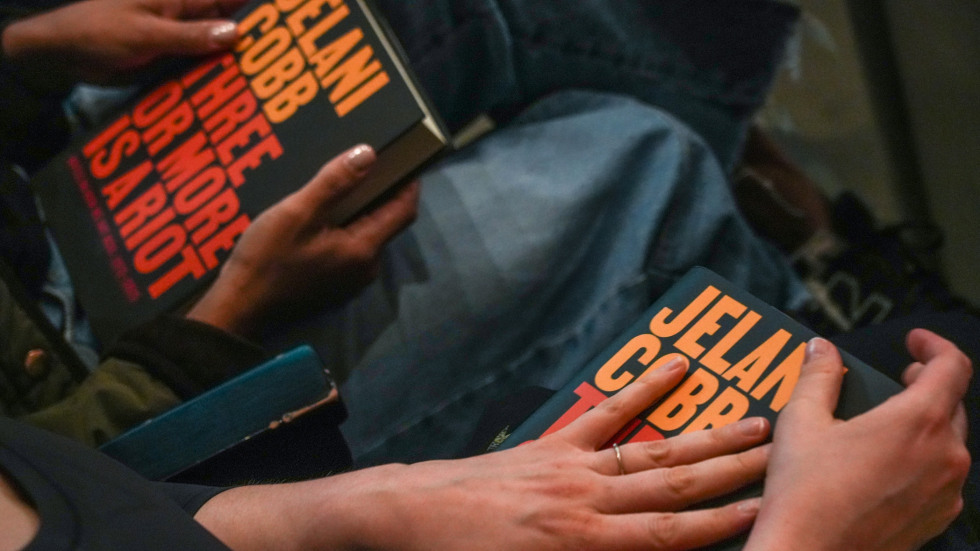
Cobb, who authored the 2025 book “Three or More is a Riot: Notes on How We Got Here, 2012-2025,” urged the audience at Brown to reject those who “seek to reduce social interaction into… behaviors that validate their own cynical presumptions about the world.”
Cobb referenced a 1967 speech that King delivered at Brown University, less than a year before his assassination, that criticized the Vietnam War as a costly and futile war — a position that was considered controversial at the time. King drew connections between militarism and materialism and “began the work of articulating a shared sense of responsibility for each other,” Cobb said.
King “famously said, ‘injustice anywhere is a threat to justice everywhere,’” Cobb said, citing King’s 1963 “Letter from Birmingham Jail.”
Cobb also connected post-Civil War white supremacist ideology to the modern political era, describing the concept where those in power view the loss of exclusive privilege as a form of victimhood.
Cobb pointed to the 2008 election of Barack Obama at U.S. president as a catalyst for a similar modern backlash, noting the so-called birther movement’s false accusations that Obama was not born in the United States as a “serial attempt to delegitimize” the country’s first Black president, he said.
“Thinking begins to take hold that any progress toward inclusion comes at the expense of white people, and this movement, this backlash, just wants to level the playing field,” Cobb said.
Ahead of Cobb's remarks, Matthew Guterl, Brown’s vice president for diversity and inclusion and a professor of Africana studies and American studies, noted the significance of the lecture series’ 30th anniversary this year.
“For three decades, this series has functioned as a cornerstone of our campus life, inviting us to…inhabit … what Dr. King famously calls a ‘fierce urgency,’” said Guterl, who before his remarks led the observation of a moment of silence to honor victims of gun violence in the wake of the tragic act of violence at Brown on Dec. 13, 2025.
Following his formal remarks, Cobb participated in a discussion moderated by Guterl during which he discussed topics ranging from his experiences playing on a multicultural baseball team as a high school student in Queens, New York, to his time in Moscow while on a Fulbright fellowship.
Cobb, who has written about politics, race and history for the New Yorker since 2012, also spoke about the importance of transparency in journalism and of creating a “verifiable record” of history for the public to consult — now and in the future.
“We have the obligation to create that [record] for people who come after us,” Cobb said, “for them to understand what we got right, and for them, in retrospect, to assess what we got wrong.”