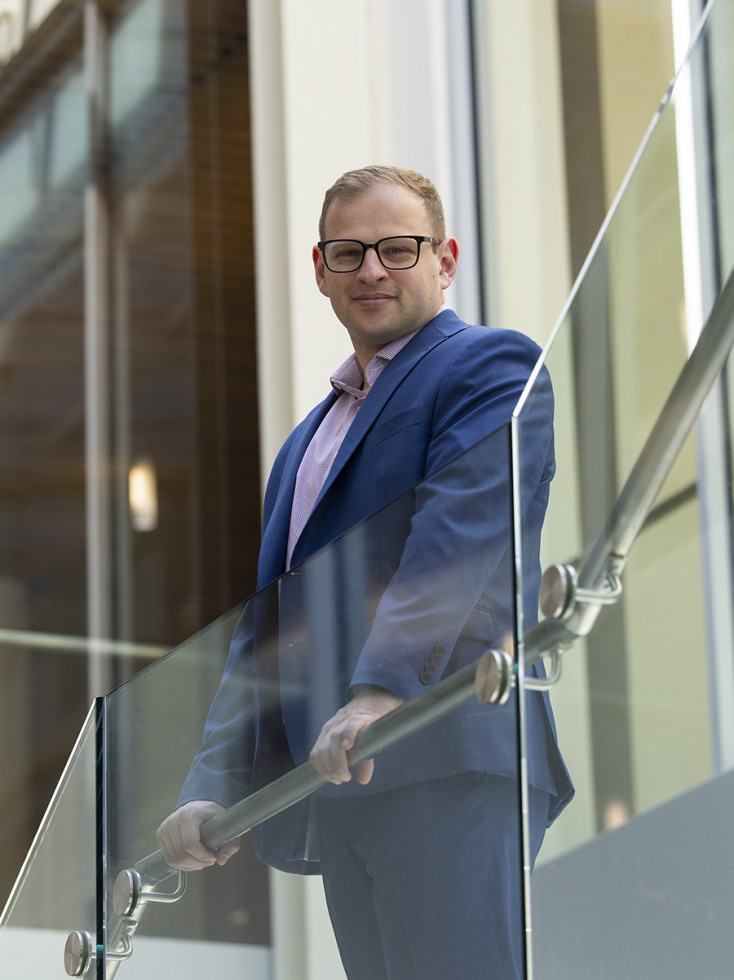
PROVIDENCE, R.I. [Brown University] — When Meylakh Barshay arrived in Providence to attend Brown University’s Warren Alpert Medical School, he had no personal connections and was unsure what medical specialty he would pursue. Four years later, Barshay says he is deeply connected to his peers and the school’s humanistic ethos and is heartbroken to leave.
“I’ve seen the benefit of being involved in the community at the local and state level, and that’s been amazing — something I feel very grateful for,” Barshay said. “So many members of the Brown medical school community are very invested in Rhode Island, and one of the beautiful things about living here is that you can have more of an impact and feel much more connected and grounded.”
As Barshay prepares to receive his M.D. and move to New York City for an emergency medicine residency at Mount Sinai Hospital, he said the support of the Brown medical school community and his experiences in Providence have empowered him to make a difference in both the emergency department and in life. He intends to share that inspiration with peers on Sunday, May 24, during Brown’s Commencement and Reunion Weekend, after his 146 fellow graduates selected him to deliver remarks at the Warren Alpert Medical School ceremony.
Barshay came to Brown after an early career in computer science, bringing a non-traditional perspective to his medical studies. Previously, he worked as director of technology for a nonprofit that allows donors to send money directly to people around the world facing extreme poverty. Though the work was meaningful, the digital distance left him feeling disconnected, and he realized he wanted to transition from purely addressing systemic problems to also helping individuals face-to-face. After studying medicine in a post-baccalaureate program at Georgetown University and working as a medical scribe in an emergency room, he set out to become a physician.
During the medical school interview process, Barshay remembers feeling a connection to Brown’s faculty and students — becoming so enthusiastic about one conversation that he accidentally knocked a painting off the wall. He was then thrilled to learn about Brown’s Primary Care-Population Medicine program, which combines training in doctoring with the systems thinking he enjoyed from his previous career.
“I thought, ‘If that’s how I feel about the community after a few hours, I think this is going to be the right place for me,’” Barshay said. “And the feeling I had that day has been validated a thousand times over. This is a very genuine place — I’ve been a part of many other professional and educational communities, but Brown holds a unique place in my heart.”
Repairing the world
While pursuing his studies, Barshay threw himself into activities. He served as operations director for the Brown Human Rights Asylum Clinic, coordinator for Brown Students at the Bedside and vice president for the Medical Student Senate. He tutored students and served as an ultrasound teaching assistant and a Clinical Skills Clerkship head teaching assistant.
For his master’s thesis, Barshay collaborated with Dr. Jared Anderson, an assistant professor of emergency medicine and clinician educator, to study text message usage in emergency departments. Together, they piloted a text messaging program at Rhode Island Hospital and the Miriam Hospital.
“The gift of having so many opportunities to be involved through the medical school is that you get to work with a lot of different people,” Barshay said. “That's given me the chance to develop close relationships with so many of our classmates.”