Topics
Date June 18, 2026
Media Contact

With college readiness boot camp, veterans and service members take on a new mission at Brown

In partnership with Warrior-Scholar Project, Brown University hosts its fourth cohort of veterans and active-duty service members for a weeklong event designed to support the transition to college life.

PROVIDENCE, R.I. [Brown University] — For some military veterans and active-duty service members considering college, the biggest challenge is not getting admitted — it’s believing that they belong.

For a week in mid-June, 11 Warrior-Scholar Project participants came to Brown University to strengthen confidence and skills and discover their place in higher education.

This summer marks the fourth consecutive year that Brown has partnered with the Warrior-Scholar Project for its College Readiness Boot Camp. Designed to help veterans and active-duty military members prepare for a collegiate academic environment, the program immerses participants in the pace, rigor and expectations of university life while equipping them with tools to succeed in the classroom.

The organization hosts college readiness boot camps on campuses across the country, some with academic themes like business or STEM. While not every participant chooses to apply to attend Brown, the partnership reflects the University’s commitment to supporting military-affiliated students, said Becky Scheusner, the program coordinator for Brown’s Office of Military-Affiliated Students.
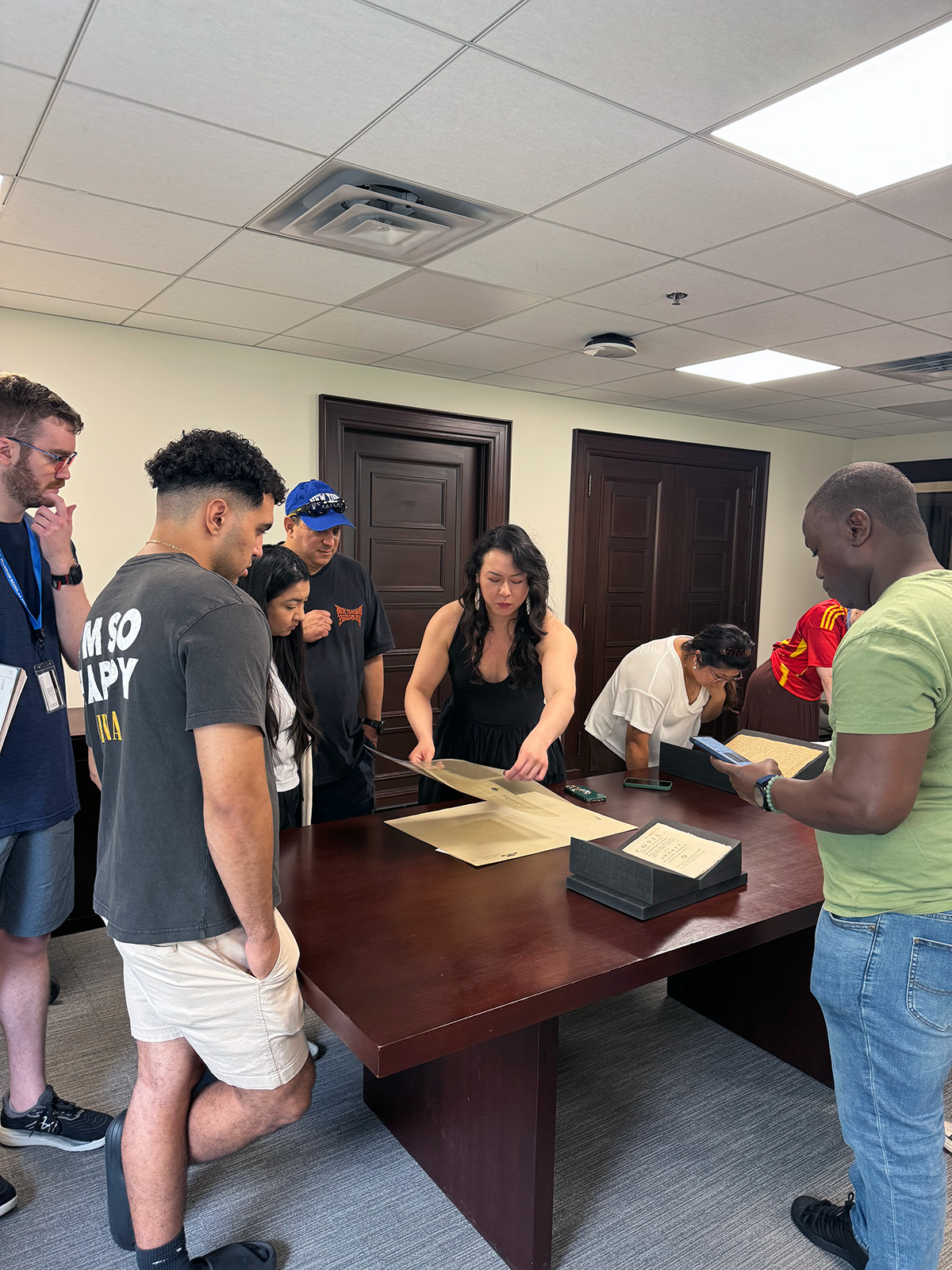
WSP participants examine historical documents
The boot camp seminars cover topics like “The Constitutional Framework,” “The Ideal of American Democracy” and “Contemporary Democratic Citizenship,” led by a mix of Brown University faculty, military fellows and alumni. 

“We’re further establishing ourselves as another place where veterans can feel appreciated and welcomed as scholars,” said Scheusner, a U.S. Navy veteran and Brown alumna. “With Warrior-Scholar Project, the work the participants are doing is very similar to what they would experience in a Brown classroom, where the idea of the Open Curriculum means you can map your desires onto an academic pathway rather than the other way around.”

The program, hosted at the Watson School of International and Public Affairs at Brown from June 13 to 20, is immersing participants in more than 75 hours of coursework designed to simulate the demands of college life. From lessons delivered by Brown faculty and mentorship from student veterans, to one-on-one tutoring sessions and group seminars led by Brown graduate students, Warrior-Scholar Project boot camp participants learn to adjust to concepts and practices that may seem unfamiliar after years spent away from classrooms.

For Brown University junior and U.S.Air Force veteran Cody Bradley, helping others with that transition is deeply personal, having navigated her own path from service to school as a participant in a Warrior-Scholar Project boot camp at Wesleyan University a few years ago. She now serves as a lead fellow for the boot camp at Brown and has seen firsthand how the program inspires others to pursue higher education.

“We give a taste of what academics is like, but it’s not just, ‘Here, take a class,’” she said. “It’s, ‘Here, take a class. Here, take a lab tour. Here are Ph.D. students you can do a research project with, and here’s a professor who will mentor you, and here’s a community that appreciates you.’ They get to actually see themselves as part of the campus.”

The boot camp seminars cover topics like “The Constitutional Framework,” “The Ideal of American Democracy” and “Contemporary Democratic Citizenship,” led by a mix of Brown University faculty, military fellows and alumni. Participants spend mornings in study groups and seminars before transitioning into writing workshops and individualized tutoring sessions led by Brown graduate students.

The work continues long after dinner. Evening workshops focus on practical skills such as time management, study strategies and community building before participants complete writing assignments and reading exercises that often stretch until nearly 11 p.m. With nearly 16 hours of scheduled programming each day, the boot camp is not for the faint of heart. But interspersed throughout the demanding schedule are opportunities to connect with fellow veterans, meet Brown students and staff, and explore campus resources.

“ I found that the biggest challenge for a lot of us is: How do we fit into academia? Warrior-Scholar Project actually showed us it's not about fitting in. It's about taking those skills that we acquired in the military and integrating them into university life. ”

Carla Perez U.S. Army veteran and Warrior-Scholar Project participant

That’s how 22-year-old Army National Guard member Mauricio Velasquez found himself in the John Carter Brown Library, eyes glued to historical documents and artifacts on display as part of the exhibition, “1776 Across the Americas: A Hemispheric History.”

“It’s practically a museum in there, and we had the privilege of listening to the actual experts speak about it all,” Velasquez said. “I felt like a little kid — they were blowing my mind.”

Velasquez said the pace and sheer breadth of the boot camp can be daunting, but that’s exactly what makes the experience so valuable, especially for service members and veterans who plan to go to graduate, law or medical school.

“Those things are going to be hard, so I think it’s important that this is hard, too — so we know that we can overcome it,” he said. “We’ve faced so many challenges before, coming from the military. What’s another one?”

Building the foundation to learn and lead

Hosting the boot camp for the fourth year marks another step Brown has taken to increase support for veterans and active-duty members of the military who are pursuing college degrees. In recent years, the University has more than doubled its enrollment of student veterans; permanently funded full scholarships for undergraduate student veterans; significantly expanded financial aid for student veterans pursuing graduate degrees; established the Cisneros Veterans Scholars Program and expanded and upgraded the Office of Military-Affiliated Students’ home on campus.

Schuesner, who first came to Brown as a student veteran before graduating and returning to work in the Office of Military-Affiliated Students, said those changes represent a cultural shift as much as an institutional one.

"You can’t build something like that if people don’t feel welcome, don’t feel supported and don’t feel like they can succeed," Scheusner said. "It feels so cool to have seen both sides of this transition, first as a veteran and student, and then coming back as a staff member and continuing to work with these students. It’s really a full-circle process."

The University’s continued investment reflects the success of programs like Warrior-Scholar Project and the remarkable outcomes they help enable.

More than 80% of Warrior-Scholar Project alumni have completed or are on track to earn a college degree, compared to 47% of the general population of veterans using the Post-9/11 GI Bill who did not enroll in the Warrior-Scholar Project, according to its leaders. In 2025, 60% of its participants were first-generation college students, reflecting the program’s reach among those navigating higher education for the first time.

For 34-year-old Carla Perez, college had always been in the back of her mind. But when it was time to graduate high school in Brownsville, Texas, joining the military was the challenge she felt called to face.

“Everyone was talking about what university they were going to, and I was like, ‘I’m waiting on orders,’” the U.S. Army veteran said. “As the years went on, I was wanting more growth in a different way. I was definitely seeking that intellectual challenge.”

After serving four years providing communications support for overseas military operations, Perez eventually enrolled at the University of Texas Rio Grande Valley, where she discovered a passion for English and is currently pursuing a bachelor’s degree. Through the boot camp at Brown, she found a community of peers navigating similar transitions.

“I found that the biggest challenge for a lot of us is: How do we fit into academia? Do we really have what it takes?” Perez said. “Warrior-Scholar Project actually showed us it’s not about fitting in — it’s about taking those skills that we acquired in the military and integrating them into university life and the classroom with our civilian counterparts.”Velasquez shared similar doubts before enrolling in the program. He had taken some courses at community college and didn’t particularly enjoy the experience. Continuing his education wasn’t at the top of his mind, until a pre-deployment conversation with his uncle made something click. Velasquez learned that his uncle, a Marine Corps veteran, had participated in a similar veteran-focused academic program before eventually attending Harvard University.

“I looked at his upbringing and my upbringing and saw how similar they were,” Velasquez said. “I thought, if my uncle can go to a school like Harvard, maybe I can, too.”

Velasquez, who is now preparing to begin his studies at the U.S. Military Academy in West Point, said that through his service, he saw that education was the most critical way to empower himself and put himself in a better position to lead.

“I saw how some of my role models had used education to transform their lives,” he said.

For Bradley, the veteran who is enrolled at Brown, those aspirations are what makes Warrior-Scholar Project so impactful.

“That’s really what makes this a special place for the participants,” she said. “Their drive for getting back into, or continuing, their education is a constant.”

That sense of purpose extends beyond the participants themselves. The Brown community members who have a hand in coordinating the boot camp, from program administrators and faculty members to graduate students and peer mentors, choose to participate year after year.

“They’re all people who have gone through the same experiences and processes and just want to give back,” Bradley said. “It’s not an easy job, but it’s a job that you come back to because you believe in it.”