Date July 30, 2026
Media Contact

Staff Spotlight: Through dedication and attention to detail, Leo Eastman cares for Brown’s campus

During a 33-year career at Brown University, the custodian has poured his energy and skills into his work while creating meaningful connections with generations of students, staff and faculty.

PROVIDENCE, R.I. [Brown University] — In 33 years as a custodian at Brown University, Leo Eastman guesses he has worked in just about every building on campus — and he knows for sure that he has made countless connections with the generations of people who have learned, taught, studied and moved through those spaces.
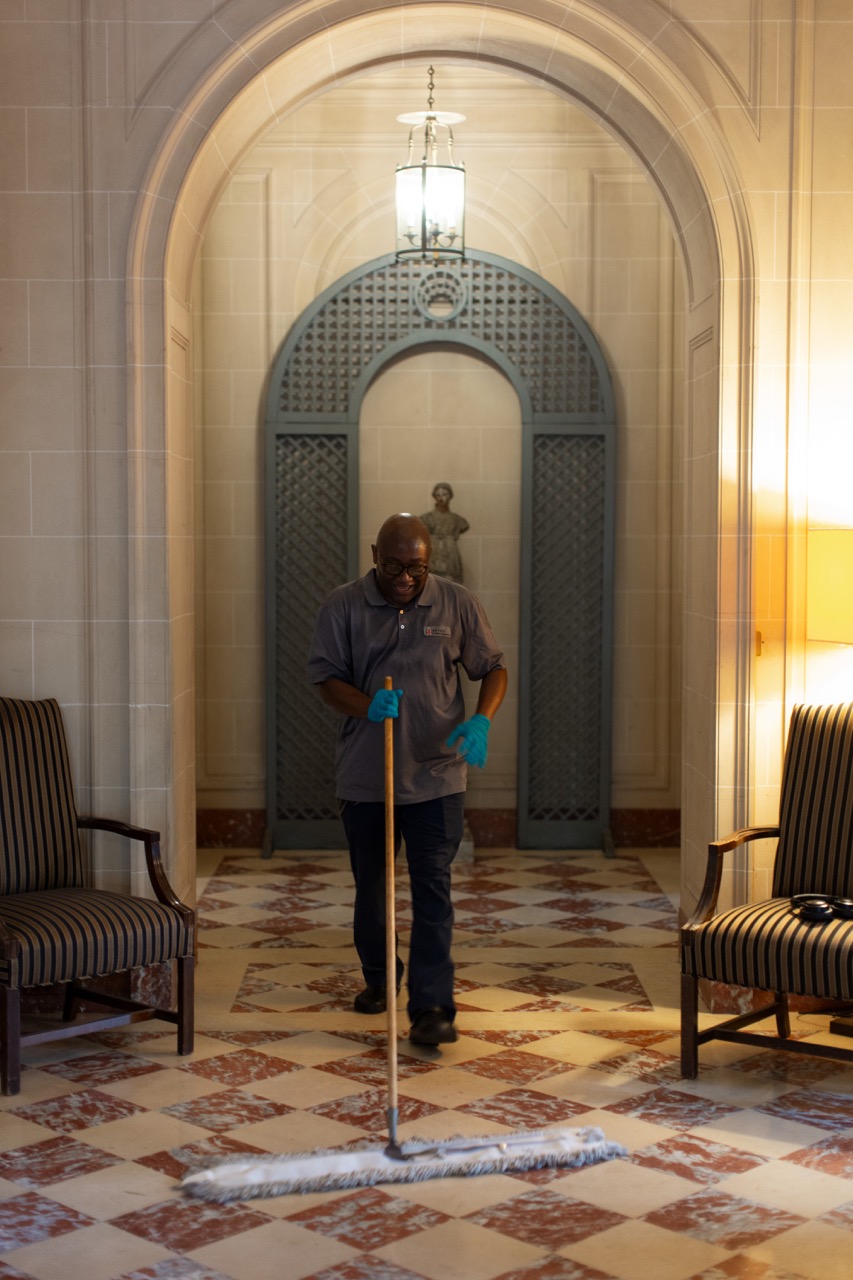
For more than three decades, Leo Eastman has meticulously stewarded Rochambeau House and its delicate furnishings. Photo by Nick Dentamaro/Brown University

In his chief role as custodian and caretaker of Rochambeau House, Eastman has meticulously stewarded the home of Brown’s French and Francophone studies and Hispanic studies departments since 1993. He cares for the century-old 20,000-square-foot building filled with ornate fixtures and delicate furnishings that was once the home of Brown Chancellor Henry D. Sharpe and his wife, Mary Elizabeth, which they designed in the style of an 18th-century French chateau.

In the decades since he first came to Brown as a temporary employee, Eastman has built a career and left an indelible mark on Rochambeau House and beyond, so much so that he won Brown’s Excellence Award for Citizenship in Spring 2026 for his contributions to the University.

“He is eager to make people feel welcomed, always greeting them with a smile, a kind word or a fun story,” Eastman’s colleagues wrote in his award nomination. “He leads with warmth and compassion and passes along stories of both the University’s history and his life with enormous affection and pride… One of the greatest testaments to Leo’s exceptional work and dedication to the people around him comes from how often alumni and former employees ask about him when they visit.”

In this Q&A, Eastman reflects on his path from Liberia to Rhode Island, his career, and the connections at Brown that have sustained and enhanced his work and life.

Q: Where are you from originally, and what was your path to Brown?

I was born in Liberia, and then I came to the United States in 1984, and I went to Saint Augustine’s College in North Carolina. There was an uprising in Liberia so I couldn’t go back, so I moved to Florida. And from Florida, I came here, and I started at Brown in March of 1993. I had some family members who worked at Brown at the time, and they recommended Brown to me, and I started off as a temp.

Q: What was your first impression of the University?

Before Brown, I worked as a cleaner, I did some bartending and restaurant work, which also involved cleaning, but this was fairly new to me. I was nervous my first day, but one of the things that made me feel comfortable is the people in this building. The chair of the French department told me, “You look nervous, but don’t worry, just take your time.” As the year progressed and the longer I stayed on the job, the more I got to know how to do it. I was hired full-time six or seven months later. So it was the people — back then, and in this building now — who made me feel comfortable.

I’ve been here so long because I am so appreciative to Brown for all that they have done for me and all that they continue to do for me... I put in 150% to the job based on all those things that Brown brought to life for [my family].

Leo Eastman Brown University custodian
 
Leo Eastman

Q: What has your employment at Brown meant to you in terms of your ability to build a life outside of Brown? 

I live in Providence. I have a wife, three daughters, and friends and family here. The Tuition Aid Program [at Brown, which provides eligible faculty and staff with financial assistance toward undergraduate tuition costs for their children] is one of the best programs that this University offers. With support from the program, all of my daughters graduated from college, and I must say thanks to Brown — it was huge. I did my research and not too many employers will do that, pay the tuition for your kids to go to college. My oldest is a nurse practitioner, my middle daughter is a cosmetologist, and the youngest is in the military in the Army.

I’ve been here so long because I am so appreciative to Brown for all that they have done for me and all that they continue to do for me: the healthcare, the pension, and the benefits that Brown provides for employees. I put in 150% to the job based on all those things that Brown brought to life for us.

Q: In addition to Rochambeau House, do you have a favorite place on campus?

Well, besides Rochambeau and doing my regular assignment, I work with Athletics a lot. I work a lot during football, basketball, hockey, lacrosse and soccer season, doing overtime on the weekend during the sports season. That’s another place that I love working because you get to interact with the people and the student-athletes.

Q: What is your favorite part about supporting the Brown community?

We’re here to give support to faculty and staff, and especially the students. The students are very appreciative. They’ll say, “Thank you, Leo,” and some students even offer to help me. I say, “No, no, I got it.” Some people may not know that because they don’t interact with students like that, but they really appreciate what we do.

Q: What do you do outside of Brown?

I spend a lot of time at Brown. But when I’m not at Brown, I do a lot of walking. 

Q: What is a typical day for you?

I’m at Rochambeau House Monday to Friday, but I take overtime on Saturdays and Sundays. That’s when I spend a lot of time at Athletics and working at functions and parties on campus. There might be a basketball game or a soccer game during the day, and then you also have an event at Alumnae Hall or Sidney Frank or Page-Robinson. I help out in other places, like preparing the dorms for Pre-College. I think I have worked in about 95% of the buildings on campus.

Q: What do you like most about working at Brown?

The colleagues and faculty, and especially the students — the camaraderie that we have, working together along with facilities. I think that’s the most important thing, to have that understanding between you and who you support. I like to make sure people feel comfortable and happy.

I always like to mentor the younger people, too. I tell them, “The best of your ability is what people see in your work that you do. And if you do a good job, people can see it, and they will appreciate you for that.”

Q: What was your reaction to receiving the Excellence Award for Citizenship?

I’m not a limelight person. I don’t like to boast or take the credit. If you say “thank you,” that’s enough, I appreciate it, so when I saw this, I couldn’t believe it. It took me two days to really believe it, and leading up to the event itself in March, I was telling the staff, “This is so surreal.” There are many people who deserve to be recognized.

My wife made an estimate of the amount of time I have actually spent at Brown over the last 33 years, and it’s a lot. She just wanted to bring it to my attention and show me, “Leo, I think you deserve this.” I always work to the best of my ability, and I think that led me to winning the Excellence Award for Citizenship.

Q: What’s something people should know about working at Brown?

It’s an excellent place to work and it’s one of the best schools on the planet. The Brown community is so great, such a nice community — the students, the professors, the staff. I would recommend it to anyone.