PROVIDENCE, R.I. [Brown University] — Constructed in 1854, the Italianate Horace Mann House on Brown University’s campus has experienced 172 years of reinvention and reuse, from its origin as a luxury apartment building to a recent role housing offices for Brown’s Graduate School leaders.
It has now entered a new chapter as the home of the University’s Department of Classics, which provides instruction and conducts research on languages, literatures and cultures of ancient Greece and Rome, from their origins through the medieval and Byzantine periods, as well as in Sanskrit and Modern Greek.
Over several months, Brown’s Facilities and Campus Operations team refreshed the four-story brick building on George Street with renovations and upgrades that preserved its historical character and readied it for the needs of one of Brown’s oldest academic departments. Faculty and staff from classics moved in before the start of the fall semester.
Joseph Pucci, chair of the department, said the move to Horace Mann House has been beneficial. For years, the department’s faculty offices had been housed in three separate locations across campus, and now faculty are all united at Horace Mann. The upgraded building also has a seminar room where classes meet, two comfortable study lounges — one for graduate students and one for undergraduates — and a 5,000-volume classics library on its lower level.
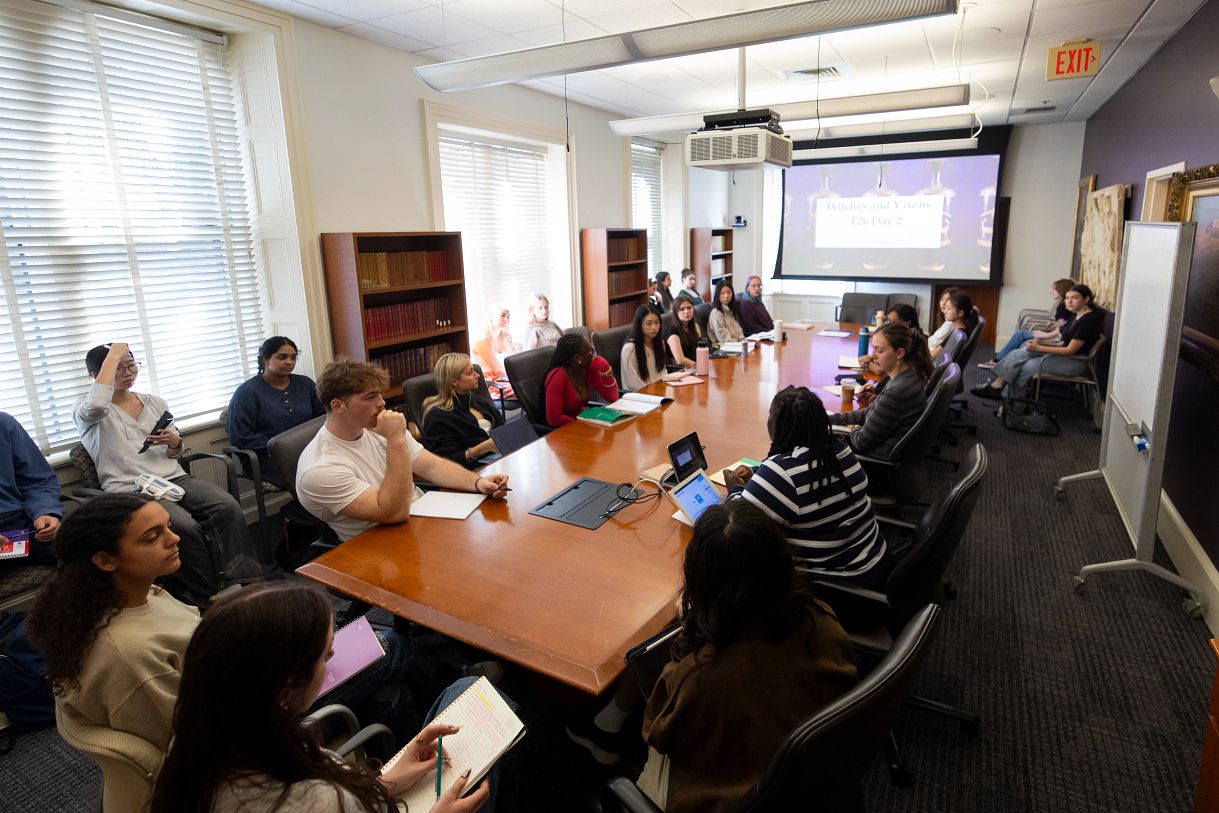
“We now have this beautiful space, a state-of-the-art facility that will take classics forward potentially through the end of this century,” said Pucci, a professor of classics.
Pucci noted that the Horace Mann House is near Wilbour Hall, home of the Department of Egyptology and Assyriology, and Rhode Island Hall, which houses the Joukowsky Institute for Archaeology and the Ancient World and the Center for Global Antiquity.
“We have formed a quadrangle devoted to ancient materials,” he said.
Pucci said he expects that the newly centralized location for the department will inspire enhanced collaboration among its scholars and students, as well as with scholars from affiliated departments.
“It’s conducive to building community,” he said. “Everyone is here together: faculty, staff, postdocs, graduate students and undergraduates.”
The renovations and upgrades, which balanced measures to preserve historic elements with 21st-century academic needs, included interior repairs, painting, carpet replacement and furniture modifications and replacement, according to Yi Vizard, a project manager in Facilities and Campus Operations who oversaw the project. The building has many distinctive features, including a warm masonry façade, steeply pitched gables, a decorative roofline and arched windows that would be difficult to reproduce in a new building, she said.
The design and construction team needed to understand which architectural features were essential to the building’s character, and then carefully integrate updated systems, finishes, accessibility improvements and departmental needs without compromising those features, Vizard said.
“That balance shaped the design approach,” Vizard said. “Instead of attempting to make Horace Mann feel new, the project preserves the qualities that make it memorable, while introducing the improvements needed for its next chapter. The result is intended to let the building’s history remain present while allowing the classics department to use it as an active, functional departmental home.”