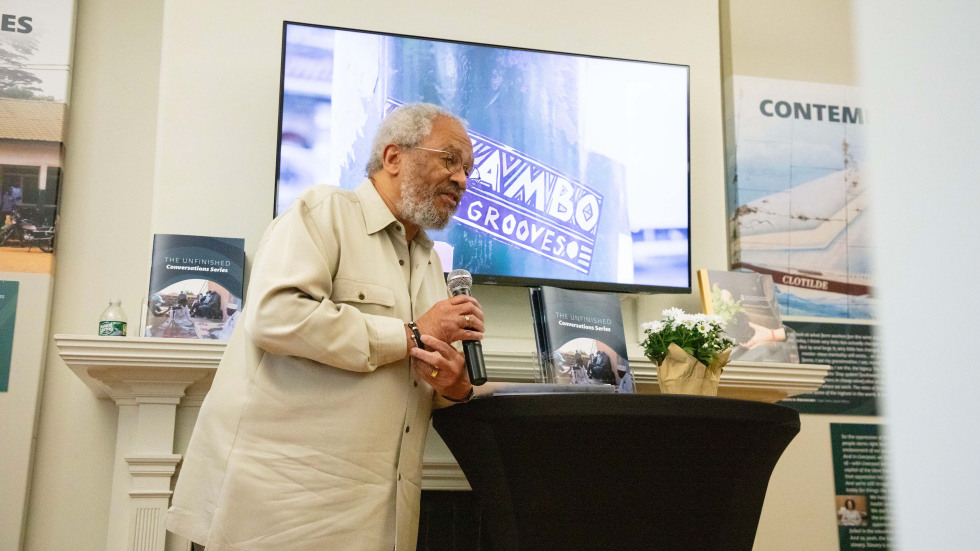
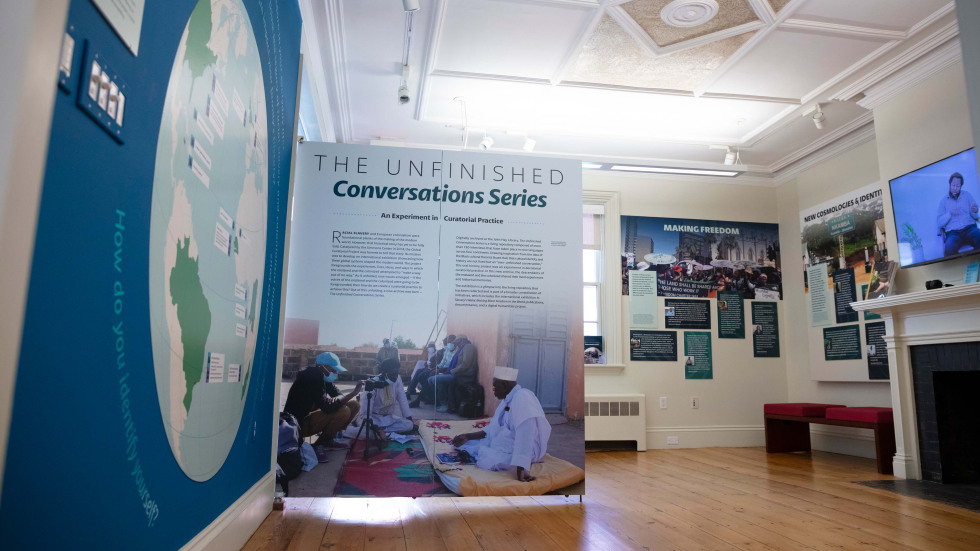
PROVIDENCE, R.I. [Brown University] — An exhibition about “Unfinished Conversations,” an oral history project led by Brown University’s Ruth J. Simmons Center for the Study of Slavery and Justice, is on view in Rio de Janeiro, Brazil, as part of a series of events in the city about the legacies of global slavery.
The exhibition at the Instituto Pretos Novos through Monday, Dec. 15, is an adaptation of one currently on view at the Simmons Center on Brown’s campus. Both were curated by Brown University Ph.D. candidate Yannick Etoundi under the direction of Simmons Center Director Anthony Bogues to offer an accessible entry point into the multifaceted oral history and public engagement project.
“‘Unfinished Conversations’ tells the global story of how racial slavery and European colonialism were the foundational planks of the making of the modern world,” said Bogues, a professor of Africana studies at Brown.
As part of “Unfinished Conversations,” researchers from across the world, led by the Simmons Center, collected more than 150 oral histories about individuals’ experiences with the legacies of racial slavery and colonialism — an archive now available to the public through the Brown Digital Repository. Multiple Brown students, including Etoundi, were involved in revising, editing and summarizing transcripts for the archive.
The work stemmed from the Global Curatorial Project, which was formed in 2014 when the Simmons Center invited scholars from global museums to come together to address the topics of racial slavery, colonialism and public history.
In addition to the exhibit at the Instituto Pretos Novos, a traveling version of another exhibition co-curated by the Simmons Center, “In Slavery’s Wake”— which premiered at the Smithsonian in Washington, D.C., in 2024 — has opened at Brazil’s national history museum in Rio de Janeiro. Translated from Portuguese as “Beyond Slavery: Building Black Freedom in the World,” it is on view at the Museu Historico Nacional through March 1, 2026, and integrates the oral histories collected as part of the “Unfinished Conversations” series.
Bogues said “In Slavery’s Wake” sparked the creation of exhibitions and events across the city organized by Global Curatorial Partners Keila Grinberg and Aline Montenegro Magalhães.
After it closes in Rio de Janeiro, “In Slavery’s Wake” is expected to travel to South Africa in May 2026.
“The exhibitions are catalytic instruments that open the space for dialogue between countries, between museums, between scholars and between ordinary people who would not otherwise be engaging in this kind of dialogue about racial slavery and colonialism,” Bogues said.
Sharing untold stories with global audiences
The exhibition on Brown’s campus, “The Unfinished Conversations Series Exhibition,” is on view through Friday, Dec 12, and focuses on the themes and curatorial process associated with the oral history project. It was adapted for the Instituto Pretos Novos and translated into Portuguese.