Date January 29, 2026
Media Contact

Exhibition of drawings by Israeli and Palestinian children is on view at Brown

“Innocent Knowledge,” a project developed in a public humanities course at Brown, shares the perspectives of children living amid conflict through their drawings, and is on view at the University through Feb. 20.

PROVIDENCE, R.I. [Brown University] — Flowers blooming next to tanks. Demolished houses beneath shining suns. People hugging as missiles fill the sky.

Those are among the images depicted in crayons, markers and colored pencils by nearly 400 children from 15 communities across Israel, the West Bank and Gaza who were invited to submit artwork for the “Innocent Knowledge” project, which originated in a Fall 2024 course at Brown called Israel-Palestine: Public Humanities.

A selection of 62 drawings from the project, collected between October 2024 and June 2025, is on view through Feb. 20 at Brown’s Ruth J. Simmons Center for the Study of Slavery and Justice. First shown last fall at Central Synagogue in New York, the exhibition is free and open to the public, but reservations are required.   

“We are hoping not only to engage the Brown community but also to bring in the larger public, as this exhibition can be of interest to anyone who is concerned about what happens in the Middle East — no matter their personal views or identities — and how it impacts our community here in the U.S. and in Rhode Island,” said Katharina Galor, an associate teaching professor of Judaic studies, who co-curated the exhibition with undergraduates Canaan Estes and Taher Vahanvaty.

The students in Galor’s course, including Estes and Vahanvaty, were assigned to come up with a proposal for a project about Israeli-Palestinian relations that was scholarly in nature but also broadly accessible.  
When Estes first conceived of the idea — inspired by the book “I Never Saw Another Butterfly,” which shares children’s drawings from the Terezín concentration camp during the Holocaust — it was meant to be a proposal only, but enthusiasm for it in Galor’s class quickly grew, and she and many of the students in the class were inspired to make it a reality. Throughout the semester, Galor, Estes, Vahanvaty and others reached out to a range of communities to invite submissions of artwork from children ages 5 to 14. They were invited to draw anything, specifically focusing on family, home or something from the past year.

The resulting exhibition and project website includes digital images of the drawings, as the originals remained with the children who created them. To preserve anonymity, they are presented without the creators’ names and are organized according to six themes, including “Family and Home,” “Violence and Loss,” and “Hope and Identity,” rather than by geographic origin or religious identity.

Katharina Galor
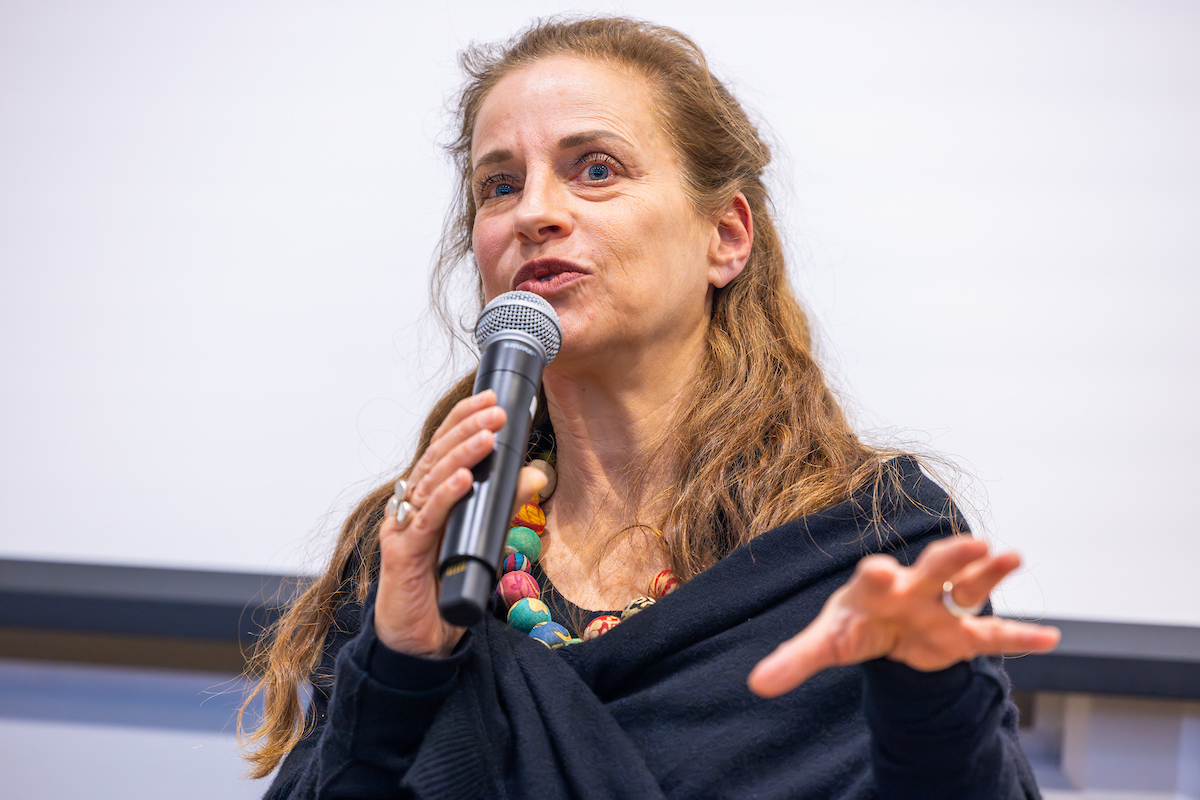
“Innocent Knowledge” co-curator Katharina Galor.

“Each drawing, created by children who are living under very different conditions, speaks from a world marked by violence, rupture and displacement, but also by memory, endurance and the instinct to make meaning,” Galor said.

Viewers can learn about individual works and represented communities by scanning QR codes on the exhibition space walls to access the project’s website, available in English, Arabic and Hebrew. Taking in the images without context can also be a powerful experience, Galor said.

“We can look at the images created by children in this distinct geography as direct testimony of what happens in their lives,” Galor said. “Of course, we can contextualize and examine these drawings as scholars using different disciplines, from psychology to human rights to law and political science, but we can also engage with these images at a much simpler level and just let them speak to us.”

The Simmons Center convened a panel discussion about the project on Wednesday, Jan. 28, and an opening reception and concert, rescheduled due to snow, will be held on Sunday, Feb. 8 from 2 to 4 p.m. at the Simmons Center. Advance registration is required