For Brown’s student-athletes, Bruno Cares redefines what it means to be a supportive teammate
Now in its third year, the peer-to-peer mental health initiative equips Brown University student-athletes with the tools to recognize warning signs of distress and respond with care, confidence and action.
Sports Psychologist Brittan Davis leads a training session for the Bruno Cares Spring 2026 cohort. Since its launch in Fall 2023, the program has trained more than 70 student-athletes, coaches and staff. All photos courtesy of Brown University Department of Athletics and Recreation.
PROVIDENCE, R.I. [Brown University] — Amiya Hopkins remembers how hard it was to watch one of her close friends struggle with her mental health.
“She didn’t want to eat, sleep, go to class… it seemed like every time I came into the room, she was in the same place,” said Hopkins, a Brown University junior on the women’s track and field team. “It hurt to see someone I cared so much about in that way.”
Drawing on the training she received as a member of Bruno Cares, a peer-to-peer mental-health support training program available to student-athletes at Brown, Hopkins acknowledged her friend’s feelings and invited her for a walk in the sunshine or a quick lunch together. Her friend said she “just couldn’t,” so Hopkins called her friend’s trusted mentor from the Brown Athletics staff, who agreed to meet and walk together to an appointment with Brown’s Counseling and Psychological Services.
“Since then, she’s been using the resources available to her,” Hopkins said. “Without Bruno Cares, I wouldn’t have had the knowledge to know what to do in that situation and how to help pull her out of a dark place.”
Bruno Cares was built for moments like these, in which a peer rather than a professional may be the first line of support. Now in its third year, the cohort-based program facilitated by the Department of Athletics and Recreation equips students with practical tools to recognize distress, respond effectively, and connect friends and teammates with professional resources before situations escalate.
“Before, I thought support just looked like giving someone a hug or telling them that everything’s going to be OK,” said Hopkins, who completed the program last spring. “Bruno Cares made me realize it’s so much deeper than that.”
1of3
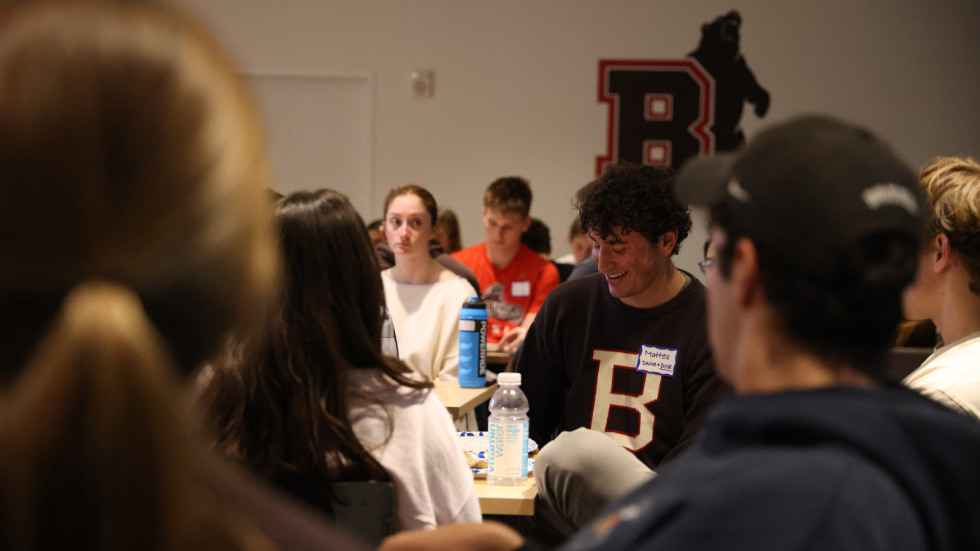
Matteo Vasiliadis, a junior on the men’s swimming and diving team, attends a Bruno Cares training session.
2of3
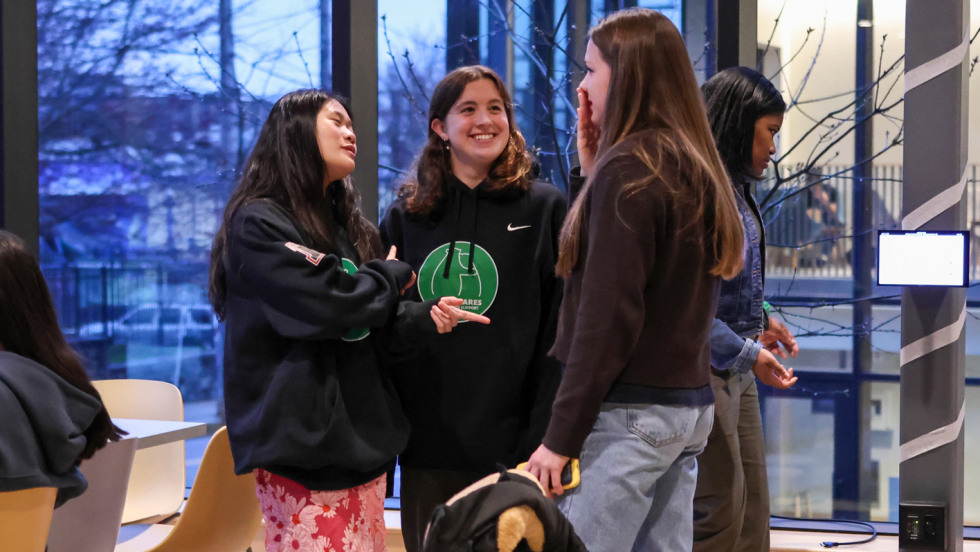
Bruno Cares equips students with practical tools to recognize distress, respond effectively, and connect friends and teammates with professional resources before situations escalate.
3of3
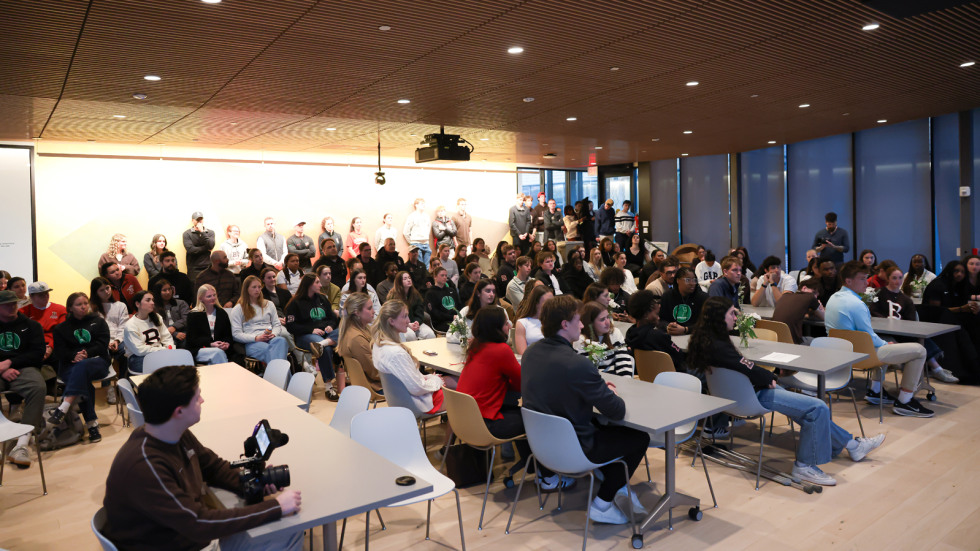
Friends, mentors, coaches and Athletics staff gathered in early April to cheer on 26 newly minted teammates and trained partners at a Bruno Cares graduation ceremony.
Bruno Cares augments a comprehensive ecosystem of support for student-athletes at Brown that includes expert staff in sports psychology, nutrition and medicine, and a wide range of resources for everything from sleep hygiene to injury prevention to mindfulness. It reflects Brown’s innovative approach to student-athlete well-being, which is anchored in personal growth and leadership development, said Sports Psychologist Brittan Davis, who holds a dual role with Athletics and Counseling and Psychological Services, and helped develop the Bruno Cares training.
“I think mental health is still seen as something to be diagnosed, rather than something that we invest in to enhance performance and our lives,” Davis said. “The approach behind this program is the latter.”
Building a peer-to-peer model
The seeds of Bruno Cares were planted years ago, when Assistant Director of Athletics Victoria Mealer-Flowers and Senior Athletic Trainer Emily Burmeister attended a conference that underscored the need for more intentional, structured mental health support within collegiate athletics programs.
When they returned to campus, Burmeister began outlining a peer support model while Mealer-Flowers launched a student-athlete mental health affinity group. But both recognized the importance of building an formal program with a trained clinician. In 2023, Davis partnered with the group to develop the curriculum.
Bruno Cares is overseen by Athletics staff and supported by a growing network of student-athletes.
We’re not just teaching them how to be good students and athletes; we’re teaching them how to be good people. We want to make sure that, in every way possible, we’re educating them and supporting their growth.
Victoria Mealer-Flowers
Assistant Director of Athletics
“We know that if student-athletes need additional help or support, they’re going to go to their friends and teammates first,” Mealer-Flowers said.
This approach is key for student-athletes, where societal norms often emphasize endurance: pushing through pain, ignoring discomfort and negative emotions to prioritize performance above all else.
“It’s hard sometimes to find community, because there is an expectation that in order to be a strong athlete, you also have to be mentally strong,” Davis said. “Oftentimes they may be not yet willing to ask for help.”
Just like a sports injury receives treatment and therapy, so should depression, anxiety and other mental health needs, Davis said.
“What if we had [many] student-athletes who all had torn ACLs at one time?” Davis said. “We’d be building out athletic training departments before we even thought about the idea of performance. That’s what we’re trying to do with mental health and with programs like Bruno Cares.”
Since Fall 2023, the program has trained more than 70 student-athletes in six cohorts, whose members are known as “teammates.” After success with students, the program was adapted and expanded last year to coaches and staff, referred to as “trained partners.” Bruno Cares teammates meet for training sessions over four weeks, in which they learn to recognize warning signs, respond to crises and guide peers toward professional resources and support systems.
Students who have completed the program are known as teammates and are identifiable on campus by Bruno Cares gear like shirts and buttons, making them a reliable, easily approachable point of contact for peers seeking support.
Some of the training exercises can have a light-hearted feel, but they’re critical to successful intervention down the line, said Danny Thompson, a junior and offensive lineman on Brown’s football team.
“You’re with new people, laughing, feeling a little bit awkward role-playing a scenario with someone you just met,” Thompson said. “But when you’re actually in those situations, you lean on your training. Having already practiced it, you go, ‘OK, I know the first couple of words of what I’m going to say, and we’ll go from there’ — that’s what’s been so valuable.”
The work of a Bruno Cares teammate isn’t over once they complete training. They continue their involvement through biweekly check-ins and additional ad hoc trainings and contribute to campus-wide programming.
They’re also identifiable on campus through Bruno Cares gear like shirts and buttons, making them a reliable, easily approachable point of contact for peers seeking support.
“The amount of time they put into this is so impressive,” Mealer-Flowers said. “It’s one thing for us as staff, but for the students who are already training, traveling, studying, and then also giving us their nights and weekends at times — it’s beautiful.”
Creating community beyond moments of crisis
For Hogan Vivier, an assistant coach for women’s soccer and a Class of 2016 graduate who played soccer at Brown, her participation in Bruno Cares as a trained partner was a “full circle” moment.
“The big reason I got into college coaching was because I wanted to be able to continue to build and improve on the experience that I had,” Vivier said at this semester’s Bruno Cares completion ceremony in April. “It was my dream to end up at Brown… To grow in this space and be part of this program has been really inspiring and makes me feel even more proud to be back at Brown.”
Bruno Cares has been equally transformative for students, empowering them to identify gaps in support on their own teams and create opportunities to address them. Thompson joined Bruno Cares as a sophomore. Halfway through his training, he “completely blew up” his knee and required reconstructive surgery.
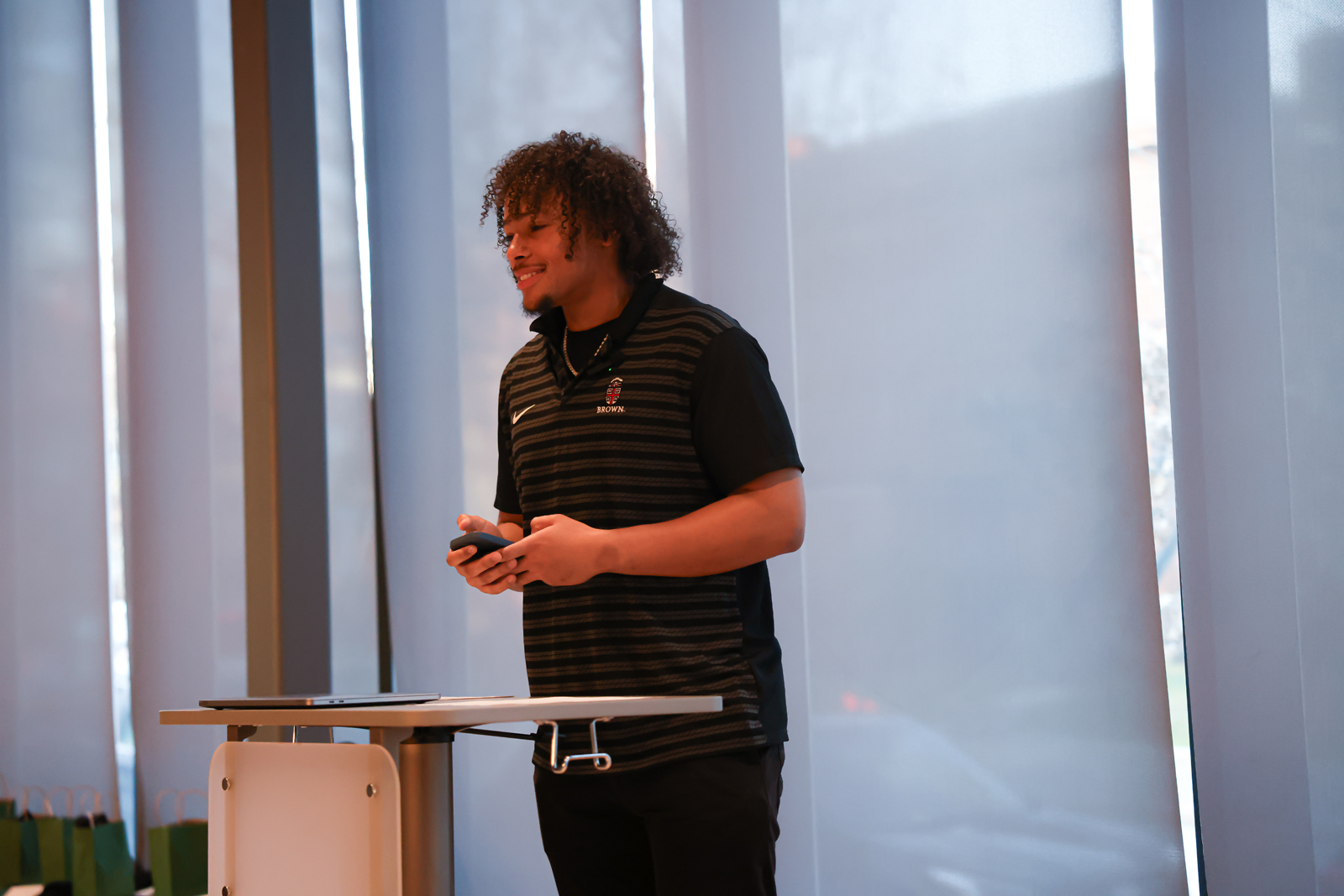
First-year student Hawk Okpokwasili, a linebacker on the football team, speaks about the motivation behind participating in Bruno Cares at the program’s graduation ceremony in April.
“But I truly believe that injury was the best thing that’s ever happened to me in terms of my athletics, leadership and mental health,” Thompson said. “Being part of Bruno Cares, I learned to flip it from ‘Wow, this is a really negative thing,’ to ‘I can grow from this and help give back to people going through negative things, too.’”
He started with his male friends.
“I noticed that whenever I talk to my guy friends and ask them how they’re doing, it’s always these one-word answers,” Thompson said. “I could see someone having the worst day of their life and they’d tell me, ‘I’m fine,’ and that’s that.”
As Thompson encouraged friends to open up, others began approaching him. Some were struggling and wanted to talk but were afraid of other people finding out. Some said they’d never met anyone going through what they were and felt alone in the struggles.
With the help of Bruno Cares leaders, Thompson started a men’s mental health group for student-athletes earlier this year. The peer group meets regularly to discuss whatever is on their minds, from debunking the “strong, silent male” stereotype in sports to how they were impacted by the Dec. 13 shooting at Brown.
Thompson was worried that no one would show up, let alone talk in front of a group.
“The buy-in has been incredible,” he said. “That first meeting, we had guys in tears, pouring out their hearts, sharing their stories and showing incredible courage in being vulnerable right off the bat. I think it just shows how important and necessary this is.”
Similarly, her experience as a Bruno Cares teammate inspired junior Ashley Paturzo, a member of the field hockey team, to establish a support group for injured and recovering student-athletes.
“ After going through Bruno Cares, I’ve realized that my value on the team is so much more than being ‘just’ an athlete.
”
Ashley Paturzo
Class of 2027, Women's Field Hockey
“As athletes, going through an injury can really challenge your identity,” she said. “It makes it a bit easier to be around people going through the same thing, who recognize how hard it is when you’re stripped of something you used to do every single day.”
These groups operate within the broader Bruno Cares framework, reinforcing its central idea that support isn’t one-size-fits-all. For Paturzo, it’s also reshaped how she sees her role on the team.
“Initially, the thought of showing up for my team felt like I have to perform my absolute best every single week, every single practice, every single strength and conditioning session, so I can help everyone else around me,” Paturzo said. “After going through Bruno Cares, I’ve realized that my value on the team is so much more than being ‘just’ an athlete.”
As Bruno Cares grows, its leaders are focused on deepening its reach by expanding trainings for coaches and staff, increasing representation across Brown’s 34 varsity teams, offering advanced education for participants and strengthening collaborations with other offices and groups across campus.
But at its core, the program’s mission remains simple: to provide students with skills that will serve them well now and into their lives beyond Brown.
“We’re not just teaching them how to be good students and athletes; we’re teaching them how to be good people,” Mealer-Flowers said. “We want to give them the ability to roll with all the punches that life will throw at them. We want to make sure that, in every way possible, we’re educating them and supporting their growth.”
After a week of welcomes at Brown’s student dormitories and a wide range of events to build connections among new students, the buzz on College Hill is back as the 2026-27 academic year gets underway.
Five of Brown’s newest students discussed their academic ambitions, from medical research to music, what drew them to College Hill and their hopes for the four years ahead.
Supported by a U.S. Department of State scholarship, the Brown University doctoral student is spending the summer in Taiwan, sharpening his Mandarin skills to advance research on Indigenous language revitalization.