Exceptional students from across the spectrum of the Brown educational experience are embracing unique opportunities to advance knowledge and make an impact through research, community engagement, entrepreneurship and more.
Rishika Kartik: Advancing accessibility through a blend of science, art and advocacy
Through a self-designed independent concentration, the Brown University senior has used art and design to expand agency, dignity and representation for people with disabilities.
1of3
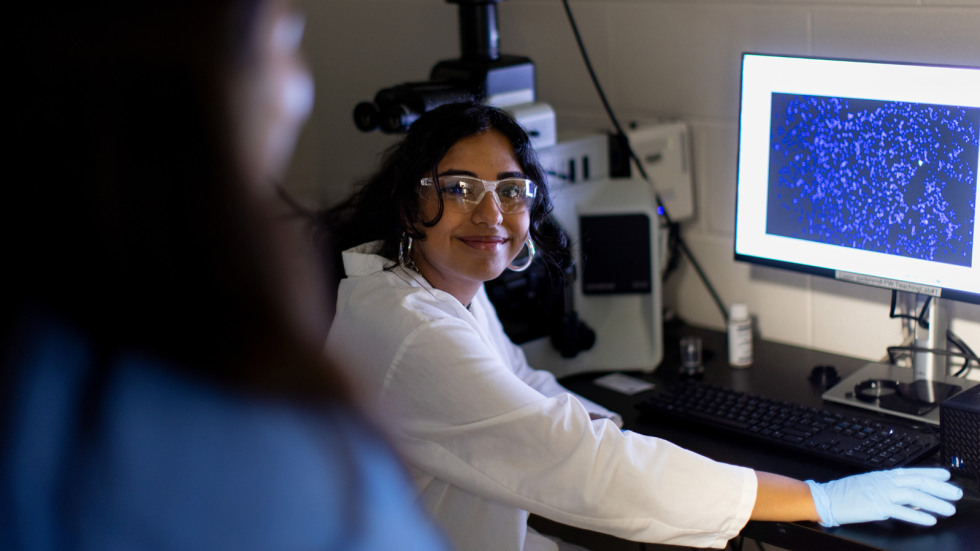
Brown University senior Rishika Kartik views dyed cells under a microscope during a course led by Chuck Toth, director of Brown’s Multi-Disciplinary Laboratories. As part of her work in the course, Kartik is co-leading a mural project at Butler Hospital’s Memory and Aging Program. All photos by Nick Dentamaro/Brown University
2of3
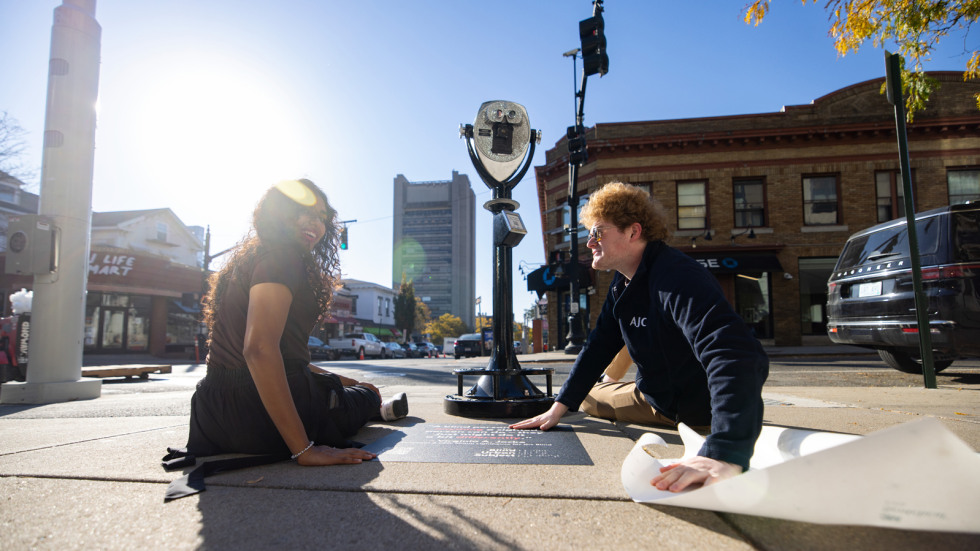
Rishika Kartik and fellow senior Daniel Solomon worked together with Brown-RISD dual-degree student Zoe Goldemberg to create the Blind Urban Subject, an interactive art piece where passersby can experience the streetscape through common ocular conditions.
3of3
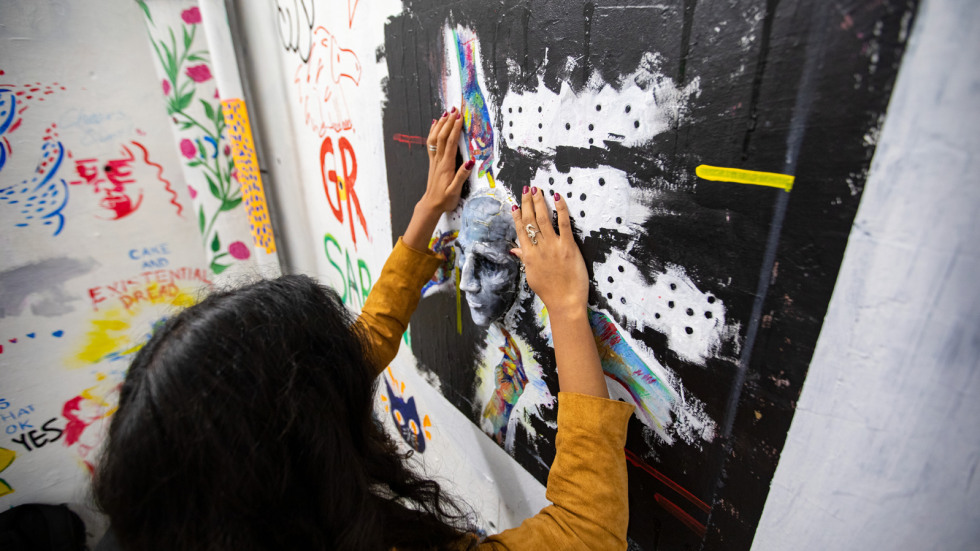
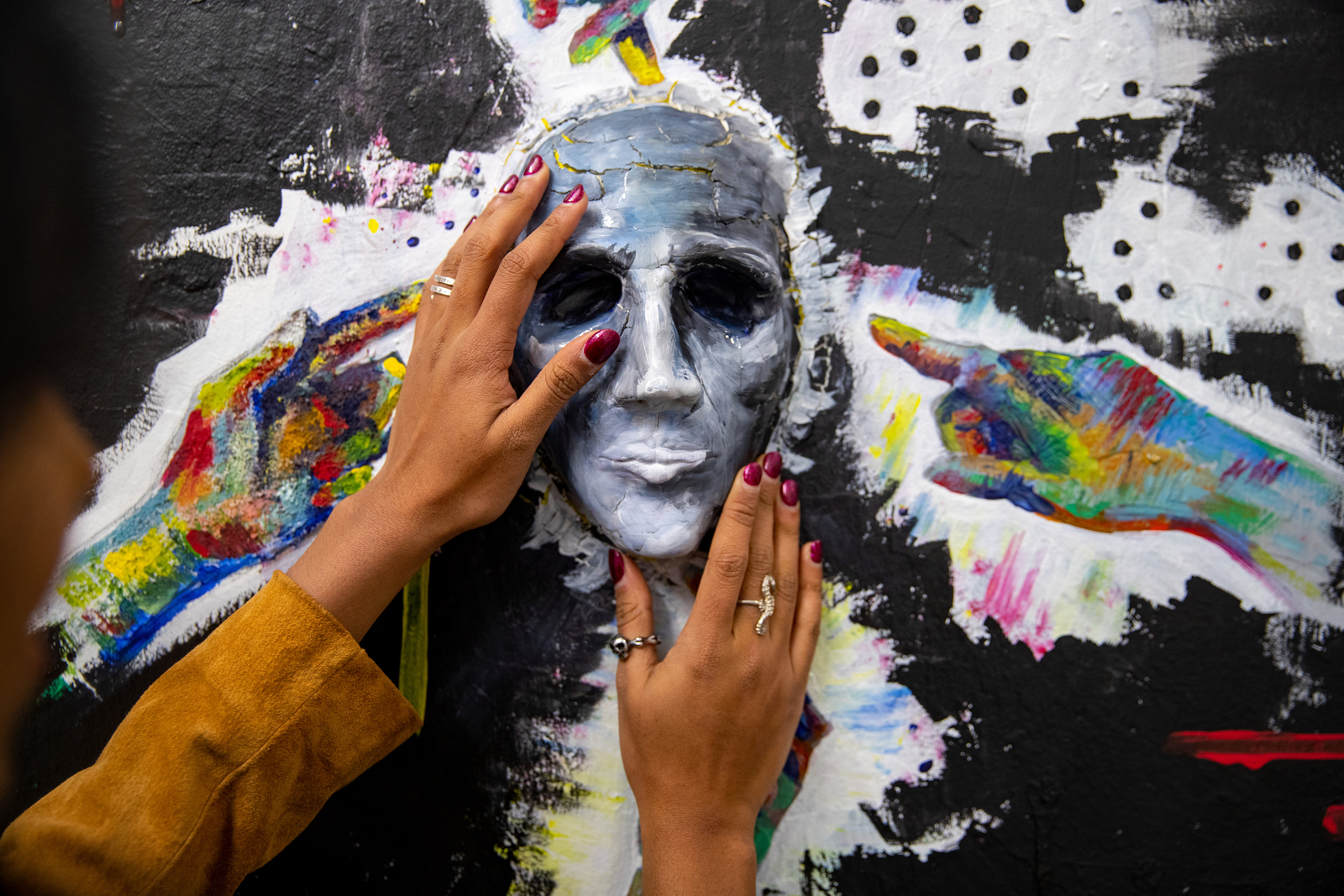
In her first year at Brown, Rishika Kartik installed a tactile art exhibit within the List Art Building stairwell, with instructions written in Braille encouraging viewers to “Please touch the art.”
PROVIDENCE, R.I. [Brown University] — When Rishika Kartik arrived at Brown University, she thought she had a plan.
Art and robotics had been her primary interests in high school, and she envisioned pursuing a concentration that could marry the two — perhaps engineering or computer science. After all, Brown had been her first choice, partly because she knew the Open Curriculum would give her the flexibility to explore seemingly disparate fields of study.
What Kartik did not anticipate was how fully she would be able to merge those interests — not just academically, but in ways that have extended into hospitals, classrooms and communities beyond campus.
“I had this idea that if you’re a scientist, that’s what you do, and if you’re an artist, that’s what you do,” said Kartik, a senior from Highlands Ranch, Colorado. “It wasn’t until being at Brown that I realized I could be a pre-med student who is also interested in art, disability justice, writing and politics.”
At Brown, Kartik designed her own independent concentration in disability and design, which focuses on a core question: How can design better reflect and include the full range of human experiences, particularly for people with disabilities?
Student Stories
This monthly profile series shines a light on students from across the spectrum of Brown University's educational experience, illuminating the distinct strengths, passions and goals that drive them forward.
Kartik’s interest in advocating for people with disabilities began in high school, shaped by her time volunteering at the Colorado Center for the Blind, where she first encountered tactile art and community-based creative practices. She was struck not only by the creativity and independence of the people she met, but also by how often disability was overlooked in broader conversations about diversity and inclusion.
“As I spent more time with people with disabilities, I realized that the assumptions that people make when designing systems for people are not neutral,” Kartik said. “There was a group of people that I cared about that I felt needed to be more represented in the design space.”
At Brown, classes like Pathology to Power: Disability, Health and Community, taught by Sarah Skeels, an instructor in behavioral and social sciences, introduced Kartik to disability studies frameworks. Courses in art, biology and engineering connected her creative practice with scientific understanding.
The tactile installation within the List Art Building stairwell was one of Rishika Kartik’s first interactive art projects she created during her time at Brown.
In a formative course led by Daniel Stupar, a lecturer and assistant director of studio and safety for Brown’s Department of Visual Art, Kartik began experimenting with tactile and interactive work, including an installation in the List Art Building stairwell at Brown.
“I wrote in Braille, ‘Please touch the art,’” she said. “The idea was that people are forced to learn more about blindness and interact with students at Brown who are blind in order to understand more about the exhibit.”
Working with faculty mentors, Kartik has also co-created and co-taught two Group Independent Study Project courses: Gerodesign, in which she worked with older adults in Rhode Island to investigate how aging and disability intersect; and Blindness, Arts and Media, in which she collaborated with blind peers to center their experiences in conversations about design and representation.
Outside of the classroom, Kartik co-leads the student organization Blind@Brown and has spearheaded and contributed to a wide range of public art initiatives, including the Blind Urban Subject, an interactive piece installed on the corner of Angell and Thayer streets in Providence.
For that project and others, Kartik shadowed Associate Professor of Surgery and Clinician Educator Wendy Chen, who also directs pediatric ophthalmology at nearby Hasbro Children’s hospital. There, informed by input from patients, families and providers, Kartik led the creation of a mural to make the clinic more welcoming to children. The finished artwork featured a scene of various animals with unique visual traits, such as shrimp and cuttlefish wearing glasses.
“We got to start these conversations with kids in a way that was very joyful, very fun,” Kartik said. “We explained to them that just like all these animals, each person who comes into the clinic has a different vision, and that’s not bad — it’s just a different way of seeing the world.”
https://www.youtube.com/embed/GPB297Bftdk
Pediatric Eye Clinic Mural
A collaborative mural led by seniors Rishika Kartik and Jason Ruddick brings together art, medicine and accessibility through visual storytelling.
A new vision for connection
True to that ethos, Kartik founded Touch and Create Studio, a program developed in partnership with the National Federation of the Blind that offers accessible art workshops and consults with organizations on inclusive design. The goal is to create community spaces where blind and sighted participants can learn from each other and challenge common misconceptions.
“Blindness is not a bad word,” Kartik said. “Most people prefer to talk about their experience directly and to be just treated like any other teenager or college student. Ableism mostly stems from lack of awareness.”
In one workshop, Kartik worked with a child who communicated primarily through art, and the child’s mother, who had recently lost her vision. The mother felt a painful disconnect, as she could no longer see her child’s artwork. So Kartik presented the child with a tool that can create raised lines from any drawing. When the mother felt her child’s tactile drawings for the first time, she was moved to tears.
“It reminded me that we relate to each other so often through art, and the fact that she felt more included and connected to someone she cared about was very meaningful to me,” Kartik said.
Throughout her time at Brown, Kartik has worked with people of all ages, from toddlers to older adults. She is currently co-leading a mural project at Butler Hospital’s Memory and Aging Program as part of her work in Modeling Human Disease Using Stem Cells, a course led by Chuck Toth, director of Brown’s Multi-Disciplinary Laboratories and an adjunct professor in biology.
“ In some ways, Brown is a very contradictory place. People are strong, yet unafraid to be vulnerable. They’re independent, but willing to drop everything to help you.
”
Rishika Kartik
Class of 2026
Kartik said that moving between these spaces has deepened her understanding of how environment, art and design can shape comfort, connection and dignity at every stage of life. It also helped clarify her path forward. Through her experiences in healthcare settings and mentorship from physicians, Kartik began to see medicine as a natural extension of her interests in accessibility and design.
After she earns her bachelor’s degree in May, Kartik will move to Beijing. As a Schwarzman Scholar at Tsinghua University, she will complete a master’s degree in global affairs with a focus on healthcare policy and science communication. Kartik then hopes to attend medical school, possibly specializing in ophthalmology.
As she prepares for life beyond the Van Wickle Gates, Kartik said she’s most grateful for the profound sense of community and support that defined her undergraduate experience, from the faculty mentors who legitimized her unique academic vision to the strangers who grew to be her closest friends.
“In some ways, Brown is a very contradictory place,” Kartik said. “People are strong, yet unafraid to be vulnerable. They’re independent, but willing to drop everything to help you. I think the essence of my time at Brown is simply, ‘think for yourself, but never walk alone.’”
After a week of welcomes at Brown’s student dormitories and a wide range of events to build connections among new students, the buzz on College Hill is back as the 2026-27 academic year gets underway.
Five of Brown’s newest students discussed their academic ambitions, from medical research to music, what drew them to College Hill and their hopes for the four years ahead.
Supported by a U.S. Department of State scholarship, the Brown University doctoral student is spending the summer in Taiwan, sharpening his Mandarin skills to advance research on Indigenous language revitalization.
Exceptional students from across the spectrum of the Brown educational experience are embracing unique opportunities to advance knowledge and make an impact through research, community engagement, entrepreneurship and more.