PROVIDENCE, R.I. [Brown University] — Artificial intelligence is poised to enable new scientific breakthroughs and technologies in fields spanning energy, materials science, supercomputing and more. The U.S. Department of Energy’s 17 National Laboratories operate at the frontier of applied AI research.
On Thursday, May 14, top researchers from those national labs met with faculty, staff and students from Brown University to discuss the future of AI-enabled scientific research. The daylong conference — Brown’s second National Labs Day — aimed to highlight current collaborations between University researchers and the national labs, and identify emerging opportunities for future scientific partnerships.
“Brown's vision is using our research excellence to try to solve today's most pressing problems, and collaborations with national labs are really critical for that,” said Greg Hirth, vice president for research at Brown, in his opening remarks. “And today, we're going to be hearing about the cutting edge of AI, which, of course, is on everyone's mind.”
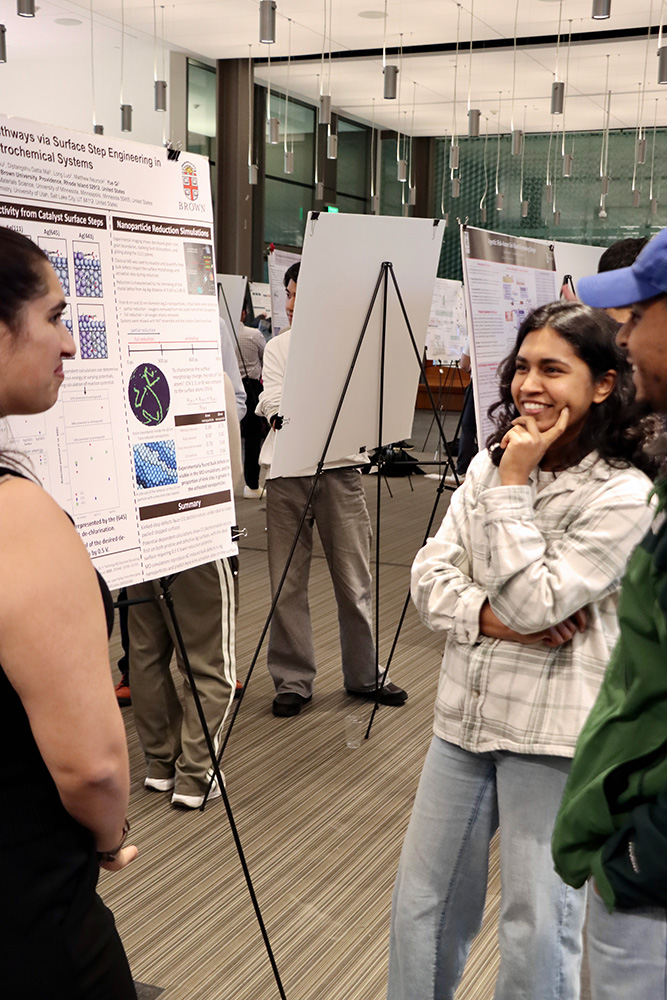
In total, 18 staff scientists from the Brookhaven, Lawrence Livermore, Los Alamos and Sandia National Laboratories took part in the program. From Brown, more than 150 community members signed up to attend topical sessions aimed at showing how shared AI tools and datasets can accelerate scientific breakthroughs. Sessions focused on AI in energy technologies, basic science research, national security and workforce development. In a late-day session at Brown’s Engineering Research Center, more than 40 posters showcased research happening at Brown in physics, chemistry, engineering, computer science and other fields.
Brown researchers have a long history of working with national laboratories. Current and recent collaborations have aimed to develop better batteries, energy-abundant hydrogen fuel cells and next-generation solar cells. In addition to highly applied research, Brown physicists work with national labs to address fundamental questions of the universe — probing the nature of dark matter, understanding the dynamics of high-energy plasmas and uncovering the behavior of fundamental particles of forces.
Working with researchers from Lawrence Livermore National Laboratory, Brendan Keith, an assistant professor of applied math, is pushing the frontiers of computer-driven material and structural design. George Karniadakis, a professor of engineering and applied mathematics, is the director of SEA-CROGS, a partnership with Pacific Northwest National Laboratory and Sandia National Laboratories that aims to develop new computational capability to analyze and predict the behavior of complex systems.
Thursday’s conference was hosted by Brown’s Division of Research and School of Engineering. In the keynote address, James Ang, chief data scientist for computing at Pacific Northwest National Laboratory, discussed collaboration across the national labs on the Genesis Mission, an initiative aimed at harnessing AI to accelerate discovery science.
“The structure includes AI for science, AI for energy and AI for security,” Ang said. “And those are really the focus points for [the Department of Energy]. These are our application drivers for the development of new technology for AI.”