Brown ranked No. 2 nationally for 2025-26 Fulbright winners
With 41 Fulbright grants offered to students and recent alumni, the University is among the top three Fulbright-producing institutions for the 10th consecutive year.
PROVIDENCE, R.I. [Brown University] — With 41 Fulbright scholarships offered to recent alumni and current graduate students in 2025-26, Brown University produced more student Fulbright winners than all but one school in the nation, according to data released by the U.S. Department of State on Tuesday, Feb. 3. The grants fund research or teaching abroad for up to one year.
The University shares the No. 2 spot with Harvard University, with Georgetown University home to the most recipients. Brown has ranked among the top three student Fulbright producers in the U.S. annually for the past 10 years, earning the No. 1 spot in five of those years, most recently in 2025. Since data collection began in 2009-10, Brown has been recognized as a Fulbright Top Producing Institution in each of those 17 years.
"Brown's Fulbright recipients join a global community committed to fostering relationships across borders and advancing international cooperation,” said Associate Dean of the College for Fellowships Joel Simundich. “Whether researching antimicrobial resistance in India, teaching English in South Korea, or studying housing cooperatives in Germany, their work helps build towards a brighter, more just world."
Brown's most recent Fulbright winners
This year’s Fulbright awardees, Brown’s largest group to date, began teaching and research assignments in 24 countries across four continents in Fall 2025.
Fulbright recipients are selected for awards based on a variety of factors including the strength of their application, personal qualifications, academic record and the extent to which the candidate and their project will advance the Fulbright mission of mutual understanding between people of the United States and people of other countries.
While applicants learn of the awards during the spring, the Fulbright program publishes data each February on the top producers of Fulbright scholars and students. As many circumstances can influence whether a Fulbright winner is able to accept the award, this data reflect the total number of awards offered, rather than accepted, for the 2025-26 program year. Of the 41 grants offered to Brown students and recent graduates in the most recent cycle, 37 were accepted.
The Fulbright U.S. Student Program has promoted international peace through intellectual and cultural exchange since its founding in 1946. The program funds approximately 2,000 recent graduates and current graduate students annually to teach and conduct research in 160 countries around the world.
Michelle Alas Molina: ‘Full-circle moments’ between Brown and Brazil
Brown’s 37 student Fulbright winners for 2025-26 are now midway through their year of teaching or conducting research in two dozen countries across North and South America, Asia and Europe. Teaching placements include elementary schools, high schools and universities, where awardees provide classroom instruction and exchange cultural perspectives, and research award recipients are pursuing projects in a variety of fields, from creative writing and neuroscience to industrial design engineering and political science.
For many recent graduates, Fulbright fellowships provide opportunities to pursue projects that extend the courses of study they chose while at Brown. For Class of 2025 graduate and Fulbright awardee Michelle Alas Molina, it also meant a return to Brazil, where she had previously studied twice as an undergraduate concentrating in international and public affairs and in Latin American and Caribbean studies.
Last September, Alas Molina began her Fulbright fellowship in São Paulo to study participatory democracy and federal budgetary amendments at Fundação Getúlio Vargas, one of Brazil’s leading institutions for international relations and public policy. There, she’s affiliated with a research center that also functions as a think tank, producing scholarship on politics and the public sector.
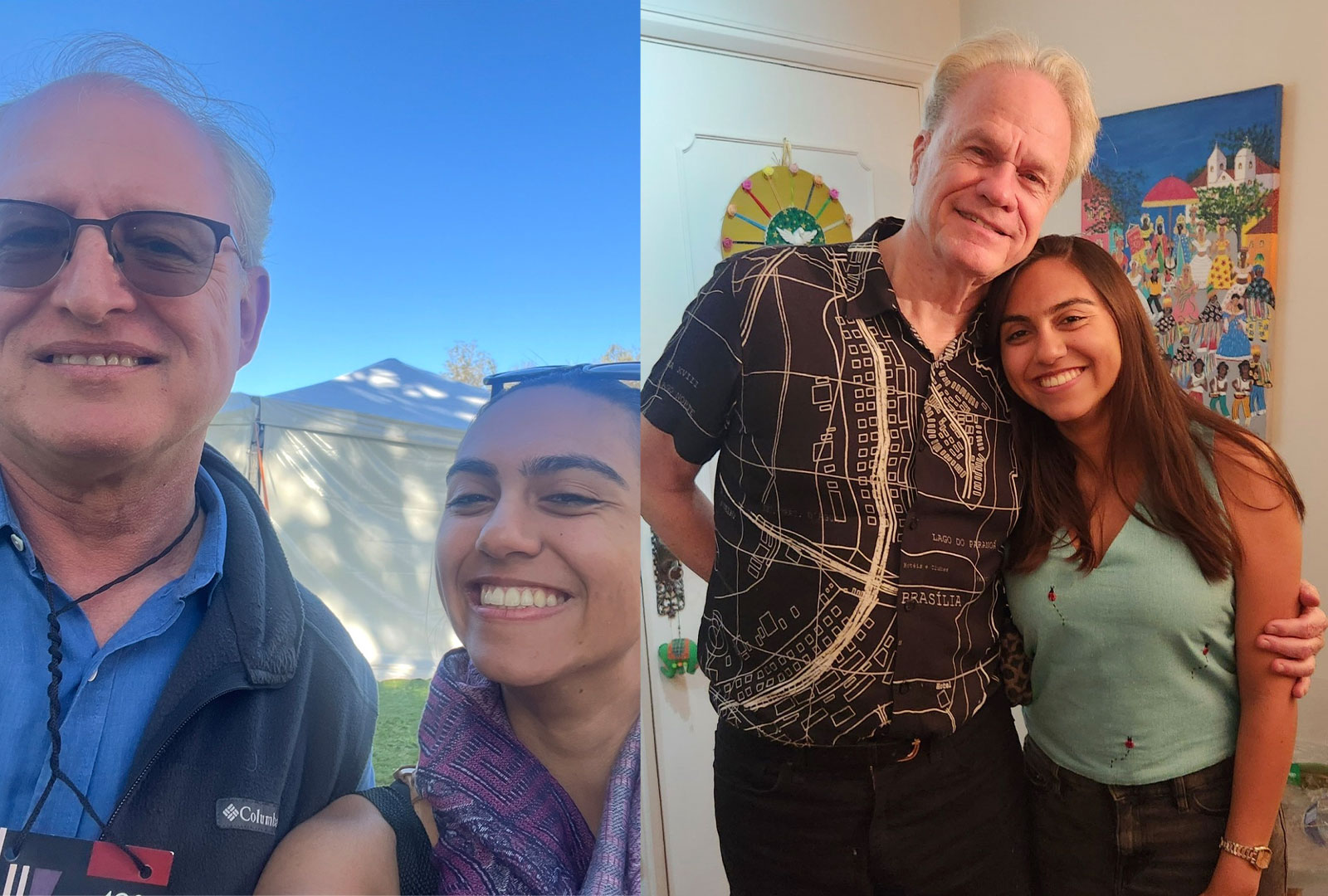
In São Paulo, Michelle Alas Molina met with Patrick Heller, left, and James Green — both Brown professors who significantly impacted Alas Molina’s studies as an undergraduate.
Alas Molina’s primary project extends her undergraduate honors thesis on participatory budgeting — a system that allows citizens to help determine how public funds are spent — which she completed under the mentorship of Patrick Heller, a Brown University professor of social sciences, international and public affairs, and sociology. While her thesis focused on a single municipality, her Fulbright research takes a more empirical approach, examining how federal budgetary earmarks influence local governance and participatory institutions.
“Essentially, I’m looking into how it is that Brazilian democratic institutions have risen, developed and evolved in the face of different transnational pressures and changing political parties,” Alas Molina said.
In addition to her independent research, Alas Molina is collaborating with Brazilian and U.S. scholars on articles exploring democratic change, federalism and the role of centrist political movements in Brazil.
“There are democratic processes here in Brazil that are distinctly Brazilian and function in a distinctly Brazilian way,” Alas Molina said. “So I've been able to talk to state senators, council people, academics and even law students here, having real discussions on peoples’ opinions — and opinions vary. It’s crucial to not approach Brazilian politics with such a U.S.-informed point of view.”
Her work in Brazil, combining independent research with collaborative scholarship, mirrors the interdisciplinary approach she cultivated at Brown. And even though she is nearly 5,000 miles from College Hill, Alas Molina said it’s always on her mind.
“Brown is 100% the reason why I’m here,” she said. “I’ve heard it called the best place to study Brazil outside of Brazil itself, and I think that’s absolutely true.”
Alas Molina credits her near-fluency in Portuguese to the University’s Department of Portuguese and Brazilian Studies, along with faculty and teaching assistants who emphasized cultural immersion alongside language instruction.
“Everyone’s always asking, ‘How is your Portuguese so good?’” she said. “And I’m like, ‘It was literally Brown.’”
Everything here connects back to what I learned at Brown… Everything that I study and everything that I know I owe to wonderful professors who had my well-being in mind, and to friends and colleagues who created such an enriching experience that I can now take with me to the rest of the world.
Michelle Alas Molina
2025-26 Fulbright recipient, Brown Class of 2025 graduate
Beyond language, Alas Molina said Brown enabled her to develop lasting friendships and mentorships that continue to guide and inspire her as she navigates life and research in São Paulo.
She lives with a former Fulbright recipient whom she met through a Brown alumnus, regularly draws on relationships formed through her thesis work and has reunited in Brazil with mentors including Heller and James Green, a professor emeritus of modern Latin American history and Portuguese and Brazilian studies. At Fundação Getúlio Vargas, Alas Molina has also attended lectures and cultural events linked to Brown-affiliated scholars, reinforcing the academic network she first developed as an undergraduate.
“Seeing them felt like a full-circle moment,” she said. “It’s like everything here connects back to what I learned at Brown… Everything that I study and everything that I know I owe to wonderful professors who had my well-being in mind, and to friends and colleagues who created such an enriching experience that I can now take with me to the rest of the world.”
When she returns to the United States in the fall, Alas Molina will draw on her research in Brazil as she pursues her career goals.
“Next year, I’m applying to law school with one intention: That is to be an immigration lawyer,” she said. “That’s why I studied what I studied, and that’s why I’m here in Brazil — to understand institutions, instability and movement, and bring that knowledge back to the U.S.”
For more than two decades, the event has channeled physical strength into support for cancer patients and survivors across Rhode Island, raising more than $200,000 for local survivorship programs.
Known as the Voyager Scholarship, the program supports future public service leaders through work-travel experiences, generous financial aid and a robust network of mentors.
The Brown University endowment provided an all-time high of $357 million for financial aid and student support, scientific research and other priorities in Fiscal Year 2026.