With support from a Brown education scholar, Central Falls charts path to return schools to local control
Research led by education policy scholar Ken Wong is helping to guide the Rhode Island city’s transition from state to local control, shaping how the community will govern and fund its schools.
In January, Mayor Maria Rivera swore in members of the new Central Falls School Board, a major step forward in the community-led effort to return schools to local control. Courtesy City of Central Falls.
PROVIDENCE, R.I. [Brown University] — When the State of Rhode Island took control of the Central Falls School District in 1991, the goal was to stabilize a system in deep financial distress.
More than 30 years later, a 2024 report from Mayor Maria Rivera showed the city’s seven public schools still face fiscal pressures, limited resources and chronically low academic performance. Determined to improve outcomes, Rivera has since been leading an effort to return the district to city control. But that transition raises big questions: What should the school board look like? How will the city ensure stable funding? And how will families and students have a voice in decisions affecting their schools?
To address those questions, a 20-member community advisory board is helping to develop a redesign plan for the district. Members have drawn on testimonials from residents, district and city data, insights from community leaders and research from academic partners — including Brown University.
With support from Brown’s Annenberg Institute, Ken Wong — a professor emeritus of education policy and political science — has worked with the city to conduct new research with actionable recommendations on governance and funding models. The board is now using that analysis as it prepares for the transition to local control by July 1, 2026, pending approval by the Rhode Island General Assembly.
The city’s first chief of education strategy, Sarah Friedman, said the city’s multi-year effort has required extensive community engagement, strategic planning, research and policy development. Importantly, it’s focused on elevating the voices of residents, with the advisory board comprising Central Falls families, teachers, alumni and other stakeholders.
1of2
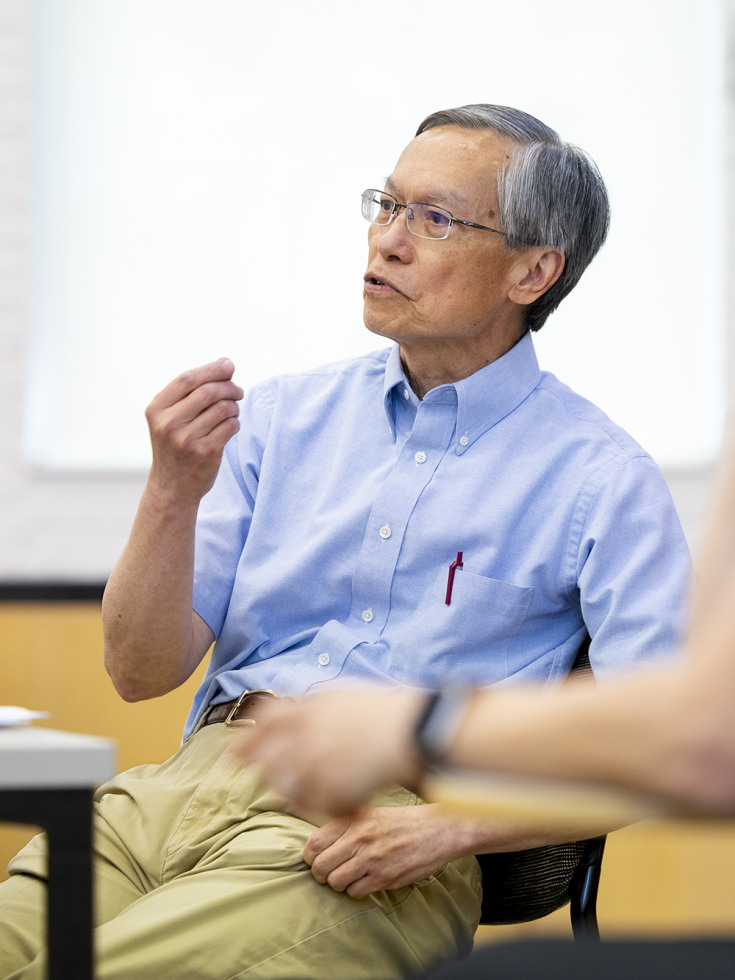
Ken Wong, professor emeritus of education policy and political science, led research informing Central Falls’ transition to local control. Photo by Nick Dentamaro/Brown University.
2of2
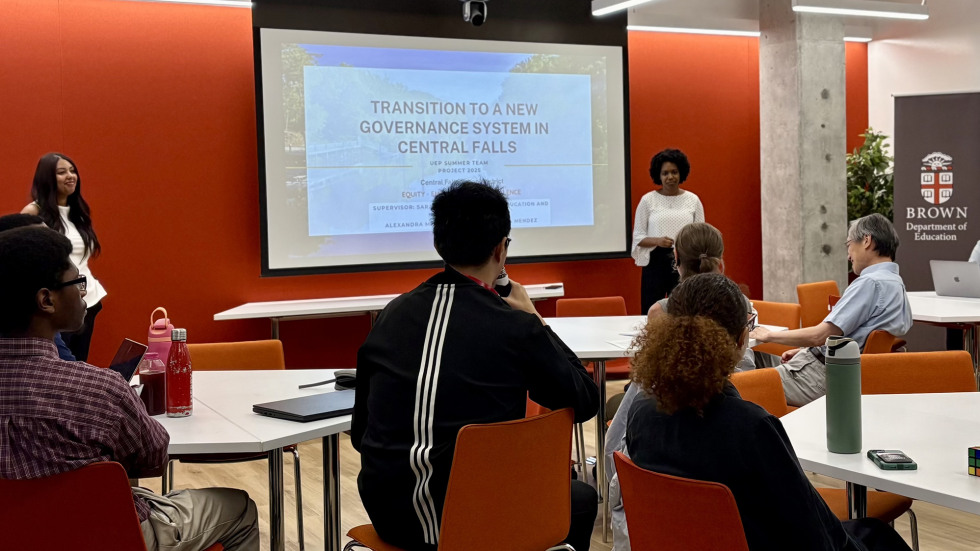
Working at the community level, graduate students in Brown’s Urban Education Policy program supported the transition through outreach and research. Here, Arianna Mendez and Alexandra Mercedes-Santos present their findings.
“The people who grew up here, who send their kids to school here, who teach here — they know this community, and that knowledge is invaluable,” Friedman said. “What makes this model powerful is that we’re grounding every decision in the lived experiences of Central Falls residents and pairing that with research. That combination gives us the strongest foundation to build a school system that truly works for our students.”
Research-to-practice partnership
Turning the city’s vision for local control into an actionable plan requires a clear roadmap. Drawing on decades of research on school governance and state interventions, Wong has helped the city’s education strategy team build that roadmap piece by piece.
One early step was establishing the community advisory board’s framework — identifying who needed to be at the table, creating criteria for selecting members, recommending how often the board should meet and drafting agendas that guide the group toward creating a redesign plan. With Wong’s support, that effort drew on findings from national research and case studies from other cities.
Once the advisory board launched in 2024, Wong and a small research team helped the city design orientations to prepare members for the complex decisions ahead. The sessions introduced members to the history and impact of state takeovers and included “Governance 101” and “Funding 101” workshops explaining the basics of school oversight and finance.
By early 2025, that groundwork allowed the board to begin designing a new governance model. To support the process, Wong examined multiple governance structures, analyzed local stakeholder concerns and interviewed educators and community leaders. His team collected lessons from cities transitioning from state intervention to local control in Rhode Island, Massachusetts and New Jersey.
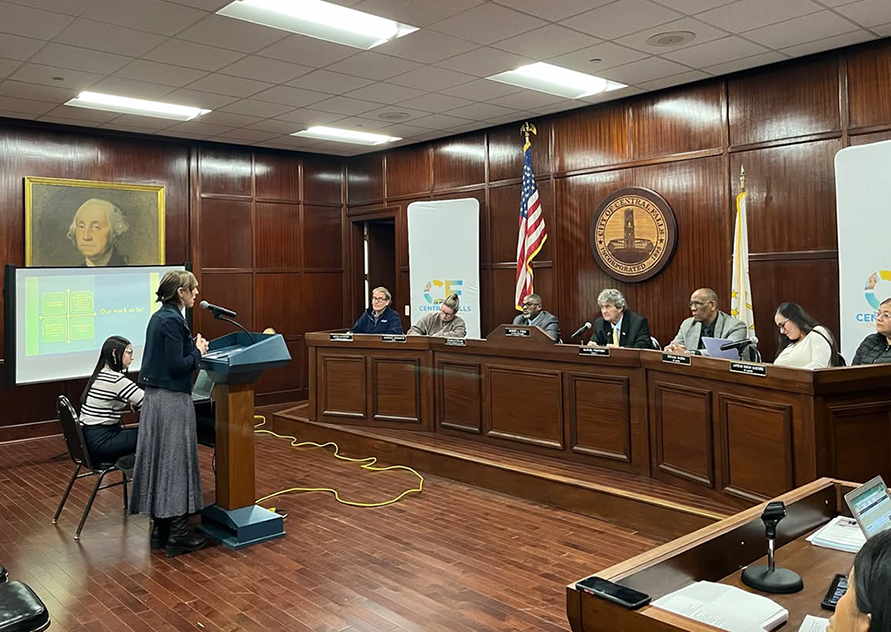
As the city makes the case for the school transition, Chief Education Strategist Sarah Friedman presents data from academic partners, including Brown. Courtesy City of Central Falls.
The findings helped the board weigh different options, he said.
“We analyzed districts with similar demographics and a history of state takeover, looking closely at how they transitioned back to local control and what governance structures they adopted,” Wong said. “In each case, we dug deeper — often interviewing local stakeholders to understand their on-the-ground experience. We then distilled those lessons into a policy brief for the board, which allowed their discussions to be grounded in clear findings and real-world examples.”
Friedman said having a research partner with deep policy expertise has been critical to designing a new model.
“I’m much more of a practitioner than a researcher,” Friedman said. “It was incredible to have a partner who could help us generate the right questions — and surface the questions we were hearing from the community.”
By partnering with Wong, the city tapped valuable expertise and resources, Friedman said. “Ken is an expert researcher. He has tools and strategies he’s honed over decades, and the advisory board deserves the best ideas and the strongest analysis we can offer.”
Wong said the collaboration helped inform his scholarship, too.
“As researchers, we’re good at designing studies and analyzing data, but that’s only part of the story,” Wong said. “I’ve learned a lot from practitioners like Sarah, because she deals with the realities of implementation — making mid-course adjustments, negotiating and compromising. Researchers can lay out guiding principles, but it’s the on-the-ground work that tests and refines them. That exchange is mutually beneficial.”
A new chapter for Central Falls schools
Grounded in Wong’s research and informed by other national experts, the advisory board ultimately recommended a hybrid school board: nine members, with four elected and five appointed through a community nominating committee.
Friedman said the model reflects exactly what residents want for the future of their schools.
Researchers can lay out guiding principles, but it’s the on-the-ground work that tests and refines them. That exchange is mutually beneficial.
Ken Wong
Professor Emeritus of Education Policy and Political Science
“They designed something I haven’t seen anywhere else,” Friedman said. “The group wanted five appointed seats, but they also wanted those seats reserved for specific groups: a current student, a current parent, a former educator, an alum and a community member. Across every conversation, people kept saying they wanted parents, teachers and students at the table when decisions are made. This model was entirely community-led, and I’m very proud the board created it.”
In July 2025, Central Falls residents voted to update the city charter and adopt the new school board structure. To help drive turnout, graduate students in Brown’s Urban Education Policy program, working as interns for the city, canvassed neighborhoods and attended community events to share information about how residents could shape the future of their schools — first by voting on the charter, then by nominating board candidates.
Following the elections and nominations last fall, Central Falls has now entered 2026 with a fully constituted school board. Members were officially sworn in in early January, and now seated, they represent the people of Central Falls in decisions related to the school district. The board will assume its full powers as a school committee upon the passage of legislation ending state control on July 1.
The mayor said establishing the new school board marks a major step toward restored local control.
“Swearing in our new school board marked a major milestone for our city — a very real new chapter in the story of Central Falls schools,” Rivera said. “It's one where our families, our teachers, our community who knows this work best finally get to lead our schools again after decades. I'm incredibly proud of our Central Falls community and community advisory board for the collaboration and hard work that got us to this point, and to our new board members who have taken the oath to help guide our district forward as we move toward local control."
Mayor Maria Rivera visits Veterans Memorial Elementary, one of the city's seven public schools. Courtesy City of Central Falls. Courtesy City of Central Falls.
The city will now turn to developing a new funding model, as it has long relied heavily on state support given its limited property tax base. Wong, who helped design Rhode Island’s 2010 school funding formula, will work with the city’s education strategy team to propose a redesign of the Central Falls Stabilization Fund, aiming to stabilize revenue and ensure the district can meet student needs in the years ahead.
Supporters say local control could allow the district to better align decisions with student needs. If successful, Central Falls could become a model for other communities, Wong said.
“There are some key components that I think are transferable to districts like Providence and beyond,” Wong said. “Right now, across the country, there are still four or five dozen school districts under state takeover, both large and small. Many of these districts are also asking the same question: How do we move to the next step? How can we reconfigure the relationship with the state and return to local control?”
He is hopeful his work with the city will have a lasting impact.
“What we’re doing with the mayor’s office has real, tangible benefits for Central Falls residents,” Wong said. “We came in at a critical moment, worked closely with city leaders and community members, and built a process for making decisions that can last beyond this transition. I hope that work benefits future generations of children in Central Falls.”
Ellie Pavlick, a computer scientist who leads Brown’s National Science Foundation AI research institute, discusses AI doom scenarios, the frontier labs “slowdown” and how to make AI safer.
Driven by curiosity and a commitment to sustainable travel, Theodore Niemeyer Lam cycled for 38 days and gained new perspectives on the country before starting his college journey.
A substantially revised proposed building site near Brook and Charlesfield streets in Providence responds to neighbor concerns and supports Brown’s goals for a state-of-the-art home for its Department of Economics.