Growing curiosity: Pre-College students explore regenerative medicine
Led by Brown faculty, high schoolers in an intensive, two-week Summer@Brown course combine cellular biology, 3D printing and entrepreneurial strategy to address one of medicine’s greatest challenges.
Toronto native Zoe Yang, 14, injects bovine blood into a decellularized scaffold made from spinach as part of Can We Build Organs? Techniques in Regenerative Medicine, one of hundreds of courses offered through Summer@Brown. All photos by Nick Dentamaro/Brown University.
PROVIDENCE, R.I. [Brown University] — In a laboratory at Brown University, 14-year-old Zoe Yang held up a completely transparent spinach leaf and delicately guided a needle into the plant’s stem.
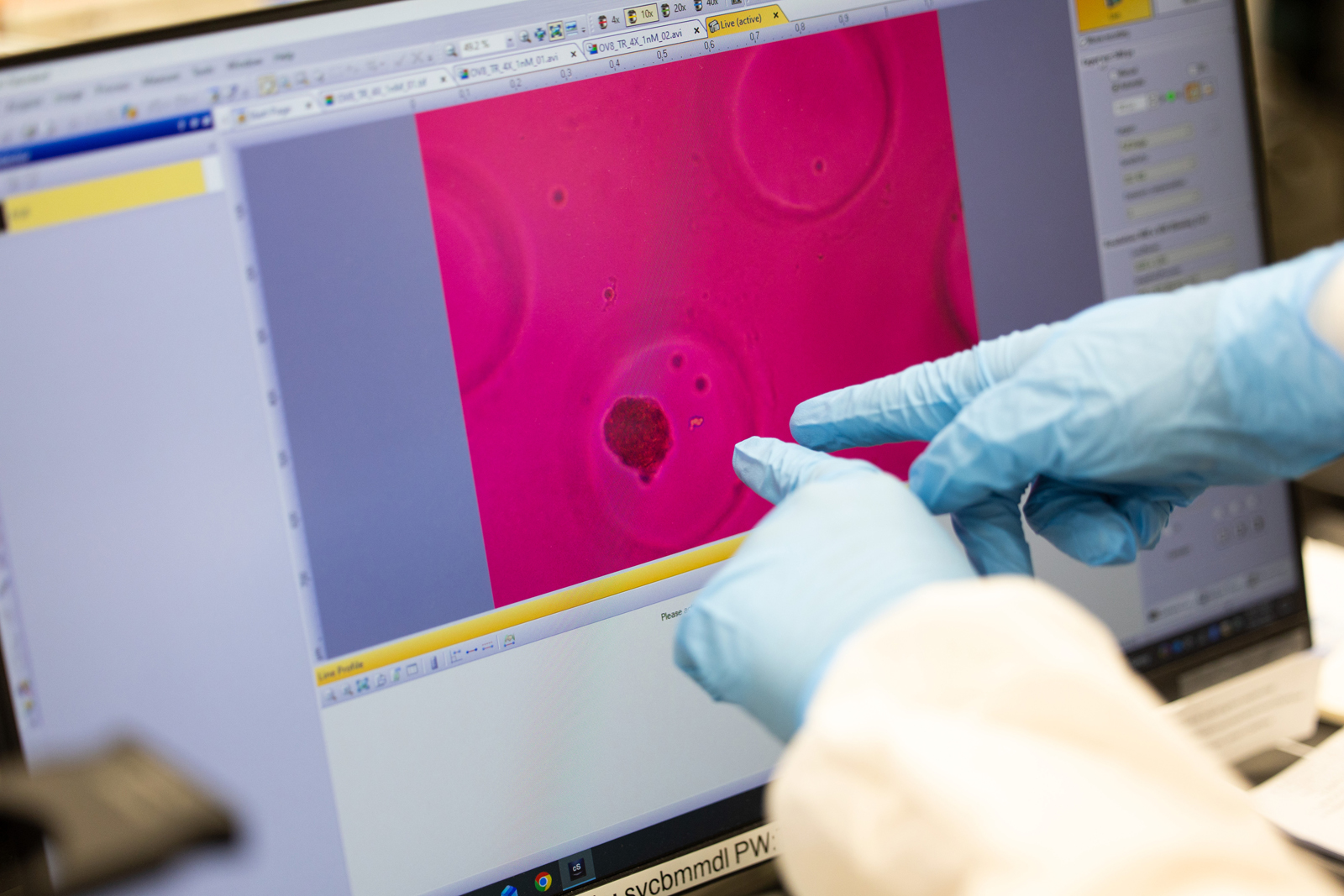
She depressed the syringe’s plunger, and within seconds, the vasculature of the leaf — now a “decellularized scaffold,” because it has undergone a biological transformation that removed every trace of its DNA — lit up with an intricate red web. Under a microscope, Yang watched as individual bovine blood cells pumped through the scaffold: the successful result of a proof-of-concept experiment in tissue engineering.
“I really wasn’t expecting to get to do this all myself,” said Yang, a rising high school sophomore from Toronto. “It’s so exciting, because most of my experiences with microscopes have been with the typical onion skin. But here, I see these living, moving cells and I’m responsible for keeping them alive.”
Designed and taught by Associate Dean of Biology Undergraduate Education Toni-Marie Achilli, the intensive, two-week course introduces students to the rapidly evolving field of regenerative medicine.
1of4
Pre-College students Eddie Musser and Isabella Netto work with graduate teaching assistant Madison Smith, left, a fourth-year pathobiology Ph.D. student who has helped instruct the class for two consecutive summers.
2of4
Eddie Musser, a rising high school senior from Connecticut, watches as individual blood cells pump through the vasculature of a decellularized scaffold he made in the course.
3of4
Students in the course develop proficiencies in basic cell culture techniques, early-stage tissue regeneration strategies and histochemical characterization of mammalian cell constructs.
4of4
The course, which accommodates 24 students and consistently fills up every summer, allows high schoolers to the opportunity to learn common laboratory techniques that are applicable in a wide range of scientific disciplines.
Supported by Achilli, graduate teaching assistants Madison Smith and Ilayda Top and the dedicated staff of Brown’s Multidisciplinary Teaching Laboratories, students rotate through a wide range of laboratory techniques commonly used in tissue engineering, from maintaining sterile cell cultures to creating decellularized scaffolds and perfusing vascular networks with real blood. They also use computer-aided design, drafting software and 3D printers to model organ vasculature and medical technologies to address organ disease and shortages.
“Being so hands-on and bringing it alive is what’s so intriguing, and to think that one of these experiences could really spark a new passion in these students, or further that passion, is really exciting,” Achilli said. “When they see the blood cells moving through the vasculature, you see their faces light up. That aha moment is undeniable.”
Engineering curiosity into confidence
For nearly a decade, Achilli has been teaching the Summer@Brown tissue-engineering course, along with another course focused on antibiotic drug discovery, with the goal of enabling aspiring scientists to investigate broad questions that shape how research moves out of the laboratory and into the real world.
“I’ve always known that I liked biology, but my degrees are in engineering, so I’m all about the application,” said Achilli, who earned her Ph.D. at Brown, working in the lab of Professor of Pathology and Laboratory Medicine Jeffrey Morgan. “Any of the headway that we can make in this space is going to have a huge impact on quality of life for people.”
We’re very rigorous, but never to the point of inaccessibility. We design the experiments so each student can succeed without feeling like science isn’t for them.
Toni-Marie Achilli
Associate Dean of Biology and Undergraduate Education
Smith, a fourth-year pathobiology doctoral student at Brown who helps teach the course, said high schoolers’ exposure to authentic laboratory practices is invaluable.
“They’re learning adaptable, relevant skills — things that I do in the lab every single day,” said Smith, whose research examines how immune systems adapt and protect against viruses.
For Eddie Musser, a rising high school senior from Wilton, Connecticut, the hands-on focus drew him to Brown for the summer. While he expected laboratory time, he was surprised that the course also highlighted entrepreneurship, economics and the process of bringing new medical technologies to patients.
“I like that biology has a real-world impact, that I can positively contribute to the health of people around me,” Musser said. “So, when I saw that there was this opportunity to do really comprehensive lab work at Brown, I was like, ‘Oh my, this is like a match made in heaven.’”
Pre-College students in the Summer@Brown course Can We Build Organs? Techniques in Regenerative Medicine examine the successful result of a fibroblast cell culture.
Musser and his classmates discussed the ethics of organ shortages, the economics of biomedical innovation and the challenges of translating scientific discoveries into treatments that can improve patients’ lives.
“Everything was relevant, timely, topical and appealing no matter what side of science you’re interested in,” he said.
While Pre-College students arrive at Brown with varying academic backgrounds, the course — which is academically equivalent to a first-year college-level course — provides plenty of one-on-one guidance and support to ensure students are confident and capable in their work.
“We’re very rigorous, but never to the point of inaccessibility,” Achilli said. “We design the experiments so each of them can succeed without feeling like science isn’t for them.”
Innovation meets impact
For 16-year-old Vaibhav Mundanat, who lives in Dubai, exploring the intersection of medicine and engineering came at a pivotal time as he explores possible career paths in biotechnology versus clinical care.
“Now I have a really clear idea of what the future of medicine and engineering looks like, and that there isn’t just one pathway: You can be someone who learns both,” Mundanat said. “When new technology arrives, you understand its background and importance. If you become a surgeon, you know how it was built and how to implement it, giving you a truly multifaceted view.”
That insight and Achilli’s mentorship led Mundanat to consider applying to Brown’s eight-year Program in Liberal Medical Education after he graduates high school, which would allow him to continue exploring different areas of study as an undergraduate while on a direct path toward admission to the Warren Alpert Medical School.
Lessons from the course, including the experiment with the spinach leaf, also changed his perspective on previous experiences, including a hospital internship, offering a newfound appreciation for the complexity and uncertainty involved in real-world healthcare.
“During that experiment, it reminded me of nurses trying to find veins — turns out that’s actually really difficult,” Mundanat said. “It just gives me a renewed sense of humanity and a better understanding of the medical world and how people do their jobs.”
To Achilli, that shift in perspective is one of the most meaningful outcomes of the course.
“My trajectory has shifted from wanting to solve a science problem in isolation to thinking alongside people, hearing their different ideas and finding ways to synthesize those ideas together,” Achilli said. “As a scientist-educator, I really love the opportunity for human connection.”
For Providence students, Brown’s Pre-College Programs open new possibilities
Full scholarships have opened Brown’s summer Pre-College Programs to hundreds of Providence Public School District students, giving them opportunities to explore academic interests and experience college life.
Known as the Voyager Scholarship, the program supports future public service leaders through work-travel experiences, generous financial aid and a robust network of mentors.
The Brown University endowment provided an all-time high of $357 million for financial aid and student support, scientific research and other priorities in Fiscal Year 2026.
Beginning with prospective undergraduates seeking to enter Brown in Fall 2027, a new waiver will eliminate the application fee for Providence public school students.