The art of slowing down: Pottery@Brown offers students space to create and contemplate
Established in 2024, the student-led club hosts daily studio sessions where Brown and RISD students learn the craft, create their own pieces, and enjoy the meditative benefits of making pottery.
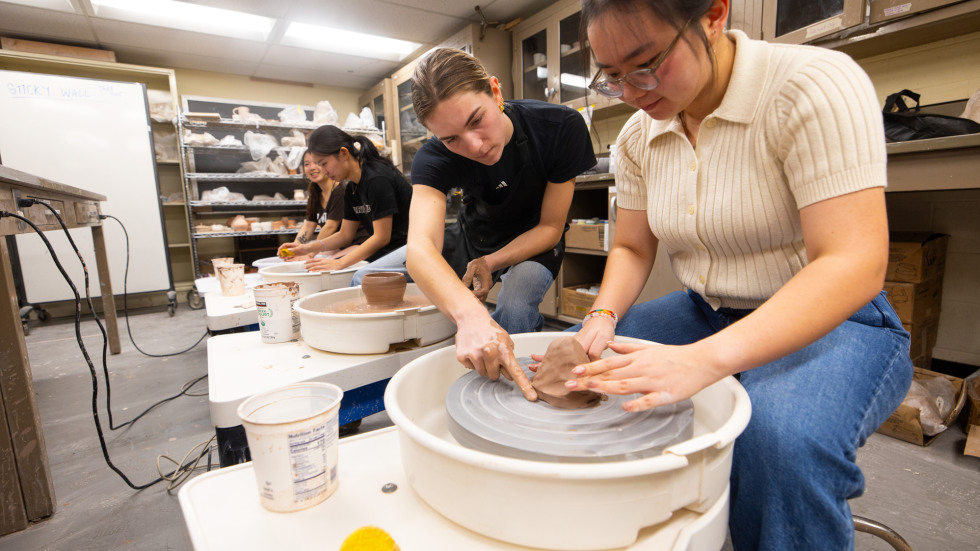
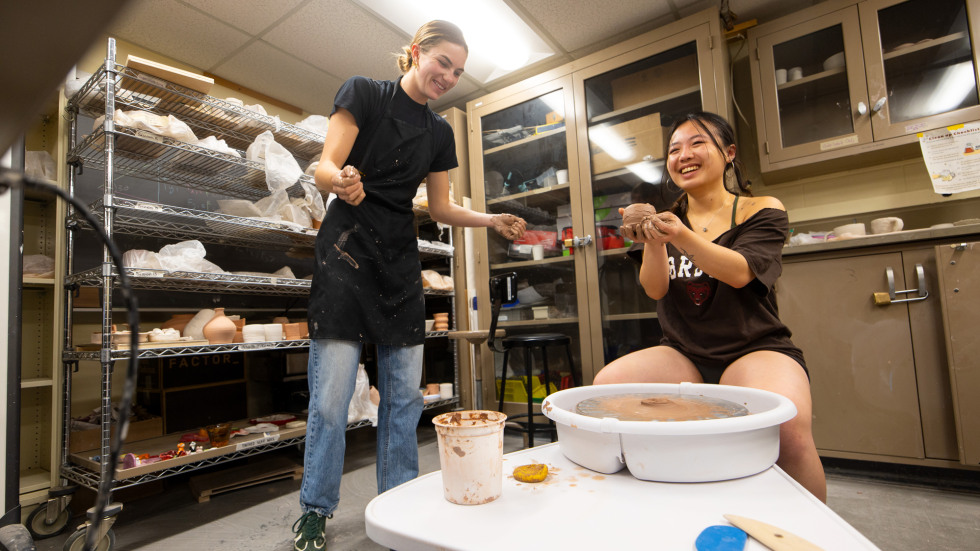
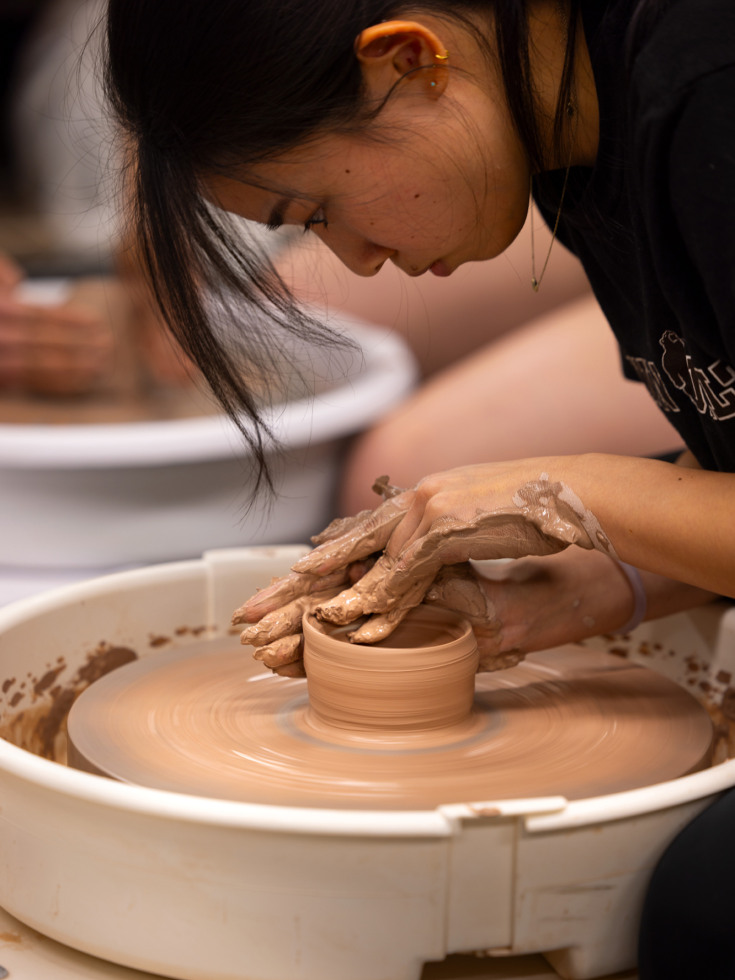
Pottery@Brown studio aide and Brown senior Roxy Hazuka trains students on how to use the pottery wheels, offering technical guidance while supporting individual creative expression. All photos by Nick Dentamaro/Brown University.
PROVIDENCE, R.I. [Brown University] — Clay begins as possibility. With speed and pressure, it yields, rising and widening at the guidance of muddy fingers. It dries and is fired in a kiln, emerging transformed. A lump of raw material becomes the mug that holds morning coffee, the plate that conveys nourishment, and an art form to return to again and again.
That cycle repeats itself daily inside of a Brown Design Workshop studio, where students gather daily for sessions hosted by a student organization called Pottery@Brown, which offers students interested in ceramics to try their hand in a casual, non-academic setting.
“People might find ceramics intimidating, because it’s hands-on and can get pretty messy,” said Jolin Zheng, a sophomore at the Rhode Island School of Design (RISD) who serves as one of the club’s media officers. “But you can’t really make mistakes with this medium, because it’s very forgiving. You can always take the material, recycle it and start over — it’s almost like a healing process.”
1of9
Pottery@Brown studio aide Roxy Hazuka helps junior Mia Nguyen prepare her clay on the wheel during an afternoon session inside the Brown Design Workshop.
2of9
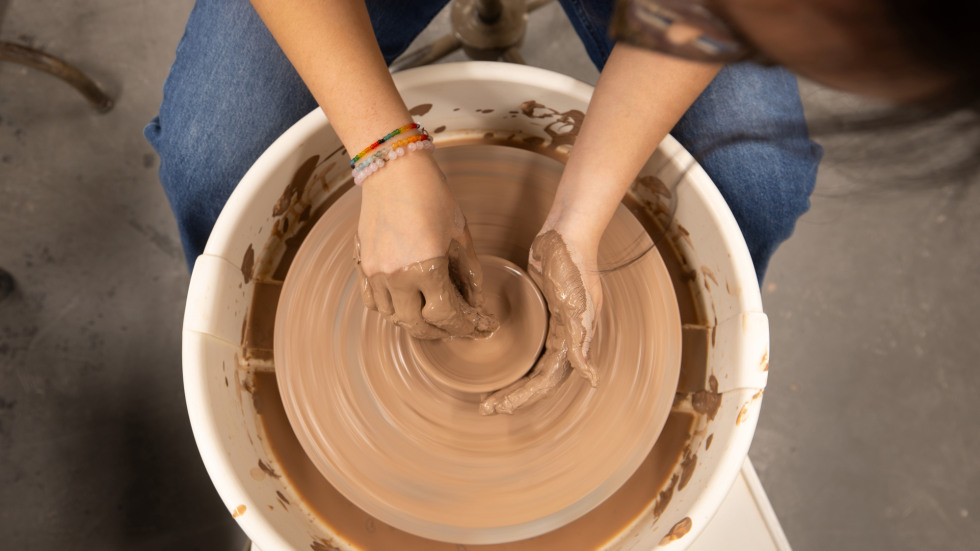
Students say working with clay is particularly meditative and therapeutic, offering them a chance to slow down and take a break from their fast-paced schedules.
3of9
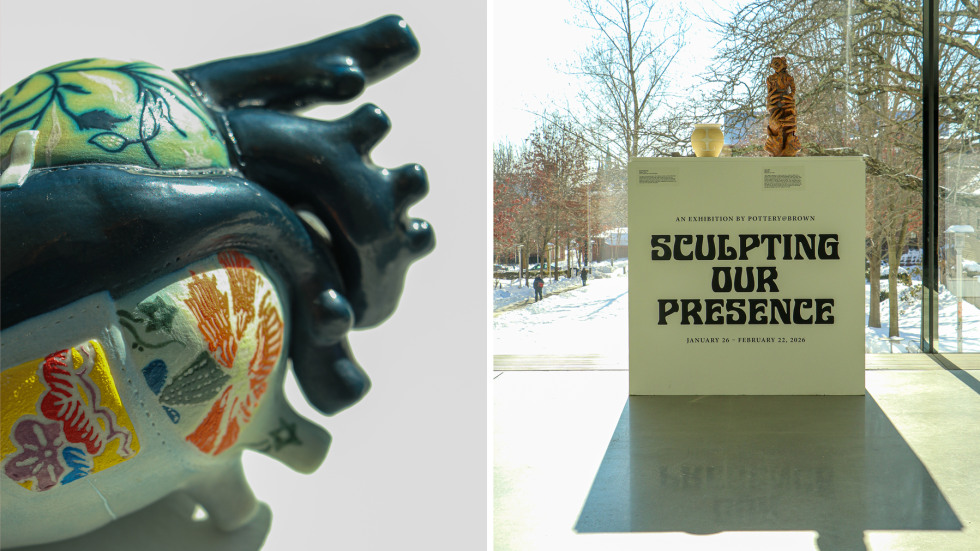
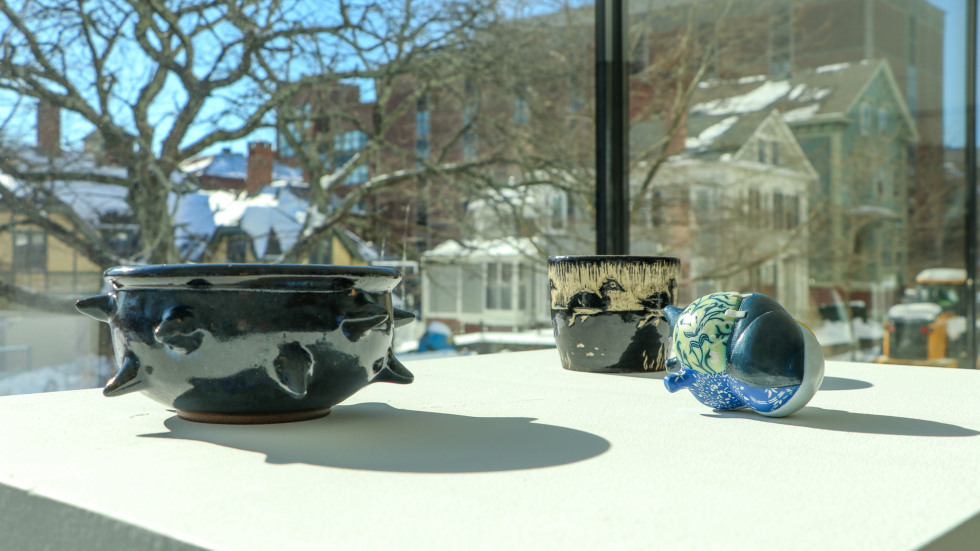
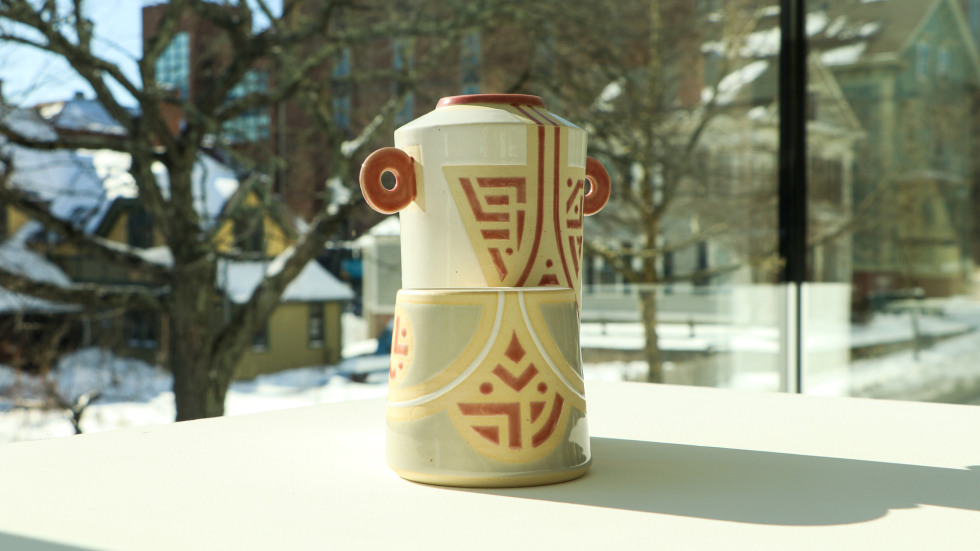
Earlier this year, Pottery@Brown hosted its inaugural exhibition, “Sculpting Our Presence,” in the Lindemann Performing Arts Center. Photo by Peter Chenot/Brown University.
4of9
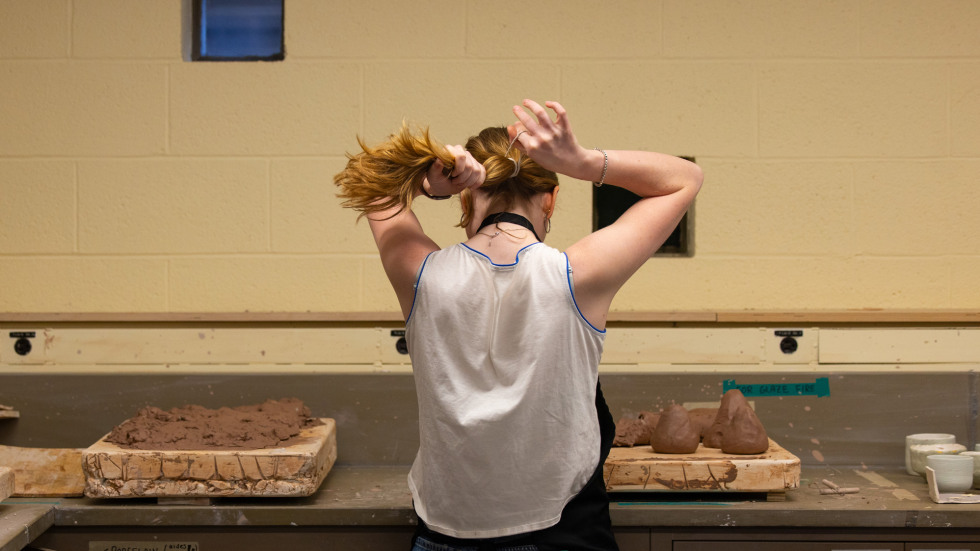
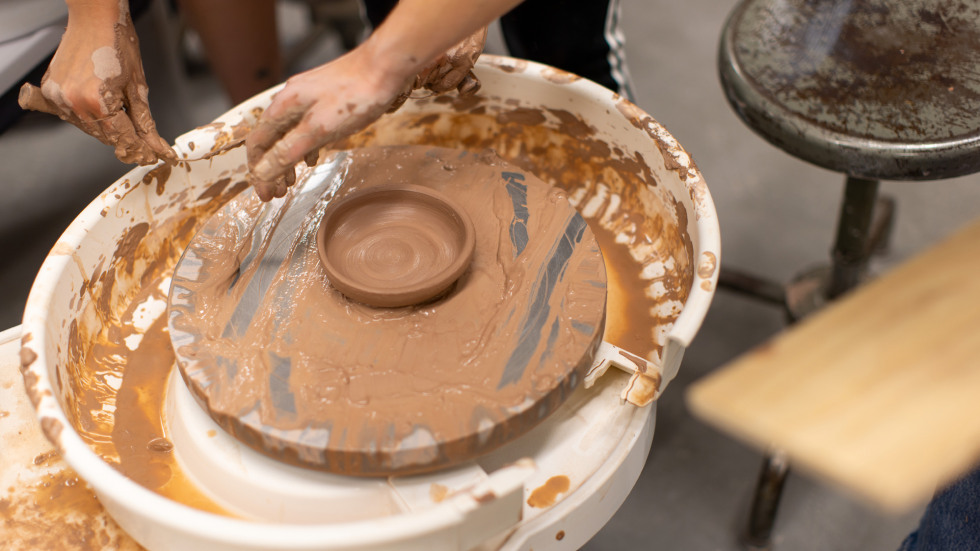
Brown first-year student and studio aide Sasha Watson puts her hair up as she prepares clay for wedging — an essential process that removes any air pockets from the clay, which could cause the piece to explode inside of the kiln.
5of9
“Having Pottery@Brown on campus has been a gamechanger for me,” said senior Roxy Hazuka, who serves as one of the club’s studio aides. “It’s my favorite type of art, and having access to it has been incredibly healthy and beautiful. I hope to offer that experience to other people.”
6of9
“As the submissions were rolling in, we found that there was this consistent theme of students trying to find themselves in the clay,” said Pottery@Brown media officer Jolin Zheng of the exhibition’s theme, “Sculpting Our Presence.” Photo by Peter Chenot/Brown University.
7of9
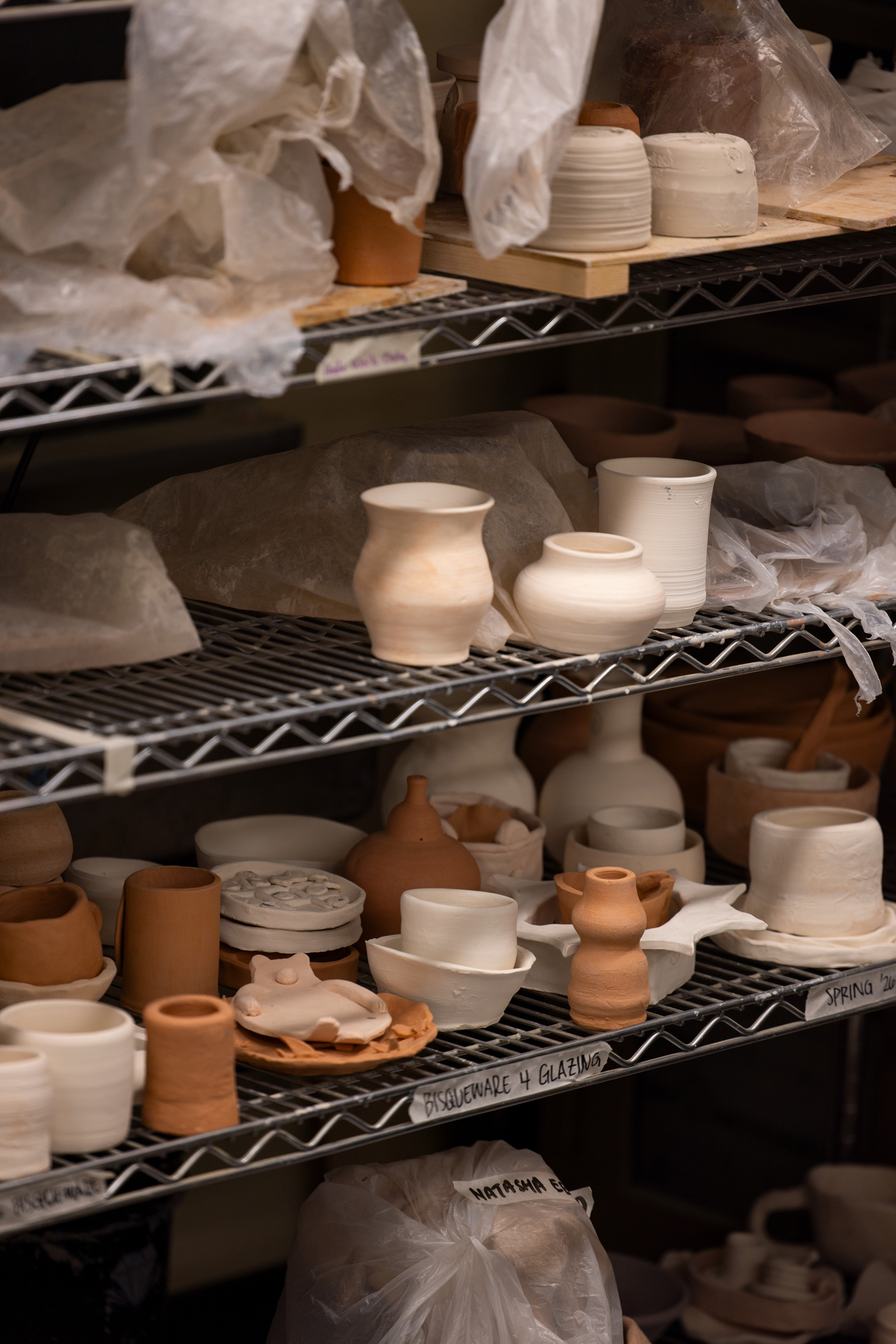
After a piece is finished and air-dried, a team of three student kiln technicians carefully pack and transport the pieces to either Artists’ Exchange or the studio of Forrest Snyder, a former RISD and Harvard ceramics professor, to be fired in a kiln.
8of9
A welcome addition, the pottery studio within the Brown Design Workshop opened just over a year ago. Before then, the club partnered with Mudstone Studios in Pawtucket, R.I., to host sessions there.
9of9
The exhibition, which was co-sponsored by the Brown Arts Institute, featured about 15 works created by Brown and RISD students. Photo by Peter Chenot/Brown University.
That process mirrors the club’s swift rise from a small idea to one of the most sought-after creative communities on campus.
The Brown Ceramics Club was first established as a student organization in Fall 2022, with modest membership. When junior Julia Gu joined the leadership team in Spring 2024, the club had about 50 sign-ups, she said. That fall, the club rebranded as Pottery@Brown, and interest skyrocketed: There are currently 1,850 students on Pottery@Brown’s mailing list, according to Gu, who now serves as the club’s president.
In her first year at Brown, Roxy Hazuka, who fell in love with clay as a high schooler, learned that there wasn’t a ceramics department or pottery studio on campus. Determined, she contacted RISD about the possibility of using their studios, only to learn that the space is reserved specifically for RISD students enrolled in the school’s ceramics program.
“I thought, ‘Well, I’m not even anywhere close to that,’” said the Brown senior, who is pursuing concentrations in environmental science and applied mathematics. “So when Pottery@Brown came about, I was thrilled. I hopped on that train right away.”
She wasn’t the only one.
“Ceramics are great gifts, because it’s something you have to put a lot of time, thought and effort into,” said Pottery@Brown President Julia Gu. “You can really personalize the piece.”
To accommodate as many interested students as possible in their modest studio, they adopted a cohort structure: There are two cohorts per semester. In a typical week, the club hosts roughly a dozen two-hour studio sessions per cohort — each led by two Pottery@Brown studio aides — that can accommodate about six students. Gu estimates that 400 students, including studio aides and members of the club’s executive board, are able to participate in a cohort each year.
Clearly, Gu said, the club has generated more interest than it can accommodate. So they developed a process similar to a ticket lottery: Pottery@Brown sends out email reminders about sign-up “drops,” and takes in students on a first-come, first-served basis, she said.
“We try to be as fair as possible, but we understand it’s a competitive process,” said Zheng, who added that the club also hosts themed, one-off workshops throughout the academic year open to all students.
Between the raw material and specialized tools and equipment required to produce work, ceramics is expensive compared to mediums like drawing or painting. A typical six-week class at a private studio can cost around $400, with additional fees for extra clay or certain glazes.
For many students, that cost makes pottery feel out of reach. But at Brown, participation is free.
In its first year, the club received generous funding from the Brown Arts Institute, which helped purchase throwing wheels and initial materials. It now relies on funding through the Undergraduate Finance Board — an elected, student-led board that manages the student activities funds — to sustain operations, buying hundreds of pounds of clay and paying for firing services at Artists’ Exchange in Cranston, Rhode Island, each semester. Still, students pay nothing.
In between classes, it’s so nice to come in here and have something that’s calm and relaxing. Plus, you get this sense of pride, seeing what you made.
Tina Li
Class of 2026
For Tina Li, a senior studying applied mathematics and economics, joining a cohort offered a low-stakes outlet for creative expression.
“I always see TikTok videos of cute pottery projects, and I feel like it’s such a cool art form that anybody can try — but it’s a little inaccessible, because you need all the materials and stuff,” Li said. “I don’t necessarily get to be very artistic with my concentrations, so this is a really fun way to sort of explore that side of me.”
A new community, shaped by hand
Inside the studio, artistic exploration unfolds slowly, equal parts focus and feel. Students sit behind the pottery wheels, their feet carefully placed on the pedal to achieve the perfect speed and elbows braced against their knees as they guide dense, wet clay upward in deliberate motions. It’s a process that demands focus, but not urgency.
“At a rigorous school where academics can be somewhat all-consuming, it’s easy to feel like you need to be studying or working in a library all the time,” said Sasha Watson, a first-year student at Brown who has served as a studio aide since the fall. “So being in the studio and building in at least two hours a week to work with your hands and out of your head seemed really rewarding to me.”
That feeling is what many students said they love the most about working with clay.
“When you’re throwing something on the wheel, you’re stuck in the same position for a while and you have to put a lot of energy into maintaining that one position,” said Gu, who observed that other artistic practices she enjoys, like music, tend to “look ahead” and require more attention to what comes next. “But with ceramics, you only get one product out of it, and you have to focus on what’s directly in front of you. I think that’s what makes it quite meditative.”
With one person working on one wheel with one piece of clay, one may assume that ceramics can be isolating. But students said the reality is the exact opposite — it’s a deeply communal practice.
Before starting their projects, students watched a tutorial by studio aide and Brown senior Roxy Hazuka, who explained the techniques required to successfully throw clay on a wheel.
Students work alongside each other, asking for help or offering gentle guidance. They brainstorm. When a piece collapses or breaks, they grieve. When it comes out better than imagined, they celebrate.
“They’re very supportive,” Li said. “They welcome anyone from a complete beginner to people who are experienced ceramicists. They’re always willing to help out … and I think it’s just pretty admirable to see a student-run club like this, because before they made this club, pottery was not a thing on campus.”
That sentiment is particularly significant to Gu, who was raised in the Seattle area, surrounded by the tech industry.
“Growing up, ‘scalability’ was a concept that was always thrown at me,” she said. “Now, I’ve been able to apply that to leading Pottery@Brown, and it makes me really happy. I’m turning it into something that’s meaningful for me, and it’s really nice to build this community.”
Back in the studio, Li presses her thumbs into the center of a spinning mound of clay, shaping something that was once formless. Across the line of four wheels, others do the same. Each piece is different, but all borne out of the same clay.
Some will collapse or crack. Some will be fired, glazed and kept as heirlooms. And some will be recycled, ready to begin again.
Four years of exploring courses and activities, building friendships and finding their way have given these seniors plenty of perspective — here’s what they want to tell the newest students on Brown’s campus.
After a week of welcomes at Brown’s student dormitories and a wide range of events to build connections among new students, the buzz on College Hill is back as the 2026-27 academic year gets underway.
Five of Brown’s newest students discussed their academic ambitions, from medical research to music, what drew them to College Hill and their hopes for the four years ahead.